Brookston Beer Bulletin

Jay R. Brooks on Beer

  • Home
  • About
  • Editorial
  • Birthdays
  • Art & Beer

Socialize

  • Dribbble
  • Email
  • Facebook
  • Flickr
  • GitHub
  • Instagram
  • LinkedIn
  • Pinterest
  • RSS
  • Twitter
  • YouTube

Powered by Genesis

Beer Tapping Physics

November 25, 2013 By Jay Brooks

physics
The Division of Fluid Dynamics of the American Physical Society sent out a press release about a new study a couple of their members recently published on cavitation, which is a word you’ll understand better from the description.

An old, hilarious if somewhat juvenile party trick involves covertly tapping the top of someone’s newly opened beer bottle and standing back as the suds foam out onto the floor. Now researchers from Carlos III University and Universite Pierre et Marie Curie, Institut Jean le Rond d’Alembert, have produced new insight into the science behind the foaming, exploring the phenomenon of cavitation.

Take a look at the release, The Physics of Beer Tapping Fluid Dynamics Explains Why Bottled Beer Bubbles Over When Tapped, and thanks to regular reader Russ R. for sending me the link. I like this explanation a bit better, though.

“Buoyancy leads to the formation of plumes full of bubbles, whose shape resembles very much the mushrooms seen after powerful explosions,” Rodriguez-Rodriguez explained. “And here is what really makes the formation of foam so explosive: the larger the bubbles get, the faster they rise, and the other way around.” He adds that this is because fast-moving bubbles entrain more carbonic gas.

Honestly, I don’t think I’ve ever done that to a person’s bottle. Of course, I tend to be around people who pour their bottle of beer into a glass.
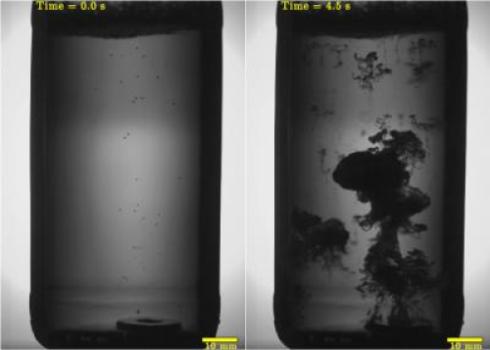
cavitation
Photo: Javier Rodriguez-Rodriguez / Carlos III University of Madrid, SPAIN Almudena Casado-Chacon / Carlos III University of Madrid, SPAIN Daniel Fuster / CNRS (UMR 7190), Université Pierre et Marie Curie, Institut Jean le Rond d’Alembert, FRANCE

Filed Under: Beers, Related Pleasures Tagged With: Science, Science of Brewing

The Brewing Process: The Operation For Great Beer

November 24, 2013 By Jay Brooks

copper-kettle
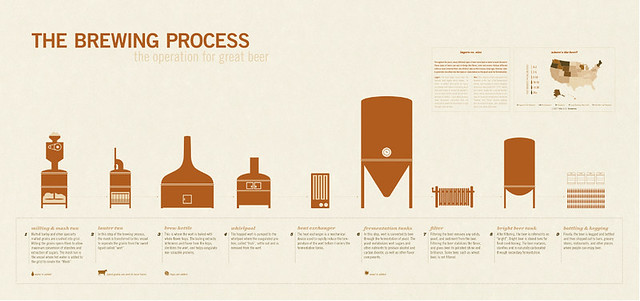
Today’s infographic is a poster showing The Brewing Process. It was created by freelance graphic designer Abie McLaughlin, who made the poster when she was a student at Kent State University.

the-brewing-process
Click here to see the poster full size.

Filed Under: Breweries, Just For Fun Tagged With: Infographics, Science of Brewing

Beer Making Process Infographic

November 22, 2013 By Jay Brooks

copper-kettle
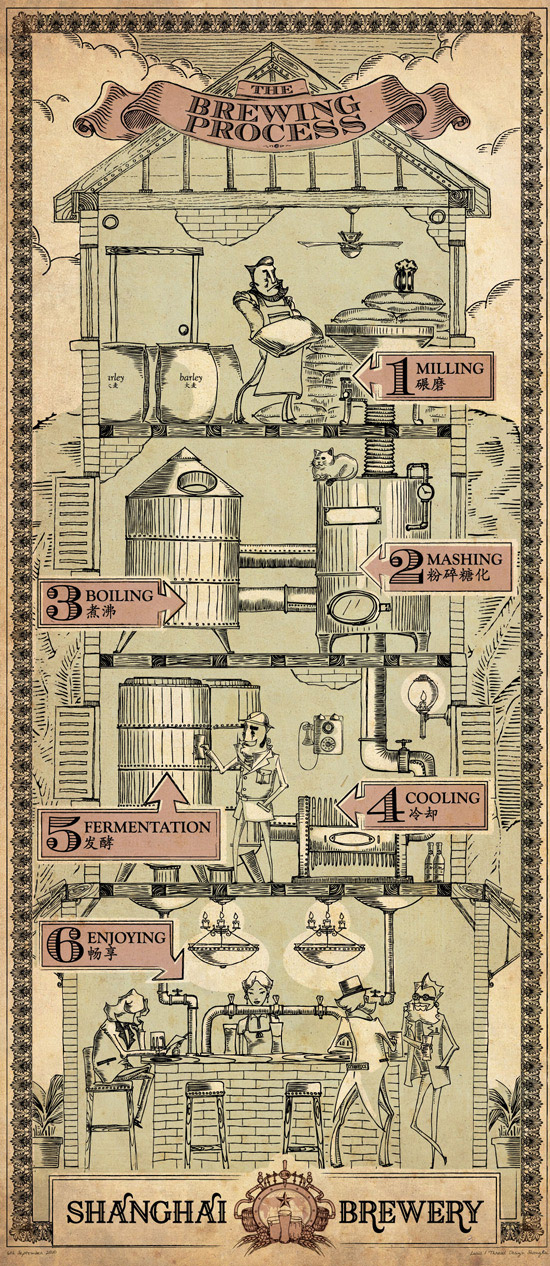
Today’s infographic is a cool, artistic poster of the beer making process from the Shanghai Brewery, which operates two breweries in China.

beer-making-process

Filed Under: Art & Beer, Breweries, Just For Fun Tagged With: Infographics, Science of Brewing

What Is Yeast?

November 12, 2013 By Jay Brooks

yeast-buddy
Today’s infographic is a generic look at yeast, part of the “kitchen curious infographic series” by the Doodle Cook.

yeastinfographic_1
Click here to see the infographic full size.

Filed Under: Just For Fun, Related Pleasures Tagged With: Infographics, Science of Brewing, Yeast

How Is Beer Made?

November 2, 2013 By Jay Brooks

beer-ingredients
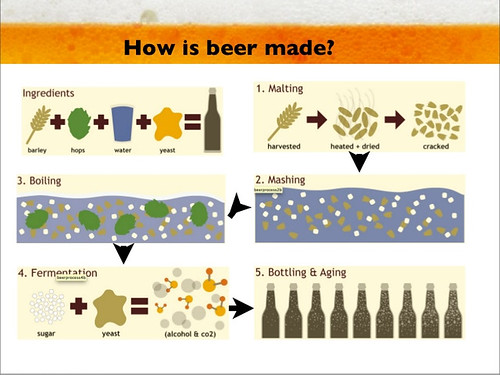
Today’s infographic is a simple illustration showing the basic steps for brewing beer. It was created for a Powerpoint presentation on the Beer Industry by Christian Adeler and Jon Bjornstad in 2011.

how-is-beer-made

Filed Under: Beers, Breweries, Just For Fun Tagged With: Infographics, Science of Brewing

The Difference Between A Lager And An Ale

October 28, 2013 By Jay Brooks

BeerSci
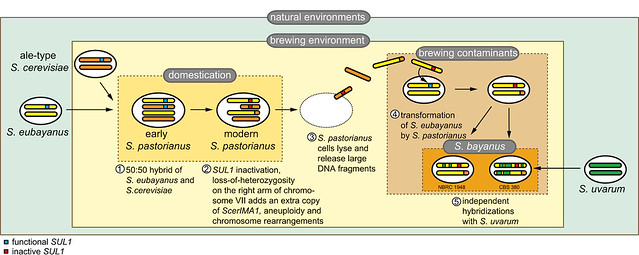
Here’s another interesting post on brewing science from Popular Science‘s BeerSci series. If you’re reading the Bulletin, chances are you’re already pretty familiar with the question What Is The Difference Between A Lager And An Ale? But author Martha Harbison gives a good overview of the technical differences in layman’s terms and goes into yeast’s history. It’s a great tale, which she refers to hilariously as a “unicellular soap opera.”

lager-yeast
“From Eubayanus to Pastorianus Ale yeast and yeast from the forests of Patagonia met in a brewery…and lager was born! Libkind et al., PNAS; August 2011”
Click here to see the chart full size.

Filed Under: Beers, Breweries, Just For Fun, Related Pleasures Tagged With: Science of Brewing, Yeast

Selecting And Generating Superior Yeasts For The Brewing Industry

October 25, 2013 By Jay Brooks

yeast-cell
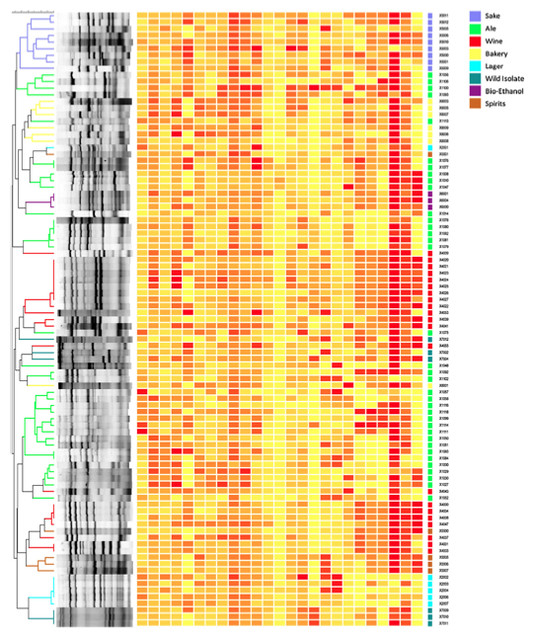
After my post a couple of days ago about Genetically Engineered Yeast, Chaz from Alaskan Brewing sent me a link to an interesting blog post by Dmitri, an amateur yeast wrangler who writes about his yeasty adventures at BKYeast. The post is a review of science literature from Cerevisia, the Belgian Journal of Brewing and Biotechnology. The article in question is titled Selecting and Generating Superior Yeasts for the Brewing Industry, which was published in 2012. It’s deliciously geeky and technical, but should be scrutable to anyone who brews either professionally or at home, thanks to Dmitri’s writing, as his goal is to take the jargon and science and make it accessible to a broader audience. As brewers struggle to have their beers stand out in an ever-increasingly crowded marketplace, it should be obvious that we’ll be seeing more and more experimentation with flavors and ingredients and ultimately more unique beers, and even new types of beers as others copy the successful ones, in the coming years. As the author notes, new varieties of hops are already facilitating that effort, and it seems likely that new strains of yeast are a logical next step in that evolution. And that’s what this research by a group from Leuven, Belgium is trying to make easier, finding the right yeast to create the right range of flavors for your beer. Give it a read.

yeast-map
“Graphical representation (heat map) of different characteristics of industrial yeast strains. Every row consists of data from a different yeast strain, every column is a different characteristic. ‘Yellow’ is a low score, and ‘red’ is a high score for this certain characteristic. The dendrogram on the left represents the genetic relatedness of the yeasts, based on an AFLP fingerprint exploiting transposon TY1 insertion site polymorphisms. The colour code on the top right indicates the origin of the yeast strains. This kind of analysis allows us to select yeasts with specific beneficial traits, for example to use in industry, or for breeding.”

Filed Under: Beers Tagged With: Science, Science of Brewing, Yeast

The Art of Beer Infographic

October 25, 2013 By Jay Brooks

art
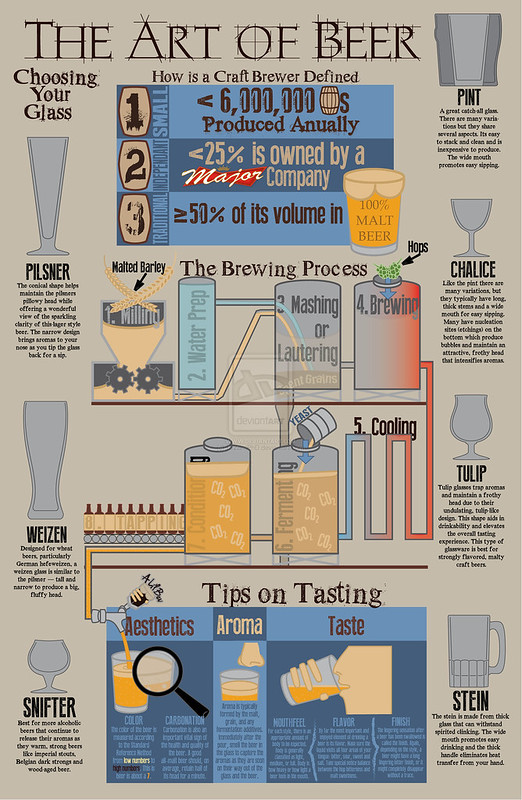
Today’s infographic, the Art of Beer, shows a variety of aspects of beer, including glassware, the brewing process and the BA”s definition of craft beer. It was created by Louis R. Zurn, a student at the Minnesota State University Moorhead.

the-art-of-beer
Click here to see the infographic full size.

Filed Under: Art & Beer, Beers Tagged With: Glassware, Infographics, Science of Brewing

Genetically Engineered Yeast

October 23, 2013 By Jay Brooks

yeast-buddy
Mashable had an interesting piece about Genetically Engineered Yeast being done by at least two companines, Amyris and Evolva, and based in part on a New York Times article, What’s That Smell? Exotic Scents Made From Re-engineered Yeast. In the Times article Amyris co-founder Jay Keasling explained “that the process is ‘just like brewing beer, but rather than spit out alcohol, the yeast spits out these products.'” The relatively new discipline, dubbed synthetic biology, is only about a decade old. There are apparently issues about whether it would be considered natural. SOme say no, because the synthetic version “contains scores of components besides” what it’s being used as, while John B. Hallagan, from the Flavor and Extract Manufacturers Association believes “it conceivably could be called a natural ingredient since it is made in a living organism.”

Filed Under: Breweries, Just For Fun, News Tagged With: Science, Science of Brewing, Video, Yeast

The Original Midget Brewery

October 14, 2013 By Jay Brooks

nanobrewery
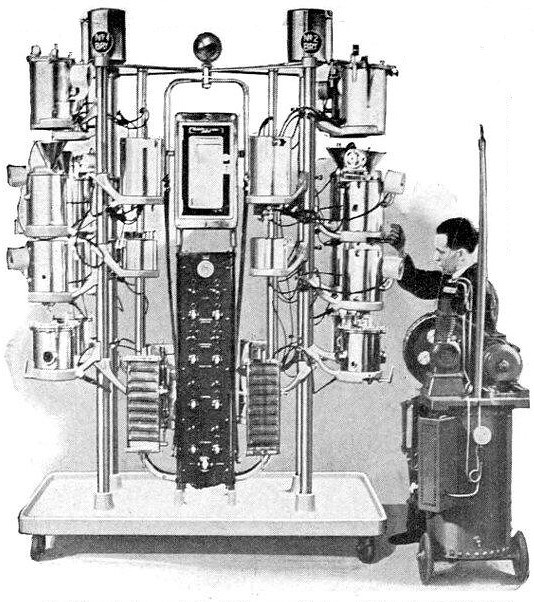
Last week, Boak & Bailey tweeted about what must have been one of the earliest commercial nanobrewery systems. I tried to find out more about the Midget Brewery, though there’s scant information available on the interwebs. Here’s what I found. In 1936, page 30 of the February issue of Popular Science featured a little piece about the Midget Brewery, developed for R&D in Great Britain.

midget-brewery-image

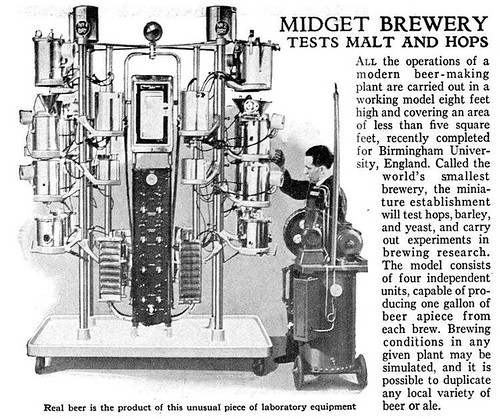
Here’s the full text that accompanied the photograph:

All the operations of a modern beer-making plant are carried out in a working model eight feet high and covering an area of less than five square feet, recently completed for Birmingham University, England. Called the world’s smallest brewery, the miniature establishment will test hops, barley, and yeast, and carry out experiments in brewing research. The model consists of four independent units, capable of producing one gallon of beer apiece from each brew. Brewing conditions in any given plant may be simulated, and it is possible to duplicate any local variety of beer or ale.

midget-brewery

Filed Under: Breweries, Just For Fun Tagged With: Brewing Equipment, History, Science of Brewing, technology, UK

« Previous Page
Next Page »

Find Something

Northern California Breweries

Please consider purchasing my latest book, California Breweries North, available from Amazon, or ask for it at your local bookstore.

Recent Comments

  • Ernie Dewing on Historic Beer Birthday: Charles William Bergner 
  • Steve 'Pudgy' De Rose on Historic Beer Birthday: Jacob Schmidt
  • Jay Brooks on Beer Birthday: Bill Owens
  • Steve 'Pudgy' De Rose on Beer Birthday: Charles Finkel
  • Steve 'Pudgy' De Rose on Beer Birthday: Bill Owens

Recent Posts

  • Historic Beer Birthday: Johann Baier February 23, 2026
  • Beer In Ads #5125: Bowler Brothers’ Bock February 22, 2026
  • Beer Birthday: Fred Bueltmann February 22, 2026
  • Historic Beer Birthday: John Emmerling February 22, 2026
  • Beer In Ads #5124: Möerlbach Bock February 22, 2026

BBB Archives

Feedback

Head Quarter
This site is hosted and maintained by H25Q.dev. Any questions or comments for the webmaster can be directed here.