Brookston Beer Bulletin

Jay R. Brooks on Beer

  • Home
  • About
  • Editorial
  • Birthdays
  • Art & Beer

Socialize

  • Dribbble
  • Email
  • Facebook
  • Flickr
  • GitHub
  • Instagram
  • LinkedIn
  • Pinterest
  • RSS
  • Twitter
  • YouTube

Powered by Genesis

The Formula For The Perfect Pint

October 19, 2012 By Jay Brooks

math
I can only assume that the UK pub chain Taylor Walker is, in the appropriate British parlance, taking the piss, with their commissioning of Mindlab to discover the formula for “the perfect pint.” Though there is a Mind Lab at the University of Sussex, this bit of news is not listed in their news or press section. At any rate, they claim to have “used complex mathematical modelling techniques to discover what conditions are required to enjoy the perfect pint.”
e-pint

So what is the formula for a perfect pint?

Here goes: E = -(0.62T2 + 39.2W2 + 62.4P2) + (21.8T + 184.4W + 395.4P + 94.5M – 90.25V) + 50(S + F + 6.4)

  • E is a factor describing overall enjoyment.
  • T is the ambient temperature in degrees Celsius.
  • W is the number of days until you are required back at work.
  • P is the number of people with whom you are drinking.
  • M is related to your mood whilst drinking the pint.
  • V is related to the volume of the music being played.
  • S and F are related to the availability of snacks and food.

Without the number variants, so slightly simpler, it’s E = -(T2+W2+P2) + (T+W+P+M-V) + 50(S+F+6.4), though it’s hardly E = MC2. Below a presumed “scientist” — he is after all, wearing a lab coat and surrounded by books and beakers — explains it all:

Filed Under: Beers, Just For Fun, News Tagged With: Humor, Pubs, Science, UK

My BFF Beer

September 28, 2012 By Jay Brooks

bff

Canada’s Random House Publishing runs an interesting website called Hazlitt, where, presumably, they feature their own authors on a variety of topics. The one that caught my attention was by Linda Besner, and it’s an essay about My Best Friend, beer.

She begins by claiming that mankind has been “thinking and talking about beer since 4000 B.C.” She’s only off by as much 5,500 years, since brewing is believed to have begun with the “advent of agriculture in the Neolithic Period of the Stone Age about 11,500 years ago.” I don’t want to dwell on that, because we haven’t even gotten to the meat of it, but it did make me initially skeptical.

The story concerns a study that examined beer commercials from both the U.S. and the Ukraine, described as a “cross-cultural study of beer’s metaphors.” Again, I’m quibbling a bit, because the researchers looked at a total of 37 ads from both nations, not exactly a large number, but the author credits them with having “seen a lot of beer commercials.” I think the average consumer might see nearly that many during the average football game, or certainly over the course of a Sunday watching sports in general. But okay, let’s let them make their point. What did they find?

“While the personification of beer is consistent from Ukrainian to U.S. commercials, it seems to me that the kind of person beer is in Ukraine is different from the kind of person beer is in the States.”

In the Ukrainian commercials, the study notes, “people do not become friends by sharing beer; rather beer drinking occurs among individuals who are already established as friends, which entails a close and trusting relationship.” The people drinking beer together are described as druh, which Dr. Lantolf translates as being like the English concept of “best friend,” rather than tovarysch, which translates as “comrade” or “acquaintance.”

In the United States, it’s almost the opposite. Apparently, we use the term “friend” rather loosely, calling people we hardly know, or have just met, our friends. In other words, many of our friends are more superficial, at least compared to how Ukrainians see them.

To illustrate, they give the example of a Budweiser commercial currently up on YouTube under the name “Magic Beer.” A young man sits alone at a bar, opening a bottle. He pours it into his glass, but, miraculously, once the glass is full, beer continues to spill forth. Quickly, he pours some of the excess beer into the glasses of the men next to him. In the next shot, the bar is packed with carousers dancing to a live Scottish band as beer continues to gush from the magic bottle. The erstwhile lonely young man dances between his new friends, a beatific look on his face. Then he drops the bottle. It smashes on the floor, and the flow of beer trickles to nothing amid ghastly silence. The outraged people around him glare daggers. Those closest to him turn and walk away.

Frankly, I hate these ads. They’re not just superficial, they’re utterly ridiculous. Saying they’re depicting how typical Americans act, or view friendship, seems like quite a leap. I think it says more about the advertisers than the consumers, and maybe even a little about the researchers that they think idealized commercials reflect real life.

Even if I accept the premise, that that may be how some people see their “friends,” I’ve never considered such people my friends. Fair-weather friends, perhaps, but that’s a rather derogatory expression. Is it possible I’m not typical? No, I don’t think so, because I’m pretty sure most of the people I know well feel roughly the same way.

I love beer. I make my living writing about it, reviewing, analyzing it, along with the people and companies who make, sell and market it. I have admittedly made friends, to varying degrees, with actual people who work in the industry. But I’d never mistake the beer itself as my friend. It’s an inanimate object, after all. I may love beer, but in the same way I love potato chips or frites. It’s not the same as another person. Doesn’t everyone know the difference?

beer-friend

Not according to the study, apparently. To wit:

It seems that not only do Americans see beer as a person, they see beer as a person other people like better than them. In this scenario, beer is the cool friend you bring to the party who makes you popular by association. As soon as your cool friend leaves, no one wants to hang out with you anymore. It’s doubtful, Dr. Lantolf says, that the producers of “Magic Beer” and other commercials are consciously depicting shallow friendships: “I think that what they were showing is how Americans typically behave.: Dr. Bobrova is originally from the Ukraine, and she says, “I didn’t expect that American commercials would show this superficial concept of American friendships. I have many friends in the U.S. and we spend time together and I share everything with them as with Ukrainian friends. But commercials show a little bit of a different picture. But then,” she adds, “I’m not a beer person.”

Should I be insulted by that? I’m really not sure. I don’t believe that’s “how Americans typically behave.” Sure, there are certainly superficial people in the world, and I’d be willing to accept that a lot of them live here in the States, but I don’t think it’s something most people aspire too. I don’t think Americans view superficiality as a positive attribute. So when the researchers say they think “Americans see beer as a person,” it’s the people in the commercials who may “see beer as a person,” but they’re not real. They’re actors. It’s not the same thing. The advertisers are projecting an image onto the characters to sell us something. It’s not necessarily a reflection of real people, or real life. Am I off base here?

I know many Canadians quietly don’t think too much of their neighbors, and there are certainly times when I agree with them, at least about how we sometimes behave and view the world. But this one I just don’t quite understand. The author of the piece, Linda Besner, is a poet from Quebec who recently published her first collection, The Id Kid. And they may be fine poems, “sassy and sumptuous,” as her publisher describes them, but I can’t help but think she doesn’t know human nature as well as she might think. But the researchers have even more to answer for, since they’re from the University of Pennsylvania, the same school where Patrick McGovern, author of Uncorking the Past, does his research and teaches.

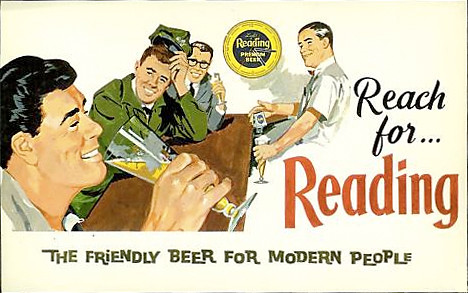
In the end, however effective advertising can be, I tend to think most people know the difference between it and real life. My old hometown beer — Reading Premium Beer — used to advertise with the wonderful slogan: “The Friendly Beer for Modern People.” I love that phrase, but it’s utterly meaningless. I don’t think beer can be friendly, any more than my cat actually likes me when I rub her belly. Oh, sure, it looks likes she’s smiling, but I know she really thinks of me as the hired help. But actual personification, or anthropomorphisation in the case of my feline companions, of beer is ultimately just as futile. It’s just the advertisers trying to project — maybe that needs a new word: advermorphisation — human characteristics onto inanimate objects. Beer will never be my BFF. The people I drink beer with? Those are my people, my true BFFs.

reading-reach-postcard

Filed Under: Beers, Editorial, Just For Fun Tagged With: Advertising, Canada, Science, Ukraine, United States

Real Drunken Monkeys

September 19, 2012 By Jay Brooks

drunken-monkey
When I hear the term “drunken monkey,” I first think of the Chinese martial art, a kind of Kung Fu. There’s also a surprising number of bars and restaurants called Drunken Monkey this or that. But in searching for information on beer in Saint Kitts and Nevis, the Caribbean island nation who celebrates their independence day today, I found an old news report that there are real drunken monkeys. In Beware of Alcoholic Monkeys on St. Kitts, they recount how these monkeys were “originally imported to the island by pirates, [and] were introduced to the tantalizing effects of umbrella-laden mojitos and shots of tequila by tourists a few decades ago. Not surprisingly, they developed a heavy hankering for it.”

A group of scientists from McGill University in Montreal, Canada, along with a foundation on the islands, saw an opportunity and captured 600 monkeys to study their drinking behavior. The monkeys drinking habits broke down into somewhat predictable groups:

  • Social drinkers: the majority of the monkeys. They prefer alcohol diluted in fruit juice, will only drink in the company of other monkeys, and not before lunch.
  • Regular drinkers: fifteen percent of the monkeys prefer their alcohol “neat” or diluted in water, not sweetened or diluted with fruit juice. Interestingly, steady drinkers do very well in social groups, and are good leaders. They run troops well, they keep order well, and they’re very dominant. This type of alcoholic monkey is a very functional animal.
  • Binge drinkers: five percent of the monkeys drink their alcohol fast, get in fights, and drink themselves into a coma. Just as in humans, there are more young males in this group. If this group has unrestricted access to alcohol, they will drink themselves to death within 2-3 months. Binge drinkers differ from regular (or “steady”) drinkers by their drinking patterns rather than by the amounts of alcohol they consume.
  • Teetotaler: fifteen percent of the monkeys prefer little or no alcohol.

So that breaks down like so:

  • 65% = Social Drinkers
  • 15% = Regular Drinkers
  •  5% = Binge Drinkers
  • 15% = Non-Drinkers

That looks similar to what I’d expect for people, too. Does anybody know how the same groups shake out for Americans, or humans across the world?

The UK’s Guardian summarized the results.

For many years, alcoholism in humans was thought to be purely a learned behaviour — the result of environmental factors. But more recent studies indicate that in humans, the tendency towards alcohol addiction has a genetic component: it tends to run in families. Research has found three regions on the human genome that may be linked to alcoholism. Unfortunately, since these areas contain up to 300 genes, it may be some years before specific “alcohol genes” are identified.

I think it is interesting that, despite living in a tropical paradise, without any economic problems or deprivation, this video clearly documents that some monkeys still become alcoholics. Additionally, this video shows how vervet monkeys’ alcohol use mirrors that of humans, suggesting that they too, have a genetic component. Further, human and vervet monkey DNA shares an 84.2% similarity. So even though it is difficult to study humans’ genetics and patterns of alcohol consumption, researchers can study vervet monkeys. So research is ongoing in these monkeys to better understand their patterns of alcohol use and abuse — valuable since scientists can carefully control the monkeys’ environment and the monkeys can be selectively bred so researchers can better understand the effects of particular genes on behaviour.

The study itself, Alcohol consumption in vervet monkeys: biological correlates and factor analysis of behavioral patterns, doesn’t reveal too much in the abstract, so I have to take the word of the two reports. But it certainly would be interesting to see if it does correlate to human behavior.
Chimp

Filed Under: Beers, Just For Fun Tagged With: Nature, Science

Beer Drinking Speed Influenced by Glass Shape

September 12, 2012 By Jay Brooks

beer-glass-tulip
With binge drinking front and center of many public policy concerns, the UK’s University of Bristol decided to examine whether it was because of the glass people were drinking out of. The School of Experimental Psychology set out to “explore the influence of glass shape on the rate of consumption of alcoholic and non-alcoholic beverages.” Their results, Glass Shape Influences Consumption Rate for Alcoholic Beverages, were published recently in PLOS ONE, a peer reviewed, open access journal.

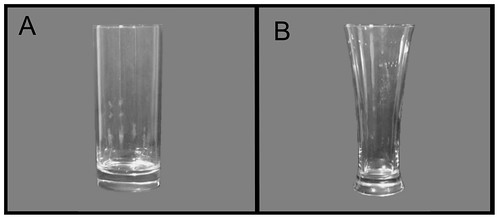
Study participants were given one of the two types of glasses below.

Figure 1

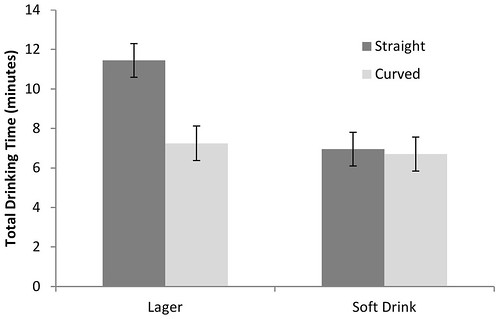
According to the summary by Health Today, “People took about almost twice as long to finish when drinking alcohol from the straight-sided glass, compared with the curved glass. There was no difference in drinking rates from the glasses when the drink was nonalcoholic.” The Bristol scientists conducting the study speculated that “people may swill their alcohol faster from curved glasses because it is more difficult to accurately judge the halfway point of these glasses,” adding that “drinkers may be less able to gauge how much they have consumed.”

They continued:

“People often talk of ‘pacing themselves’ when drinking alcohol as a means of controlling levels of drunkenness, and I think the important point to take from our research is that the ability to pace effectively may be compromised when drinking from certain types of glasses,” said study researcher Angela Attwood of the University of Bristol’s School of Experimental Psychology in the United Kingdom.

While there is a difference, is there a correlation? The researchers seem to think so, though their methodology is unique and it’s the first time, as far as they know, that such a study has been conducted.

Figure 2

Here’s their nutshell conclusion.

Participants were 60% slower to consume an alcoholic beverage from a straight glass compared to a curved glass. This effect was only observed for a full glass and not a half-full glass, and was not observed for a non-alcoholic beverage. Participants also misjudged the half-way point of a curved glass to a greater degree than that of a straight glass, and there was a trend towards a positive association between the degree of error and total drinking time.

But unfortunately they begin with the false premise that “alcohol consumption is associated with increased mortality and morbidity.” Numerous studies have shown that people who drink alcohol in moderation are likely to live longer than either abstainers or binge drinkers (however that’s defined). And at least one study has shown that even binge drinkers will likely live longer than teetotalers. And while there are some persons genetically more susceptible to certain diseases if they drink too much, many other diseases have positive correlations with moderate drinking, that is alcohol use may lower the risk of people contracting those diseases. So public policy really should be aimed at educating the citizenry that it’s in their best interest to drink alcohol responsibly and in moderation. At a minimum, both sides of the story of alcohol should be part of the public discussion instead of the often one-sided version we have today that takes all of the negatives as givens and has no time for any positive findings to balance perspectives.

After more proselytizing and propaganda in their introduction it seems clear which side of the debate they come down on, which I think tends to influence the study itself. They’re looking for a way to reduce drinking — not that that’s a bad goal in and of itself — but while the results seem interesting, the fact is that they set out not to “explore the influence of glass shape on the rate of consumption of alcoholic and non-alcoholic beverages,” as they initially stated, but instead to effect public policy for their somewhat anti-alcohol agenda. It’s not hard to tease that out of how they characterize what they’re doing. For example, when they explain the rise of “branded drinking glasses in the United Kingdom,” they also include statements like “[w]hile alcohol advertising is still permitted in the United Kingdom” (as if they’d prefer it was not or suggesting it one day may not be) and state that glassware with a brewery’s logo on it constitutes a “currently unregulated, marketing channel,” it becomes nakedly obvious that they disagree with the world the way it is.

Happily, unlike many such studies, the entire journal article is online, so you can judge for yourself. I tend to be somewhat paranoid about these affairs, and am usually skeptical about such efforts.

Figure 1

Another issue I have is the glasses themselves. The first is meant, I presume, to be an average pint glass, but it doesn’t look quite like the familiar shaker pint glass. It more resembles the stange, though shorter, but it has the straight walls and does not curve out and taper slightly into a wider mouth like most pint glasses. The second glass is a common type of pilsner glass and more appropriate to the beer they used in the study. But that first glass I’ve rarely seen used in a pub or bar, at least on these shores. Isn’t it just as likely they overlooked the obvious: that participants drank faster because the beer tasted better in a more appropriate glass? They certainly never addressed using a more proper glass and seemed to overlook that aspect entirely, as if it didn’t matter one iota. Considering how careful they appeared to be with so many other aspects of the study, the choice of glasses seems almost comically devoid of reason.

The beer was apparently a 4% a.b.v. lager from Brasserie Saint-Omer, a French brewery. Why an English university didn’t see fit to include a British beer in the study is not disclosed, and to my mind makes little sense. Clearly, the researchers need to get out to the pub themselves a little more often.

But from this preliminary, somewhat flawed first attempt, the authors make the leap that their findings could inform public policy and use them to alter “policy decisions regarding structural changes to the drinking environment which may reduce drinking rates and correspondingly impact on resulting alcohol-related harms.” Whoa, cool your jets there. That’s quite a leap, with almost no apparent understanding of the importance of glassware to beer, even as they admit their “study cannot fully resolve the mechanism which underlies the effects we observed.”

Even if you’re not a hardcore beer geek who insists on just the right glass for a beer, I think we can all agree that a plastic cup is not as good as glass and that some glassware simply works better with certain drinks, in the worlds of beer, wine and spirits. Imagine the hue and cry if they’d suggested people would sip their champagne much more slowly if one used a martini glass or coffee mug for their next wedding toast. I just can’t abide the notion that glassware choice should be dictated by a public policy trying to slow the pace of drinking across the board, using a bludgeon for a problem I’m not even sure actually exists. I tend to be a slow drinker already, so I may not be the target demographic, but I’d still be swept up in its net if my glassware choice was arbitrarily dictated by politicians and so-called health officials. No matter how well-intentioned, they would undoubtedly remove certain glassware from circulation, limiting the types a bar or pub could use in serving their beer. That, I believe, would be bad for all of us. You want that pilsner in a pilsner glass? Forget it, you’ll get the pint glass and like it. Otherwise, you can’t be trusted to drink slowly enough. There are already enough bad bars using a single glass to serve everything they stock, it seems like this could only make things worse.

Filed Under: Beers, Editorial, Just For Fun, News, Politics & Law Tagged With: Glassware, Science

Beer Safe To Drink In Post-Apocalyptic World

September 11, 2012 By Jay Brooks

mushroom-cloud
It’s nice to know that after the world ends in a nuclear fireball, we’ll still have beer to drink. According to an interesting article at the Nuclear Secrecy Blog Restricted Data, beer was tested and found to be relatively safe after being exposed to a nuclear blast. In 1955, Operation Teapot tackled the problem of what surviving humans might drink after the big one was dropped. In Beer and the Apocalypse, author — and historian of science at the American Institute of Physics — Alex Wellerstein details the experiments and their results. It’s a fascinating and frightening tale. And at least it gives me an excuse to increase the size of my beer cellar.

Filed Under: Beers, Just For Fun, News Tagged With: Oddities, Science

A Toast To The Moon

August 25, 2012 By Jay Brooks

moon
It’s the end of an era. Neil Armstrong, the first man to walk on the surface of the moon passed away today at 82. I was 10 that July when the historic moon walk took place. Like most kids my age, I was deeply obsessed with the NASA space program, had many models and books, and even drank Tang. Neil Armstrong was a real hero to me as a kid and I have no less admiration for him as an adult. I’ll raise a toast tonight to Neil Armstrong, and the entire group of Apollo astronauts, along with the thousands of engineers, scientists and technicians that achieved what so many thought was impossible, that — in John F. Kennedy’s words — “of landing a man on the moon and returning him safely to the earth.”

apollo_lager

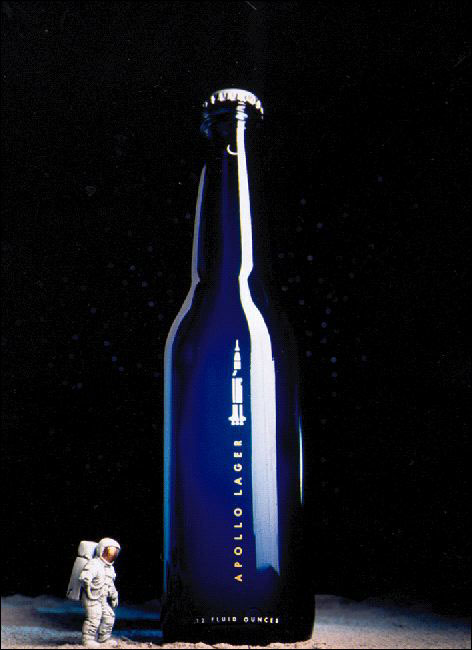
The only question is what is the appropriate beer to toast Armstrong, and the Moon? I still have two bottles of Apollo beer from the 1990s but I’m certainly not going to open any of those. I also have a cool blue 3L bottle of Apollo Lager, which was empty since it was given to me, so that obviously won’t work.

moonshot-logo

To bad we can’t drink a Moonshot tonight. Maybe a beer brewed with Apollo hops? Sixpoint’s summer seasonal is called Apollo, and Laurelwood has a Space Stout, but I can’t either of those. There’s Blue Moon, of course though I think I’d prefer the more local Moonlight or even Half Moon Bay. What beer will you choose?

barney-spaceman

Filed Under: Beers, Just For Fun, News Tagged With: History, Science

College Drinkers Are Happier & Cooler

August 21, 2012 By Jay Brooks

humor
This has just got to cheese off Alcohol Justice and the other neo-prohibitionist wingnuts, but Time magazine is reporting the results of a recent study that found the unpleasant truth that students who binge drink in college are actually happier and enjoy higher status among their peers. In Why College Binge Drinkers Are Happier, Have High Status, they began with a bang:

College binge drinkers say they’re happier with their social lives than those who don’t indulge — but it’s probably the boost in social status, not the booze itself that lifts their mood, according to new research presented at the annual meeting of the American Sociological Association.

“Binge drinking is a symbolic proxy for high status in college,” said study co-author Carolyn Hsu, an associate professor of sociology at Colgate University in a statement, noting that it’s what the wealthy, powerful and happy students on campus do.

The study found that rich white frat boys reported having the greatest social satisfaction at school and were considered the big men on campus by others. They were not only happier than students in low-status groups — women, minorities and people who were less financially well-off — but also more likely to binge drink. “Binge drinking then becomes associated with high status and the ‘cool’ students on campus,” said Hsu.

Low-status students in turn reported being happier if they binged than if they didn’t. Indeed, alcohol seemed to be the great social equalizer, bringing members of low-status groups to happiness levels similar to those of greater social power if they binged. “Students in all groups consistently liked college more when they participated in the campus’ binge drinking culture,” Hsu said.

The results are still preliminary, but it’s still notable for at least trying to better understand why binge drinking persists, despite endless efforts to curb it. Though to be fair, most of those efforts are misguided bludgeons like “just say no” and other ideas doomed to fail by neo-prohibitionist groups.

Other interesting tidbits included the fact that “the most stressed and highly anxious students were the least likely to binge, suggesting that the negative emotions that often drive alcoholism are not influencing many of these bingers.” And in a related study, it was found that College Men Who Post About Alcohol Have More Facebook Friends. In a way, it’s not surprising, as social status is pretty important at that age, possibly more important than at any other time. College students, often on their own for the first time in their young lives, trying to find themselves and become their own adults, have the added burden of having virtually no education regarding alcohol and having to obtain it through illegal means thanks to the anti-alcohol efforts of the past several decades. So when the study concludes “that the social advantages of binge drinking do not mitigate its negative consequences on health and academic performance,” I can only say, well, duh.

But it’s the final paragraph that contains the most important wisdom, totally lost on neo-prohibitionists and especially people who do not drink.

Surprisingly little research is conducted on the positive effects sought by drug users and what they actually achieve via their drug consumption; the assumption is that alcohol and other drugs are always bad and their users are irrational. But until more studies like this are conducted, prevention programs are unlikely to improve. We can’t prevent what we don’t understand.

Just say know.

Filed Under: Editorial, News, Politics & Law Tagged With: Science, Statistics

Drinkers Half As Likely To Get Lou Gehrig’s Disease

August 13, 2012 By Jay Brooks

lou-gehrig
Though contracting ALS (or Amyotrophic Lateral Sclerosis) is relatively rare, according to a new Dutch study, your risk is cut in half if you drink moderately, when compared to abstainers. Better known, at least in North America, as Lou Gehrig’s Disease — since the New York Yankees first baseman famously contracted it in 1938 — the ABMRF is reporting about the new study. According to their information, the Risk of ALS Seen to be Lower in Drinkers than Abstainers. Their full article is below:

A Dutch population-based case-control study of the rare but devastating neurological disease amyotrophic lateral sclerosis (ALS) suggests that the risk of such disease is increased among smokers, as has been shown previously. However, surprisingly, the risk of ALS was seen to be markedly lower among consumers of alcohol than among abstainers.

The study conducted between 2006 and 2009 included surveying 494 patients with incident ALS, a large sample for the rare disease, and 1,599 controls. Investigators compared results with those from cohorts including patients with prevalent ALS and referral patients.

Results highlight the importance of lifestyle factors in the risk for ALS. Current smoking is associated with an increased risk of ALS and a worse prognosis. However, alcohol consumption is associated with a reduced risk of ALS, as the risk among drinkers was about one half that of non-drinkers.

You can see the abstract for the study itself, Smoking, Alcohol Consumption, and the Risk of Amyotrophic Lateral Sclerosis: A Population-based Study, at PubMed.

Filed Under: Beers, Editorial, News, Related Pleasures Tagged With: Health & Beer, Science, Statistics, The Netherlands

How Neo-Prohibitionists Target Alcohol

August 11, 2012 By Jay Brooks

target-alcohol
Mark Twain is generally credited with popularizing the phrase: “There are three kinds of lies: lies, damned lies and statistics.” He attributed it to British statesman Benjamin Disraeli, though most historians now dispute that. So even when speaking about lying, there were lies. Today’s neo-prohibitionists would be proud, lying with statistics is something they’ve finely honed into its own kind of science. If you haven’t read How To Lie With Statistics or the more recent Trust Us, We’re Experts!, they both provide great insights into just how it’s been done over the years, and continues to be done with alarming frequency.

Thanks to Jason K. for alerting me to this one, which in the news is being portrayed with the intentionally misleading How Alcohol Ads Target Kids. The story concerns a study sponsored by CAMY (the Center on Alcohol Marketing and Youth) — itself a bit of an anti-alcohol organization who receives funding from the king of the neo’s, the Robert Wood Johnson Foundation — that examined alcohol advertising in eleven magazines over a five-year period. The study itself was recently published in The Journal of Adolescent Health with the much less misleading title Risky Messages in Alcohol Advertising, 2003–2007: Results From Content Analysis.

When CAMY released a press release about the study, they re-titled it Alcohol Advertising Standards Violations Most Common in Magazines with Youthful Audiences — also not exactly accurate — and by the time it got to the media (who love alarming headlines) it became How Alcohol Ads Target Kids, which was picked up by such high profile websites as Yahoo News, Live Science and Business News Daily.

All of the news stories rely on the CAMY press release and not the study itself, which seems at least a little strange. So here’s the Abstract:

Purpose
To assess the content of alcohol advertising in youth-oriented U.S. magazines, with specific attention to subject matter pertaining to risk and sexual connotations and to youth exposure to these ads.

Methods
This study consisted of a content analysis of a census of 1,261 unique alcohol advertisements (“creatives”) recurring 2,638 times (“occurrences”) in 11 U.S. magazines with disproportionately youthful readerships between 2003 and 2007. Advertisements were assessed for content relevant to injury, overconsumption, addiction, and violations of industry guidelines (termed “risk” codes), as well as for sexism and sexual activity.

Results
During the 5-year study period, more than one-quarter of occurrences contained content pertaining to risk, sexism, or sexual activity. Problematic content was concentrated in a minority of brands, mainly beer and spirits brands. Those brands with higher youth-to-adult viewership ratios were significantly more likely to have a higher percentage of occurrences with addiction content and violations of industry guidelines. Ads with violations of industry guidelines were more likely to be found in magazines with higher youth readerships.

Conclusions
The prevalence of problematic content in magazine alcohol advertisements is concentrated in advertising for beer and spirits brands, and violations of industry guidelines and addiction content appear to increase with the size of youth readerships, suggesting that individuals aged <21 years may be more likely to see such problematic content than adults.

There’s a lot gobbledygook and psychobabble jargon in that, but happily the news reports picked up the additional information in the press release to help out those of us who can’t afford to pay to see the full article. The so-called “study” is not exactly scientific, despite the academic journal publication and pedigree, but suffers greatly from how it’s defined and how the ads were characterized — how those “risk codes” were applied. As the study was sponsored by a particular organization with an agenda, it’s hardly a surprise that the conclusions would support that agenda. After all, they bought and paid for it.

One of the premises is that the 11 magazines they examined were ones with a “substantial youth readership,” which is important since they’re claiming that alcohol companies are targeting kids and/or violating advertising standards. I’d love to know which magazines they targeted, but that information has not been made readily available, even though you’d think that with such a dire problem they’d want to warn parents which magazines not to let their impressionable young children read. Should we wonder why that is? What it really comes down to is how they define “substantial youth readership?” For the study, that meant at least 15% of the readership was estimated to be underage, which is presumably what they mean by “youth.” I think most people would be hard pressed to consider 15% of anything “substantial.” So right from the get go, the study seems flawed; unless of course your goal is to manufacture a particular conclusion.

They further claim that these ads “frequently showed alcohol being consumed in an irresponsible manner.” First of all, how you define what “irresponsible” means is at best very subjective and certainly prone to be interpreted differently by different people. One of the examples of what they mean is “showing alcohol consumption near or on bodies of water.” Since when is that the hallmark of irresponsible behavior? Beer can’t be consumed responsibly, or safely, if there’s water nearby? Seriously, WTF?

Other examples they give include “encouraging overconsumption and providing messages supportive of alcohol addiction.” But those are both so vague as to be almost meaningless, and very open to interpretation. They further suggest that “sexual connotations or sexual objectification” were seen in “nearly one in five ad occurrences.” Again, pretty vague and subjective, but beyond that, so what? Isn’t “sex sells” the number one rule of advertising? Even if true, is alcohol advertising the only group using sex to sell their product? Or is that tactic literally everywhere. I remember being shown in an advertising class during college how the word “sex” could be found in the hair of the colonel in Kentucky Friend Chicken advertising. Sex is everywhere. Shock, surprise? Hardly. It’s the reason we’re all here. If you go looking for it, you’re going to find it. And frankly, under the circumstances, finding less than 20% of the alcohol ads with sexual content seems positively rock bottom, and something that they should see as a positive, wouldn’t you think?

But despite such vagueness, CAMY is undaunted, and finds exactly what they’re looking for. CAMY director and study co-author David Jernigan makes this claim. “The bottom line here is that youth are getting hit repeatedly by ads for spirits and beer in magazines geared towards their age demographic.” He goes on. “As at least 14 studies have found that the more young people are exposed to alcohol advertising and marketing, the more likely they are to drink, or if already drinking, to drink more, this report should serve as a wake-up call to parents and everyone else concerned about the health of young people.”

But another similar study by CAMY done in 2010 found that Less Alcohol Advertising Makes No Difference. In that study — covering nearly the same period of time — they found that youth exposure to alcohol advertising in magazines fell by 48 percent, alcohol advertising placed in publications with under 21 audiences greater than 30 percent fell to almost nothing by 2008, and youth exposure in magazines with youth age 12-to-20 audience composition above 15 percent declined by 48.4 percent. So apparently with that no longer a problem, they instead turned their attention to magazines with a youth readership of less than 15%. That must be the problem. There has to be a problem, after all. Without problems, there can be no fund raising. There can be no clarion call to arms against the heathen drinkers and alcohol companies.

This is the modern era of non-profits. There always has to be a problem. Now matter how much progress their organization makes against whatever problem they believe exists — and they will crow about that progress — the problem persists ad infinitum. It has to. But this particular problem has already been disproved. In 2003, a “‘Federal Trade Commission report to Congress indicate[d] that its comprehensive investigation’ found no evidence of targeting underage consumers.” See Alcohol Ads Target Youth? for the full story. The media may call this “How Alcohol Ads Target Kids,” but I can’t help but see it as just the opposite. When you look closer, it seems to me more like “How Neo-Prohibitionists Target Alcohol.”

Filed Under: Editorial, News, Politics & Law Tagged With: Anti-Alcohol, Prohibitionists, Science, Statistics

Moderate Drinking Prevents Bone Loss In Women

July 16, 2012 By Jay Brooks

bone
The ABMRF is reporting the results of a new study conducted at Oregon State University published in Menopause, the Journal of the North American Menopause Society. The study, Moderate alcohol intake lowers biochemical markers of bone turnover in postmenopausal women, appears to conclude that “Drinking alcohol in moderation with a healthy lifestyle may benefit women’s bone health, lowering their risk of developing osteoporosis.”

From the abstract:

Objective: Epidemiological studies indicate that higher bone mass is associated with moderate alcohol consumption in postmenopausal women. However, the underlying cellular mechanisms responsible for the putative beneficial effects of alcohol on bone are unknown. Excessive bone turnover, combined with an imbalance whereby bone resorption exceeds bone formation, is the principal cause of postmenopausal bone loss. This study investigated the hypothesis that moderate alcohol intake attenuates bone turnover after menopause.

Methods: Bone mineral density was determined by dual-energy x-ray absorptiometry in 40 healthy postmenopausal women (mean +/- SE age, 56.3 +/- 0.5 y) who consumed alcohol at 19 +/- 1 g/day. Serum levels of the bone formation marker osteocalcin and the resorption marker C-terminal telopeptide (CTx) were measured by immunoassay at baseline (day 0) and after alcohol withdrawal for 14 days. Participants then consumed alcohol and were assayed on the following morning.

Results: Bone mineral density at the trochanter and total hip were positively correlated to the level of alcohol consumption. Serum osteocalcin and CTx increased after abstinence (4.1 +/- 1.6%, P = 0.01 and 5.8 +/- 2.6%, P = 0.02 compared with baseline, respectively). Osteocalcin and CTx decreased after alcohol readministration, compared with the previous day (-3.4 +/- 1.4%, P = 0.01 and -3.5 +/- 2.1%, P = 0.05, respectively), to values that did not differ from baseline (P > 0.05).

Conclusions: Abstinence from alcohol results in increased markers of bone turnover, whereas resumption of alcohol reduces bone turnover markers. These results suggest a cellular mechanism for the increased bone density observed in postmenopausal moderate alcohol consumers. Specifically, the inhibitory effect of alcohol on bone turnover attenuates the detrimental skeletal consequences of excessive bone turnover associated with menopause.

The ABMRF report on the study:

Bones are in a constant state of remodeling with old bone being removed and replaced. In people with osteoporosis, more bone is lost than reformed resulting in porous, weak bones. About 80% of all people with osteoporosis are women, and postmenopausal women face an even greater risk because estrogen, a hormone that helps keep bone remodeling in balance, decreases after menopause.

A study by Oregon State University researchers assessed the effects of alcohol withdrawal on bone turnover in postmenopausal women who drank one or two drinks per day several times a week. A significant increase in blood markers of bone turnover was measured in women after they stopped drinking for just two weeks. Alcohol appears to behave similarly to estrogen in that it reduces bone turnover, the researchers said.

Investigators studied 40 early postmenopausal women who regularly had one or two drinks a day, were not on any hormone replacement therapies, and had no history of osteoporosis-related fractures.

Results suggest evidence for increased bone turnover, a risk factor for osteoporotic fractures, during the two week period when the participants stopped drinking. Less than a day after the women resumed their normal drinking, their bone turnover rates returned to previous levels.

“Drinking moderately as part of a healthy lifestyle that includes a good diet and exercise may be beneficial for bone health, especially in postmenopausal women,” said researchers. “After less than 24 hours to see such a measurable effect was really unexpected.”

Filed Under: News Tagged With: Health & Beer, Science, Statistics

« Previous Page
Next Page »

Find Something

Northern California Breweries

Please consider purchasing my latest book, California Breweries North, available from Amazon, or ask for it at your local bookstore.

Recent Comments

  • Ernie Dewing on Historic Beer Birthday: Charles William Bergner 
  • Steve 'Pudgy' De Rose on Historic Beer Birthday: Jacob Schmidt
  • Jay Brooks on Beer Birthday: Bill Owens
  • Steve 'Pudgy' De Rose on Beer Birthday: Charles Finkel
  • Steve 'Pudgy' De Rose on Beer Birthday: Bill Owens

Recent Posts

  • Beer In Ads #5185: It’s Bock Time January 28, 2026
  • Beer Birthday: Shane McNamara January 28, 2026
  • Historic Beer Birthday: John Goetz January 28, 2026
  • Beer Birthday: Jean-Marie Rock January 28, 2026
  • Beer In Ads #5184: The “B”s Are Here, Bruton Bock Beer January 27, 2026

BBB Archives

Feedback

Head Quarter
This site is hosted and maintained by H25Q.dev. Any questions or comments for the webmaster can be directed here.