Three Logicians Walk Into A Bar …

logic-brain
While I had a logic class in college, and dabbled in debate, I’ve probably forgotten more than I ever learned. But I still love the notion of breaking down the thought process. My son, who’s 11 and autistic, often has trouble understanding humor. As a result, I increasingly find myself trying to explain the punchline of a joke — why it’s funny — and I’ll break it down for him. What invariably happens, of course, is that in that process, the joke is stripped of its humor and is no longer funny. For some reason, that never deters me. I’ve always had a thing for jokes and thinking about why they’re funny. If I wasn’t so damn shy I would have loved to have tried my hand at stand-up comedy back when I was a younger man. I think that’s why I loved The Aristocrats so much. Ninety minutes breaking down and re-telling one joke. What’s not to love?

So check out the comic strip below. It’s mildly amusing, at least to me. You most likely won’t laugh out loud, but you may smile, at least. But from the point of view of logic, it’s also quite correct, and instructional. It was originally posted by Spiked Math Comics, who admits he doesn’t know the strip’s original creator.

three-logicians

But here’s where it veers headlong into geekdom. It was picked up by a Danish University linguistics student, Emil Kirkegaard, who posted Three Logicians Walk Into a Bar: A Formal Explanation, a breakdown and analysis of the joke, complete with formulas, and explanation of the logic principles behind it.

Here’s one expressing the root problem: E↔(Wa∧Wb∧Wc)

The whole explanation is just as funny as the original strip, to me at least, in its own right and certainly does explain the joke, although if you didn’t think it was funny to begin with, this probably isn’t going to help. But us geeks have to stick together, no matter what geekworld we belong to.

The Science Of Beer Color

color
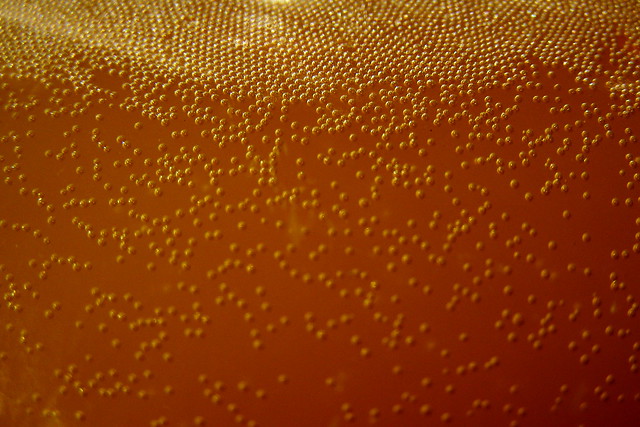
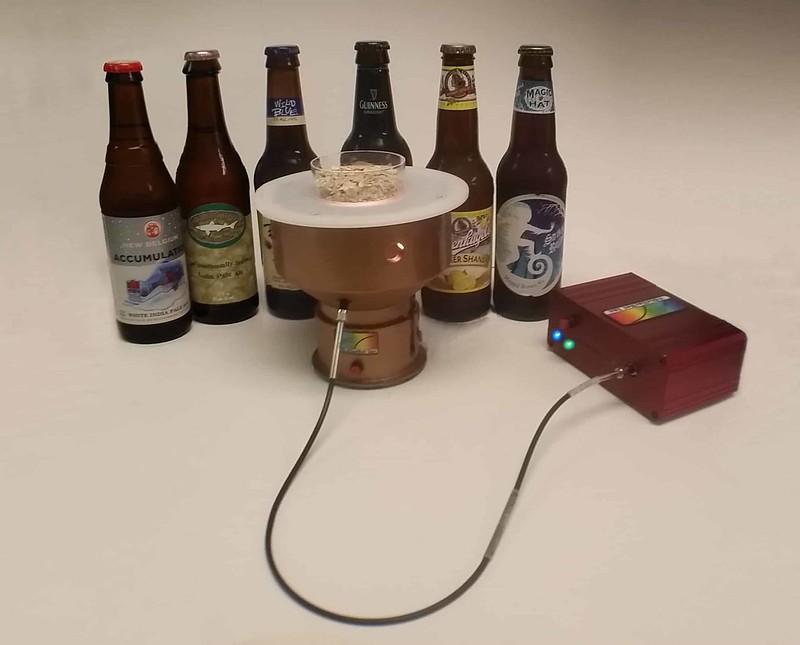
Popular Science’s BeerSci series had another interesting post last month on How Beer Gets Its Color, this time addressing “the two chemical reactions that most influence the malt character and color of your brew.” It’s wonderfully geeky, and goes into the Maillard reaction, named for French chemist Louis Camille Maillard, which is also known as “browning,” and is essentially how “amino acids react with a reducing sugar.” Between that, and caramelization, the various colors in beer are created.

Brewers used to use the Lovibond scale — expressed as “Degrees Lovibond” — when referring to color, but it’s largely been replaced by SRM (Standard Reference Measurement) or the EBC (European Brewing Convention), which is similar but has a different numbering system. Here’s what the SRM range looks like:

SRM_Beer_Color_Chart

For more infomation, check out the terrific Beer Color Laboratories. I keep their wallet size color reference guide in my wallet at all times, and have the larger one in my office. They’re great if you don’t have a spectrophotometer lying around.

logo-beertone

Another interesting expression of beer color is coming out of Switzerland. Beertone is essentially a playful spoof on or homage to the Pantone color system used by design professionals. Beertone is taking individual beers and making a beertone card for each, with information about each beer on it. Here’s a sample mock-up of what the cards will look like.
beertone-card

  1. The Beer Color: The concept from Beertone. Each beer has been shot in a special glass, to avoid reflexes and extern influences. The results are amazing.
  2. The Beer Bottle: There’s so many cool Beer Labels that we thought, we must have the bottle on each page.
  3. Alcohol by Volume: The percent alcohol by volume (% alc/vol). It’s a standard measure of how much alcohol (ethanol) is contained in an alcoholic beverage.
  4. Brewery: it’s important to know who produced the Beer. Big and small companies have their places on Beertone.
  5. Beer Name: That’s most important thing to remember when the barkeeper asks what do you wanna drink.
  6. The Color Information: As part from Beertone concept, we present the color references from different color models. With the best values compared to the Beer color.
  7. Brewery Site: If you want to know more about the Beer and its Brewery, here you will have their official site.
  8. Beer Description: Here the Beer enthusiasts will have a description about each Beer. Useful information is always relevant. What a better way to start a good conversation at the bar?

So far, only Swiss beers are available for pre-order — and they’re pretty pricey — with plans for German beers and Brazilian beers to be released later this year.

beertone-1

It certainly seems like a cool idea, if a little unwieldy. I think they should sell them like trading cards and sell packs at bars. But I’d certainly like to see them expanded into the U.S., Great Britain, the Czech Republic, et al., and see what a wider geographic range of beers would look like.

beertone-2

How Alcohol Travels Through The Body

ethyl-alcohol
Today’s infographic concerns the subject of How Alcohol Travels Through the Body, each stage of the way and what happens at each place alcohol travels from mouth to liver and out again. Remember, you don’t buy alcohol, you just rent it. Just click on the image to view it full screen.

The Science Of The Spins

spins
Given that today is New Year’s Eve — what I generally refer to as Amateur Drinking Day — I thought this science lesson from Mental Floss on what causes the spins was an appropriate topic. In Why Does Alcohol Cause the Spins?, author Matt Soniak explains that sometimes after an evening’s drinking that the room appears to be spinning out of control. You lie down, but it doesn’t help. No matter what you do, the vertigo persists, causing great discomfort and often the loss of lunch, dinner and everything else that used to be in your stomach. Here’s why.

The spins happen because of an odd effect alcohol has on your ears — specifically, on three tiny, fluid-filled structures called the semicircular canals. Inside each of these canals is a fluid called endolymph and a gelationous structure called the cupula, which is filled with cells covered in fine, hair-like stereocilia.

As you move around, the movement of the endolymph lags behind the more solid cupula, distorting and bending it — and those little hairs. When the hairs bend, the electrical signal they send to your brain is altered, helping you to make sense of the rotations your head experiences on each of the three planes the canals sit on — movements up and down, left and right and backward and forward — and keep your balance.

Booze throws this system out of whack. Alcohol thins the blood, and when boozy blood travels to the inner ear, it creates a density difference between the cupula and the fluid in the canals, and distorts the cupula’s shape. The little hairs bend and send a signal to your brain that tells it you’re rotating when you’re really not, and this illusion of motion makes it seem like the room is spinning.

Some of the things that you most want to do when you’re good and drunk, like lie down and close your eyes, make the sensation worse, since you don’t have any visual or physical cues to counteract the false sense of motion. Looking at a fixed object and keeping your feet planted on the ground can help lessen the effect, but there’s no real way to stop it.

So now you know. The bad news is there’s pretty much nothing you can do about it apart from practicing moderation and drinking plenty of water. If I know I’ll be drinking a lot, I try to eat a hearty meal beforehand, drink a glass of water in between each beer, snack during the party and take some Advil and Vitamin B before going to sleep. Happy New Year everybody.

Maybe this will help; maybe not.

the-spins

The Science of Beer Goggles

beer-goggles
Hmm, not sure how to think about this one. It’s kinda fun, and occasionally funny, but it also goes a little bit too far when it tackles the “bag over her face” issue, although it does offer advice for both women and men. The infographic was created by freedating.co.uk, an online dating website in Great Britain, so it was probably meant to be somewhat tongue in cheek.

There is actually some science behind the concept of beer goggles, and a couple of years ago I wrote about the Math Behind Beer Goggles. The infographic does also include some of that, too, at least.

science-of-beer-goggles
You can see this chart larger at Love Infographics.

The Formula For The Perfect Pint

math
I can only assume that the UK pub chain Taylor Walker is, in the appropriate British parlance, taking the piss, with their commissioning of Mindlab to discover the formula for “the perfect pint.” Though there is a Mind Lab at the University of Sussex, this bit of news is not listed in their news or press section. At any rate, they claim to have “used complex mathematical modelling techniques to discover what conditions are required to enjoy the perfect pint.”
e-pint

So what is the formula for a perfect pint?

Here goes: E = -(0.62T2 + 39.2W2 + 62.4P2) + (21.8T + 184.4W + 395.4P + 94.5M – 90.25V) + 50(S + F + 6.4)

  • E is a factor describing overall enjoyment.
  • T is the ambient temperature in degrees Celsius.
  • W is the number of days until you are required back at work.
  • P is the number of people with whom you are drinking.
  • M is related to your mood whilst drinking the pint.
  • V is related to the volume of the music being played.
  • S and F are related to the availability of snacks and food.

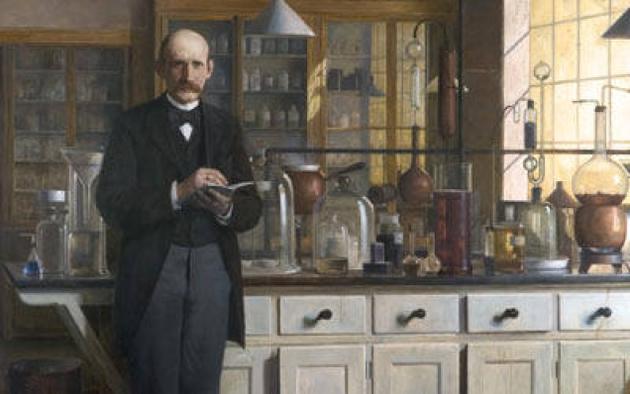
Without the number variants, so slightly simpler, it’s E = -(T2+W2+P2) + (T+W+P+M-V) + 50(S+F+6.4), though it’s hardly E = MC2. Below a presumed “scientist” — he is after all, wearing a lab coat and surrounded by books and beakers — explains it all:

My BFF Beer

bff

Canada’s Random House Publishing runs an interesting website called Hazlitt, where, presumably, they feature their own authors on a variety of topics. The one that caught my attention was by Linda Besner, and it’s an essay about My Best Friend, beer.

She begins by claiming that mankind has been “thinking and talking about beer since 4000 B.C.” She’s only off by as much 5,500 years, since brewing is believed to have begun with the “advent of agriculture in the Neolithic Period of the Stone Age about 11,500 years ago.” I don’t want to dwell on that, because we haven’t even gotten to the meat of it, but it did make me initially skeptical.

The story concerns a study that examined beer commercials from both the U.S. and the Ukraine, described as a “cross-cultural study of beer’s metaphors.” Again, I’m quibbling a bit, because the researchers looked at a total of 37 ads from both nations, not exactly a large number, but the author credits them with having “seen a lot of beer commercials.” I think the average consumer might see nearly that many during the average football game, or certainly over the course of a Sunday watching sports in general. But okay, let’s let them make their point. What did they find?

“While the personification of beer is consistent from Ukrainian to U.S. commercials, it seems to me that the kind of person beer is in Ukraine is different from the kind of person beer is in the States.”

In the Ukrainian commercials, the study notes, “people do not become friends by sharing beer; rather beer drinking occurs among individuals who are already established as friends, which entails a close and trusting relationship.” The people drinking beer together are described as druh, which Dr. Lantolf translates as being like the English concept of “best friend,” rather than tovarysch, which translates as “comrade” or “acquaintance.”

In the United States, it’s almost the opposite. Apparently, we use the term “friend” rather loosely, calling people we hardly know, or have just met, our friends. In other words, many of our friends are more superficial, at least compared to how Ukrainians see them.

To illustrate, they give the example of a Budweiser commercial currently up on YouTube under the name “Magic Beer.” A young man sits alone at a bar, opening a bottle. He pours it into his glass, but, miraculously, once the glass is full, beer continues to spill forth. Quickly, he pours some of the excess beer into the glasses of the men next to him. In the next shot, the bar is packed with carousers dancing to a live Scottish band as beer continues to gush from the magic bottle. The erstwhile lonely young man dances between his new friends, a beatific look on his face. Then he drops the bottle. It smashes on the floor, and the flow of beer trickles to nothing amid ghastly silence. The outraged people around him glare daggers. Those closest to him turn and walk away.

Frankly, I hate these ads. They’re not just superficial, they’re utterly ridiculous. Saying they’re depicting how typical Americans act, or view friendship, seems like quite a leap. I think it says more about the advertisers than the consumers, and maybe even a little about the researchers that they think idealized commercials reflect real life.

Even if I accept the premise, that that may be how some people see their “friends,” I’ve never considered such people my friends. Fair-weather friends, perhaps, but that’s a rather derogatory expression. Is it possible I’m not typical? No, I don’t think so, because I’m pretty sure most of the people I know well feel roughly the same way.

I love beer. I make my living writing about it, reviewing, analyzing it, along with the people and companies who make, sell and market it. I have admittedly made friends, to varying degrees, with actual people who work in the industry. But I’d never mistake the beer itself as my friend. It’s an inanimate object, after all. I may love beer, but in the same way I love potato chips or frites. It’s not the same as another person. Doesn’t everyone know the difference?

beer-friend

Not according to the study, apparently. To wit:

It seems that not only do Americans see beer as a person, they see beer as a person other people like better than them. In this scenario, beer is the cool friend you bring to the party who makes you popular by association. As soon as your cool friend leaves, no one wants to hang out with you anymore. It’s doubtful, Dr. Lantolf says, that the producers of “Magic Beer” and other commercials are consciously depicting shallow friendships: “I think that what they were showing is how Americans typically behave.: Dr. Bobrova is originally from the Ukraine, and she says, “I didn’t expect that American commercials would show this superficial concept of American friendships. I have many friends in the U.S. and we spend time together and I share everything with them as with Ukrainian friends. But commercials show a little bit of a different picture. But then,” she adds, “I’m not a beer person.”

Should I be insulted by that? I’m really not sure. I don’t believe that’s “how Americans typically behave.” Sure, there are certainly superficial people in the world, and I’d be willing to accept that a lot of them live here in the States, but I don’t think it’s something most people aspire too. I don’t think Americans view superficiality as a positive attribute. So when the researchers say they think “Americans see beer as a person,” it’s the people in the commercials who may “see beer as a person,” but they’re not real. They’re actors. It’s not the same thing. The advertisers are projecting an image onto the characters to sell us something. It’s not necessarily a reflection of real people, or real life. Am I off base here?

I know many Canadians quietly don’t think too much of their neighbors, and there are certainly times when I agree with them, at least about how we sometimes behave and view the world. But this one I just don’t quite understand. The author of the piece, Linda Besner, is a poet from Quebec who recently published her first collection, The Id Kid. And they may be fine poems, “sassy and sumptuous,” as her publisher describes them, but I can’t help but think she doesn’t know human nature as well as she might think. But the researchers have even more to answer for, since they’re from the University of Pennsylvania, the same school where Patrick McGovern, author of Uncorking the Past, does his research and teaches.

In the end, however effective advertising can be, I tend to think most people know the difference between it and real life. My old hometown beer — Reading Premium Beer — used to advertise with the wonderful slogan: “The Friendly Beer for Modern People.” I love that phrase, but it’s utterly meaningless. I don’t think beer can be friendly, any more than my cat actually likes me when I rub her belly. Oh, sure, it looks likes she’s smiling, but I know she really thinks of me as the hired help. But actual personification, or anthropomorphisation in the case of my feline companions, of beer is ultimately just as futile. It’s just the advertisers trying to project — maybe that needs a new word: advermorphisation — human characteristics onto inanimate objects. Beer will never be my BFF. The people I drink beer with? Those are my people, my true BFFs.

reading-reach-postcard

Real Drunken Monkeys

drunken-monkey
When I hear the term “drunken monkey,” I first think of the Chinese martial art, a kind of Kung Fu. There’s also a surprising number of bars and restaurants called Drunken Monkey this or that. But in searching for information on beer in Saint Kitts and Nevis, the Caribbean island nation who celebrates their independence day today, I found an old news report that there are real drunken monkeys. In Beware of Alcoholic Monkeys on St. Kitts, they recount how these monkeys were “originally imported to the island by pirates, [and] were introduced to the tantalizing effects of umbrella-laden mojitos and shots of tequila by tourists a few decades ago. Not surprisingly, they developed a heavy hankering for it.”

A group of scientists from McGill University in Montreal, Canada, along with a foundation on the islands, saw an opportunity and captured 600 monkeys to study their drinking behavior. The monkeys drinking habits broke down into somewhat predictable groups:

  • Social drinkers: the majority of the monkeys. They prefer alcohol diluted in fruit juice, will only drink in the company of other monkeys, and not before lunch.
  • Regular drinkers: fifteen percent of the monkeys prefer their alcohol “neat” or diluted in water, not sweetened or diluted with fruit juice. Interestingly, steady drinkers do very well in social groups, and are good leaders. They run troops well, they keep order well, and they’re very dominant. This type of alcoholic monkey is a very functional animal.
  • Binge drinkers: five percent of the monkeys drink their alcohol fast, get in fights, and drink themselves into a coma. Just as in humans, there are more young males in this group. If this group has unrestricted access to alcohol, they will drink themselves to death within 2-3 months. Binge drinkers differ from regular (or “steady”) drinkers by their drinking patterns rather than by the amounts of alcohol they consume.
  • Teetotaler: fifteen percent of the monkeys prefer little or no alcohol.

So that breaks down like so:

  • 65% = Social Drinkers
  • 15% = Regular Drinkers
  •  5% = Binge Drinkers
  • 15% = Non-Drinkers

That looks similar to what I’d expect for people, too. Does anybody know how the same groups shake out for Americans, or humans across the world?

The UK’s Guardian summarized the results.

For many years, alcoholism in humans was thought to be purely a learned behaviour — the result of environmental factors. But more recent studies indicate that in humans, the tendency towards alcohol addiction has a genetic component: it tends to run in families. Research has found three regions on the human genome that may be linked to alcoholism. Unfortunately, since these areas contain up to 300 genes, it may be some years before specific “alcohol genes” are identified.

I think it is interesting that, despite living in a tropical paradise, without any economic problems or deprivation, this video clearly documents that some monkeys still become alcoholics. Additionally, this video shows how vervet monkeys’ alcohol use mirrors that of humans, suggesting that they too, have a genetic component. Further, human and vervet monkey DNA shares an 84.2% similarity. So even though it is difficult to study humans’ genetics and patterns of alcohol consumption, researchers can study vervet monkeys. So research is ongoing in these monkeys to better understand their patterns of alcohol use and abuse — valuable since scientists can carefully control the monkeys’ environment and the monkeys can be selectively bred so researchers can better understand the effects of particular genes on behaviour.

The study itself, Alcohol consumption in vervet monkeys: biological correlates and factor analysis of behavioral patterns, doesn’t reveal too much in the abstract, so I have to take the word of the two reports. But it certainly would be interesting to see if it does correlate to human behavior.
Chimp