Brookston Beer Bulletin

Jay R. Brooks on Beer

  • Home
  • About
  • Editorial
  • Birthdays
  • Art & Beer

Socialize

  • Dribbble
  • Email
  • Facebook
  • Flickr
  • GitHub
  • Instagram
  • LinkedIn
  • Pinterest
  • RSS
  • Twitter
  • YouTube

Powered by Genesis

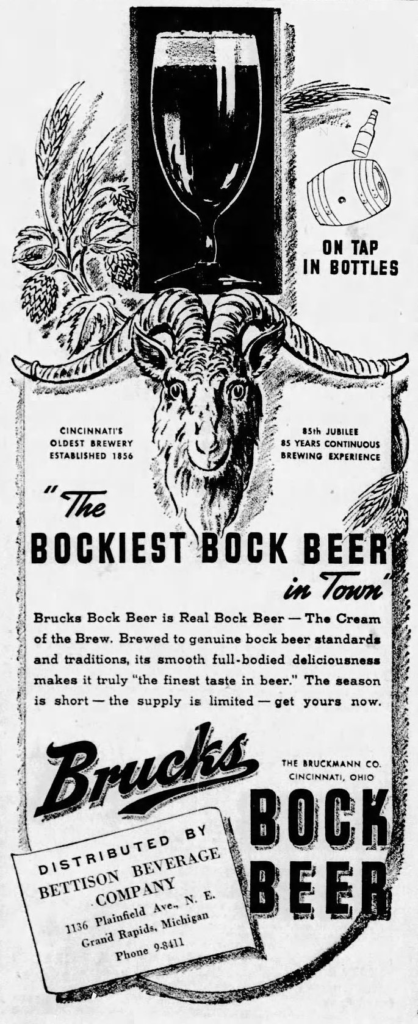
Beer In Ads #5176: Springtime Prescription From Old Doc Bock

January 19, 2026 By Jay Brooks

Two years ago I decided to concentrate on Bock ads for awhile. Bock, of course, may have originated in Germany, in the town of Einbeck. Because many 19th century American breweries were founded by German immigrants, they offered a bock at certain times of the year, be it Spring, Easter, Lent, Christmas, or what have you. In a sense they were some of the first seasonal beers. “The style was later adopted in Bavaria by Munich brewers in the 17th century. Due to their Bavarian accent, citizens of Munich pronounced ‘Einbeck’ as ‘ein Bock’ (a billy goat), and thus the beer became known as ‘Bock.’ A goat often appears on bottle labels.” And presumably because they were special releases, many breweries went all out promoting them with beautiful artwork on posters and other advertising.

Monday’s ad is for Wiedemann Bock Beer, which was published on January 19, 1962. This ad was for the George Wiedemann Brewing Co. of Louisville, Kentucky and Cincinnati, Ohio, which was originally founded by George Wiedemann in 1860 in Louisville, Kentucky, and later also opened a brewery in Cincinnati, Ohio. This ad ran in The Cincinnati Post, of Cincinnati, Ohio.

Filed Under: Art & Beer, Beers, Breweries, Just For Fun Tagged With: Advertising, Bock, History, Ohio

Beer Birthday: Henry “Zadie” Benesch

January 19, 2026 By Jay Brooks

union-craft

Today would have been the 106th birthday of Henry “Zadie” Benesch. Unfortunately, he passed away a few days shy of his 101st birthday on January 11, 2021. Until then, the centenarian was believed to be the oldest living person working for a brewery, where he helped out at his grandson’s brewery in Baltimore, Maryland, Union Craft Brewery. Thanks to Gregg Wiggins and Tom Cizauskas for alerting me to this story. You can read more about Zadie in an interview of him from a few years before when he turned 99 from the Washington City Paper. Here is what Yours For Good Fermentables had to say:

Happy 100th birthday to America’s (and the world’s?) oldest brewery worker: Henry ‘Zadie’ Benesch. A World War II veteran, Mr. Benesch works at Union Craft Brewing in Baltimore, Maryland, USA.

On Jan. 19, 2020, Henry will celebrate his 100th birthday. He isn’t sure what’s kept him alive for a full century. ‘I can’t answer that, but I say I drank from the fountain of youth when I was 17 and I smoked cigars when I was 22 and I’m still smoking cigars and drinking bourbon.’ “

“His badass-ness just rubs off on all of us,” said Union Craft Brewing co-founder Kevin Blodger. His fellow co-founder, Adam Benesch, is one of Henry’s 16 grandchildren.

Sounds like a fascinating person with a lot of stories to tell. The brewery has declared January 19th as “Zay Day” and thrown a big birthday bash at the brewery. Join me in drinking a toast to Zadie with a beer, a cigar, or bourbon.

Zadie

In his obituary on Baltimore Jewish Living they reprinted Zadie’s 11 Life Lessons, and I think they bear repeating and taking to heart.

  1. You can never have too many hats.
  2. Vegetables are always optional.
  3. Exercise will kill you.
  4. Travel often and see the world.
  5. Coffee, bourbon, Blackwing Lager and cigars are the four basic life necessities.
  6. Show up and work hard.
  7. Treat everyone you meet with kindness and compassion.
  8. Don’t take life so seriously.
  9. Stay humble.
  10. Keep it simple.
  11. Appreciate what you have.
Zadie-Orioles

Filed Under: Birthdays, Breweries, Just For Fun Tagged With: Baltimore, Maryland

Historic Beer Birthday: George Bechtel

January 19, 2026 By Jay Brooks

bechtel
Today is the birthday of George Bechtel (January 19, 1841-July 16, 1889). He was born in Germany, but moved to the U.S. with his parents at just six-months-old. His father was John Bechtel, who founded a brewery on Staten Island, New York, in 1853. It was initially was known as the John Bechtel Brewery, but in 1865, he sold the brewery to his son, George Bechtel, who renamed it the George Bechtel Brewery. George Bechtel continued to operate it until it closed for good in 1907.

George-Bechtel

This brief biography is from “Staten Island Brewery Barons” by Patricia M. Salmon, published in 2016:

George Bechtel was the owner and operator of the Bechtel Brewery on Staten Island. He was born in Germany and immigrated to New York with his family when he was six years old and by the age of 18 he was working in the brewery started by his father John Bechtel in Stapleton as a brewery worker. He purchased all of his father’s interests in the brewery in 1870 and by 1874 the main building was named George Bechtel’s Brewery.

By 1882, brewers at Bechtel Brewery produced about 80,000 barrels per year, which reached up to 150,000 barrels annually by the turn of the century. The business was valued at three quarter million dollars. For many years the Bechtel Brewery was the most significant business on Staten Island.

geo-bechtel
George married the former Eva Schoen, whose family has the mausoleum next to the Bechtel mausoleum, in 1865. They had four daughters, Anna, Carrie, Louise, Agnes and two sons, John and George Jr. Their six-year-old son John died in 1875.

George suffered from severe heart problems for at least two months before his death at the age of 48.

bechtels-brewery

This account is from “100 Years of Brewing,” published in 1903. The second part of the article is about John Moffat:

john-bechtel-100yrs-1
bechtels-brauerei
john-bechtel-100yrs-2

george-bechtel-brewery

This early history of the brewery is from “History of Richmond County, from its discovery to the present time,” by Richard Mather Bayles, published in 1887:

Bechtel’s Brewery, perhaps the largest of these, was located at Stapleton, where it was founded by John Bechtel, in 1853. In 1865 he sold the concern to his son, George Bechtel, the present proprietor. The capital invested here amounts to well nigh half a million dollars. In 1865 the revenue tax of this brewery was $10,000, and ten years later it had increased to $60,000. It employs about fifty hands.

George Bechtel, was born in Germany in 1840. He came with his parents to America at the age of six months, and in 1851 entered the grammar school of ColumbiaCollege. After finishing his course at that institution he began an apprenticeship in the brewery which his father had established at Stapleton in 1853. From 1860 to 1865 he occupied the position of superintendent of the establishment, and while engaged in that capacity he established the first ice-house in the East. In 1865 he rented the property from his father, and in 1870 purchased his entire interest, becoming the sole proprietor.

The original building proving too small for his rapidly increasing business, Mr. Bechtel concluded to tear it down and in its place he built the present elegant structure, special attention being given to its equipment. So energetically was the work of erection pushed that in ten weeks after the first stone was laid brewing had recommenced. The continued increase of his business is due to the high quality of excellence which he maintains in all his productions. Mr. Bechtel has been foremost in all public and benevolent matters. During the riots in 1861 he sheltered large numbers of these homeless people in the woods and sent them nourishment daily till the trouble had subsided, a circumstance which the colored people on Staten Island have never forgotten and for which they have been ever grateful.

Mr. Bechtel’s benevolent qualities show themselves on all occasions, and many poor families on Staten Island have been the recipients of his charity. It is said of him that he is ever ready to help where it is needed. In 1879 the Japanese embassy, together with the secretary of state and several other gentlemen, paid a visit to Mr. Bechtel’ s brewery. As a result they ordered one hundred thousand bottles of beer to be sent to Japan. On their return they sent him several very flattering letters and a pair of costly vases as a token of their esteem.

Bechtel-brewery-1897

Filed Under: Birthdays, Breweries, Just For Fun Tagged With: History, New York

Historic Beer Birthday: Frank H. Bechaud

January 19, 2026 By Jay Brooks

bechaud

Today is the birthday of Frank H. Bechaud (January 19, 1848-November 28, 1916. He was born in Rheinpflz, Germany, but emigrated with his parents in 1850, when he was two, settling on Fond du Lac, Wisconsin. In 1871, along with two of his brothers, Adolph and Jean (a.k.a. John), founded the A.G. Bechaud Brewery, which was also known as the A.G. Bechaud & Bros. Brewery and later, beginning in 1875, traded under the Empire Brewery name, before returning to Bechaud Brewery when it reopened after prohibition ended, before closing for good in 1941.

Frank-H-Bechaud

Here’s an obituary of Bechaud from the Brewers’ Journal:

Frank-H-Bechaud-obit-1
Bechaud Brewery Perfect Brew Label
Frank-H-Bechaud-obit-2
Bachaud-Empire
Frank-H-Bechaud-obit-3
fond-du-lac-wi-bechaud-brewing-company-1911
Extra-Brew-Beer-Labels-Bechaud-Brewing-Co-Empire-Brewery

Filed Under: Birthdays, Breweries, Just For Fun Tagged With: Germany, Wisconsin

Historic Beer Birthday: James Watt

January 19, 2026 By Jay Brooks

Today is the birthday of James Watt, not the BrewDog co-founder, but the “Scottish inventor, mechanical engineer, and chemist who improved on Thomas Newcomen’s 1712 Newcomen steam engine with his Watt steam engine in 1781, which was fundamental to the changes brought by the Industrial Revolution in both his native Great Britain and the rest of the world.

While working as an instrument maker at the University of Glasgow, Watt became interested in the technology of steam engines. He realised that contemporary engine designs wasted a great deal of energy by repeatedly cooling and reheating the cylinder. Watt introduced a design enhancement, the separate condenser, which avoided this waste of energy and radically improved the power, efficiency, and cost-effectiveness of steam engines. Eventually he adapted his engine to produce rotary motion, greatly broadening its use beyond pumping water.

Watt attempted to commercialise his invention, but experienced great financial difficulties until he entered a partnership with Matthew Boulton in 1775. The new firm of Boulton and Watt was eventually highly successful and Watt became a wealthy man. In his retirement, Watt continued to develop new inventions though none was as significant as his steam engine work. He died in 1819 aged 83.

He developed the concept of horsepower, and the SI unit of power, the watt, was named after him.”

186a,James Watt
A portrait of James Watt, by Carl Frederik von Breda, completed in 1792.

Of course, from our perspective his most important contribution was to the industrial revolution, and specifically the improvement of brewery efficiency. While Watt did not invent the steam engine, his improvements made it practical, especially in breweries.

The Watt Steam Engine

The Watt steam engine (alternatively known as the Boulton and Watt steam engine) was the first type of steam engine to make use of a separate condenser. It was a vacuum or “atmospheric” engine using steam at a pressure just above atmospheric to create a partial vacuum beneath the piston. The difference between atmospheric pressure above the piston and the partial vacuum below drove the piston down the cylinder. James Watt avoided the use of high pressure steam because of safety concerns. Watt’s design became synonymous with steam engines, due in no small part to his business partner, Matthew Boulton.

The Watt steam engine, developed sporadically from 1763 to 1775, was an improvement on the design of the Newcomen engine and was a key point in the Industrial Revolution.

Watt’s two most important improvements were the separate condenser and rotary motion. The separate condenser, located external to the cylinder, condensed steam without cooling the piston and cylinder walls as did the internal spray in Newcomen’s engine. Watt’s engine’s efficiency was more than double that of the Newcomen engine. Rotary motion was more suitable for industrial power than the oscillating beam of Newcomen’s engine.

watt-engine

Watt’s most famous steam engine was the one installed at the Whitbread Brewery in 1785, which was known as the Whitbread Engine. Today it’s located in the Powerhouse Museum in Sydney, Australia.

The Whitbread Engine

The Whitbread Engine preserved in the Powerhouse Museum in Sydney, Australia, built in 1785, is one of the first rotative steam engines ever built, and is the oldest surviving. A rotative engine is a type of beam engine where the reciprocating motion of the beam is converted to rotary motion, producing a continuous power source suitable for driving machinery.

This engine was designed by the mechanical engineer James Watt, manufactured for the firm Boulton and Watt and originally installed in the Whitbread brewery in London, England. On decommissioning in 1887 it was sent to Australia’s Powerhouse Museum (then known as the Technological, Industrial and Sanitary Museum) and has since been restored to full working order.

Installation of the Watt Steam Engine at Whitbread.

History of the Whitbread Engine

The engine was ordered by Samuel Whitbread in 1784 to replace a horse wheel at the Chiswell Street premises of his London brewery. It was installed in 1785, the second steam engine to be installed in a brewery, and enabled Whitbread to become the largest brewer in Britain. The horse wheel was retained for many years, serving as a backup in case the steam engine broke down. The drive gear of the engine, still evident today, was connected to a series of wooden line shafts which drove machinery within the brewery. Connected machinery included rollers to crush malt; an Archimedes’ screw, that lifted the crushed malt into a hopper; a hoist, for lifting items into the building; a three-piston pump, for pumping beer; and a stirrer within a vat. There was also a reciprocating pump connected to the engine’s beam, used to pump water from a well to a tank on the roof of the brewery.

In a marketing coup for both the brewer and the engine’s manufacturer, King George III and Queen Charlotte visited the brewery on 24 May 1787. The engine remained in service for 102 years, until 1887.

The engine made its way to the Powerhouse Museum (then known as the Technological, Industrial and Sanitary Museum) through Archibald Liversidge, an English-born chemist, scientist and academic at the University of Sydney, who was a trustee of the museum. Liversidge was in London in 1887, at the time of the engine’s decommissioning, and when he heard that the engine was to be scrapped he asked whether it could be donated to the museum. Whitbread & Co agreed on condition that the engine be set up and used for educational purposes.

Subsequently, the engine was dismantled and shipped to Sydney on the sailing ship Patriarch. For shipping purposes, the large flywheel was divided into two halves. While the flywheel’s rim could be unbolted, the hub with attached spokes had to be drilled through and rejoined after shipping. A shortage of funds meant the engine was kept in storage for several years. Eventually the engine was erected in its own engine house, behind the main building at the museum’s old Harris Street premises. During the 1920s or 1930s, an electric motor was added so that people could see the engine in motion. During the 1980s the Technology Restoration Society was formed in order to raise funds for the engine’s restoration. Restoration took place at the Museum’s Castle Hill site. During the restoration, some parts – including the piston – were replaced to preserve the original parts. The engine, restored to steaming condition, was installed in the new Powerhouse Museum in 1988. Today the engine is sometimes operated as part of the Museum’s Steam Revolution exhibition, steam being provided by the Museum’s central boiler.

watt-steam-engine

Technical specifications

The engine has a 0.64 metres (25 in) diameter piston with a 1.8 metres (6 ft) long stroke, driven by a mean effective pressure of 70 kilopascals (10 psi). Its top speed is 20 revolutions per minute (rpm) of the flywheel. In the engine’s youth, it had a maximum power output of approximately 26 kilowatts (35 hp).[It underwent a series of alterations in 1795, converting it from single-acting to double-acting; it was alleged at the time that this conversion improved its power to 52 kilowatts (70 hp), but the Powerhouse Museum claims this is false. A centrifugal governor, which moderates the level of steam provided if the engine begins to overload was added some years after this, and beam and main driving rod, both originally of wood, were replaced in sand-cast iron.

Apart from its age, the engine is notable in that it embodies the four innovations which made Boulton & Watt’s engines a significant driver of the Industrial Revolution. The first is a separate condenser, which increases the efficiency of the engine by allowing the main cylinder to remain hot at all times. The second is the parallel motion, which converts the up-and-down motion of the piston into the arcing motion of the beam, whilst maintaining a rigid connection. The rigid connection allowed the engine to be double-acting, meaning the piston could push as well as pull the beam. Third is the centrifugal governor, used to automatically regulate the speed of the engine. Finally the sun and planet gear convert the reciprocating motion of the beam into a rotating motion, which can be used to drive rotating machinery.

There’s also another Boulton & Watt engine at the National Museum of Scotland. It “was built in 1786 to pump water for the Barclay & Perkins Brewery in Southwark, London. Made double-acting in 1796, it was then capable of grinding barley and pumping water. At that time, no one else could supply a steam engine that performed both these actions at once. With some minor modifications, it remained in service at the brewery until 1884.”

boutonwattengine

And this is more from the National Museum of Scotland:

James Watt (1736-1819) was a prolific inventor, surveyor, instrument maker and engineer. His engines dramatically increased the power that could be generated through steam.

By entering into partnership with the Birmingham magnate Matthew Boulton in 1774, James Watt was able to channel the vast resource of Boulton’s Soho Foundry. Their partnership was so successful that the Boulton & Watt firm supplied engines and expertise to countries as far a field as Russia and Greece.

After pumping water and grinding barley for almost eighty-seven years, the engine came out of service in 1883.

You can see a diagram of the engine in action here:

Watt’s Steam Engine
Boulton-and-Watt-engine-1

Inside the Engine
Boulton-and-Watt-engine-2

Lighting the Fire
Boulton-and-Watt-engine-3

Running the Engine
Boulton-and-Watt-engine-4

If you want to read more in-depth about Watt’s development of the steam engine, Chapter III of “The Development of the Modern Steam-Engine: James Watt and His Contemporaries” is online, and there’s also various links at Watt’s page at the Scottish Engineering Hall of Fame.

Watt-postcard

Filed Under: Birthdays, Breweries, Related Pleasures Tagged With: Brewing Equipment, History, Science, Science of Brewing, Scotland

Historic Beer Birthday: Frank Reisch

January 19, 2026 By Jay Brooks

Today is the birthday of Frank Reisch (January 19, 1842-May 22, 1896), who at one time was involved in the management of the Reisch Brewing Co. He was the son of the founder, Franz Sales Reisch, who established the family brewery in 1849, in the city of Springfield, Illinois. According to Wikipedia, “the brewery operated until 1920 when it was forced to close because of Prohibition. It reopened in 1933 and stayed open until it shut its doors permanently in 1966.” During that time it changed names seven times.

frank-reisch-portrait-illustration

Find A Grave has a short biography, taken from the “Portrait & Biographical Album of Sangamon County, IL:

Son of Frank and Susannah Reisch. In 1863, he was admitted into partnership of the Reisch Brewery in Springfield, IL, founded by his father Frank. In 1868 they built a mammoth structure in which Frank carried on the business after the death of his father in 1875.

From the time that he entered into partnership with his father, the business steadily increased and was one of the leading industries of the city. The brewery was finely fitted up with all the best machinery for carrying on the manufacture of beer. The capacity of the brewery was one hundred barrels a day, and gave employment to fifty-five men and to eight teams.

Mr. Reisch was a thorough business man who took a keen interest in everything calculated to promote the growth and development of Springfield. He was a strong man in financial circles, was a Director in the Illinois National Bank and a stockholder in the street railway system.

reisch1
The brewery in Springfield (date unknown).

The 1910 book 100 Years of Brewing has a short entry about the brewery:

Reisch-100-years

Here’s the letterhead for the company from shortly after they incorporated in 1903.

Reisch-brew-1024x440

The Historical Encyclopedia of Illinois and History of Sangamon County doesn’t have an entry for Frank Reisch though he is mentioned in his father’s entry.

Frank-Reisch-dads-bio

reisch3
The brewery slightly closer (date unknown).

Tony White, who’s the great-great grandson of Reisch brewery founder Franz Sales Resich, is working on a book about his family’s brewing legacy. He also has a great webpage with lots of information about Reisch Brewing, including photographs and interviews with other family members.

rbss013
A stylized postcard of the brewery c. 1930s.

Here’s part of an entry of Frank Reisch from the Encyclopaedia of Biography of Illinois, though I clipped the second half, which discusses his involvement in local banking.

Reisch-beer2
A Resich Brewery delivery truck from around 1915. You can see many more photos from Springfield Breweries in a slideshow by the Reisch Brew Crew.
reisch-family-members

Additional information can be found at the Springfield Journal Register and Manic Publishing’s Ghost of brewing past.

Lester Jones, of the Beer Institute & George Reisch, of Anheuser-Busch @ GABF Saturday
Lester Jones, currently with the NBWA, and my friend George Reisch at GABF in 2009.

George Reisch is currently the Brewmaster and Director of Brewmaster Outreach at Anheuser-Busch, and has been there since 1979. He’s a fifth generation with Franz Sales Resich, Frank’s father, being first. His 96-year old father Edward is 4th generation (and will be 97 on March 1). His son Patrick Reisch brews for Goose Island and is 6th Generation.

Reisch-Gold-Top
One of their best-selling beers back in the day, Gold Top.

Filed Under: Birthdays, Just For Fun Tagged With: History, Illinois

Beer In Ads #5175: Tivoli Bock Is Back In Town!

January 18, 2026 By Jay Brooks

Two years ago I decided to concentrate on Bock ads for awhile. Bock, of course, may have originated in Germany, in the town of Einbeck. Because many 19th century American breweries were founded by German immigrants, they offered a bock at certain times of the year, be it Spring, Easter, Lent, Christmas, or what have you. In a sense they were some of the first seasonal beers. “The style was later adopted in Bavaria by Munich brewers in the 17th century. Due to their Bavarian accent, citizens of Munich pronounced ‘Einbeck’ as ‘ein Bock’ (a billy goat), and thus the beer became known as ‘Bock.’ A goat often appears on bottle labels.” And presumably because they were special releases, many breweries went all out promoting them with beautiful artwork on posters and other advertising.

Sunday’s ad is for Tivoli Bock Beer, which was published on January 18, 1955. This ad was for the Tivoli Brewing Co. of Denver, Colorado, which was originally founded in 1864 as the Colorado Brewery. This ad ran in The Pueblo Chieftain, of Pueblo, Colorado.

Filed Under: Art & Beer, Beers, Breweries, Just For Fun Tagged With: Advertising, Bock, Colorado, History

Historic Beer Birthday: Samuel Whitbread II

January 18, 2026 By Jay Brooks

whitbread
Today is the birthday of Samuel Whitbread II (January 18, 1764-July 6, 1815). Despite being the son of Whitbread Brewery founder Samuel Whitbread, he is most remember for being a politician. According to Wikipedia:

Whitbread was born in Cardington, Bedfordshire, the son of the brewer Samuel Whitbread. He was educated at Eton College, Christ Church, Oxford and St John’s College, Cambridge, after which he embarked on a European ‘Grand Tour’, visiting Denmark, Sweden, Russia, Poland, Prussia, France and Italy. He returned to England in May 1786 and joined his father’s successful brewing business.

Samuel-Whitbread_II
“Samuel Whitbread Esqr. M.P.” by Samuel William Reynolds after John Opie, 1804. This is the painting’s description. “A fine full length, seated portrait of the brewer, philanthropist and Whig politician Samuel Whitbread (1758-1815). He sits at his desk, wearing a dark suit and hessian boots, before an open window, his hand resting on a piece of paper. In the background is a draped curtain and on the floor is a pile of books.”

For over two decades he was a Member of Parliament:

Whitbread was elected Member of Parliament for Bedford in 1790, a post he held for twenty-three years. Whitbread was a reformer — a champion of religious and civil rights, for the abolition of slavery, and a proponent of a national education system. He was a close friend and colleague of Charles James Fox. After Fox’s death, Whitbread took over the leadership of the Whigs, and in 1805 led the campaign to have Henry Dundas, 1st Viscount Melville, removed from office.

Whitbread admired Napoleon and his reforms in France and Europe. He hoped that many of Napoleon’s reforms would be implemented in Britain. Throughout the Peninsular War he played down French defeats convinced that sooner or later Napoleon would triumph, and he did all he could to bring about a withdrawal of Britain from the continent. When Napoleon abdicated in 1814 he was devastated. Whitbread began to suffer from depression, and on the morning of 6 July 1815, he committed suicide by cutting his throat with a razor.

NPG D4774; Samuel Whitbread
This portrait of Whitbread was done in 1806.

Bedfordshire Genealogy and History has a fuller biography of Samuel Whitbread 2nd:

Samuel Whitbread, the son of the brewer Samuel Whitbread, and Harriet Hayton, was born in Cardington, Bedfordshire in 1758. His mother died when he was a child and his father took great care over his only son. When Samuel was sent to Eton he was accompanied by his own private tutor. Samuel continued his education at Christ Church, Oxford and St. John’s College, Cambridge, where he met his lifelong friend, Charles Grey.

After university Samuel Whitbread sent his son on a tour of Europe, under the guidance of the historian, William Coxe. This included visits to Denmark, Sweden, Russia, Poland, Prussia, France and Italy. When Samuel returned in May 1786, he joined his father running the extremely successful family brewing business.

In 1789 Samuel Whitbread married Elizabeth Grey, the sister of Charles Grey. The two men were deeply interested in politics. Grey was already MP for Northumberland and in 1790 Whitbread was elected MP for Bedford. In the House of Commons, Whitbread and Grey became followers of Charles Fox, the leader of the Radical Whigs.

Whitbread soon emerged in Parliament as a powerful critic of the Tory Prime Minister, William Pitt. A passionate supporter of reform, Whitbread argued for an extension of religious and civil rights, an end to the slave-trade, and the establishment of a national education system.

In April 1792, Whitbread joined with a group of pro-reform Whigs to form the Friends of the People. Three peers (Lord Porchester, Lord Lauderdale and Lord Buchan) and twenty-eight Whig MPs joined the group. Other leading members included Charles Grey, Richard Sheridan, Major John Cartwright, Lord John Russell,George Tierney, and Thomas Erskine. The main objective of the the society was to obtain “a more equal representation of the people in Parliament” and “to secure to the people a more frequent exercise of their right of electing their representatives”. Charles Fox was opposed to the formation of this group as he feared it would lead to a split the Whig Party.

On 30th April 1792, Charles Grey introduced a petition in favour of constitutional reform. He argued that the reform of the parliamentary system would remove public complaints and “restore the tranquillity of the nation”. He also stressed that the Friends of the People would not become involved in any activities that would “promote public disturbances”. Although Charles Fox had refused to join the Friends of the People, in the debate that followed, he supported Grey’s proposals. When the vote was taken, Grey’s proposals were defeated by 256 to 91 votes.

In 1793 Samuel Whitbread toured the country making speeches on the need for parliamentary reform. He encouraged people to sign petitions at his meetings and when he returned to London they were presented to Parliament. Whitbread also campaigned on behalf of agricultural labourers. In the economic depression of 1795, Whitbread advocated the payment of higher wages. When Whitbread introduced his minimum wage bill to the House of Commons in December 1795 it was opposed by William Pitt and his Tory government and was easily defeated.

Whitbread was a strong supporter of a negotiated peace with France and supported Fox’s calls to send a government minister to Paris. Whitbread argued for Catholic Emancipation and opposed the act for the suppression of rebellion in Ireland. His friend, Samuel Romilly, said that Whitbread was “the promoter of every liberal scheme for improving the condition of mankind, the zealous advocate of the oppressed, and the undaunted opposer of every species of corruption and ill-administration.”

In 1807 Samuel Whitbread proposed a new Poor Law. His scheme not only involved an increase in the financial help given to the poor, but the establishment of a free educational system. Whitbread proposed that every child between the ages of seven and fourteen who was unable to pay, should receive two years’ free education. The measure was seen as too radical and was easily defeated in the House of Commons.

Whitbread refused to be disillusioned by his constant defeats and during the next few years he made more speeches in the House of Commons than any other member. Sometimes his attacks on George III and his ministers were considered to be too harsh, even by his closest political friends.

Unable to persuade Parliament to accept his ideas, Whitbread used his considerable fortune (his father, Samuel Whitbread had died in 1796) to support good causes. Whitbread gave generous financial help to establish schools for the poor. An advocate of the monitorial system developed by Andrew Bell and Joseph Lancaster, he helped fund the Royal Lancasterian Society that had the objective of establishing schools that were not controlled by the Church of England.

When the Whigs gained power in 1806, Whitbread expected the Prime Minister, Lord Grenville, to offer him a place in his government. He was deeply disappointed when this did not happen. Some claimed it was because Whitbread was too radical. Others suggested it was due to snobbery and the aristocrats in the party disapproved of a tradesman entering the cabinet.

After this rejection, Whitbread consoled himself with his involvement in the Drury Lane Theatre. In 1809 the theatre was destroyed by fire. Already over £500,000 in debt, the theatre was in danger of going out of business. Whitbread became chairman of the committee set up to rebuild the theatre. With the help of his political friends, Whitbread managed to raise the necessary funds and the Drury Lane Theatre was reopened on 10th October, 1812.

In 1815 Whitbread began to suffer from depression. Over the years he had been upset by the way he was portrayed by the political cartoonists such as, James Gillray and George Cruikshank. He also began to worry about the brewery business and the way he was treated in the House of Commons. After one debate in June he told his wife: “They are hissing me. I am become an object of universal abhorrence.” On the morning of 6th June 1815, Samuel Whitbread committed suicide by cutting his throat with a razor.

And if that’s not enough, the “Dictionary of National Biography, 1885-1900, Volume 61” also includes a biography and Encyclopedia.com has an overview of the company, as does AIM25.

This is a political cartoon featuring Samuel Whitbread entitled “The Brewer and the Thistle.” It was drawn by James Sayers, and published by Hannah Humphrey, June 26, 1805. The people in the cartoon include Charles James Fox (1749-1806), James Maitland Lauderdale (1759-1839), William Wilberforce (1759-1833), Sir Home Riggs Popham (1762-1820), Samuel Whitbread (1758-1815) and Henry Dundas Melville (1742-1811). While I’m sure you need to be a historian specializing in this period of British history, the Royal Collection Trust gives this description. “Whitbeard in costume of beer casks, attacks thistle with Melville’s head. (r) alehouse; Fox and Launderdale (in tartan) laugh. Wilberforce leans out of window dressed as Puritan. (l) blunderbuss fired at sign of St. Vicent.”

Whitbread-Brewery-1900
Finally, here’s the Whitbread Brewery on Chiswell Street in London as it appeared around 1900.

Filed Under: Beers, Birthdays, Just For Fun, Politics & Law, Related Pleasures Tagged With: England, Great Britain, History, Politics

Beer Birthday: Jamie Emmerson

January 18, 2026 By Jay Brooks

Today is the 63rd birthday of Jamie Emmerson, one of the founders, and the original brewmaster, of Full Sail Brewing. Now the Executive Brewmaster, Jamie steers the ship of Full Sail along with his wife and co-founder Irene. Jamie is a terrific person and active promoter of craft beer and the local beer community everywhere, but especially in Oregon. Join me in wishing Jamie a very happy birthday.

Jamie with Art Larrance at the OBF Parade in 2009.
Barney Brennan, me Jamie and Irene Fermat at SAVOR in Washington, DC a few years ago.
With the ceremonial hammer at the opening of OBF in 2008.

Filed Under: Birthdays, Just For Fun Tagged With: Oregon

Beer Birthday: Jeff Alworth

January 18, 2026 By Jay Brooks

Today is the 58th birthday of Jeff Alworth, blogger extraordinaire at Beervana. Despite annual trips to Portland, it was years until the first time Jeff and I met, although we’d been corresponding with one another for many years. We sat down for a pint or three at one of my favorite Portland watering holes, Hair of the Dog. Jeff is one of the most thoughtful, engaging beer writers, and his book, The Beer Bible has become the gold standard, and more recently released version 2.0. Join me in wishing Jeff a very happy birthday.

Em Sauter, Jeff and me in Portland a few years ago.
DSCN2375
Jeff and Alan Sprints at Hair of the Dog Brewery.
SAM_0390
Jeff and Stan Hieronymus at CBC in Portland a few years back.
Jeff-Alworth-and-me
Me and Jeff a few Augusts ago when he was in Marin County on his the first leg of his book tour for the Beer Bible.
jeff-alworth-and-harris
Jeff and John Harris at Don Younger’s wake (photo by Lisa Morrison).
IMG_7901
With Emily Sauter at the World Beer Awards judging in D.C. a few years ago.

Filed Under: Birthdays, Just For Fun Tagged With: Oregon, Portland

« Previous Page
Next Page »

Find Something

Northern California Breweries

Please consider purchasing my latest book, California Breweries North, available from Amazon, or ask for it at your local bookstore.

Recent Comments

  • Ernie Dewing on Historic Beer Birthday: Charles William Bergner 
  • Steve 'Pudgy' De Rose on Historic Beer Birthday: Jacob Schmidt
  • Jay Brooks on Beer Birthday: Bill Owens
  • Steve 'Pudgy' De Rose on Beer Birthday: Charles Finkel
  • Steve 'Pudgy' De Rose on Beer Birthday: Bill Owens

Recent Posts

  • Beer In Ads #5196: Happy Days Are Here Again February 8, 2026
  • Historic Beer Birthday: Andrew MacElhone February 8, 2026
  • Historic Beer Birthday: A.J. Houghton February 8, 2026
  • Historic Beer Birthday: Charles Tascher February 8, 2026
  • Historic Beer Birthday: Lüder Rutenberg February 8, 2026

BBB Archives

Feedback

Head Quarter
This site is hosted and maintained by H25Q.dev. Any questions or comments for the webmaster can be directed here.