

Today’s ad is an old classic, by Eugene Oge, a French illustrator who did a number of great beer adverts during his lifetime from 1861-1936. He was a major figure in the Belle Epoque and did many outstanding ads for resorts, food, and all sorts of beverage brands. This ad, known as Biere au Diable (Beer to the Devil) was done in 1912. I’ll undoubtedly feature more of his posters, but this is probably my favorite. I love the bright colors, the contrast and the simplicity of it. As they (you know who “they” are) say, “in heaven there is no beer.” If true, then this is where we must go to drink it. I’m not spending eternity without beer. I’ll meet you there.

Beer In Art #54: Vangobot’s 99 Bottles Pop Art

Today’s work of art may be one of the strangest pieces I’ve highlighted here, and may in fact stretch the definition of what actually constitutes “art.” The piece, or rather pieces, were designed by a human artist, but were painted by a robot, dubbed “Vangobot,” no doubt a reference to Vincent Van Gogh. The title of the work is a literal one, 99 Bottles of Beer on the Wall.
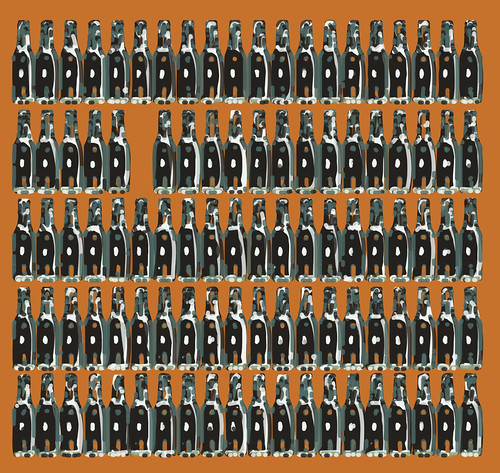
99 Bottles of Beer on the Wall — Reflect.
The Vangobot is the brainchild of the Pop Art Machine and here’s their description:
Pop Art Machine is an experimental art suite that renders complex vectors portraying many different brush sizes, paint layers and brush handling techniques. The results can be printed but also physically painted with acrylics on canvas using a specialized CNC based robot named Vangobot.
There’s even a short video of Vangobot in action, painting.
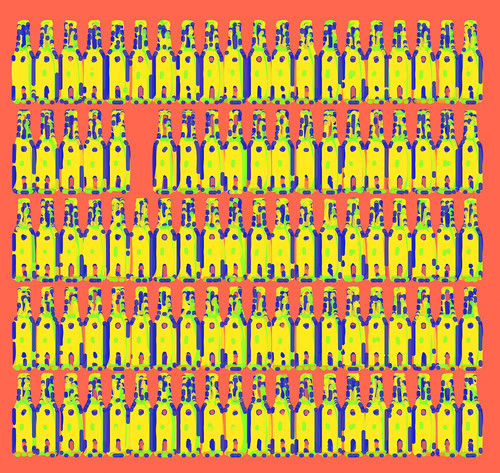
99 Bottles of Beer on the Wall — Spring Fashion.
There are fifteen different versions of 99 Bottles of Beer on the Wall, of which I’ve featured seven of them here. As far as I can tell, the names of each version have something to do with either their color scheme or an association made from that color.
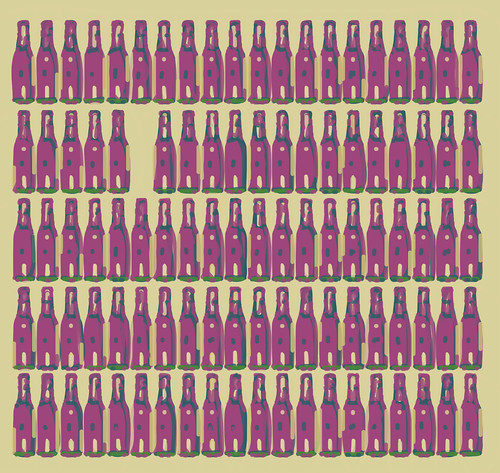
99 Bottles of Beer on the Wall — Trident.
At the Pop Art Machine website there are over 20,000 paintings done by Vangobot.
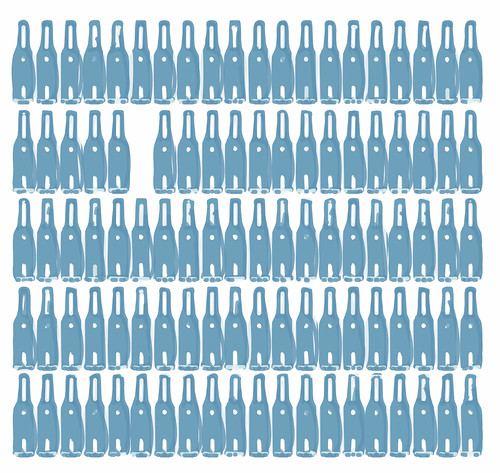
99 Bottles of Beer on the Wall — Theology.
The website features Pop Art, a style that’s as much an attitude as a style. From Wikipedia:
Pop art is a visual art movement that emerged in the mid 1950s in Britain and in the late 1950s in the United States. Pop art challenged tradition by asserting that an artist’s use of the mass-produced visual commodities of popular culture is contiguous with the perspective of fine art. Pop removes the material from its context and isolates the object, or combines it with other objects, for contemplation. The concept of pop art refers not as much to the art itself as to the attitudes that led to it.
Pop art is an art movement of the twentieth century. Characterized by themes and techniques drawn from popular mass culture, such as advertising, comic books and mundane cultural objects, pop art is widely interpreted as a reaction to the then-dominant ideas of abstract expressionism, as well as an expansion upon them. Pop art, aimed to employ images of popular as opposed to elitist culture in art, emphasizing the banal or kitschy elements of any given culture, most often through the use of irony. It is also associated with the artists’ use of mechanical means of reproduction or rendering techniques.
Much of pop art is considered incongruent, as the conceptual practices that are often used make it difficult for some to readily comprehend. Pop art and minimalism are considered to be the last Modern Art movements and thus the precursors to postmodern art, or some of the earliest examples of Postmodern Art themselves.
Pop art often takes as its imagery that which is currently in use in advertising.[5] Product labeling and logos figure prominently in the imagery chosen by pop artists. Consider the Campbell’s Soup Cans labels, by Andy Warhol. Even the labeling on the shipping carton containing retail items has been used as subject matter in pop art. Consider Warhol’s Campbell’s Tomato Juice Box 1964, (pictured below), or his Brillo Soap Box sculptures.
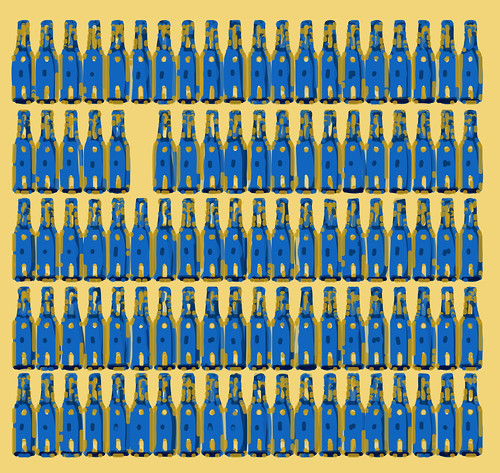
99 Bottles of Beer on the Wall — Blue.
Some of the most well-known Pop Artists include Andy Warhol, Roy Lichtenstein, Jasper Johns and Keith Haring (who was born in Reading, PA but grew up in nearby Kutztown; I had his uncle as my art teacher in high school).
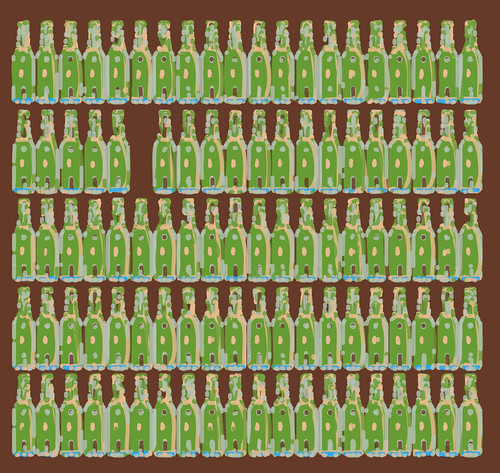
99 Bottles of Beer on the Wall — Gone Walkabout.
All fifteen versions of 99 Bottles of Beer on the Wall can be downloaded in the high resolution size of 3600 × 3406 so it can be printed fairly large, perhaps large enough to fill your wall.
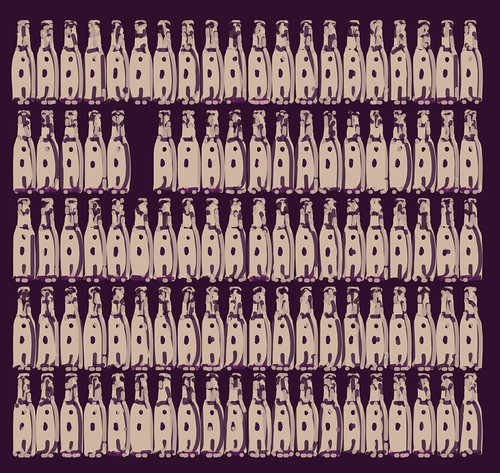
99 Bottles of Beer on the Wall — Astoria.
For about Pop Art, beyond Wikipedia, there’s also some good info at the Art Archive, Art Lex, World Wide Arts Resources and Pop Art Machine has a large collection of articles about Pop Art.
Beer In Ads #7: National Premium & Turkey
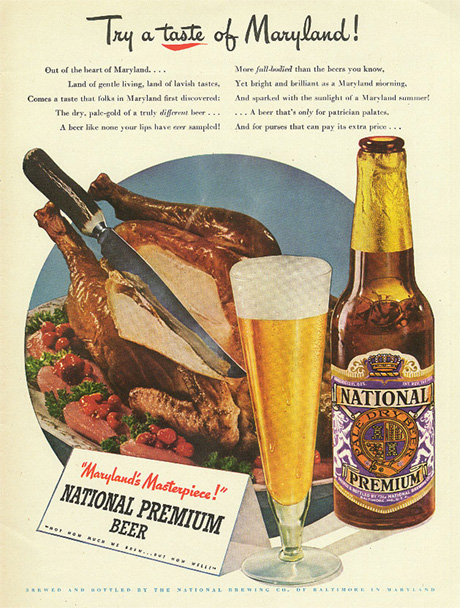
Today’s ad is more modern, because it’s Thanksgiving Day and I wanted to use one that was done for the holiday. This juicy turkey ad was for National Premium Beer, subtitled a “Pale Dry Beer,” and brewed by National Brewing of Baltimore, Maryland from 1936-1995. While accounts of the brewery’s origin vary from around 1850, 1855 or 1872 (and under several different names), after Prohibition ended, it returned as National Brewing with its most famous beer being National Bohemian, or “Natty Boh,” which today is owned by Pabst and brewed by Miller. This ad is for their premium beer, and is from the 1950s. Hoppy Thanksgiving.
Bottle Openers Made By Blacksmiths

A few years ago, my friend Tom Peters, the co-owner of Monk’s Cafe in Philadelphia, celebrated a big anniversary, I can’t recall which one it was — five years maybe, ten? Anyway, he had a local blacksmith experiment with making the perfect bottle opener.
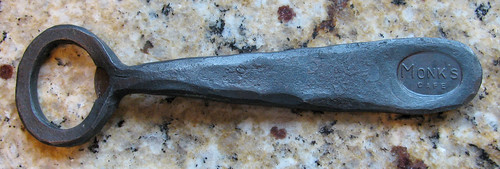
Then, once he had the best design, he had 100 of them made with his logo stamped on the handle. I was somehow fortunate to be given one (thanks Tom!) and to date it’s been my favorite bottle opener I’ve ever owned. It just feels right in your hand, the perfect heft. It pops any crown with very little effort and makes a pleasantly satisfying sound in the process. In short, it’s a pleasure to use. It makes me want to open more beer bottles.
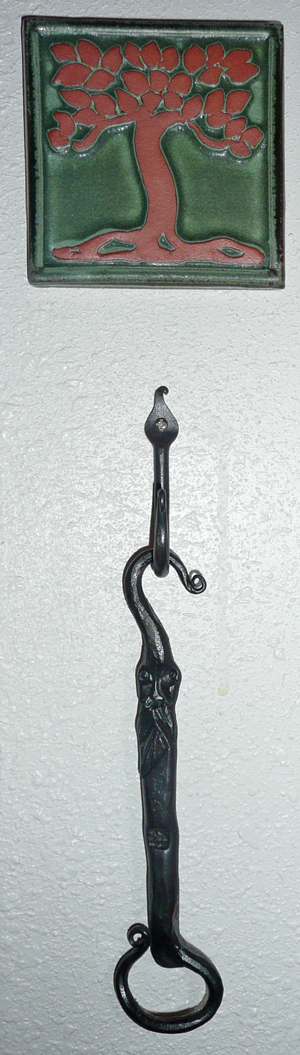
Last month, I was in Asheville, North Carolina on vacation with my family. In addition to wanting to check out their growing beer scene, there was a show we wanted to go to, the Craft Fair of the Southern Highland Craft Guild. My wife and I are huge fans of artisan crafts, hand made objects. It’s the same impulse that makes me love craft beer. We came home with a number of beautiful objects. But as we were first going in we happened upon a blacksmith set up outside the hall where the show was taking place. We stopped to watch him work and got to chatting. The blacksmith’s name was Alwin Wagener, and his business was known as Wagener Forge. He had a very interesting, cool looking corkscrew, so I told him the story of the Monk’s Cafe opener. He said he also had made bottle openers and asked how long we were going to be at the show, and we went inside for several hours. When we returned, he had made the opener pictured below.
It works as well as the Monk’s opener and is very cool looking, too. I love the green man’s face, with the hair looped up to hang it from. Because of strange state laws, we couldn’t buy it from him there and met him later at his studio, where we also picked up a handmade matching hook. The tile above it was also something we picked up at the craft fair. They two just seemed to compliment each other so I hung them together on the wall in our kitchen.
Beer In Art #53: George Morland’s Alehouse Politicians
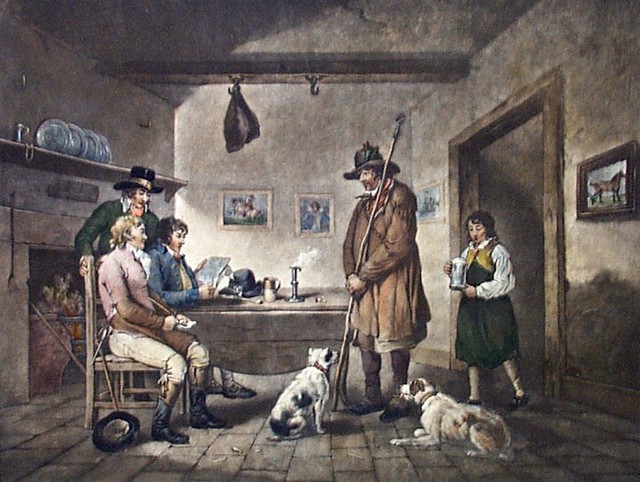
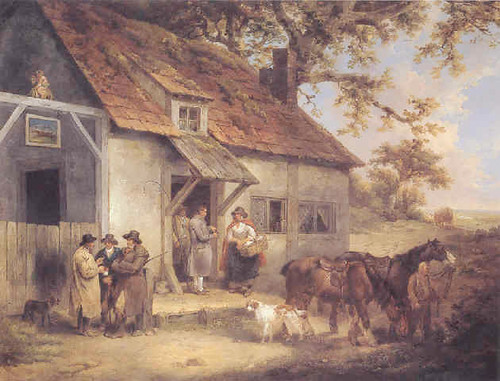
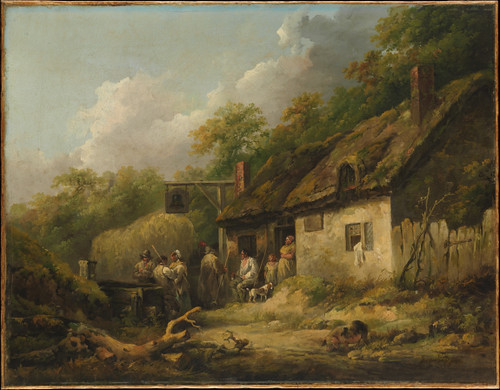
Today’s artist comes from the very early days of England’s artistic beginnings. Before the 18th century, there was little that could properly be called “English art.” At that time, most art came from France, Spain, The Netherlands, Germany and a few others. That’s who English painters studied. But that began to change in the mid-1700 with such painters as Thomas Gainsborough, William Turner, John Constable, George Romney, Henry Raeburn and today’s featured painter, George Morland. While others painted portraits and some city life, Morland concentrated on rural life and, naturally, the county inn was often featured in his works. The initial painting that led me to Morland, pictured below, is known as Alehouse Politicians,, most likely painted during the 1790s.
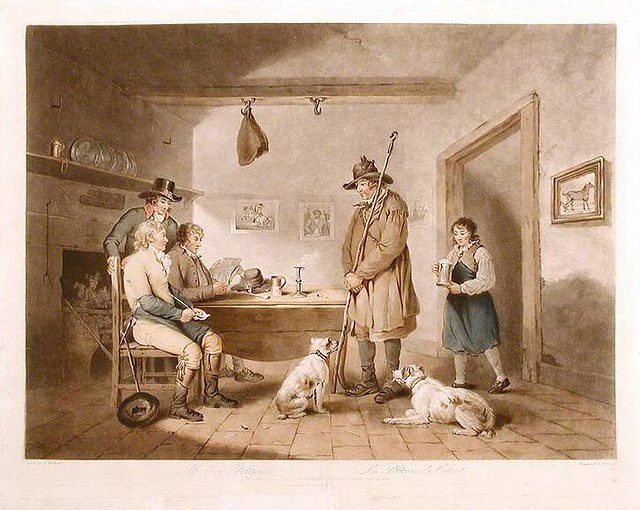
Like most of Morland’s popular paintings, others made copies of them as engravings to be sold to the public, such as this Mezzotint by W. Ward, published by Wards and Co. in 1801.
Plenty more of Morland’s rural paintings depicted inns, such as the Fox Inn, painted in 1792.
Or The Bell Inn, from the Metropolitan Museum of Art:
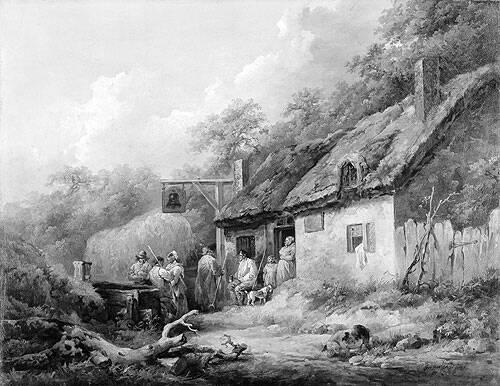
Which itself was redone as a black and white engraving:
From his biography at Wikipedia:
Morland was born in London on 26 June 1763. His mother was a Frenchwoman, who possessed a small independent property of her own. His grandfather, George H. Morland, was a subject painter. Henry Robert Morland (c. 1719 – 1797), father of George, was also an artist and engraver, and picture restorer, at one time a rich man, but later in reduced circumstances. His pictures of Jaundry-maids, reproduced in mezzotint and representing ladies of some importance, were very popular in their time.
The finest of Morland’s pictures were executed between 1790 and 1794, and amongst them his picture of the inside of a stable, in Tate Britain, London, may be reckoned as a masterpiece. His works deal with scenes in rustic and homely life, depicted with purity and simplicity, and show much direct and instinctive feeling for nature. His coloring is mellow, rich in tone, and vibrant in quality, but, with all their charm, his works reveal often signs of the haste with which they were painted and the carelessness with which they were drawn. He had a supreme power of observation and great executive skill, and he was able to select the vital constituents of a scene and depict even the least interesting of subjects with artistic grace and brilliant representation. His pictures are never crowded; the figures in them remarkably well composed, often so cleverly grouped as to conceal any inaccuracies of drawing, and to produce the effect of a very successful composition. As a painter of English scenes he takes the very highest position, and his work is marked by a spirit and a dash, always combined with broad, harmonious coloring. He exhibited regularly at the Royal Academy from 1784 down to 1804, but few of his academy pictures can be identified owing to the inadequate description of them afforded by their titles.
Here’s yet another one, Outside the Alehouse Door, painted in 1792.
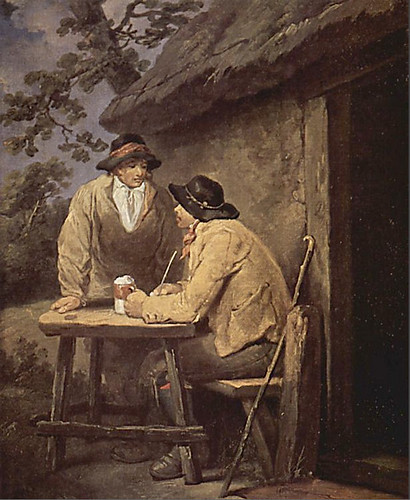
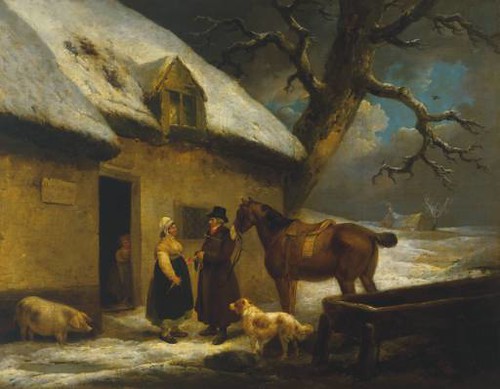
And here’s one final painting, Outside an Inn, Winter, painted around 1795, and part of the Tate Collection:
If you want to know more about George Morland, his Wikipedia page is a good start, but there’s also a good biography at the Online Encyclopedia. The Sterling Times has the most complete collection of his prints and Google Books has an online book about Morland, George Morland: his life and works. ArtCyclopedia has a good collection of links and more of his works can also be seen at The Old Print Shop, Intaglio Fine Art, the Art Renewal Center and the Tate Collection.
Anchor’s Christmas Ale Artwork

The Monday before Thanksgiving is the traditional date that Anchor Brewery used to release their Christmas Ale (a.k.a. Our Special Ale), undoubtedly the first annual holiday beer in the silver age of brewing. For the last few years, it’s been released earlier, usually the first week of November. Last year I lamented that loss of seasonality and I continue to celebrate what I call Anchor Christmas Ale Day on that Monday before Thanksgiving. This year is the 35th annual release of the beer, which except for the first few years has been a different recipe every year.
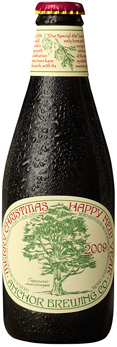
For the past few years, Anchor’s Christmas Ale has been fairly similar each year, unlike the roller coast years of the mid-1990s, which, I confess, I remember with a special fondness. (Plus I also have several magnums of each year stretching back a decade and 12 oz. bottles a little farther.) I had an opportunity to try some last weekend and it’s about how I remember it last year, still tasting quite good and will undoubtedly be the beer I enjoy with my Thanksgiving dinner.
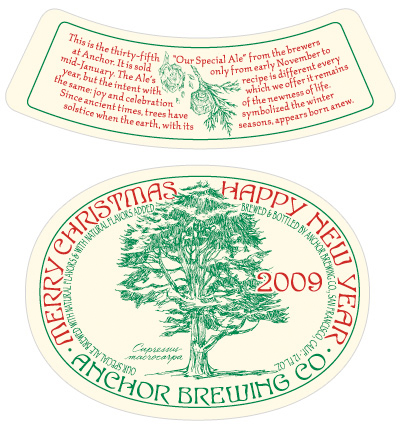
The reason I bring this up today, instead of on Monday, is that the San Francisco Chronicle profiled the 82-year old Jim Stitt, the artist who’s drawn virtually all of Anchor’s beer labels, including 35 different Christmas Ale labels, beginning with Anchor Porter in 1974. (There’s also a photo gallery with more of Stitt’s labels.)
This year’s label features the “iconic Monterey cypress near Stanyan and Fell Streets, where the Panhandle meets Golden Gate Park. Lit up from head to toe shortly after Thanksgiving every year, it’s San Francisco’s unofficial Christmas tree. And this year, it becomes the very first San Francisco native to have its portrait on Anchor Brewing Co.’s Christmas Ale.”
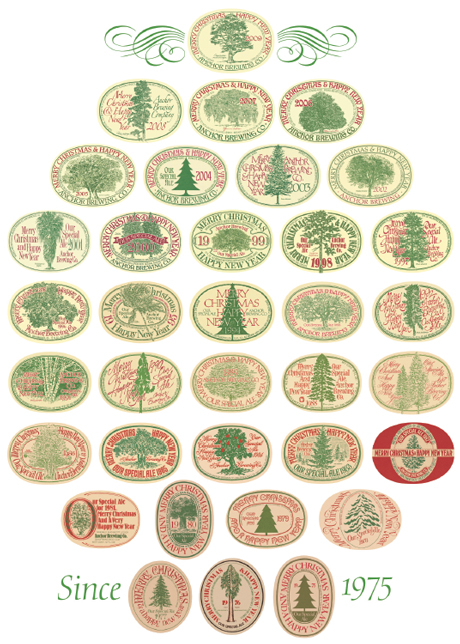
My favorite quote from Stitt is this. “It’s a handmade beer, so the label should be hand-drawn.” Below are all 35 of Stitt’s hand-drawn labels for Anchor Christmas Ale.
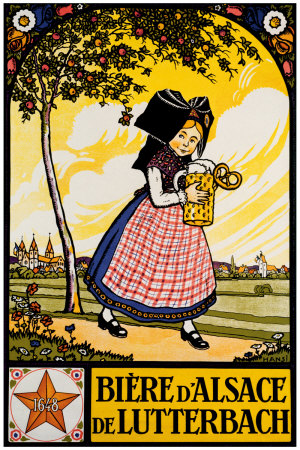
Beer In Ads #6: Biere d’Alsace
The artist for today’s ad was born in the Alsace, in 1873, in what is today part of France. But two years before he was born, it belonged to the German Empire, who had annexed it after the Franco-Prussian War that began in 1870. Why is that relevant? Because Jean-Jacques Waltz, better known as “Hansi,” grew up hating the Germans and early in his career drew editorial cartoons poking fun at them. This won him few friends in Germany and in fact he even spent time in jail, “imprisoned several times by German authorities for making fun of the German military and professors.” In addition to putting down his captors, he wrote and drew scenes extolling Alsace’s virtues. One of his most famous works was a history of Alsace for kids by “Uncle Hansi,” L’Historie d’Alssace. The ad today features a girl in the traditional costume of the Alsace, and in fact it shows up in a number of Hansi’s works. I’m not sure if the illustration is advertising for a specific brewery of just beer from the Alsace generally. There is a brewery in Luttenbach (near the border between France in Germany in the Alsace) today known as Les Caves de la Brasserie. The date in the star, 1648, seems to suggest an older brewery, one that perhaps is no longer with us.
Beer In Art #52: Ernst Henseler’s Beer Evening
Today’s work of art is straight out of Germany’s history pages, and in fact I found it at the German History in Documents and Images website. It was by a relatively obscure German artist named Ernst Henseler. About all I could find out about him is that he was born in 1852 and died in 1940. Though I called it “Beer Evening” above, today’s painting is really titled Bismarck in Conversation with Reichstag Deputies at a Parliamentary Soirée and is believed to have been painted in 1894.
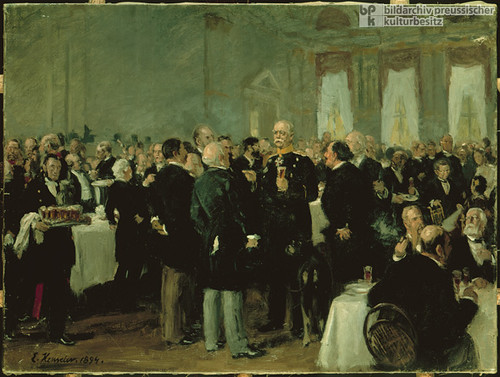
The painting is an illustration for the section of the GHDI entitled “Forging an Empire: Bismarckian Germany (1866-1890)” and under the sub-heading “Parties and Political Mobilization.” This also included the following description of the events in the painting:
This painting by Ernst Henseler (b. 1852) shows a parliamentary “beer evening” in the Imperial chancellery. These soirées provided Bismarck with an opportunity to convince parliamentary friends and foes alike that his policies deserved support. Sometimes consensus-building flowed in the opposite direction. Note that beer was more plentiful than food on such occasions, perhaps to the disappointment of one of Bismarck’s dogs, who was also on the invitation list.
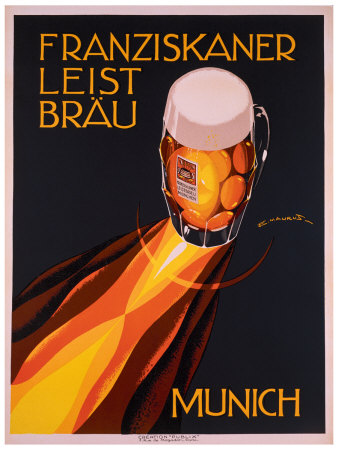
Beer In Ads #5: Franziskaner Leist Brau
The name Franziskaner today is most often associated with the Bavarian weiss beer brewed by Spaten, but originally it was a separate company known as Franziskaner-Leist-Bräu. The word “Franziskaner” means Franciscan, which is why there’s a monk on the labels nowadays. They merged with Spaten in 1922, so today’s ad is undoubtedly before then. Poster companies selling a reproduction of today’s ad all say it’s circa 1930, but given the earlier merger I’m not sure that can be right, unless of course it continued as a separate brand in their advertising. The artist’s name is either Maurus or Maueus, but that’s a close as I can pin it down.
Beer In Art #51: Frederick Daniel Hardy’s Home Brewed Ale
For today’s work of art we revisit the Victorian Era, when most large households included a home brewery. The artist is Frederick Daniel Hardy and his painting is entitled Home Brewed Ale.
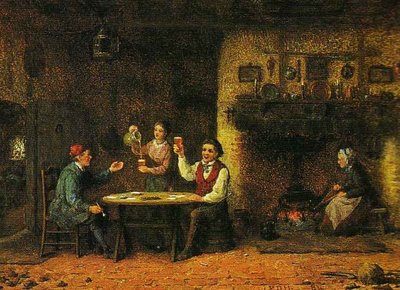
Hardy was born in 1826 or 27 and lived until 1911. Born in Windsor, England, he was originally a musician for Queen Victoria before abandoning it to study art. This painting was created around 1884. Like this work, most of Hardy’s are scene of everyday life for ordinary people.
If you want to learn more about the artist, Wikipedia has a little information, but generally there’s not much about Hardy. You can see more of his work at Bridgeman Art.