Brookston Beer Bulletin

Jay R. Brooks on Beer

  • Home
  • About
  • Editorial
  • Birthdays
  • Art & Beer

Socialize

  • Dribbble
  • Email
  • Facebook
  • Flickr
  • GitHub
  • Instagram
  • LinkedIn
  • Pinterest
  • RSS
  • Twitter
  • YouTube

Powered by Genesis

Patent No. 527123A: Means For Transporting Beer

October 9, 2016 By Jay Brooks

patent-logo
Today in 1894, US Patent 527123 A was issued, an invention of Valentin Oppl, for his “Means For Transporting Beer.” There’s no Abstract, although in the description it includes these claims:

My invention relates to means for transporting beer, and the invention consists in a four-wheeled vehicle having a tank permanently thereon, pumps connected with the tank and power mechanism to operate the pumps.

US527123-0
US527123-1
US527123-2

Filed Under: Beers, Breweries, Just For Fun, Politics & Law, Related Pleasures Tagged With: History, Law, Patent

Patent No. 40200A: Improved Apparatus For Cooling Beer

October 6, 2016 By Jay Brooks

patent-logo
Today in 1863, US Patent 40200 A was issued, an invention of Henry Steubing, for his “Improved Apparatus For Cooling Beer or Other Liquids.” There’s no Abstract, although in the description it includes these claims:

The said apparatus is used in the following manner: Cold water or iced water is introduced into the space d from a reservoir, until the space d is filled with it and during the whole time of cooling. Then the ale, beer, or other liquid to be cooled is admitted into the hollow cylinder c steadily and continuously, when the same Will overflow into the space formed by the flange e, and will 110W down through the holes n n’ n on the outer mantel, a, into the space formed by the lower flange, j’, after which it flows out of the apparatus through the pipe i. Thus it will be seen that a certain quantity of iced water or cold water cools the ale, beer, or other liquid, rst by its contact on the inside b of the cooler, and then by its contact on the outside c of said cooler, thereby effecting `a great saving of the cooling material.

US40200-0

Filed Under: Beers, Breweries, Just For Fun, Politics & Law, Related Pleasures Tagged With: Brewing Equipment, History, Law, Patent

Patent No. 3469992A: Chill Stability And Foam Adherence Of Beer

September 30, 2016 By Jay Brooks

patent-logo
Today in 1902, US Patent 3469992 A was issued, an invention of Frede B. Strandskov and Henry L. Ziliotto, assigned to the F&M Schaefer Brewing Co., for their “Chill Stability and Foam Adherence of Beer.” There’s no Abstract, although in the description it includes these claims:

The present invention relates to improvements in the chemical preservation of beer and more particularly it relates to the improvement of the chill stability and the foam adherence properties of beer which has been preserved against microbial growth by the addition thereto of a chemical preservative.

It is a desideratum in the beer making art to eliminate the necessity for pasteurization or refrigeration of finished beer. This is desirable (1) to avoid possible deleterious effects on the taste of the commercial product; (2) to avoid having to keep the beer refrigerated in storage before consumption; and/or (3) to obtain saving in cost per unit produced. It is known that beer may be preserved against microbial growth and the above objects thus accomplished, by treating the finished beer with heptyl parahydroxybenzoate, i.e., the heptyl ester of para-hydroxybenzoic acid as well as alkali metal or alkaline earth metal salts thereof. The discovery of the use of this compound to preserve finished beer represents a great advance in the art of beer making and provides the means by which the disadvantages of the necessity of pasteurization and/or refrigeration may be avoided. It has been discovered that the preservation in the abovemanner, however, tends to introduce complications which it is desirable to overcome if the most acceptable beer product is to be obtained.

In order to be commercially acceptable, a beer must possess certain properties; for example, it must be sparkling clear. Two additional properties which are most significant to beer connoisseurs are referred to as chill stability and foam adherence. The first of these relates to the property noted above as sparkling clear. As the name implies, on occasion a haze forms in some beer when it is chilled. As the temperature of the beer is returned to room temperature, the haze disappears, only to reappear upon subsequent rechilling. This haze is referred to as chill haze. The second of these significant properties, foam adherence, is of special importance to the connoisseurs. This property relates to the adherence of the beer foam to the sides of the drinking glass as the foam collapses or as the glass is being emptied. Beer, which in all other respects has excellent potential, may be excluded from the market solely because of the lack of an acceptable level of foam adherence. One of the marks of a beer connoisseur is his appreciation of the significance of beer foam adherence to the sides of the drinking glass.

3,469,992 Patented Sept. 30, 1969 In the instant invention it is important to note that foam adherence is notably distinct from the property of foam retention. Foam retention, or foam life, is a quality denoting the ability of the head, or layer of foam on a beer, to resist collapse with passage of time. Foam adherence as noted above refers to the ability of foam, as it collapses or as the beer is drained away, to leave a film of foam curtains or lace clinging to the walls of the container. It is from this curtain that the measurement of foam adherence is obtained. A significant foam curtain may be formed from beer, the head of which has completely collapsed and disappeared.

When finished beer is preserved against microbial growth by the addition thereto of heptyl para-hydroxybenzoate or a salt thereof, it has been found that adverse effects are sometimes produced on the acceptable values for chill stability and foam adherence. It is the object of the instant invention to overcome these adverse effects in order that the most commercially acceptable product possible may be obtained.

131683850

Filed Under: Beers, Breweries, Just For Fun, Politics & Law, Related Pleasures Tagged With: History, Law, Patent, Science of Brewing

Patent No. 2906624A: Apparatus And Method For Extracting Air From Beverages

September 29, 2016 By Jay Brooks

patent-logo
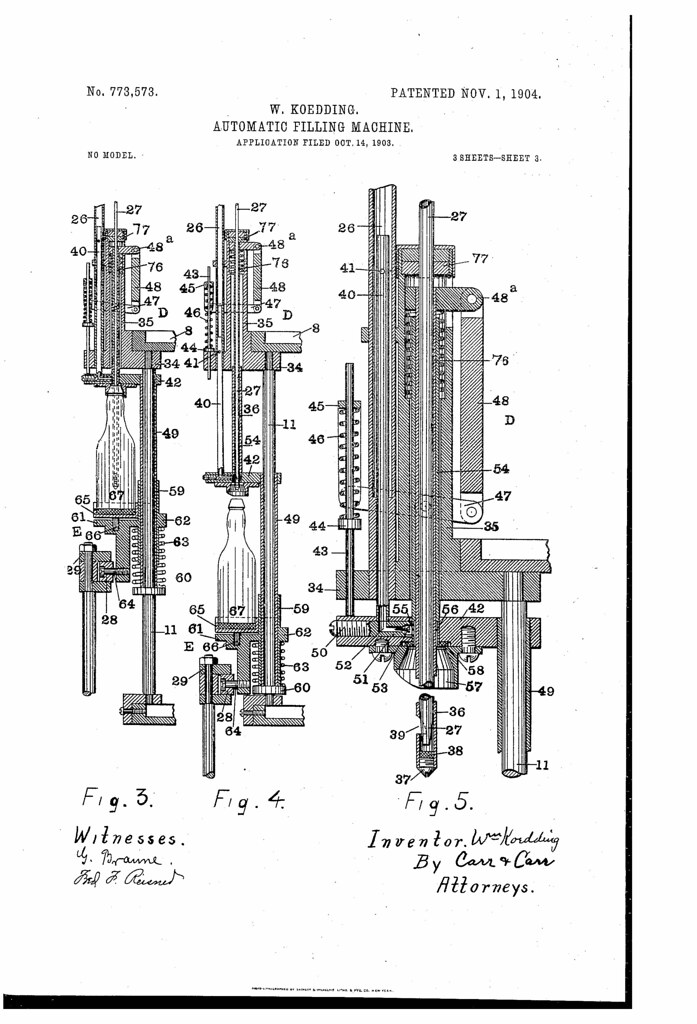
Today in 1959, US Patent 2906624 A was issued, an invention of Pincus Deren, assigned to Pabst Brewing Co., for his “Apparatus and Method for Extracting Air from Beverages.” There’s no Abstract, although in the description it includes these claims:

The present invention consists in the method or process of controlling the air content of carbonated beverages, especially bottled beer, and to the apparatus for carrying out the process.

It is well known that conventional practices in bottling carbonated beverages, particularly beer, causes a certain amount of oxidation of some of the constituents of the product, resulting in an undesirable change in flavor and in accelerated instability which greatly reduces the shelf life of the beverage.

Numerous attempts were made to eliminate’the excess air, and it was found that to remove the excess air successfully it was necessary to cause the beverage to foam and permit the latter to rise in the neck of the bottle to expel the air above the liquid level. Also, it was found that, to achieve good results, enough of the foam must be formed to fill the neck with fine bubbles to the top of the rim of the bottleneck.

One means for producing foam is by knocking the bottle sufliciently to cause the release of the gas in the beer; another means is by jetting or squirting a stream of beer into the beer in the bottle after it has been filled. A third method is by the injection of a stream of CO gas into the liquid.

Control of the degree of foaming by the methods just described is very difficult. When the knocking procedure is used, the condition of the surface of the bottle influences the degree of foaming. When jetting, either with beer or with CO gas, the liquid content is disturbed, and small variations in the temperature of the product and on the inside surface of the container will result in different degrees of foaming. The uncontrolled foaming results in either great variations in the final air content, or in the loss of large quantities of beer.

The primary object of the present invention is to overcome the disadvantages inherent in the conventional 7 Another object of the invention resides in the provision of novel means for removing most of the air before the foam is formed.

A further object is to reduce the losses of beverage due to excessive foaming and thereby practically eliminate socalled short fills.

A still further object resides in the provision of novel means for creating instantaneous suction on the liquid just as the foam starts to form to facilitate the removal of air.

Still another object of the invention consists in the provision of a new and novel apparatus to permit the process and the steps thereof to be accomplished and carried out successfully.

Numerous other objects and advantages will be apparent throughout the progress of the specification.

US2906624-0

Filed Under: Beers, Breweries, Just For Fun, Politics & Law, Related Pleasures Tagged With: Bottles, Brewing Equipment, History, Law, Patent

Patent No. 3760968A: Composite Container Article

September 25, 2016 By Jay Brooks

patent-logo
Today in 1973, US Patent 3760968 A was issued, an invention of S. Amberg, C. Heyne, and J. Meincer, assigned to Owens Illinois Inc., for their “Composite Container Article” Here’s the Abstract:

The invention disclosed relates to an improved container article for pressurized products, such as beer, beverages, and the like, which is made from a glass bottle or jar and a sheet of shrinkable plastic material pre-decorated as flat sheet, then wrapped on a mandrel to a sleeve that is telescopically inserted over the major side wall of the bottle so that a lower marginal end thereof overhangs the bottom end of the bottle. The sleeve may be of a pre-foamed or non-foamed plastic material and is shrunken in situ by heat so that it fits snugly on the bottle surface and conforms to the body around its shoulder, side wall and its lower corner radius or heel and onto the bottom end of the bottle protecting the glass against surface damage, providing a pre-printed label or decoration for the bottle and covering the bearing surface and lower corner radius of the bottle protecting those areas plus affording coaster protection to furniture or like surfaces. The orientation of the plastic is major on the peripheral dimension of the sleeve and minor on the axial dimension. Antistatic compounds are applied to the surface opposite the printed surface also priming the bottle for good cohesion of the sleeve. The plastic sleeve has a skin depth differential, the thicker skin being adjacent the bottle.

US3760968-1
US3760968-2
US3760968-3

US3760968-4 US3760968-5

US3760968-6 US3760968-7

US3760968-10

Filed Under: Beers, Breweries, Just For Fun, Politics & Law, Related Pleasures Tagged With: Bottles, History, Law, Packaging, Patent

Patent No. 3403029A: Reconstituted Beer Process Using Fractional Crystallization

September 24, 2016 By Jay Brooks

patent-logo
Today in 1968, US Patent 3403029 A was issued, an invention of Emil A. Malick, assigned to Phillips Petroleum Co., for his “Reconstituted Beer Process Using Fractional Crystallization.” There’s no Abstract, although in the description it includes these claims:

Reconstituted beer is formed by fractionally crystallizing a beer product to form a concentrate containing some precipitate and a separate precipitate containing fraction, holding at least the concentrate at the temperature of the fractional crystallization process to allow additional precipitation to take place, heating at least the concentrate to allow redissolving of flavor bodies and the like from the precipitate, combining the heated concentrate and separate precipitate containing fraction, and separating precipitate from the combination.

US3403029-0

Filed Under: Beers, Breweries, Just For Fun, Politics & Law, Related Pleasures Tagged With: History, Law, Patent, Science of Brewing

Patent No. 4542682A: Lauter Tuns

September 24, 2016 By Jay Brooks

patent-logo
Today in 1985, US Patent 4542682 A was issued, an invention of John C. Hancock, for his “Lauter Tuns.” Here’s the Abstract:

A lauter tun (10,100) has a bottom (16) comprising two flat plates (18,20) joined together on a straight line (see 22), each plate (18,20) sloping downwardly from the center-line to the peripheral wall (14) of the tun, such that during flushing, water flows down each slope to flush solids towards two large collection points (26) located at the lowest point of the bottom 16.

US4542682-1a
US4542682-4 (1)
US4542682-3 (1)
US4542682-2 (1)

Filed Under: Beers, Breweries, Just For Fun, Politics & Law, Related Pleasures Tagged With: Brewing Equipment, History, Law, Patent, Science of Brewing

Patent No. 3607298A: Hop Concentrates

September 21, 2016 By Jay Brooks

patent-logo
Today in 1971, US Patent 3607298 A was issued, an invention of Robert O. V. Lloyd and William Mitchell Hatfield, assigned to Bush Boake Allen Ltd., for his “Hop Concentrates.” There’s no Abstract, although in the description it includes these claims:

The present invention relates to hop extracts, including isomerized hop extracts and to processes for their production.

Hops contain, among other things: soft and hard resins including such weakly acidic compounds as humulones (e.g. humulone, cohumulone and adhumulone) and lupulones; essential oils which are those relatively volatile oils which contribute to the characteristic odor of hops; fixed oils, which are contained in the hop seeds and are not readily distilled or extracted by hot water; and water-soluble material such as tannins and proteins.

In the traditional brewing process hops are boiled with wort, which is an aqueous solution of malt sugars. As a consequence of the boiling, a variety of resins and oils pass into the wort. Of these the most important are the humulones, which on boiling are partially isomerized to form water-soluble isohumulones. It is believed that the isohumulones are the principle bittering agent present in the finished beer, but a very large number of other compounds of widely differing chemical nature are also present in traditional beer and contribute to its properties. in the traditional process only a small proportion of the humulones present in the hops are isomerized and taken into solution. Further disadvantages of the traditional method are the need to store a large bulk of hops, which are liable to deteriorate, and the variability of flavor between batches.

The extraction of hops by solvents to give hop extracts which can be used to replace or augment hops in the brewing of beers and ales has received considerable attention for many years. This problem has attracted increased attention during the last l years because of the development in the chemistry of hop constituents and because the brewing industry has become rather less conservative in its attitude toward changes in materials and methods.

DSCN2724

Filed Under: Beers, Breweries, Just For Fun, Politics & Law, Related Pleasures Tagged With: History, Hops, Law, Patent, Science

Patent No. 1391561A: Food Product Obtained From Brewers’ Yeast

September 20, 2016 By Jay Brooks

patent-logo
Today in 1918, US Patent 1391561 A was issued, an invention of John C. Miller, for his “Food Product Obtained From Brewers’ Yeast.” There’s no Abstract, although in the description it includes these claims:

Brewers waste yeast when dried has for some years been utilized for a force feed for animals. When analyzed, the dried brewers yeast contains, on an average, about fifty-four per cent crude protein, twenty-five per cent nitrogen free extract, two per cent crude fat and ten per cent ash and fiber.

I have discovered that when properly prepared, a flour can be obtained from the brewers waste yeast which can be effectively and properly used when mixed with wheat flour, or when used by itself, as a food product for human consumption.

In the processes heretofore employed in drying brewers yeast, the material has been dried on steam heated rollers and scraped therefrom from by scraping knives, which renders the material coarse and gritty. The older dried products have never been suitable for either as a substitute for or when mixed with wheat flour for human consumption.

In preparing my product, the wet material in the preferred apparatus is delivered into the rapidly rotation cylinder from which it is discharged by centrifugal force at the delivery end of the cylinder in the form of a very fine annular spray and is there subjected to a current of heated air, which is blown annularly across the centrifugally discharged material, so that the moisture is very rapidly taken up and the material can be readily collected in the form of a dry powder free from grit and in the condition of a flour.

US1391561-0

Filed Under: Beers, Breweries, Just For Fun, Politics & Law, Related Pleasures Tagged With: Food, History, Law, Patent, Science, Science of Brewing

Patent No. 505424A: Beer Tempering Device

September 19, 2016 By Jay Brooks

patent-logo
Today in 1893, US Patent 505424 A was issued, an invention of Gustav Kruse, for his “Beer Tempering Device.” There’s no Abstract, although in the description it includes these claims:

The object of my invention is to provide a beer tempering device in which the difficulty of cleaning the pipes, or worm, thereof shall be reduced to a minimum and in which, at the same time, it may be done to perfection.l As heretofore constructed these devices were uncleanly and, consequently, unhealthful because there was no known means of cleaning them thoroughly, and; hence, where the government looks after the sanitary properties of such devices, their use has been prohibited, generally, because; even after a thorough cleansing with known methods, their cleanliness was either doubtful, or: ultimately, could be proved to be unsatisfactory. To overcome said difficulties I have devised a `new mechanism which, when used according to my direction will overcome all objections and be perfectly clean.

US505424-0

Filed Under: Beers, Breweries, Just For Fun, Politics & Law, Related Pleasures Tagged With: Brewing Equipment, History, Law, Patent

« Previous Page
Next Page »

Find Something

Northern California Breweries

Please consider purchasing my latest book, California Breweries North, available from Amazon, or ask for it at your local bookstore.

Recent Comments

  • Bob Paolino on Beer Birthday: Grant Johnston
  • Gambrinus on Historic Beer Birthday: A.J. Houghton
  • Ernie Dewing on Historic Beer Birthday: Charles William Bergner 
  • Steve 'Pudgy' De Rose on Historic Beer Birthday: Jacob Schmidt
  • Jay Brooks on Beer Birthday: Bill Owens

Recent Posts

  • Historic Beer Birthday: Jan Léonardus Moortgat September 13, 2026
  • Beer Birthday: Lorenzo Dabove September 13, 2026
  • Beer Birthday: Dan Gordon September 13, 2026
  • Beer In Ads #5347: It’s Here! September 12, 2026
  • Beer Birthday: Steve Gonzalez September 12, 2026

BBB Archives

Feedback

Head Quarter
This site is hosted and maintained by H25Q.dev. Any questions or comments for the webmaster can be directed here.