Brookston Beer Bulletin

Jay R. Brooks on Beer

  • Home
  • About
  • Editorial
  • Birthdays
  • Art & Beer

Socialize

  • Dribbble
  • Email
  • Facebook
  • Flickr
  • GitHub
  • Instagram
  • LinkedIn
  • Pinterest
  • RSS
  • Twitter
  • YouTube

Powered by Genesis

Patent No. 349178A: Cooling Air And Apparatus Therefor

September 14, 2016 By Jay Brooks

patent-logo
Today in 1892, US Patent 349178 A was issued, an invention of Stanislas Rouart, for his “Cooling Air and Apparatus Therefor.” There’s no Abstract, although in the description it includes these claims:

The main object of my invention is to effectively cool the air of rooms or spaces in which it is necessary or desirable to maintain a free circulation of air as, for instance, in cellars for storing or treating beer, etc.

US349178-0
US349178-1

Filed Under: Beers, Breweries, Just For Fun, Politics & Law, Related Pleasures Tagged With: Brewing Equipment, History, Law, Patent, Science of Brewing

Patent No. WO2012122019A1: Barley Cultivar Moravian 115

September 13, 2016 By Jay Brooks

patent-logo
Today in 2012, US Patent WO 2012122019 A1 was issued, an invention of Dennis Dolan, assigned to MillerCoors, for his “Barley Cultivar Moravian 115.”

Untitled
Moravian barley in Colorado.

Here’s the Abstract:

A barley cultivar, designated MV115, is disclosed. MV115 is a high yield, lodging resistant cultivar with exceptional malting characteristics particularly useful in the brewing industry. The disclosure relates to seeds, plants, and to methods for producing a barley plant produced by crossing barley cultivar MV115 with itself or another barley variety. Methods for producing a barley plant containing in its genetic material one or more transgenes are disclosed. Barley varieties or breeding varieties, plant parts, methods for producing other barley varieties, lines or plant parts, and to the barley plants, varieties, and their parts derived from the use of those methods are disclosed. The disclosure further relates to hybrid barley seeds and plants produced by crossing bariey cultivar MV115 with another barley cultivar. Methods for developing other barley varieties or breeding lines derived from variety MV115 including cell and tissue culture, haploid systems, mutagenesis, and transgenic derived lines are disclosed.

Untitled

Last year, I visited Coors’ barley fields in a valley in Colorado, where local farmers grow Moravian barley for them.

Untitled

Filed Under: Beers, Breweries, Just For Fun, Politics & Law, Related Pleasures Tagged With: barley, History, Law, MillerCoors, Patent

Patent No. EP0070570B1: Yeast Strain For Use In Brewing

September 13, 2016 By Jay Brooks

patent-logo
Today in 1989, US Patent EP 0070570 B1 was issued, an invention of George Stewart Graham, Edmund Goring Thomas and Russell Ingeborg, assigned to the Labatt Brewing Company, for their “Yeast Strain For Use in Brewing.” There’s no Abstract, although in the description it includes these claims:

This invention relates to a novel yeast strain suitable for use in the brewing of beer and to a method of preparing the same.

In the brewing of beer, i.e. ale and lager, ale yeast strains (Saccharomyces cerevisiae) are traditionally top-cropping strains and lager yeast strains (Saccharomyces uvarum (carlsbergensis)) are bottom-cropping strains. That is, when the attenuation of the wort, which may be broadly defined as the conversion of fermentable substrate to alcohol, has attained a certain level, the discrete yeast cells of most ale strains adhere or aggregate to an extent that, adsorbed to bubbles of carbon dioxide, they will rise to the surface under quiescent conditions (e.g. when the medium is not agitated) where they are “cropped” by being skimmed off. In the case of lager strains, the aggregated cells are not adsorbed to bubbles of carbon dioxide and settle out of suspension to the bottom of the vessel where they are “cropped” by various standard methods.

One of the limitations of the known ale yeast strains is that they do not function satisfactorily in worts having plato values (°P) higher than about 14.5°P and values of only about 9°P to 12°P are usually required. The plato value (°P) is defined as the weight of dissolved solids, expressed as a percentage, in water at 15.6°C. Generally, the higher the plato value at which a yeast strain will function, the greater is the conversion of fermentable substrate to alcohol for a given volume of wort. Consequently, the resultant fermentation product would be one of higher than usually desired final alcohol content and would generally be diluted before packaging. Since the dilution to obtain a standard, commercially acceptable product would occur at the end of the brewing process, the overall throughput of such a brewing system would be substantially increased over a conventional system. Furthermore, beers produced from such high plato worts generally exhibit improved colloidal haze and flavour stability.

In view of the economic advantages possible in fermenting worts of higher plato values, there has been a substantial amount of research carried out in the hope of obtaining a yeast strain which will function at such higher plato values in the range of about 16°P to 18°P, i.e. a yeast strain which will remain in the body of the wort until substantial or total conversion of the fermentable sugars to alcohol atthe higher Plato values has occurred. As an alternative, attempts have been made to maintain known yeast strains in the body of the wort by mechanical means, such as continuous stirring, in the hope thatthe yeast would continue to function if maintained in contact with the wort. However, this has proved to be inefficient and in many cases more expensive because of the extra energy required to operate such mechanical means. Furthermore, many such attempts have been frustrated by difficulties of product flavour match with present commercially acceptable standards.

The inventors of this invention have now discovered a yeast strain which is an ale yeast (species Saccharomyces cerevisiae) that not only functions at high plato values, e.g. up to about 18°P, but also flocculates to the bottom of the fermenting vessel when conversion or attenuation has been substantially completed (the latter feature, as noted above, is usually characteristic of a lager strain rather than an ale strain).

The present novel organism was found to be a component of a mixture of ale yeasts maintained by the assignee. The organism was isolated and biologically pure cultures thereof were produced by techniques considered standard by those skilled in the art and can be obtained upon request from the permanent collection of the National Collection of Yeast Cultures (termed “NCYC” herein), Food Research Institute, Norwich, Norfolk, England. The accession number of the organism in this repository is NCYC No. 962.

Thus, according to one aspect of the present invention there is provided a brewing process wherein a malt wort is prepared; fermented with brewers’ yeast; and, following completion of the fermentation, finished to the desired alcoholic brewery beverage; the improvement comprising fermenting said wort having a Plato value of about 14.5 or greater with a strain of the species Saccharomyces cerevisiae brewers’ yeast having the NCYC No. 962.

In another aspect the invention provides a brewing process for producing ale, wherein a hopped, 30% corn grit adjunct wort is prepared having a Plato value of from about 16°P to 18°P; fermented at a temperature of about 21°C for about 3 to 5 days with a species of Saccharomyces cerevisiae brewers’ yeast; and, following completion of the fermentation, finished to the desired ale; the improvement comprising fermenting said wort with a strain of the species Saccharomyces cerevisiae brewers’ yeast having the NCYC No. 962.

In a further aspect the invention provides a biologically pure culture of a brewers’ yeast strain of the species Saccharomyces cerevisiae having the NCYC No. 962, said strain having the ability to ferment high Plato value worts of 14.5 or greater and the ability of flocculate to the bottom of the fermentation vessel when attenuation is substantially complete.

In a further aspect of the invention provides a method of manufacturing a novel brewers’ yeast strain, wherein a yeast strain is propagated in an oxygenated nutrient medium, the improvement comprising propagating a biologically pure culture of a yeast strain of the species Saccharomyces cerevisiae having the NCYC No. 962.

The advantage of the yeast strain of the present invention (referred to herein as strain 962 for the sake of convenience) is that it has both bottom-cropping characteristics as well as the ability to ferment high specific gravity worts. The bottom-cropping characteristic is advantageous because of increased utilization in the brewing industry of large conical-based vessels for fermenting the wort, and bottom-cropping is especially facile in such vessels. Thus strain 962 is particularly well adapted for use with continuous brewing techniques as well as batch-wise brewing.

The fact that strain 962 can ferment worts having high plato values is economically advantageous in that use of such worts allows dilution with water at a much later stage in the processing, generally prior to packaging. By reducing the amount of water required in the majority of process stages, increasing production demands can be met without the expansion of existing brewing, fermenting and storage facilities and the overall throughput of an existing brewery system can be substantially increased by the use of strain 962. Consequently, the brewing process can be carried out at a reduced overall cost, including a reduced energy cost.

Thus, while a number of bottom-cropping ale strains are known, the dual characteristics of bottom-cropping and the ability to ferment which gravity worts makes strain 962 of the present invention especially useful in the brewing of ale.

0070570-imgf0001

Filed Under: Beers, Breweries, Just For Fun, Politics & Law, Related Pleasures Tagged With: History, Law, Patent, Science of Brewing, Yeast

Patent No. WO2007102850A1: Gluten-Free Beer And Method For Making The Same

September 13, 2016 By Jay Brooks

patent-logo
Today in 2007, US Patent WO 2007102850 A1 was issued, an invention of Russell J. Klisch, assigned to the Lakefront Brewery, for his “Gluten-Free Beer and Method For Making the Same.” Lakefront Brewery developed this patented for their beer New Grist. Here’s the Abstract:

A gluten-free beer derived from fermentable sugars obtained from an enzymatic reaction with gluten-free cereals and grains, and a method of making a gluten-free beer that includes dissolving enzyme-produced fermentable sugars derived from gluten-free cereals and grains in water to produce an aqueous solution, adding a yeast nutrient, a protein coagulant and hops to the aqueous solution to form an aqueous brew, and fermenting the aqueous brew by the addition of yeast to produce a gluten-free beer.

new-grist-logo-and-bottles

Filed Under: Beers, Breweries, Just For Fun, Politics & Law, Related Pleasures Tagged With: Gluten-Free, History, Law, Patent, Science of Brewing

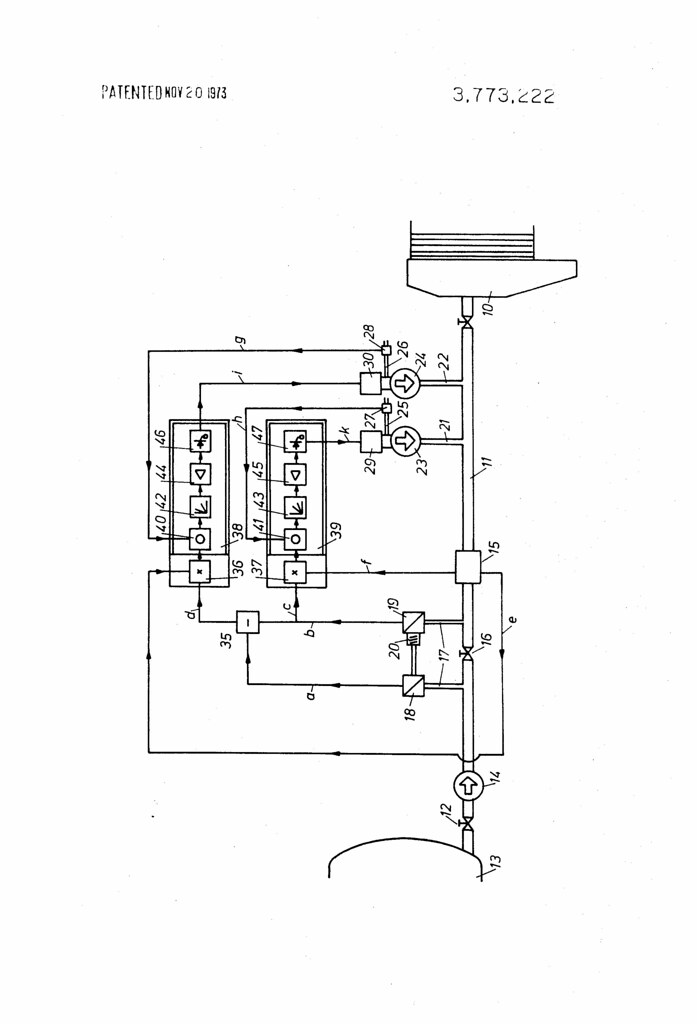
Patent No. 3834296A: Continuous Production Of Beer Wort From Dried Malt

September 10, 2016 By Jay Brooks

patent-logo
Today in 1889, US Patent 3834296 A was issued, an invention of Uwe Jess and Wolfgang Kehs, for their “Continuous Production of Beer Wort From Dried Malt.” Here’s the Abstract:

An apparatus for continuously making beer wort from dried malt has a malt soaking unit and a malt crusher which is adapted to receive the soaked malt from the unit and has at least two smooth-surface cooperating rolls and drive means for driving them at differential velocities. A conduit system has a plurality of upright heatable conduit sections and serves for heating a mash which is produced after the malt has been treated in the crusher, and a clarifying unit is provided for clarifying the mash having been heated previously.

US3834296-1
US3834296-2

Filed Under: Beers, Breweries, Just For Fun, Politics & Law, Related Pleasures Tagged With: History, Law, Patent, Science of Brewing, Wort

Patent No. 410994A: Stave Dressing Machine

September 10, 2016 By Jay Brooks

patent-logo
Today in 1889, US Patent 410994 A was issued, an invention of Charles Sommer, for his “Stave Dressing Machine.” There’s no Abstract, although in the description it includes these claims:

My invention relates to improvements in that class of machines by which staves used in the manufacture of cooperage, such as beer kegs, barrels, etc. are dressed. Its object is to dress the staves on both sides at once, giving them at the same time the desired curve corresponding with the curve of the keg or barrel and providing at the two ends additional thickness, allowing depth for the croze.

US410994-0

Filed Under: Beers, Breweries, Just For Fun, Politics & Law, Related Pleasures Tagged With: Barrels, Brewing Equipment, History, Law, Patent

Ballantine’s Literary Ads: James Hilton

September 9, 2016 By Jay Brooks

ballantine
Between 1951 and 1953, P. Ballantine and Sons Brewing Company, or simply Ballentine Beer, created a series of ads with at least thirteen different writers. They asked each one “How would you put a glass of Ballantine Ale into words?” Each author wrote a page that included reference to their beer, and in most cases not subtly. One of them was James Hilton, who’s best known for a few novels turned into films. His ad ran in 1952.

Today is the birthday of James Hilton (September 9, 1900–December 20, 1954), who “was an English novelist best remembered for several best-sellers, including Lost Horizon and Goodbye, Mr. Chips. He also wrote Hollywood screenplays.”

ballantine-1952-Hilton

His piece for Ballantine was done in the form of his reminiscences about his first Ballantine Ale, and why he continues to recommend it or serve it to friends:

I first tasted Ballantine Ale on a mountain. We left a few bottles hidden in the first snow on the way up, and when we came down they were a treasure trove — deliciously iced and full of the flavor of fellowship and happy hours.

Since then I have enjoyed Ballantine Ale and offered it to friends on many far different occasions — lower in altitude but just as high in satisfaction. For Ballantine Ale is a good drink at all levels — and by a good drink, I mean that I’ve always found it thirst-quenching, smooth and comfortable, kind to the senses and nourishing to the memory.

ballantine-1952-Hilton-text

Filed Under: Beers, Birthdays, Breweries, Related Pleasures Tagged With: Advertising, Ballantine, History, Literature

Patent No. 708942A: Apparatus For Racking Off Beer

September 9, 2016 By Jay Brooks

patent-logo
Today in 1902, US Patent 708942 A was issued, an invention of Harry Torchiani, for his “Apparatus For Racking Off Beer.” There’s no Abstract, although in the description it includes these claims:

My invention relates to apparatus for filling barrels, kegs, or the like with fermented liquids, such as beer; and one of the objects of the invention is to collect the foam that arises in a barrel or keg being charged and prevent it from passing into another barrel or keg that is being charged; and another object of the invention is to provide improved means for firmly connecting the racking-off faucet with a barrel or keg and for readily disconnecting it therefrom; and to these ends my invention comprises the novel details of improvement that Will be more fully hereinafter set forth, and then pointed out in the claims.

US708942-0
US708942-1

Filed Under: Beers, Breweries, Just For Fun, Politics & Law, Related Pleasures Tagged With: Brewing Equipment, History, Law, Patent, Science of Brewing

ABI Buys Brouwerij Bosteels

September 8, 2016 By Jay Brooks

bosteels ABI
I was at a conference in Sacramento most of the day, but it was hard to escape the jaw-dropping news that Anheuser-Busch InBev has acquired another brewery to add to its growing portfolio. That kind of news is becoming almost routine, but this time the brewery they bought is a little surprising. Brouwerij Bosteels, who until this deal was a member of the Belgian Family Brewers, makes a trio of high profile, well-known beers: Kwak, Tripel Karmeliet and DeuS. Until now, the brewery had been in the same family — the Bosteels — for over 200 years, and seven generations, having been founded Evarist Bosteels in 1791.

While the price was not disclosed, the rumor is $225 million, or “15 times enterprise value to Ebitda,” according to The Street, by way of reports coming out of Belgium. Antoine Bosteels will continue to run the family business

DSCN4636
Antoine Bosteels (center, with his father to the right) during a visit to the brewery in 2013.

Via Craft Business Daily, Korneel Warlop, who is the Manager External Communication BeLux & Global at Anheuser-Busch InBev, said “Bosteels will continue brewing its heritage brands Tripel Karmeliet, Kwak and DeuS in the original brewery in Buggenhout, Belgium.

DSCN6001
The Bosteels brewery during a second trip there, also in 2013.

Filed Under: Breweries, News Tagged With: Anheuser-Busch InBev, Announcements, Belgium, Business, Press Release

Ballantine’s Literary Ads: Henry Morton Robinson

September 7, 2016 By Jay Brooks

ballantine
Between 1951 and 1953, P. Ballantine and Sons Brewing Company, or simply Ballentine Beer, created a series of ads with at least thirteen different writers. They asked each one “How would you put a glass of Ballantine Ale into words?” Each author wrote a page that included reference to their beer, and in most cases not subtly. One of them was Henry Morton Robinson, who was reasonably well known in 1951, when his ad ran.

Today is the birthday of Henry Morton Robinson (September 7, 1898–January 13, 1961), who “was an American novelist, best known for A Skeleton Key to Finnegans Wake written with Joseph Campbell and his 1950 novel The Cardinal, which Time magazine reported was ‘The year’s most popular book, fiction or nonfiction.'”

ballantine-1951-Robinson

His piece for Ballantine was done in the form of his reminiscences about how Ballantine Ale has helped him relax over the years:

If Ballantine Ale didn’t exist, it would be necessary to invent it.

The tensions generated by modern life begin to lessen for me whenever I pluck a dewy-cold bottle of Ballantine Ale from the refrigerator. Anticipation mounts as I snap off the cap with its familiar three rings. There’s a promissory gurgle in the neck of the green bottle, then a swirl of full-bodied amber ale into my tilted glass. I watch the creamy collar rise to the brim — and the ritual of pouring is complete.

A sip, a swallow, a draught — according to my mood. Deep speaks to deep, as thirst and tension vanish together. Relaxed, I savor the distinctive after-tang prized by everyone who has ever tasted this hefty brew.

I lift glass and bottle to gauge my remaining measure of enjoyment. I’m prolonging, not scanting, an experience that will be repeated when I open another bottle of Ballantine Ale to be my companion at lunch or dinner.

ballantine-1951-Robinson-text

Filed Under: Beers, Birthdays, Breweries, Related Pleasures Tagged With: Advertising, Ballantine, History, Literature

« Previous Page
Next Page »

Find Something

Northern California Breweries

Please consider purchasing my latest book, California Breweries North, available from Amazon, or ask for it at your local bookstore.

Recent Comments

  • Bob Paolino on Beer Birthday: Grant Johnston
  • Gambrinus on Historic Beer Birthday: A.J. Houghton
  • Ernie Dewing on Historic Beer Birthday: Charles William Bergner 
  • Steve 'Pudgy' De Rose on Historic Beer Birthday: Jacob Schmidt
  • Jay Brooks on Beer Birthday: Bill Owens

Recent Posts

  • Beer Birthday: Steve Donohue August 3, 2026
  • Beer In Ads #5309: Falling Down Heute Bock August 2, 2026
  • Historic Beer Birthday: Armin Louis Neubert August 2, 2026
  • Historic Beer Birthday: Albert Moortgat August 2, 2026
  • Beer Birthday: Chris LaPierre August 2, 2026

BBB Archives

Feedback

Head Quarter
This site is hosted and maintained by H25Q.dev. Any questions or comments for the webmaster can be directed here.