Brookston Beer Bulletin

Jay R. Brooks on Beer

  • Home
  • About
  • Editorial
  • Birthdays
  • Art & Beer

Socialize

  • Dribbble
  • Email
  • Facebook
  • Flickr
  • GitHub
  • Instagram
  • LinkedIn
  • Pinterest
  • RSS
  • Twitter
  • YouTube

Powered by Genesis

Historic Beer Birthday: Oliver Hughes

May 20, 2026 By Jay Brooks

Today is the birthday of Oliver Hughes (May 20, 1959-July 30, 2016). Hughes, along with partner Liam LaHart, co-founded Ireland’s first brewpub, the Porterhouse Brewing Company in 1996. It’s now grown in size, part of the Porterhouse Group. Unfortunately, He passed away in the Fall of 2016 at age 57, and the brewery he started was sold in 2023.

This is an appreciation written about Hughes in Drinks Industry Ireland:

Oliver was the co-founder and director of the Porterhouse Group. An entrepreneur who pushed the boundaries wherever he could, he was not content with helping to start the craft beer revolution in Ireland; he went on to create Ireland’s first purpose-built distillery in over 200 years.

Oliver’s mind never stopped turning, whether it was thinking of how to improve his own ventures or how to help others. His ideas are ingrained in the mind of the Porterhouse and his concepts for growth in the Porterhouse Group have been put in place, mainly due to his boundless energy and dreaming.

Oliver and Liam LaHart’s original “mad” idea was Harty’s brewery in Blessington, Co Wicklow, in the 1980s. This attempt at a micro-brewery in Ireland was followed in 1989 by the setting up of The Porterhouse in Bray which pushed craft beer onto the Bray locality.

Following that in 1996, we saw the Porterhouse Temple Bar begin trading. This was only the beginning of the adventure for cousins Hughes and LaHart. They soon opened up Porterhouse Covent Garden in London, the Porterhouse North (recently converted to The Whitworth), the Porterhouse Central and the Porterhouse at Fraunces’ Tavern in New York while the group also expanded to The Port House chain of tapas restaurants.

Oliver’s most recent treasure was the Dingle Whiskey Distillery. His idea was once again ahead of the curve. Oliver only saw one cask ever released, Cask No 2, on 19th December 2016. He was extremely proud of the Dingle Distillery and he knew the future was bright.

Oliver’s ideas, influence and energy can be seen in everything the Porterhouse group has done and will do going forward.

He will be missed.

oliver-hughes

And this was his obituary in the Guardian, written by Roger Protz:

Oliver Hughes, who has died of a heart attack aged 57, was known as the godfather of the Irish beer revolution. His pioneering Porterhouse pubs and brewery brought much-needed choice to Irish drinkers and, while he was a minnow in an ocean of stout, his mere presence annoyed Guinness.

There are now about 50 small breweries in the republic, challenging the hegemony of the duopoly of Guinness and Murphy’s, the latter owned by Heineken. The existence of that growing independent sector was inspired by Oliver’s determination to create diversity for beer drinkers.

Born in Dublin, he was the only child of Lillian and Brian, a barrister whose work took the family to Fiji, where he served as a magistrate. They later moved to the UK, where Brian practised in Nottingham and Scunthorpe. Oliver studied law at Hatfield Polytechnic (now the University of Hertfordshire) and, while drinking in pubs in Hatfield and neighbouring St Albans, he came into contact with Alan Swannell, one of the early microbrewers of the 1980s, who ran tiny breweries in Kings Langley and Ware.

With his cousin and future business partner Liam LaHart, Oliver went to folk concerts organised by the Irish community in Kilburn, north-west London, and the pair also took part in Troops Out demonstrations and campaigned for the release of the Birmingham Six and Guildford Four. In London they came across the groundbreaking chain of Firkin brewpubs run by David Bruce. Oliver and Liam were impressed by beers with quirky names such as Dogbolter and T-shirts with slogans such as: “If you nick my pint I’ll firkin punch you.” Oliver said the Firkins were the model for the future Porterhouse pubs.

Back in Dublin, Oliver practised as a barrister between 1989 and 1999. But he was still enthused by brewing, and with Liam he opened a brewery called Harty’s in County Wicklow. It failed after two years because, Oliver sai,: “We brewed beer for publicans who wouldn’t pay the bills”. Undaunted, the pair opened the first Porterhouse pub in Bray. They hired “a man with a van” who drove to Europe to bring back previously unknown beers from Belgium and Germany. They also sold beer from another early Irish micro, Galway Hooker.

“We discovered years later,” Oliver recalled, “that other publicans had opened a book on how long we would survive in a pub that didn’t serve Guinness. Some said two days, others six months.”

But Oliver and Liam had touched a nerve with Irish drinkers, and in 1996 they opened a Firkin-inspired Porterhouse brewpub in Temple Bar, Dublin. I was an early visitor to the pub on Parliament Street, a three-storey building with a 10-barrel brewery that restored a famous Dublin style called Plain, the local name for porter made famous by Flann O’Brien in his poem A Pint of Plain is Your Only Man.

Oyster Stout used real oysters, restoring another old Irish tradition. The stand-out beer for me was Wrasslers 4X Stout, based on a recipe from a long-defunct brewery called Deasy’s in west Cork: it was the favourite beer of Michael Collins, founder of the Irish Free State.

Oliver’s ability to get up the noses of big brewers was shown when he was threatened with legal action by Anheuser-Busch and Carlsberg over a wheat beer called Weiserbuddy and a lager dubbed Probably, which was brewed at the Porterhouse. Anheuser-Busch owns Budweiser, the biggest brand in the US, where it is known simply as Bud, while Carlsberg is famous for its long-running promotion that claims the beer is: “Probably the best lager in the world.” Oliver’s legal training told him he would have to change the names before the writs arrived, but he ensured maximum publicity for his beers and pub.

Oliver and Liam expanded. They opened a vast Porterhouse in Covent Garden, London, and two more followed in Dublin, including the equally vast Porterhouse Central on Nassau Street, with their long-standing beers joined by a cask-conditioned real ale, TSB, and Dublin Pale Ale. “We were the first brewery to make pale ale in Ireland,” Oliver said. “Nobody knew what it was and we had to teach people about hops.”

Restless and energetic, Oliver and Liam added restaurants and a nightclub called Lillie’s Bordello in Dublin, built a standalone brewery outside the city to supply their pubs and free trade, and turned Fraunces Tavern in Manhattan into a Porterhouse. The tavern is the oldest inn in New York and famous as the place where George Washington said farewell to his troops at the end of the War of Independence. The site pleased Oliver’s quiet but passionate republicanism. The Porterhouse group now employs 500 people and exports beer to the US, Italy, Spain and Scandinavia.

I once arranged to meet Oliver in Porterhouse Central on Nassau Street in 2012. He was very late, as timekeeping was not his strong point. I’d been travelling all day and urgently needed food. “Let’s go and eat,” he said, and marched me off to a nearby restaurant where we dined on superb Spanish tapas. “Who owns this place?” I asked innocently. “I do,” he replied.

His last enterprise was a whiskey distillery built in 2012 in a redundant sawmill in Dingle on the west coast of Ireland, the first new distillery in the country for 200 years.

Irrepressible and unstoppable, he said his rule of thumb for running successful pubs and breweries was “to watch what the big players do… and avoid it”.

porterhouse

Filed Under: Birthdays, Breweries, Just For Fun Tagged With: History, Ireland

Historic Beer Birthday: Benjamin, Lord Iveagh

May 20, 2026 By Jay Brooks

guinness-white
Today is the birthday of Lord Benjamin “Benjie” Iveagh (May 20, 1937-June 18, 1992). His full name was The Rt. Hon. (Arthur Francis) Benjamin Guinness, 3rd Earl of Iveagh. “Lord Iveagh (often popularly known as Benjamin Iveagh) was born into the Anglo-Irish Guinness family, being the son of Arthur Onslow Edward Guinness, Viscount Elveden, and Elizabeth Cecilia Hare. He was educated at Eton College, Trinity College, Cambridge, and the University of Grenoble. He inherited the title from his grandfather, The 2nd Earl of Iveagh, in September 1967. He lived at Farmleigh in the Phoenix Park in Dublin and was chairman of Guinness 1961–1992. He was a trustee of two charitable housing associations, the Iveagh Trust in Dublin and the Guinness Trust in London.”

benjamin-guinness

Here’s Guinness’ obituary from The Independent:

Arthur Francis Benjamin Guinness, businessman, born 20 May 1937, styled Viscount Elveden 1945-67, Director Guinness 1958-92, Assistant Managing Director 1960-62, Chairman 1962-86, President Guinness plc 1986-92, succeeded 1967 as 3rd Earl of Iveagh, Member Seanad Eireann 1973-77, married 1936 Miranda Smiley (two sons, two daughters; marriage dissolved 1984), died London 18 June 1992.

As far as the business world is concerned, the Earl of Iveagh will be remembered chiefly as the man who recruited Ernest Saunders to Guinness.

His own business career was at best undistinguished and at times positively disastrous. By the early 1980s, Guinness’s need for a dynamic new chief executive was desperate. With every day that passed, the Guinness family fortune seemed to slip further into the sea as the company’s stock price plummeted new depths. The City was clamouring for management changes.

It was in these circumstances that Saunders, head-hunted from a top marketing job with Nestle in Switzerland, went to Ireland to be interviewed at Iveagh’s house, Farmleigh, in Phoenix Park on the outskirts of Dublin.

Iveagh’s undoing was probably in being appointed chairman of Guinness at too young an age – a mere 25. His reign was marked first by a phase of unbridled diversification away from the core brewing business and then a prolonged period of debilitating decline. By the time Saunders had his first meeting with him, Guinness was engaged in, among other things, snake-farming, orchid-growing, and the manufacture of babies’ plastic potties.

Saunders remembers Farmleigh as a cold, empty, lonely sort of place with ‘an enormous entrance hall lined with dozens and dozens of wellington boots’. In his son’s book Nightmare, Saunders paints a picture of aristocratic decay – lunch at a tiny table in the middle of a huge draughty dining- room punctuated by the sound of a butler padding down forgotten corridors. At one point a cat jumps up on the table and tiptoes through the butter.

Saunders believed that he was seen by Iveagh and the rest of the Guinness family as a kind of gamekeeper. He still tells the story of how at a family wedding he was put below the salt on the servants’ table during the reception. He believes that the Guinnesses, as much as anyone else, made him into a scapegoat for what later occurred.

In truth Iveagh was the perfect chairman for a thrusting, dynamic and unscrupulous chief executive such as Saunders. From the beginning Iveagh abdicated all responsibility and power to Saunders. Often away from London at his home in Dublin, he became like an absentee landlord. At the same time he became a highly useful foil to Saunders, who would use Iveagh to bolster his management decisions. ‘I have spoken to Lord Iveagh and he is entirely in agreement,’ Saunders would say, often falsely.

Indeed, when Saunders was put on trial over the Distillers takeover, there were some famous and bitter recriminations between the two. Time and again, what Saunders said happened was at odds with Iveagh’s account. The sadness of it all was that by the time Iveagh gave evidence, Saunders’s claim that what was being heard was the rambling, confused and muddled account of a befuddled alcoholic suffering from some form of amnesia was all too believable. It was plain to all who witnessed Iveagh on the stand, that by giving Saunders and his henchmen such a free hand, Iveagh had failed in his duties as chairman, and indeed to that extent could be held accountable for the financial scandal that followed.

3rd_earl_of_iveagh

And here is his obituary from the New York Times:

The third Earl of Iveagh, who served as chairman of Guinness P.L.C. during a period of change and turmoil for the British brewing and spirits giant, died here on Thursday. He was 55 years old.

Company officials said he had died of a throat ailment but declined to provide further details.

Lord Iveagh was a descendant of the Arthur Guinness, the brewer who founded the company in Dublin in 1759. Lord Iveagh served as chairman from 1962 until 1986 and as president from 1986 until last month, when he left the company.

By the late 1970’s, the company, whose name is still most widely associated with the stout that bears its name, was stagnating and appeared to be in danger of becoming a takeover target. A program undertaken by Lord Iveagh to diversify out of alcoholic beverages did not do much to improve the company’s performance. Consumption Increased

To breathe new life into Guinness, Lord Iveagh recruited Ernest W. Saunders from Nestle, the Swiss food giant, to be chief executive in 1981. Mr. Saunders began the marketing effort that increased consumption of Guinness stout, whose sales are among the fastest growing of major beers in the world.

Mr. Saunders also began to pursue the acquisition strategy that helped to transform Guinness into a world powerhouse in spirits, especially Scotch and gin. Under Mr. Saunders, Guinness bought Arthur Bell & Son, a Scotch producer, for $574 million in 1985 and the Distillers Company, a leading British spirits company, for $4 billion in 1986.

It later emerged that Mr. Saunders had taken part in an illegal scheme to prop up Guinness’s share price during the takeover fight for Distillers to give Guinness’s stock-and-cash offer a better chance of prevailing.

When the scandal broke, Lord Iveagh at first backed Mr. Saunders but then changed his mind. Guinness’s board, including Lord Iveagh, voted to dismiss him in January 1987. Mr. Saunders later went to jail.

Under Anthony J. Tenant, who succeeded Mr. Saunders as chief executive and is now chairman, Guinness has become one of the world’s most successful and profitable drinks companies. But the scandal tarnished the Guinness name. Over the centuries, the family had earned a reputation as philanthropists and enlightened employers.

The Saunders era also brought about the end of the Guinness family’s dominance over the company. As a result of the issuing of new shares by the company to pay for acquisitions, the family’s stake in Guinness fell from about 25 percent in the late 1970’s to less than 2 percent today. Lord Iveagh’s decision not to seek re-election to the company’s board in May left it without a Guinness director for the first time.

Arthur Francis Benjamin Guinness, who was known as Ben to friends, was born on May 20, 1937, to Viscount Elveden and the former Lady Elizabeth Hare. His father died in action in World War II in 1945, and he became Viscount Elveden and heir to his grandfather, the second Earl of Iveagh.

He was educated at Eton, at Trinity College, Cambridge, and the University of Grenoble.

A shy man and bibliophile who once dreamed of becoming a farmer, he found himself drawn into the family business instead. He was elected to the board of the company in 1958, became assistant managing director in charge of the Park Royal brewery in London in 1959 and succeeded his grandfather as chairman three years later. Married in 1963

He married Miranda Daphne Jane Smiley in 1963 and became the third Earl of Iveagh when his grandfather died in 1967.

Lord Iveagh, who had a home in London and estates in Suffolk, England, and Castleknock in County Dublin in Ireland, loved horses and racing. He also served four years as an appointed member of the Irish Senate in the 1970’s.

Lord Iveagh’s marriage ended in divorce in 1984. A newspaper obituary today in The Daily Mail by his cousin Jonathan Guinness, said the divorce was amicable and Lord Iveagh had been cared for in his former wife’s home in London during the illness that caused his death.

He is survived by their two sons and two daughters. The earldom now goes to his eldest son, Arthur Edward Guinness.

benjie-guinness-miranda_getty_images
Benjamin Guinness and his wife Miranda Smiley, from their wedding in 1963

Filed Under: Birthdays, Breweries, Just For Fun Tagged With: Guinness, History, Ireland

Historic Beer Birthday: Louis de Luze Simonds

May 20, 2026 By Jay Brooks

simonds
Today is the birthday of Louis de Luze Simonds (May 20, 1852-1916). Though he was born in New York, at 19 his father, Frederick William Simonds, and his uncle, Henry Adolphus Simonds (who was a partner in the family brewery H & G Simonds) decided he would be groomed to take over the UK brewery since Uncle Louis had no heirs. He moved to England and began working for the brewery in 1872, and later became chairman, a post he held until his death from the flu epidemic in 1916.

Simonds-L-de-L-1907

The Simonds family maintains a website chronicling their brewery and members of the family through history, which includes a biography of Louis de Luze Simonds.

simonds-brewery

“The Simonds brewery was founded in Broad Street in Reading by William Blackall Simonds in 1785 (although his father had a brewing arm of his malting business as early as 1760). The company moved to Bridge Street, where it remained until 1978. The site is now occupied by The Oracle shopping centre. Simonds became a very early limited company in 1885, taking the name of H & G Simonds from William’s two sons, Henry and George. The latter was the father of a later director, George Blackall Simonds, a sculptor.”

“The company amalgamated with Courage & Barclay in 1960 and dropped the Simonds name after ten years. Eventually the firm became part of Scottish & Newcastle who sold the brands to Wells & Young’s Brewery in 2007 and closed the Reading brewery three years later.”

Simonds-L-de-L-1916-1

Filed Under: Birthdays, Breweries Tagged With: England, History

Beer Birthday: David Walker

May 20, 2026 By Jay Brooks

Today is the 62nd birthday of David Walker, co-founder of Firestone Walker Brewing Co. Originally from Great Britain, David married co-founder Adam Firestone’s sister, and moved to California. The two brothers-in-law began homebrewing on the family’s winery property and decided to start a brewery business together in 1996. I first met David over ten years ago and I carried his beer at BevMo from the beginning. But I’ve gotten to know him better in the last few years and he’s become one of my favorite people in the industry. Join me in wishing David a very happy birthday.

Rich Norgrove and Brian Hunt with David at my 60th birthday party a few years ago.
Vinnie Cilurzo, David,, Matt Brynildson, and his wife, David’s wife, and Natalie Cilurzo at the 2018 Firestone Walker Invitational.
Travis Smith and Mike Sardina, both from Societe Brewing of San Diego, with David at the Firestone Walker Invitational in 2016.
In 2014, I was in Belgium to judge the Brussels Beer Challenge and walking the streets of Brussels late at night randomly ran into David and his wife taking some Firestone Walker employees on a trip to Belgium.
In 2017 on a family vacation to Santa Barbara we made a quick detour to visit Firestone Walker’s Barrelworks and happily discovered that David was there and was able to show us around.
Matt Brynildson, Jamie Smith, and David at A Night Of Ales Beer Dinner at the Toronado in 2009.

Filed Under: Birthdays, Breweries, Just For Fun Tagged With: California, Great Britain, UK

Beer In Ads #5253: Bock-Bier Adlerbrauerei Düsseldorf

May 19, 2026 By Jay Brooks

Two years ago I decided to concentrate on Bock ads for awhile. Bock, of course, may have originated in Germany, in the town of Einbeck. Because many 19th century American breweries were founded by German immigrants, they offered a bock at certain times of the year, be it Spring, Easter, Lent, Christmas, or what have you. In a sense they were some of the first seasonal beers. “The style was later adopted in Bavaria by Munich brewers in the 17th century. Due to their Bavarian accent, citizens of Munich pronounced ‘Einbeck’ as ‘ein Bock’ (a billy goat), and thus the beer became known as ‘Bock.’ A goat often appears on bottle labels.” And presumably because they were special releases, many breweries went all out promoting them with beautiful artwork on posters and other advertising. With Spring approaching, there are so many great examples that I’m going to post two a day for a few months.

Tuesday’s ad is for “Bock-Bier Adlerbrauerei Düsseldorf” created in 1900. This poster was for the Adlerbrauerei Düsseldorf (or Adler Brewery) of Düsseldorf, Germany, which was founded in 1875. The poster was created by German artist Gustav Olms.

Filed Under: Art & Beer, Beers, Breweries, Just For Fun Tagged With: Advertising, Bock, Germany, History

Historic Beer Birthday: Frederick Metz

May 19, 2026 By Jay Brooks

metz-bros

Today is the birthday of Frederick Metz (May 19, 1832-March 7, 1901). He was born in Hesse-Cassel, Germany but moved to the U.S. in his teens, eventually settling in Omaha, Nebraska. Along with his brother Philip, he bought what was originally the McCumbe Brewery in 1861, which had been founded two years earlier in 1859. It went through a series of name changes before settling on Metz Bros. Brewing Co. from 1894 until it closed in 1917. The label continued after prohibition, but oddly was brewed by the Walter Brewing Co. of Pueblo, Colorado (although it originated in Eau Claire, Wisconsin). In 1938, the Metz Brewing Co., also of Omaha, Nebraska began brewing under that name, having been originally the Joseph Guggenmos Brewery, when it was founded in 1896, and later was the Nebraska Brewing Co. and the Willow Springs Brewing Co. It appears the Metz Brothers may have been involved in that brewery, too, but I can’t find anything definitive to confirm it.

Fred-Metz-Nebraskans

Here is a short biography of Metz from his Wikipedia page:
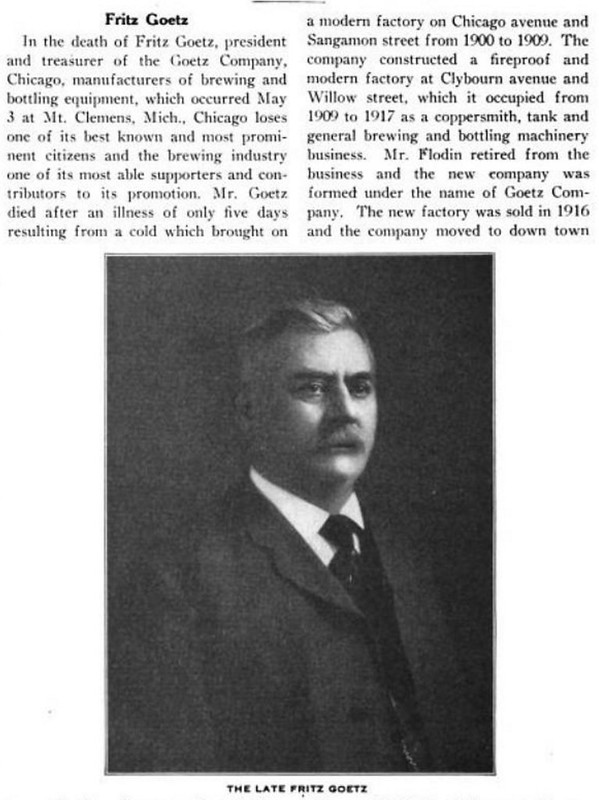
Born in Hesse-Kassel (or Hesse-Cassel), Germany, Frederick was educated as a forester. In 1851 he emigrated to the United States of America through the port of New Orleans, Louisiana, and settled in St. Louis, Missouri, where he worked in the mercantile business. In 1857 he came to Bellevue, Nebraska and continued in the merchandising trade until 1862. Frederick next went to Denver, Coloradoand established a wholesale and commission business in general merchandise, which he owned until 1864. In 1864 Frederick returned to Nebraska and with his brother Philip purchased the McCumbe Brewery, the first brewery in Nebraska, which they renamed Metz Brewery. Frederick served in the Nebraska Senate in 1871 and again 1885. He was president of German Savings Bank in Omaha.

Frederick-Metz-mini

He married Louisa Beate Gesser of St. Louis in 1855. Frederick and Louisa had four sons and three daughters together. In 1873 Louisa died and was buried in Prospect Hill Cemetery. In 1877 Frederick married Adele Wassmer, who was born in Holstein, Germany, and had emigrated to Nebraska. Together they had one son and one daughter. Metz died at the brewery at the age of 69, and was also interred at the Prospect Hill Cemetery in North Omaha.

Metz-Bros-brewery

And this short history of the brewery is from its Wikipedia page:

The Metz Brothers Brewing Company was among the first brewers in the U.S. state of Nebraska, having been established in the city of Omaha in 1859. It was among the earliest manufacturers in the city. After originally opening as the McCumbe Brewery, the facility was sold several times until brothers Frederick and Philip Metz purchased it in 1861.[2] Metz was one of the “Big 4” brewers located in Omaha, which also included the Krug, Willow Springs and Storz breweries.

Metz-beer-nebraska

In 1880 the Metz Brewery was located at 1717 South 3rd Street, and was producing 12,400 barrels (1,970 m3) per year. Later the facility moved to 209 Hickory Street into the former Willow Springs Distilling Company facility. Considered to be modern for the time, the facilities sat on an entire city block. Early brewing equipment included three cooling vaults, two of which were twenty feet wide by seventy-five feet long, and one smaller, being twenty feet wide by thirty in length. The ice rooms immediately above were of the same dimensions. The mash tub and brewing kettle each had a capacity for holding one hundred barrels. Barns for the delivery horses were also located on site. The brewery was said to have “no equal in the country.” The Metz brothers also ran the Metz Brothers Beer Hall, located on 510 South Tenth Street, where beer was supplied in barrels by horse-drawn cart from the main brewery.

The Metz Brewery closed because of the Prohibition. The facility was sold to an agriculture company in 1920. The label was brewed until 1961 by the Walter Brewing Company of Pueblo, Colorado.

metz-brewery

This biography is from the “History of Douglas County,” published in 1882:

Frederick Metz, surviving member of the firm of Metz Bros., brewers and malsters, Omaha. Mr. Metz was born in Hessel-Cassel, Germany, 1832, and was educated to the profession of forester there. In 1851 he came to America; landed in New Orleans, and settled in St. Louis the same year, where he was identified actively with the mercantile business till 1857, when he came to Nebraska and located at Bellevue and carried on merchandising there till 1862. In that year he went to Denver, Colo., and established a wholesale and commission business in general merchandise, which he ably conducted till 1864, when he returned to Nebraska and located here, where he has been prominently identified with his present business since. In 1855 he was married to Miss Louisa Beate Gesser, in St. Louis. She was born and reared there, and departed this life in 1873, and is buried in Prospect Hill Cemetery here, leaving a family of four sons and three daughters,–Minnie, now Mrs. Richard Siemon, of Canton, Ohio; Estelle, now Mrs. Ferdinand Schroeder, of Omaha; Charles Frederick, Jr., Tony, Arthur and Louis. In 1877 he married Miss Adele Wassmer, who was born in Holstein, Germany, and reared in Nebraska. They have a family of one son and daughter, Herman and Louisa. Mr. Metz has always been an active worker in the development of the social and industrial welfare of his locality. In 1871 he accepted the position of Representative for this district in the Senate and Legislature of his State, and has taken an active interest in the general growth of the city.

Metz-flying-high

And this is Metz’s obituary from the American Brewers’ Review:

Fred-Metz-obit-1
metz-jubilee-beer
Fred-Metz-obit-2
metz bros brewing co button

Filed Under: Birthdays, Breweries, Just For Fun Tagged With: Germany, Nebraska

Historic Beer Birthday: Josephus Petrus Van Ginderachter

May 19, 2026 By Jay Brooks

Today is the birthday of Josephus Petrus Van Ginderachter (May 19, 1889-June 17, 1959). He was the son of Corneel van Ginderachter, and the grandson of Cornelius Antonius Van Ginderachter, who, in 1888, acquired the Brouwerij Martinas, which had been founded in 1871 by Florentinus De Boeck. Josephus, who was sometimes referred to as Joseph, created their most well-known beer in 1928, Ginder-Ale, and the business became known as Brouwerij Ginder-Ale.

This account, that mentions Joseph’s contributions, is from a Flanders heritage website:

In 1908, the brewery buildings were again adapted, including an increase in the volume parallel to the Kattestraat. The street facade on the Kattestraat was adapted around 1923 as a result of the construction of, among other things, a warehouse, to the left of the former buildings, which was extended to the current volume. The brewery buildings were also further expanded in 1927 and 1930. From the interwar period, Joseph Van Ginderachter was director of the brewery. In 1928 he launched Ginder-Ale, a top-fermented beer. In addition to being a brewer, he was also mayor of Merchtem from 1933 to 1959. Under his directorship, the brewery flourished during the 1950s. This was accompanied by the construction of a new director’s house with offices on the side of the Langensteenweg (after the demolition of, among other things, the former brewer’s house and a warehouse), as well as an extension of the industrial buildings. The architect was Paul-Jean De Vos. The house on Langensteenweg was registered in the land register in two phases, namely first the right part and the gate in 1949 with offices and a caretaker’s house, and then in 1950 the director’s house on the left side of the passage. The extension of the brewery was registered in the land register in 1952 and included a building with cold stores. Another large-scale expansion followed in 1955. The brewery also expanded during that period with a building with a bottling plant on the other side of the Kattestraat (1954). 1956 building plans, drawn up by engineer L. Durin (Ghent), adapted the appearance of this complex on the Katte and Dendermondestraat. This building was also expanded later. A connecting bridge was also built between the buildings on Kattestraat (demolished around 1995). Afterwards Constant De Smedt took over the brewery and finally in 1973 the Artois brewery. Production continued until the late 1980s and the brewery finally closed in 1991.

This image has an empty alt attribute; its file name is KF_objecten_1445000804251605371925

Here’s a short history of the brewery translated from the Belgian website Residentie Martinas.

The brewery was founded in 1871 by Florentius De Boeck (1826-1892) – the father of composer August De Boeck – and was taken over in 1888 by Corneel van Ginderachter. After Corneel’s death, the company was managed by his wife Hendrika van Nuffel, who had to hand over her copper boilers to the Germans during the First World War. In 1928, son Joseph launched the high fermentation beer Ginder Ale, a beer of the Spéciale belge type that, according to experts, was closely related to the taste of Antwerp’s De Koninck or Palm from Steenhuffel. The company enjoyed its greatest success in the 1950s, employing 180 people at its peak. In 1973 it was taken over by the Artois Brewery – from 1988 Interbrew – and it continued to brew there until 1991. From then on, production was transferred to Leuven and to date 3,000 hectoliters are produced annually. This beer is usually distributed in the vicinity of Merchtem, so that one can literally speak of a regional beer. Due to the successive mergers, Brouwerij Ginder-Ale is part of Anheuser-Busch InBev.

This image has an empty alt attribute; its file name is martinas95-2.jpg

Filed Under: Birthdays, Breweries, Just For Fun Tagged With: Belgium

Historic Beer Birthday: John Hinchliffe

May 19, 2026 By Jay Brooks

Today is the birthday of John Hinchliffe (May 19, 1850-March 18, 1915). His father, also named John Hinchliffe, was born in Yorkshire, England but moved to New Jersey and founded the Hinchliffe Brewing & Malting Company in 1863. The brewery eventually employed his three sons, including John Hinchliffe Jr., who was later president. In 1890, it joined a consolidation of five local breweries in Paterson which became known as the Paterson Brewing & Malting Co. The brewery was closed by prohibition and never reopened.

This obituary comes from the American Brewers Review in 1915:

HinchliffePortraits

This brewery history is from the Paterson Historic Preservation Society:

The Hinchliffe Brewing & Malting Company was one of at least a dozen of breweries to operate out of Paterson in the pre-Prohibition Era. Owned and operated by John Hinchliffe & sons, who had previously founded the Eagle Brewery in Paterson in 1861 (on the Eve of the Civil War), Hinchliffe Brewing built the impressive brick structure that still stands on Governor Street in 1899. Designed by Charles Stoll & Son, notable “brewer’s architects” from Brooklyn, New York, building lasted eight months and once completed she was the largest in the city. Advertising broadsides from the era feature products such as their “East India Ale,” Porters, and Brown Stouts. The Brewery had a three-story ice factory located behind it, and at full capacity could produce 75,000 barrels per year. In 1917, the Brewery was converted to cold storage for supplies headed to the battlefields of World War I.

Glassware and advertising from Hinchliffe Brewery are considered collectibles due to their pre-Prohibition origins. Unfortunately, the Brewery would not survive the 18th Amendment and the Volstead Act, as the Hinchliffe family closed operations to conform with the law of the land.

And this history is by Peter Blum:

hinchcliffe-brewing-malting

And this is from the City of Paterson, New Jersey’s website:

The Hinchliffe Brewing and Malting Company was formed in 1890 by the well-known Hinchliffe brothers, the three sons of the English founder of the Eagle Brewery in 1861. The Eagle was likely the earliest medium-scale brewery in Paterson. John Hinchliffe began under the name Hinchliffe & Co., and was later changed to Shaw, Hinchliffe & Penrose in 1867 following association with those gentlemen. While business did well, in 1878 Penrose withdrew from the firm to which then the name changed to Shaw & Hinchliffe. Soon afterward in 1881, Shaw went abroad due to illness and died there, leaving the firm under its founder, John Hinchliffe, who again was alone in the endeavor until his death in 1886. His sons John, William and James inherited the property and the business, to which they put their minds and in 1890 set out together. They hired the well-known firm of Charles Stoll & Son of Brooklyn to draw up plans for the city’s largest and most modern brewing facility. The brew house stood five stories tall, built of brick and iron and trimmed with granite, and behind was a modern ice making facility three stories tall. A four-story cold storage facility was also constructed at the time fronting Governor Street.

The 1890s was the high time for the brewing industry in Paterson. The four main breweries in Paterson consolidated as the Paterson Consolidated Brewing Co. and in 1899 the Hinchliffe brothers also joined and became board leaders of the organization. John Hinchliffe died in 1915, the same year that more than 30 of Paterson’s saloons were closed due to the lack business. The brewing industry in Paterson was soon thereafter crippled and dissolved by the Temperance movement and prohibition era of the 1920-30s.

On January 15, 1904, a fire broke out at the Hinchcliffe Brewery Malt House. One firefighter died when he fell from a ladder during efforts to put out the blaze, and at least three others were injured. The website Paterson Fire History has photographs and newspaper clippings from the fire.

Hinchliffe-Brewery-1904-fire

Hinchcliffe-pure-malt

Filed Under: Birthdays, Breweries, Just For Fun Tagged With: England, Great Britain, History, New Jersey

Beer In Ads #5252: Bockbier Löwenbrauerei Böhmisches Brauhaus

May 18, 2026 By Jay Brooks

Two years ago I decided to concentrate on Bock ads for awhile. Bock, of course, may have originated in Germany, in the town of Einbeck. Because many 19th century American breweries were founded by German immigrants, they offered a bock at certain times of the year, be it Spring, Easter, Lent, Christmas, or what have you. In a sense they were some of the first seasonal beers. “The style was later adopted in Bavaria by Munich brewers in the 17th century. Due to their Bavarian accent, citizens of Munich pronounced ‘Einbeck’ as ‘ein Bock’ (a billy goat), and thus the beer became known as ‘Bock.’ A goat often appears on bottle labels.” And presumably because they were special releases, many breweries went all out promoting them with beautiful artwork on posters and other advertising. With Spring approaching, there are so many great examples that I’m going to post two a day for a few months.

Monday’s ad is for “Bockbier Löwenbrauerei Böhmisches Brauhaus,” created most likely in or after 1922 (although one source claims 1912, which makes no sense). This poster was for the (or Löwenbrauerei-Bohemian Brewery) of Berlin, Germany, which was created by a merger between the Böhmisches Brauhaus and Löwenbrauerei in 1922. The poster was created by German artist Georg Räder.

Filed Under: Art & Beer, Beers, Breweries, Just For Fun Tagged With: Advertising, Bock, Germany, History

Historic Beer Birthday: Maria Best

May 16, 2026 By Jay Brooks

Today is the birthday of Maria Best (May 16, 1842-October 3, 1906). She was the daughter of Philip Best and wife of Frederick Pabst.

The photo below was taken around 1870. Here’s its description: “Quarter-length studio portrait of Maria Best Pabst (1842-1906). She is wearing a dress with leg of mutton sleeves and ornate embroidery. The daughter of successful Milwaukee brewer Phillip Best, Maria married Captain Frederick Pabst in 1862. Together they had ten children, only five of whom survived to adulthood. Pabst went into partnership with his father-in-law in 1863 and eventually owned what would become the Pabst Brewery.”

Maria in 1870.

Frederick Pabst, before he became a brewery owner, was a steamship captain of the Huron, a Goodrich steamer on Lake Michigan. Maria Best, when she was a passenger on his ship, met the dashing Pabst and then began courting, marrying in 1862. Not long afterward, Pabst became a partner in his father-in-law’s business, the Philip Best Brewing Co.

Filed Under: Birthdays, Breweries, Just For Fun Tagged With: History, Pabst, Wisconsin

« Previous Page
Next Page »

Find Something

Northern California Breweries

Please consider purchasing my latest book, California Breweries North, available from Amazon, or ask for it at your local bookstore.

Recent Comments

  • Bob Paolino on Beer Birthday: Grant Johnston
  • Gambrinus on Historic Beer Birthday: A.J. Houghton
  • Ernie Dewing on Historic Beer Birthday: Charles William Bergner 
  • Steve 'Pudgy' De Rose on Historic Beer Birthday: Jacob Schmidt
  • Jay Brooks on Beer Birthday: Bill Owens

Recent Posts

  • Beer In Ads #5305: Gnomes & Heute Bockbier! July 29, 2026
  • Historic Beer Birthday: Max Schwarz July 29, 2026
  • Beer In Ads #5304: Heute Bockbier! July 28, 2026
  • Historic Beer Birthday: Sharon Vaughn July 28, 2026
  • Beer In Ads #5303: Heute Bock July 27, 2026

BBB Archives

Feedback

Head Quarter
This site is hosted and maintained by H25Q.dev. Any questions or comments for the webmaster can be directed here.