Brookston Beer Bulletin

Jay R. Brooks on Beer

  • Home
  • About
  • Editorial
  • Birthdays
  • Art & Beer

Socialize

  • Dribbble
  • Email
  • Facebook
  • Flickr
  • GitHub
  • Instagram
  • LinkedIn
  • Pinterest
  • RSS
  • Twitter
  • YouTube

Powered by Genesis

Beer In Ads #5256: Oh Boy.. This Really Picks You Up!

June 1, 2026 By Jay Brooks

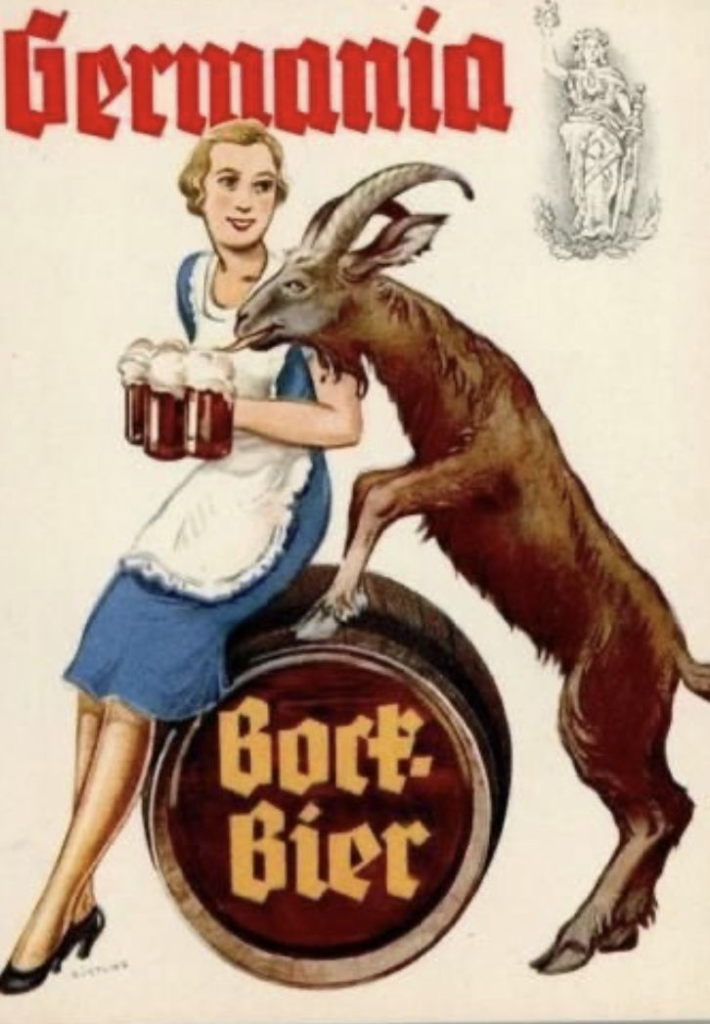
Two years ago I decided to concentrate on Bock ads for awhile. Bock, of course, may have originated in Germany, in the town of Einbeck. Because many 19th century American breweries were founded by German immigrants, they offered a bock at certain times of the year, be it Spring, Easter, Lent, Christmas, or what have you. In a sense they were some of the first seasonal beers. “The style was later adopted in Bavaria by Munich brewers in the 17th century. Due to their Bavarian accent, citizens of Munich pronounced ‘Einbeck’ as ‘ein Bock’ (a billy goat), and thus the beer became known as ‘Bock.’ A goat often appears on bottle labels.” And presumably because they were special releases, many breweries went all out promoting them with beautiful artwork on posters and other advertising. With Spring approaching, there are so many great examples that I’m going to post two a day for a few months.

Monday’s ad is for Menominee Genuine Bock Beer, which was published on June 1, 1941. This ad was for the Menominee-Marinette Brewing Co., of Menominee, Michigan, which was founded in 1870 as the De Heck & Scharmbruch Brewery. This ad ran in The Escanaba Daily Press, of Escanaba, Michigan.

Filed Under: Art & Beer, Beers, Breweries, Just For Fun Tagged With: Advertising, Bock, History, Michigan

Historic Beer Birthday: Thomas Carling

June 1, 2026 By Jay Brooks

Today is the birthday of Thomas Carling (June 1, 1797-February 17, 1880). He was born in Yorkshire, England but emigrated to Canada, settling in London, Ontario, in 1818, where he founded what would become the Carling Brewery in 1840.

This biography is from Find-a-Grave:

Son of William and Margaret Carling of Etton. Wishing to find his fortune in a young country he sailed from Hull on May 17, 1818 for Canada. (Since there was not much opportunity for tenant farmers in England, many of the young farmer sons left to be successful elsewhere.)

The interesting journey was recorded by his son, Sir John Carling, and is included in the hard-bound book by George P. DeKay, available in the London Room at the London Public Library.
Thomas arrived at his new farm in London township in 1819 and began the long job of clearing the land of trees and building a log cabin. The location was lot 14, concession 8 however in 1824 he moved to a farm further south at lot 26, con. 6, nearer to his in-laws.

About 1839 he moved from the farm into the town of London (Pall Mall and Colborne streets location). It is said that he felt his three surviving sons would receive a better education there.
The origin of CARLING BREWERY is Thomas Carling and London, Ontario. Since he had move time after moving to a town setting, Thomas began brewing beer likely similar to the recipes of home-brewed English beer. The beer was a popular refreshment for the British soldiers who were stationed nearby at the British garrison. It was not long before sons William and John persuaded their father to turn the business over to their management and control. The company was named “W. & J. Carling Ltd.” In 1882 the “Carling Brewing and Malting Co. of London Ltd.” was formed with John as its president. Later the business expanded throughout Canada, the United States, Europe and beyond. The business remained in the family for about 100 years.

Thomas married Margaret Routledge on Oct. 6, 1820. The two had to be married by a Justice of the Peace because in 1820 there was no Church of England minister in the area. This marriage was the first in the newly formed township for a non-native couple. In order to legalize a marriage, it was necessary to post, in three locations, a document signed by the JP in question, the three places being a mill door, a distillery door and on a large tree at a public crossroads.

And this short history of the Carling Brewery is from their Wikipedia page:

The history of Carling dates back to 1818, when Thomas Carling, a farmer from the English county of Yorkshire, and his family settled in Upper Canada, at what is now the city of London, Ontario. He brewed an ale which became popular, and eventually took up brewing full-time. The first Carling brewery had two kettles, a horse to turn the grinding mill and six men to work on the mash tubs, and Carling sold his beer on the streets of London, Ontario from a wheelbarrow.

In 1840 Carling began a small brewing operation in London, selling beer to soldiers at the local camp. In 1878 his sons, John and William, built a six-story brewery in London, which was destroyed by fire a year after opening. Thomas Carling, shortly after helping to fight the fire, died of pneumonia.[citation needed]

William and John took over the company, naming it the W & J Carling Brewing Co. John Carling died in 1911 and the company changed hands numerous times since. It was acquired by Canadian Breweries Limited, which was eventually renamed Carling O’Keefe, which merged with Molson, which then merged with Coors to form Molson Coors Brewing Company.

carling-brewery-1875-80

This plaque for Carling is in Yorkshire, England, dedicated in 2000:

carling-ad-1925

This short brewery history is from the Carling website:

Carling’s British roots trace all the way back to the Yorkshire village of Etton, little known, but forever in the hearts of Carling as the birthplace of our namesakes, William Carling and his son Thomas. Inheriting his father’s passion and skill for brewing, a 21-year-old Thomas emigrated to Canada taking his father’s Yorkshire beer recipe, which on arrival in Canada he used to brew privately for admiring family and friends. The township Thomas settled in soon became an Imperial Army post where the thirsty soldiers became fans of the Carling family’s Yorkshire brew. In 1843 he built his first commercial brewery, only for his sons William and John to take up the baton soon after, and begin producing lager for the first time in 1869, sewing the first seeds of Carling’s refreshingly perfect pint.

And this is a portion of a history written by Cecil Munsey in 2003, entitled “Carling Black Label Beer in the White Bottle:”

Filed Under: Birthdays, Breweries, Just For Fun Tagged With: Canada, England, Great Britain, History

Historic Beer Birthday: Adolph G. Bechaud

May 30, 2026 By Jay Brooks

bechaud

Today is the birthday of Adolph G. Bechaud (May 30, 1840-March 5, 1919). He was born in Rheinpflz, Germany, but emigrated with his parents in 1850, when he was ten, settling in Fond du Lac, Wisconsin. In 1871, along with two of his brothers, Frank and Jean (a.k.a. John), founded the A.G. Bechaud Brewery, which was also known as the A.G. Bechaud & Bros. Brewery and later, beginning in 1875, traded under the Empire Brewery name, before returning to Bechaud Brewery when it reopened after prohibition ended, before closing for good in 1941.

Adolph-G-Bechaud
Bechaud as a Captain in the U.S. Army.

This obituary is from Bechaud’s Find-a-Grave page, on originally ran on the front page of the Fond du Lac Daily Commonwealth, Wednesday, March 5, 1919:

 ADOLPH G. BECHAUD DEAD; LEADER IN BUSINESS CIRCLES. End Comes to Interesting and Active Life. WAS CAPTAIN IN CIVIL WAR. Fond du Lac Banker, Capitalist and Manufacturer Succumbs at Age of 79. Captain Adolph G. Bechaud; vice president of the Commercial National Bank since its organization, veteran of the Civil War, and a man whose business energy and integrity has left a deep impression upon the life of Fond du Lac, died at 4:30 o’clock this morning at the family residence 457 West Eleventh street. his illness has been of about four weeks’ duration, though for some months past there has been a noticeable lack of that interest and activity which has always been characteristic of him. Mr. Bechaud was born May 30, 1840, in Dirmstein, Germany, and came to the United States in 1853, settling in Fond du Lac with his parents. The outbreak of the Civil War found Mr. Bechaud, then a young man just turning his twenties, ready and willing to serve. On October 29, 1861, he volunteered at Chicago and was assigned to Company B of the Thirteenth Illinois Cavalry. At the age of 23 he was advanced from rank of sergeant to that of first lieutenant. He was commissioned as such January 6, 1863. His command was detailed for duty in the western theater of the war, being engaged largely in scouting work in Missouri, Mississippi and Arkansas. On Oct. 19, 1863, he was advanced to the rank of captain taking command of Company B, of the Thirteenth cavalry and serving as such in the later campaigns of the war, and being in command on his discharge from the service at the close of the war. Capt. Bechaud served under Generals Davis, Carr and Steel. In 1864 he took his discharge and came back home to take the duties of civil life. He became associated with Paul Hauser who conducted one of the pioneer breweries of the county on the ledge east of the city. Here Mr. Bechaud learned the fundamentals of the business which was later to become his life work. In 1871 he joined his brothers in the organization of the Bechaud Brewing company, taking the office of president which he has continuously held. On June 6, 1870 he was married to Miss Elizabeth Kramer, then of the town of Taycheedah. Mr. Bechaud leaves in addition to his wife, the following children: Mrs. F.W. Orth, Mrs. H.T. Schmidt, August Bechaud, Mrs. John P. Kalt, Adolph Bechaud, Jr., and Mrs. W.W. Petrie, also six grandchildren, Adolph V. Orth, Charlotte Venne, Robert Bechaud, Ross Petrie, Marcia Petrie and Audrey Bechaud. He is also survived by two brothers; J.B. Bechaud of this city and Armand Bechaud of Chehalis, Wash. Mr. Bechaud was a man of keen business judgment, an indefatigable worker, one who stood unflinchingly by the accepted honorable principles of business dealing. His energy interest and desire that everything should be attended to in a business like way was characteristic of him. He was one of the moving spirits in the organization of the Commercial National bank, and his counsel was often sought and always relied upon in matters requiring decision that would be unerring. In business and social circles he will be missed by a wide circle of friends. Socially he was a member of the Elks and Edwin A. Brown Post No. 130 G.A.R. While plans for the funeral are not fully determined, it is probable that the service will be held Friday afternoon at the residence.
Adolph-G-Bechaud-pair

And this obituary ran on page 1 of the Fond du Lac Daily Reporter, Wednesday, March 5, 1919:

CAPT. A.G. Bechaud. Born May 30, 1840 Died March 5, 1919. CAPT. BECHAUD EXPIRES AFTER LONG ILLNESS. Brewing Co. Head and Bank Officer Dies at Home on West Eleventh St. VETERAN OF THE CIVIL WAR. Captain Adolph G. Bechaud, aged 79, president and one of the founders of the Bechaud Brewing company, vice-president and director of the Commercial National bank and one of the city’s most prominent residents died at 4:30 o’clock this morning at his home, 457 West Eleventh street, after a lingering illness. Mr. Bechaud was taken seriously ill about four weeks ago and since then has been confined to his bed. His condition gradually grew worse until this morning, when the end came peacefully. The deceased was born in Dirmstein Germany, on May 30, 1840, and when thirteen years of age came to the United States with his parents. The family settled in Fond du Lac county in 1853 and Mr. Bechaud had resided in this vicinity practically ever since. When the civil war broke out, Adolph G. Bechaud was one of the first Fond du Lac county young men to join forces. He enlisted as a private in the Thirteenth company of the Illinois Cavalry at Chicago, Ill., on October 29, 1861. He was commissioned as a first lieutenant on January 6, 1863 and on October 19, 1863, was promoted to rank of captain. He commanded the Thirteenth company and did scouting work under Generals Davis, Carr and Steele in the states of Missouri, Mississippi, Arkansas and Louisiana. He was mustered out of the service December 31, 1864. After the war Captain Bechaud returned to Fond du Lac county and for sometime was employed at the Hauser Brewery at Taycheedah. When the Hauser Brewery burned, Mr. Bechaud came to this city and was one of the founders of the Bechaud Brewing company. The present brewery on West Eleventh was built in 1872 and has been in operation since that time under the direction of Captain Bechaud and his brothers. He served as president of the brewing company for many years. The deceased had been a director of the Commercial National bank for several years and a few years ago was chosen vice-president of the institution. he was a member of the Fond du Lac lodge N. 57 B.P. O. E. and also the G.A.R. Although he never held a public office, Mr. Bechaud has always taken an active interest in public affairs. Mr. Bechaud was married to Miss Elizabeth Kraemer in Taycheedah on June 16, 1870. Besides a widow, Mr. Bechaud leaves four daughters, Mrs. F.W. Orth, Mrs. A.H.T. Schmidt, Mrs. P. Kalt, and Mrs. W.W. Petrie, all of this city, two sons, August Bechaud and Adolph Bechaud, Jr., and six grandchildren, Adolph Orth, Charlotte Venne, Robert Bechaud, Ross Petrie, Marcia Petrie and Audrey Bechaud. he also leaves two brothers, J.B. Bechaud of this city and Armand Bechaud of Washington, D.C. The funeral will be held at 2 o’clock Friday afternoon from the residence, 457 West Eleventh street and interment will be held at Rienzi cemetery.

Adolph-G-Bechaud-and-wife
Adolph and his wife, Elizabeth Kraemer Bechaud.

This history of the Bechaud Brewery is from Oshkosh Beer’s post “An Illustrated History of the Brewing Industry in Fond du Lac.”

In 1871, Fond du Lac’s most successful brewery was opened at 515 Main Street by the brothers Frank, John and Capt. A.G. Bechaud. Formed during the presidency of Ulysses S. Grant, their brewing company also set the standard for longevity among Fond du Lac beer makers, surviving until 1941, when Franklin Delano Roosevelt began his third term in office.

Bechaud-Brewery

The Bechaud brothers, all born in Bavaria, started brewing at their Main Street location but they also bought lakeshore property on Lake Winnebago just northwest of the city limits, where they envisioned locating their permanent brewing empire. However, the beachfront brew-house was not to be. Instead, in 1873, the Bechauds opened their new large brewery on Eleventh Street, just west of Hickory Street.

Bechaud Brewery Perfect Brew Label

The Bechauds also maintained a Main Street address. Their “sample room” gave people a chance to enjoy the freshest beer the company had to offer. The most popular brand produced by Bechaud, “Empire” was bottled and sold in various cities. Their other beers included “Műnchner” and “Pilsener.” In all, the company sold an average of 15,000 barrels of their beers annually.

fond-du-lac-wi-bechaud-brewing-company-1911
Extra-Brew-Beer-Labels-Bechaud-Brewing-Co-Empire-Brewery
Bachaud-Bock

Write caption…

Filed Under: Birthdays, Breweries, Just For Fun Tagged With: Germany, History, Wisconsin

Historic Beer Birthday: John Gilroy

May 30, 2026 By Jay Brooks

Today is the birthday of John Gilroy (May 30, 1898-April 11, 1985). While not a brewer or even brewery owner, he was nonetheless at least partially responsible for the success of Guinness with his iconic advertising that he created for them beginning in 1928.

Here’s his entry from Wikipedia.

“Born in Whitley Bay, Northumberland, England, Gilroy attended Durham University until his studies were interrupted by World War I, during which he served with the Royal Field Artillery. He resumed studying at the Royal College of Art in London, where he remained as a teacher. He taught at Camberwell College of Arts.

In 1925, he gained employment at S.H. Benson’s advertising agency, where he created the iconic advertisement art for Guinness featuring the Zoo Keeper and animals enjoying Guinness. He worked with Dorothy L. Sayers. He was also an accomplished portrait painter, numbering Royalty, Politicians, Actors and many others amongst his sitters. He worked in his large studio at 10 Holland Park, London, the former home and studio of Sir Bernard Partridge. He was a long-standing and much loved member of the Garrick Club, where he was created a Life Member and Chairman of the Works of Art Committee 1970-1975. He was awarded and Honorary MA by Newcastle University in 1975, and was made a Freeman of the City of London in 1981.”

The Guinness Collectors Club has a more thorough biography:

John Gilroy (1898-1985) was a superb natural draughtsman and a versatile illustrator and artist who produced advertsising material, portraits, landscapes, murals and greeting cards.

Born on the 30th of May 1898 at Whitley Bay, Newcastle upon Tyne, he was one of a family of eight (five boys and three girls), born to John William Gilroy and his wife Elizabeth. William Gilroy was a marine landscape painter and technical draughtsman and it was obvious from an early age that John junior was going to follow in his footsteps. The young John practised copying cartoons from Punch and took on all kinds of work to pay for drawing materials. From the age of fifteen he was a cartoonist for the Evening Chronicle, Newcastle, commissioned to produce cartoons of well-known entertainers who played the Newcastle theatres.

John attended Sandyford School followed, in 1909, by Heaton Park Road Upper School. At this date his family was living at 25 Kingsley Place. In June 1912, he left Heaton Park and, having attained his drawing certificate, won a scholarship to Armstrong College Art School, Durham University to study under Professor K.G. Hatten.

The First World War interrupted Gilroy’s studies and he served with the Royal Field Artillery in France, Italy and Palestine. In September 1919 he resumed his studies taking a place at the Royal College of Art, London (RCA). During his time there he produced illustrations for the college student magazine and occasionally played in goal for the college football team. In 1920 he attained his Board of Education certificate and the RCA diploma in decorative painting. His work was also rewarded through scholarships and prizes, winning, in 1919, the North Lordbourne prize for composition and, in 1921, the college drawing prize and the British Institute Scholarship for decorative painting. In 1922 Gilroy won an RCA travelling scholarship in mural painting having missed the Prix de Rome by only one vote.

Gilroy graduated from the RCA in July 1923 but stayed on there until 1925 as a teacher. From 1924 to 1926 he also taught drawing from the figure in the evenings at the Camberwell School of Art. In 1924 he married Gwendoline Peri-Short who had been a fellow pupil at the RCA and three years later they had a son, John.

In 1925 Gilroy embarked on his long association with the advertising agency S H Benson Ltd (Benson’s). Although Benson’s was the first advertising agency for whom Gilroy worked as an in-house artist, he had already proven himself in the commercial art sphere. His earliest known piece of commercial art, dating from 1920 when he was still a student, was for a promotional leaflet for the Mangnall-Irving Thrust-Borer commissioned by the Hydraulic Engineering Co.

Gilroy’s early work at Benson’s is reputed to have been on campaigns for Skipper Sardines and Virol. During his time there he also worked on campaigns for Bovril, Macleans and Monk & Glass Custard. His first significant assignment was the Mustard Club campaign for Coleman’s of Norwich, on which he worked with fellow artist William Brearley and copywriters Oswald Greene and Dorothy L Sayers. Between 1926 and 1933 the pens of Gilroy and Brearley brought eccentric characters like Baron de Beef, Signor Spaghetti and Miss Di Gester to life on bill boards and in magazines everywhere.

In 1928 Benson’s won the Guinness advertising account and Gilroy became involved with the product with which his work is most closely associated. Gilroy’s first known Guinness poster was produced in 1930. Working with copywriters like Ronald Barton and Robert Bevan, Gilroy produced more than 100 press advertisements and nearly 50 poster designs for Guinness over 35 years. He is perhaps best remembered for his posters featuring the girder carrier and the wood cutter from the Guinness for Strength campaigns of the early 1930s and for the Guinness animals. The animals, including a lion, toucan, gnu and kangaroo, appeared, with their long-suffering zookeeper, on posters, press advertisements, show cards and waiter trays from the 1930s to the 1960s.

Gilroy continued to produce Guinness advertisements well into the 1960s even though he left Benson’s employment as an in-house artist in the 1940s to continue freelance work.

During the 1920s and succeeding decades commercial art was not Gilroy’s sole occupation; he began to build his reputation as a painterboth of portraits and landscapes. One of his earliest portrait commissions was to paint the future Edward V111 for the Royal Mid-Surrey Golf Club, of which Gilroy was a member and the Prince was patron.

In 1930, while the family was living at The Cottage, Hyde Park Road, Kew Gardens, Gilroy has his first painting, Gwen. exhibited at the Royal Academy. Throughout the 1930s Gilroy’s work continued to be exhibited at the Royal Academy and to appear on advertising boardings, in newspapers and even in the Radio Times. In 1941, with the onset of the blitz, the artist moved to Rasehill, Chorleywood Road, Rickmansworth. His wife and son moved to Cheltenham where, in the same year, he held a one-man exhibition of his work, which then travelled to Sunderland Public Art Gallery.

Throughout the war years, Gilroy’s work continued to be exhibited at the Royal Academy while his commercial art talents were employed by the Ministry of Information in campaigns such as Make-do-and-mend, Keep it under your hat and We want your kitchen waste. He also improved morale by painting murals at various Royal Air Force bases and produced a series of drawings-in-one-line of contemporary political and military figures, called Headlines, which appered in The Star.

By 1945, when his painting Diamond Setting was exhibited at the Royal Academy, the artist’s address was given as 6 Avenue Studios, Sydney Close, SW3. A year laterhe prodced another mural, this time in the bar of the Mrritt Arms Hotel near Greta Bridge on the estate of his close friend Major Morritt. The work at the Morritt Arms began on the 1st February 1946 and was completed within10 days. When Gilroy and his assistant proudly displayed the walls of the bar decorated with Dickensian figures, closer inspection revealed them to be caricatures of local people and staff from the hotel.

In 1949 Esme Jeudwine, a former pupil and portrait subject, introduced Gilroy to the Royle family and another long and successful association began. Gilroy produced five greeting card designs for Royle Publications Ltd (Royles) in that year with another 464 published designs over the next 35 year. In 1966, Gilroy was acting Art Director for Royles.

In 1950 Gilroy married Elizabeth Margaret Bramley (nee Outram Thwaite). The couple lived at 17 Queen’s Gate, Kensington, but moved a year later to 10 Holland Park Road, W14, the former home and studio of Sir Bernard Partridge, whose cartoons Gilroy had copied from Punch as a child. The magnificent studio at Holland Park Road saw the creation of advertising work for T.F. Carrington Van PostingLtd. where Gilroy was Head of the Art Department, and was regularly visited by members of the Royal Family, politicians, actors and many others who came to have theit portraits painted.

In 1957 Gilroy held another one-man exhibition this time at Leighton House Gallery and two years later produced a series of landscapes of McGill University, Montreal, to illustrate a book McGill, The Story of a University, edited by Hugh MacLennan. In 1970 Gilroy held a retrospective exhibition at Upper Grosvenor Galleries and three years later an exhibition of his humorous designs for Royles was held at the London headquarters of Austin Reed Ltd.

In his later years ‘Jack’ Gilroy was a longstanding and much loved member of the Garrick Club where he was Chairman of the Works of Art Committee and where a number of his portraits now hang. In 1975 Gilroy was awarded an honorary MA by Newcastle University and in 1981, now living at 6 Ryecroft Street, Fulham, he was appointed a Freeman of the City of London.

John Gilroy died at Guildford on the 11th April 1985, aged 86, and is buried at Ampney St Peter in Gloucestershire near the home of his son and three grandchildren.

He created the zoo animals and other popular characters for Guinness from either 1928 or the early 1930s (accounts differ), but the first one he did appears to be the Guinness for Strength ad featuring a steel girder in 1934. According to some accounts, it was so popular that people even started ordering a ‘girder’ in the pub.

Guinness-1934-girder

The following year, the Toucan debuted, and quickly became one of the most recognizable of the Guinness animals, used in marketing and advertising by Guinness for over 45 years. Here’s the story of its design from History House:

The idea of using a toucan was born in the advertising agency of S.H.Benson in London. Staff included the talented artist John Gilroy was newly employed as the poster artist, and among the copywriting team was Dorothy L Sayers, now famous as a writer, poet and playwright, and best known for her amateur detective stories featuring Lord Peter Wimsey. She had started at the agency in 1922 and worked there while writing books in her spare time.

This team produced some memorable posters for Guinness including several posters in the whimsical “Zoo” series. These included a zoo keeper with a Guinness, a sea lion balancing drink on his nose, an ostrich with the shape of a swallowed glass halfway down its neck, a tortoise with a glass of stout on its back, and a toucan with two Guinness bottles balanced on its beak accompanied by the words.

If he can say as you can
“Guinness is good for you”
How grand to be a Toucan
Just think what Toucan do.

Gilroy remained with the advertising agency until 1960 during which time he designed many other Guinness posters. As to how animals came to be used in an advertising campaign was recalled later by Gilroy. “The Guinness family did not want an advertising campaign that equated with beer. They thought it would be vulgar. They also wanted to stress the brew’s strength and goodness. Somehow it led to animals.”

The toucan returned on several occasions on all types of advertising media and on memorabilia. In 1982 Guinness changed advertising agencies and it was decided that the toucan was no longer an effective advertising motif and it was dropped.

The text from that ad was actually written by Dorothy L. Sayers, who worked for the same advertising agency as Gilroy before she became a famous mystery writer, well-known for such characters as Lord Peter Wimsey, and others.

Gilroy’s first Toucan ad, from 1935.

And here’s a sample of some more of his work for Guinness.

And finally, by no means complete, these are other Guinness ads I’ve collected in a Flickr gallery, many of which are by John Gilroy. And here’s some more accompanying an article entitled John Gilroy for Guinness: Four Corners and Some Vision.

Filed Under: Art & Beer, Beers, Birthdays, Breweries, Just For Fun, Related Pleasures Tagged With: Advertising, Guinness, History

Beer In Ads #5254: Geo. Walter Bock Is Just What You Need To Tone Up Your System

May 26, 2026 By Jay Brooks

Two years ago I decided to concentrate on Bock ads for awhile. Bock, of course, may have originated in Germany, in the town of Einbeck. Because many 19th century American breweries were founded by German immigrants, they offered a bock at certain times of the year, be it Spring, Easter, Lent, Christmas, or what have you. In a sense they were some of the first seasonal beers. “The style was later adopted in Bavaria by Munich brewers in the 17th century. Due to their Bavarian accent, citizens of Munich pronounced ‘Einbeck’ as ‘ein Bock’ (a billy goat), and thus the beer became known as ‘Bock.’ A goat often appears on bottle labels.” And presumably because they were special releases, many breweries went all out promoting them with beautiful artwork on posters and other advertising. With Spring approaching, there are so many great examples that I’m going to post two a day for a few months.

Tuesday’s ad is for Geo. Walter Bock Beer, which was published on May 26, 1906. This ad was for  the Geo. Walter Brewing Co., which was founded in 1862 by George Muench, which George Walter becoming involved around 1880. This ad ran in The Post-Crescent, of Appleton, Wisconsin.

Filed Under: Art & Beer, Beers, Breweries, Just For Fun Tagged With: Advertising, Bock, History, Wisconsin

Historic Beer Birthday: Joseph Theurer

May 24, 2026 By Jay Brooks

Today is the birthday of Joseph Theurer (May 24, 1852-May 14, 1912). Born in Philadelphia of German descent, who became a well-known brewer in both his native Pennsylvania and Illinois. After he married Emma Schoehofen, he became VP of his father-in-law’s Chicago brewery, the Peter Schoenhofen Brewing Company in 1880. After Peter passed away in 1893, Theurer became president and remained at the helm until his own death in 1912.

Here’s a biography from Find a Grave:

Joseph Theurer, who was of German descent, was born in Philadelphia in 1852. He became one of the most knowledgeable brewers of his day. He served as Treasurer of the Illinois State Brewers Association from 1898 to 1911 and he held title of President of the United States Brewing Association from 1903 to 1905.

Joseph arrived in Chicago in the Fall of 1869 and worked as an apprentice to brewers Adam Baierle and K.G. Schmidt. In 1871, he had been working at the Huck Brewery for less than a week when the brewery was destroyed in The Great Chicago Fire.

So he returned to Philadelphia for a year to work at the brewery of Bergdoll & Psotta. And then headed back to Chicago in 1872 to work at Bartholomae & Leicht brewery until 1874. He was also employed for one season at the Clybourn Avenue Malthouse of F. Wacker & Co. before returning to Philadelphia until his marriage to Peter Schoenhofen’s daughter, Emma Schoehofen, in 1880.

Upon his marriage to Emma, he became Vice President of Schoenhofen Brewing Company in Chicago until his father in law Peter’s death in 1893. Joseph took over as President of Schoenhofen Brewing from 1893 until 1911.

In 1896, Joseph commissioned what is now known as the Theurer-Wrigley Mansion. The Mansion, built in the late Italian Renaissance style, was designed by Richard Schmidt and listed on the National Register of Historic Places in 1979. The 20,000+ square foot mansion features 11 bedrooms and 6 baths. Furnished with nearly all Tiffany light fixtures, many have been removed by previous owners or sold. An original Tiffany stained glass window from the Mansion is currently on display at the Chicago History Museum. Recent reports show the Mansion being listed for 9.5 million dollars as a foreclosure in 2011, but it has since been purchased and is currently occupied by a single owner.

On May 14, 1912 Joseph died from pneumonia and was laid to rest along with Peter Schoenhofen in the magnificent Egyptian revival style tomb in Graceland Cemetery. Services were conducted on May 17th in front of the tomb and conducted in both English and German. Attendees included members of the Illinois and Cook County Brewers Associations as well as a large number of charitable organizations, family and close friends.

Joseph was survived by his widow Emma, two sons, Peter S. and Joseph Jr., and two daughters Miss Margareta Theurer and Mrs. Marie (Richard) Ostenrieder.

The Encyclopedia of Chicago has a concise history of the Peter Schoenhofen Brewing Co.:

Peter Schoenhofen, a Prussian immigrant, was in Chicago working in the brewing trade by the 1850s. In 1861, he started a partnership with Matheus Gottfried; they were soon operating a brewery at Canalport Avenue and 18th Street where, during the early 1860s, they made about 600 barrels of lager beer a year. In 1867, Schoenhofen bought out his partner, and the company became the Peter Schoenhofen Brewing Co. By 1868, annual output had increased to about 10,000 barrels. During the 1890s, when the business was owned by the City Contract Co. of London, England, annual output reached 180,000 barrels. Around 1900, the Schoenhofen family regained control of the company, which employed about 500 people at its brewery on West 12th Street by 1910. During this time, the company was also known as the National Brewing Co. The company’s “Edelweiss” brand of beer was a big seller. Operations shut down during Prohibition, but by 1933, after the national ban on alcohol production was lifted, the company was back in business as the Schoenhofen-Edelweiss Co. After being purchased by the Atlas Brewing Co. in the late 1940s, Schoenhofen became part of Dewery’s Ltd. of South Bend, Indiana, in 1951, and thereafter assumed the Dewery’s name. By the beginning of the 1970s, there was nothing left of its Chicago operations, although Dewery’s reintroduced the famous Edelweiss brand in 1972 after nearly a decade-long hiatus.

Today, the land where the brewery was located is known as the Schoenhofen Brewery Historic District and to see earlier photos of that area, Forgotten Chicago has a short history, with lots of pictures.

edelweiss-yellow

Filed Under: Birthdays, Breweries, Just For Fun Tagged With: Chicago, History, Illinois, Philadelphia

Historic Beer Birthday: James Barkley

May 23, 2026 By Jay Brooks

Today is the birthday of James Barkley (May 23, 1854-?). He was born in Baltimore, Maryland, at the age of 26 he started working for a local maltster, Solomon Strauss. He later worked for another brewer and maltster, John Marr, before joining the Gottlieb-Bauernschmidt-Strauss Brewing Company as secretary and treasurer, upon its formation on March 1, 1899. The G-B-S Brewing Co. (as it was often referred to as) consisted of a merger of sixteen local breweries. It was reorganized again in 1901, changing its trade name to the Globe Brewing Co. (which was the name of one of the sixteen founding members) although “G-B-S” continued to printed on its labels for years afterward. It finally closed for good in 1963.

Here’s a history of the brewery from the 1903 book, “100 Years of Brewing:”

g-b-s-100yrs-1
g-b-s-100yrs-brewery
g-b-s-100yrs-2
g-b-s-100yrs-officers

This account is from “American Breweries of the Past,” by David G. Moyer:

globe-brewery

One of the brewery’s best-selling beer was “Arrow Beer.”

arrow-beer-1930s

arrow-neon

arrow-coaster

Filed Under: Birthdays, Breweries, Just For Fun Tagged With: History, Maryland

Historic Beer Birthday: Henry Wagstaff

May 22, 2026 By Jay Brooks

tui
Today is the birthday of Henry Wagstaff (May 22, 1836-October 19, 1911). He was born in Derbyshire, England, after trying his hand as a policeman and a grocer, moved to New Zealand when he was 48, in 1883. A few years later, in 1889, Wagstaff and Edward Russell founded the Wagstaff Brewery in Mangatainoka, on the North Island. It became quite successful, but in 1903, Wagstaff sold his shares and moved back to England, returning in 1911, but died later that same year. Tui Brewery, of course, continued on without Wagstaff and today is owned by DB Breweries.

There’s not much about him apart from some failed businesses and whispers of infidelity, and he appears to have been quite a character. When his Tui Brewery celebrated its 125th anniversary recently, a book of the brewery’s history was created, and a few pages can be seen online, including the first page discussing Henry Wagstaff.

wagstaff-booklet-1
wagstaff-booklet-2

wagstaff-founders
I think this is Wagstaff in the gray beard at the center of this photo.

It’s also unclear when the brewery name changed from the Wagstaff Brewery to Tui Brewery.

Filed Under: Birthdays, Breweries, Just For Fun Tagged With: England, History, New Zealand

Historic Beer Birthday: Jacob Leinenkugel

May 22, 2026 By Jay Brooks

Today is the birthday of Jacob Leinenkugel (May 22, 1842-July 21, 1899). He was born in what today is Germany, but moved with his family to American when he was only three years old, in 1845. In 1867, along with John Miller, he co-founded the Spring Brewery in Chippewa Falls, Wisconsin. In 1884, Jacob bought out Miller and the name was changed to the Jacob Leinenkugel Brewing Co. Miller Brewing Co. bought the brewery in 1988, but it continues to be managed by the Leinenkugel family.

This biography of Jacob is taken from Find-a-Grave:

Jacob Leinenkugel was one of the most generous, and in thought and deed one of the most upright men. He was a thoughtful, patriotic citizen, ever devoted to the welfare of the city and anxious in every way with his reach to promote the happiness and welfare of his fellow men. No man ever heard from the lips of Jacob Leinenkugel an unkind or uncharitable saying concerning another. His word was indeed his bond; and in small matters as well as large.” (as written of Jacob Leinenkugel in the the Daily Independent, July 22, 1899).

Jacob Mathias Leinenkugel, born in Germany (Prussia) in 1842, came to America with parents in 1845. He grew up in Sauk City, Wisconsin. There he and his four brothers were taught the art of brewing by their father, Matthias.

He married Josephine Imhoff, daughter of another German immigrant family from Highland, Wisc., in 1865. Shortly after the birth of their first son Matt in 1866, Jacob realized a growing desire for independence and a business of his own. Together Jacob, Josephine and baby Matt journeyed north into logging territory, eventually settling in Chippewa Falls. There, in 1867, he built a little brewery with his friend John Miller (no relation to the Miller Brewing Company).

Jacob built a home on the brewery property where his two daughters, Rose and Susan, and a second son, William, were born.

Josephine, in the tradition of pioneer women, worked beside her husband as he struggled to establish the small company. Josephine prepared three meals a day for up to 20 hungry men, in addition to caring for her family. As the brewery grew larger and the major expansion of the brewery started to take place, there were more employees to feed. She would rise at 3 a.m. to do the family (which now included three adopted children) wash before beginning breakfast for employee boarders at 5 a.m. Josephine died of acute pneumonia in 1890, at the age of forty-four, the winter before the expansion was completed. Family members remember Susan Mayer Leinenkugel, daughter to Josephine, describing her mother as having “worked herself to death.” The city newspaper wrote of Josephine after her death: She was a devoted wife and mother, one who was ever ready to strengthen in all labor, and comfort in all sorrow: one who faithfully performed the common duties of life, the noblest part of woman’s work in this world.

Two years after the death of Josephine, Jacob married Louisa Wilson, and a son Edward, was born.

It wasn’t unusual for Jacob Leinenkugel to choose a life of brewing. It was his legacy. Plus, he looked the part! Perfectly cast, he was a big, round, hard-working German. What many people don’t know is that Jacob had other interests too.

He erected and owned the first creamery in the county. He opened a meat and grocery store on brewery property. He milled feed grains for the dairy industry and made “Snowdrift” flour for the local retail market. (The firms dam formed the millpond which was located across from Irvine Park. After Jacob’s death and the venture became unprofitable, the mill was razed and the land donated to the city in connection with the Marshall family to form Marshall Playgrounds.) He was elected alderman in the first city election of 1869 and was reelected in 1871,1880 and 1883. He was the mayor of Chippewa Falls on three separate occasions: 1873, 1884 and 1891. He was extremely progressive and enjoyed and embraced the use of new inventions and technology. In fact, as mayor of Chippewa Falls he pushed for electric streetlights in the downtown area. (Our fine city had electric streetlights before the large thriving metropolis to the west, called St. Paul, Minnesota.)

Jacob and his family had their “summer home” on the shores of a lake north of Chippewa Falls. It was his refuge-that special spot where an individual or the family gathered to celebrate all of life’s blessings. Each year a family “outing” was planned. One summer Sunday all members of the family arrived home to head north for the annual outing when Jacob became ill. He requested that the family not wait for him … he’d follow in a few days after he felt better. Jacob never felt better. The family was summoned home.

Leinenkugel-brewery-1930
The brewery around 1930.

And this fuller history is from the website Chippewa Falls History:

When people hear the name Leinenkugel, most would think of the beer or maybe even Chippewa Falls, Wisconsin. As the owner of Colette’s Tavern says, “Some people get hysterical when they find out I have it. The beer’s got some kind of charm.” (Brewer’s Digest). Most, however, do not think of the rich and interesting history that has gone into the Jacob Leinenkugel Brewing Company. Most of this history comes from its origins and how over five generations, the business has kept within the Leinenkugel family. To properly tell the history of this family, we must start at the beginning with Jacob Mathias Leinenkugel himself. Jacob Leinenkugel was born May 22nd, 1842 in Prussia to Matthias and Maria Leinenkugel (1860 Federal Census). Jacob and his entire family arrived in New York on August 2nd, 1845. They had taken a ship, the American, from Amsterdam to New York, New York. Jacob Leinenkugel was three at the time of this trip (Arrival in New York, 1845). The Leinenkugel family settled in Prairie du Sac, Wisconsin and stayed there to raise their children (1860 Federal Census). In 1865, Jacob Leinenkugel married Josephine Imhoff in Sauk City, Wisconsin. Two years later, Jacob, Josephine and their son, Mathias, all moved to Chippewa Falls when Jacob started the Spring Brewery, now known as the Jacob Leinenkugel Brewing Company (Chippewa Falls Main Street, pg. 76).

Leinenkugel's-Spring-Brewery

The brewery was constructed in 1867 on property along the Duncan Creek which Jacob had purchased from Hiram Allen (Chippewa Falls Main Street, pg. 10). Jacob Leinenkugel established the Spring Brewery with John Miller (Chippewa Falls Wisconsin). In their first year alone, they “…delivered 400 barrels…with a small cart pulled by a horse named Kate.” (Bottom’s Up). Originally, the Brewery only had two teams of horses, which meant they could deliver kegs of beer up to ten miles outside of Chippewa Falls. “During the early years, Jacob Leinenkugel drove the wagon himself.” (Chippewa Falls Main Street). The Spring Brewery was named as such because it was built near the Big Eddy Springs in Chippewa Falls. These springs “…poured nonacidic, non-alkaline water that the brewery uses without treatment to this day.” (Breweries of Wisconsin). The Spring Brewery soon became the Jacob Leinenkugel Spring Brewery Company when John Miller sold his share in 1883 (Bottom’s Up).

It is said that “Jacob Leinenkugel…was more than a brewer of Leinenkugel’s beer. Described as a noble, magnanimous man and a generous contributor to Notre Dame Church, he served two years as mayor.” (Chippewa Falls Wisconsin). Indeed, Jacob Leinenkugel was more than just a brewer. He also had a rich family life. He had five children with his first wife, Josephine. The oldest, Mathias “Matt” Jacob was born in 1866. Their oldest daughter, Rose, was born in 1867. Their next oldest son, William, was born in 1870. Susan, the second oldest daughter, was born nine months later in 1870 (1870 Federal Census). And finally, they had one child who was born in 1873 but sadly passed away as an infant (Infant Leinenkugel). Josephine Leinenkugel passed away in 1890, at the age of 44 (Chippewa Falls Main Street). A few years later, Jacob Leinenkugel re-married in 1892. He married Anna Wilson and had two children. Della, the oldest, was born in 1894 and Edward was born in 1896 (1905 State Census).

Jacob-Leinenkugel-family-1842

In further blogs, I will touch on each of his children and their families. Unfortunately, William from Jacob Leinenkugel’s first marriage did not live very long. He passed away suddenly on January 22nd, 1897. The Chippewa Herald reported that he “…died at noon today of consumption after suffering about two years with this disease.” William had worked at the brewery with his father and the rest of his family. The paper states how he was “…a hard and faithful worker and a valuable assistant to his father who depended largely on his son’s good judgment on matters pertaining to the…business.” (Chippewa Herald).

Jacob Leinenkugel passed away on July 21st, 1899. Before his death, he contributed many things to Chippewa Falls, other than the Brewery. One of these accomplishments was erecting and owning the first creamery in the county. He was also able to serve as mayor three separate times in Chippewa Falls, in 1873, 1884, and 1891. All of these accomplishments paint a picture of a man who was “…a thoughtful, patriotic citizen, ever devoted to the welfare of the city and anxious in every way with his reach to promote the happiness and welfare of his fellow men.” (Daily Independent).

Leinenkugel-fermenting-tanks-1897
Leinenkugel’s fermenting tanks in 1897.

Another post at the website Chippewa Falls History explores Jacob Leinenkugel: The Later Years:

After Jacob Leinenkugel’s first wife, Josephine, passed away, he waited two years before marrying Anna Louise Wilson in 1892. Not nearly as much is known about his second marriage, but it’s still quite interesting.

Anna Louise Wilson was born in December of 1865, in Pennsylvania (Wisconsin State Census, 1905). Her parents were Bernhard and Eva Wehrle. Her father was born in 1823 and her mother in 1823. They were both born in Switzerland. Their whole family lived in St. Louis, Missouri, where her father worked as a backer (St. Louis 1880 Census).

After Jacob and Anna’s marriage in April, 1892, they had two children. The first was named Della and she was born in 1894 (Wisconsin State Census, 1905). However, there was no further information found on her after 1905. Their other child was Edward J. and he was born on September 21st, 1896 (Wisconsin Vital Record Index). Edward grew up to be a first lieutenant in the U.S. Army during World War I. He started his service on June 5th, 1918 (U.S. Veterans Gravesites). When he came back from the war, he married Eleanor in 1920 (1930 Federal Census). Edward and Eleanor lived in St. Paul, Minnesota for a short time after getting married, where Edward worked as a salesman (City Directories).

For the next few years, it appears they moved around as they started having a family. Patricia “Patty” Leinenkugel was born June 17th, 1923 in Illinois. Their second oldest, Joanne Leinenkugel, was born in 1927 in Missouri. Finally, their youngest, Roberta O. Leinenkugel, was born June 4th, 1929 in Florida (1930 Federal Census, Cook County Birth Index). According to the City Directories, Edward and Eleanor stayed in Tampa, Florida until 1932. During this time, Edward worked as a real estate agent and as a salesman. Then, in 1934, the family moved back to St. Paul, Minnesota. Here, Edward worked as a broker, a box maker, and a packer. In 1941, he worked as a packer for Swift & Co. (City Directories). Edward and Eleanor were able to live out the rest of their days together. Edward passed away on October 31st, 1967. Not even three years later, Eleanor passed away as well on August 6th, 1970 (Minnesota Death Index).

And this tray was created to commemorate the brewery’s 125th anniversary in 1992.

Leinenkugels-125th-Anniversary-Serving-Trays-10-16-inches-Jacob-Leinenkugel-Tray-1
Leinenkugels-125th-Anniversary-Serving-Trays-10-16-inches-Jacob-Leinenkugel-Tray-2


Filed Under: Birthdays, Breweries, Just For Fun Tagged With: Germany, History, Wisconsin

Historic Beer Birthday: Frederick Kirschner

May 21, 2026 By Jay Brooks

Today is the birthday of Frederick Kirschner (May 21, 1856-June 29, 1897). Kirschner Frederick Kirschner, Jr., son of Frederick Kirschner and Maria Wick, joined his father-in-law, Andrew Hemrich in Seattle, Washington to work at the Hemrich brewery. He continued working for family, and later himself, in several brewing enterprises in the Seattle area throughout his life.

According to “An Illustrated History of the State of Washington,” by Rev. H.K. Hines, published in 1893, as posted on the Brewery Gems page on Frederick Kirschner:

FRED KIRSCHNER, treasurer of the Seattle Brewing & Malting Company, was born in Cincinnati, Ohio, May 21, 1856. His parents, Frederick and Mary (Weicke) Kirschner, were natives of Germany, but emigrated to America in the early ’50s and located in Cincinnati, where Mr. Kirschner followed his trade of molder in an iron foundry. In 1856 he removed to Buffalo City, Wisconsin, and engaged in the draying business up to 1888, then in farming until 1888, when he removed to Seattle, where he now resides. Our subject was educated in the schools of Wisconsin, and remaining at home followed the avocations of the farm until April, 1878, when he was married at Alma, Wisconsin, to Miss Emma Hemrich.

He then located in Alma and was connected with the brewery of Mr. Hemrich for one year, then for three years was proprietor of the Union House. He then purchased a plant and engaged in the manufacture of soda water, which enterprise be continued until 1885, when he came to Seattle and purchased an interest in the Bay View brewery, assuming the duties of secretary and continuing in such capacity until April, 1892, when, upon the incorporation of the Bay View Brewing Company, he was made secretary and treasure, and so continued up to the spring of 1893, when the Bay View consolidated with the Albert Braun Brewing Company and the Claussen-Sweeney Brewing Company, under the incorporate name of the Seattle Brewing & Malting Company, and Mr. Kirschner was elected treasurer of the new organization. He is also interested in valuable mining interests in the Cascade mountains, and now owns real estate in the city of Seattle.

Mr. and Mrs. Kirschner have three children: William, Andrew and Emily. Socially, Mr. Kirschner affiliates with the social and benevolent German societies of Seattle.

Brewery Gems continues with additional information obtained from Frederick’s great-grandson, Bradley W. Kirschner. In addition, in “A Volume of Memoirs and Genealogy of Representative Citizens of the City of Seattle and County of King, Washington,” and in a biography of Andrew Hemrich, there is also mention of Frederick’s role in the brewery businesses.

Filed Under: Birthdays, Breweries, Just For Fun Tagged With: History, Washington

« Previous Page
Next Page »

Find Something

Northern California Breweries

Please consider purchasing my latest book, California Breweries North, available from Amazon, or ask for it at your local bookstore.

Recent Comments

  • Bob Paolino on Beer Birthday: Grant Johnston
  • Gambrinus on Historic Beer Birthday: A.J. Houghton
  • Ernie Dewing on Historic Beer Birthday: Charles William Bergner 
  • Steve 'Pudgy' De Rose on Historic Beer Birthday: Jacob Schmidt
  • Jay Brooks on Beer Birthday: Bill Owens

Recent Posts

  • Beer In Ads #5305: Gnomes & Heute Bockbier! July 29, 2026
  • Historic Beer Birthday: Max Schwarz July 29, 2026
  • Beer In Ads #5304: Heute Bockbier! July 28, 2026
  • Historic Beer Birthday: Sharon Vaughn July 28, 2026
  • Beer In Ads #5303: Heute Bock July 27, 2026

BBB Archives

Feedback

Head Quarter
This site is hosted and maintained by H25Q.dev. Any questions or comments for the webmaster can be directed here.