Brookston Beer Bulletin

Jay R. Brooks on Beer

  • Home
  • About
  • Editorial
  • Birthdays
  • Art & Beer

Socialize

  • Dribbble
  • Email
  • Facebook
  • Flickr
  • GitHub
  • Instagram
  • LinkedIn
  • Pinterest
  • RSS
  • Twitter
  • YouTube

Powered by Genesis

Indian Gov’t Issues Arrest Warrant For Mendocino Brewing Owner Vijay Mallya

April 20, 2016 By Jay Brooks

mendocino
Those of you who’ve been in the beer world for a few decades will no doubt remember the tumultuous period around 1997 when Vijay Mallya, and his UB Group, which also owns the Indian beer Kingfisher, started buying up breweries. They picked up Nor’Wester Brewing first, along with a few others, and UB Group consolidated their U.S. holdings under the name “United Craft Brewers, Inc.,” or simply “United Craft.” The first five included Nor’Wester Brewing Company of Portland, OR; Aviator Ales of Woodinville, WA; Mile High Brewing of Denver, CO; Bayhawk Ales of Irvine, CA; and North Country Brewing of Saratoga Springs, NY. United Craft later added Mendocino Brewing Co. of Hopland, CA and Humboldt Brewing of Arcata, CA, and then Carmel Brewing of Carmel, CA. United Craft lists a Sausalito address, which is coincidentally where owner Vijay Mallya also built a multi-million dollar home. But essentially only Mendocino Brewing remains of the breweries as a viable brand, although Humboldt was sold off.

I remember when UB initially bought Mendocino Brewing and Mallya began visiting their distributors. He would attend distributor meetings with an actual entourage, including bodyguards, which was not exactly endearing to anybody. Within a short time the Mendocino brand, which had been very successful locally, began to fall precipitously. It’s never really recovered, though they do quite a bit of contract brewing out of their Ukiah facility. Mallya has a fairly ruthless reputation for his business practices, and I’ve spoken to at least two people who’ve done business with him in other industries who’ve had nothing flattering to say about the way he conducts himself, so the news being reported by the Drinks Business came as no surprise, except perhaps as to why it took so long. Undoubtedly, there, as here, the rules for billionaires are different than it is for you and me.

According to Drinks Business report, “Indian authorities have issued an arrest warrant against Vijay Mallya, the former head of United Spirits, just days after freezing his passport.”

The warrant was issued on the “third strike and out” practice of the Indian Enforcement Directorate (ED) when the colourful former tycoon failed to appear at the third time of asking at a Mumbai court to answer allegations of misuse of funds loaned to his Kingfisher Airlines by a state-owned bank, IDBI.

This is one of 17 Indian banks seeking to recover some $13 billion from Mallya. Last month they rejected his proposed scheme to repay $600 million.

It is alleged that Mallya used part of the $134m loan from IDBI to buy properties overseas. The airline, which was never profitable, collapsed into bankruptcy in 2012 with debts approaching £1bn.

Mallya has consistently denied impropriety and his private holding company, UB Group, said that the full loan, including up to $65m alleged to have been diverted to Mallya’s personal use, had been “used for legitimate business purposes only”.

The statement said that the arrest warrant was “erroneous and unjustified”.

Mallya, who is thought to be in Britain, has been ordered by India’s supreme court to disclose all his assets to the authorities.

P1050563
Inside the newer Mendocino brewery in Ukiah.

Filed Under: Breweries, News, Politics & Law Tagged With: Business, India

Patent No. 581206A: Apparatus For Aerating Liquids

April 20, 2016 By Jay Brooks

patent-logo
Today in 1897, US Patent 581206 A was issued, an invention of Peter Cooper Hewitt, for his “Apparatus for Aerating Liquids.” There’s no Abstract, although in the description it includes this summary:

My invention is applicable to aerating waters, beer, and other liquids.

In the manufacture of beer by some methods the carbonic acid in the beer is extracted and it becomes necessary to replace the gas thus taken out.

The object of my invention is to thoroughly aerate the beer while it is in the form of a highly-attenuated film.

My invention consists in a centrifugal machine of peculiar construction adapted to reduce the liquid to the form of an extremely thin film, the centrifugal machine being operated in a closed vessel suitable for the required pressure.

US581206-0
US581206-1

Filed Under: Beers, Breweries, Just For Fun, Politics & Law, Related Pleasures Tagged With: Advertising, Brewing Equipment, History, Science of Brewing

Asahi Buys Grolsch, Peroni & Meantime

April 19, 2016 By Jay Brooks

asahi grolsch peroni meantime
Business Insider is reporting that Anheuser-Busch InBev, who’s in the process of closing the deal for SABMiller, agreed to sell off Grolsh, Peroni and Meantime Brewing, which is part of SABMiller’s portfolio, most likely in order to smooth the regulatory approvals necessary to close the transaction. In fact, this deal in contingent on the other one, so that if the ABI/SABMiller deals fall apart, then this one won’t go through either and they’ll remain part of SABMiller.

SABMiller posted a short press release today:

SABMiller plc (“SABMiller”) has been informed by Anheuser Busch InBev SA/NV (“AB InBev”) that following its announcement on 10 February, it has accepted the binding offer from Asahi Group Holdings, Ltd (“Asahi”) to acquire certain of SABMiller’s European premium brands and their related businesses (excluding certain US rights), following completion of the relevant employee information and consultation processes applicable to the sale of these brands and businesses.

The acquisition by Asahi of these premium brands and related businesses (comprised of the Peroni, Grolsch and Meantime brand families and related businesses in Italy, the Netherlands, the UK and internationally (“the Business”)) is conditional on the successful closing of the recommended acquisition of SABMiller by AB InBev as announced on 11 November 2015, which itself contains certain regulatory pre-conditions and conditions, and the approval by the European Commission of Asahi as a purchaser of the Business.

SABMiller-minus-GMP

Filed Under: Breweries, News Tagged With: Anheuser-Busch InBev, Business, Japan, SABMiller

Patent No. 20120093992A1: Apparatus And Method For Stripping Wort

April 19, 2016 By Jay Brooks

patent-logo
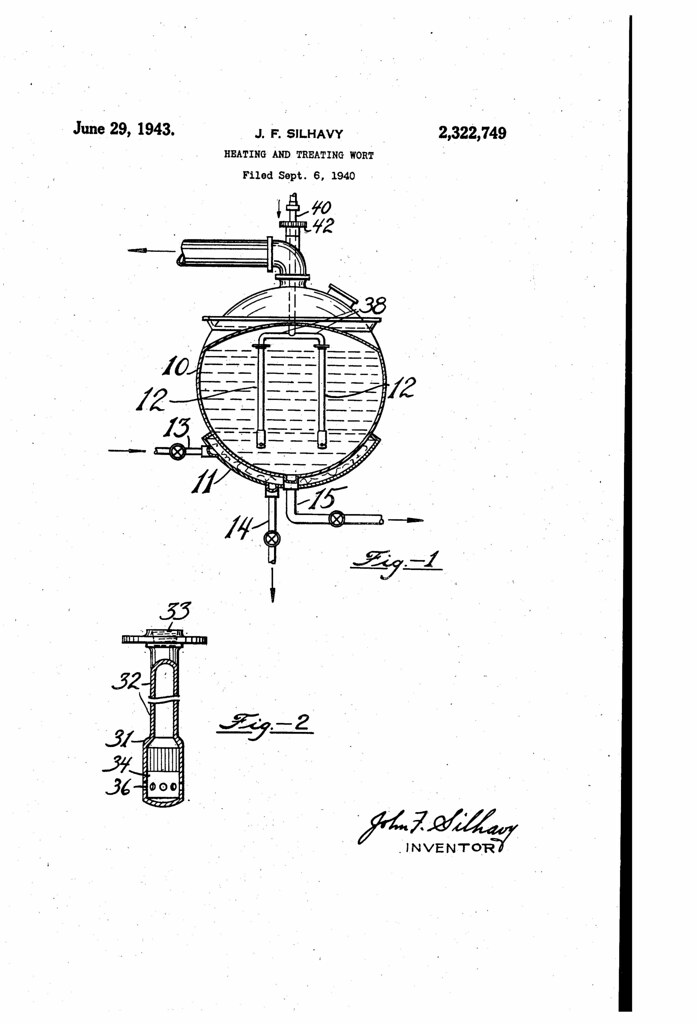
Today in 2012, US Patent 20120093992 A1 was issued, an invention of Peter Gattermeyer and Christian Dorr, assigned to Krones Ag, for their “Apparatus and Method For Stripping Wort.” Here’s the Abstract:

An apparatus and a method for stripping wort, with the apparatus including a receptacle that has a wort inlet and a wort outlet, and a heater on the side wall of the receptacle as well as a distributor device which applies the wort to the heating surface of the heater, such that the wort runs down the heating surface as a film.

US20120093992A1-20120419-D00001
US20120093992A1-20120419-D00002

US20120093992A1-20120419-D00003

US20120093992A1-20120419-D00005
US20120093992A1-20120419-D00006

Filed Under: Beers, Breweries, Just For Fun, Politics & Law, Related Pleasures Tagged With: History, Law, Patent, Science of Brewing, Wort

Patent No. 2155134A: Fermentation Process

April 18, 2016 By Jay Brooks

patent-logo
Today in 1939, US Patent 2155134 A was issued, an invention of Walter Karsch, for his “Fermentation Process.” There’s no Abstract, although in the description it includes this summary:

This invention relates to a fermentation process for the production of alcohol from liquids containing carbohydrates.

The invention provides that the total quantity of yeast shallrbe led positively and continuously in a circuit through a fermentation system consisting of a mixing device and a separating device in this wise that the total quantity of .yeast is moved unidirectionally from the mixing device to the separating device and back to the mixing 5 device. Preferably, after a predetermined controllable time, each yeast particle passes through the separating device and thus comes in contact, with fresh particles of sugar. The yeast is thus for a short time only free from the material to be fermented. The fermented liquor, after a predetermined controllable time, and after once traversing the fermentation system, leaves the said system beyond the separating device. It has been found that yeast can operate continuously in this process because it is removed as rapidly as possible from the conversion products formed. The loss of yeast cells observed with discontinuous fermentation practically does not occur in the present process. The mixing oi the yeast and of the liquor to be fermented is as intimate as possible, so that the conversion of the sugar to alcohol and to carbonic acid is effected with the greatest rapidity. At the exchange surface–the yeast membranes-by the intimate admixture the conversion products formed are withdrawn and new sugar molecules added.

By the flow through the fermentation system in the direction from the mixing device to the separating device it is further ensured that each yeast particle is separated positively after a predetermined time from the conversion products and is mixed with fresh sugar particles. No yeast particles can move in the fermentation system otherwise than in the desired direction, or settle, which is of great importance for the attainment of a maximum output of alcohol. Likewise the fermented liquor is led positively to the separating device, so that the result is obtained that the nocuous conversion products formed are separated as soon as possible from the yeast.

In the preferred embodiment the liquor is subjected to an after-fermentation in the interval between the mixing of the yeast with the liquor to be fermented and the separation of the yeast from the fermented liquor.

US2155134-0

Filed Under: Beers, Breweries, Just For Fun, Politics & Law, Related Pleasures Tagged With: History, Law, Patent, Science of Brewing

Patent No. 34943A: Beer Measure

April 15, 2016 By Jay Brooks

patent-logo
Today in 1862, US Patent 34943 A was issued, an invention of Charles Chinnock, for his “Beer Measure.” There’s no Abstract, although in the description it includes this summary:

I have invented a new and improved can and measure for liquids liable to froth or foam when drawn or measured and also to separate the froth or foam from the liquid when pouring into other vessel or vessels.

US34943-0

Filed Under: Beers, Breweries, Just For Fun, Politics & Law, Related Pleasures Tagged With: Brewing Equipment, History, Law, Patent, Science of Brewing

NBWA Brewery Count Over 4,800

April 12, 2016 By Jay Brooks

nbwa
Some very interesting analysis from the NBWA, and their economist Lester Jones, about the number of breweries in America. Lester’s analysis uses slightly different metrics from the TTB and doesn’t define craft breweries as narrowly as the BA, and also the TTB doesn’t distinguish exactly what mat beverages are being made, if they’re licensed as a brewery then they’re included in the data. Those difference in calculating show the NBWA’s number for how many breweries there in America is 4,824, or over 550 more. But even more remarkable is that based on the number of “permitted breweries on record” at the TTB by the end of last year, that number could swell beyond 6,000, which seems absolutely crazy. The number is California alone, at 788, is just shy of 800. Sheesh!

Here’s the entire analysis below since the whole summary is worth reading:

Each year, the NBWA requests data from the TTB on tax paid withdraw volumes by size of brewery. Once again, this year’s TTB data provides some interesting brewing industry insights into the dynamics of the U.S. brewing industry. This data also is helpful for us to supplement the Brewers Association data on overall independent craft beer growth and brewery count. According to the BA, craft brewer volumes grew by 13 percent to 24.5 million barrels in 2015. The BA also reported 4,269 total operating breweries for 2015. As with all statistics, how the numbers are collected and reported can vary across organizations. In our industry, the numbers also change quickly.

As of April 2016, the U.S. domestic brewing industry had 4,824 reporting breweries according to the TTB. As with the BA’s brewery count of 4,269, this number is expected to change as additional new brewers are counted that may not yet have been fully recognized and/or reported by either the TTB or the BA data. The data presented below is for all types of malt beverage manufacturers and recognizes only the individual facility, not the ownership or control group.

Highlights from the 2015 TTB brewery count data include:

  1. The small brewer group (making less than 7,500 barrels) accounted for less than 2 percent of all domestic volumes yet accounted for 93 percent of all breweries. The smallest of this group has 566 breweries reporting less than one barrel of production each in 2015. These super small brewers can thank the contracting brewing industry for helping them sell almost 100,000 barrels – a figure well beyond their reported production capacity.
    The medium brewer group (making between 7,501 and 60,000 barrels) is a much smaller group consisting of 246 breweries, but these few breweries account for 1.6 times more volume than the 4,475 breweries in the small brewer group.
  2. The large brewer group consists of only 82 breweries making between 60,001 and 1.9 million barrels. This is a unique group within the industry as they pay the mixed rate federal excise tax of $7 for the first 60,000 barrels and $18 on each barrel over 60,001. While a much smaller group of only 82 breweries, they collectively produce more than four times the amount of beer as the medium brewer group. The large brewer group also has the largest range of production volumes and saw the fewest number of new entrants (17 breweries) into its ranks in 2015.
  3. Finally, we get the extra-large group. This is a group of only 21 breweries that produce more than 84 percent of all domestic beer – more than five times the amount made by all 4,803 combined. The closing of the MillerCoors brewery in Eden, North Carolina, will reduce this class of brewers by one in future reports and will take a significant-sized brewery offline for the first time in many years.
  4. The industry added around 1,500 new breweries in 2015 – that is equivalent to four new breweries a day entering the marketplace. As a highly capital-intensive business, starting small is the name of the game. Growing a beer brand takes a long time, and economies of scale are earned over decades. The largest U.S. breweries have been in operation for decades, and economies of scale should help maintain the beer volumes even in the face of declining per capita beer consumption.
  5. With more than 6,000 permitted breweries on record at the end of CY 2015, 2016 is set to be an even more competitive year for the brewing industry. Just as economies of scale drive the brewing side of the industry, logistical expertise and local market insights drive the efficiencies inherent in beer distributor networks. Working together and maximizing their comparative advantages, brewers, distributors and retailers will deliver unprecedented choice and value to American beer consumers in 2016.

Brewery counts by size 2015_Page_1

Brewery counts by size 2015_Page_2

Filed Under: Beers, Breweries, Just For Fun, News, Politics & Law, Related Pleasures Tagged With: Business, Distributors, Economics, Statistics

ABI Buys Devils Backbone

April 12, 2016 By Jay Brooks

ABI devils-backbone
In what’s becoming almost routine news, Anheuser-Busch InBev announced this morning the acquisition of Devils Backbone Brewing of Roseland, Virginia.

Here’s the press release:

Today, Anheuser-Busch announced an agreement to acquire Devils Backbone Brewing Company, the leading and fastest-growing craft brewery in the state of Virginia. Devils Backbone will be the latest partner to join the diverse portfolio of craft breweries within The High End, the company’s business unit comprising unique craft and import brands.

“I am extremely pleased to announce the partnership of Devils Backbone Brewing Company with Anheuser-Busch. While we are joining a creative group of craft breweries in the division, Devils Backbone will retain a high level of autonomy and continue its own authentic DNA within The High End framework,” said Steve Crandall, co-founder and CEO of Devils Backbone Brewing Company. “The existing management team plans to stay on board for many years, while continuing to innovate and bring locally crafted Virginia beer to the nation.”

In 2008, founders Steve and Heidi Crandall opened the doors to Devils Backbone Brewing Company in the Virginia Heartland, after being inspired by a ski trip to northern Italy in 1991 where they had their first taste of Germanic style beer. After success with the first brewpub, Basecamp, the decision was made to break ground on the Outpost facility, in Lexington, Virginia. Originally projected to produce 10,000 barrels of beer in its first ten years, the Outpost produced almost 45,000 barrels in its first three. Steve credits much of this early success to the excellent network of distributors within his system, which is weighted heavily towards Anheuser-Busch.

“I congratulate Steve and Heidi Crandall and the entire Devils Backbone team as they partner with Anheuser-Busch,” said Virginia Governor Terry McAuliffe. “Through the strength of Anheuser-Busch’s network of distributors, Devils Backbone’s award-winning craft beer will soon be available throughout the country and beyond. I want to thank Devils Backbone for their immense contribution to Virginia’s world-class craft beer industry, and I look forward to the additional exposure for Virginia as a leading state for craft beer lovers.”

Today, the Outpost Brewery & Taproom in Lexington serves as the primary production brewery while the Basecamp Brewpub & Meadows in Roseland, serves as a visitor destination. Devils Backbone takes full advantage of the scenic 100-acre Basecamp property surrounded by the Blue Ridge Mountains, offering a variety of opportunities for guests to enjoy the outdoors. In 2015, the two locations hosted more than 500,000 guests.

“Devils Backbone has captivated beer drinkers in Virginia since opening its doors eight years ago,” said Felipe Szpigel, President, The High End. “From the beginning, they have shown creativity and talent with the great beers they brew, and they’ve been able to use the authentic offerings at Basecamp Brewpub & Meadows to cultivate a fun, outdoor lifestyle that resonates with everyone. Pair these qualities with dynamic leadership and a dream to do something bigger, and you have the recipe for an even more promising future.”

While best known for its flagship Vienna Lager, which accounted for nearly 60% of Devils Backbone volume in 2015, the portfolio also includes other award-winning year-round favorites like Eight Point IPA and Schwartz Bier. Developing beers with personality and individual integrity of flavor has helped enable Devils Backbone to win four National titles: 2014 Great American Beer Festival Mid-Size Brewery & Brew Team, 2013 Small Brewing Company & Small Brewing Company Brew Team, 2012 Small Brewpub & Small Brewpub Brewer, 2010 World Beer Cup Champion Brewery, and the Virginia Craft Brewers Fest Best of Show medals in 2015, 2014, 2013 and 2012.

First Beverage Group acted as financial advisor to Devils Backbone Brewing Company. Anheuser-Busch’s partnership with Devils Backbone is expected to close in the second quarter, subject to customary closing conditions. Terms of the agreement were not disclosed.

devilsbackbone-coaster

Filed Under: Breweries, News, Politics & Law Tagged With: Anheuser-Busch InBev, Announcements, Business, Press Release

Scranton Media Family Buys Flying Fish

April 11, 2016 By Jay Brooks

flying-fish
I somehow missed this news, which seems to have come out without too much fanfare a few days ago. Maybe we’re becoming desensitized to brewery M&A? Certainly Twitter wasn’t abuzz with the news. Flying Fish Brewing, one of New Jersey’s earliest small brewers, was bought by the Lynett and Haggerty families, who own Times-Shamrock Communications. They own a dozen newspapers and eleven radio stations. On April 8, they announced that they’d bought a controlling interest in the Somerdale, New Jersey brewery, though the deal was quietly done a month earlier, on March 11.

Flying Fish was founded in 1995 by Gene Muller. They started in Cherry Hill, but moved to larger quarters in Sommerville four years ago.

According to the Scranton Times-Tribune (one of the papers owned by the family), this is how it went down.

The family’s expertise in marketing, events and promotions will help the brewery continue to grow and expand its footprint, said Bobby Lynett, manager of L&H Brewing Partners, the entity that now holds a majority interest in Flying Fish. They declined to disclose the cost of their acquisition.

“Flying Fish is a nice brewery with good people and a great product,” said Mr. Lynett, a publisher of The Times-Tribune. “We want to help it grow.”

Flying Fish currently employs 33 people who produce about 24,000 barrels of beer each year.

Gene Muller, founder of Flying Fish, said he began looking for new partners when some initial investors began to cash out on their investment in the company. He joked that the Scranton family emerged as a good fit “because they are Irish.”

Mr. Muller, 61, believes Flying Fish will benefit from events and other business interests of the Lynett-Haggerty families, whom he refers to as “The Scranton Guys.”

“There are obvious synergies,” he said. “We saw an opportunity to inject some enthusiasm into the company and take care of our initial investors. The Scranton Guys are part of a 100-year-old company. They understand the long-term horizon.”

The capital for L&H Brewing Partners came from some individual family members and Elk Lake Capital, set up by the family to invest in non-media companies to add diversity to the family’s holdings beyond Times-Shamrock’s media holdings of newspapers, radio stations and outdoor advertising. Elk Lake already owns a land-surveying company and water-testing company.

Toasting the Class of '96: Greg Koch, Mark Edelson, Bill Covaleski, Tom Kehoe, Gene Muller & Sam CalagioneAt a Philly Beer Week event celebrating the Class of '96: Greg Koch, Mark Edelson, Bill Covaleski, Tom Kehoe, Gene Muller & Sam Calagione.

Filed Under: Breweries, News Tagged With: Business, New Jersey, Pennsylvania

Patent No. 2547988A: Process For Improving The Foam Of Fermented Malt Beverages And Product Obtained Thereby

April 10, 2016 By Jay Brooks

patent-logo
Today in 1951, US Patent 2547988 A was issued, an invention of Hilton B. Levy, Arthur L. Schade and James S. Wallerstein, for his “Process For Improving the Foam of Fermented Malt Beverages and Product Obtained Thereby” for beer bottles. There’s no Abstract, although in the description it includes this summary:

The present invention relates to fermented malt beverages and more particularly to beverages of this type characterized by the capacity for forming a. stable, that is, a long-lived foam.

It is accordingly the general object of the present invention to provide fermented malt beverages Whose foam-head is longer-lasting in character than the foam-head produced by the normal components of these beverages as at present manufactured.

It is a further object of the invention to improve a persistent or enduring foam which he lasting qualities of the foam-head of fermented beverages by adding to such beverages at any suitable time in the course ,of their manufacture, but preferably after the fermenting and initial or coarse filtering, but prior to the storage period, a small quantity of a soluble non-toxic carboxy-methyl cellulose, preferably in the form of its alkali metal salt, such as the sodium and potassium salts.

We have now discovered that the foam of beer may be prolonged in a simple and economical manner by the addition to the beer of, small amounts of a water-soluble, heat-stable form of carboxy-methyl cellulose, as, for example, the

sodium salt of such material. This is commonly called cellulose gum, and, is a completely harmless and edible material. When solutions of, for example, sodium carboxy-methyl cellulose are added to beer in a concentration of 5 to 200 parts per million, the duration of the foam is greatly increased and a persistent froth is produced which endures for as much as several hours. Preparations of the sodium carboxy-methyl cellulose are particularly valuable when they are of a high viscosity type, and they increase the foam duration period many times.

beer_foam

Filed Under: Beers, Breweries, Just For Fun, Politics & Law, Related Pleasures Tagged With: History, Law, Patent, Science of Brewing

« Previous Page
Next Page »

Find Something

Northern California Breweries

Please consider purchasing my latest book, California Breweries North, available from Amazon, or ask for it at your local bookstore.

Recent Comments

  • Bob Paolino on Beer Birthday: Grant Johnston
  • Gambrinus on Historic Beer Birthday: A.J. Houghton
  • Ernie Dewing on Historic Beer Birthday: Charles William Bergner 
  • Steve 'Pudgy' De Rose on Historic Beer Birthday: Jacob Schmidt
  • Jay Brooks on Beer Birthday: Bill Owens

Recent Posts

  • Beer In Ads #5310: From Behind Heute Bock August 3, 2026
  • Historic Beer Birthday: Emanuel Bernheimer August 3, 2026
  • Historic Beer Birthday: Ellis Wainwright August 3, 2026
  • Beer Birthday: Steve Donohue August 3, 2026
  • Beer In Ads #5309: Falling Down Heute Bock August 2, 2026

BBB Archives

Feedback

Head Quarter
This site is hosted and maintained by H25Q.dev. Any questions or comments for the webmaster can be directed here.