Brookston Beer Bulletin

Jay R. Brooks on Beer

  • Home
  • About
  • Editorial
  • Birthdays
  • Art & Beer

Socialize

  • Dribbble
  • Email
  • Facebook
  • Flickr
  • GitHub
  • Instagram
  • LinkedIn
  • Pinterest
  • RSS
  • Twitter
  • YouTube

Powered by Genesis

Patent No. 3071403A: Crowned Bottle Rejection Pin For Bottle Pick Up Apparatus

January 1, 2016 By Jay Brooks

patent-logo
Today in 1963, US Patent 3071403A was issued, an invention of William J. Hohenstein and Helmut W. Preu, assigned to Schaefer Brewing Co., for their “Crowned Bottle Rejection Pin For Bottle Pick Up Apparatus.” There’s no Abstract, although in the description it includes this summary:

The present invention relates to a crowned bottle rejection pin for use on apparatus which picks up empty bottles for moving them from place to place.

A conventional apparatus for removing empty bottles, such as beer bottles or the like, from cases for transferring them to a conveyer for movement into a washing machine, has a plurality of heads thereon which have an expandable rubber sleeve within them. The heads are connected to a source of compressed air so that when the heads are lowered over the tops of the bottles in a case of empty bottles, the compressed air is fed to the heads and it expands the rubber sleeves around the tops of the bottles. The apparatus is then operated to lift the empty bottles from the case or the like and move them to a conveyer.

It often occurs, however, that caps or crowns will be placed on the tops of the bottles after they are empty, and when the heads on the bottle removing apparatus move down around the tops of the empty bottles, they will pick up the crown as well as the empty bottle and transport it to the conveyer to the washing machine. The crown will remain on the bottle in the washing machine and prevent a brush spindle which cleans the inside of the bottle as well as the rinsing tube from entering the bottle. This malfunction results in the spindles and rinse tubes being bent out of shape, requiring a thirty to fifty minute shutdown of the machine to replace the bent parts.

It is an object of the present invention to provide a pin which can be placed within the heads on the bottle removing apparatus which will prevent the head from picking up an empty bottle which has a crown thereon, yet which will not prevent the head from picking up a bottle without such a crown thereon.

US3071403-0

Filed Under: Beers, Breweries, Just For Fun, Politics & Law, Related Pleasures Tagged With: Bottles, Brewing Equipment, History, Law, Packaging, Patent, Science of Brewing

Session #107: A Friendly Discussion of Friendships

January 1, 2016 By Jay Brooks

friends
The 107th Session is hosted this month by Dan Conley, who writes the brewery blog for the Community Beer Works in Buffalo, New York. For his topic, he’s asking us to consider whether breweries are our friends, or not, by bluntly asking the question. “Are breweries your friends?” Dan goes on to explain what he’s looking for in his announcement for the January Session:

To be in business nowadays you pretty much have to have a social media presence. This is especially true in the beer world, where some breweries have basically built themselves on their personality. And yet, at the end of the day, we’re also selling you something.

I believe this is the first Session to be hosted by a brewery rather than beer blogger. [It’s not, but he’s correct that there haven’t been many. Ed.] How do you feel about that? Do you want your feeds clear of businesses, or do you like when a brewery engages with people? Can you think of anyone who does it particularly well, or poorly? As the person who does our social media, which I think is very good (although not quite good enough), I struggle with this problem. I’m on both sides, and rather than come to any sort of conclusion of my own I thought I would make all of you write about it.

session_logo_all_text_200

So to answer this question, I think we have to know what friendship is. I know that sounds like a stupid question, but I don’t think it really is. I tend to think that we all define what it means to be friends differently, not to mention that there are numerous levels of friendship. There are many different schools of thought about the differences in friendship we have among the people we know, from acquaintances (someone we barely know) to our best friend, partner/spouse and family. Some put family in a different category altogether, and I guess that makes sense since you can’t get rid of a family member who continually annoys you. You can stop talking to them and make a point of never being around them, but that doesn’t change their status: they’re still family. So for our purposes, I’ll avoid family and concentrate on people we choose to spend time with.

Not surprisingly, there are myriad theories of friendship. One of the simplest involves four levels. For example, the Institute of Basic Life Principles sets their levels as follows:

  1. Acquaintance
  2. Casual Friend
  3. Close Friend (Fellowship)
  4. Intimate Friend

That one seems like a good start but seems too broad to be very useful, as it leaves little room for nuance, setting up a lot of either/or situations. Friendship seems more complicated than those four. Still others have more, as many as six or seven. For example Cherie Burbach, who calls herself a “Friendship Expert” lists six Stages Of Friendship and another blog by Steve Schappell called Life, Relationships, the Universe and everything details The seven levels of friendship.

  1. Acquaintance
  2. Mentor
  3. Online Friend
  4. Friend
  5. Good Friend
  6. Best Friend
  7.  

  1. General Friend
  2. Work Friend
  3. Activity Friend
  4. Outer Circle Friend
  5. Inner Circle Friend
  6. Close Friend
  7. Girlfriend/Boyfriend/Best Friend

Those are, of course, just examples. I’m no social scientist and haven’t been studying the “friend” question for years. But I have friends, of course. And they’re certainly some friends who are closer than others. In my own experience, you start with people you don’t know at all, strangers, or more charitably friends you haven’t met yet. Then you meet them, you become acquainted with them, and voilà, they’re acquaintances. It’s a start. And sometimes they do become friends, at least at some level. Some may never rise above the casual level, but others will climb the ladder, so to speak. Here’s my own unscientific take on the levels of friendship, based solely on my own experience and thinking about it for the last couple of days.

brookston-pyramid-of-friends

  1. Strangers
  2. Acquaintance
  3. Casual Friend
  4. Associates & Colleagues
  5. Good Friends
  6. Your Gang, Crew, Group, Tribe, Inner Circle, Posse
  7. BFF / Partner

And below is me spitballing what I mean by the levels of friendship in my pyramid.

  1. Strangers: This is essentially everyone you don’t know personally, meaning you have not met them or been introduced. It would include people that you know, meaning you know of them, perhaps even know their name, which would include famous people and personalities, friends of friends, people you’ve seen at work or at school or in your neighborhood or at the grocery store checkout line, etc., but you haven’t actually spoken to. This is without a doubt the largest group of people, containing billions and billions of people, but it’s also brimming with possibilities, because we can meet new people every single day. That’s why I jokingly subtitled this “friends you haven’t met yet.” Every single person in this group has the potential, however unlikely, to move into the next category.
  2. Acquaintance: These are people who are not quite your friends yet, but who are also no longer strangers. These are people you are acquainted with. Not only do you know their names and probably something about them, they also know who you are and you have, at a minimum, spoken to them. You probably have at least something in common with them, perhaps a mutual friend or you share work, a team, a hobby or maybe fit into some other venn diagram circle with them.
  3. Casual Friend: These are slightly more familiar than acquaintances. They’re people you’ve probably had a conversation with, but it was likely about the weather or whether the Giants will win the World Series this year (The answer to this is “yes,” BTW), nothing too deep or profound. You’d say hello to them whenever you saw them, and might even stop briefly to exchange pleasantries or shoot the shit. They’re most likely friends of other good friends, or new to your circle of acquaintances for some reason. Some will move up and become better friends, while others will likely stay in this friend purgatory where things remain pleasant enough but never grow more intimate. Maybe you just don’t click, maybe you don’t have enough shared interests or see eye to eye on some issues. But it doesn’t have to be a negative, either. Casual friends are the laboratory where all your friends come from, these are just the ones that didn’t quite make it up to the next level. They have their own set of good friends, and so do you. But they’re nice people and they make up a significant portion of your world.
  4. Associates & Colleagues: These are people you interact with on a professional level, often at work, but it could also be in other pursuits like hobbies, your school or some other organization you’re involved with. When you see them, you probably talk primarily about those shared groups you’re both involved in, but you also can spend time socially and know something personal about one another. Your discussions are generally more lively, longer and would likely involve alcohol. This is the level of friendship that would include having a beer. You associate with them in bars. After a hard day at work, you meet up with them for happy hour. At the end of the day attending a conference, you’ll see them at the hotel bar. You’ll feel comfortable walking up to them or they’ll wave you over to join them. They’re becoming your drinking buddies.
  5. Good Friends: These are people you make plans to spend time with. You make a point of scheduling time together. You’ll also drink with them, usually a lot, but they also know where you live, have been to your house, and maybe even crashed there a time or two. If you don’t live in the same town, they always call when they’re visiting wherever you live. They know a lot about you personally, probably started out as a colleague or associate in something. Maybe you went to school together or shared time in some mutual pursuit, and after a time grew closer and closer. You probably exchange Christmas cards.
  6. Your Gang, Crew, Group, Tribe, Inner Circle, Posse: These are the good friends you spend the most time with, and identify as your group of friends. They’re the ones you invite to impromptu backyard barbecues, birthday parties or other holiday brouhahas. You plan out events with them well in advance, many of them annual or regularly occurring. They make up the people in your wedding party, the groomsmen or bridesmaids. They know all of your intimate details. They know what you like to drink. They’re the ones you’re nervous to have meet your new girlfriend or boyfriend. What they think about you matters, at least to you. They have your best interests at heart, and you look out for them, too. People in this group would hold your hair back while you puke your guts out, and some might even clean it up afterwards while you sleep it off. These are the people in most of your group photos, your drunken revelries, the ones with shared histories and hilarious tales that are told over and over again. People not a part of this group often feel left out at a group event because they don’t get all of the inside references. Even if you move away or drift apart, you stay friends for life. They’re like family you choose.
  7. BFF / Partner: This is very small group. It’s your husband, wife, boyfriend, girlfriend, whoever you’re intimate with and have made a commitment to, along with perhaps one or two other people who you would feel comfortable asking to be the best man or maid of honor at your wedding, or perhaps godfather or godmother to your children. This is who you’d call first to bail you out of jail. This is who would call you when they need a ride to the emergency room. You have almost no secrets from these few souls. They know everything about you, and they still like you. They’re true friends in every sense of the word.

One thing I’ve also noticed from observing my kids is that the younger you are, the easier it is to make friends, and especially to identify people you’ve just met as friends. I think we grow more reserved, more private or more guarded. Not everyone, of course, some people are naturally more gregarious and talkative. They usually become salespeople. I’m certainly not one of them. That’s why I became a writer: less talking, more quiet time. But I certainly notice that it’s increasingly harder to open up to people now that I’m in my mid-fifties.

When I worked in an office, with other people in it, I hung out with work friends from time to time, and in fact that’s where I met my wife, when she started working for another lawyer in the same office. Twenty years later, she’s a lawyer and I work from home and take care of our kids. So the only people I see, apart from a few exceptions, are family and people I work with, which now consists of mainly people who also work in the beer world at some level. 2016 is my 25th year writing about beer and working at some level within the industry. As a result, I’ve met a lot of people in the same field, having at least beer in common, and in some cases much more.

I recognize that beer is a business. It has to be. It can’t really be anything else and the brewer or brewery owner who doesn’t keep that in perspective is likely going to fail. I’m not blind to the fact that I can help (or hurt) a brewery by writing about it, but also a brewery can help me by giving me something to write about. There’s certainly a symbiosis. But they are people, too, just like you and me. Since I’ve been doing this for such a long time, I have known quite a few other people who have also been at this for years. And some of them have remained acquaintances, while others have become casual friends or even close ones. There’s a certain inevitability to that, as far as I’m concerned. I believe I’ve remained professional, or at least tried to, but people are, I think, drawn together by shared experiences. And as a result I do count several brewery owners, brewers and people who work in the industry as my friends. What level of friends? It varies, of course, and some are closer friends than others.

friends-brookston

Am I worried about that? Do I think it’s made me “tainted” or somehow beholden to anyone? Emphatically “no.” A few people think that a journalist should never be social and keep an arm’s length with the people they’re writing about. And they’re welcome to that opinion, and can conduct their affairs as they see fit. I have, however, grown weary of hearing how corrupt I am for such behavior if I don’t hold myself to the same standard that others would impose on me. I feel confident that the majority of my readers don’t care or don’t think I’m being untrustworthy with them with whatever I write about a beer or a brewery.

I also think readers like to see a glimpse into the personality of the people who brew their beer. And I don’t think I could bring that level of intimacy about a person I’m writing about unless I actually had a real relationship with that person, knew them for far longer than the time it took to call them up for an interview. My friendships, at whatever level, provide background and context that I doubt could be created any other way then simply living among the people in the industry, and mixing socially within it. Like many journalists, I suspect, I hear countless rumors and information provided off the record precisely because I can be trusted to keep that information private. But I also think that I can therefore have a better understanding of events, their consequences and what they might mean because of the background and context that I’ve built up over the last quarter century. I like to joke that I know where all the bodies are buried, but there’s some truth to that. I have institutional knowledge that I believe has significant value that I wouldn’t otherwise possess if I’d remained at arm’s length from people in the industry.

That does not mean, naturally, that I couldn’t or wouldn’t write critically about a beer or a brewery if it was appropriate, in my opinion. But every journalist has to choose for themselves, with their readers in mind of course, what they write about. And with obvious exceptions, I generally prefer to write about positive things, good beers worth drinking and breweries making good beer, especially when it comes to work where my audience is primarily consumers, unlike the Bulletin, which I suspect is more trade-oriented in its demographics. So I’ll continue to count others in the beer industry as my friends, some as close friends, some as simply casual acquaintances but all of them the reason I love my job, and I will continue to do so as I see fit.

Bud-1907-friend

But Dan’s question is “Are breweries your friends?” Which is a slightly different question. The Supreme Court may have declared corporations to be “people,” but the rest of us know how absurd that is, and can tell the difference. So while I’m perfectly at ease having friends in the beer industry, breweries themselves, and especially the ones large enough to have a staff beyond just the founders, the Mom and Pops, and the solo operations, are clearly businesses. And if they’re corporations — as many are — then they have a duty to shareholders (even if they’re just themselves and a few investors) to maximize profits and do whatever it takes to remain profitable. They want, and really need, your money to stay in business. Is there a difference between small, medium and large corporations? I think so. The small and some of the medium enterprises incorporated solely for liability protection, but function like they are accountable to their customers and the wider world. Some of the medium, or regional breweries, and many of the larger ones do not, and function more or less like any big corporation, which is to say the profit motive is the primary reason for virtually every decision. And for the most part, we all know who those businesses are.

But what about typical consumers, people who don’t write about beer, don’t dissect it or subject the industry to scrutiny on a daily basis? Are the people who simply drink a brewery’s beer or even are fans of them also “friends” of the brewery?

A few years ago, I interviewed Tony Magee, owner of Lagunitas, for a profile of him I wrote for Beer Connoisseur magazine. I first met Tony in the mid-1990s, maybe a year or so after he’d started out, before they’d moved to their present location in Petaluma. So around two years ago we met for lunch and I turned on my tape recorder (now just an app on my phone, but somehow that doesn’t sound as poetic) and talked for about three and a half hours. We did talk about the brewery, and the beer industry, but also touched on a bewildering array of fascinating tangential topics, too. One interesting idea we talked about was the relationship of the beer drinker, especially fans, to the brewery, and how they function a lot like tribes.

And while that particular incident was borne of necessity, it is indicative of the seat-of-the-pants philosophy that marked early success at Lagunitas. Magee made decisions based on what seemed to be right, using his gut and voracious appetite for information for guidance. And he listened to his customers.

“After Fritz Maytag, I don’t think any craft brewer ever took a risk and things would become risky only when their shortcomings caught up with them. Consumers built the industry. Period. As you look backwards, you might think you caused this or you caused that but the truth is that there’s this set of desires out there and it could have been craft beer, or nicotine-free cigarettes or it could have been electric cars or a clothing thing but there’s this thirst for a connective thing in life. Take all the tattooing that goes on today. You know I don’t tattoo, right, but this anthropologist was writing, saying that he thinks it reflects the death of a culture, that culture has abandoned its people and they do tattooing in order to build tribes.”

“There was a guy I ran into a while ago,” continued Magee, “and his daughter was an academic doing her thesis at MIT and she was writing a socio-anthropological paper about the ‘new primitives,’ and I really think craft beer is all about that. The tribe wills things into being, through collective thirst, and they’re always looking for that desire to be fulfilled. And it could come in lots of different forms, but in this case it came in the form of craft beer, and when the tribe — these people from a dying culture — recognized that they could see something in it, and then those consumers nurtured the breweries. They were willing to accept the brewery’s failures. This is why we could sell so much beer when we weren’t making very good beer. And why nobody got upset when our bottles would explode during the early 2000’s.”

Magee believed this plays into the idea of consumers and broken hearts, where consumers grow to love certain brands, and really want them to succeed, in fact actively nurture them into being successful. But at some point the brand has to continue to deliver. He points to one large and beloved California brewer, as a prime example. “What they did — the need that they satisfied — was consistency, predictability and a clear thing, you know. Well, that was plenty. But it found its limits. Because you also need to be able provide people with variety, challenges and engagement. So now they’re all over that. But it wasn’t until they started doing that, that they began growing again. They responded to the love. They didn’t betray it by denying and saying, ‘No I’m going to give you this instead.’”

“The biggest brewers now want to drive people, as if they were a herd. ‘It’s a herd. We need to manage it. We need to cut out our segment and try to drive it to our side.’ Craft beer, by contrast, is still cultivating its market. Craft beer is a currency of social interaction within tribes. There’s no reason why the future of craft beer won’t be local. It’s where that value is most evident to people.”

And I think he was onto something there. Again, I think it’s analogous to music. Craft beer fans, especially early adopters, feel like they discovered something akin to a new band or musical movement. They feel like they’re in on a secret that until recently less than 10% of the population was aware of, much less when it’s about a single brewery. And I do feel that people feel a sense of kinship or even ownership in that brewery’s success. And who can fault a brewery for feeding that desire? I really think it’s not at all cynical in most cases. I also believe that many, if not most, small brewers feel a reciprocal kinship with their core customers who did help them succeed. In may not be, strictly speaking, “friendship” but I think it does share some similar elements and their associated feelings. I also think that partially explains why some people seem to feel betrayed when a brewery sells to a larger beer company, precisely because the brewery did such a good job of helping them or letting them feel a part of their “tribe.” And again, in my experience, I think that affection for their consumers is genuine for most brewers. It’s only when they begin to grow and make the seemingly unexpected business decision that it jars people out of their happy place.

TEAM UNITY AND COOPERATION

In the end, I think breweries can be, and often are, your friends, or something akin to that. It may not be the same sort of friendship that you experience with actual people, but it does provide some of the same emotions and often makes you feel like you belong or are a part of something in the same way belonging to a circle of friends with shared interests does. I know that technically, the real answer is “no” because people can’t be friends with organized entities, it requires “two or more people.” But that, I think, is too black and white, and oversimplifies people’s relationship with businesses. People have long been willing to essentially advertise a company’s brand by volunteering to wear a t-shirt, hat or other article of clothing or decoration that contains the businesses brand, logo or imagery. And in many cases, people actually pay for this privilege, handing over their money to buy this merchandise. Why would any sane person buy a shirt with the Nike swoosh on it, or any other company’s logo? It’s because they identify with whatever they perceive the brand to stand for on an emotional level. They believe it expresses something about their own personality that they want to identify with, and want others to see in them. And that’s as true for breweries as any other business.

If you stepped back from being part of a brewery’s tribe, you’d have to notice that they needed you to succeed. Somebody has to buy their beer or they won’t stay in business and can’t keep making it. So why shouldn’t they treat the people who are responsible for their continued success as nicely as possible, as “friends of the brewery.” From their point of view, that’s exactly what their best customers are. It’s smart business to create compelling merchandise with their logos, brands and beers on them and make them as cool as possible so people will want to wear them. Not only does it provide another revenue stream, which can be quite lucrative, it also spreads awareness of their brand in a more personal or intimate way than you could ever achieve with traditional advertising. Every person walking around in a logo t-shirt is a walking billboard. If the brand is perceived as cool, so is the person wearing the shirt. That’s gold if you’re a business.

Is it cynical or overly calculated on the part of a business to cultivate those perceptions or emotions so that their brand does resonate with consumers and especially their fans? I don’t think so. We all want to belong to something, even the people in those breweries, so there’s a part of this that’s human nature. Why not tap into it? A brewery owner wants his business to succeed, of course, and there any many paths to achieve that, not to mention that success is defined differently for different people. Some are content to achieve a sustainable level of profit while others are always trying to grow and make more, while others are somewhere in between. Making great beer is a good start, but with 4,000+ breweries vying for your attention and your wallet, that’s not enough. Every brewery needs their beer brand to stand out, to mean something to the people drinking it, enough so that they do feel part of their tribe.

Until, of course, they make a business decision that’s seemingly at odds with the perception you had of their brand. Then you feel like they tricked you, even though they really didn’t. They may have helped, but you convinced yourself you were part of the tribe, indeed its membership is largely self-imposed. You decided you identified with the brewery because of shared ideals or some other intangible emotional response. Few breweries did what Rogue managed by creating actual membership cards to the Rogue Nation, their tribe of fans. But the effect is the same everywhere. When we make an emotional investment in a business, it’s the ultimate marketing tool, but there is also a potential cost if you don’t keep it in perspective.

I think many breweries do want to reach you on an emotional level. They want to be your friend, or at a minimum want you to think that they are you friend. And I think they really are at some level, though not usually in the way you probably think. It may be that they’re “friendly” rather than your actual friend. But in most cases, that’s enough, especially if you’re able to stay objective and keep it in perspective. So I think brewers and breweries are in “the friend zone,” just don’t mistake that for more than what it is.

your-friend-beer

Buds-a-friend

Filed Under: Breweries, Just For Fun, The Session Tagged With: Blogging, Websites

Patent No. 3071469A: Process In The Manufacture Of Beer

January 1, 2016 By Jay Brooks

patent-logo
Today in 1963, US Patent 2226813 A was issued, an invention of Erik Krabbe and Kenneth W. Wendt, assigned to Miller Brewing, for his “Process in the Manufacture of Beer and the Like.” There’s no Abstract, although in the description it includes this summary:

The present invention relates to an improved process and apparatus for the manufacture of beer and the like and includes among its objects the provision of improved apparatus for aging and finishing of beer and fermented beverages, and of improved procedures for accomplishing the same.

The present invention contemplates a number of embodiments, including installations for the conversion of existing tank storage facilities to a system of continuous flow aging and without undue modification thereof. Other embodiments provide disclosures of relatively more economical construction for use in new installations, and which provide similar desirable results in the end product.

US3071469-0
US3071469-1
US3071469-2
US3071469-3

Filed Under: Beers, Breweries, Just For Fun, Politics & Law, Related Pleasures Tagged With: Brewing Equipment, History, Law, Patent, Science of Brewing

Patent No. 2623672A: Beer Jetter

December 30, 2015 By Jay Brooks

patent-logo
Today in 1952, US Patent 2623672 A was issued, an invention of James H O’Neil, assigned to the Continental Can Co., for his “Beer Jetter.” There’s no Abstract, although in the description it includes this summary:

The invention relates to new and useful improvements in a method of packaging beer in containers and more particularly in open top cans. The elimination of air from the head space of the container before sealing is recognized as desirable. Many expedients have been proposed and utilized for this purpose, including the directing of a jet of inert gas into the beer beneath the surface thereof through a nozzle submerged in the beer in an open top can for causing foam to ll the head space and force the air therefrom. The wide open mouth of the open top can presents difficulties when attempts are made to direct a jet of inert gas into the beer from a point above the surface of the beer, because the jetted stream entrains surrounding air which is driven into the beer along with the inert gas causing an excessive amount of air to be entrapped in the beer and foam. Also, the velocity of the jet must be controlled to avoid blowing the foam from the surface of the beer thereby causing excessive foaming and Waste of beer.

An object of the invention is to provide a method of directing inert gas into an open top can partially filled with a gas containing beverage which includes the step of first covering the mouth of the can so as to provide a closed head space with a vent opening leading to the atmosphere and then directing a jet of inert gas through the closed head space at a point above the surface of the beer at a velocity sufficient to cause the gas to penetrate the surface of the beer for causing the beer to foam and iill the head space with foam.

US2623672-0
US2623672-1
US2623672-2

Filed Under: Beers, Breweries, Just For Fun, Politics & Law, Related Pleasures Tagged With: Brewing Equipment, Cans, History, Law, Packaging, Patent

Patent No. 717493A: Wort-Cooler

December 30, 2015 By Jay Brooks

patent-logo
Today in 1902, US Patent 717493 A was issued, an invention of Albert Zeiger, for his “Wort-Cooler.” There’s no Abstract, although in the description it includes this summary:

This invention relates to an apparatus for cooling wort as it comes from the kettles in the brewery; and it embodies certain novel features of construction and arrangement of parts which enables it to be used not only as a wort-cooler, but as a strainer to remove the hops from the wort, thus permitting the wort to be run directly from the cooler into the fermenting-room and dispensing with the necessity of the hopper-jack, which has heretofore been used.

US717493-0
US717493-1

Filed Under: Beers, Breweries, Just For Fun, Politics & Law, Related Pleasures Tagged With: Brewing Equipment, History, Law, Patent, Science of Brewing, Wort

Patent No. 466310A: Wort And Yeast Aerator For Beer Vats

December 29, 2015 By Jay Brooks

patent-logo
Today in 1891, US Patent 466310 A was issued, an invention of Otto Hitter, for his “Wort and Yeast Aerator For Beer Vats.” There’s no Abstract, although in the description it includes this summary:

I have invented a-certain new and useful Improvement in Wort and Yeast Aerators for Beer Vats, of which the following is a full, clear, and exact description, reference being had to the accompanying drawings, forming part of this specification.

This apparatus is constructed and arranged consists in features of novelty hereinafter fully described, and pointed out in the claims. Figure I isa detail view of the aerator and shows the coupling for the air-hose, the air filter, the bulb-casing of which later forms a handle or hold for the operator, by which he directs the instrument. It also shows the inception filtered air-chamber, the supply air tube, and the compound aerating-bulb; and Fig. II is a vertical section of a brewers fermenting vat and shows the yeast and wort aerator in active operation therein.

US466310-0

Filed Under: Beers, Breweries, Just For Fun, Politics & Law, Related Pleasures Tagged With: Brewing Equipment, History, Law, Patent, Science of Brewing, Wort

Patent No. 3225510A: Article Cartoning Machine

December 28, 2015 By Jay Brooks

patent-logo
Today in 1965, US Patent 3225510 A was issued, an invention of Robert J. Weichhand and Wickliffe Jones, for their “Article Cartoning Machine.” There’s no Abstract, although in the description it includes this summary:

This invention relates to article packaging and more particularly to a machine for packing beer bottles in conventional six-pack or eight-pack cartons.

More specifically, the machine of this invention is intended for packaging beer bottles in cartons which are formed of paperboard material and which are furnished in a fiat collapsed condition. The collapsed cartons are loaded in stacked formation into a magazine, which includes mechanism for withdrawing the collapsed cartons individually from the lower portion of the magazine subsequently to be erected and loaded. In order to obtain the high loading rate, as indicated above, the bottles, which are fed in a continuous stream, are segregated into groups and the groups advanced into the erected carton from opposite ends. After being loaded with the bottles, liquid adhesive is applied to the flaps of the cartons, then the flaps are folded to a closed position and sealed before the loaded cartons are discharged from the machine.

To perfect a cartoning machine which will handle 600 to 1,200 or more bottles per minute and package them in an automatic manner, the bottles must flow in a substantially straight line continuous movement without any stopping or starting. At the rate of movement of this machine, the inertia of stopping the bottle and starting it again or of jerky acceleration and deceleration would break the bottle or at least scar and tear the paper label. It has thus been an object of this invention to provide a bottle cartoning machine which utilizes smooth acceleration and deceleration substantially straight line continuous flow of the bottles to be packaged and which eliminates abrupt impact reciprocating or oscillating elements which might break the bottle or at least scar the labels upon the bottles. It should be understood that while this machine has been described with reference to packaging bottles, it is equally adaptable to packaging other articles. Of course a machine operable to handle fragile glass is capable of handling metal containers such as beer cans.

The machine includes a series of continuous motion conveyor systems for advancing and erecting cartons after they have been withdrawn individually from the magazine. Thus, the first conveyor apparatus receives the carton blank as it is withdrawn from the bottom of the magazine and includes means for handling the flaps which project outwardly from the opposite open ends of the advancing blank. A first stage conveyor apparatus advances the blank toward a main carton transport conveyor and concurrently partially erects the carton. The partially erected carton is then transferred to a main carton conveyor and during transfer is completely erected by con- Patented Dec. 28, 1965 ice tinuously advancing spacer lugs on the main carton transport conveyor. These lugs coact with the first stage conveyor apparatus to completely erect the carton. The spacer lugs of the main carton conveyor confine the carton firmly in its erected condition and advance it toward the bottle loading zone with the several carton flaps extending outwardly to an open position to avoid any interference of the bottles as they are advanced into the open end of the erected carton.

As the erected carton advances to the loading zone, six cans (or eight cans in the case of an eight-pack) are fed laterally from a pair of parallel bottle conveyors into the opposite ends of the carton by stationary converging guide rails. The bottles are segregated into groups of three each (or four in the case of an eight-pack) and fed into the carton. The segregating mechanism consists of restraining fingers which enter in front of every third bottle. These restraining fingers move at a slower rate than the bottle conveyors so that the restraining fingers slow the movement of the bottles. The down stream finger then releases a group of three which move away from the finger or move downstream at a rate determined by the bottle conveyor which is moving faster than the restrained bottles. As soon as the group of three bottles have moved downstream so as to establish a gap between the restrained bottles and the unrestrained ones, spacer fingers enter the gap so as to maintain the spacing between the now grouped bottles. Guide rails then force the group of bottles across a continuously moving bucket conveyor which maintains the spacing of the groups and into the open sides of the cartons. After the bottles are loaded into the carton, liquid adhesive is supplied to the flaps and the flaps are folded to a closed position and sealed as the carton advances toward the discharge end of the machine.

A further objective of the invention has been to provide an improved segregating mechanism for forming articles into groups while advancing the articles toward a packaging zone where the segregated groups are fed transversely into the open end of an advancing carton.

US3225510-0
US3225510-1
US3225510-2
US3225510-3
US3225510-4
US3225510-5
US3225510-6
US3225510-7
US3225510-8
US3225510-9
US3225510-10
US3225510-11
US3225510-12
US3225510-13
US3225510-14

Filed Under: Beers, Breweries, Just For Fun, Politics & Law, Related Pleasures Tagged With: Bottles, Brewing Equipment, History, Law, Packaging, Patent, Science of Brewing

Patent No. 1013057A: Keg-Rinsing Machine

December 26, 2015 By Jay Brooks

patent-logo
Today in 1911, US Patent 1013057 A was issued, an invention of George Denison Prentice, for his “Keg-Rinsing Machine.” There’s no Abstract, although in the description it includes this summary:

My invention is a machine for rinsing or washing out casks, kegs, or other receptacles, the same being caused to operate automatically by the weight of a cask or keg placed in due position on the ,machine, and requiring no attention or manipulation. Water is discharged into a cask or keg when placed on a depressible support and over a perforated nozzle. When the keg-support is depressed it opens a water-discharge valve and raises a weighted piston in a cylinder or dash-pot, and the time required for descent .of the piston to its original position determines the time of discharge of water into the keg. I thus provide for automatic discharge of water into a keg for rinsing the same and for automatic regulation of the time during which said discharge shall continue.

US1013057-0
US1013057-1
US1013057-2

Filed Under: Beers, Breweries, Just For Fun, Politics & Law, Related Pleasures Tagged With: Brewing Equipment, History, Kegs, Law, Patent

Patent No. 531314A: Process Of And Apparatus For Preparing Beer

December 25, 2015 By Jay Brooks

patent-logo
Today in 1894, US Patent 531314 A was issued, an invention of A.M. Hofmann, for his “Process of and Apparatus for Preparing Beer.” There’s no Abstract, although in the description it includes this summary:

It may be stated at the outset that I have primarily designed my improvement for the particular application to beer in barrels or kegs orin bottles, and I therefore, and for the sake of convenience, hereinafter confine the description of my invention in its application to racking, carbonating and bunging beer, though it is also applicable to, and I desire to be understood as intending it for, any and all liquids or beverages requiring similar treatment to prepare them in receptacles for the market.

A known manner of carbonating a beverage to prepare it for the market is to introduce into the holder containing it a liquid (preferably of the same kind) in small quantity proportionately to the quantity contained in the holder, but so highly charged with the gas, for which -,it affords a vehicle and a mixing or incorporating medium, as to supply the contents of the receptacle,and thoroughly impregnate them, with a charge of gas adequate for all requirements in the beverage.

I find that where the carbonating procedure referred to is employed on beer, the diffusion of the gas through the beer in the receptacle, however thoroughly it may be produced, is not lasting where the receptacle is not completely, or at least approximately, filled with the beer to be charged, which it rarely is; since the space left on filled affords, as it were, a pocket, in which the gas tends to accumulate, and whence it quickly escapes on opening or venting the receptacle, leaving the beer, when poured or drawn for consumption, insufficiently carbonated. Incomplete filling of the receptacles is, perhaps, as likely of occurrence where the receptacles are glass bottles as where they are barrels or kegs, notwithstanding that the transparent nature of the former renders the matter of completely filling them readily accomplishable.

My process consists in withdrawing from a .receptacle after filling it with beer (taken by preference directly from the cask) a suitably small proportion of its contents, and replacing the quantity thus withdrawn with an equal, or approximately equal, quantity of liquid highly charged with gas, thereby, practically, withdrawing the desired quantity from the receptacle, then charging it excessively with gas, and returning to the receptacle the same liquid, charged, that was withdrawn from it. Thus, after a receptacle has been completely filled, or substantially so, with the beer to be carbonated, (and complete filling of a barrel or keg is a matter as simple as filling a bottle) by withdrawing ascertain quantity to make room or the charge, and replacing it with an equal or substantially equal quantity of the supercharged carbonating liquid, the desirably full condition of the receptacles is attained.

US531314-0
US531314-1
US531314-2
US531314-3
US531314-4
US531314-7

Filed Under: Beers, Breweries, Just For Fun, Politics & Law, Related Pleasures Tagged With: Brewing Equipment, History, Law, Patent, Science of Brewing

Patent No. 664824A: Cold Air Pressure Apparatus For Beer

December 25, 2015 By Jay Brooks

patent-logo
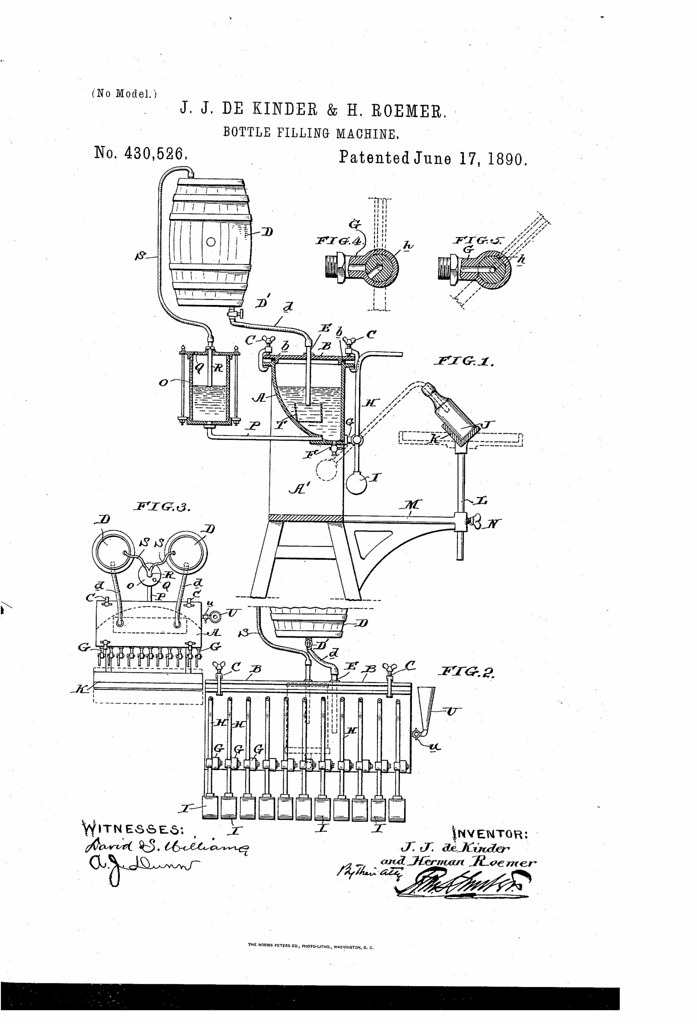
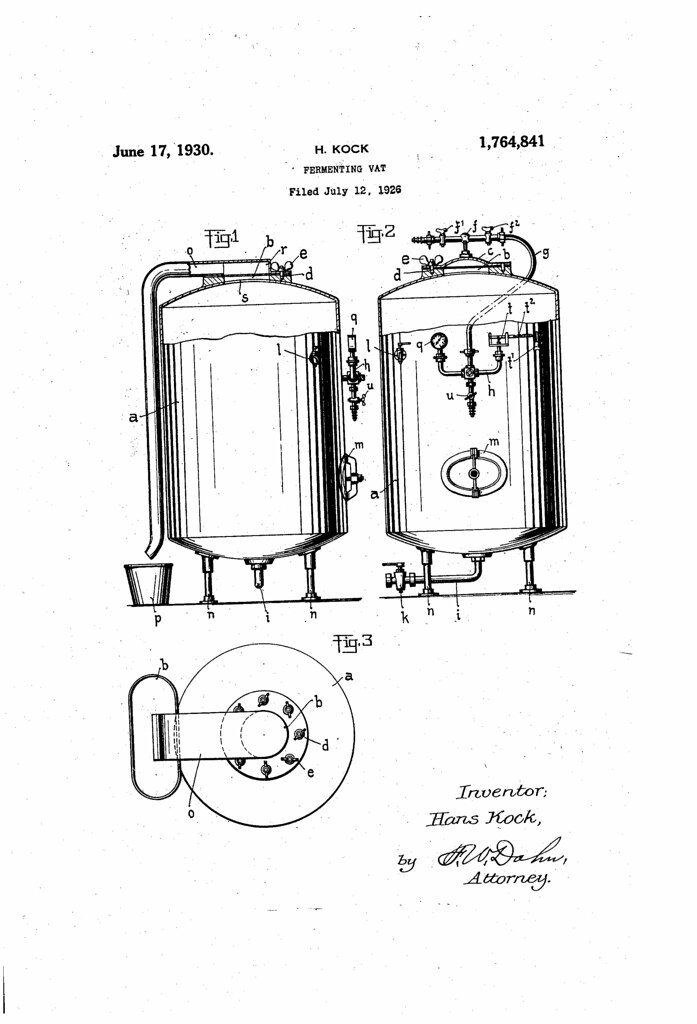
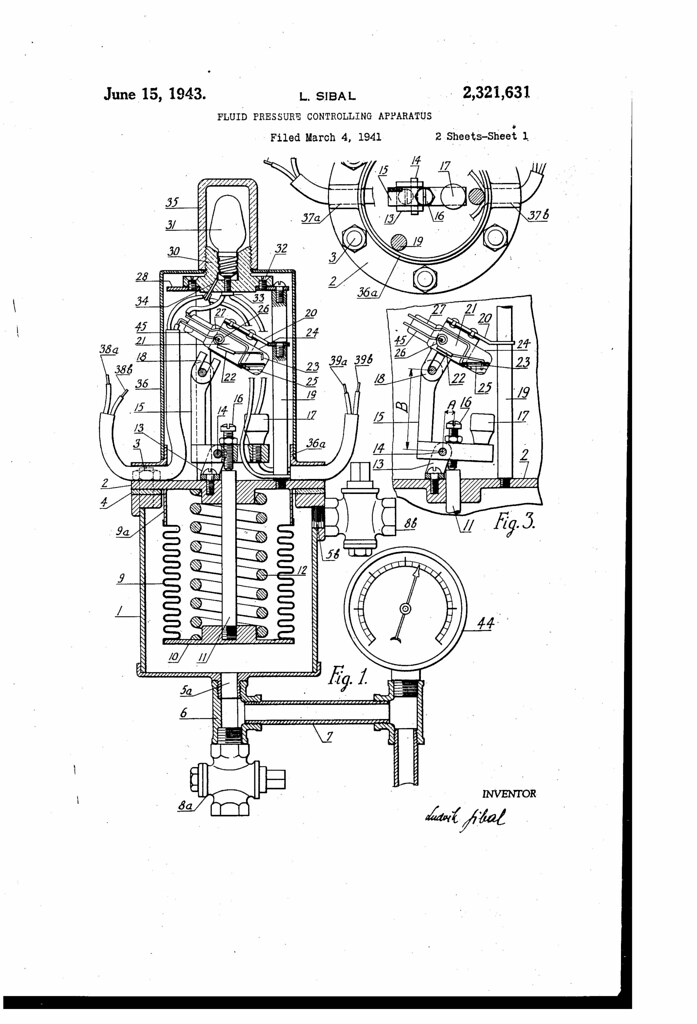
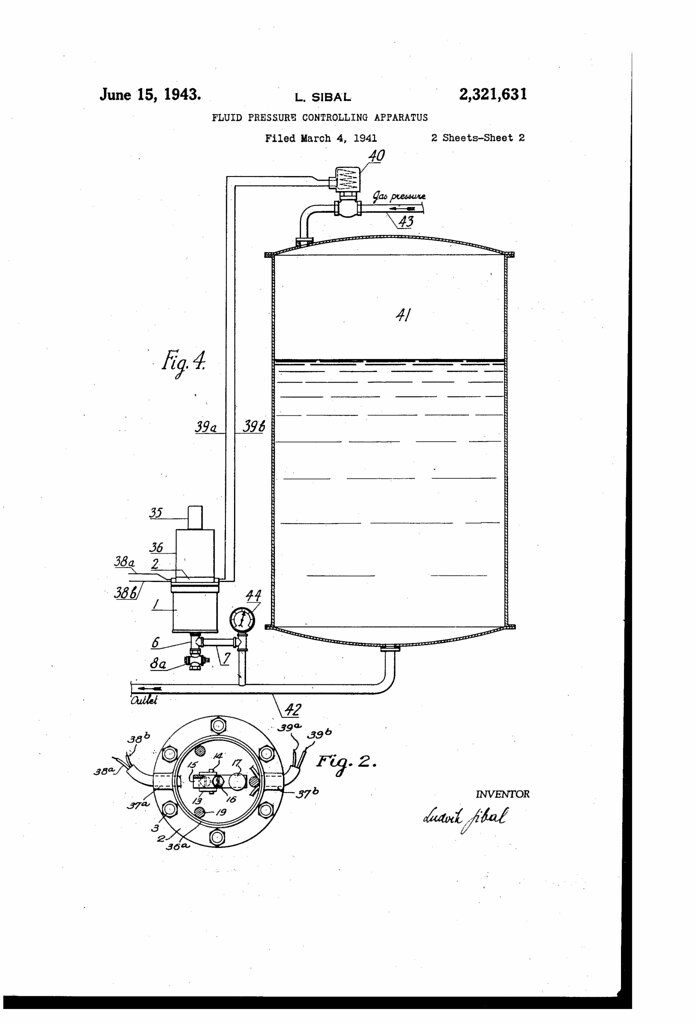
Today in 1900, US Patent 664824 A was issued, an invention of Gottlieb Schmidt, for his “Cold Air Pressure Apparatus For Beer or Other Fluids.” There’s no Abstract, although in the description it includes this summary:

My invention relates to an apparatus involving an air-chamber and a refrigerator adapted more particularly for cooling beer or other fluid, wherein cold air will be directed under pressure to said fluid where it is to be dispensed, the construction and operation of the parts thereof being hereinafter set forth, and the novel features thereof pointed out in the claims.

apparatus-for-beer-patent-from-1900-navy-blue-aged-pixel

And here are the original drawings filed with the application:
US664824-0
US664824-1

Filed Under: Beers, Breweries, Just For Fun, Politics & Law, Related Pleasures Tagged With: Brewing Equipment, History, Law, Patent, Science of Brewing

« Previous Page
Next Page »

Find Something

Northern California Breweries

Please consider purchasing my latest book, California Breweries North, available from Amazon, or ask for it at your local bookstore.

Recent Comments

  • Bob Paolino on Beer Birthday: Grant Johnston
  • Gambrinus on Historic Beer Birthday: A.J. Houghton
  • Ernie Dewing on Historic Beer Birthday: Charles William Bergner 
  • Steve 'Pudgy' De Rose on Historic Beer Birthday: Jacob Schmidt
  • Jay Brooks on Beer Birthday: Bill Owens

Recent Posts

  • Historic Beer Birthday: Oliver Hughes May 20, 2026
  • Historic Beer Birthday: Benjamin, Lord Iveagh May 20, 2026
  • Historic Beer Birthday: Eduard Buchner May 20, 2026
  • Historic Beer Birthday: Louis de Luze Simonds May 20, 2026
  • Historic Beer Birthday: Johann Adam Lemp May 20, 2026

BBB Archives

Feedback

Head Quarter
This site is hosted and maintained by H25Q.dev. Any questions or comments for the webmaster can be directed here.