Brookston Beer Bulletin

Jay R. Brooks on Beer

  • Home
  • About
  • Editorial
  • Birthdays
  • Art & Beer

Socialize

  • Dribbble
  • Email
  • Facebook
  • Flickr
  • GitHub
  • Instagram
  • LinkedIn
  • Pinterest
  • RSS
  • Twitter
  • YouTube

Powered by Genesis

Historic Beer Birthday: John Christoph Wunder

March 24, 2026 By Jay Brooks

Today is the birthday of John Christoph Wunder (March 24, 1855-February 11, 1929). He was born in Streitberg, Germany, and emigrated to the U.S. in 1872, when he was 17, settling in Minneapolis Minnesota. Ten years later he became naturalized as a citizen. He worked as a liquor agent, and eventually opened his own saloon in 1887.

Here, Tavern Trove picks up the story:

In 1884 he was an agent for a liquor dealer in that city. By 1887 Wunder had his own saloon. In 1895 Wunder, along with Charles H. Sievers of Minneapolis, John G. Hinkle of St. Paul, William Bryler of St. Louis, and C. F. Kessler of San Diego together capitalized the San Diego Brewery of California. He left that partnership in 1898 to purchase the Bavarian Brewery in San Francisco, whereupon he renamed it the Wunder Brewery. He phased out its flagship Bavaria Lager Beer in favor of his own Wunder Beer. He continued to run the brewery until it was merged into the Union Brewery syndicate. The brewery closed in 1909 and Wunder retired in Germany.

Wunder brewery employees in 1894.

The Bavarian Brewery had been founded by Philip Frauenholz in 1852 at Vallejo & Green Streets in San Francisco, but later moved to Greenwich & Scott Streets. After buying the brewery in 1898, Wunder renamed it the Wunder Brewing Co. and it remained that until he closed in 1909. Somebody reopened it, sort of, under the name Wunder Beverages in 1930 at 830 Isabella Street and ran that until 1955.

Two years after retiring to Germany, Wunder passed away in December of 1928 when he was 73 years old. This short obituary is from the Oakland Tribune on December 20, 1928:

San Francisco, c. 1898.

Filed Under: Birthdays, Breweries, Just For Fun Tagged With: California, Germany, History, San Francisco

Historic Beer Birthday: John Mannheim

March 24, 2026 By Jay Brooks

Today is the birthday of John Mannheim (March 24, 1822-1880). He was born in Kärlich, Germany, and emigrated to the U.S. atv least as early as 1849, since he married German-born Veronica Berg that year in Iowa. He first settled in Dubuque, Iowa, where he ran a hotel, then moved to Chatfield, Minnesota, where he had a variety store. At some point he began brewing because in the 1869 Minnesota census he was listed as a brewer, but ten years later, having moved to Glendale, Montana, the census listed him as a baker. In 1874, he founded the John Mannheim Brewery, which was also known as the Glendale Brewery.

The brewery c. 1885.

In 1877, he brought on a partner, Frank Gilig, who took over the brewery when Mannheim died in 1880, but it burned down in 1887.

One of the few ads I could find, from after Gilg took over the brewery.
Another 1885 view of the brewery, this time in the background, on the left.

Filed Under: Birthdays, Breweries, Just For Fun Tagged With: Germany, History, Montana

Beer In Ads #5181: “Handy” Guide To Better Bock

March 23, 2026 By Jay Brooks

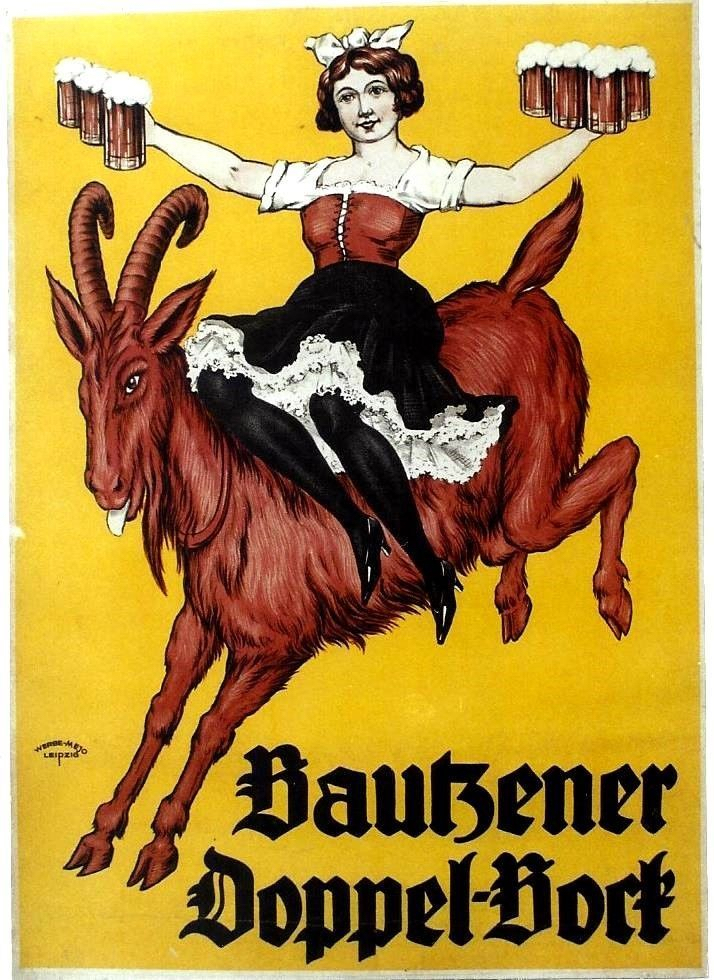
Two years ago I decided to concentrate on Bock ads for awhile. Bock, of course, may have originated in Germany, in the town of Einbeck. Because many 19th century American breweries were founded by German immigrants, they offered a bock at certain times of the year, be it Spring, Easter, Lent, Christmas, or what have you. In a sense they were some of the first seasonal beers. “The style was later adopted in Bavaria by Munich brewers in the 17th century. Due to their Bavarian accent, citizens of Munich pronounced ‘Einbeck’ as ‘ein Bock’ (a billy goat), and thus the beer became known as ‘Bock.’ A goat often appears on bottle labels.” And presumably because they were special releases, many breweries went all out promoting them with beautiful artwork on posters and other advertising. With Spring approaching, there are so many great examples that I’m going to post two a day for a few months.

Monday’s second ad is for Ballantine’s Bock Beer, which was published on March 23, 1939. This one is from the P. Ballantine & Sons Brewing Co., of Newark, New Jersey, which was originally founded in 1840.  This ad ran in The Press of Atlantic City, of Atlantic City, New Jersey.
Filed Under: Art & Beer, Beers, Breweries, Just For Fun Tagged With: Advertising, Bock, History, New Jersey

Beer In Ads #5180: Bring Back My Gam Bock To Me

March 23, 2026 By Jay Brooks

Two years ago I decided to concentrate on Bock ads for awhile. Bock, of course, may have originated in Germany, in the town of Einbeck. Because many 19th century American breweries were founded by German immigrants, they offered a bock at certain times of the year, be it Spring, Easter, Lent, Christmas, or what have you. In a sense they were some of the first seasonal beers. “The style was later adopted in Bavaria by Munich brewers in the 17th century. Due to their Bavarian accent, citizens of Munich pronounced ‘Einbeck’ as ‘ein Bock’ (a billy goat), and thus the beer became known as ‘Bock.’ A goat often appears on bottle labels.” And presumably because they were special releases, many breweries went all out promoting them with beautiful artwork on posters and other advertising. With Spring approaching, there are so many great examples that I’m going to post two a day for a few months.
Monday’s first ad is for Gambrinus Bock Beer, which was published on March 23, 1951. This one was for the August Wagner Breweries, Inc., of Columbus and Chillicothe, Ohio and was founded in 1906 as the Gambrinus Brewing & Bottling Co. This ad ran in The Springfield News-Sun, of Springfield, Ohio.

Filed Under: Art & Beer, Beers, Breweries, Just For Fun Tagged With: Advertising, Bock, History, Ohio

Beer In Ads #5179: Back Again! Pittsburgh Brewing Co’s Bock Beer

March 22, 2026 By Jay Brooks

Two years ago I decided to concentrate on Bock ads for awhile. Bock, of course, may have originated in Germany, in the town of Einbeck. Because many 19th century American breweries were founded by German immigrants, they offered a bock at certain times of the year, be it Spring, Easter, Lent, Christmas, or what have you. In a sense they were some of the first seasonal beers. “The style was later adopted in Bavaria by Munich brewers in the 17th century. Due to their Bavarian accent, citizens of Munich pronounced ‘Einbeck’ as ‘ein Bock’ (a billy goat), and thus the beer became known as ‘Bock.’ A goat often appears on bottle labels.” And presumably because they were special releases, many breweries went all out promoting them with beautiful artwork on posters and other advertising. With Spring approaching, there are so many great examples that I’m going to post two a day for a few months.

Sunday’s second ad is for Pittsburgh Brewing Co’s Bock Beer, which was published on March 22, 1917. This one was for the Pittsburgh Brewing Co., of Pittsburgh, Pennsylvania and was founded by Edward Frauenheim in 1861. This ad ran in The Pittsburgh Press, also of Pittsburgh, Pennsylvania.

Filed Under: Art & Beer, Beers, Breweries, Just For Fun Tagged With: Advertising, Bock, History, Pennsylvania

Historic Beer Birthday: Joseph A. Straub

March 22, 2026 By Jay Brooks

Today is the birthday of Joseph A. Straub (March 22, 1880-1948). He was the son of Peter Straub, who founded the Straub Brewery in St. Mary’s, Pennsylvania in 1872. After his father passed away, Joseph became brewmaster and general manager. The brewery is still owned and operated today by the Straub family.

Joseph Straub.

Following Peter’s death on December 17, 1913, his sons assumed control of the brewery, renaming it the Peter Straub Sons Brewery. During this time, the brewery produced Straub Beer as well as other beer, such as the pilsner-style Straub Fine Beer and Straub Bock Beer. In 1920, the Straub Brothers Brewery purchased one half of the St. Marys Beverage Company, also called the St. Marys Brewery, where St. Marys Beer was produced. During Prohibition, which lasted from January 29, 1920, until December 5, 1933, the brewery produced nonalcoholic near-beer. On July 19, 1940 they purchased the remaining common stock and outstanding bonds of the St. Marys Beverage Company.

straub-family-1904
The Straub Family in 1904. Joseph is the second from the left in the back row.
straub-brewery-1895-closeup
The Benzinger Spring Brewery in 1895. Joseph is standing to the right of the large cask.

Filed Under: Birthdays, Breweries, Just For Fun Tagged With: Pennsylvania

Beer In Ads #5178: Wow! The Public Is Really Getting A Boot Out Of Gold Bond Double Bock Beer

March 22, 2026 By Jay Brooks

Two years ago I decided to concentrate on Bock ads for awhile. Bock, of course, may have originated in Germany, in the town of Einbeck. Because many 19th century American breweries were founded by German immigrants, they offered a bock at certain times of the year, be it Spring, Easter, Lent, Christmas, or what have you. In a sense they were some of the first seasonal beers. “The style was later adopted in Bavaria by Munich brewers in the 17th century. Due to their Bavarian accent, citizens of Munich pronounced ‘Einbeck’ as ‘ein Bock’ (a billy goat), and thus the beer became known as ‘Bock.’ A goat often appears on bottle labels.” And presumably because they were special releases, many breweries went all out promoting them with beautiful artwork on posters and other advertising. With Spring approaching, there are so many great examples that I’m going to post two a day for a few months.

Sunday’s first ad is for Gold Bond Double Bock Beer, which was published on March 22, 1950. This one was for Cleveland & Sandusky Brewing Co., of Cleveland, Ohio, and was founded in 1852 by C. W. Schmidt and Robert Hoffmann. This ad ran in the Cleveland Press, of Cleveland, Ohio.

Filed Under: Art & Beer, Beers, Breweries, Just For Fun Tagged With: Advertising, Bock, History, Ohio

Beer In Ads #5177: The Fable Of Bock Beer!

March 21, 2026 By Jay Brooks

Two years ago I decided to concentrate on Bock ads for awhile. Bock, of course, may have originated in Germany, in the town of Einbeck. Because many 19th century American breweries were founded by German immigrants, they offered a bock at certain times of the year, be it Spring, Easter, Lent, Christmas, or what have you. In a sense they were some of the first seasonal beers. “The style was later adopted in Bavaria by Munich brewers in the 17th century. Due to their Bavarian accent, citizens of Munich pronounced ‘Einbeck’ as ‘ein Bock’ (a billy goat), and thus the beer became known as ‘Bock.’ A goat often appears on bottle labels.” And presumably because they were special releases, many breweries went all out promoting them with beautiful artwork on posters and other advertising. With Spring approaching, there are so many great examples that I’m going to post two a day for a few months.

Saturday’s second ad is for multiple Canadian Bock Beers, which was published on March 21, 1929 in Vancouver, Canada, where there was no national prohibition at that time. This ad was for the Government Liquor Stores of British Columbia. This ad ran in the Vernon News, of Vancouver, British Columbia.

Filed Under: Art & Beer, Beers, Breweries, Just For Fun Tagged With: Advertising, Bock, Canada, History, Vancouver

Historic Beer Birthday: William Worthington

March 21, 2026 By Jay Brooks

Today is the birthday of William H. Worthington (March 21, 1723-1800). Actually, it’s the date of his baptism, but that’s as close as we know, and, strangely, no one seems to have recorded the day he passed away and all we know is it was sometime in 1800. In 1761, he founded the Worthington Brewery in Burton-on-Trent, with the help of his wife Ann Tarratt, when “he purchased a brewery in the High Street for 320 pounds from Richard Cummings of Repton.”

The Worthington brand was purchased from Bass by the American brewing company Coors in 2002, which following a merger became Molson Coors in 2005. Worthington’s White Shield IPA has continued to be brewed since 1829. In 2010, Molson Coors opened the William Worthington microbrewery, which brews historical and seasonal beers.

The Worthington Brewery c. 1899.

Here’s the early history of the brewery, from Wikipedia:

William Worthington (1723–1800) was born at Orton on the Hill in Leicestershire, the fourth child of William Worthington (1687–1742), yeoman farmer, and his wife, Elizabeth. In 1744, he moved to Burton upon Trent in Staffordshire where he worked as a cooper at Joseph Smith’s brewery. In 1760, Worthington purchased the brewery from Smith’s successor, Richard Commings, for £320 (equivalent to £50,000 as of 2019).

By the 1780s, the brewery probably had an annual output of around 1,500 barrels, similar to the rival breweries of Benjamin Wilson and Michael Bass. Throughout the eighteenth century, Worthington sales were mostly of porter, directed towards the Baltic market, which was transported via narrowboat through the River Trent to the Port of Hull. Largely as a result of this trade, by the time of Worthington’s death in 1800, Worthington & Co. ranked among the largest of the provincial breweries.

And this account of the brewery is from the Oxford Companion to Beer, written by my friend Tim Hampson.

Worthington Brewery was established by William Worthington in the English town of Burton-on-Trent in 1744. It became one of a handful of companies to trade lucratively with the Baltic states along with the better-known Burton entrepreneurial brewers run by the Wilson, Sketchley, Bass, and Evans families. By the 1820s a worsening relationship with Napoleon Bonaparte soured much of this trade, and an alternative market had to be found.

Since at least the 1780s the East India Company had exported beers to the Indian sub-continent, following in the wake of the administrators and troops who left the United Kingdom to work in settlements there. Records show that some of the first shipments took place in 1697.

The trade was dominated by London brewer Abbot & Hodgsons, but the Burton brewers recognized a business opportunity when they saw one. When the London brewer faltered, the trade quickly became dominated by Burton brewers Bass and Allsop, and, to a lesser extent, Worthington. They first began to imitate the London brewers’ beer but discovered that a Burton IPA had the attribute of arriving in Calcutta pale, clear, and sparkling. See burton-on-trent and india pale ale. Sometime around the start of the 20th century the term “India pale ale” disappeared from White Shield’s label and became known by its heart shield and dagger label design, which was first registered as a trademark in 1863.

Worthington was never one of the big Burton brewers and was subsumed within the growing Bass empire in 1927. Somehow, nonetheless, the beer survived as a bottled beer. It was a curiosity as it still contained yeast in the bottle, long after the practice of bottle-conditioning had largely disappeared from British brewing. Drinkers’ conversations often focused on whether the beer should be poured clear or have the yeast tipped into the glass too. Many beer enthusiasts have commented upon the beer’s ability to age well, gaining character in the bottle over a year or two.

Blue plaque at the Unicorn Inn, Orton-on-the-Hill, August 2017. (Photo: Steve Peck)

Filed Under: Birthdays, Breweries, Just For Fun Tagged With: England, Great Britain, History, UK

Beer In Ads #5176: I’m “Bock” Again

March 21, 2026 By Jay Brooks

Two years ago I decided to concentrate on Bock ads for awhile. Bock, of course, may have originated in Germany, in the town of Einbeck. Because many 19th century American breweries were founded by German immigrants, they offered a bock at certain times of the year, be it Spring, Easter, Lent, Christmas, or what have you. In a sense they were some of the first seasonal beers. “The style was later adopted in Bavaria by Munich brewers in the 17th century. Due to their Bavarian accent, citizens of Munich pronounced ‘Einbeck’ as ‘ein Bock’ (a billy goat), and thus the beer became known as ‘Bock.’ A goat often appears on bottle labels.” And presumably because they were special releases, many breweries went all out promoting them with beautiful artwork on posters and other advertising. With Spring approaching, there are so many great examples that I’m going to post two a day for a few months.

Saturday’s first ad is for Old Style Bock Beer, which was published on March 21, 1941. This one was for G. Heileman Brewing Co., of La Crosse, Wisconsin, and was founded in 1858, and they also had a branch in Winona. This ad ran in the Winona Daily News, of Winona, Wisconsin.

Filed Under: Art & Beer, Beers, Breweries, Just For Fun Tagged With: Advertising, Bock, History, Minnesota

« Previous Page
Next Page »

Find Something

Northern California Breweries

Please consider purchasing my latest book, California Breweries North, available from Amazon, or ask for it at your local bookstore.

Recent Comments

  • Bob Paolino on Beer Birthday: Grant Johnston
  • Gambrinus on Historic Beer Birthday: A.J. Houghton
  • Ernie Dewing on Historic Beer Birthday: Charles William Bergner 
  • Steve 'Pudgy' De Rose on Historic Beer Birthday: Jacob Schmidt
  • Jay Brooks on Beer Birthday: Bill Owens

Recent Posts

  • Historic Beer Birthday: Bert Grant May 17, 2026
  • Beer Birthday: Gary Spedding May 16, 2026
  • Historic Beer Birthday: Maria Best May 16, 2026
  • Historic Beer Birthday: John Schneider May 16, 2026
  • Beer Birthday: Roger Lind May 16, 2026

BBB Archives

Feedback

Head Quarter
This site is hosted and maintained by H25Q.dev. Any questions or comments for the webmaster can be directed here.