Brookston Beer Bulletin

Jay R. Brooks on Beer

  • Home
  • About
  • Editorial
  • Birthdays
  • Art & Beer

Socialize

  • Dribbble
  • Email
  • Facebook
  • Flickr
  • GitHub
  • Instagram
  • LinkedIn
  • Pinterest
  • RSS
  • Twitter
  • YouTube

Powered by Genesis

Beer In Ads #5136: Do Not Disturb: SB Bock Beer Is “Tucked In” For A Long, Leisurely Ageing!

December 8, 2025 By Jay Brooks

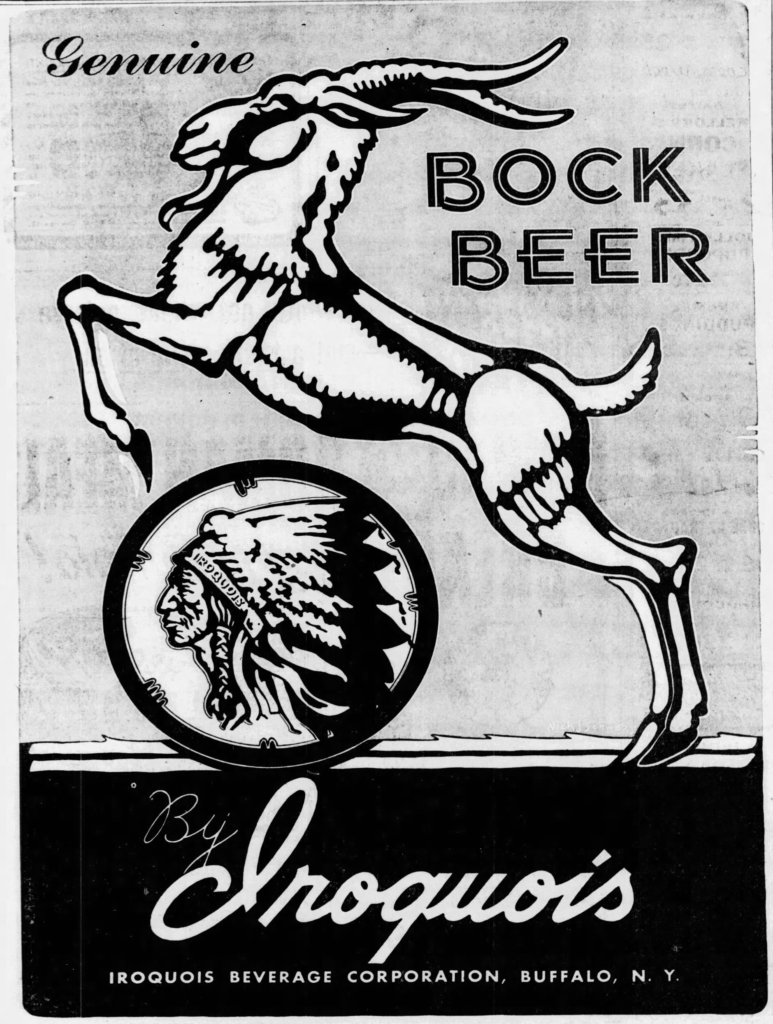
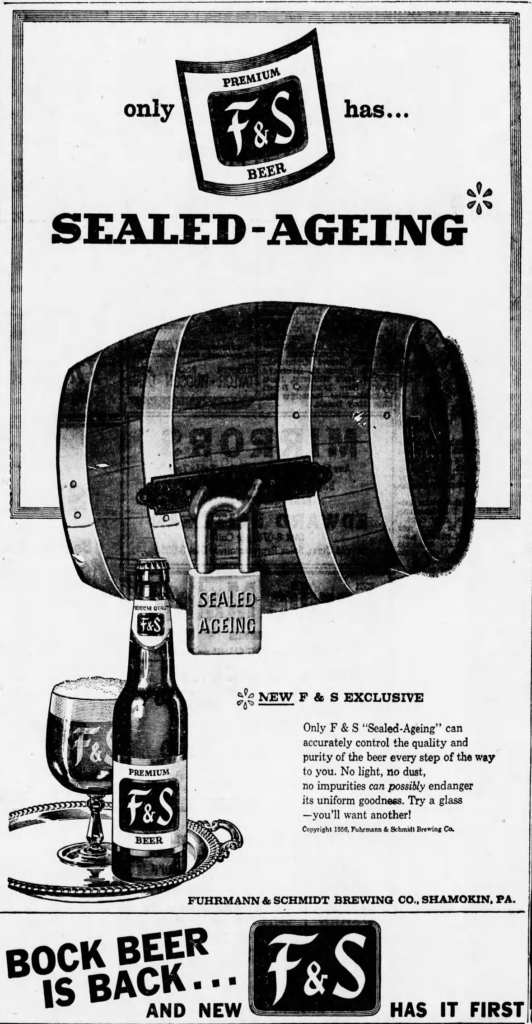
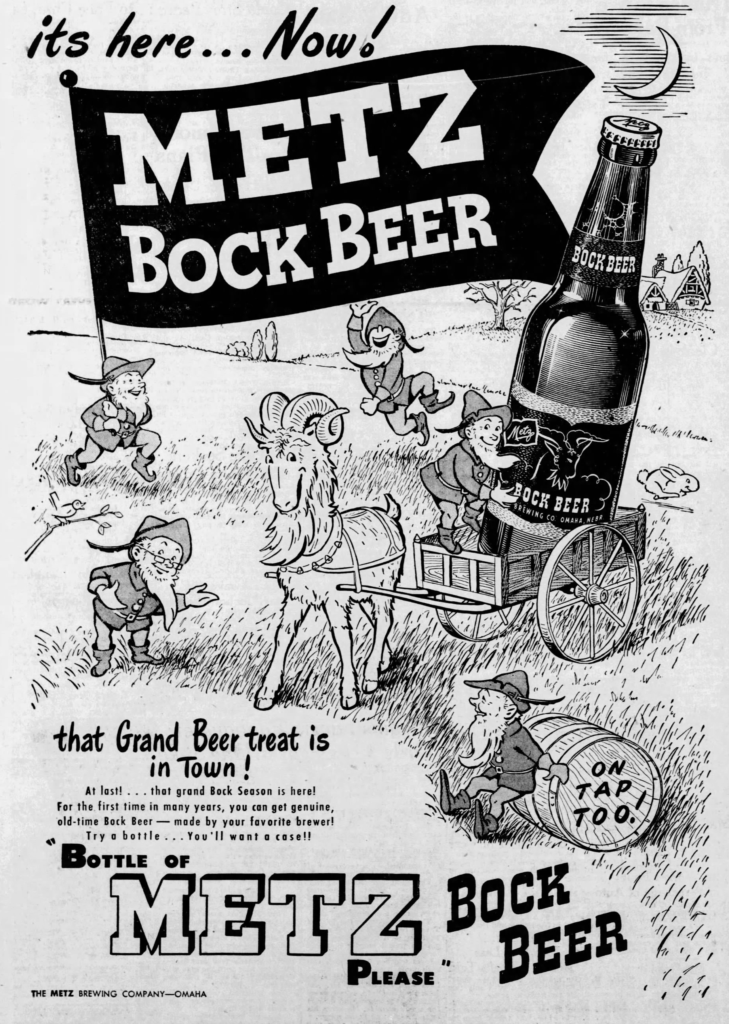
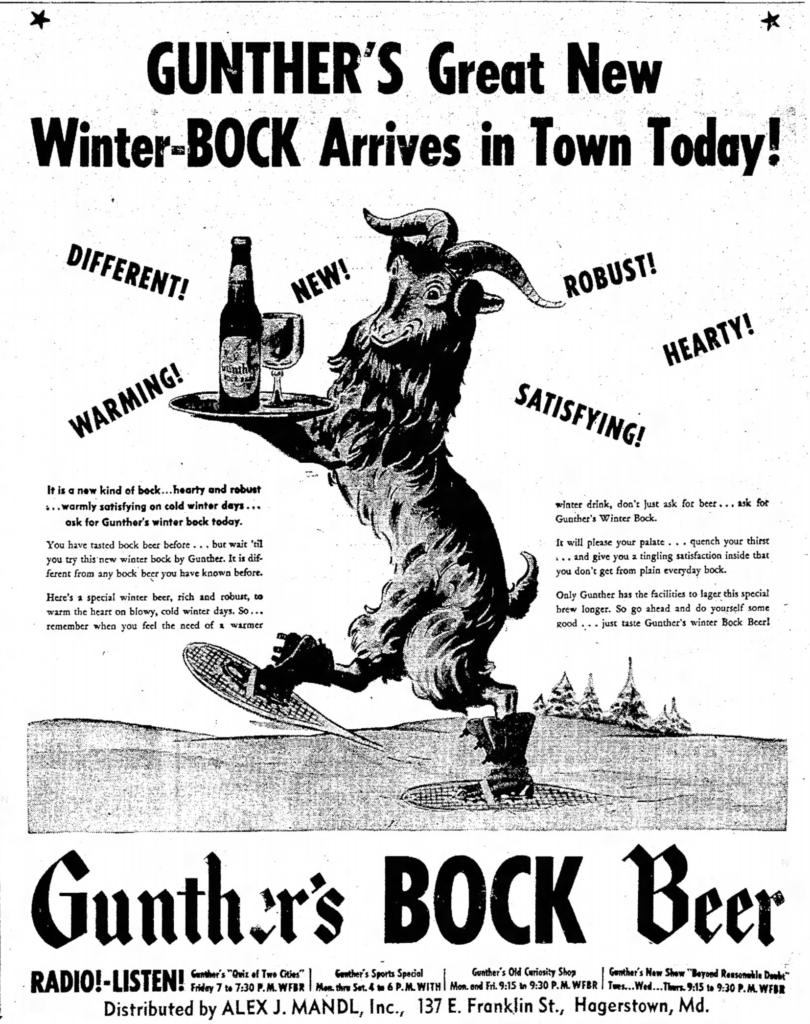
Last year I decided to concentrate on Bock ads for awhile. Bock, of course, may have originated in Germany, in the town of Einbeck. Because many 19th century American breweries were founded by German immigrants, they offered a bock at certain times of the year, be it Spring, Easter, Lent, Christmas, or what have you. In a sense they were some of the first seasonal beers. “The style was later adopted in Bavaria by Munich brewers in the 17th century. Due to their Bavarian accent, citizens of Munich pronounced ‘Einbeck’ as ‘ein Bock’ (a billy goat), and thus the beer became known as ‘Bock.’ A goat often appears on bottle labels.” And presumably because they were special releases, many breweries went all out promoting them with beautiful artwork on posters and other advertising.

Sunday’s ad is for Pickwick Bock Beer, which was published on December 7, 1953. The brewery was the Southern Brewing Co. of Tampa, Florida, which was originally founded in 1934, but closed in 1963. This ad ran in The Tampa Tribune, from Tampa, Florida.

Filed Under: Art & Beer, Beers, Breweries, Just For Fun Tagged With: Advertising, Bock, Florida, History

Historic Beer Birthday: Charles N. Hamm

December 8, 2025 By Jay Brooks

wisconsin
Today is the birthday of Charles N. Hamm (December 8, 1886-October 16, 1918). This is one of the brewer’s birthdays I know the absolute least about. What little I know came from a snippet from a genealogical page about the family that bought the Hamm’s family brewery in 1932, although the Jung’s had apparently been leasing it for many years before that, possibly as early as 1918. Charles N. Hamm and his family, as far as I can tell, owned and possibly founded (although it seems more likely they bought in to) the Silver Lake Brewery, which was founded in Random Lake, Wisconsin in 1866. Charles’ father, Carl Hamm, was born in 1853, in Baden-Württemberg, Germany so it seems unlikely he started a brewery in Wisconsin when he was thirteen, plus records indicate he came to the U.S., initially New York, in 1872, and didn’t settle in Wisconsin until at least 1883, which is where his son Charles was born.

But at some point the Hamm family did acquire it, renaming it the Charles Hamm Brewery in 1910. In 1917, The Brewers Journal listed Charles N. Hamm as the “president, general manager, and brewmaster.” Hamm apparently enlisted in the Army and was sent to Europe to fight in World War I, leaving William Jung as brewmaster. Unfortunately, Hamm caught pneumonia while overseas and died in 1918.

In 1920, Jung leased the brewery from the Hamm family, and called it the Jung Beverage Co. during prohibition, but bought it outright in 1932. From then on it was known as the Jung Brewing Co. and 1952, when Jung sold out to Herman Sitzberger, who kept it going under the same name until 1958, when it closed for good.

Random-Lake-8-Medium
Random Lake, Wis. today, with a population as of the 2010 census of 1,594.

Filed Under: Birthdays, Breweries, Just For Fun Tagged With: History, Wisconsin

Historic Beer Birthday: John Weyand

December 8, 2025 By Jay Brooks

weyand
Today is the birthday of John A. Weyand (December 8, 1859-1907). He was the son of Christian Weyand, who founded what would become the Christian Weyand Brewing Co., which remained in business until closed by prohibition in 1920.

john-weyand
This biography of Weyland os from “Our County and its people: A descriptive work on Erie County, edited byTruman C. White, from 1898:

Weyand, John A., vice president and general manager of the Christian Weyand Brewing Company, and one of Buffalo’s most respected citizens, was born in that city, December 8, 1859. He early evinced a desire to acquire an education and after passing through the public schools and Canisius College he entered the Bryant & Stratton Business College, from which he was graduated before attaining his majority. He immediately entered his father’s brewery, remaining in that business until 1890, when it was made a stock company and he was made vice president and general manager. Aside from his extensive business affairs, Mr. Weyand takes an active interest in church affairs, being a member of St. Louis Catholic church, is a trustee of St. John’s Protectory, member of the Buffalo Orpheus, Sangerbund and Liedertafel. He has always taken an active interest in all public enterprises and was a park commissioner under Mayor Bishop.

Christian-Weyand-prize-banner-ad

This short history of the brewery, including mentions of John and his father, is from the “1897 Brewers Convention Buffalo NY,” published by the Buffalo Brewers Association:

Christian Weyand Brewing Company.

In 1866, Christian Weyand established the business now conducted by The Christian Weyand Brewing Company. Mr. Weyand is a native of France, having been born in the province of Lorraine a little more than seventy years ago. There he spent his youth and received his education; but in his twenty-first year he left Lorraine for the wider opportunities of the New World, landing in New York just fifty years ago. He soon found his way to Buffalo, but it was nearly twenty years before he began the business with which his name is now so intimately connected in the minds of all Buffalonians. During these years he worked as a shoemaker — at first as an employee, and later in a shop of his own.

Mr. Weyand, with a partner, began the brewing business in a small way, with little capital and a poorly equipped plant; but the purest and best of barley malt was used from the start, and improved machinery was introduced as fast as the necessary capital could be secured. In 1873. Mr. Weyand assumed entire charge of the business, and applied himself vigorously to the task of building up a model brewery. His efforts met with entire success, and in a few years his establishment became one of the first in its line in Buffalo — a city that boasts of many fine breweries. In 1890, he organized the business into a stock company, called The Christian Weyand Brewing Company, of which he is president, his son, John A. Weyand, vice-president and manager, and another son, Charles M. Weyand, secretary and treasurer. Since then the business has materially increased, and in 1896-97 it became necessary to make extensive additions to the plant. The new buildings on the corner of Main and Goodell streets, built of buff terra cotta elaborately ornamented in Renaissance style, are exceedingly handsome; and it is now one of the best-equipped breweries in the country.

buffalo-main-and-goddell
This is purported to be a photograph of the house at the “Southeast Corner Main and Goodell Streets” from the 1912 “Picture Book Of Earlier Buffalo.” But as Michael F. Rizzo and Ethan Cox, authors of “Buffalo Beer” point out, “the structures in the background and to the left of the subject must have been the Christian Weyand brewery. Indeed, the least occluded building to the left was, I think, their office address on Goodell.”

Christian-Weyand-tray

Filed Under: Birthdays, Breweries, Just For Fun Tagged With: History, New York

Beer In Ads #5135: Only The Lilacs Wait For Spring … When Bock Beer Is Here In December!

December 7, 2025 By Jay Brooks

Last year I decided to concentrate on Bock ads for awhile. Bock, of course, may have originated in Germany, in the town of Einbeck. Because many 19th century American breweries were founded by German immigrants, they offered a bock at certain times of the year, be it Spring, Easter, Lent, Christmas, or what have you. In a sense they were some of the first seasonal beers. “The style was later adopted in Bavaria by Munich brewers in the 17th century. Due to their Bavarian accent, citizens of Munich pronounced ‘Einbeck’ as ‘ein Bock’ (a billy goat), and thus the beer became known as ‘Bock.’ A goat often appears on bottle labels.” And presumably because they were special releases, many breweries went all out promoting them with beautiful artwork on posters and other advertising.

Sunday’s ad is for Pickwick Bock Beer, which was published on December 7, 1953. The brewery was the Haffenreffer Brewery of Boston, Massachusetts, which was originally founded in 1870. It was located in the Jamaica Plain area of Boston, and today the site of the brewery is where the Boston Beer Co. operates one of its breweries.  This ad ran in The Republican, from Springfield, Massachusetts.

Filed Under: Art & Beer, Beers, Breweries, Just For Fun Tagged With: Advertising, Bock, History, Massachusetts

Historic Beer Birthday: Christian William Feigenspan

December 7, 2025 By Jay Brooks

feigenspan
Today is the birthday of Christian William Feigenspan (December 7, 1876-February 7, 1939). His father, Christian Benjamin Feigenspan, was born in Thuringia, Germany but moved his family to New Jersey and founded the C. Feigenspan Brewing Company of Newark in 1875, though at least one source says 1868. When his father died in 1899, Christian William took over management of the brewery, which remained in business through prohibition, but was bought by Ballantine in 1943. He was also “president of Feigenspan Brewing Company, president of Federal Trust Company, and president of the United States Brewers’ Association.”

CW-Feigenspan

Here’s a short biography from Find-a-Grave:

Businessman. He took over Newark, New Jersey’s Feigenspan Brewery Company, founded by his father in 1868, when his father died in 1899. He then transformed the company into one of the best known breweries up until and after prohibition. Today it’s labels are the among the most sought after by collectors.

Feigenspan-bock-1900

Here’s another biography from “Legendary Locals of Rumson,” written by Roberta H. Van Anda:

Christian-William-Feigenspan-bio

feigenspan-brew

Feigenspan-PON-BeerAle-Coasters-Over-4-Inches-Christian-Feigenspan-Brewing

PON-BeerAles-Coasters-Over-4-Inches-Christian-Feigenspan-Brewing-Co
And here’s his obituary from his local newspaper:

feigenspan-obit

Christian-Feigenspan-Breweries-Tip-Trays-3-6-inches-Christian-Feigenspan-Inc--Pre-Prohibition

feigenspan-brewery
Feigenspan1909AdNYSun2
Feigenspan-PON-Beer--Labels-Christian-Feigenspan-Brewing-Co

Filed Under: Birthdays, Breweries, Just For Fun Tagged With: History, New Jersey

Beer In Ads #5134: Look, Yes It’s Here, Gem Bock Beer

December 6, 2025 By Jay Brooks

Last year I decided to concentrate on Bock ads for awhile. Bock, of course, may have originated in Germany, in the town of Einbeck. Because many 19th century American breweries were founded by German immigrants, they offered a bock at certain times of the year, be it Spring, Easter, Lent, Christmas, or what have you. In a sense they were some of the first seasonal beers. “The style was later adopted in Bavaria by Munich brewers in the 17th century. Due to their Bavarian accent, citizens of Munich pronounced ‘Einbeck’ as ‘ein Bock’ (a billy goat), and thus the beer became known as ‘Bock.’ A goat often appears on bottle labels.” And presumably because they were special releases, many breweries went all out promoting them with beautiful artwork on posters and other advertising.

Saturday’s ad is for Gem Bock Beer, which was published on December 6, 1950. This ad was for the Walter Bros. Brewing Co. of Menasha, Wisconsin, which was originally founded as the Island City Brewery in 1860. It became known as Walter Bros. in 1933 after prohibition, although the brothers had been involved in the brewery since 1888. This ad ran in The Post Crescent, from Appleton, Wisconsin.

Filed Under: Art & Beer, Beers, Breweries, Just For Fun Tagged With: Advertising, Bock, History, Wisconsin

Historic Beer Birthday: Henry Liebmann

December 6, 2025 By Jay Brooks

S-Liebmann
Today is the birthday of Henry Liebmann (December 6, 1836-March 27, 1915). He was born Heinrich Liebmann in Schmiedelfeld, Baden-Wuerttemberg, Germany. His father owned the Castle Schmiedelfeld, but when Henry was four, the family moved to Ludwigsburg and operated the Zum Stern Inn there, which also included a brewery. For political reasons, some of the family moved to America around 1850 to build a home, and the rest followed in 1854. Initially he ran the old Maasche Brewery, but later built a new brewery in Bushwick. Originally, it was called the Samuel Liebmann Brewery, but when his sons joined the brewery, it was called the S. Liebmann’s Sons Brewery. When Henry’s father died in 1872, Henry and his brothers took over the family brewery, and Henry became brewmaster. After prohibition ended, the brothers’ six sons re-opened the brewery as the simpler Liebmann Breweries, but in 1964 they changed the name again to Rheingold Breweries, after their most popular beer. The brewery closed in 1976.

henry_liebmann_original

Here’s his obituary from the Brewers Journal, in July of 1915:

henry-liebmann-obit-usba

Liebmanna_Lager_Beer

This is from “The Originators of Rheingold Beer: From Ludwigsburg to Brooklyn – A Dynasty of German-Jewish Brewers,” by Rolf Hofmann, originally published in Aufbau, June 21, 2001:

New Yorkers over the age of fifty will remember the brand name Rheingold Beer and the company’s brilliant publicity stunt in which a bevy of attractive young women competed annually for the privilege of being elected that year’s Miss Rheingold and appearing in ads on billboards and in the subways throughout the New York area.

The beer’s evocative name with its allusion to Germany’s great river, was the culmination of a German-Jewish family enterprise that had its beginnings in 1840 in the town of Ludwigsburg, north of Stuttgart, in what was then the Kingdom of Württemberg. One Samuel Liebmann, a member of a prominent Jewish family in the region, settled there and bought the inn and brewery “Zum Stern.” A liberal and staunch supporter of Republican ideals, Liebmann encouraged other like-minded citizens, including some soldiers from the garrison, to meet in his hospitable surroundings. The ideas fomented there contributed to the local revolution of 1848. It brought the opprobrium of the King down upon Liebmann’s enterprise, and “Zum Stern” was declared off limits to the soldiers. Soon thereafter, in 1850, Samuel Liebmann emigrated to the U.S.

The family settled in Brooklyn and Samuel, together with his three sons, Joseph, Henry, and Charles, opened a brewery once again at the corner of Forest and Bremen Streets. With the responsibilities divided among the family – Henry became the brewing expert, Charles. the engineer and architect, Joseph, finance manager – the company was already flourishing by the time of Samuel’s death in 1872. Success also led to a concern for the company’s Brooklyn surroundings, and the Liebmanns became involved in local welfare – focusing on housing and drainage systems.

Each of the three brothers had two sons, and when the older Liebmanns retired in 1903, the six members of the third generation took over. Other members of the family also contributed to the gradual expansion of the company. In 1895 Sadie Liebmann (Joseph’s daughter), married Samuel Simon Steiner, a trader in high quality hop, an essential ingredient for good beer. Steiner’s father had begun merchandising hop in Laupheim in 1845 and still today, S.S. Steiner, with its headquarters in New York, is one of the leading hop merchants. Under these fortuitous family circumstances, beer production grew constantly. In the early years, the brewery had produced 1000 barrels per year, by 1914 its output stood at 700,000 barrels.

hofmann-rheingold1
Henry Liebmann (center with white beard) and family.

Unfortunately, political developments in the U.S. between 1914 and 1933 were extremely disadvantageous for the Liebmann brewery. The resentment against Germany and anything German during World War I led to an informal boycott of German beers. Following close upon the lean wartime years, was the implementation of Prohibition in 1920 forbidding the manufacturing and trading of alcohol. The Liebmann enterprise managed to survive by producing lemonade and a product they called “Near Beer.”

With the reinstatement of legal alcohol production under President Roosevelt in 1933, opportunities for the brewery opened up, abetted by the anti-Semitic policies of Hitler’s Germany. The pressures on Jewish businessmen there, brought Dr. Hermann Schülein, general manager of the world-renowned LšwenbrŠu brewery, to America. Schulein’s father, Joseph, had acquired two of Munich’s leading breweries at the end of the nineteenth century–Union and Münchner Kindl–and his son had managed the 1920 merger with Löwenbrau. Arriving in New York with this experience behind him, Hermann Schülein became one of the top managers of the Liebmann brewery and was instrumental in its spectacular growth after World War II.

Working with Philip Liebmann (great-grandson of Samuel), Schülein developed a dry lager beer with a European character to be marketed under the brand name “Rheingold.” According to company legend, the name was created in 1883 at a brewery dinner following a performance at the Metropolitan Opera. When the conductor took up his glass, he was so taken with the shade of the beer, that he declared it to be the color of “Rheingold.” For New Yorkers, however, the name Rheingold did not bring to mind the Nibelungen fables, but the pretty young ladies who participated in Schülein’s most brilliant marketing strategy – the selection of each year’s Miss Rheingold by the beer-drinking public of greater New York

At the height of the campaign’s success in the 1950’s and 60’s, the Liebmann Brewery had an output of beer ten times that of Löwenbrau at the same time in Munich.

For thirty years, Rheingold Beer reigned supreme in the New York area, but by 1976, as a local brewery, it could no longer compete with nationwide companies such as Anheuser & Busch, Miller, and Schlitz, and its doors were closed. Only recently, using the same brewmaster, Rheingold is once again being sold in the tri-state area.

S-Liebmanns-Brewing-poster

Here’s an “Origin of Liebmann Brewery” posted by a relative on Ancestry.com:

On May 12 1833 (Sulzbach-Laufen Archive) Samuel and his older brother Heinrich bought a castle/inn Schmiedelfeld, Sulzbach-Laufen, Schwaebisch Hall District that dated from 1739. They renovated the place and created a prosperous farm/estate and in 1837 began a brewery in the cellar. In 1840, he moved to Ludwigsburg, near Stuttgart and purchased the gasthaus [guest house or inn] “Zum Stern” on Seestrasse 9 (later Zum Rebstock) which included a brewery. (source: Translation extract from Dr. Joacim Hahn’s book, History of the Jewish Community of Ludwigsburg)

After supporting a movement to oust King William I of Wurttemberg, and sensing the wavering tolerance of Jewish businessmen, Samuel sent his eldest son Joseph to the US in 1854 to scout out a location to establish a brewery.

Samuel retired in 1868 and turned the family business over to his sons Joseph, Charles, and Henry under the name S. Liebmann’s Sons Brewery.

liebmanns-rheingold

S-Liebmanns-Sons-Cards-Trade-Cards-S-Liebmanns-Sons-Brewing-Company_17585-1

Filed Under: Birthdays, Breweries, Just For Fun Tagged With: Germany, History, New York

Beer Birthday: Dave Gull

December 6, 2025 By Jay Brooks

Today is the 51st birthday of Dave Gull, founder of New Helvetia Brewing in Sacramento, California. Dave was born and raised in Sacramento, and founded New Helvetia Brewing in 2011, which is also when we first met. Dave is a University of Oregon alum and worked in real estate before turning his attention to brewing, first as a homebrewer then as a brewery owner. Dave’s also been active in both his local brewer’s guild as well as the CCBA, the state guild. Join me in wishing Dave a very happy birthday.

Charlie Bamforth and Dave at New Helvetia Brewing in 2013.
Dave with another person born December 6th, Natalie Cilurzo (center).
At GABF in 2018, picking up a silver medal for their coffee beer.
Dave with Jamie Floyd at GABF.

NOTE: Photos 1 & 4 purloined from Facebook.

Filed Under: Birthdays, Breweries, Just For Fun Tagged With: California, Northern California, Sacramento

Historic Beer Birthday: Henry Rahr Jr.

December 6, 2025 By Jay Brooks

rahrs
Today is the birthday of Karl Heinrich Rahr, anglicized as Henry Rahr Jr. (December 6, 1865-September 24, 1909). He was born in Green Bay, Wisconsin, the son of Henry Rahr, who founded the East River Brewery in Green Bay. When his sons were old enough, he brought them into the business, and in 1891, when Henry Sr. died, Henry Jr. became president and his brother Frederick also worked for the brewery. They re-named it Henry Rahr’s Sons Brewing Co., but later shortened it to Rahr Brewing Co. It survived prohibition, finally closing in 1966.

This obituary is from the American Brewers Review from 1909:

And this lengthier obituary is from the Green Bay Press-Gazette on September 24, 1909:

Rahrs_Brewery_Green_Bay_1895

This short history of the brewery is from The Neville Public Museum:

One hundred fifty years ago, Henry Rahr established a brew house on the corner of Main Street and N. Irwin Avenue in Green Bay known as the East River Brewery. It would become the largest and most well-known historic brewery in Green Bay. Following the death of Henry Rahr in 1891 the business was passed to his sons Henry Jr. and Frederick and became Henry Rahr & Sons Co. Prior to Prohibition (pre 1920) Rahr’s was producing 60,000 barrels of beer per year. After Prohibition was repealed in 1933, the brewery was back in business and began pumping out “Standard,” “Special,” “Belgian” and “Old Imperial Pale Beer.” In 1966 the company was sold to Oshkosh Brewing Co. Exactly 100 years after opening, Rahr’s Brewery was shut down. The brewery buildings were demolished, leaving no trace behind except for Rahr’s merchandise, barrels, and bottles.

Rahr-packers-1965

And this brewery history is from “Breweries of Wisconsin,” by Jerold W. Apps and Jerry Apps:

rahr-sons-brew

rahr-all-star-brew-1936

Filed Under: Birthdays, Breweries, Just For Fun Tagged With: History, Wisconsin

Beer In Ads #5133: Enjoy The Bright Taste In Bock

December 5, 2025 By Jay Brooks

Last year I decided to concentrate on Bock ads for awhile. Bock, of course, may have originated in Germany, in the town of Einbeck. Because many 19th century American breweries were founded by German immigrants, they offered a bock at certain times of the year, be it Spring, Easter, Lent, Christmas, or what have you. In a sense they were some of the first seasonal beers. “The style was later adopted in Bavaria by Munich brewers in the 17th century. Due to their Bavarian accent, citizens of Munich pronounced ‘Einbeck’ as ‘ein Bock’ (a billy goat), and thus the beer became known as ‘Bock.’ A goat often appears on bottle labels.” And presumably because they were special releases, many breweries went all out promoting them with beautiful artwork on posters and other advertising.

Friday’s ad is for Genesee Bock Beer, which was published on December 5, 1981. This ad was for Genesee Brewing Co. of Rochester, New York, which was originally founded in 1878. This ad ran in The Berwick Enterprise, from Berwick, Pennsylvania.

Filed Under: Art & Beer, Beers, Breweries, Just For Fun Tagged With: Advertising, Bock, History, New York, Pennsylvania

« Previous Page
Next Page »

Find Something

Northern California Breweries

Please consider purchasing my latest book, California Breweries North, available from Amazon, or ask for it at your local bookstore.

Recent Comments

  • Ernie Dewing on Historic Beer Birthday: Charles William Bergner 
  • Steve 'Pudgy' De Rose on Historic Beer Birthday: Jacob Schmidt
  • Jay Brooks on Beer Birthday: Bill Owens
  • Steve 'Pudgy' De Rose on Beer Birthday: Charles Finkel
  • Steve 'Pudgy' De Rose on Beer Birthday: Bill Owens

Recent Posts

  • Historic Beer Birthday: William J. Lemp February 21, 2026
  • Beer Birthday: Sayre Piotrkowski February 21, 2026
  • Beer In Ads #5213: Sterling Bock At Its Mellow Best February 20, 2026
  • Historic Beer Birthday: Joseph F. Hausmann February 20, 2026
  • Beer In Ads #5212: Once Again … It Is The Professor’s Please To Present Bartel’s Bock Beer February 20, 2026

BBB Archives

Feedback

Head Quarter
This site is hosted and maintained by H25Q.dev. Any questions or comments for the webmaster can be directed here.