Brookston Beer Bulletin

Jay R. Brooks on Beer

  • Home
  • About
  • Editorial
  • Birthdays
  • Art & Beer

Socialize

  • Dribbble
  • Email
  • Facebook
  • Flickr
  • GitHub
  • Instagram
  • LinkedIn
  • Pinterest
  • RSS
  • Twitter
  • YouTube

Powered by Genesis

Craft Beer Up 11% In 1st Half Of 2008

July 29, 2008 By Jay Brooks

The midyear numbers are out, and things couldn’t look better, which is especially wonderful under the circumstances. The Brewers Association released sales through the first half of 2008 and growth of craft beer by dollars is up a very healthy 11%.

According to their press release, “The Brewers Association attributes this growth to a grassroots movement toward fuller flavored, small batch beers made by independent craft brewers.” I’m all for that, but since it’s dollars one must at least speculate that higher prices for craft are driving that number, at least to a certain extent. Since others (admittedly with an agenda of showing craft in not the best light) have suggested that craft sales are slowing, it’s tempting to worry about the absence of where volume of sales is for the first half of the year. But as the Nielsen Company, points out, “beer sales are affected the least by the economic downturn, with wine sales showing the most impact. Additionally, craft beer is gaining customers from across all segments of beverage alcohol.” So perhaps I’ve no reason to worry after all.

More from the BA’s press release:

“Newer brands by the larger brewers, like Belgian style wheat beers, have huge distribution advantages over beers by independent craft brewers,” said Paul Gatza, Director of the Brewers Association. “These brands can grow when the large brewers decide they want them to grow with the ability to impact what brands get shelf space and tap handles. At the same time, beer from craft brewers is being requested by the customer, which encourages distributors and retailers to make the beer available.” According to the Brewers Association, 1,420 of the 1,463 U.S. breweries are independent craft brewers.

The Brewers Association reports that in the first half of 2008 volume of beer sold by craft brewers grew by 6.5% totaling an estimated 4 million barrels of beer compared to 3.768 million barrels sold in the first half of 2007. Harry Schuhmacher of Beer Business Daily stated, “Crafts have really taken pricing this year given high input costs, and yet it is still driving volume gains faster than the beer category.”

But if the numbers all bear this out, then it’s very good news indeed. With rising prices across the board for all manner of food and beverages, there has been much speculation about whether consumers would continue to be willing to spend more for craft beer or would retreat back to the cheaper stuff from the big beer companies. The initial anecdotal evidence I’d been hearing suggested to me that sales by most breweries had not suffered significantly from higher prices at retail and at the tap. More than a few people I’ve talked to in the last several months have said demand is still rising unabated. The BA’s stats do appear to bear that out, so hopefully what initially seemed like a brick wall staring us down in the near future might in reality be another hurdle, but one which can be jumped over with a good business plan and, most importantly, a good-tasting, full-flavored beer.

Filed Under: Breweries, News Tagged With: Press Release, Statistics

Brewers Day Profile: Brian Hunt

July 18, 2008 By Jay Brooks

moonlight
Shortly after I launched the website for International Brewers Day, I got an appropriately curmudgeonly comment disdaining the idea from my friend Brian Hunt, who owns Moonlight Brewing. Here’s what he had to say.

Let’s all just make good beer and drink it. The Brewer’s Association will log acres of forests for special posters and mailings. I can see Hallmark jumping on this one big time, and before long you’ll have to wade through all the K-Mart “holiday” ads looking for that right something for the brewers in your life. I vote no on this.

While hardly shy, I think having worked in the moonlight for so many years has made Brian shy away from the limelight. That alone made him the perfect choice for my first IBD profile. He is, to my mind, one of the truly unsung heroes of brewing, quietly making some of the nation’s best beers.

And happily I’m not the only one. In an article entitled Czech Mate, published in Forbes, the author reveals that of all the beers rated on Beer Advocate, Moonlight’s Reality Czech is the only golden lager on their list of the “Top Beers on Planet Earth.” Unfazed, Hunt explains.

“We have almost no concept in this country that we can have a beer that is light but also flavorful and vibrant,” explains Brian Hunt, Moonlight Brewing’s owner (and sole employee). “Making a great lager like that requires more time, more skill and more expense than making an ale.”

moonlight-ibd2

Brian Hunt was, of course, born in a log cabin near Sacramento, and walked ten miles to school, uphill — both ways — through blizzards in winter and punishing heat in summer. Alright, everything in that last sentence, except Sacramento, I made up. But Brian’s past just cries out to be remade as mythic fable.

ibd-vertical-red-grunge

Brian started college at U.C. San Diego as a biochemistry major, but soon realized that most of his fellow students were pre-med, a path he decidedly was not interested in pursuing. So he transferred to U.C. Davis to study fermentation sciences with an eye toward becoming a winemaker. But fate stepped in when he was randomly assigned Michael Lewis as his advisor. Needing income, he found himself working in Lewis’ laboratory and found it was easy to be persuaded to concentrate on beer instead of wine. He found his fellow brewing students much closer to his own temperament, more down to earth and fun. “Beer just seemed more enjoyable.” Hunt remarked.

After graduating with a degree in Fermentation Sciences in 1980, Hunt relocated to the heart of early brewing — Milwaukee, Wisconsin — to take a job at the Schlitz Brewery. He loved the history of the place. Everywhere you looked it was there. Hunt spent about eighteen months working for Schlitz. There were no computers in the place. Every step they took was done manually, so you learned the reason why you did certain things, and you could extrapolate those to subsequent steps, too. As a result, he learned a lot in that year and a half, crediting that experience with setting the tone for the rest of his career.

He moved back to California in 1981, brewing at the now long gone Berkeley Brewing Co., making ales and lagers on a 40-bbl system. After that venture went belly-up, he consulted on several brewing projects throughout the Bay Area, before ending up at Acme Brewing in Santa Rosa, California in 1985. He was there two years, but the brewery never had much of a chance owing to financial issues that the owners had not anticipated. The majestic 100-bbl brewhouse finally made its first batch of beer on March 2, 1987, but it was too late. Hunt says of his time there that it was a great MBA project and he learned most of what he needed (whether he wanted to or not) about the business side of the brewing industry.

When the Santa Rosa brewery finally shuttered its doors, Brian spent some time working for the other team at Grgich Hills Winery before a brief stint formulating two beers (whose recipes have since changed) and helping layout the brewery itself at the early Anderson Valley Brewing Co. in Boonville.

In 1988, Brian finally opened his own place in Napa with a descendant of the Hamms brewing family. He had a 1/3-share of Willett’s Brewing Co. (now Downtown Joe’s) from sweat equity and $1,100 of his own money. But by 1992, a get-rich-quick lawsuit brought by one of the brewpub’s employees forced Willett’s into bankruptcy. Brian Hunt saw the writing on the wall, and when someone phoned him to offer 100 Hoff-Stevens kegs, he bought them for himself and began … well, moonlighting.

moonlight-ibd3

The original Moonlight brewery was built in a barn behind the house he was renting. He built the entire system himself using equipment cobbled together from a variety of sources. Brian bought old kettles from a winery that couldn’t boil water, and so had to be adapted. Quite a number of items from Sierra-Nevada’s yard sale (when they opened their own larger brewery in Chico) found their way into Moonlight’s brewery barn, including fermenters and a keg washer. The whole enterprise was financed with credit cards and a $20,000 personal loan. The initial brewhouse included a 7-bbl system.

The original name was going to be Old Barn Brewery, but it never sounded quite right. New Moon Brewing was also an early contender of the hundreds of names that were brainstormed. But once the name Moonlight was floated, there was no turning back. It just worked on so many levels and it seemed to mean different thing to different people, a quality Hunt relished.

For the first two-and-a-half years, beginning in 1992, Brian literally slept 5-1/2 nights out of every seven. He was working two jobs, one at the newly opened Downtown Joe’s (where the bankrupt Willett’s brewpub had been) and at his own place in the barn. This continued until he could afford to concentrate just on Moonlight Brewing. But just a few years into the new venture, another monkey wrench was thrown Hunt’s way. His landlord decided he wanted the house Hunt and his family lived in for his own son and told Brian they had to go. Luckily, they let him keep the brewery in the barn until it could be moved. In 1999, Hunt and his family moved to their present location. It would take another four years until all he permits were in place and the new brewery was built. The new system was 21-bbl and was the original Hart Brewing system, which Brian bought from the Thomas Kemper brewery on Bainbridge Island in Washington. The present set-up has pieces from at least fifty different breweries, either ones that went out of business or upgraded.

stained-hops

Neither the original brewery now the new one has a computer of any kind in it, and that’s by design. It’s because of one of Hunt’s favorite quotes, this one by Albert Einstein. “Imagination is more important than knowledge.” Hunt sees one of the most important aspects of brewing as creativity and thinks of himself more as a tinkerer or toymaker of sorts. And, as he puts it, “you can’t see what’s happening if you’re just pushing buttons.” He believes that many young brewers don’t understand how to make “delicious” because of what he terms “a failure of imagination.” This is because, he says, “many are not taught how to think for themselves.

moonlight-ibd1

The first three beers Moonlight brewed are all still being made: Lunatic Lager, Death & Taxes, and Twist of Fate. Lunatic Lager’s original name, though, was Moonlight Pale Lager, so named because Hunt thought it would translate better to consumers already aware of the newly popular pale ales. The fourth beer Hunt made was Bombay by Boat IPA, also in 1992, and it was one of the first IPAs made in America. At that time, nobody really made one and certainly those few who did, did not call it an IPA.

moonlight-ibd4

Hunt believes that being small also allows him a flexibility that bigger breweries can only dream about. He can follow market trends and turn on a dime. Because he not only brews the beer, but also delivers it (he’s a one man operation, most of the time) he’s not removed from his customer but mingles and converses with them almost every day of the week.

His original plan was to hope that he could make a living in Sonoma selling whatever he brewed. Though his net is spread slightly wider than he originally thought, it’s not by much, and he’s remained true to initial vision. “I don’t find success by selling a lot, I find it by selling to people who respect it or appreciate it.” So long as that’s the case, we won’t be seeing Moonlight beer in grocery stores nationwide or even bottle locally. Brian’s just not looking for that kind of success. He’s content doing what he wants in his own way, an iconoclast to the end. As you’d expect, Hunt also doesn’t think much of competitions either. “Fame is empty.” He says. “Good beer should not be.” So while that may be a loss for the people who can’t find Moonlight beer in their neighborhood, it does make the Bay Area just that much more of special place for beer and provides yet another reason for beer fans around the world to make the pilgrimage to taste California beer.

moonlight-ibd5

Or put another way — as his pint glasses used to read — “good beer is as good beer does.”

Filed Under: Breweries, Just For Fun, News, Related Pleasures Tagged With: California, Interview, Northern California

Sam Calagione Uncorked

June 20, 2008 By Jay Brooks

dogfish-head-green
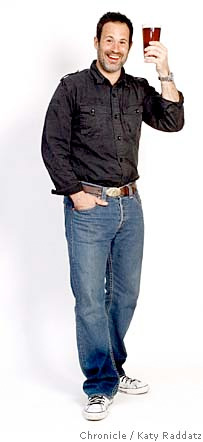
My “Uncorked” interview with Sam Calagione, from the Dogfish Head Brewery, is in today’s San Francisco Chronicle. I’m quite pleased with how it turned out. If you’re unfamiliar with the Uncorked series in the San Francisco Chronicle, they’ve been doing them for some time now, and it’s an interview that begins with some expository background information. They’re meant to be fun and a little thought provoking, with at least a few quirky, off-the-wall questions thrown in for good measure. I read a number of them in preparing my own questions, so I could get the tone right. So when I came up with my questions for Sam, I figured ask far more than I needed so that I could pick and choose the best ones. Sam, of course, is no stranger to public speaking and so made the process much easier. The hard part was choosing what to include and what to leave out. So here are a few more questions and answers from the original interview that I didn’t have the room to include in the Chronicle article.

sam-chron

What’s your favorite style of beer for spring?

I would have to say, just IPA. In general, whether it’s a big imperial IPA or a regular one. Those grassy, fruity, estery characters of an IPA remind me of the greening of the trees and the greening of the grass and just nature coming back to life.

Why should everybody in America be drinking craft beer?

Because Americans are starting to trade up and appreciate the finer things and recognizing that instead of a soul-killing SUV or vacation house, that they can spend $10 and get the world’s best beer. The craft beer renaissance is truly an affordable connoisseurship and compared to wine, where the world’s best bottles are going to cost hundreds, if not thousands, of dollars, anybody in America can buy the world’s best beers. And because every American lives within ten miles of their local brewery, it’s not only an affordable connoisseurship but it’s an accessible world, too.

As an Italian-American, what do you think of the recent Italian beer renaissance?

It’s beautiful. It’s just indicative of a culture that embraces the finer things, whether it’s wine, beer or culinary. They got their priorities right over there. It’s about living well and spending time with loved ones and friends around a table full of great food and drink. I think it’s a wonderful sign of the craft brewing renaissance to watch it landing in other cultures that had traditionally been more associated with wine.

Why Did You Choose Delaware?

To be perfectly honest, by the time I got my shit together and raised the money I needed to start it, there were only eight states left in America that didn’t have a brewery. And I thought it would be great marketing cache to be the first brewery in a state and the first brewery in the first state sounded good. My wife, Mariah, who runs the company with me was born and raised in Delaware. So I’d go down and visit her in the summer, and living right on the Atlantic beach seemed pretty cool. I love it, we’re two hours from D.C., Baltimore and Philly, and it’s a great place to live and have a brewery.

What is a Randall?

A Randall is an organicalyptic hop-inducing module. Basically it was an invention we came up with for an east coast vs. west coast beer event, where Russian River Brewing, and some others, brought their beers and at the end of the day the east coast brewers beat the west coast brewers for the best hoppy beers in the country. We’ve now made 300 Randalls, and they’re being used in breweries all around the world. Basically, it’s a glorified, customized pool filter that we load with whole leaf hops and the beer acts as a solvent and strips the oils off the hop leaves and pour them in your glass. It’s just a great tool to educate the consumer on what hops does to beer. Not many consumers see hops changing their beer at the point where they’re actually drinking it, so it’s been a neat educational tool for us.

Do you take a certain pride when brewer’s say about their own beers, “No Randall Required?”

I actually do. Basically, to me, it sounds like insecurity, like maybe they should start thinking about using a Randall.

You’ve done a couple of Rap CDs, the Pain Relievez, with your head brewer Bryan Selders, and on a few songs you taunt West Coast brewers. Are you worried about any reprisals while you’re in town, on their turf, so to speak?

I hope they don’t Tupac my Biggie. It’s all done in good fun and we love those guys. But boy, I hope they bring out a response album, but I don’t think they have the guts or the rhythm.

What did you drink last night?

About 10-12 beers, to be perfectly honest. I was with my good friends that own breweries from around the country and we collectively brewed this gueuze-style beer called Isabelle Proximus. So we ended the night with that, but we enjoyed each others’ beers in all the courses that led up to that. That project is indicative of how altruistic and mutually supportive the craft brewing industry is. It’s an amazingly unique community where we teach each other what we know for the greater good and try and help each other, recognizing that collectively 1450 breweries in America have less than a 5 percent share and three giant ones have over an 80 percent share, but the craft beer [segment] is where the growth is at and it shows that the consumer now understands and appreciates what the small breweries in America are doing.
 
The rest of the interview can be read in today’s San Francisco Chronicle (page F-3) or online at SFGate.com.

Filed Under: Breweries, Just For Fun Tagged With: Delaware, Interview

Bud Woos Modelo

June 12, 2008 By Jay Brooks

The Wall Street Journal is today reporting that Anheuser-Busch has entered into talks with Grupo Modelo about some sort of merger or acquisition in an effort to keep InBev’s takeover bid from becoming a reality. This is at least one of the strategies that had been floated in recent weeks and months for strengthening A-B. If you’re unfamiliar with Grupo Modelo, they are the largest brewer in Mexico, with nearly a two-thirds share of the Mexican market, and I’m sure you know at least one of their dozen brands: Corona. A-B already has a 50% stake in the Mexican beer company, but it’s non-voting stock and thus they have no control over the business. Today’s AP story regarding the InBev deal mentioned that InBev’s weak performance last quarter makes getting enough equity to complete the takeover possibly problematic, meaning that an A-B that also included control of Corona would be more expensive, which might be enough to kill the deal. Strap in folks, this is getting interesting.


Filed Under: Breweries, News Tagged With: Anheuser-Busch, Business, Modelo

A Tale of Two Bretts

June 1, 2008 By Jay Brooks

russian-river hallertau-nz
My first beer stop after recovering from my trip to New Zealand was to head up to Russian River Brewing. It was not because I was craving hops after two weeks mostly without them — although I was — but for another reason related instead to Brettanomyces. One of the most interesting beers I sampled in New Zealand, at Hallertau Brewbar near Auckland, was called Porter Noir, an English-style porter aged in local pinot noir barrels for four months which then spent six more months bottle conditioning with additional Brettanomyces. I brought back two bottles with me, but unfortunately one of them was damaged during the flight. It didn’t break but developed a small leak. Some of the beer seeped out but happily stayed inside the Ziplock bag I had packed it in. So I knew I had to drink it pretty quickly before it went flat.

two-bretts-1

So I stopped by Russian River’s new production brewery to open it for Vinnie Cilurzo, figuring he’d appreciate trying another Brett beer. The place looked quite a bit different then when I was there less than three weeks before. For one thing, all the construction equipment and spare parts were gone, making it look much larger inside and out. Vinnie also showed me the sixty barrels of the Consecration — the first beer brewed at the new brewery — aging in the barrel room. Most already have the Zante Currants added, but a few are still waiting for them. The beer will age for at least nine months before being released.

two-bretts-2
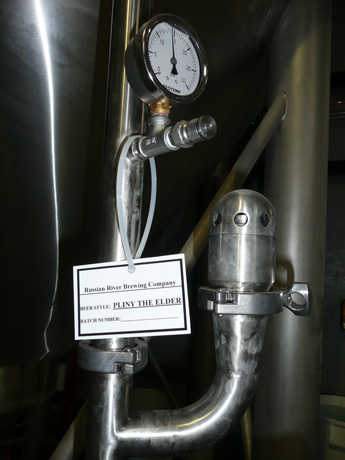
The first batch of Pliny the Elder in the fermenter, waiting to be bottled in early July.

two-bretts-3

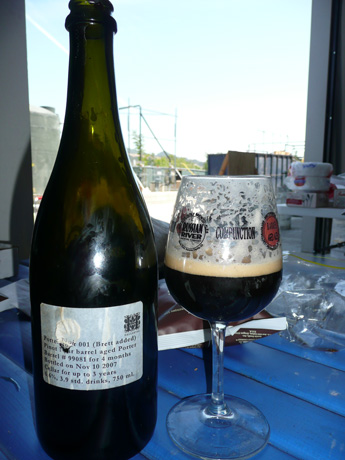
So we opened the Hallertau Porter Noir. Although it had lost a few inches of beer from the neck, it was still quite well-carbonated. All of the bottles at this point are from Batch 001, but this one was from Barrel #99081 and was bottled on November 10, 2007. It was 6.6% abv. Dark in color and a very thick tan head. The nose was marked by characteristic barnyard aromas with just a touch of malty sweetness. The nose was slightly less pungent than the sample I had in New Zealand, but Vinnie and I both declared it to be quite tasty. The Brett character married quite nicely with the nutty, malty porter flavors.

two-bretts-4
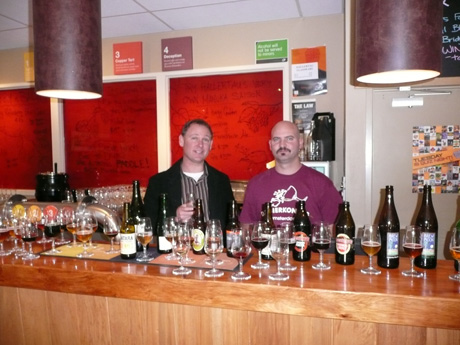
At the original tasting of this beer at Hallertau Brewbar last week in New Zealand. On the left is my host, Luke Nicholas — who owns Epic Beer and is also VP of the recently formed New Zealand Brewers Guild — and, on the right, Stephen Plowman, owner/brewer of Hallertau Brewbar & Restaurant.

Filed Under: Beers, Breweries, Just For Fun Tagged With: New Zealand, Russian River Brewing

CBC Begins In San Diego

April 22, 2008 By Jay Brooks

ba
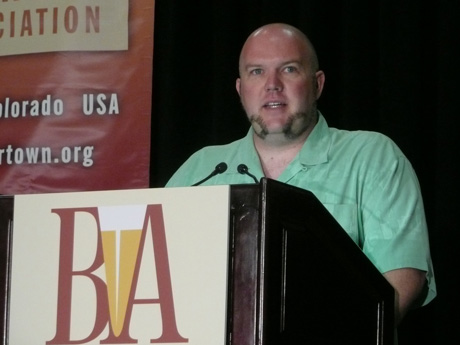
The Craft Brewers Conference, this year held in San Diego, officially began last Thursday — as it always does — with all the Brewers Association members assembled in a large hall for the “Welcome and Keynote Address.” During this time, they also present three awards important within the craft beer industry.

cbc08-20

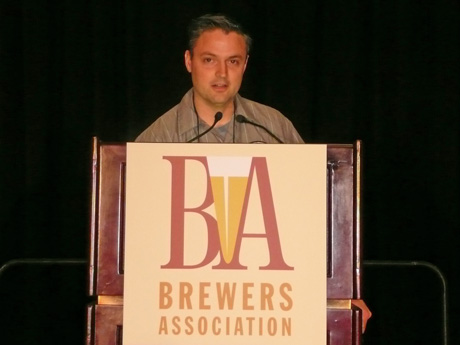
After opening remarks from BA President Charlie Papazian, Tom Nickel gave the history of San Diego, the area’s beer community, along with tips on what to see and do in the city.

cbc08-23

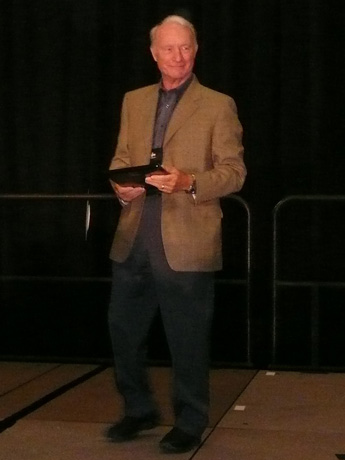
Dr. Michael Lewis, from U.C. Davis, received one of the three awards.

cbc08-25

As did Vinnie Cilurzo, from Russian River Brewing.

gallery

For more information and photos from this year’s first day of the Craft Brewers Conference, visit the photo gallery.

Filed Under: Breweries, Events, Just For Fun, News Tagged With: Awards, Brewers Association, CBC, San Diego

Losing Their Share of Mind

February 9, 2008 By Jay Brooks

trkanim
Anheuser-Busch’s “100% share of mind” program is legendary. It started ten years ago, when A-B began offering incentives to their distributors so they’d care only about A-B products. Though I assume they never said so — wink, wink — they encouraged distributors to drop non-A-B brands and concentrate on only the important brands. And at that time, such was A-B’s market strength that many distributors did in fact tow the line. But lately as domestic sales have been static or slipping, distributors are adding non-Bud brands to their portfolios to stay at the same level of profitability. The Associated Press had an article last week about this recent phenomenon called Beer Distributors Want More Than One Best Bud.

As the article points out:

For consumers, it means greater choice at their local bars and liquor stores. Wall Street analysts say the movement signals a weakening of the St. Louis brewer’s clout in the marketplace, as small-batch “craft” beers and imports, as well as wine and spirits, wrest market share from mass-market brews like Budweiser.

Many of the 560 nationwide A-B distributors realized that as craft beer is increasingly in demand, that their competitors were having the last laugh, because they were free to pick up whatever brands they wanted and believed they could be successful selling.

While IRI general manager Bump Williams described the program as a “great business model,” not everybody was convinced that it was fair. The DOJ launched an investigation into anti-trust violations, but later abandoned it. Naturally, A-B continues to push the program with such statements as “[w]e want their efforts and focus aligned with ours.” Well, who wouldn’t? But that isn’t how the world works nor is it how it should work. It’s schemes like this one that gave A-B its reputation as a bully. And it appears that they still have that mindset. Again, from the AP article.

Still, Anheuser wasn’t happy with the way it learned of the Tennessee distributors’ decision. “We found out later (in their decision-making process) than we would have liked,” says Mr. Peacock. “When we don’t get early communication, it rubs us wrong.”

Now why would one business be rubbed the wrong way if another, supposedly separate and independent company, didn’t consult with them before making a business decision? The best illustration of this mindset comes from more than a decade ago, with the former head of A-B, August Busch III, sitting around a conference table at their Hawaiian distributor petulantly throwing bottles of craft beer against the wall, smashing them to bits, to show his displeasure with a separate business having the unmitigated gall to sell something he can’t profit from. It’s that arrogance, borne of being the market leader for such a long time, that leads a company to believe that whatever is in their best interest is in everyone else’s best interests, too.

But as the market changes, that’s becoming less and less tenable. Distributors are realizing that to remain successful, they have to stock brands that their customers want, regardless of who makes them. That only makes good business sense. Some industry analysts, like my friend Harry Schuhmacher who runs Beer Business Daily, are surprised that it has taken so long for this to begin happening. As he puts it. “It really hasn’t been a widespread national jailbreak.” But that’s the hold that A-B has traditionally had over its distributors. Now that it’s finally beginning to erode, it will be interesting to see what percentage share of mind Bud is left with.

Filed Under: Breweries, Editorial, News, Politics & Law Tagged With: Anheuser-Busch, Beer Distributors, Big Brewers, Business

World’s First All-Rye Beer

January 23, 2008 By Jay Brooks

bear-republic
Most rye beers that I’m aware of use only around 10-20% rye with the rest being the more traditional barley. I’ve always liked that little something that rye adds to the beer and was in heaven over ten years ago during that year or so when it seemed like almost everybody was making a rye beer. These days, rye beers are a bit more on the rare side, though there’s still a few hundred being made in North America.

There is also a German style of beer, Roggenbier, which uses at anywhere from 25-65% rye malt, depending on whose account you accept. The German Institute says “half barley malt and equal portions of wheat and rye malts” are used while the BJCP guidelines say “Malted rye typically constitutes 50% or greater of the grist (some versions have 60-65% rye). Remainder of grist can include pale malt, Munich malt, wheat malt, crystal malt and/or small amounts of debittered dark malts for color adjustment.” Nothing against the BJCP, but I’m more inclined to to accept the version of the German Beer Institute since it’s an association of German breweries and related institutions.

So those are the common rye beers, what about using 100% rye? Well, probably the first and foremost reason you never hear about all-rye beers is that it is so difficult to brew with. Rye has no husks, like barley does, and that means it’s extremely difficult to sparge (which is spraying hot water on the spent grain) as without the husks it turns to a thick porridge or concrete.

There was a Irish brewer, Dwan Tipperary Brewing, who closed a few years back, who made a beer called All Rye Beer or All Rye Paddy at least once. But there’s no information as to whether it really used 100% rye malt, apart from that suggestive name. I’ve also come across an account of a homebrewer making an all-rye beer. MoreBeer’s forum also has a topic dedicated to why this is a difficult task.

ezryder-1

So perhaps I should change the title to the world’s only currently made commercial example of a 100% rye beer, but it doesn’t sound very sexy that way, now does it? At any rate, Bear Republic Brewing in Healdsburg, California on Friday, debuted what they believe to be the world’s first 100% rye beer. I was on hand to try some of the first keg of their new Easy Ryeder and talk with the brewers about it.

But let’s talk about the beer itself first. It had a dull copper color, slightly hazy, with a decent tan head. The nose was a little restrained, with some bready aromas, a touch of hops and, naturally, some rye character. But it was surprisingly smooth, mild and very drinkable, an easy ryeder indeed. I was surprised to learn it was 5% abv because it seemed more like a session beer to me, and I would have guessed a little lower than that. I thought the rye flavors might overpower the beer, but that’s not the case at all. It is light and refreshing throughout with just enough hop character (at 30 IBUs) for balance. It finishes with just a bit of rye flavor lingering, before dissipating quickly and cleanly. Again, I think my expectations were that if beer with just a fraction of rye tends to give it strong rye flavors and character, that with all rye it would be even more so, but that wasn’t really was not what happened. Instead, they managed to create a unique, ultimately very drinkable beer that in temperament seems closer to a wheat beer, but with the more barley-like flavors of rye.

The beer went through several trials before getting things right. To combat the wort turning to concrete, they had to watch the temperature fluctuations much more closely than usual (no more than 3-5 degrees or it turned to stone), and with bags of rice hulls added to make up for the lack of husks in rye malt. It was, of course, difficult to get the malt to break down and early test batches, if they didn’t become concrete-like, were still very thick and viscous and even hard to remove from the lauter tun at all. Even so, the first test batch that yielded drinkable results was the color of bad gravy, having a dull gray tint to it from all pale rye malt. Apparently it tasted fine, but who among us wants a beer the color of dishwater? Twenty-five pounds of chocolate rye malt was then added to give it the much more appealing color it exhibits today. The hops they used are Chinook and Saaz. It took four tries to get it right, as there really aren’t any manuals for tis kind of beer. Was it worth all that effort? I think so, as the results are quite tasty and in some ways different from anything else I’ve tried. It certainly must have been a learning experience and it’s interesting to see that it is possible on a commercial level to use only rye. It’s quite an achievement, and if you love rye — or just brewing innovation and creativity — you owe it to yourself to get up to Healdsburg to try this new beer.

ezryder-2
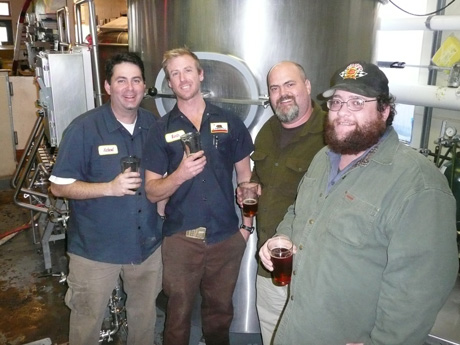
Bear Republic brewers Rich Norgrove, Jode Yaksic, Peter Kruger and Ray Lindecker. Jode, according to Rich, had the most to do with creating the Easy Ryder, from doing the research, test batches and coming up with the name.

Filed Under: Beers, Breweries, News, Reviews Tagged With: Bay Area, California, Ingredients, Malt, Northern California, Science of Brewing

The New Brewhouse at Lagunitas

January 21, 2008 By Jay Brooks

I stopped by Lagunitas Brewing Friday afternoon to see the new brewhouse that I’d heard they’re in the process of installing. They’re in week three of a nine-week installation of a new 80-barrel system from a German company, ROLEC Prozess-und Brautechnik GmbH, along with many new pieces of equipment. Peter Moroskow and his team, who also recently installed new breweries at both Stone Brewing and Victory Brewing, had taken over the place and there were miles of pipes and other equipment everywhere, with blueprints dotting the walls and a Bavarian flag hanging overhead.


The Bavarian flag hanging from above, with just a fraction of the pipe remaining on the floor below.

For more photos of brewing equipment being installed at Lagunitas, visit the photo gallery.
 

Filed Under: Breweries Tagged With: Bay Area, Brewing Equipment, California

Coast Range Closed?

January 10, 2008 By Jay Brooks

coastrange
I heard a rumor today from a fairly reliable source that Coast Range Brewing in Gilroy, California has closed their doors for good. My understanding is that they’re a Chapter 11 Reorganization Bankruptcy and are actively looking for a buyer.

I’m sorry to say that’s it’s not a huge surprise as they’ve been having financial difficulties … well, for a very long time now. For several years at least they’ve managed to stay afloat due mainly to doing contract beers for a variety of clients, having picked up quite a lot of new business when Golden Pacific Brewing was sold to Gambrinus a few years back. Before that they picked up a tidy sum from a French brewery by selling them the U.S. rights to the name Desperado, which had been the name of their Pale Ale, so that the tequila flavored French Desperado beer could try to take over the American beer market during those thirty seconds when tequila flavored beers were the “in” thing — A-B’s Tequiza, which they still make, managed to own the category.

Coast Range’s passing, though, is quite a shame as I thought brewer Peter Licht was quite talented. Back when fruit beers were more popular, he made a Blackberry Wheat that I thoroughly enjoyed. And he did several fine contract brews for me when I was the beer buyer at BevMo, too. The only reason they never seemed to reach very far beyond their own backyard had more to do with distributor networks, retailers and some poor management decisions than bad product. I will mourn their passing tonight with one of their Farmhouse beers, a new label they debuted two years ago.

Filed Under: Breweries, News Tagged With: Bay Area, Business, California, Northern California

« Previous Page
Next Page »

Find Something

Northern California Breweries

Please consider purchasing my latest book, California Breweries North, available from Amazon, or ask for it at your local bookstore.

Recent Comments

  • Bob Paolino on Beer Birthday: Grant Johnston
  • Gambrinus on Historic Beer Birthday: A.J. Houghton
  • Ernie Dewing on Historic Beer Birthday: Charles William Bergner 
  • Steve 'Pudgy' De Rose on Historic Beer Birthday: Jacob Schmidt
  • Jay Brooks on Beer Birthday: Bill Owens

Recent Posts

  • Historic Beer Birthday: Frederick Kirschner May 21, 2026
  • Beer Birthday: Nick Matt May 21, 2026
  • Historic Beer Birthday: Oliver Hughes May 20, 2026
  • Historic Beer Birthday: Benjamin, Lord Iveagh May 20, 2026
  • Historic Beer Birthday: Eduard Buchner May 20, 2026

BBB Archives

Feedback

Head Quarter
This site is hosted and maintained by H25Q.dev. Any questions or comments for the webmaster can be directed here.