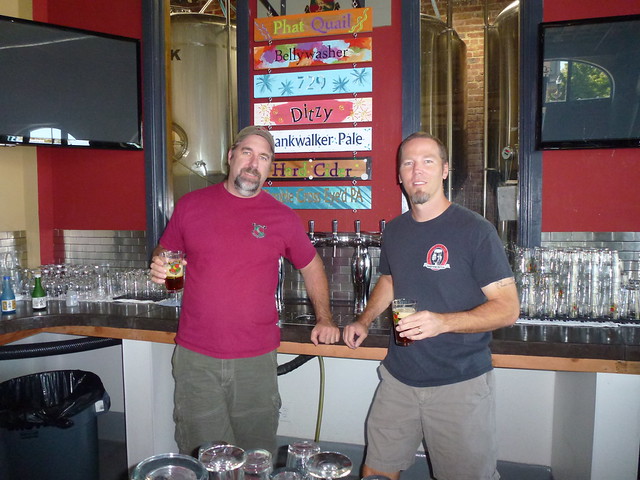
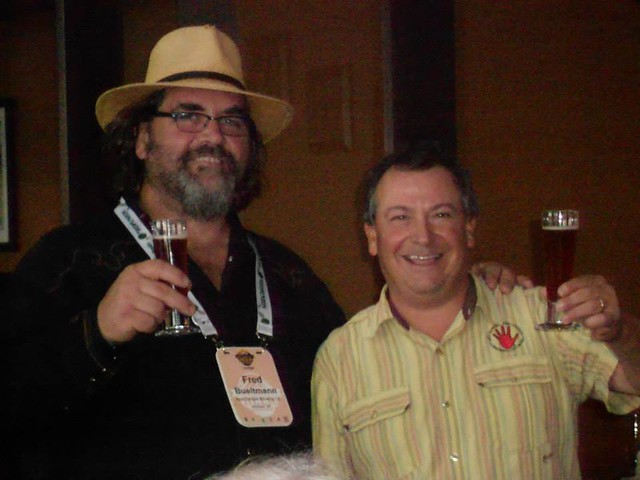
The original rogue, Jack Joyce, who founded Oregon Brewing — better known today as Rogue — would have celebrated his 82nd birthday today. Sadly, he passed away in late May of 2014. Join me in drinking a toast to Jack’s memory today.


By Jay Brooks


The original rogue, Jack Joyce, who founded Oregon Brewing — better known today as Rogue — would have celebrated his 82nd birthday today. Sadly, he passed away in late May of 2014. Join me in drinking a toast to Jack’s memory today.


By Jay Brooks


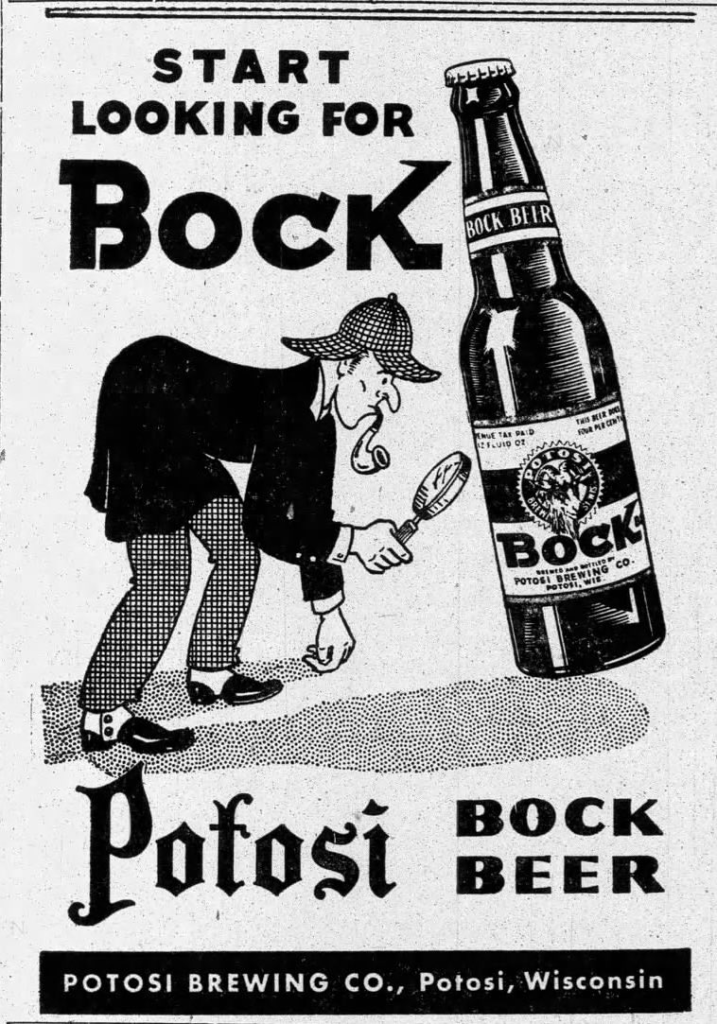
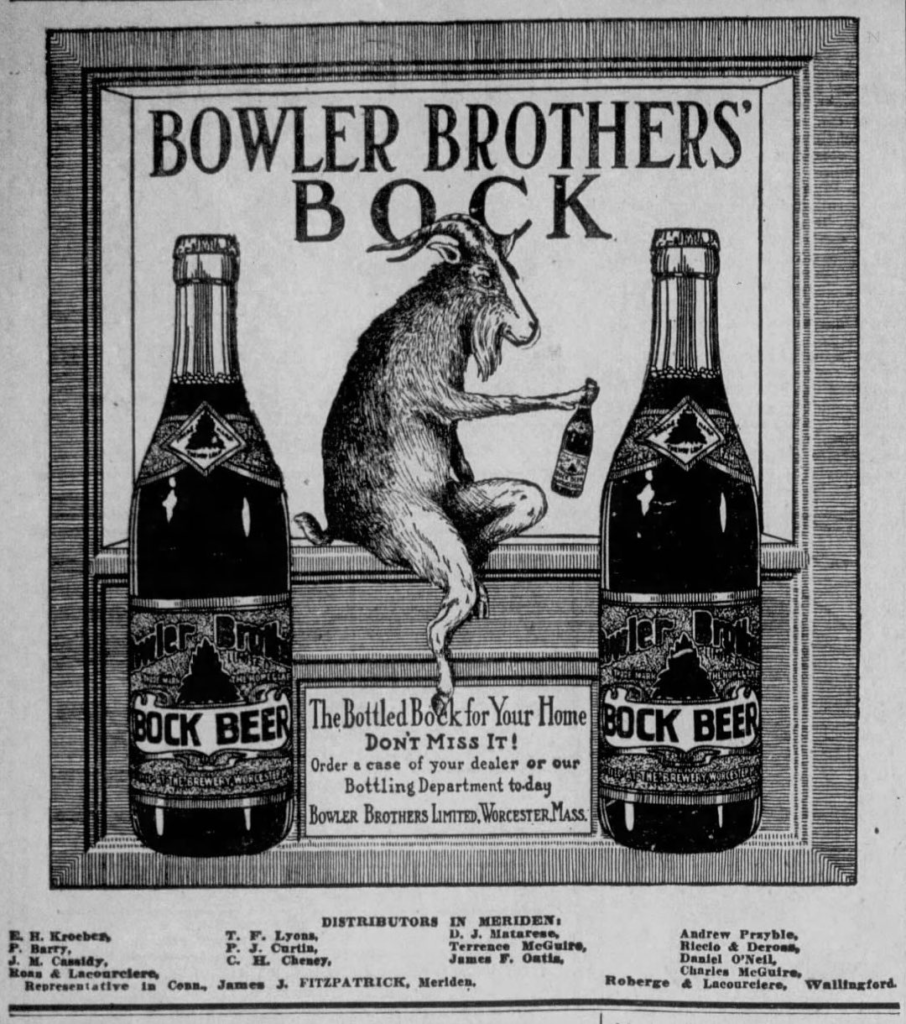
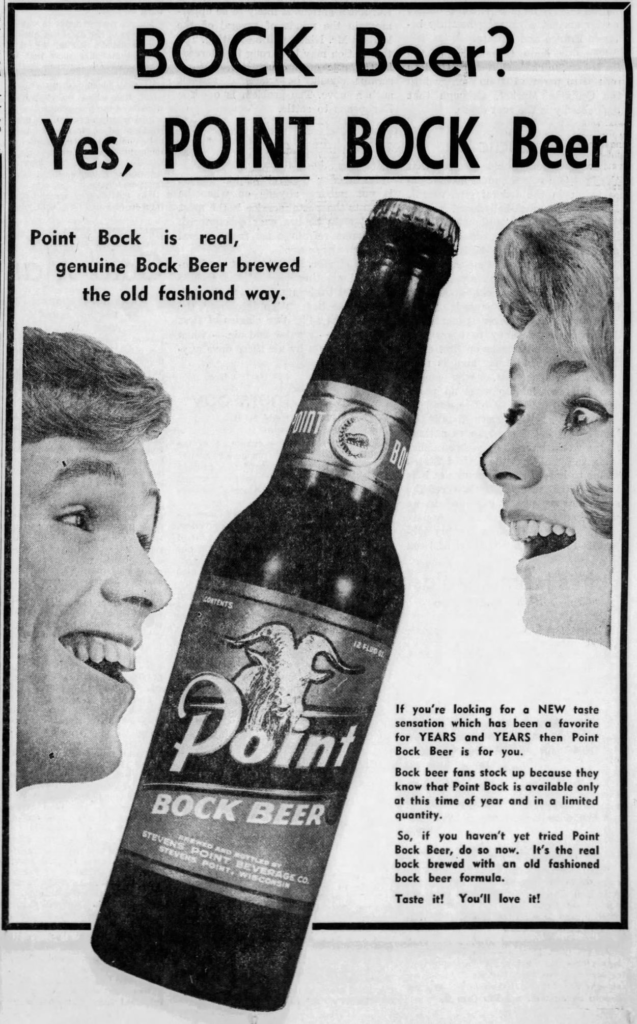
Last year I decided to concentrate on Bock ads for awhile. Bock, of course, may have originated in Germany, in the town of Einbeck. Because many 19th century American breweries were founded by German immigrants, they offered a bock at certain times of the year, be it Spring, Easter, Lent, Christmas, or what have you. In a sense they were some of the first seasonal beers. “The style was later adopted in Bavaria by Munich brewers in the 17th century. Due to their Bavarian accent, citizens of Munich pronounced ‘Einbeck’ as ‘ein Bock’ (a billy goat), and thus the beer became known as ‘Bock.’ A goat often appears on bottle labels.” And presumably because they were special releases, many breweries went all out promoting them with beautiful artwork on posters and other advertising.
Tuesday’s ad is for Gem Bock Beer, which was published on December 9, 1950. This ad was for the Walter Bros. Brewing Co. of Menasha, Wisconsin, which was originally founded as the Island City Brewery in 1860. It became known as Walter Bros. in 1933 after prohibition, although the brothers had been involved in the brewery since 1888. This ad ran in The Green Bay Press Gazette, from Green Bay, Wisconsin.

By Jay Brooks

![]()
Today is the birthday of Henry Hermann Rueter (December 9, 1832-November 27, 1899). He was born in Westphalia, Germany, but moved to Boston, Massachusetts. In 1867, along with Irishman John R. Alley, founded the Highland Spring Brewery. By 1885, they had moved to Heath & 165 Terrace Streets, but was known after that as Rueter & Co., Inc., although their trade name continued to be the Highland Spring Brewery. After prohibition ended, they were known as the The Croft Brewing Co., but in 1952 were bought by the Narragansett Brewing Co., who closed them for good the following year.

Here is a biography from the Boston Landmarks Commission when the property where the brewery was located applied for historic status, researched by Angelica Coleman and Marcia Butman:
Henry Rueter was born in 1832 I the province of Westphalia, Germany. He immigrated to the US in 1851 and after a short stay in New York came to Boston and worked for the Roxbury brewer G. F Burkhardt. With John D. Alley he established Highland Springs Brewery. After Alley withdrew to form his own company, the firm reorganized as Rueter and Co. After Rueter’s death (1899) his sons retained control of the company.
Another source discusses the family background. “The family was founded in this country by the late Henry H. Rueter, who came to Boston in 1831, at 18, from Gutersloh, Westphalia, his birthplace. He was of honorable ancestry, uniting the blood of the Rueters and the Von Eickens.”

From “The Men of Boston and New England, The Boston American,” 1913
Henry H. Rueter founded the Highland Spring Brewery in 1869, and in three years had made it the largest brewery in the United States and today it still maintains its place as the greatest ale brewery of America.
The present head of the family is Henry A. Rueter, born in Boston, educated in Germany, and now in his fifty-fourth year. He is president of Rueter & Company; and of its affiliated lager beer interest the A J. Houghton Companv; and is a director in the National Rockland Bank, the American Trust Co., the Roxbury Institution for Savings, and the Mass. Bonding and Ins. Co. He was one of the incorporators ot the Mass. Automobile Club, and has served it in various capacities. The Country Club and the Algonquin Club count him among their members as does the Boston Chamber of Commerce. Mrs. Rueter was Miss Bertha Glover, only daughter of the late William H. Glover of Rockland, Me. They have two children,-William G. Rueter, now in his final year at Harvard, and Miss Martha Von Eicken Rueter.
A graduate of Harvard, and later a student at Boston Univ. Law School and Bonn University, Germany, Conrad J. Rueter is a recognized authority on the technical and practical application of the liquor law. He has served his city for upwards of seventeen years as trustee of the Boston City Hospital having been reappointed in 1913 for another five vear term. He belongs to the Boston Art Club, the Puritan Club, and the Harvard Club; and is a member of the Liederkrantz Club of New York. In his fiftieth year, his pleasure in outdoor sport is evidenced bv his membership in the Mass. Automobile Club, the Brae Burn Country Club and the Wollaston Golf Club Mrs. Conrad J. Rueter was Miss Ramseyer. There is one son.-John Conrad Rueter.
At the head of the sales staff is Frederick T. Rueter. and the brewing department itself is in direct charge of Ernest L Rueter. youngest of the four brothers, as general manager and master-brewer. Both names appear on the rolls of the Boston Athletic Assn. Ernest L. Rueter is also a member of the Country Club. Frederick T. Rueter is unmarried. Mrs. Ernest L. Rueter was Miss Myra Chevalier, and there is one daughter-Miss Jeanette.

And here’s another short history of the brewery from the Wikipedia page about the Highland Spring Brewery Bottling and Storage Buildings:
The Highland Spring Brewery was founded in 1867 by a pair of immigrants, one Irish and the other German. The enterprise was a significant success, producing lagers, ales, and porters, and eventually gaining a nationwide reputation. In part for legal reasons, the two buildings built by the company (one for production, the other for storage and bottling) were connected by a tunnel and piping. The brewer ceased operations when Prohibition began in 1920. One of the company’s brewmasters opened the Croft Brewery in the 1892 building in 1933 after Prohibition ended, the storage building having been sold to the Ditson Company and significantly altered for its use. Croft was acquired by Narragansett Brewing Company in the 1952, and operated on the premises for just one year before closing the plant and moving production to their Rhode Island Brewery until 1981 when it too closed.

By Jay Brooks


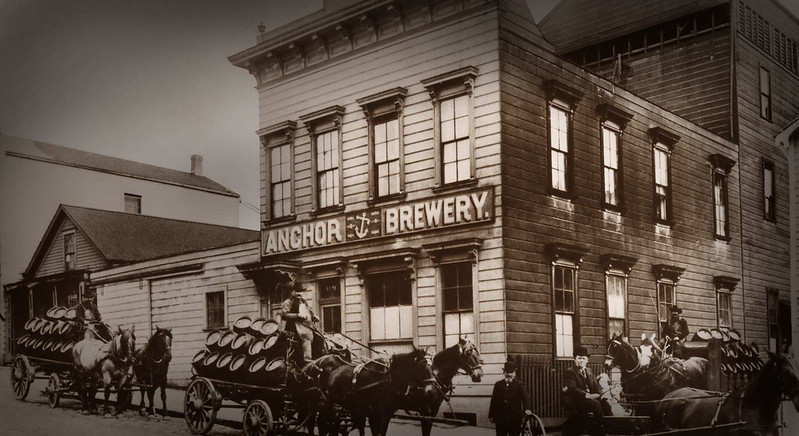
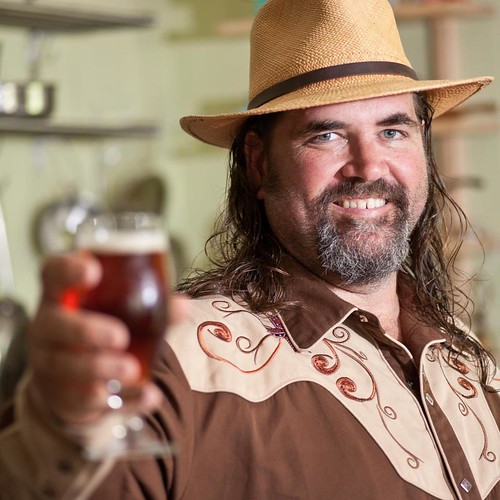
Fritz Maytag, who bought the failing Anchor Brewery in 1965 and turned it into a model for the microbrewery revolution, celebrates his 88th birthday today. It’s no stretch to call Fritz the father of craft beer, he introduced so many innovations that are common today and influenced countless brewers working today. A few years ago, Maytag sold Anchor Brewery and Distillery to Keith Greggor and Tony Foglio of the Griffin Group, and in 2017 acquired by Sapporo Breweries, then closed last year ago, but continued to make his York Creek wine and for a time consulted with Anchor as Chairman Emeritus. I was happy to see him again a few years ago, first at the California Beer Summit, and later when I was invited to introduce him to receive an award from the Northern California Brewers Guild in Sacramento, and more recently he unexpectedly showed up at the Anchor taproom the day before it closed last year. Join me in wishing Fritz a very happy birthday.


By Jay Brooks


Last year I decided to concentrate on Bock ads for awhile. Bock, of course, may have originated in Germany, in the town of Einbeck. Because many 19th century American breweries were founded by German immigrants, they offered a bock at certain times of the year, be it Spring, Easter, Lent, Christmas, or what have you. In a sense they were some of the first seasonal beers. “The style was later adopted in Bavaria by Munich brewers in the 17th century. Due to their Bavarian accent, citizens of Munich pronounced ‘Einbeck’ as ‘ein Bock’ (a billy goat), and thus the beer became known as ‘Bock.’ A goat often appears on bottle labels.” And presumably because they were special releases, many breweries went all out promoting them with beautiful artwork on posters and other advertising.
Sunday’s ad is for Pickwick Bock Beer, which was published on December 7, 1953. The brewery was the Southern Brewing Co. of Tampa, Florida, which was originally founded in 1934, but closed in 1963. This ad ran in The Tampa Tribune, from Tampa, Florida.

By Jay Brooks

![]()
Today is the birthday of Charles N. Hamm (December 8, 1886-October 16, 1918). This is one of the brewer’s birthdays I know the absolute least about. What little I know came from a snippet from a genealogical page about the family that bought the Hamm’s family brewery in 1932, although the Jung’s had apparently been leasing it for many years before that, possibly as early as 1918. Charles N. Hamm and his family, as far as I can tell, owned and possibly founded (although it seems more likely they bought in to) the Silver Lake Brewery, which was founded in Random Lake, Wisconsin in 1866. Charles’ father, Carl Hamm, was born in 1853, in Baden-Württemberg, Germany so it seems unlikely he started a brewery in Wisconsin when he was thirteen, plus records indicate he came to the U.S., initially New York, in 1872, and didn’t settle in Wisconsin until at least 1883, which is where his son Charles was born.

But at some point the Hamm family did acquire it, renaming it the Charles Hamm Brewery in 1910. In 1917, The Brewers Journal listed Charles N. Hamm as the “president, general manager, and brewmaster.” Hamm apparently enlisted in the Army and was sent to Europe to fight in World War I, leaving William Jung as brewmaster. Unfortunately, Hamm caught pneumonia while overseas and died in 1918.

In 1920, Jung leased the brewery from the Hamm family, and called it the Jung Beverage Co. during prohibition, but bought it outright in 1932. From then on it was known as the Jung Brewing Co. and 1952, when Jung sold out to Herman Sitzberger, who kept it going under the same name until 1958, when it closed for good.

Random Lake, Wis. today, with a population as of the 2010 census of 1,594.
By Jay Brooks


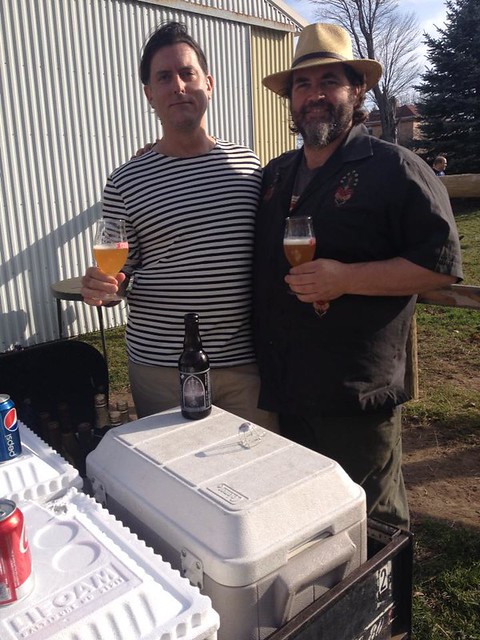
Today is the 59th birthday of Peter Licht, former brewmaster at Hermitage Brewing. Peter grew up in Rochester, New York but came to California to attend the master brewers program at U.C. Davis in 1994, and ended up staying in the Bay Area. When I first met him, he was brewing at Coast Range Brewing in the South Bay. When that brewery folded, he joined the San Jose Tied House, and moved with the equipment to when they closed to the brewpub to create the Hermitage Brewery at a new location and was there untuk they closed the brewery during Covid. Peter made some great contract beer for me at Coast Range (when I was at BevMo) and I was happy to see him land at Hermitage, where he had continued to brew a wide range of great beers. More recently, he’s working with the Independent Brewers Alliance, which a co-op for breweries to share buying power on supplies, resources and materials. Join me in wishing Peter a very happy birthday.


By Jay Brooks
![]()
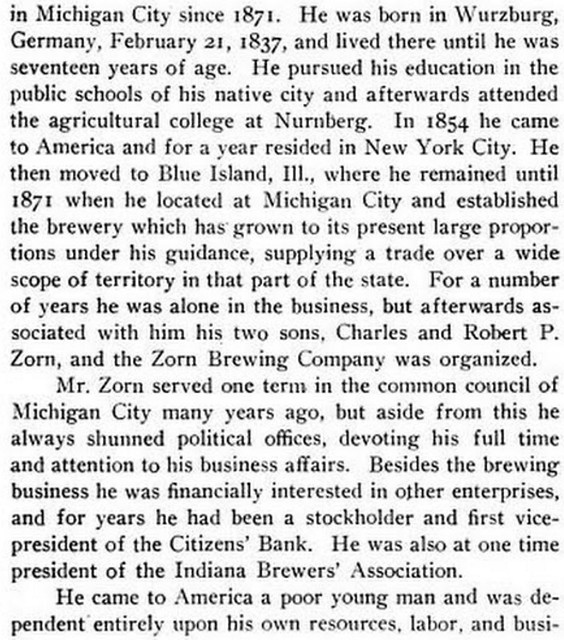
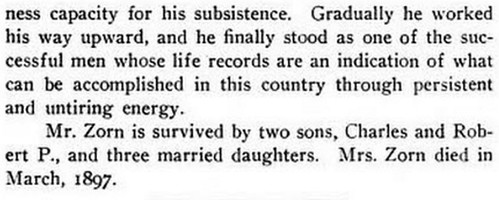
Today is the birthday of John A. Weyand (December 8, 1859-1907). He was the son of Christian Weyand, who founded what would become the Christian Weyand Brewing Co., which remained in business until closed by prohibition in 1920.

Weyand, John A., vice president and general manager of the Christian Weyand Brewing Company, and one of Buffalo’s most respected citizens, was born in that city, December 8, 1859. He early evinced a desire to acquire an education and after passing through the public schools and Canisius College he entered the Bryant & Stratton Business College, from which he was graduated before attaining his majority. He immediately entered his father’s brewery, remaining in that business until 1890, when it was made a stock company and he was made vice president and general manager. Aside from his extensive business affairs, Mr. Weyand takes an active interest in church affairs, being a member of St. Louis Catholic church, is a trustee of St. John’s Protectory, member of the Buffalo Orpheus, Sangerbund and Liedertafel. He has always taken an active interest in all public enterprises and was a park commissioner under Mayor Bishop.

This short history of the brewery, including mentions of John and his father, is from the “1897 Brewers Convention Buffalo NY,” published by the Buffalo Brewers Association:
Christian Weyand Brewing Company.
In 1866, Christian Weyand established the business now conducted by The Christian Weyand Brewing Company. Mr. Weyand is a native of France, having been born in the province of Lorraine a little more than seventy years ago. There he spent his youth and received his education; but in his twenty-first year he left Lorraine for the wider opportunities of the New World, landing in New York just fifty years ago. He soon found his way to Buffalo, but it was nearly twenty years before he began the business with which his name is now so intimately connected in the minds of all Buffalonians. During these years he worked as a shoemaker — at first as an employee, and later in a shop of his own.
Mr. Weyand, with a partner, began the brewing business in a small way, with little capital and a poorly equipped plant; but the purest and best of barley malt was used from the start, and improved machinery was introduced as fast as the necessary capital could be secured. In 1873. Mr. Weyand assumed entire charge of the business, and applied himself vigorously to the task of building up a model brewery. His efforts met with entire success, and in a few years his establishment became one of the first in its line in Buffalo — a city that boasts of many fine breweries. In 1890, he organized the business into a stock company, called The Christian Weyand Brewing Company, of which he is president, his son, John A. Weyand, vice-president and manager, and another son, Charles M. Weyand, secretary and treasurer. Since then the business has materially increased, and in 1896-97 it became necessary to make extensive additions to the plant. The new buildings on the corner of Main and Goodell streets, built of buff terra cotta elaborately ornamented in Renaissance style, are exceedingly handsome; and it is now one of the best-equipped breweries in the country.

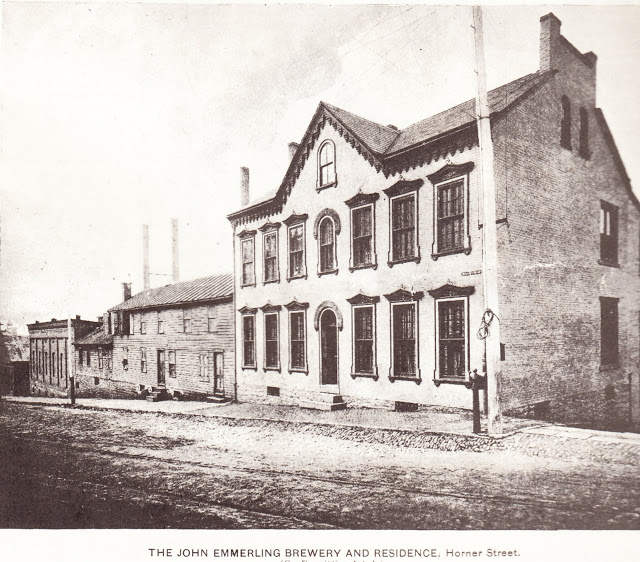
This is purported to be a photograph of the house at the “Southeast Corner Main and Goodell Streets” from the 1912 “Picture Book Of Earlier Buffalo.” But as Michael F. Rizzo and Ethan Cox, authors of “Buffalo Beer” point out, “the structures in the background and to the left of the subject must have been the Christian Weyand brewery. Indeed, the least occluded building to the left was, I think, their office address on Goodell.”

By Jay Brooks


Last year I decided to concentrate on Bock ads for awhile. Bock, of course, may have originated in Germany, in the town of Einbeck. Because many 19th century American breweries were founded by German immigrants, they offered a bock at certain times of the year, be it Spring, Easter, Lent, Christmas, or what have you. In a sense they were some of the first seasonal beers. “The style was later adopted in Bavaria by Munich brewers in the 17th century. Due to their Bavarian accent, citizens of Munich pronounced ‘Einbeck’ as ‘ein Bock’ (a billy goat), and thus the beer became known as ‘Bock.’ A goat often appears on bottle labels.” And presumably because they were special releases, many breweries went all out promoting them with beautiful artwork on posters and other advertising.
Sunday’s ad is for Pickwick Bock Beer, which was published on December 7, 1953. The brewery was the Haffenreffer Brewery of Boston, Massachusetts, which was originally founded in 1870. It was located in the Jamaica Plain area of Boston, and today the site of the brewery is where the Boston Beer Co. operates one of its breweries. This ad ran in The Republican, from Springfield, Massachusetts.

By Jay Brooks

Today is the birthday of Christian William Feigenspan (December 7, 1876-February 7, 1939). His father, Christian Benjamin Feigenspan, was born in Thuringia, Germany but moved his family to New Jersey and founded the C. Feigenspan Brewing Company of Newark in 1875, though at least one source says 1868. When his father died in 1899, Christian William took over management of the brewery, which remained in business through prohibition, but was bought by Ballantine in 1943. He was also “president of Feigenspan Brewing Company, president of Federal Trust Company, and president of the United States Brewers’ Association.”

Here’s a short biography from Find-a-Grave:
Businessman. He took over Newark, New Jersey’s Feigenspan Brewery Company, founded by his father in 1868, when his father died in 1899. He then transformed the company into one of the best known breweries up until and after prohibition. Today it’s labels are the among the most sought after by collectors.

Here’s another biography from “Legendary Locals of Rumson,” written by Roberta H. Van Anda: