Believe it or not, since 1979, St. Luke’s Lutheran Church in Illinois has had a musical group, the St. Luke’s Bottle Band. According to their website, the band was “founded by Professor Paul Phillips. Over the past few years the St. Luke’s Bottle Band has been featured on National Public Radio, the NBC Nightly News, Wild Chicago and the Jenny Jones Show. The band has traveled to Atlanta Georgia to perform for the American Lutheran Church Musicians Conference, as well as Door County, Wisconsin, to present a concert at the Fish Creek Auditorium. The Bottle Band has appeared on An American Moment with James Earl Jones and twice on the Late Show with David Letterman.” (Thanks to Tom D. for sending me the link.) In addition to Scott Joplin’s Peacherine Rag below, there are a number of additional videos of the bottle band performing, including a rousing kazoo version of John Philip Sousa’s Washington Post March. The also have a Facebook page. Enjoy.
Beer In Ads #241: Schlitz Famo Soldier

Thursday’s ad is for Schlitz Famo, from around 1918. Famo was their non-alcohol beer during Prohibition, or as they referred to it, “a pure non-intoxicating beverage.” I’m not sure what the tie-in was with the man in uniform, though it was during World War I, and since today is Veteran’s Day — originally Armistice Day for that war’s end.
Most of the beer companies scrambled to come up with a N/A brand in the years just before Prohibition as they finally started to see the writing on the wall. For an interesting overview of the names they came up with, check out Prohibition and Near-Beer Names.
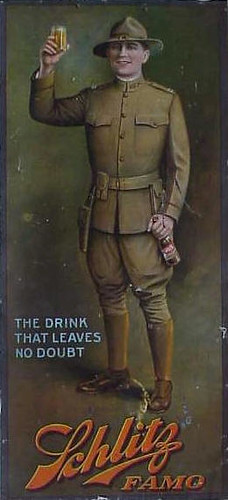
During the early part of Prohibition, brewers at the time were emphasizing cleanliness by saying that “Schlitz Famo goes through a pulp filter–then through a sterilized pipe line to glass-lined tanks in a cool cellar for aging. A sterilized line carries it to automatic filling machines containing sterilized bottles, thence to Pasteurization” They further stressed the nutritional values of their products. The company boasted that Schlitz Famo is more than a drink. It is a food. Every time you take a glass of Schlitz Famo you are taking something to eat. Every compound essential to the human body is present in Schlitz Famo–protein, carbohydrates, mineral matter and water–the only factor absent being fats, and they are formed in the body from the carbohydrates. These elements repair and build up broken-down tissues and impart to the body heat and muscular energy. That’s why we say Schlitz Famo is a worth-while cereal beverage. It is non-intoxicating. It is healthful, refreshing and satisfying. It has the wonderful hop aroma.
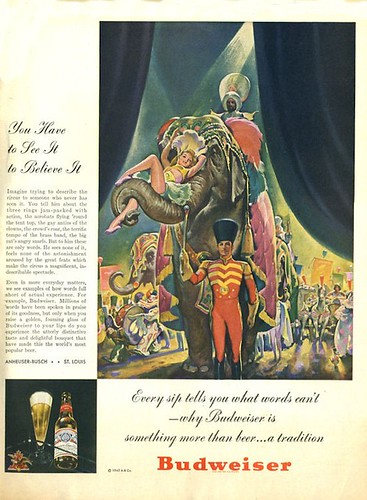
Beer In Ads #240: Bud, You Have To See It To Believe It
Wednesday’s ad is for Budweiser from 1948. It depicts a very colorful, surreal circus scene with the slogan “You Have To See It To Believe It.”
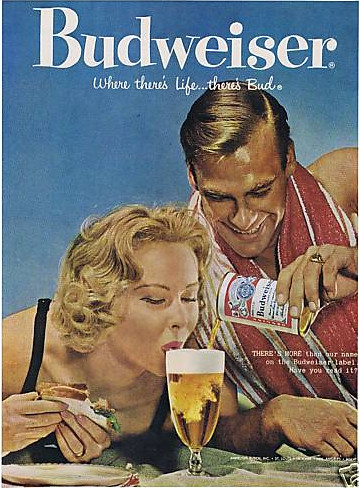
Beer In Ads #239: Bud Beach Sipping
Tuesday’s ad is for Budweiser from 1958. It’s from the “Where There’s Life … There’s Bud” series and features a couple at the beach. The man is pouring beer from a can to overflowing — tilt the glass, dude! — while the woman tries to sip it up before it spills over the side, while holding a partially-eaten sandwich. Is it just me, or is there something vaguely odd about the ad?
New Evidence Supports Theory That Beer Sparked Civilization

The theory that it was beer that caused early man to make the transition from hunter/gatherers to farmers instead of bread, thus starting civilization itself, has been gathering steam since it was first proposed by anthropologists in the 1950s. The latest support comes from archaeologist Brian Hayden at Simon Fraser University in Canada, who will be submitting his recent research to the journal Current Archeology. His theories suggest that it wasn’t just the beer that was important, but its use in rituals like feasts that help bring people together.
From the article in Live Science:
The advent of agriculture began in the Neolithic Period of the Stone Age about 11,500 years ago. Once-nomadic groups of people had settled down and were coming into contact with each other more often, spurring the establishment of more complex social customs that set the foundation of more-intricate communities.
The Neolithic peoples living in the large area of Southwest Asia called the Levant developed from the Natufian culture, pioneers in the use of wild cereals, which would evolve into true farming and more settled behavior. The most obvious explanation for such cultivation is that it was done in order to eat.
Archaeological evidence suggests that until the Neolithic, cereals such as barley and rice constituted only a minor element of diets, most likely because they require so much labor to get anything edible from them — one typically has to gather, winnow, husk and grind them, all very time-consuming tasks.
Hayden told LiveScience he has seen that hard work for himself. “In traditional Mayan villages where I’ve worked, maize is used for tortillas and for chicha, the beer made there. Women spend five hours a day just grinding up the kernels.”
However, sites in Syria suggest that people nevertheless went to unusual lengths at times just to procure cereal grains — up to 40 to 60 miles (60 to 100 km). One might speculate, Hayden said, that the labor associated with grains could have made them attractive in feasts in which guests would be offered foods that were difficult or expensive to prepare, and beer could have been a key reason to procure the grains used to make them.
“It’s not that drinking and brewing by itself helped start cultivation, it’s this context of feasts that links beer and the emergence of complex societies,” Hayden said.
Feasts would have been more than simple get-togethers — such ceremonies have held vital social significance for millennia, from the Last Supper to the first Thanksgiving.
“Feasts are essential in traditional societies for creating debts, for creating factions, for creating bonds between people, for creating political power, for creating support networks, and all of this is essential for developing more complex kinds of societies,” Hayden explained. “Feasts are reciprocal — if I invite you to my feast, you have the obligation to invite me to yours. If I give you something like a pig or a pot of beer, you’re obligated to do the same for me or even more.”
“In traditional feasts throughout the world, there are three ingredients that are almost universally present,” he said. “One is meat. The second is some kind of cereal grain, at least in the Northern Hemisphere, in the form of breads or porridge or the like. The third is alcohol, and because you need surplus grain to put into it, as well as time and effort, it’s produced almost only in traditional societies for special occasions to impress guests, make them happy, and alter their attitudes favorably toward hosts.”
Food and beer together at the heart of the birth of civilization. Now that’s pairing idea I can get behind.
Full Fact Disputes UK Alcohol Statistics

In response to the highly unscientific study published in The Lancet last week suggesting alcohol is more dangerous than heroin, FullFact.org — “A [British] independent fact-checking organisation” — asked the question “Are alcohol-related problems on the rise?” Their conclusion? “Full Fact finds little support in the evidence.”
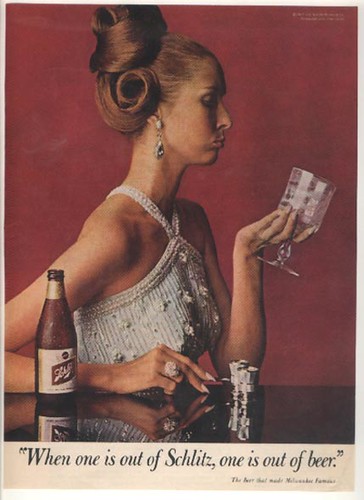
Beer In Ads #238: When One Is Out Of Schlitz, One Is Out Of Beer
Monday’s ad is for Schlitz, from — I’m guessing — the swinging, sophisticated sixties with a play on their famous slogan “when you’re out of Schlitz you’re out of beer” being rendered more proper, as “When One Is Out Of Schlitz, One Is Out Of Beer.”
Beer In Art #101: Vincent Van Gogh’s Wheat Fields

Today’s artworks are all by one of the world’s most well-known artists, Vincent Van Gogh. Given last Friday’s Session topic — wheat beers — I thought it would be fun to look at some paintings of what fields. Wheat fields were a favorite subject for Van Gogh and throughout his life he painted at least 40 artworks that included a wheat field.
One of his most famous wheat field paintings was Wheatfield with Crows, painted toward the end of Van Gogh’s life, in 1890, the same year he passed away. It was also the subject of an episode of Simon Schama’s Power of Art, a wonderful documentary series on art that I heartily recommend. In addition, it was used in a surreal sequence of a lesser know film by Akira Kurosawa called Dreams. The original is in the Van Gogh Museum in Amsterdam.
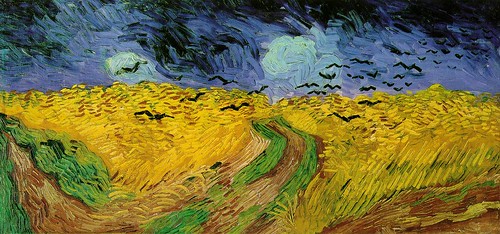
Here’s what the Van Gogh Museum has to say about the painting:
Wheatfield with Crows is one of Van Gogh’s most famous paintings and probably the one most subject to speculation. It was executed in July 1890, in the last weeks of Van Gogh’s life. Many have claimed it was his last work, seeing the dramatic, cloudy sky filled with crows and the cut-off path as obvious portents of his coming end. However, since no letters are known from the period immediately preceding his death, we can only guess what his final work might really have been. Some scholars believe it was the Tree-roots, but we have no proof that this was the case.
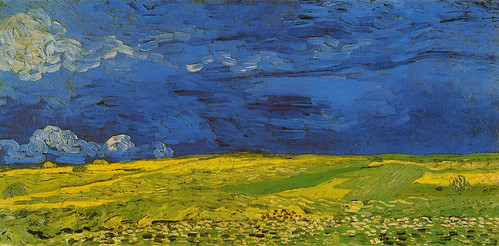
Another one painted around the same time was Wheat Field Under Clouded Sky, also painted in 1890.
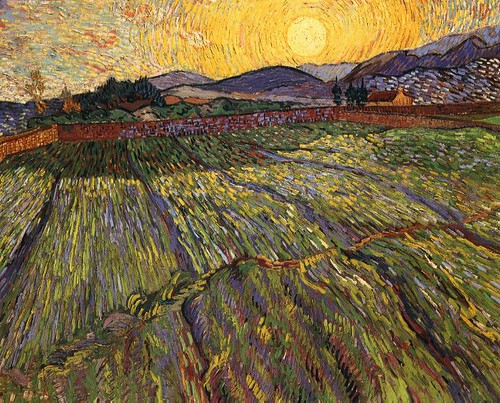
Can Gogh also executed a series of paintings called “The Wheat Field” series. All of the paintings “depict the view Van Gogh had from the window of his bedroom on the top floor of the asylum” at Saint-Rémy-de-Provence from June 1889 to May 1890. Here’s one from that series, Wheat Field, Sunrise, painted in 1890.
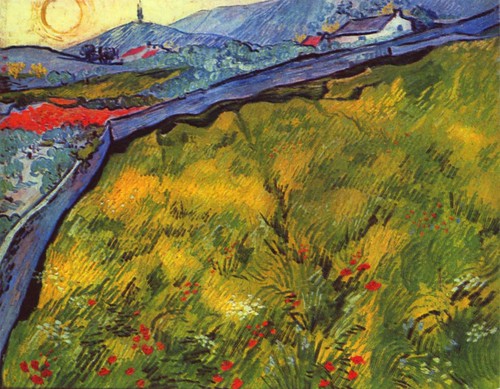
And here’s another one, Wheat Field with Rising Sun, from 1889.
For more about Vincent Van Gogh, Wikipedia is a good place to start, though there’s even more at the Vincent Van Gogh Gallery, which has a complete list of his works. There are also tons of links at the ArtCyclopedia and another biography at the Web Museum.
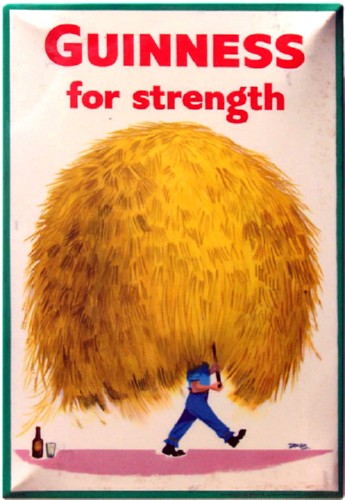
Guinness Ad #42: The Bale of Hay

Our 42nd Guinness poster by John Gilroy features carrying the biggest bale of hay, having presumably just finished off a pint of Guinness. The glass in the bottom right is empty, after all. That’s what gave him “Guinness for Strength” to be able to carry such a big load. It also looks a bit like a giant blond afro.
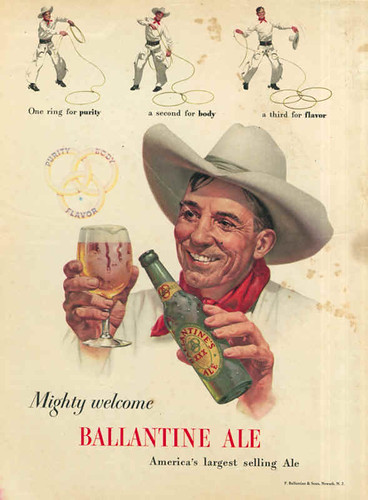
Beer In Ads #237: Mighty Welcome Ballantine
Friday’s ad is for Ballantine Ale and features everybody’s favorite humorist and cowboy, Will Rogers, who once said “he never met a man he didn’t like.” Perhaps the ad is trying to suggest he’d never met a beer he didn’t like either. I’m not sure when the ad is from, but Rogers passed away in 1935.