

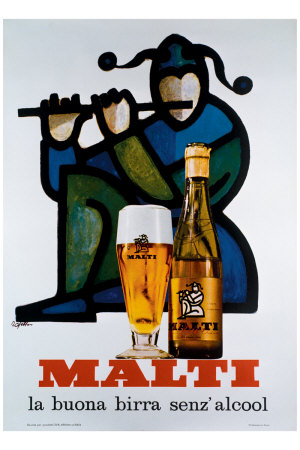
Monday’s ad is somewhat unusual in that it’s for a non-alcoholic beer. This one’s called Malti and is from Italy. I’m not quite sure why they chose a flute player for the logo, but as stained glass I think it’s pretty cool looking. I’m guessing it’s from the sixties or possibly early seventies. Anybody know anything different? The tagline translates to essentially “good beer without alcohol.”
Beer In Art #61: Alex Arshansky’s Cheers

Today’s works of art is quite modern, painted in a style that’s been described as “biomorphic cubism with a touch of surrealism.” The title of the acrylic painting is Cheers, and it was completed last year, in 2009.

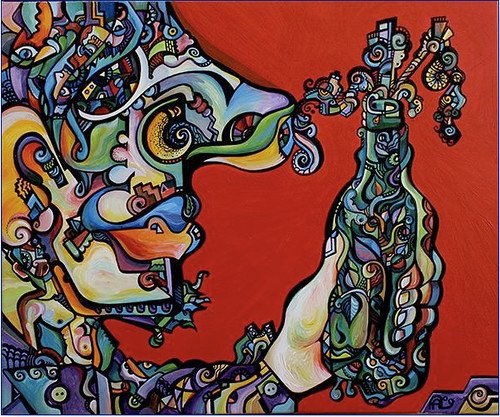
The artist, Alex Arshansky, moved with his family from Moscow, Russia to Tucson, Arizona when he was 18. From his Fine Art America biography:
Alexander was born in Moscow and has moved to Arizona (USA) at the age of 18. As the East met West, his work has evolved and become more expressive, depicting symbolic, ambiguous forms and subjects. The critics and art lovers define Alexander’s style as Biomorphic Cubism with elements of surrealism. Great attention is paid to numbers, letters, signs and symbols. Alexander’s works feature vivid, saturated colors – they produce a visual impact even without understanding the content of the painting. Some of his art pieces present a challenging interpretation of religious events and common dogmas to the point of insult.
You can see more of Arshansky’s work at his own website and also at Fine Art America.
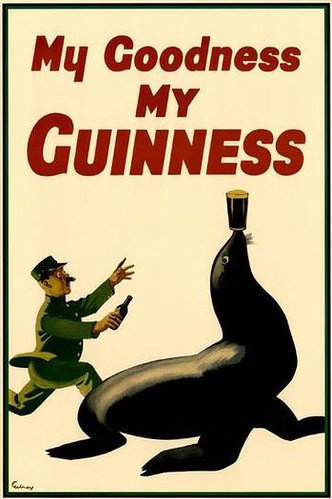
Guinness Ad #1: The Balancing Seal

The first poster John Gilroy did for Guinness is believed to be of a seal balancing a pint of beer. Gilroy apparently got the idea while visiting the circus. The UK Independent related the story last year, when Guinness was celebrating their 250th anniversary, and simultaneously their 80th anniversary of advertising.
The artist was reputedly visiting the circus one day when he was impressed by the sight of a sea lion balancing a ball on his nose. Gilroy, deploying the strange thought processes of great advertising creatives down the decades, conjured the image of a sea lion balancing a bottle of the black stuff and made it the subject of an iconic Guinness poster ad. From there followed a menagerie: an ostrich, a tortoise and then the famous toucan, the best-known Guinness animal.
That would have been in 1930, the year after Guinness began advertising. Gilroy continued to work on this Guinness campaign for the next 35 years.
Beer In Ads Special Edition: John Gilroy

You probably know John Gilroy’s advertising artwork, even if the name is not familiar. John Gilroy is responsible for the iconic Guinness ads that ran from 1927 through the 1960s. Featuring toucans, kangaroos, bears, ostriches and other animals along with the occasional steel-carrying strongman, lumberjack and zookeeper, the roughly fifty posters Gilroy produced are some of the most famous beer ads ever done. So many of his posters are famous that it seems a shame not to highlight them separately from the other ads I’ve been featuring during the week. So each Saturday I’ll post a new Guinness poster or ad. Gilroy is believed to have done nearly 50 of the posters and another 100 print ads for Guinness over a 35-year period working on the Guinness account, first with a firm, and later as a freelancer.
Below is a sample of what you’ll see over the coming year or two, every Saturday.
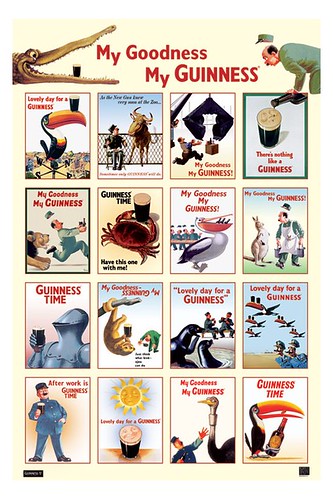
For more about John Gilroy, see Wikipedia (and their page on Guinness advertising), Celtic Shamrock, Newcastle University (where Gilroy was an alum), Journal Live and especially at the Guinness Collector’s Club, which has a great biography page.
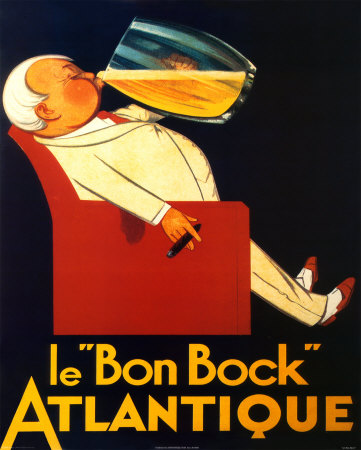
Beer In Ads #23: Le Bon Bock
Friday’s ad is another old art poster from France. I don’t know the artist, the brewery or even the year is was created, though it was most likely in the first few decades of the last century. “Le Bon Bock” I presume is “the good beer” and Atlantique may be the brewery, or it may simply refer to beer along the Atlantic coast of France.
Texas Beer Columnist Throws Beer Under The Bus

This is strange and perplexing, especially given all the attacks on alcohol in both this country and, as I’ve recently been highlighting, in the UK as well. Beer columnist Eric Braun, who writes for the San Antonio Express-News, in his most recent column began with this incendiary headline: Beer Is Not Health Food. Except that is actually is. Braun seems peeved by that classic of slights, the imagined one. He’s bothered by the fact that during a nearby Houston conference on cancer, the program included — what to regular readers here is old news — the study that xanthohumol (a substance found in hops) is effective in combating cancer. His problem with that comes “when headlines and television announcers start touting that “’beer might actually be good for you.’”
He brings this up because there isn’t enough xanthohumol in the average glass of beer to make any difference and he’s afraid people will use this as excuse to drink more. As someone who read this study when it was first published (and countless more like it) the majority of scientists both in this specific study and those who do this type of work are very, very careful — I’d even say too careful — to NOT suggest that people should use their results to justify increased drinking. I’ve never read one of these studies or their abstracts that come even close to saying people should take their results to mean they should increase their imbibing. Not once. His fears seem misplaced to me. It’s not the scientists at fault, but shoddy journalists who go for style over substance, the “headlines and television announcers [who] start touting that ‘beer might actually be good for you.’” But instead he blames the beer, saying it’s not health food.
Buried toward the end of his piece, Braun finally admits that “[t]he good news is that beer, in moderation, is perfectly healthful for most adults and has been shown to have at least some positive health effects.” I figured he must have known that, but the damage is already done. People will see that headline, conclude what they already believe and what neo-prohibitionists have been telling them — that beer is bad for them — and never even reach the thirteenth paragraph. But it’s the conclusion where he goes off the rails.
The larger point, however, is that if you are drinking to get healthy, you’re doing it all wrong.
Beer should be how you reward yourself for a good day’s work, celebrate a victory for the home team or toast the good life.
That’s just wrong. I think it’s bad advice and nearly irresponsible, in my opinion. The fact is that beer is indeed health food, and can be good for you. The reason Braun has noticed that “several times a year a new medical study is released stating that drinking beer or wine is actually healthful,” is precisely because it is, and evidence keeps mounting to confirm what people have known since the dawn of time. Beer wasn’t called “liquid bread” throughout most of history because it was a cute name, but because it shared the same ingredients and nutritional value and furthermore was safer to drink than water. But beer is, especially good beer, a living food. Real food. That’s been true historically and today beer is far better for you than an equivalent amount of soda, which is loaded with sugar and other chemicals.
But I adamantly disagree that beer should only be a reward, a celebration or used to toast something special, as Braun concludes. That suggests it’s set apart from a healthy lifestyle. He seems to be equating it with dessert, something to have only once in a while. But the fact is that regularly drinking moderately is healthier than either abstaining altogether or drinking heavily. To me that means moderate consumption of alcohol is part of a healthy lifestyle. How could it be otherwise? Drink responsibly and you’ll live longer. How is that not a health food?
From Professor David J. Hanson’s wonderful Alcohol Problems and Solutions:
Moderate drinkers tend to have better health and live longer than those who are either abstainers or heavy drinkers. In addition to having fewer heart attacks and strokes, moderate consumers of alcoholic beverages (beer, wine or distilled spirits or liquor) are generally less likely to suffer hypertension or high blood pressure, peripheral artery disease, Alzheimer’s disease and the common cold.
Sensible drinking also appears to be beneficial in reducing or preventing diabetes, rheumatoid arthritis, bone fractures and osteoporosis, kidney stones, digestive ailments, stress and depression, poor cognition and memory, Parkinson’s disease, hepatitis A, pancreatic cancer, macular degeneration (a major cause of blindness), angina pectoris, duodenal ulcer, erectile dysfunction, hearing loss, gallstones, liver disease and poor physical condition in elderly.
I hate to call out a fellow colleague, another beer columnist, but I just can’t figure what Braun’s angle is in this article. What point is he trying to make? Can it really be as simple as he honestly doesn’t believe beer is healthy? He can’t really be worried that someone might read those health claims, even if inflated, and actually decide to start drinking heavily, can he? Looking over some of his other recent columns, it seems like normal run-of-the-mill stuff, talking about favorite craft beers from last year or what beer to drink during the football playoffs.
But there it is, hanging in the air, “beer isn’t health food,” and me silently screaming at my computer screen. “Yes it is! What is the matter with you? Why would you say that?” I just don’t get it. Aren’t there enough attacks on alcohol already?
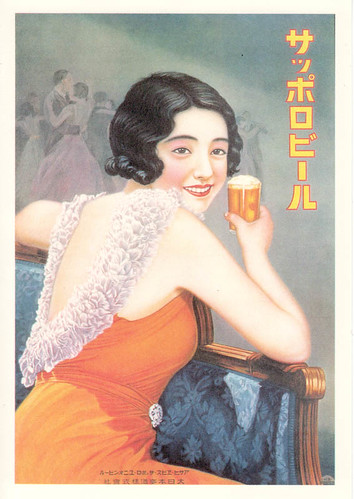
Beer In Ads #22: Sapporo’s At The Dance
Thursday’s ad is from Japan, and is for Sapporo beer. The ad is from 1934 and pictures a woman sitting and enjoying a beer, presumably at a dance watching the other couples cut a rug. One oddity; is it just me or does that glass in her hand look pretty small? Or is she perhaps a giant? Either way, it seems a little out of proportion. It’s also interesting that apart from the kanji writing and the woman’s obvious ethnicity, it could be any western ad for beer.
Beer In Ads #21: Molson’s Crown & Anchor
Wednesday’s ad is from Canada, and was published in 1955. After opening their Toronto brewery the same year, Molson debuted their first lager beer, Crown and Anchor. This ad, featuring dancing sailors, was one of the first ads for the new beer. I wonder what “sparkling light” is?
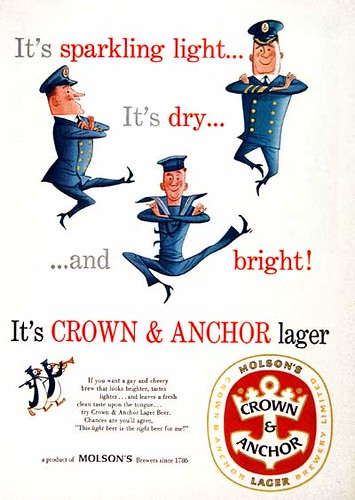
If you can’t read the text, either click on the ad for a larger view or read the transcription below.
If you want a gay and cheery
brew that looks brighter, tastes
lighter … and leaves a fresh
clean taste upon the tongue …
try Crown & Anchor Lager Beer.
Chances are you’ll agree,
“This light beer is the right beer for me.”
Brookston Beer Quiz #4

Here is quiz number four. This one is without images, because there were problems last time (see below). For this quiz, there is a beer slogan that is or was used for a particular beer or brewery. See how many you can get right. Good luck. Let me know how you did.
If you missed any previous quizzes, they can all be found on the beer quiz page.
NOTE: A number of people in the last quiz told me they couldn’t see the images. If you were one of those people, please send me the name of the browser you were using so I can try to see what’s going wrong. I tested it using Firefox and Safari and it worked fine. Perhaps it’s Microsoft Explorer or other browsers that is the problem?
Three-Year Session Anniversary To Feature A Cask Of Characters

The next Session, to be held February 5, will mark our three-year anniversary of The Session. Our 36th Session will coincidentally take place on the first day of SF Beer Week this year. Our Host, Thomas Cizauskas of Yours For Good Fermentables, has chosen the topic Cask-Conditioned Beer, which he describes as follows:
Cask-conditioned ale —or “real ale” as it is called, somewhat boastfully, by the Campaign For Real Ale (CAMRA), a beer consumer advocacy group in the UK— is defined by that organization as
beer brewed from traditional ingredients, matured by secondary fermentation in the container from which it is dispensed, and served without the use of extraneous carbon dioxide.
Viewers of [his] blog have read [his] opinions on cask-conditioned ale, and probably once too often. So, let’s hear yours, and not only yours. Why not invite brewers and drinkers and bemused casked-spectators to contribute essays for the Session?
He offers several approaches one might take the topic, with a colorful cask of characters:
- Ale vs. Lager Knockdown: “can lagers be cask-conditioned?”
- Beer Ticker: “who makes the best, and who serves the best?”
- Cellarmanship: “how should a pub handle a cask?”
- Cultural Debate: “how Americans have ‘extremed’ the cask experience, or how Americans need further lessons from the British.”
- Definitional: ” other than that CAMRA description, what ‘is’ cask-conditioned ale?”
- Ecomium: “how cask-conditioned ale will transform the world.”
- Geek: ” at what temperature to serve, to sparkle or not sparkle, and how clear should clear be?”
- International: “where was the most unexpected place you drank a pint of cask-conditioned ale?”
- Lifestyle Essay: “how you first lost your cask-conditioned ale virginity.”
- Pesce PETA: “can one be a vegetarian and drink cask ale?”
- Style Harangue: “why saisons, for example, should have no place in a cask, or should.”
- Zymurgical & Practical: “how does your brewery commercially produce and transport cask-conditioned ale?”
But in the end …
Make it a sad story. Make it a love story. But … make it! And make it here, Friday, February 5.
Write your story, then link to it here on the 5th as a comment or at my own post that day. A few days later, I’ll collate, analyze, comment, and link back. Include some photos, too: of casks, of imbibing their contents, of filling them.
Above all, let’s have perspective folks, perspective! Cask-conditioned ale is not a matter of life and death; it’s much more.
So let’s see who can cask new light on this subject and who scrapes the bottom of the barrel.