Brookston Beer Bulletin

Jay R. Brooks on Beer

  • Home
  • About
  • Editorial
  • Birthdays
  • Art & Beer

Socialize

  • Dribbble
  • Email
  • Facebook
  • Flickr
  • GitHub
  • Instagram
  • LinkedIn
  • Pinterest
  • RSS
  • Twitter
  • YouTube

Powered by Genesis

Beer In Ads #2: The Spanish Senorita

October 22, 2009 By Jay Brooks

ad-billboard
Today’s beer ad is a beautiful illustration by Achille Mauzan, an Italian artist who created many posters and other illustrations during the Art Deco period from the 1920s-40s and beyond. He was born Luciano Achille Mauzan in the French Riviera but spent most of his life in Italy and Argentina. This ad was created for an unknown Spanish beer, depicting a senorita, “adorned in customary garb, having this brand fixed atop a staff-like scepter.”
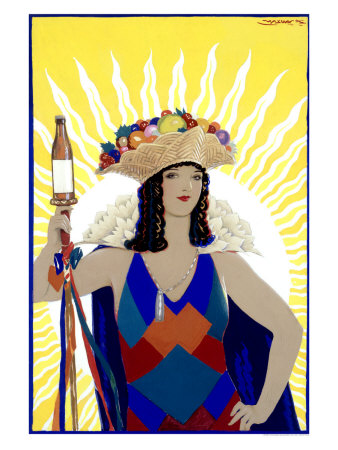

Achille Mauzan: The Spanish Senorita

Filed Under: Art & Beer, Beers, Just For Fun Tagged With: Advertising, Europe, History, Spain

Beer In Ads #1: Beer Belongs

October 8, 2009 By Jay Brooks

ad-billboard
For nearly a year now, every Sunday I’ve been exploring the intersection of the world of art with beer in my Beer In Art series. In searching for more art to showcase, I keep coming upon wondrous examples of advertising illustration. So far, I’ve been reluctant to use them because there’s plenty of fine art involving beer to keep my Sunday’s busy for quite some time. So instead, I figured I’d start featuring advertising art with beer as a separate series. Every Thursday I’ll highlight a beer ad, usually one from the past, that has some impressive artwork associated with it.

To begin, there can be no better choice than the Beer Belongs series that the United States Brewers Foundation (USBF) did from 1945-1956. The bulk of the series, known as the Home Life in America series, ran from 1946-1956 and included 120 numbered ads. In addition, there were several more unnumbered ads that both preceded the Home Life series and were run after its conclusion. They were so popular, even Mad Magazine did a spoof of the ads. You’ve probably seen them at flea markets and antique shows. I have several of them framed in my hallway. About a year ago, I became curious about how many ads were produced and tried to learn about their history. Unfortunately, there wasn’t much out there and after trolling auction sites and the internet for a good six months, off and on, I put together a complete list of all the ads. I collected graphic versions of all the ads with the help of the Beer Institute and got a taste of their origins and history by reading the minutes of meetings by the USBF and looking at old trade publications and books that mention the ad campaign.

That led to an article about this popular ad campaign in this month’s All About Beer magazine (the November 2009 issue, beginning at page 44). Obviously, All About Beer couldn’t run all of the ads, so I’ve put them into a Flickr gallery so you can view all 120 of them, possibly for the very first time anywhere. That’s at the bottom of this post. You can also see the rest of them (the ones that came before and after, along with the spoofs) at my Beer Belongs … Enjoy It! page. There, you can also read some more about the ads and find out a little bit more of their history, though I’d also encourage you to pick up the article in this month’s All About Beer, too, to get the full picture.

bb-header

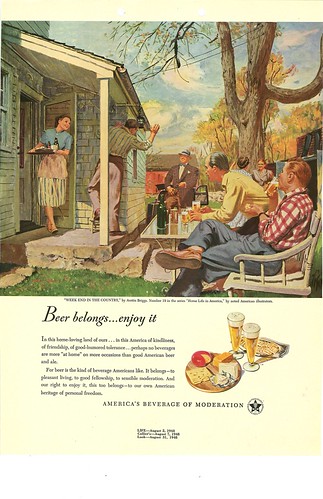
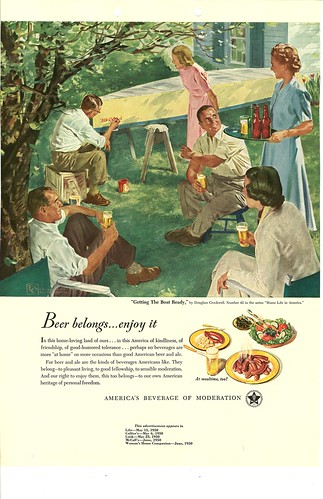
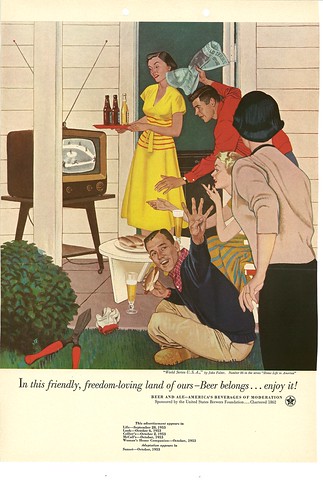
Here are three representative examples from the Home Life in America series:

019. Week End In the Country by Austin Briggs, 1948
#19 in the Home Life in America series. Week End in the Country, by Austin Briggs, 1948.

042. Getting the Boat Ready by Douglass Crockwell, 1950
#42 in the Home Life in America series. Getting the Boat Ready, by Douglass Crockwell, 1950

086. World Series U.S.A. by John Falter, 1953
#86 in the Home Life in America series. World Series U.S.A., by John Falter, 1953.

You can see all 120 of the Home Life in America series in the gallery below. This Flickr gallery is best viewed in full screen. To view it that way, after clicking on the arrow in the center to start the slideshow, click on the button on the bottom right with the four arrows pointing outward on it, to see the photos in glorious full screen. Once in full screen slideshow mode, click on “Show Info” to identify each ad’s title, artist and the year it ran.

Filed Under: Art & Beer, Beers, Just For Fun Tagged With: Advertising, History

Top 5 Beer Cities & America’s Best Beers

October 6, 2009 By Jay Brooks

mens-journal
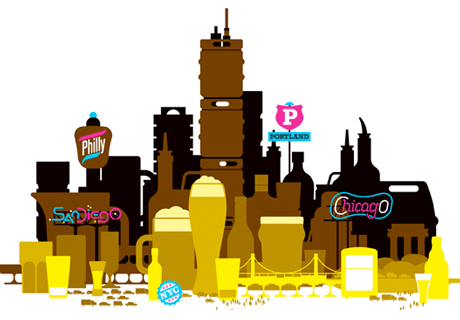
Men’s Journal yesterday released their annual lists of beer, both America’s Best Beers and The Top Five Beer Towns in the U.S.. Let’s look at the top five cities first.

  1. San Diego
  2. New York City
  3. Portland
  4. Philadelphia
  5. Chicago

It’s nice to see San Diego get some much-deserved love. While I think New York has improved in it’s beer scene over the last few years, I still have a hard time seeing it as being superior to Portland or Philly. Of course, Men’s Journal, like many periodicals, is published in New York and it’s been my experience (I lived there for several years once upon a time) that New Yorkers have an over-developed sense of their central position in the world. Naturally, I would have liked to see San Francisco on the list, but really it’s the Bay Area in total that’s most deserving, not that just the city’s scene isn’t good, too.
top-5-beer-cities
As for the beers they highlight this year, it’s a pretty good list, I’m happy to say. I especially love their introduction, where they reveal what many of us in the beer world have been saying for a few years now: “American craft brews now dominate” around the world. Finishing with “[n]ow there’s no reason to travel farther than your nearest specialty grocery store for a perfect beer.” If only the grocery chains would catch up and stock a wider range of good beer.

The list is divided into five broad categories; ales, lagers, dark beers, Belgian-style and cutting edge. Authors Christian DeBenedetti and Seth Fletcher then chose three beers of each kind to come up their top 25. As subjective at these lists can be, I have to say Men’s Journal is getting better at picking their top beers. While there are plenty of other beers I might have put on such a list — as any two people would undoubtedly choose different beers — I can’t really quibble with any of the beers they picked, save one or two, but not even enough to mention. I’ll have to do my own list one of these days.

Filed Under: Beers, Editorial, Just For Fun, News, Reviews Tagged With: Lists, Mainstream Coverage, Statistics

Framing Beer Announced For Next Session

October 4, 2009 By Jay Brooks

session-the
Andrew Couch at I’ll Have a Beer has agreed to host our 33rd Session and he’s announced his topic for it. And for those of us who are numbers geeks, it has nothing to do with Rolling Rock.
r-33-rolling-rock
Instead he begins with this wonderfully enigmatic tale:

My sister once told me a story she had heard about a sculpture exhibit: on the winter day it opened, the artist placed a coat rack next to the door. Predictably, the patrons hung their coats on it. Each day the artist moved the rack a bit closer to the rest of the exhibit, until the day came when the visitors chose not to use the “piece of art” for their coats. That day the artist placed a sign on the coat rack that stated simply, “Art begins here.”

Framing is a concept often associated with politics, but which in reality can be applied to virtually anything. Couch goes on to explain what he’s looking for, discussing the philosophy of framing beer and how to apply it to next month’s Session.

Imagine persuasively describing craft beer to someone who has until now entirely missed out, maybe in a sales situation. Perhaps it’s a brown ale and you can can describe the caramel and toast flavors, or it’s a pale ale and you have fruit or herbs from the hops. You might start having to defend yourself if it’s an IPA and those hops taste earthy, resiny, or particularly bitter. You’ll definitely meet some resistance if your favorite is an imperial anything, brimming with intensity and a sharp kick, or if you’d like to convince a person of the credibility of a sour beer or anything for which you must use the word ‘funky’. Each of these descriptions is inevitably an attempt to ‘frame’ the beer, putting the consumer in the proper state of mind to drink it.

For better or worse, in everyday situations beer comes with a label. This label very really ‘frames’ the beer inside. The fact that the beer comes commercially-produced signals the presence of investment (if not skill). A style name or tasting notes indicates the general characteristics to expect. If you know the brewery the beer is framed with your past experiences. Even the label art will affect your expectations for the beer.

What role does this framing play in beer tasting, especially for ‘professional evaluators’? Relate an amusing or optimistic anecdote about introducing someone to strange beer. Comment on the role a label plays in framing a beer or share a label-approval related story. I have not done much blind tasting, and I would be intrigued to hear about this ‘frameless’ evaluation of beer.

And drink a beer. Ideally drink something that you don’t think you will like. Try to pick out what it is about that brew that other people enjoy (make sure to properly frame the beer!).

Extra credit will be given for specific mention of the Post article prompting this topic, or for use of the phrase “priming the pump”.

Get framing. See you in November.

beer-framed

Filed Under: Beers, News, The Session Tagged With: Announcements, Blogging

Weekend Reading

October 4, 2009 By Jay Brooks

reading-books
In my on-going efforts to stay caught up, here is some worthwhile reading I’ll suggest taking a look at. These are various random beer articles that have come to my attention over the last few weeks. Enjoy.

  1. Craft Beer In A Can? A Gutsy Move Is Paying Off from NPR
  2. Oh Dear, It’s Beer, Beer, Beer, Beer by Joanne Weintraub, on the Milwaukee-Wisconsin Journal Sentinel Online
  3. That’s a ‘Binge Belly,’ Not a Beer Belly on WebMD Health News
  4. Category Builders vs. Category Killers on the Branding Strategy Insider
  5. Why Every Cold Beer Costs You More by Michael Brush on MSN Money
  6. Celebrate the History of Statistics: Drink a Guinness by Andrew Leonard on Salon’s How the World Works, which is also discussed at the Economist’s View

Filed Under: Beers, Breweries, Just For Fun Tagged With: Economics, Mainstream Coverage

Firestone Walker Beer Dinner: The 2nd Last At Cathedral Hill

October 3, 2009 By Jay Brooks

beer-chef
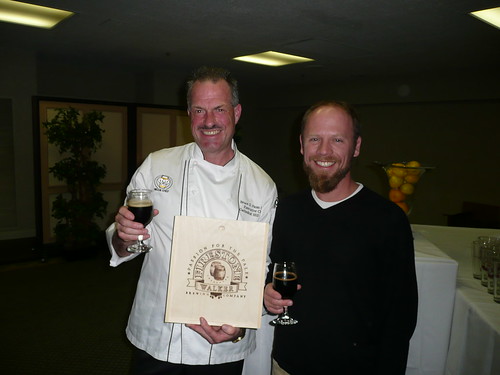
Last night was the second to last beer dinner that will take place at the Cathedral Hill Hotel in San Francisco. The hotel is scheduled to be torn down on Halloween to make way for a new hospital. The Beer Chef, Bruce Paton, put on four wonderful courses paired with the beers of Firestone Walker Brewing in Paso Robles, California. Brewer Matt Brynildson was on hand to talk about his beers.

Bruce & Matt Brynildson
The Beer Chef, Bruce Paton, with Firestone Walker brewer Matt Brynildson.

Below is a slideshow of the beer dinner. After clicking on the arrow in the center to start the slideshow, you can also click on the button on the bottom right with the four arrows pointing outward on it, to see the photos in glorious full screen. Once in full screen slideshow mode, click on “Show Info” to identify who and what’s in the photos.

The final beer dinner at the Cathedral Hill Hotel will take place on October 23. Keep an eye on the Beer Chef website for details.

Filed Under: Beers, Events, Food & Beer Tagged With: Beer Dinner, California, Northern California, San Francisco

Session #32: Drink East, Young Man

October 2, 2009 By Jay Brooks

east
Session #32 heads east this month, courtesy of Girl Likes Beer, whose personal goal to sample a beer from every country with their own brewery. She’s had quite a few west of her native Poland, but the east is still largely unexplored. So she’s invited us to go east with her. She explains:

I would like you to pick your favorite beer made east from your hometown but east enough that it is already in a different country. It can be from the closest country or from the furthest. Explain why do you like this beer. What is the coolest stereotype associated with the country the beer comes from (of course, according to you)? And one more thing. If you do a video or picture of the beer (not obligatory of course) try to include the flag of the country.

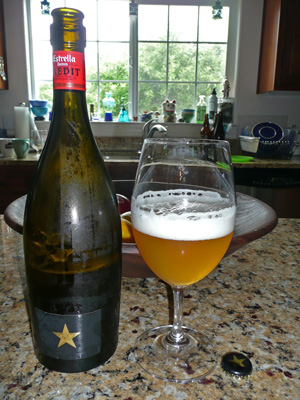
Where I live in Marin County, California is roughly along the 38th Parallel. Following the line of 38 degrees of latitude east, the next countries one encounters, not including a few Atlantic islands, are Portugal and Spain. As I don’t necessarily have a favorite from those nations readily at hand, I’ll go instead for most recently tried. The most recent Spanish beer I’ve tried, is INEDIT, created by Grupo Damm in Barcelona, Spain. Below is my review of it that was published on one of my other blogs, Bottoms Up.

session_logo_all_text_200

Apparently when Ferran Adrià does something new, the food world pays attention. He’s considered one of the world’s great chefs and cooks at el Bulli, his restaurant in Girona, which is in the Catalonia region of Spain. In 2004, he was listed in Time magazine as one of the 100 most influential people in the world. So he’s no doubt a superstar in the restaurant biz.

spain

Adrià recently lent his expertise to beer-making and worked with Spanish brewery Grupo Damm in Barcelona to help create INEDIT, a beer specifically designed as a food beer. Damm is best known for their flagship Estrella Damm, a decent, if unexceptional, example of a European lager, somewhat similar to Heineken or Stella Artois. So if you were going to pair up with a brewery to make a food beer, whatever that even means, there might be better choices, breweries that already understand the balancing of flavors between beer and food, for example.

Cooking, it should be pointed out, does not automatically make one an expert on beer any more than it makes a brewer an expert chef. The press release claims that designing the beer took 1 1/2 years and “400 trial iterations between the master brewers of Estrella Damm,” Adrià, his retaurant partner Juli Soler, and two of the sommeliers from el Bulli. If you know anything about brewing and how long the average batch takes, if might cause you to wonder how it was possible to brew 400 batches in such a short period of time.

At the Damm website, the reason given for why they wanted to make this beer is explained.

Inedit is the first beer specifically created to accompany food. It is born from the conviction that a beer that could be paired with the utmost respect to the best cuisine was necessary. That is its aim and its virtue, and that is what makes Inedit different, special and unique.

A fine sentiment, except that most craft beer along with many of the fine beers brewed in Belgium, Germany, England and others have already been brewed with food in mind. It’s just part and parcel of any good artisanal beer that its very design, its particular ingredients, and the process by which it was brewed all assures it will be an excellent compliment or contrast with just the right food. Many chefs who have been working with beer for years, such as our own Bruce Paton, the beer chef, already know this to be true and have made a living out of discovering those perfect pairings.

But the press releases really trips over itself:

Developed for gastronomy, INEDIT is an alternative to wine for pairing with all dishes — from informal to more exquisite, sophisticated types of food. INEDIT is a unique coupage of barley malt and wheat with spices which provide an intense and complex aroma. It aims to complement food once thought to be a challenge in terms of culinary pairings, including salads, vinegar-based sauces, bitter notes such as asparagus and artichokes, fatty and oily fish, and citrus.

With its delicate carbonation, INEDIT adapts to acidic, sweet and sour flavors. Its appearance is slightly cloudy, and INEDIT has a yeasty sensation with sweet spices, causing a creamy and fresh texture, delicate carbonic long aftertaste, and pleasant memory. The rich and highly adaptable bouquet offers a unique personality with a smooth, yet complex taste.

Unlike most beers, INEDIT is bottled in a 750 ml black wine bottle and is intended for sharing. INEDIT is to be served in a white wine glass, filled halfway and chilled in a cooler.

All well and good, except that how is it possible every beer aficionado knows something, something they take for granted even, that Adrià and his crew do not; which is that beer is, and has always been, a wonderful match with challenging foods.

The very idea of there being an all-purpose beer “for pairing with all dishes” suggests they don’t really understand beer’s complexities at all. No chef worth his salt would ever suggest there’s one wine that might go with any dish, but beer has for so long suffered in the shadows, and many chefs, sadly, think that beer is just one thing: the mass-produced adjunct swill that people guzzle at sporting events.

That they’ve missed the boat is again made obvious by the statement that “[u]nlike most beers, INEDIT is bottled in a 750 ml black wine bottle and is intended for sharing.” There are many, many beers that are bottled in a 750 ml size, not to mention the 22 oz. bomber, which has been around for decades. Both are, and always have been, for sharing.

Then there’s the serving suggestions, that it “be served in a white wine glass, filled halfway and chilled in a cooler.” I’m okay with the white wine glass — sort of — but Belgians and others have specifying particular glassware for their beer for a century or longer. I feel confident that there’s a beer glass that could work, too. But chilling it in a cooler? I don’t even understand that. Is that done with white wine? Is the wine put in the glass and then both are placed in a cooler to chill? Or do they mean that the glass should be chilled in a cooler first, a milder version of a frosted glass? Either way it’s a bad idea, something you should never do to your beer. It probably wouldn’t hurt it the way a frosted glass has the potential to harm beer, but it’s a road we shouldn’t even start traveling down.

But let’s forget all the hype and just talk about the beer itself. After all, that’s really what’s most important. Not surprisingly, Inedit does not live up to the hype. How could it? It’s not that it’s bad, it’s really not, but it’s hardly exceptional in a field in which there are literally countless examples of better beers to pair with food, perhaps hundreds of them being brewed right now just in the Bay Area. Try Arne Johnson’s Point Reyes Porter (from Marin Brewing) with a fine Mexican mole, for example. Absolute heaven. Or Vinnie Cilurzo’s Salvation (from Russian River Brewing) with the Chili Chocolate Mousse featured by Bruce Paton yesterday in his Food & Beer piece. Another slice of heaven. But let’s get back to Inedit.

Inedit’s nose is surprisingly subtle with few spices coming through. As it warms, some of them do start to appear, though still they remain underneath. The sweetness is what comes through on the nose. It’s slightly cloudy like a witbier, though apparently it’s a blend of a lager (most likely something similar to Estrella Damm) and, they claim, a German-style weissbier. There’s no hint of cloves or banana in the nose, suggesting instead that a weissbier yeast has not been used. It has been brewed with orange peel, coriander and licorice. Orange peel and coriander are common ingredients in a Belgian-style wit or white beer, though not a Bavarian-style weissbier. It is unfiltered and is 4.5% a.b.v.

inedit

The mouthfeel is a little thin though the flavors do exhibit some creaminess. Again it’s sweet flavors that dominate the palate, with what spices that do come through being very subtle and remaining in the background throughout. The lager blend seems to contribute a nice clean character, and the finish is quick and similarly clean, dropping off almost immediately. It’s not a bad beer, though there’s no real synergy to the blend, as if it can’t make up its mind what it wants to be. It could work fine with a light salad or some other light fare, but I don’t think it would stand up to heavier flavors very well. At around $9.99, it’s not a bad deal, just don’t expect to be wowed.

I noticed a curious thing though about how this beer’s been received in the two weeks since it was first opened to great fanfare at chef Dan Barber’s Blue Hill at Stone Barns. Barber’s another big time chef, and this year he was picked by Time magazine as one of the 100 most influential people, and it was none other than Ferran Adrià who wrote about Barber for Time. People who’ve reviewed this beer seem to be split down the middle along some telling lines. Beer reviewers seem to consider it, as I do, as average at best. But many food writers, presumably because anything Adrià does is newsworthy, wrote uncritically about it, accepting what was in the press release and passing it along verbatim without question. I’ll let you decide what conclusions to draw from that.

In the New York Times, food writer Florence Fabricant gushes that it “behaves like a wine,” which personally I take as an insult, though I know she doesn’t mean it that way. I suspect Fabricant and other food and wine writers will continue to not quite know what to make of this beer, simply because they don’t seem to really understand it. Fabricant continues by saying later in the short review that Inedit “undergoes a second fermentation in the bottle, like Champagne.” Except that its secondary fermentation, in the beer world, is called bottle conditioning, and is a common practice that’s at least as old as the similar method in champagne-making. There was no need to resort to wine in trying to describe what was going on in the beer.

When she interviewed Adrià last week about the beer she got this gem. “The idea was to make a beer to drink with food, from a wineglass.” The problem, as I see it, with statements like that and Fabricant’s suggestion that the beer is “behaving” like a wine is that, simply put, it isn’t, it can’t, and we shouldn’t even want it to: it’s beer. The only thing about it that makes it appear in any way wine-like is their lack of experience with beer and their apparent refusal to learn anything about it, preferring to fall back on laughingly uneducated wine comparisons. Beer is already the equal of wine in terms of complexity and sophistication, and has been for some time. Sure, there are simple beers, the most popular ones made by the big breweries, for example. But there are also box wines, table wines and Blue Nun, too. That chefs and food writers have no trouble distinguishing between fine wine and the more pedestrian varieties should prepare them to view beer in the same way, yet so few do. Don’t get me wrong, I love wine, too. But it’s just made from one thing: grapes. Beer is made from four primary ingredients (barley, hops, water and yeast). Add to that other grains (like wheat or rye) and other fruit, herbs and spices, then take it and age in a barrel. There are virtually endless combinations of these ingredients and processes that all but guarantee that the complexity that can be realized by a great beer far exceeds most, if not all, wine. These great, complex, sophisticated beers are fantastic with food, and have been for a long time. Pick up Garret Oliver’s “The Brewmaster’s Table,” Stephen Beaumont’s “beer bistro cookbook” or Lucy Saunders’ “Beer & Food, Pairing & Cooking with Craft Beer” at your local bookstore. These authors, and many others, have been writing about the pleasures of beer and food for years and years. It’s frustrating that beer has to continue to claw and fight for the respect it deserves.

Things are starting to change — slowly — and some chefs are beginning to discover that beer often pairs better with many different dishes; heavy meat dishes, cheese, and other spicy foods, to name a few. A majority of culinary schools do teach their students about wine but still ignore beer entirely. To me, that says a lot about the root of the problem. Despite decades of effort by hundreds and hundreds of small breweries to elevate the quality and status of craft beer, many still refuse to afford it the respect it’s due. That’s a shame really. They’re missing out on a lot of pleasure.

Inedit, unfortunately, will not prove to be the answer. The name, Inedit, means “novel, new or original” in French. Too bad it’s not really any of those things.

Filed Under: Beers, The Session Tagged With: Europe, Spain

GABF: A Week In 1 Minute

October 1, 2009 By Jay Brooks

gabf_logo
The Brewers Association, who put on the Great American Beer Festival, just posted a cool little video of GABF, showing three days of set up, four festival days and the final clean-up day all in time-lapse film that takes only a minute. See if you can spot anybody you know.

The Great American Beer Festival from Brewers Association on Vimeo.

Filed Under: Beers, Events, Just For Fun Tagged With: GABF, Video

Beer In Art #45: The Hindu God Shiva As Bhairava, Bestower Of Beer

September 30, 2009 By Jay Brooks

art-beer
Today’s work of art is an unusual one. I chose it because it’s on display at the Denver Art Museum, where a good portion of the beer community has been all last week for the Great American Beer Festival. It’s a sculpture from around the 1600s of Bhairava, one of the forms the Hindu god Shiva can take.

bhairava_1967

It’s originally from Nepal and is “polychromed wood, 33 1/4 in. high.” The museum described the work as follows:

Here, the Hindu god Shiva is shown in his terrifying form, Bhairava, which he assumes to destroy evil. He stands menacingly astride a prostrate human figure and is framed by an ornate multi-colored archway carved with deities and mythical creatures, including the sun-bird Garuda at the top. The hole at the front of the lotus base was perhaps used with a spout attachment in festivals when from an elevated position Bhairava would dispense beer to devotees below.

Searching around a little more, it seems Bhairava is also commonly known as “The Bestower of Beer.”

Wikipedia has some basic information about Bhairava:

Bhairava (Sanskrit: भैरव, “Terrible” or “Frightful” Tamil: பைரவன், வயிரவன்)), sometimes known as Bhairo or Bhairon or Bhairadya, is the fierce manifestation of Shiva associated with annihilation. He is one of the most important deities of Nepal, sacred to Hindus and Buddhists alike.

He is depicted ornamented with a range of twisted serpents, which serve as earrings, bracelets, anklets, and sacred thread (yajnopavita). He wears a tiger skin and a ritual apron composed of human bones. Bhairava has a dog as his divine vahana (vehicle).

At the Rubin Museum of Art in New York City, there’s a mask of Bhairava on display, also from 16th century Nepal.

Bhirava mask

From the Rubin’s description:

While in his peaceful forms Shiva is depicted in human form, his wrathful form, the terrifying Bhairava, is shown as more monstrous than human, with demonic features that reflect his ultimately destructive purpose. Still this wrathful emanation remains connected to his non-violent alter ego. Not only does Shiva’s serene countenance gaze down from the center of Bhairava’s crown, but the terrible form also shares several important iconographic attributes with his peaceful counterpart, reinforcing Shiva’s dual role as destroyer and regenerator.

The Hindu god Shiva is a many-sided god. In this mask he appears in a wrathful state as Bhairava, while you can also see his peaceful alter-ego at the top of his crown. As the embodiment of Shiva’s destructive power, Bhairava eliminates ignorance and the ego to help practitioners reach spiritual enlightenment.

Bhairava is very popular, particularly in the small Himalayan country of Nepal. He is worshipped in temples and during festivals and by Hindus and Buddhists alike. Large Bhairava masks, such as this one, are unique to Nepal and play an important role in the festival celebration of Indra-jatra (a festival in the Katmandu Valley, celebrated by both Hindus and Buddhist practitioners.) On specific evenings home-brewed beer, stored in a hidden pot, is dispensed through a tube that emerges from the mask’s mouth. Devotees consume this beverage (created as an offering to Bhairava) with the belief that it will bring blessings upon them in the coming year.

Yet another mask can be found at the Art Institute of Chicago. In the description on Knile’s Flickr page (who took the photograph of the mask below), he also mentions the beer aspect of the Bhairava.

Nepalese-made copper head of Bhairava, a form Shiva takes. A vat of beer sat behind the head, and tubes went down to the mouth from the vat. Believers would drink from these tubes.

bhairava_mask

In 1999, the Philadelphia Museum of Art acquired a mask of the Nepalese God Bhairava, Bestower of Beer, which they describe with this story:

Lavish public festivals were vital to the politics of the Malla period. Some Malla kings revived fading traditions, while others introduced new practices to public worship in order to reinforce their claims to the throne or sway public opinion. This mask of Bhairava, a wrathful form of Shiva, was created during the Malla period for such a celebration. During a festival like Indra-Jatra, which is celebrated annually over several days in early fall, a mask like this is connected to a large pot filled with home-brewed beer. At an auspicious moment, the mask, garlanded with leaves and flowers, is wheeled out on a wooden platform and the sanctified beer is released suddenly, spurting out of its open mouth. As music plays, crowds of worshipers jostle to catch a mouthful of beer, considered a gift and a blessing from the god. Both Hindus and Buddhists worship this deity who is honored as the protector of the city of Kathmandu.

bhairava_mask-3

Known as the Face of Bhairava, it was made in the Kathmandu Valley, Nepal during the Malla Period (1200-1769), but is most likely circa 16th century. It’s made of mercury-gilded copper alloy repoussé with rock crystal, paint, foil, and glass and measures 29 x 25 x 18 inches.

In a 1999 press release, they elaborate:

The Hindu god Shiva bears many different names and forms across South Asia. In Nepal, the most important of these is Shiva in the form of Bhairava. Bhairava is a feared and ferocious god, needing to be pacified with offerings, but he is also a powerful guardian and the destroyer of evil. The Philadelphia Museum of Art welcomes a newly acquired image of this terrifying-yet beloved-deity. Fierce, powerful, elegant and delightful, the Face of Bhairava glares at visitors from high on a wall in the Gallery of Himalayan Art.

A huge, mask-like face, the Museum’s image of Bhairava is two and one-half feet high. Three bulging eyes, tangled hair, bared fangs, and ornaments of skulls and snakes indicate the god’s fierce nature. The gilded sculpture is constructed of multiple pieces of hand-beaten copper. Its face is topped with an exquisite crown wrought with lusciously realistic flowers and foliage, and inset with large cabochon rock crystals and glass jewels. Four perky serpents intertwine their bodies to form the crown. Their scales are overlaid with helmet-like skulls disgorging pearl chains and a small head of Shiva in his peaceful form. This sculpture most likely dates to the 16th century. Red pigment and ritual powder coat the curling flames that fan out above the crown, evidence that the image was worshiped for many years. Although missing its original round earrings, neck, and two lower hair segments, this fragile image of Bhairava has survived in an astonishingly complete state.

Monumental heads of Bhairava are made in Nepal for various festivals but most notably for Indra-Jatra, an important and complex multi-day event that takes place in early fall in the city of Kathmandu. Named after Indra, king of the gods’ heaven, the festival focuses on the reaffirmation of Nepal’s more worldly ruler. Along with honoring the dead, activities include the re-consecration of the king by the Kumari (the living goddess), and the commemoration of the conquest of Kathmandu by King Prithvi Narayan Shah, who conquered Nepal in the 18th century and founded the present dynasty. Another activity of Indra-Jatra is the honoring of Bhairava, who is not only one of the servants of the Kumari, but also the protective deity of the city of Kathmandu.

On the afternoon of the third day of the festival, an enormous mask-like copper image of Bhairava, much like the Museum’s sculpture, is specially garlanded with leaves and flowers and placed on a cart. The actual image in use today in Kathmandu was consecrated in 1795 and during most of the year is sequestered behind a latticework screen near the royal palace. During the festival, it is brought out and a large clay pot of home-brewed beer is placed behind and within the face. A copper pipe is run from the pot through a hole in the mouth of the image (the grinning mouth of the Museum’s Bhairava bears a hole the size of a penny between its fangs). After the Kumari has been honored, sanctified beer spouts from the pipe, drawn by gravity but appearing to spurt from Bhairava’s open mouth. As music plays, worshippers jostle to catch a mouthful of beer, for it is considered a gift and a blessing from the god. Other smaller images of Bhairava, made of metal, clay or wood—and also rigged to dispense beer—are used during the festival; the Museum’s Bhairava was originally intended for this purpose.

In the The Roots of Tantra, by Sunthar Visuvalingam and Elizabeth Chalier-Visuvalingam, there’s a fascinating chapter called Between Veda and Tantra: Pachali Bhairava of Kathmandu (Towards an Acculturation Model of Hindu-Buddhist Relations) in which they reveal just how closely beer is associated with the worship of Bhairava:

In the Newar tradition, each god has generally two temples. One is situated outside the town, and the god is venerated there in the open-air temple called a pitha. The other is inside the town, and the god is venerated in a closed temple called a dyahche in Newari. This dyahche is, in fact, a special room inside the house of the family who keeps the Bhairava jar. In the closed temple, Pachali Bhairava is represented by and worshiped as a jar filled with beer.

You can see yet another Bhairava mask at the Dallas Museum of Art and one being auctioned at Christie’s.

On a website about the Himalayan Gods, they reveal in that tradition “the inter-relationship between the worshiper and the worshiped is demonstrated each year on the night of the full moon during the Indra Jatra festival when the great mask of Bhairava, dated 1795, in the palace square in Kathmandu, issues sacred beer from its open mouth through a bamboo pipe to waiting devotees below.”

In Part 6. “Socio-Political Levels in the Sacrificial Schema, “they describe how at “[t]he annual festival of Pachali Bhairava is based on the Hindu sacrificial schema, where there reappears the ancient theme of the theft of the Fire and Soma (ambrosia), represented in the present case by the jar of beer.”

A God known as “The Bestower of Beer” and “worshiped as a jar filled with beer!” How have I never heard of this before?

Filed Under: Art & Beer, Beers Tagged With: History, Nepal, Religion & Beer

The 21A Jinx Is Broken

September 29, 2009 By Jay Brooks

21st-amend
There’s been a running gag at Shaun O’Sullivan’s expense that’s been going now for something like ten years. While Shaun has won medals at GABF with previous breweries he’s worked at and with the brewpub he co-owns, 21st Amendment, he’s never won a medal with 21A when he was attending GABF. Up until Saturday, every medal 21st Amendment has won happened when Shaun was not there to collect the award and bask in the glory of winning.

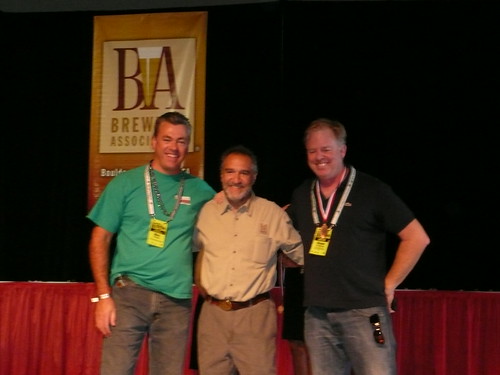
But this year, with Shaun in the audience, the jinx was finally broken when 21st Amendment won a bronze medal for their Diesel Imperial Smoked Porter in the Smoked Beer category.

P1160385

Afterward, I caught up with Shaun and asked him about finally breaking the curse.

Later, with co-owner Nico Freccia, and 21A bartender Claudia Davis, I coaxed out a rendition of the Watermelon Wheat song, GABF edition.

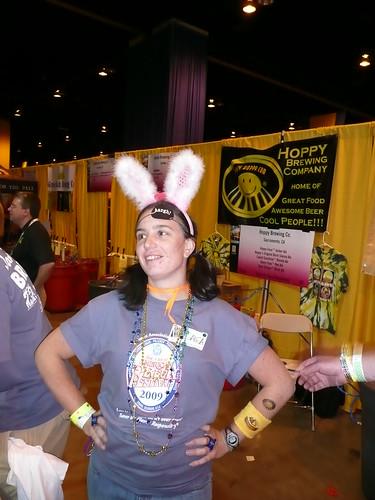
If you noticed the girl with rabbit ears walk through the shot during the Watermelon Wheat song, I happened upon “bunny girl” later in the afternoon session and snapped a photo so we could all get a better look.

Bunny Girl

Filed Under: Beers, Breweries, Events, Just For Fun Tagged With: Awards, GABF, Music, Video

« Previous Page
Next Page »

Find Something

Northern California Breweries

Please consider purchasing my latest book, California Breweries North, available from Amazon, or ask for it at your local bookstore.

Recent Comments

  • Bob Paolino on Beer Birthday: Grant Johnston
  • Gambrinus on Historic Beer Birthday: A.J. Houghton
  • Ernie Dewing on Historic Beer Birthday: Charles William Bergner 
  • Steve 'Pudgy' De Rose on Historic Beer Birthday: Jacob Schmidt
  • Jay Brooks on Beer Birthday: Bill Owens

Recent Posts

  • Beer In Ads #5371: Miller Bock Beer October 11, 2026
  • Beer Birthday: Kirby Shyer October 11, 2026
  • Beer Birthday: Kushal Hall October 11, 2026
  • Beer Birthday: Jaime Ojeda Selamé October 11, 2026
  • Beer In Ads #5370: Salmon Bock October 10, 2026

BBB Archives

Feedback

Head Quarter
This site is hosted and maintained by H25Q.dev. Any questions or comments for the webmaster can be directed here.