Brookston Beer Bulletin

Jay R. Brooks on Beer

  • Home
  • About
  • Editorial
  • Birthdays
  • Art & Beer

Socialize

  • Dribbble
  • Email
  • Facebook
  • Flickr
  • GitHub
  • Instagram
  • LinkedIn
  • Pinterest
  • RSS
  • Twitter
  • YouTube

Powered by Genesis

Home Drinking On The Rise … D’uh.

July 20, 2010 By Jay Brooks

graphchart
Another d’uh study was just released by the Mintel Group, showing that Alcohol Manufacturers Drink in Profits From At-Home Consumption, almost as if the alcohol industry manufactured the recession.

With fewer jobs, less money circulating (at least in the bottom 99% of the economy) and the nation deep in recession, exactly what result would any reasonable person expect but the fact that more people are staying home? Here’s what Mintel’s study found:

Among alcohol drinkers, 90% consume alcoholic beverages at home, compared to 77% who drink outside the home. Furthermore, those surveyed consume almost twice the amount of drinks at home in an average month than they do in restaurants or bars (10 vs. 5.7).

The nearly $80 billion off-premise alcoholic beverage market has grown 21% since 2004 as more consumers cut back on eating out in light of trying economic times. Drinkers are also cutting back in terms of the alcohol they’re purchasing for at-home consumption — 28% of respondents who drink alcoholic beverages at home have traded down to less expensive brands than last year to save money.

“In a price-sensitive environment, consumers may shy away from discretionary expenses, like alcohol, to save a few bucks,” says Garima Goel-Lal, senior analyst at Mintel. “About half of those who report drinking alcohol at home are drinking less than they did a year ago, but the market is still enjoying viability.”

While beer enjoys the largest share of market sales (48%), wine is the most popular alcoholic beverage consumed off-premise, with 67% of those who drink alcohol at home indulging in a glass. Distilled spirits are consumed by 57% of respondents and regular beer by 53%.

To me, the most interesting statistic is that drinking at home is causing people to have almost twice as much when they imbibe. In a sense, it’s like a backlash against people being afraid to drink when they’re out due to the efforts of neo-prohibitionists to create such anti-alcohol atmosphere. I wonder how that registers with their community? In fact, Join Together led with the bit about people drinking more, though you’d think that perhaps they’d be celebrating the fact that less people are driving to do their drinking.

Filed Under: Beers, Editorial, News Tagged With: Statistics

Brewery Openings Surge

July 17, 2010 By Jay Brooks

copper-kettle
The Brewers Association had an interesting little item yesterday, A New Brewery Nearly Every Day, in which they detailed the recent numbers of new brewery openings. It’s a pretty remarkable jump.

  • Last Year: 110 confirmed openings
  • So Far This Year: 155 confirmed openings
  • Total U.S. Breweries Now: 1,625

If that pace continues, we’d see roughly 250 open this year, which is more than in any other year I can recall. From the work of brewery detective Erin Glass, most of these are not nanobreweries, either — not that there’s anything wrong with nanobreweries or even picobreweries.

This is made even more impressive given the state of our economy. I’d be curious to know where the financing for these new businesses is coming from, whether traditional small business loans or from more creative sources.

Here’s where that leaves us:

Where does that put us for brewery counts? We believe there were 1,625 U.S. breweries as of the June 30 count. While the brewpub roster is climbing a little, up to 993, as we see some closings to offset the growth somewhat, the number of microbreweries is at 520 now.

Will it continue for the rest of the year? Here’s a stat. One year ago we had 260 projects on our breweries-in-planning list. Today we have 389.

open-comein

Filed Under: Breweries, News Tagged With: Statistics, United States

Portland’s Organic Roots Brewery Closes

July 14, 2010 By Jay Brooks

roots
Ugh, I hate this kind of news. John Foyston is reporting that Oregon’s first organic brewery, Roots Brewing in Portland, is closed. Owner Craig Nicholls also founded the North American Organic Beer Festival, but no word on the festival’s fate. Check out the full story in the Oregonian.

roots

Filed Under: Breweries, News Tagged With: Oregon, Organic, Portland

Small Businesses Ask For Alcohol Fee Postponement

July 13, 2010 By Jay Brooks

postponement
If you’ve been following the Marin Institute’s efforts to have San Francisco enact an alcohol fee, then you know that there was a Small Business Commission hearing last night at City Hall. Item 5 on the agenda:

Discussion and possible action to make recommendations to the Small Business Commission on Board of Supervisors File No. 100865 [Establishing an Alcohol Mitigation Fee.] Ordinance amending the San Francisco Administrative Code, Chapter 106, by adding Sections 106 through 106.28, to impose a fee on alcoholic beverage wholesalers and certain other persons who distribute or sell alcoholic beverages in San Francisco to: 1) recover a portion of San Francisco’s alcohol-attributable unreimbursed health costs, and; 2) fund administration costs. Presentation by representatives of the Marin Institute. Explanatory Documents: BOS File No. 100865 and report titled, “The Cost of Alcohol to San Francisco: Analyses Supporting an Alcohol Mitigation Fee.”

Yesterday, the Marin Institute also issued a press release, ‘Charge for Harm’ Alcohol Mitigation Fee Deserves San Francisco Small Business Support, in which they demonstrated how out of touch with reality they are by suggesting small businesses must support higher taxes, higher prices and the very real possibility of a loss of revenue. In case you missed it, I also wrote about that yesterday, too. Presumably, the Marin Institute thought last night’s meeting was a mere formality, but San Francisco business owners were a lot smarter than the Marin Institute gave them credit for.

The result of the hearing was that the Small Business Commission strongly asked supervisor John Avalos (sponsor of the alcohol fee ordinance) to delay a vote on the AMFO until after the August break, which is after Labor Day. Avalos has agreed and so we’ll all have more time to build our case against the AMFO and the faulty nexus study that does not support it. It will also afford an opportunity to spread the other side of the story and correct the propaganda, since so far most of the mainstream media coverage has been very one-sided, giving most people a false impression of the AMFO and its impact.

While it’s far from over, this is a great first round victory for the forces of reason and common sense. It will interesting to see how the Marin Institute spins this. Drink a toast tonight, perhaps in San Francisco or at least with a beer brewed in San Francisco.

Filed Under: Breweries, Editorial, News, Politics & Law Tagged With: California, Prohibitionists, San Francisco

Marin Institute Declares Small Businesses Deserve To Go Out Of Business

July 12, 2010 By Jay Brooks

marin-institute
In a press release issued today, the Marin Institute — who’s pushing a mandatory alcohol fee in San Francisco — stated that their bogus ‘Charge for Harm’ Alcohol Mitigation Fee Deserves San Francisco Small Business Support. Yes, by all means, every business should support more taxes and higher prices, that’s just good business.

A hearing is scheduled for this afternoon at 5:30 by the Small Business Commission and will take place at San Francisco City Hall. If you own or run a small business that involves alcohol, be sure to tell them what you think you deserve. Do you deserve to pay more taxes, even though roughly 46% of the price of every beer goes to taxes, which makes it the most heavily taxed product in America? Do you deserve to have higher prices than the rest of the state? Do you deserve to make less money? Do you deserve to have fewer customers? Do you deserve to lay off good employees?

Here’s another brilliant piece of logic from the press release:

The proposed ordinance is supported by a “nexus study” commissioned by the San Francisco City Comptroller’s Office. The study found $17.7 million in direct city and county unreimbursed expenses for alcohol-related problems addressed by community behavioral health services, fire department emergency medical transport, San Francisco General Hospital, and the Sheriff’s department.

Bullshit. The nexus study is titled The Cost of Alcohol to San Francisco: Analyses Supporting an Alcohol Mitigation Fee. It’s whole purpose is to present only one side of the story, ignoring anything and everything that might oppose it or show it for the farce it is. It didn’t “find” anything, it just totaled up some questionable expenses and claimed they were due to alcohol. You can read more detail about the truth of nexus study here.

More tortured logic:

“All San Francisco residents and small businesses unfairly bear the burden of government costs for alcohol-related problems,” said Michele Simon, JD, MPH, research and policy director for the alcohol industry watchdog, Marin Institute. “This relatively small fee will ensure alcohol wholesalers and importers — not bars, restaurants, or retailers — will pay their fair share to mitigate the tremendous economic costs of alcohol harm in San Francisco.”

If, and that’s a big if, “All San Francisco residents and small businesses” share these costs supposedly, but not proven to be, attributable to alcohol, then why shouldn’t all residents and businesses pay for them, equally, like all other taxes? Why single out out alcohol manufacturers, wholesalers, retailers, bars, hotels and the people who drink alcohol. Because the fee as it’s been proposed targets alcohol, and by extension the people who drink it. But the vast majority of people who legally drink alcohol do so responsibly and in moderation, and do not burden the city’s resources.

And it’s not a “relatively small fee” because they conveniently keep ignoring the fact that it will be marked up before being passed on to consumers.

And here’s how much they care about the small businesses they think deserve to support the fee:

The alcohol mitigation fee will not be allowed to exceed the costs as outlined in the nexus study, and will be imposed primarily on regional wholesalers and the portion of local brews consumed locally. Most beer is produced by foreign corporations who could easily bear some of the fee.

“[P]rimarily on regional wholesalers?” First of all, what about the distributors in San Francisco? I guess they don’t count. And the regional wholesalers, those are California businesses that would be targeted if they plan to do business in the city — which many of them do — and are located just outside the city in the Bay Area. And going after the foreign beer corporations — forgetting for a moment that they employ tens of thousands of American workers — ignores completely the more than 225 small family-owned breweries in California (eight of which are in San Francisco), along with the hundreds of small wineries and micro-distilleries.

And lastly, this:

“Small business in San Francisco should not let Big Alcohol scare them into opposition,” said Bruce Lee Livingston, executive director of Marin Institute. “We ask small businesses to be supportive, as the policy will charge alcohol wholesalers for harm instead of taxpayers and all taxpaying small businesses.” Livingston added, “We’ve all been paying for the emergency, detox and treatment costs of alcohol, but this smart fee shifts the costs to the Big Beer corporations and their wholesalers.”

Please, what planet does Livingston live on? How could he not realize that the fee will be passed along to “taxpayers and all taxpaying small businesses?” They will be paying. We all will be. He can’t possibly think otherwise, can he? He wants businesses to support their own demise? Because even businesses that don’t sell alcohol, but that benefit from it, will also be harmed by a loss of business in San Francisco. This stupid fee doesn’t shift any burdens whatsoever, though I suspect the Marin Institute knows that.

Filed Under: Breweries, Editorial, News, Politics & Law Tagged With: Prohibitionists

The Prodigal Fal Returns To Anderson Valley

July 12, 2010 By Jay Brooks

anderson-valley
Anderson Valley Brewing President Trey White announced today that Fal Allen would be returning to Boonville to become brewmaster again. Allen had been the brewmaster at Anderson valley for a number of years, but left four years ago to build a craft brewery in Singapore for Asia Pacific Breweries. His contract is about to end, and still having a home in Boonville undoubtedly made the decision easier, but I think it’s great news for both Fal and the Anderson Valley brewery. Allen’s expected to back at the Northern California brewery by Labor Day. Welcome back, Fal.

fal-al-5
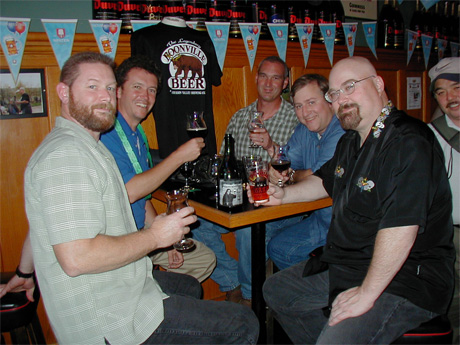
Back when Fal was still with Anderson valley, launching Brother David at the Toronado in San Francisco. Clockwise from left: Fal, Mark Cabrera, David Gatlin, me and Dave Keene, the beer’s namesake and Toronado owner.

From the press release:

“Fal Allen is one of the top brew masters within the American craft beer industry” says Mr. White; “The beers created by Anderson Valley are amongst the premier craft beers available in the world. Fal’s superb craftsmanship combined with his environmentally conscientious approach fits perfectly with our strategy of maintaining and expanding Anderson Valley’s reputation as the maker of some of the world’s best craft beers.”

“As brew master, Fal will lead our efforts to provide delicious yet cutting-edge brews while simultaneously performing as a key brand ambassador for the Anderson Valley Brewery. In addition to his primary work in the brewery, Fal will work in the trade educating the public and our distributor partners on our products in particular and the benefits of craft beer in general.”

Fal has over twenty years of experience in the craft beer industry and is well regarded for his innovative and creative style. Fal has been published extensively on a wide array of craft brewing topics and serves frequently as a judge at the GABF and other top quality brewing competitions. Fal previously worked as head brewer and general manager from 2000 to 2004 at Anderson Valley Brewing during a significant growth phase for the brewery.

Fal Allen says: “I greatly enjoyed my previous work with the Anderson Valley Brewery. I love the brand and have tremendous respect for the brewing staff at Anderson Valley. I very much look forward to working with Trey White as I believe his vision for maintaining and enhancing the quality of Anderson Valley’s beers whilst expanding the brand’s marketing potential is truly exciting. I cannot wait to get back!”

fal-arch-2
Fal in Singapore.

Filed Under: Breweries, News Tagged With: California, Northern California

Proving Direct Harm: SF Nexus Study Finally Released

July 10, 2010 By Jay Brooks

graphchart
When San Francisco supervisor John Avolos introduced his (and the Marin institute’s) proposed ordinance, the Alcohol Mitigation Fee Ordinance (AMFO), two weeks ago, he was required to also include a nexus study to assess the impact of the ordinance on San Francisco. Despite the vote on AMFO being next Wednesday, July 14, the nexus study was only yesterday finally released, meaning any opposition has a mere 3 working days to review and respond to it. Maybe that’s business as usual for city politics, but it certainly reeks of being unfair at best and at worst undermines the democratic process.

The AMFO seeks to impose a tax on every alcoholic drink sold in San Francisco. They’re calling it a “fee” in order to get around certain political and legal requirements that would make it harder to enact. Supporters of the AMFO continue to say it will amount to “a nickel a drink,” but while that may sound reasonable to many people, it’s nowhere near the truth. The fee itself is 7.6 cents per ounce of alcohol, meaning every single drink and drink package sold will require a separate calculation to determine the actual fee. More importantly, the AMFO will be levied at the wholesale level, which will then be marked up, usually twice. The fee will actually be around 50-75 cents per six-pack and anywhere from $0.75-$1.00 (or more) per pint. And it will be even higher on wine and spirits. The “nickel a drink” mantra is, quite simply, a lie to gain support from ordinary people who won’t examine the reality more closely.

Well yesterday — finally — the City and County of San Francisco released the nexus study, on Friday (which is where, it’s said, news goes to die, which is what they’re counting on, most likely). I had always been under the assumption that the study was supposed to be an impartial look at the impact and the direct link necessary to apply this type of fee. Apparently I was wrong, because the title of the study is The Cost of Alcohol to San Francisco: Analyses Supporting an Alcohol Mitigation Fee. So anything that does not support the AMFO was systematically ignored. There’s not one mention of any of the possible side effects, economic or otherwise that the AMFO will cause. It also means the city essentially spent a lot money for the Lewin Group to prove the case, with no thought whatsoever that it might be wrong or have unintended consequences. That’s your tax dollars. They don’t look at whether it was or wasn’t a good idea, they just started with the premise that it was and worked from there. It would be hard to imagine a worse way to represent the needs of all San Francisco residents. This is quite simply politicians deciding something, without a balanced perspective, and ramming it down the throats of everyone they were sworn to represent. What makes it worse, in this case, is that the impetus came from the Marin Institute, an organization that’s anti-alcohol to its core. The majority of people in San Francisco enjoy drinking responsibly and do so every day without causing the harm that the Marin Institute has accused them of nor do they place any burden on the city’s resources as is further alleged. But the neo-prohibitionists have whispered into the ear of at least one supervisor that there’s some money to be made, and here we are, the will of the people be damned once more.

As I wrote last week, the nexus study is required partly because of the Sinclair decision, a California Supreme Court case involving a similar type of fee for the potential harm caused by lead paint. To me the obvious difference between the two is that lead paint is bad for everybody, whereas not only is that not true for alcohol, but in fact the moderate consumption of alcohol has very real and tangible health benefits. Even without the benefits, most adults who drink responsibly are at the very least not going to emergency rooms, being arrested or otherwise taxing the city’s resources every time they go out for a beer with friends. I don’t doubt that there are such people, but they’re a very small minority and yet the city is willing to punish every single person who drinks and damage one of the few industries actually thriving in a weak economy.

But let’s look at the nexus study itself. At 68 pages, it’s a lot to digest and with the vote next week there’s little time to examine it. That it was released so late was undoubtedly by design, which is annoying, to say the least, and it’s impenetrably dense with lots of charts and exhibits, many that have almost nothing to do with the issue at hand, which is to show a direct “causal connection or nexus between the product and its adverse effects.”

I’ll try to point out as many discrepancies and failures of logic as I can — and of course take a look at the whole thing yourself — but please keep in mind that it’s not an impartial document.

First of all, the study doesn’t even appear to be trying to prove the required causal connection at all, but instead sets out from the premise that it’s just true, because they say it’s true. In the executive study:

The purpose of this study is to estimate a portion of the health-related economic costs of the measurable, direct effects of alcohol consumption to the City and County of San Francisco. These estimates will be used by the City to assess the public health impact of alcohol and inform policy surrounding an alcohol mitigation fee.

So I’d say that’s a pretty big problem right out of the gate. The study doesn’t even purport to do what it’s required to. It’s supposed to be used to “prove” the nexus of harm the ordinance alleges, but it simply states it as fact, with no proof and then goes on to estimate the numbers. To me, that’s the arrogance of the anti-alcohol community. They just assume their point of view is the only one, and figure that just saying so is enough. That your tax dollars were spent on such a farce should be troubling to any San Francisco resident who drinks responsibly.

The study alleges that “[a]ll of the programmatic cost items have a strong connection with alcohol use and high data accuracy, meaning that alcohol-related incidence was accurately identified and attributed.” But the only studies cited (to be fair, I haven’t had time to check them all) were done by biased parties. For example, here’s the first two I looked at. The first study heavily relied upon, The cost of alcohol in California was done in 2008 and sponsored by … wait for it … the Marin Institute. The second, Alcohol-Related Deaths and Hospitalizations by Race, Gender, and Age in California had two researchers, the first, Mandy Stahre, was from the University of Minnesota. The second lead researcher, Michele Simon was from … wait for it … the Marin Institute.

The bulk of the 68-page study is given over to how they estimate the costs, despite the fact that there’s no real attempt made at all to actually prove the direct causal connection or nexus between drinking alcohol and costing the city money. They just keep repeating that it’s true over and over again, presumably because their goal wasn’t even to make the required connection.

But even within their presumption of cause, they list costs that they claim are associated with alcohol use that are characterized as “high causation,” “medium causation,” and “medium/low causation.” Those are not direct causes, and they don’t even say they are, as the Sinclair decision requires. Some of the things listed in those categories are epilepsy and hepatitis, as if anyone who drinks will become epileptic or get hepatitis. It’s absurd. There are so many factors for any individual that may lead to these type of illnesses that it’s hardly reasonable to say it was alcohol that caused them. While the over-consumption of alcohol may be a contributing factor, it’s not remotely reasonable to use it to gin up the costs attributable to alcohol.

Using the same logic as the AMFO, you could apply it to virtually anything sold in San Francisco. For example, each year the City and County of San Francisco incurs costs resulting from the consumption of red meat. These include the costs of providing medical care for people with high blood pressure, treatment and prevention costs, choking, costs resulting from meat-related heart attacks, and the indirect costs associated with disability and diminished capacity. Therefore, all red meat should be taxed. You see the danger. Everything we do, consume, etc. has risks that can be attributed to it. But it’s the individuals who decide how they’ll use them, that is whether they’ll do so responsibly or not. And some people are more susceptible to harm then others, but we shouldn’t punish the people who can and do use the thing — in this case alcohol — responsibly.

The study then moves on to jail and even includes the salaries and fringe benefits of jail workers. Now let me ask a question. If alcohol were outlawed, would they shut down the jail? Of course not, the jail would be open regardless. Crimes will continue to be committed, the need for the city to provide jails has little, if any bearing, on whether alcohol is available. Trying to charge the alcohol itself for something stupid someone does after drinking it would be the same as levying a fee on gun makers and ammo companies. Yet most gun owners don’t commit crimes or kill people. But if a similar fee as the AMFO was imposed on them, everyone would have to pay more for a gun because of the minority that did use them in criminal activity. You think the NRA would let that pass without comment?

It’s also like saying that once someone has a few drinks, that personal responsibility no longer applies. At that point, the AMFO seems to suggest that people can no longer control their own actions and it’s the alcohol now at fault, as if anyone or everyone who drinks alcohol will become a criminal. They just can’t help themselves, ignoring, of course, every single person who does drink a few beers and isn’t arrested or hauled off to the emergency room — which is almost everyone, the vast majority.

The same applies to their next cost, the Fire Department, EMS services and other associated overheads costs. It’s the fault of the alcohol itself, not the individual decisions to have another drink. It doesn’t really matter how many charts of costs incurred by the city they present for these services, that’s their job. That’s what the services are there for. It’s why we all want them, in case someone we know or ourselves needs them. It’s unfortunate that there are people who don’t know when to stop drinking, but they should be responsible for that bad decision, and it shouldn’t be up to the rest of us to be punished for their stupidity. Every person in San Francisco, the state of California and the U.S. already pays for those services through the many taxes we already pay. To say that people who drink have to pay a little bit more just because they choose to drink alcohol — which is legal, I shouldn’t have to say — is ludicrous.

Pages 26 to 31 are devoted to how the fee is calculated. If it takes six pages to lay that out, I’d have to say it may be too complex a scheme. It’s the first time I know it’s been tried, and it looks to be an administrative nightmare, not that the folks pushing this care how onerous any part of it is for their avowed enemies. The city cares about money and the neo-prohibitionists care about doing anything they can to punish and hurt alcohol. As they’ve publicly stated — and even commented directly on this blog — they’re supposedly after the big multi-national alcohol companies, though it doesn’t seem to bother them that they’re also dragging down every small, family owned craft brewer and small winery in California. There are over 225 small breweries and probably even more wineries, not to mention micro-distilleries. They claim not to be “after” them, but the AMFO harms them equally, and possibly even more so since they’re so small it will be harder for them to absorb the fee than it may be for the bigger companies.

Next, there’s an appendix of alleged attributable causes, each with their own AAF, or Alcohol-Attributable Fraction. But the AAF goes completely against the very idea of the nexus study, whose point you may recall was that it is required to show a direct causal connection. What it shows instead, that a percentage of people who drink alcohol may contract a particular disease. That’s not a direct nexus. It’s risk. Adults are free to take those risks. It includes things like accidental poisoning, by people who got drunk and accidentally drank Drano. That’s tragic, but it’s hardly the fault of the alcohol. Same deal with suicide. If your life is so bad that you want to kill yourself and you drink before doing so, is it not obvious that the root causes of the suicide are far more deeply in that person’s psyche than binge drinking? A few drinks, hell even a lot of drinks, is not going to make most people off themselves.

It just goes on from there, blaming alcohol for the homeless, homeless outreach programs, emergency services, etc. as if being homeless is directly attributable to drinking. Homeless people I’d wager drink because they’re homeless and their lives suck and our society does not really help them. But rather than acknowledge a huge glaring societal problem, it’s easier to just blame the alcohol.

Finally, at page 65 (4 pages from the end) in the section Attribution by Type of Beverage and Point of Sale they grudgingly mention that there are health benefits, at least for wine and spirits, none are offered for beer. And the only two even mentioned is that drinking wine decreases cardiovascular risk and whisky — get this — increased tooth fracture resistance. That’s right whisky will make it harder to break your tooth when you fall on your face. That’s apparently it’s only positive.

Despite the fact that they quote both the National Institute on Alcohol Abuse and Alcoholism (NIAAA) and the USDA’s Report on the Dietary Guidelines 2010 (which I also recently reported on), they completely ignored the many, many cited studies in the new report on the dietary guidelines that show many positive correlations between all alcohol — beer, wine and spirits — when consumed responsibly and in moderation. In fact , the NIAAA recommended changing the standard for moderate drinking from a daily one to a weekly standard and stating that the number of safe drinks per day could effectively be doubled so long as the maximum per week was not exceeded.

But perhaps the most glaring omission was the meta-study they did on the effects of moderate drinking on total mortality, meaning how does responsible drinking do in creating a more or less healthy lifestyle. Predictably, it was found that a majority, if not all, of the studies examined show a positive correlation between moderate drinking and living longer and being more healthy.

Total Mortality. In most Western countries where chronic diseases such as CHD, cancer, stroke and diabetes are the primary causes of death, results from large epidemiological studies consistently show that alcohol has a favorable association with total mortality especially among middle age and older men and women. A recent updated meta-analysis of all-cause mortality demonstrated an inverse association between moderate drinking and total mortality (Di Castelnuovo, 2006). The relative risk of all-cause mortality associated with moderate drinking was approximately 0.80. The J-shaped curve, with the lowest mortality risk for men and women at the average level of one to two drinks per day, is likely due to the protective effects of moderate alcohol consumption on CHD, diabetes and ischemic stroke as summarized in this chapter.

In other words, you’ll be healthier if you have one or two beers a day. Isn’t it therefore reckless for the city of San Francisco to make it more difficult for people to live their lives in a way that has been shown to make them healthier? The meta-study shows a direct causal connection between moderate drinking and living longer and more healthy, the opposite nexus that is needed to legally impose the fee.

The remaining three pages are taken up with biased studies that show exactly what the city and the Marin Institute wants to show and ignores anything that doesn’t fit their world view. In other words, the study is a sham. It’s propaganda. It’s not in anyway balanced, and it doesn’t even try to be, even though an honest assessment would actually be in the best interests of the people who live (and pay taxes) in San Francisco.

It completely ignores any economic harm and the loss of jobs that will undoubtedly occur if less people are visiting and drinking in San Francisco. It completely ignores any of the potential harm it will cause. To me, that’s a travesty. Let’s at least have an honest debate. Like the one-sided C.W. Nevius column in the Chronicle, the mainstream and local media has been amazingly uncritical and supportive of the AMFO, swallowing whole the propaganda of the anti-alcohol fee while ignoring nearly completely any serious opposition to it.

If you oppose the AMFO — and frankly you should, especially if you drink responsibly in San Francisco — visit SaveMyCaJob for details on how you can help. But do it quickly, because the vote is this coming Wednesday, July 14.

Fight the Fee!

UPDATE 7.12: I just learned that the hearing for a vote on the AMFO, scheduled for July 14, has been postponed until July 28, though the decision had nothing to do with allowing more time for people to review the nexus study.

Filed Under: Editorial, News, Politics & Law Tagged With: California, Prohibitionists, San Francisco

Don’t Let Facts Get In Your Way

July 7, 2010 By Jay Brooks

marin-institute
Regular Bulletin readers know how I feel about the Marin Institute. They style themselves as a “watchdog” group but in reality they’re a run of the mill anti-alcohol, neo-prohibitionist group. I often accuse them of going to great lengths to distort facts or manufacture reality to further their cause, taking an ends justify the means approach to everything they do. The “charge for harm” nonsense they’re trying to foist on San Francisco is a prime example, but today witnessed an even clearer example of how far they’ll go in bending reality to their will.

The USDA has released their updated version of the Dietary Guidelines For Americans 2010, where they looked at more recent research regarding food and beverages of all kinds, updating the 2005 edition (it’s regularly updated every five years). Well, this is bad news for the anti-alcohol folks, because recent science has been revealing more and more health benefits for the moderate consumption of alcohol, and so not surprisingly, that’s what is reflected in the new guidelines. But the Marin Institute has never been one to let facts stand in their way, and so they’ve wasted no time in criticizing the report’s findings and asking their unquestioning faithful to do likewise, calling the whole thing “dangerous” and “unscientific,” despite the fact that the whole report is based on science and each study relied upon is cited in the bibliography. It’s laughable that they’d call it “unscientific” while they themselves just shout it down and spread propaganda and utterly nonfactual claims about why they don’t like its conclusions. To them, it’s only science if they agree with the results. To me, that’s far more dangerous than anything in the report.

So what does this dangerous report say? It’s Chapter 7 that tackles alcohol and it’s fairly balanced from my point of view, and probably would be for any reasonable person. It talks about both the risks of over-consumption and the benefits of moderate drinking. It’s quite cautious in making any affirmative recommendations. There were also some interesting statistics. For example, I’d often heard that about a third of adults don’t drink alcohol, but a recent survey revealed that 76% of men and 65% of women had consumed alcohol in the past year. Most compelling was the decision to change the definition of moderate drinking from a daily standard to a weekly one, and to raise the daily recommendations from 2/1 (men/women) to 4/3.

The recent release of Rethinking Drinking by the National Institutes of Alcohol Abuse and Alcoholism (NIAAA), provides guidelines that are consistent, in part, with the 2005 Dietary Guidelines, but also add additional guidance on weekly patterns of consumption. This NIAAA booklet, which is also designed to help individuals drink less if they are heavy or “at risk drinkers,” defines “low-risk” drinking as no more than 14 drinks a week for men and 7 drinks a week for women with no more than 4 drinks on any given day for men and 3 drinks a day for women (NIAAA, 2009).

The 2010 Dietary Guidelines Advisory Committee (DGAC) largely agreed with this definition of moderation from the NIAAA because it implied that consumption was based on daily intake averaged over the week and also because the NIAAA guideline was generally consistent with the recommendation from the 2005 Dietary Guidelines.

Not surprisingly, this caused the Marin Institute to go apoplectic. Of course, the definition of “binge drinking” has been five drinks in a single session, which is laughingly absurd, especially so now in light of four being considered within the bounds of moderation. The five-drink-standard branded every single person who attends a five-course beer dinner a binge drinker, which is utter nonsense.

dietary-guidelines-2010

The Dietary Guidelines also asked some interesting questions about the effects of moderate drinking, and reports some findings that the anti-alcohol groups will have a hard time dismissing, and in fact any rebuttal of them is so far missing from their complaints. For example:

What is the Relationship between Alcohol Intake and Cognitive Decline with Age?

Conclusion

Moderate evidence suggests that compared to non-drinkers, individuals who drink moderately have a slower cognitive decline with age. Although limited, evidence suggests that heavy or binge drinking is detrimental to age-related cognitive decline.

Implications

Alcohol, when consumed in moderation, did not quicken the pace of age-related loss of cognitive function. In most studies, it was just the opposite—moderate alcohol consumption, when part of a healthy diet and physical activity program, appeared to help to keep cognitive function intact with age.

They also did a meta-study on the effects of moderate drinking on total mortality, meaning how does responsible drinking do in creating a more or less healthy lifestyle. Predictably, it was found that a majority, if not all, of the studies examined show a positive correlation between moderate drinking and living longer and being more healthy.

Total Mortality. In most Western countries where chronic diseases such as CHD, cancer, stroke and diabetes are the primary causes of death, results from large epidemiological studies consistently show that alcohol has a favorable association with total mortality especially among middle age and older men and women. A recent updated meta-analysis of all-cause mortality demonstrated an inverse association between moderate drinking and total mortality (Di Castelnuovo, 2006). The relative risk of all-cause mortality associated with moderate drinking was approximately 0.80. The J-shaped curve, with the lowest mortality risk for men and women at the average level of one to two drinks per day, is likely due to the protective effects of moderate alcohol consumption on CHD, diabetes and ischemic stroke as summarized in this chapter.

In other words, you’ll be healthier if you have one or two beers a day. But woe be to any brewery that might think to actually suggest that to a potential customer. That’s where the neo-prohibitionists are most worried. In the conclusion to their comments to the new dietary guidelines, the Marin Institute are very “concerned.” Here are some excerpts of their worrying, and my open letter response as to why they’re on the train to loony town.

There is no public health organization that recommends starting to drink alcohol for abstainers, or drinking more alcohol for current drinkers, as either a preventive behavior to address specific medical problems, or as a population-level primary prevention strategy.

Perhaps not, but there should be. The only reason there isn’t, is because organizations like the Marin Institute would treat such a recommendation as a declaration of war. Even though the facts indicate that moderate drinking is healthier than abstaining, nobody would dare to state the obvious conclusion to draw from that just because of how they’d react, in other words fear is the reason, not common sense.

Indeed, federal, state, local and community public health agencies, including Marin Institute, work tirelessly to address the tremendous physical, social, and economic harm caused by alcohol. Yet the Report sounds as if drinking alcohol is not only a suggested therapeutic option to discuss with one’s doctor, but also a general recommendation for all Americans to consider as part of an overall wellness plan.

It “sounds as if drinking alcohol is a therapeutic option” because it is. Alcohol does not cause the harm, too much alcohol may cause harm, but moderate consumption is beneficial. You just continuing to say the opposite of what’s true doesn’t make it any less so.

The Committee must be aware that the Report’s messages about alcohol consumption will be misinterpreted by the powerful corporations and trade organizations that sell and promote alcoholic beverages. The alcohol industry has a long history of exploiting the Dietary Guidelines for their benefit, and the suggestions contained in the Report lend themselves to further misuse. We are especially concerned that despite the Report’s caveats, the industry will use the new recommendations to promote alcohol consumption and increased consumption.

Don’t worry, you’re safe. Maybe you should relax and enjoy a frosty beverage; perhaps I could suggest a beer? You must think the alcohol companies are pretty stupid, despite how shrewd you usually paint them. With you “watchdogging” them, there’s no way any alcohol company could launch a campaign suggesting people start drinking or drinking more, even though the evidence points to the fact that it wouldn’t be a bad idea. At any rate, thanks to your predecessors after prohibition, the advertising guidelines already expressly forbid health claims, so as usual you’re worrying about nothing.

We also ask that the Committee revise the Report and subsequent Guidelines to send a much more cautionary, evidence-based message regarding alcohol consumption to the public. Finally, we recommend that the new Guidelines maintain the formulation of 2/1 per-day consumption of alcohol. We urge you to err on the side of caution when recommending safe alcohol consumption levels and behaviors to improve health and prevent harm.

Err on the side of caution? Let’s see, they reviewed the science and came to a conclusion you didn’t like. That’s not an error or not being cautious, it’s simply letting facts dictate what makes sense in terms of a policy of what’s best for the average person.

But your whole posturing, tantrum-filled press release and comments speak volumes about your real intentions. While an average person might look at those findings and think to themselves, “great, it’s good to be informed and know how eating and drinking certain things will affect me. Now I can make an informed decision on how to live my life.” But you look at that and instead cry, “I don’t like those finding, they must be wrong. There’s science behind it, but I don’t like the conclusions so the science must be wrong. I don’t like the recommendations, so they must be “dangerous.”

I know it’s nearly impossible for the Marin Institute or any similar organization to have an open mind and be reasonable about these sorts of things. Fanaticism is rarely compatible with reason or common sense. But I continue to marvel at how any organization who never misses an opportunity to call an alcohol company on not being truthful can themselves be so fast and loose with the truth. Lying to keep someone else truthful (or at least for a cause you believe in) seems completely immoral, or at least amoral, to me. If the facts are contrary to your point of view, maybe it’s your point of view that’s wrong? Maybe it’s time to question your assumptions? I know that’s not going to happen, but not letting the facts get in your way by just ignoring them or pretending they don’t exist or are wrong isn’t going to fool anybody except the people who you’ve hoodwinked already. And maybe that’s their point in the end, maybe it’s just about keeping the faithful faithful by telling them what they want to hear and appearing to fight their absurd fight. But I sure wish they’d let the facts get in their way.

Filed Under: Beers, Editorial, News, Politics & Law Tagged With: Prohibitionists, Science, Statistics

Fight The Fee

July 6, 2010 By Jay Brooks

cahj
If you read my rebuttal to San Francisco Chronicle columnist C.W. Nevius support of the proposed fee on alcohol in the city, then perhaps you recall that he interviewed the California Alliance of Hospitality Workers so he could appear to show both sides of the argument. It was not really in any way balanced, and in fact I think he used them as a straw man, though he did so in a way that I believe was incorrect at any rate.

Happily, the California Alliance of Hospitality Workers is fighting back, and is trying to get people to contact their local supervisor in San Francisco to have city residents ask their politicians to oppose the proposed fee. The e-mail to use is Board.of.Supervisors@sfgov.org. If you live in San Francisco and drink alcohol in moderation and responsibly, please contact your supervisor and ask him or her to oppose the ordinance.

cal-alliance-hjobs

You can also see their response to the proposed ordinance, Supervisors’ Short-Sighted Proposal to Tax Alcohol Will Hurt Hard-Working San Franciscans. They’ve also set up a Facebook page.

One additional important fact that they mention is that the required Nexus Study has still not been filed or made public. With the hearing to vote on the proposed ordinance a week away — July 14 — at the very least that’s stacking the deck and at the worst is complete bullshit.

Here’s just a few more reasons why this tax is unfair, particularly to craft beer:

  • This legislation taxes beer by alcohol strength, putting a huge and cumbersome burden on brewpubs, self-distributing small brewers and wholesalers because each and every beer is taxed at a different rate.
  • Craft brewers are not part of the problem. Craft beer is priced high and is a product of quality, not quantity. Craft beer drinkers do not abuse their beverages.
  • With the “margin chain” and price point consideration, the tax will be much higher than five cents a drink. At retail off-premise, the increase will be about 50-75 cents a six-pack and on premise about 75 cents to a dollar per pint.
  • Brewers are already heavily taxed. Small brewers already pay a state and a federal excise tax in addition to all other business and sales taxes. Combined, about 40-44% of the cost of a beer already goes to taxes.
  • Higher drink prices in a singular market such as San Francisco will lead consumers to not come into the City for dining and entertainment.
  • Higher taxes will lead to lost jobs, off-setting the new tax.
  • The proposed tax would hinder the ability of craft brewers in the City to grow, employ more people and positively contribute to City’s economic recovery.
  • Higher taxes will mean higher prices which means lower sales. If this tax in imposed, sales will decrease and craft brewers will not be able to sustain the ability to continue full employment or continue to invest in our business and community.

Filed Under: Beers, Editorial, News, Politics & Law Tagged With: California, San Francisco, Taxes

Sam Calagione To Star In Discovery Channel Show

June 30, 2010 By Jay Brooks

discovery
It’s been all over the series of tubes that is the interwebs all morning, but in case you missed it, Sam Calagione from Dogfish Head Craft Brewery in Delaware, will be starring, along with Patrick McGovern from the University of Pennsylvania, in a new series on the Discovery Channel this fall. The show will be called BREWED.

Below is a portion of the press release.

Beer is the drink of the masses. If you look into a glass of beer you can see the past, present and future of mankind. Cicero lauded it, Genghis Khan fought for it and now Discovery Channel celebrates it with a world premiere series, BREWED, exploring the culture, history and variety of beer.

Meet Sam Calagione: maverick entrepreneur, family man and owner of Dogfish Head Brewery in Rehoboth Beach, Delaware. As an ambassador to the world of craft beer, Sam travels the world to experience what every culture brings to its own special brew.

In BREWED, Sam shows viewers the other side of the bottle, sharing the stories of beer sub-cultures as well as exploring life inside The Dogfish Head Brewery. BREWED goes behind the scenes at Dogfish Head as Sam’s merry band of creative brewmasters concoct new taste varieties.

“BREWED taps more than just kegs and barrels, it unlocks a fascinating history of beer making, showcasing the ingenuity and passion behind our love affair with those alluring suds and how it played a role in building civilizations,” said Clark Bunting, President and General Manager of Discovery Channel.

Running a successful business also requires inspiration, so BREWED hits the road for the ultimate beer tasting road trip. Along with archeologist and beer expert Pat McGovern, Sam sets out to recreate “ancient ales” that have been discovered at sites around the world from Egypt to Peru. He travels to Rome to research old world Italian beers as inspiration for a new site in New York with Mario Batali. A visit to New Zealand introduces the idea of making the “first tomato based beer.” And back home, Sam is tasked to come up with a commemorative beer called “Bitches Brew” to celebrate the 40th anniversary release of Miles Davis’ famous recording.

“Beer has always been my passion. It is so much more than what you see in the glass. I’m excited to share the diligence, daring and creativity that we pour into our work,” said Calagione.

The show is being produced by Zero Point Zero Production, the company responsible for Anthony Bourdain No Reservations and Diary of a Foodie. I like the fact that Pat McGovern is involved. His book, Uncorking the Past: The Quest for Wine, Beer, and Other Alcoholic Beverages, is fascinating and he has a very interesting take on the history of beer. It’s certainly great to see beer finally getting a high profile television show.

sam-toro-1
Sam Calagione in the back room of the Toronado when I interviewed him for an Uncorked piece I wrote for the San Francisco Chronicle two years ago, and I also posted some questions that didn’t make the newspaper article.

Filed Under: Beers, Breweries, News, Related Pleasures Tagged With: Television

« Previous Page
Next Page »

Find Something

Northern California Breweries

Please consider purchasing my latest book, California Breweries North, available from Amazon, or ask for it at your local bookstore.

Recent Comments

  • Bob Paolino on Beer Birthday: Grant Johnston
  • Gambrinus on Historic Beer Birthday: A.J. Houghton
  • Ernie Dewing on Historic Beer Birthday: Charles William Bergner 
  • Steve 'Pudgy' De Rose on Historic Beer Birthday: Jacob Schmidt
  • Jay Brooks on Beer Birthday: Bill Owens

Recent Posts

  • Beer In Ads #5136: American Bock Beer Is Being Served Today! February 28, 2026
  • Historic Beer Birthday: James Younger February 28, 2026
  • Historic Beer Birthday: Joseph Metcalfe February 28, 2026
  • Beer In Ads #5135: What Record’s Bock Beer Is February 27, 2026
  • Historic Beer Birthday: Albert Braun February 27, 2026

BBB Archives

Feedback

Head Quarter
This site is hosted and maintained by H25Q.dev. Any questions or comments for the webmaster can be directed here.