Brookston Beer Bulletin

Jay R. Brooks on Beer

  • Home
  • About
  • Editorial
  • Birthdays
  • Art & Beer

Socialize

  • Dribbble
  • Email
  • Facebook
  • Flickr
  • GitHub
  • Instagram
  • LinkedIn
  • Pinterest
  • RSS
  • Twitter
  • YouTube

Powered by Genesis

Happy Thanksgiving From The Brookston Beer Bulletin

November 24, 2011 By Jay Brooks

turkey
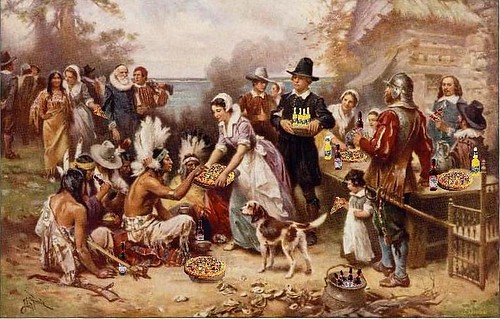
I just finished my family’s Thanksgiving feast, enjoyed with a 2000 magnum of Our Special Ale from Anchor Brewing that I found nestled in the back of one of our refrigerators. Boy am I stuffed. Before the tryptophan kicks in and I’m found drooling on the sofa, I wanted to take a moment to wish everybody a Happy Thanksgiving.
Thanksgiving-pilgrims-beer

I’m incredibly thankful that people come here to read what I write, see what I share and drink what I drink. Thank you from the bottom of my pint glass.

Turkey-beer
Happy Thanksgiving!

ThanksgivingGrowlerWebBanner10
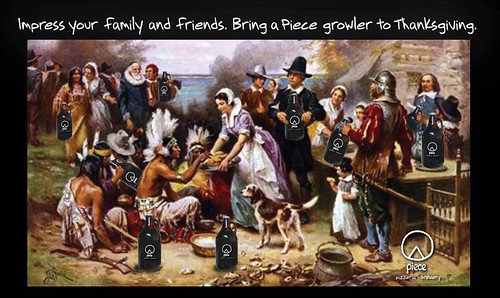
And I love the mash-up Chicago’s Piece Brewery did with this Thanksgiving scene and their growlers.

Filed Under: Beers, Editorial, Just For Fun, Related Pleasures Tagged With: Blogging, Holidays

Updates On The Vodka & Tampon Hoax

November 21, 2011 By Jay Brooks

tampon
You may recall my skeptical take on the Vodka and Tampon story two weeks ago. Since then, I got an e-mail from a friend with a link to a Tiny Cat Pants post In Which I Debunk the Vodka-Soaked Tampon Myth. Today, I learned from the Missus that Danielle Crittenden, Managing Editor, Blogs, for the Huffington Post Canada was as skeptical as I was. Crittenden’s also the wife of famed conservative David Frum and an author in her own right. She posted her own efforts at reproducing the vodka tampon on the Huffington Post, in an article entitled Bartender, a Dirty Martini With a Tampon!. Like Tiny Cat Pants, it didn’t go well … at all. And it’s part of mounting evidence that the people spreading this story are, for lack of a better term, full of shit. As I suspected, this sounded more like an urban legend, a hoax, a way for media outlets to scare parents. But read Crittenden’s account, it’s pretty funny, and scary, but in a whole different way.

Filed Under: Editorial, News Tagged With: Rumors, Science

Declines Of The British Pub Slowing?

November 20, 2011 By Jay Brooks

pub-sign
In September, the British Beer & Pub Association released information regarding pub closures in the UK.

Back in the 1970s more than 90% of all beer consumed in Britain was bought from the “on trade” — pubs and clubs.

According to the British Beer & Pub Association this ratio had fallen to 51% from pubs and 49% from supermarkets at the end of last year. “It will cross over in the near future,” said a spokesman, possibly as soon as this Christmas.

This would be a watershed moment for Britain’s beer industry, a culmination of long-standing change in consumers’ drinking habits as well as confirmation that the recession has caused people to stay at home more.

The figure came as a report from the GMB union highlighted how the high price of beer has caused the destruction of thousands of neighborhood pubs, in turn damaging many working class communities. It said that local pubs, many of which had survived the Blitz and the great depression of the 1930s, were now being destroyed by the recession.

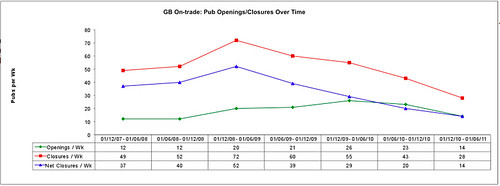
Pub closures hit a record rate of 53 a week at the height of the recession. Last year, 26 a week closed their doors, leaving just 52,500 pubs in Britain, nearly half of the level at its peak before the World War II.

The Beer & Pub Association blamed competition from the supermarkets, which often sell beer as a “loss leader” to drive customers into their stores, and above-inflation increases to beer duty. The GMB blamed large pub companies putting up their prices because they were struggling with too many debts.

Last week, they released a new statement, Sticking to the facts on pub closure numbers, which said, in part:

The BBPA has moved to set the record straight over conflicting analysis in recent days of UK pub closure figures. It is absolutely clear from CGA data, says the BBPA, that free trade pubs have been closing at a much faster rate that tenanted and leased pubs in recent years. The BBPA has published its full analysis of the data on its website, today available from the link below.

From January 2009 to June this year, CGA figures show 3,444 free trade pubs closed, compared with 2,239 tenanted and leased pubs over the same period. As the free trade sector has considerably fewer pubs, their closure rate over the period was almost double that of the tenanted and leased sector, at 16 per cent, as compared with 8 per cent. Taking new openings into account, there was a 9 per cent net reduction in free houses, compared with a 6 per cent reduction in tenanted and leased.

Free trade closures are higher, despite the considerable numbers of pubs being sold into the free trade from the tenanted sector. The reason that there are more free-trade pubs now than there were at the start of 2009 is that companies have sold tenanted/leased pubs to private owners, where this has been deemed appropriate.

“Pub closures are caused by a huge range of issues — the greatest of which we can influence are undoubtedly punitive rates of taxation and the high cost of regulation. And though there is still some way to go to halt the decline, we should all welcome that the latest figures show that the net closure rate has fallen significantly.”

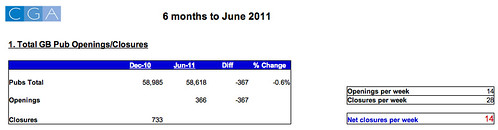
Still, net closures are 14 per week. That’s two a day! But really, it’s 28 pubs closing each week or four a day, which is even more alarming. I’ve been told by Brit friends who know more about this than I do that it’s the bad pubs that are closing, but I have a hard time believing that’s all it is. With that many closing, there must be some good ones, or at least just average ones, that can’t survive as well.

CGA-2011-1

Overall closures are declining since their all-time high (or low) in 2008, as are openings as well, so you can see why there is some reason for optimism. When things are going poorly, you tend to focus on whatever positives you can. Everyone who was involved in craft beer in the mid-1990s will know what I mean. But I’d still be more pleased if the British pub was to regain its footing by opening more pubs than are closing.

CGA-2011-2

Filed Under: Beers, Editorial, News, Politics & Law Tagged With: Pubs, Statistics, UK

MADD Rates The States

November 17, 2011 By Jay Brooks

drunk-driving
According to a press release sent out by the neo-prohibitionist organization MADD yesterday, it’s the five-year anniversary of the launching of their Campaign to Eliminate Drunk Driving® program, which you can tell is all about the results since they went to the trouble to get a “registered trademark” on the name. I also find it somewhat ironic that an organization whose name is “Mothers Against Drunk Driving” has to start a side campaign within its organization to eliminate drunk driving. Isn’t that supposed to be their main purpose? It was, of course — once upon a time — but it’s moved so far from that simple idea now that it seems it’s almost an afterthought so that five years ago they had to create a new program to address the issue of drunk driving.

So yesterday they released the somewhat arrogantly-named “Report to the Nation, which rates each state on its progress toward eliminating drunk driving.” The news is just what you’d expect, indeed what it is every time. “[W]e’ve made substantial progress together, but there is still much work to be done.” And so it goes. Every time. They have to make progress, or why do they even exist, but there always has to be more to do, or else who would keep giving them money? That dichotomy creates contradictions that call all of their assertions into question. For example, on page 6 of the 32-page report, a splash page entitled “A New Hope,” the headline is “drunk driving fatalities reduced by almost half.” And that would certainly be good news, I don’t dispute that. Except that what they refer to as “remarkable progress” in the first paragraph morphs into something entirely different by the second paragraph, which begins: “Despite great progress, drunk driving fatalities have remained relatively stagnant since the mid-nineties, with roughly one out of three highway deaths caused by a drunk driver.” Now how exactly can fatalities be “reduced by almost half” while at the same time “remaining relatively stagnant?”

It’s a game, sadly. Non-profits may not care about profits the way corporations do, but that doesn’t mean they don’t care about money … a lot. They complain constantly about the money that alcohol companies spend on lobbying or influencing policy, but that’s exactly what these neo-prohibitionist groups do, too. Most non-profits may start out with the best of intentions, with a clear goal in mind, but then seem to collapse under their own weight into money-sucking organizations nearly as bad as those they often rail against as they grow larger. In a sense, they become victims of their own success. They become “institutions,” with fixed costs, offices, salaries to pay, consultant fees, marketing materials, advertising, webmasters, etc. They need a lot of money just to take care of their day-to-day costs, never mind whatever they’re trying to achieve. MADD’s gone so far from their original intent that when my son was in kindergarten, he got a bookmark from them during “red Ribbon Week” so he’d know that drugs are bad. Never mind that he parroted that message the next time we tried to give him medicine when he was sick, not quite old enough to process that not ALL drugs were bad.

The “report” also floats yet another made up number of how much it all costs, this time that “drunk driving costs the United States more than $132 billion annually.,” similar to the CDC’s recent $223.5 billion figure, though that was for “excessive alcohol use,” not just driving. Their “research” was done by the Pacific Institute for Research and Evaluation (PIRE), and their figure “includes $61 billion in monetary costs, plus quality-of-life losses valued at $71 billion,” just as notoriously impossible to quantify as lost wages, though they did still try to include “crashes outside of work involving employees and benefit-eligible dependents.” The full study itself, however, is not included in the “report,” just a one-paragraph summary of it so I don’t know all of the particulars.

Another aspect of the report is about “turning cars into the cure,” which really means just “ignition locks,” one of the most invasive ideas ever implemented, especially for first-time offenders who do not constitute the bulk of the problem. What continues to bother me about this is that MADD, and the rest of the Anti-Alcohol bunch, continue to ignore supporting a much better solution, the technology to create cars that drive themselves. That technology is surprisingly close to becoming a reality, with several prototypes in various states of development and being tested. It would virtually eliminate not just drunk driving, but bad driving, texting and telephone issues while driving, and so much more. Just input the address of where you want to go into a computer and the car takes you there while you sit and watch. Instead, MADD seems to prefer technology that punishes. At a minimum, why not support both?

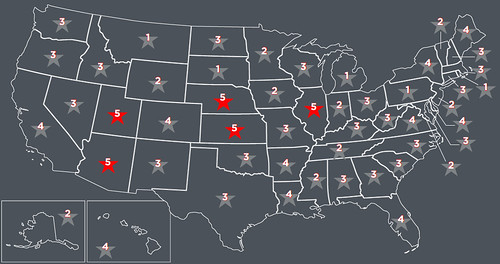
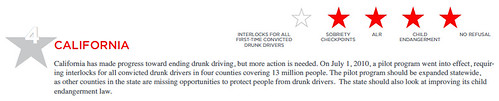
But the bulk of the “report,” around half of it, is their evaluations of how each state is doing to combat drunk driving, at least according to their criteria. They use a five-star scale, with each star representing whether the state does what MADD wants them to regarding the following:

  1. Interlocks for All First-Times Convicted Drunk Drivers
  2. Sobriety Checkpoints
  3. Administrative License Revocation
  4. Child Endangerment
  5. No Refusal

MADD-rating-states-map

Five states got highest marks:

  1. Arizona
  2. Illinois
  3. Kansas
  4. Nebraska
  5. Utah

And like a good bell curve, five got just 1 (nobody got a zero):

  1. Michigan
  2. Montana
  3. Pennsylvania
  4. Rhode Island
  5. South Dakota

There’s also an interactive map where you can see how your state did. California, for example, got a surprising 4. I’m sure Alcohol Justice would disagree with that one.

MADD-rating-states-cal

The states that got a five are still, of course, encouraged to do more. And by more, MADD means for each state to accept what they think is the best approach. Do what we say, or risk a bad rating, that seems to be at least part of the message. With most states receiving a three, there’s plenty of room for improvement, and plenty of need for more fund-raising.

Filed Under: Editorial, News, Politics & Law Tagged With: Anti-Alcohol, Prohibitionists, Statistics

Fomenting Female Fear

November 16, 2011 By Jay Brooks

women
The purported scientific journal Alcoholism: Clinical and Experimental Research has just published another doozy, this one entitled The Legacy of Minimum Legal Drinking Age Law Changes: Long-Term Effects on Suicide and Homicide Deaths Among Women. The idea was to compare people drinking before the age was raised to 21 with when 18-year olds could still legally imbibe, but the conclusions are .. well, off the deep end and unnecessarily alarmist. So, of course, anti-alcohol groups are running with the results, just as you’d expect.

Despite it being in a “scientific journal” it appears to be nothing more than junk science. They start with this premise. “Prior to the establishment of the uniform drinking age of 21 in the United States, many states permitted legal purchase of alcohol at younger ages. Lower drinking ages were associated with several adverse outcomes, including elevated rates of suicide and homicide among youth.” Really? So the other 139 nations who allow people 18 or under are all killing their kids, getting them to commit suicide more often or generally simply not caring about their health. Most of the rest of the world allows their citizens to drink before they turn 21. Apart from the eight countries where it’s illegal for everyone — mostly for religious reasons — only a dozen countries are as high as 21 (only 5 according to Alcohol Problems & Conclusions), like us. Clearly, the rest of the world hates its kids, right?

Here’s the rest of the Abstract:

Methods:  Analysis of data from the U.S. Multiple Cause of Death files, 1990 to 2004, combined with data on the living population from the U.S. Census and American Community Survey. The assembled data contained records on over 200,000 suicides and 130,000 homicides for individuals born between 1949 and 1972, the years during which the drinking age was in flux. Logistic regression models were used to evaluate whether adults who were legally permitted to drink prior to age 21 were at elevated risk for death by these causes. A quasi-experimental analytical approach was employed, which incorporated state and birth-year fixed effects to account for unobserved covariates associated with policy exposure.

Results:  In the population as a whole, we found no association between minimum drinking age and homicide or suicide. However, significant policy-by-sex interactions were observed for both outcomes, such that women exposed to permissive drinking age laws were at higher risk for both suicide (OR = 1.12, 95% CI: 1.05, 1.18, p = 0.0003) and homicide (OR = 1.15, 95% CI: 1.04, 1.25, p = 0.0028). Effect sizes were stronger for the portion of the cohort born after 1960, whereas no significant effects were observed for women born prior to 1960.

Conclusions:  Lower drinking ages may result in persistent elevated risk for suicide and homicide among women born after 1960. The national drinking age of 21 may be preventing about 600 suicides and 600 homicides annually.

Okay, the first thing that should stick out is the statement that “[i]n the population as a whole, we found no association between minimum drinking age and homicide or suicide.” But then they go on to suggest “significant” findings for just women, even though their findings show that for suicide, a woman is only 12% more likely to commit suicide if she starts drinking legally at 18, and 15% more likely to be murdered. That hardly sounds “significant” and seems small enough that statistical error alone could account for some of the difference. But more importantly, it makes no allowance for any of the literally millions of other factors that lead to any person committing suicide or being murdered. And there’s just no causation or direct correlation linking the two outcomes. The difference in time alone could account for the statistical difference. The time when the age was 18 was different than later, when it was 21. Times change, and so accordingly would how people react to it.

And again, even though it’s only women who the “study” found were affected, they note that the “trends were not mirrored among men,” but examining all this data that “proves” a link for women, their answer to why it doesn’t increase a risk for men is this. “It’s hard to say why that happened.” Well, how scientific. When the results are what they’re looking for, they point to the data. When the data doesn’t support the conclusion they want, they don’t know what happened. Hmm.

Join Together’s headline, Lower Legal Drinking Age Linked to Higher Risk for Homicide, Suicide in Women, claims there is a definite link (which the study itself never says). And their graphic shows a presumably passed out woman in front of a blurry empty bottle of liquor. At the end of their article, lead researcher Richard Grucza says the following. “In fact, what we have here is a natural experiment that supports that idea, by demonstrating an unintended but positive consequence that comes from having raised the drinking age.” But there’s nothing natural about that conclusion. Just like MADD in the past has claimed victory against drunk driving deaths while ignoring improved car safety, mandatory seat belt laws and countless other factors, this “study” looks at two cohorts of numbers and jumps to a conclusion worthy of Evel Knievel’s rocket car leap over the Snake River without ever showing a connection actually linking the two outcomes. Really, they just assume there is a connection, presumably for no better reason than they’re looking for one.

It just feels like there’s no real evidence to truly support such far-reaching conclusions, more like they’re using the data to force an outcome. They’ve certainly over-simplified society and the complex ways in which people determine they want out or want to take someone else out. So they blame alcohol, and when people started drinking.

Filed Under: Editorial, News, Politics & Law Tagged With: Cranks, Prohibitionists, Science, Statistics

Belgium’s Liquid Communication

November 12, 2011 By Jay Brooks

belgium
The NPR program PRI’s The World had an interesting piece yesterday by a Clark Boyd entitled In Belgium, It’s Not Just Beer. It’s ‘Liquid Communication.’ I like that turn of phrase, “Liquid Communication,” though the gist of the article is that the author, understandably, worries that ABI might start capitalizing on the romance of Belgian beer as they attempt to launch their “Belgian Beer Cafe” chain in the U.S. There are already 55 of them worldwide, but now they’re seeking to franchise them in the states, too. The concept appears to be making the Belgian beer cafe as famous as the Irish bar or the English pub that can be found in every big city in the world, and probably just as authentic.

ABI, of course, has several Belgian beers in its portfolio, including Hoegaarden, Leffe, Belle-Vue and the ubiquitous Stella Artois. According to the pitch, the cafes would also carry non-ABI Belgian beers, but you know which ones would get the most attention and focus. They would no doubt appeal to consumers who are not hardcore beer geeks but have heard the news that Belgium makes some world class beers. And while that’s not necessarily a bad thing, it’s hard not to share the author’s concerns that ABI would fuck it up for everybody. Stella Artois is not exactly the best or most representative Belgian beer, yet it’s now the one most people are aware of. But it’s as far away from what makes Belgian beer great as Bud is from Trumer Pilsner or Radeberger. But I would certainly like to communicate liquidly.

Filed Under: Beers, Breweries, Editorial, Just For Fun, News Tagged With: Belgium, Mainstream Coverage

Drunk Off … Er, In Your Ass?

November 11, 2011 By Jay Brooks

tampon
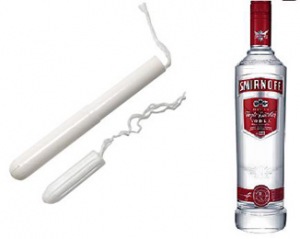
A mix of thanks and “how could you” to Stephen Beaumont for tweeting this story, because now that I know it, I can’t unknow it. According to Digital Journal, a growing trend among Phoenix, Arizona, area youths — disturbingly both girls and boys — is to get drunk by soaking a tampon in vodka and inserting it … well, you get the idea. According to the report, the practice was first identified in 1999, in the Oxford Journal of Alcohol and Alcoholism, although in that instance they wrote about just three case studies all of whom were adults in their late twenties to their mid-thirties. Also, in April of this year, the same thing was reported to be happening in Germany, too.

The latest story’s origin is a Channel 5 KPHO Phoenix TV report, where a Dr. Quan is the medical source, saying they’ll get a “[q]uicker high, they think it’s going to last longer, it’s more intense.” School Resource Officer (whatever that is) Chris Thomas adds “[w]hat we’re hearing about is teenagers utilizing tampons, soak them in vodka first before using them. It gets absorbed directly into the bloodstream. There’s no barrier, there’s no stomach acid to prevent it.” Dr. Quan agreed. “I would expect it to absorb pretty quickly as well, because it’s a very vascular structure.” Okay, that’s probably enough to give you the idea of what “butt chugging” is. Two things leap to mind.

One, this has got to be a hoax. Kids messing with adults and them falling for it hook, line and sinker. Maybe it’s just me, but when I was a kid, not only would this have never occurred to us, but even if it had, we would never have tried it. Heroin addicts shoot up between their toes to avoid detection. Same deal here, apparently, but there are just too many simpler ways to avoid detection than this. It’s just too much committed effort for most people. Or is that just me? Plus, mainstream media, and television in particular, loves a good scare story, something that puts fear into its viewers. This story is dripping with cautionary words, something else for parents to be “concerned” about. Perhaps some idiots did try it, but a growing trend? I’m just not buying it. You?

Second, if it is true, however doubtful, it shows the futility of having 21 be the minimum legal drinking age and avoiding any real education before that time. People will find a way to do almost anything if properly motivated. And few things motivate a teenager more than being told they can’t do something. I keep hearing that line from Jurassic Park in my head. “Nature will always find a way.” And so it goes.

tampons-soaked-in-vodka

UPDATE: Thanks to Rick at Pacific Brew News for sending me this Tiny Cat Pants post In Which I Debunk the Vodka-Soaked Tampon Myth.

Filed Under: Editorial, News Tagged With: Rumors, Science

Pink Beer … You Know, For The Girls

November 8, 2011 By Jay Brooks

pink-beer
Apparently there’s yet another misguided attempt to reach women with the aim of tempting them to try beer by making the color of the beer pink. This time it’s a group of young South African women attending Durban University of Technology who came up with the idea for the beer, which they’re calling Pink Fantasy, according to a post yesterday on Beer Universe. Needless to say, all of the women I know who love craft beer drink it because of how it tastes, not because it matches their shoes. Are there really women in the world who, when pressed, would actually say, “well, I’d try beer if only it wasn’t that unpleasant orange … or golden … or brown … or black? But if it was pink, like Barbie, maybe I would actually get over my ignorant phobia that beer is bitter and how I just know I won’t like it. Maybe I’ll finally give this kicky new pink beverage a try.” Sheesh. I could keep ranting, but I think Ginger Johnson from Women Enjoying Beer said it best in these two posts: Still Not “Getting It” and Marketing Beer to Women, Part 4: No Pink.

Filed Under: Beers, Editorial, News, Politics & Law Tagged With: Africa, South Africa, Women

Societal Costs vs. Personal Costs For Alcohol

November 3, 2011 By Jay Brooks

cdc
At first glance I thought my pals at Alcohol Justice (AJ) got their hooks in the Center for Disease Control and Prevention (CDC), because I don’t know anyone better at making up behaviors that cry out for personal responsibility that are ascribed to society (for the cost) and business (for the fault). Their absurd “charge for harm” campaign, which seeks to make alcohol companies, the businesses that sell their products, and the communities that they live in wholly responsible for the personal decisions and behavior of a minority of people who abuse alcohol, seems to have been swallowed whole in a new study, apparently by the CDC, that was recently published in the American Journal for Preventative Medicine. That study, not surprisingly, was the subject of a recent AJ press release, CDC Releases New Cost Study: Excessive Alcohol Use Cost the U.S. $223.5 Billion in 2006, which they summarize:

Of the total costs, 72.2% ($161 billion dollars) is attributed to lost productivity in the workforce. The remaining costs are attributed to healthcare (11%), criminal justice (9.4%), and effects such as property damage (7.5%). While the CDC has had strong data on premature deaths caused by alcohol consumption (79,000 annually, with an estimated 2.3 million years of potential life lost each year), it last performed an economic cost analysis in 1998, when the annual cost was estimated to be $184.6 billion.

While $223.5 billion dollars is a massive number — almost 3 times what the federal government spent on pre-primary through secondary education in 2010 — the authors of the study believe that it is a substantial understatement of the true costs of alcohol use in the United States. They recommend “effective interventions to reduce excessive alcohol consumption—including increasing alcohol excise taxes, limiting alcohol outlet density, maintaining and enforcing the minimum legal drinking age of 21 years, screening and counseling for alcohol misuse, and specific countermeasures for alcohol- impaired driving such as sobriety checkpoints.” With the national cost of alcohol consumption ringing in at nearly $2 per drink, we could not agree more.

Of course they couldn’t agree more, it’s catnip to their agenda and I wouldn’t be surprised to find a closer link to the study that has not been disclosed since it seems so much like a self-fulfilling prophecy of their own propaganda with conclusions that so closely mirror their own proposals to “fix” alcohol abuse at the expense of the majority of responsible drinkers and local craft brewers who positively affect their local economies and communities. And my instinct turns out to be true, though not with AJ, but because this study “was supported by generous grants from the Robert Wood Johnson Foundation to the CDC Foundation.” For me, that’s the smoking gun. If you don’t know who the Robert Wood Johnson Foundation is, they’re the mother of all neo-prohibitionist groups, and they fund most of the other ones, setting the agenda for a majority of other anti-alcohol organizations nationwide. Supposedly, AJ no longer accepts donations from the Robert Wood Johnson Foundation, though when I asked when they stopped receiving support from them, I never got an answer.

But a closer look at the study reveals that the charges it ascribes to “society” are not actually borne by society at large, at least to my way of thinking, but instead are paid privately by the individuals who supposedly abused alcohol or the private companies that employ them. To me, that makes them false statistics because they say one thing that turns out to not actually be true. So let’s look as those numbers of societal “costs.” Here’s the breakdowns, according to AJ’s press release:

  1. 72.2%: Lost productivity in the workforce
  2. 11%: Healthcare
  3. 9.4%: Criminal justice
  4. 7.5%: Property damage

Okay, the biggest expense blamed on alcohol abuse is “lost productivity in the workforce,” accounting for nearly three-quarters of the total, or about $161 billion. But unless they work for the government (and there’s no data on what percentage might) the costs, it seems to me, would be paid by the private companies they work for. And if they continually show up late, hungover or so they can’t do their job, how many would remain employed for an extended period of time? However you slice it, that’s not me or society paying for the poor performance of that binge-drinking employee. I suppose you could argue that a company filled with such people might result in higher prices passed along to consumers, but any such company that doesn’t weed out employees who don’t perform their jobs well is most likely going to go out of business for other reasons, as well.

The other lost productivity category is early mortality by alcohol-abusers. These people apparently selfishly die before they can do enough work to be considered to have paid their debt to be a member of society. But if you drink yourself into an early grave, your unfinished work or debt to society has got to be the least of your troubles. It’s more likely that the reasons for your early demise have multiple causes, many of which were probably not addressed by the society who was as responsible for you as they claim you were to country, state, community and family. I honestly can’t see how you can total dollar amounts for work undone by one individual, when undoubtedly another person stepped in and did it instead. I don’t mean to sound cold, but with unemployment so high, when a position becomes available under such circumstances, I feel confident that there will be someone to take that job and get the work done. So how does that cost society anything?

But let’s also look at the number itself, $161 billion. GDP at the end of 2006 (the same timeframe as this study) was $13.58 trillion. That makes this “cost to society” 1.19% of GDP. Not only is that a pretty small percentage though, even if true, nothing in their reasoning suggests it’s anything close to the truth.

The next highest cost is from healthcare. But again, unless the binge drinker has no health insurance and doesn’t pay his own medical bills, how is society paying? For those with insurance, their policy pays their medical bills, and whatever isn’t covered under their policy they become personally responsible for. I admit that it’s more likely that a person who abuses alcohol, and may not be able to keep down a job, might not have health insurance, but in the only civilized nation without universal healthcare I would argue that’s more a failure of our society than a cost to it. Whoever ends up paying for the medical care of binge drinkers, it seems more likely it will be insurance companies first, responsible individuals second, and, if at all, society last.

Third, criminal justice apparently accounts for 9.5%. What is meant by “criminal justice” includes $73 billion, of which “43.8% came from crash-related costs from driving under the influence, 17.2% came from corrections costs, and 15.1% came from lost productivity associated with homicide. Other categories include fire loss, crime victim property damage and “special education” about “fetal alcohol syndrome.” In the full text of the study, Table 2 lists who they think is responsible for all these costs, whether the government, the drinker and his family or society (though I should point out how that was arrived upon is completely absent from the study). Given that the entire study supposedly claims the “cost of excessive alcohol consumption in the United States in 2006 reached $223.5 billion,” you’d think that the personal costs even they admit to would not be a part of the total at all. Even by the CDC study’s own admission, 41% of the costs they claim are to society, are actually “paid” by the individual drinker (and his family). That’s almost half that don’t appear to be a cost to society as a whole. How does that not call into question their methodology and/or their conclusions?

But many of these other categories seem plain silly. Fire loss and property damage? Those are crimes, whether or not the person perpetrating them was drinking or not. To say it’s alcohol-related if they had a drink before they robbed someone seems as ludicrous as including a car accident in which the passenger was drinking in drunk driving statistics (which actually has been routinely done). And corrections? If you’re in jail for a crime you committed, yes that’s a cost to society, but that’s a cost we’ve all agreed is supposed to be borne by society, like the police and fire departments. It’s not like there’s some special jails that don’t count or count double if the criminal had a drinking problem. It’s really just a way to inflate the numbers and, as usual, make the problem with alcohol abuse seem far worse than it is.

And while I’m on that subject, let’s briefly mention how absurd the very definition of a “binge drinker” is in compiling these statistics, too. I’ve written about this many times, such as in Inflating Binge Drinking Statistics, Son of Binge Drinking Statistics Inconsistencies and Inventing Binge Drinking.

Lastly, “property damage,” which is really “other effects,” is listed as 7.5% of the harm blamed on alcohol. This is very confusing, because in the study’s Table 1, “criminal justice” is actually listed under “other effects” so I’m not sure what AJ is up to with their list. So I’ve actually addressed property damage above here, though Table 1 also includes a separate column for “crime-related” so the row for “criminal justice” is 100% “crime-related” so I’m not sure what’s being doubled-up on, but surely something is odd, if not intentionally.

The other factors not accounted for, as usual, are any positive effects of alcohol. Although both the study and AJ makes a big deal about what negative effects they couldn’t quantify, they’re completely unconcerned about any omitted positive ones. Certainly there are economic benefits for local communities as well as society at large. But even ignoring those, this “study” undoubtedly does not take into account how total mortality is improved by moderate, responsible drinking as set forth in the most recent FDA dietary guidelines, as well as a number of scientific studies and meta-studies that have shown the same thing. How many people who do drink moderately as part of a healthy lifestyle actually save society money because of their responsible behavior, which includes a drink or two daily?

It also doesn’t take into account how many crimes are prevented or stress relieved which might otherwise have led to “costs to society” because a person had a drink or two and calmed down, relaxed and decided not to do something rash, stupid or illegal. Given that the majority of people who drink alcohol do so responsibly and do not cost society anything, even by these absurd standards, it seems likely a lot more “costs” are actually prevented by moderate alcohol consumption. So where’s the balance? As even this “study” admits, “[m]ost of the costs were due to binge drinking — it’s the subtitle of the CDC’s press release — although the CDC claims “[e]xcessive alcohol consumption, or heavy drinking, is defined as consuming an average of more than one alcoholic beverage per day for women, and an average of more than two alcoholic beverages per day for men, and any drinking by pregnant women or underage youth.”

Of course, that’s at odds with the most recent dietary guidelines that the FDA released, which “defines ‘low-risk’ drinking as no more than 14 drinks a week for men and 7 drinks a week for women with no more than 4 drinks on any given day for men and 3 drinks a day for women.” But the anti-alcohol groups didn’t like that definition, and they gave the money for this study to be done, so they can safely ignore anything that doesn’t fit the conclusion they paid for. Why the government is so hot to be in bed with anti-alcohol factions is a bit trickier, but I feel confident money and control are at the root. The CDC’s handling of autism research has made me more than a little suspect of their motives and their ties to the medical industry and academic institutions.

But the larger picture is the question of Societal Costs vs. Personal Costs for alcohol. Few other products sold in America are as demonized as alcohol and it remains one of the few that continues to be blamed en masse for the actions of a minority of people who abuse it. Whatever harm they do personally is writ large across the entire spectrum of consumption, as if everybody who drinks is a bad person costing society its moral compass and leading us down the mother of all bad roads. We are becoming the scapegoats for all of society’s ills. Make no mistake about it, there are people who want a return to prohibition and the groundwork is being laid as we speak to try it again. And we know how well it turned out the last time. But we should be honest about it. Everything we do costs society something, but only alcohol is singled out to pay for the small number of people who abuse it. It’s a question of weighing the good with the bad and what’s best for a majority of people. Given that the vast majority of people are responsible drinkers who enjoy both drinking alcohol and the rituals that go along with it, I’d say that society has always been better off when its populace could have a beer. And that’s good both for the individual and society as a whole.

Filed Under: Breweries, Editorial, Politics & Law Tagged With: Anti-Alcohol, Government, Health & Beer, Prohibitionists, Propaganda, Statistics

Drinking & Cultural Anthropology

October 28, 2011 By Jay Brooks

social-anthropology
BBC Magazine published online a couple of weeks ago an interesting piece on cultural anthropology as it relates to drinking patterns, entitled Viewpoint: Is the Alcohol Message All Wrong?. While the article itself I found compelling on its on, the way in which it was attacked in the voluminous number of comments is at least as interesting, too.

It was written by Kate Fox, a co-director of the Social Issues Research Centre (SIRC). As for Fox’s ideas, she begins with the media-driven perception that Britain is “a nation of loutish binge-drinkers – that [they] drink too much, too young, too fast – and that it makes [them] violent, promiscuous, anti-social and generally obnoxious.” She suggests that those very perceptions are deeply believed among people living there, but that they are wrong.

In high doses, alcohol impairs our reaction times, muscle control, co-ordination, short-term memory, perceptual field, cognitive abilities and ability to speak clearly. But it does not cause us selectively to break specific social rules. It does not cause us to say, “Oi, what you lookin’ at?” and start punching each other. Nor does it cause us to say, “Hey babe, fancy a shag?” and start groping each other.

The effects of alcohol on behaviour are determined by cultural rules and norms, not by the chemical actions of ethanol.

There is enormous cross-cultural variation in the way people behave when they drink alcohol. There are some societies (such as the UK, the US, Australia and parts of Scandinavia) that anthropologists call “ambivalent” drinking-cultures, where drinking is associated with disinhibition, aggression, promiscuity, violence and anti-social behaviour.

There are other societies (such as Latin and Mediterranean cultures in particular, but in fact the vast majority of cultures), where drinking is not associated with these undesirable behaviours — cultures where alcohol is just a morally neutral, normal, integral part of ordinary, everyday life — about on a par with, say, coffee or tea. These are known as “integrated” drinking cultures.”

Seems reasonable enough, almost common sense really. And it’s certainly consistent with my own personal experience. Some people are bad drunks, they use the idea that alcohol will make them act badly to act badly. I’ve seem many examples of such people growing up and through the present. But they’re the minority. I’ve also seen countess people who don’t believe that drinking alcohol will alter their moral compass in the least, and for those people — easily the vast majority of people I know — it doesn’t. The effects of alcohol in such people are largely benign. They don’t don’t turn into assholes. They may get more chatty, more open, more sleepy perhaps; but they don’t become “violent, promiscuous, anti-social and generally obnoxious.”

Fox goes on to suggest that there’s little difference in the amount of alcohol consumed, as it makes little difference at all. What matters is the cultural norm, the attitudes of the society that, at least in part, dictate the consequent behavior. And she says there are numerous studies that prove just that. These “experiments show that when people think they are drinking alcohol, they behave according to their cultural beliefs about the behavioural effects of alcohol” even if given placebos. She continues:

The British and other ambivalent drinking cultures believe that alcohol is a disinhibitor, and specifically that it makes people amorous or aggressive, so when in these experiments we are given what we think are alcoholic drinks – but are in fact non-alcoholic “placebos” – we shed our inhibitions.

We become more outspoken, more physically demonstrative, more flirtatious, and, given enough provocation, some (young males in particular) become aggressive. Quite specifically, those who most strongly believe that alcohol causes aggression are the most likely to become aggressive when they think that they have consumed alcohol.

Our beliefs about the effects of alcohol act as self-fulfilling prophecies — if you firmly believe and expect that booze will make you aggressive, then it will do exactly that. In fact, you will be able to get roaring drunk on a non-alcoholic placebo.

And our erroneous beliefs provide the perfect excuse for anti-social behaviour. If alcohol “causes” bad behaviour, then you are not responsible for your bad behaviour. You can blame the booze — “it was the drink talking”, “I was not myself” and so on.

She then explains that it may be our attitudes toward alcohol and what it does to us, or what we believe it allows us to do, that we should focus on changing. If the people who use alcohol as an excuse to act badly instead acted like the rest of us and believed otherwise, there might be less bad drunks. That doesn’t sound too radical to me, but judging from the 1000+ comments made in just 48 hours after the article was posted, you’d think she was suggesting we kill puppies and children.

Many of the commenters complain that the author, Kate Fox, is a shill for the alcohol industry because her organization, the Social Issues Research Centre (SIRC) receives funding from companies who sell alcohol. And that does appear to be the case, although the total funds they receive appear to be from a wide variety of sources, many of which (in fact it would appear a majority) are not alcohol companies. Their funding page does include Diageo, Greene King and the Wine Action Trade Group. But those three are the only ones among 56 donors listed, some of which are very big companies indeed. SIRC’s stated mission is “SIRC is a non-profit organisation that conducts research and consultancy across a wide range of topics, including on-going monitoring and analysis of social trends and related issues.” And given the wide and varied sponsors, it would appear that they’re not exactly in the pocket of big alcohol, as their critics seem to insist.

The main charge lobbied at them is that the British Medical Journal (BMJ) attacked them in a study entitled “how seriously should journalists take an attack from an organisation that is so closely linked to the drinks industry?” But that appears to be in response to SIRC criticizing journalists for publishing stories on health scares so in a sense it seems the BMJ was responding to being criticized by criticizing them. Most commenters seem to believe that the BMJ, and “academic journals” in general, are unassailable, which I’ve found is hardly the case. They’re as open to misuse as anything or anybody. My point is that while it can be important to look at who’s behind any study (and I do it all the time) I find that it’s done far more routinely when it’s a business interest than an anti-alcohol group. If this was an anti-alcohol piece, the media would be falling all over itself in acceptance of it as fact, despite that what comes out of anti-aclohol groups is every bit as much self-serving propaganda as what they’re accusing SIRC of, and without any actual proof, either; just character assassination.

The vitriol in the more than 1,000 comments is staggering, and just the number of comments removed for violating their house rules — language presumably — is higher than I think I’ve ever seen. There’s so many that are just emotional responses, and very little beyond she’s wrong, he’s wrong and I know best kind of opinions. It may well be that SIRC is not to be trusted, but the dismissal of the substance of Fox’s arguments or a seeming unwillingness to either understand or address them, or indeed just remain civil, says more about the fanatical commenters than anything else could.

Particularly interesting is that in the final paragraph Fox concludes that “[o]ver the past few decades the government, the drinks industry and schools have done exactly the opposite of what they should do to tackle our dysfunctional drinking.” That doesn’t exactly jibe with her alleged image of an alcohol industry shill.

So while I don’t believe her theory is the only reason that some people behave badly when they drink, I certainly think it can account for a lot of the problems that are currently being blamed on alcohol. Shouldn’t we at least be able to talk about alternatives to the one way we now think about alcohol in society? Especially when you consider that the very organizations against it keep saying that the problem is growing and all their efforts are for naught. You’d think the neo-prohibitionists would welcome another way to combat what they perceive to be the biggest problem to hit society since the plague. But judging by this article’s critics, I can’t help but think they’re not going to change the way they think about alcohol anytime soon.

Filed Under: Beers, Editorial, Politics & Law Tagged With: Anti-Alcohol, Science, UK

« Previous Page
Next Page »

Find Something

Northern California Breweries

Please consider purchasing my latest book, California Breweries North, available from Amazon, or ask for it at your local bookstore.

Recent Comments

  • Ernie Dewing on Historic Beer Birthday: Charles William Bergner 
  • Steve 'Pudgy' De Rose on Historic Beer Birthday: Jacob Schmidt
  • Jay Brooks on Beer Birthday: Bill Owens
  • Steve 'Pudgy' De Rose on Beer Birthday: Charles Finkel
  • Steve 'Pudgy' De Rose on Beer Birthday: Bill Owens

Recent Posts

  • Beer In Ads #5204: Oh Brother! Griesedieck Bros. Genuine Premium Bock Beer Is Here! February 15, 2026
  • Historic Beer Birthday: Emil Resch February 15, 2026
  • Historic Beer Birthday: Philip Zang February 15, 2026
  • Beer In Ads #5203: Robert Portner’s Bock Beer February 15, 2026
  • Historic Beer Birthday: August Schell February 15, 2026

BBB Archives

Feedback

Head Quarter
This site is hosted and maintained by H25Q.dev. Any questions or comments for the webmaster can be directed here.