Brookston Beer Bulletin

Jay R. Brooks on Beer

  • Home
  • About
  • Editorial
  • Birthdays
  • Art & Beer

Socialize

  • Dribbble
  • Email
  • Facebook
  • Flickr
  • GitHub
  • Instagram
  • LinkedIn
  • Pinterest
  • RSS
  • Twitter
  • YouTube

Powered by Genesis

When Common Sense Gives Way To Business Sense

March 3, 2011 By Jay Brooks

abita
First Anchor Brewing trademarked Steam Beer, but did so at a time when absolutely nobody else in the world made anything even remotely similar, so it was entirely understandable. As the years rolled on, and many brewers have been forced to call the same or similar type of beer a “California Common,” I can’t help but think it’s an idea whose time has passed. I know it’s too valuable, but personally I’d like to see them relinquish their hold over the name and allow the rest of the world to call it by its proper name.

Then Full Sailing Brewing came out with their genius stubbie bottles that they called Session Lager and Session Black. And that might have been the end of it, but as I understand it, they also trademarked “session beer” and related marks. No one objected, of course, because there’s nobody to object. “Session beer” was, and in my mind remains, a generic term so there really was no one to file an Amicus curiae or otherwise oppose the trademark. What I don’t understand is how an already established generic term can be appropriated for private business use. When a trade name becomes so common — remember Scotch tape? — that it becomes the generic word for it then it loses its status as a protected trademark, in effect a product of too much success. Other examples of generic words that used to be trade names include aspirin, escalator, heroin, kerosene, laundromat, linoleum, pilates, thermos, videotape and zipper, to name just a few. But session started out as a generic, loosely defined term. I love Full Sail, but hate the notion that they “own” the term “session beer.”

That brings us up to yesterday, when Abita Brewing of Louisiana sent a cease and desist letter to a local charity, claiming that they own the trademark on the term “pub crawl,” and have since 1999. According to the Baton Rogue Business Report:

An attorney representing the Abita Brewing Company has sent a cease-and-desist letter to a charity organizer, ordering him not to use the term “pub crawl” to refer to his events. Todd Owers III, an attorney with the New Orleans firm of Carver Darden, says Abita owns the Louisiana state trademark for “pub crawl” and that for Manu Kamat to use the term in referring to his events in downtown Baton Rouge is a clear infringement on the brewery’s rights. Kamat says he started organizing monthly bar tours across downtown Baton Rouge in December to benefit the New Orleans Council for Community and Justice. Participants pay a few dollars, which entitles them to drink specials at participating bars for the night. Kamat says he finds Abita’s actions “a little bully-ish.” David Blossman, president of Abita, says the brewery is trying to protect its rights. “We’re trying to work these things out amicably,” he says. Kamat says he got the letter from Owers on Feb. 18, the night of his most recent event. In the letter, Owers attached documents that show Abita filed an application to use the trade name “pub crawl” with the Secretary of State in July 1999 and renewed it for another 10 years in July 2009. Kamat says he’s seen the term “pub crawl” all across the U.S. and Europe and that Abita’s action is like trying to trademark the term “happy hour.” But Blossman says that Abita made the term “pub crawl” known across Louisiana and that the term is now synonymous with the brewery. Kamat says he’s a “huge fan” of Abita and is looking for ways to continue to have his events without further upsetting the popular local brewery. He’s dubbed the next event, set for March 25, a “bar golf.” But he won’t comply with one request from Abita—to transfer control of the domain name pubcrawlbr.com to the brewery.

Now I don’t live in Louisiana, but I still have to question the statement that “Abita made the term ‘pub crawl’ known across Louisiana and that the term is now synonymous with the brewery.” I’ve heard, and used, the term everywhere I’ve traveled, both here and abroad and I think you’d be hard pressed to convince me that it’s not a near universal term in the English-speaking world. I certainly have no such association between Abita and pub crawls. In 1999, when they apparently were granted a state trademark, again there would have been no one to oppose them or speak on behalf of such a generic term. My bet is nobody even realized they “owned” the term “pub crawl.” And while I know full well that trademark holders have an affirmative duty to vigorously defend their marks, I can’t see how this won’t be a dead loser in the goodwill department or for that matter what advantage there is to actually owning the trademark on a term most people already believe is generic in the first place.

UPDATE: In a swift and smart move, Abita president David Blossman today posted a note to their Facebook page reversing their position. Here’s an excerpt:

In the 1990s big corporate breweries began trying to mimic craft beers and take over the types of events smaller breweries like us had created. To protect the Pub Crawl for our fans we trademarked the name of the event in Louisiana only. Our intent was to prevent any confusion and to stop the big breweries from copying our success. Over the years, we’ve sent out letters asking others not to use the name Pub Crawl unless it is an Abita sponsored event.

We’ve heard from you today on this trademark issue and we agree. Your respect is far more important to us than two little words.

This morning we reached out to the New Orleans Council for Community and Justice and let them know we’ve changed our mind and our position on the trademark issue. We have offered and they have accepted our support of their next event, scheduled for March 25. Abita is proud of our history of charitable giving to our community through our fundraising brews and our commitment to non-profit organizations.

That’s a classy move, in my opinion. Few businesses can admit they’re wrong or at least admit an error in judgment. They appear to have listened to their customers and understood that their loyalty and respect was more important than being in the “right” legally.


Filed Under: Breweries, Editorial, News, Politics & Law Tagged With: Business, Law, Louisiana

Proud Of British Beer

March 1, 2011 By Jay Brooks

uk
In quasi-answer to I Am A Craft Brewer, Britain’s Society of Independent Brewers (SIBA) has released a video of their own: Proud of British Beer. It’s very well produced, and I like that they included not just brewers, but also farmers, publicans and salespeople to show the entire chain from farm to glass. It was also great seeing so many familiar faces.

Of course, the original video was made for a trade conference, whereas SIBA’s effort seems aimed directly at consumers, and especially those that might be on the fence about whether or not to support Britain’s beer industry. I love the end, because it goes after the wisdom of more and more taxes on beer, a situation similar to what’s happening in America, too. The answer, of course — here as there — is that neo-prohibitionst and anti-alcohol groups are using the weakened economy to further their agenda of attacking and punishing alcohol for its perceived sins. It’s great to see the brewing industry fighting back, something that I feel desperately needs to happen in the U.S., too. But over here, the media tends to pay a disproportionate amount of attention to well-funded anti-alcohol propaganda while ignoring any contrary opinions. If our national discourse on alcohol is anything, it’s certainly not fair or balanced.

One reason Proud of British Beer is so good is that the script was written by Pete Brown, and you can read his thoughts about Proud of British Beer on his blog. Pete’s a kindred spirit when it comes to the neo-prohibitionists and he makes an important case for beer in the UK. Well done, Pete!

From SIBA’s Vimeo page:

“Proud of British Beer” is a short film produced by the Society of Independent Brewers. It features brewers, both large and small, hop and barley growers, maltsters and industry suppliers. Our concerns are that the continued above inflation increases in beer duty are destroying this indigenous British industry. Pubs, which are an integral part of the fabric of British society are also being forced to close at the rate of 29 per week. This cannot be allowed to continue.

We are proud of British beer. Are you?

Filed Under: Beers, Breweries, Editorial, Just For Fun, Politics & Law Tagged With: UK, Video

Former MADD Chapter President Caught Driving Drunk

February 25, 2011 By Jay Brooks

drunk-driving
I don’t want to make light of this, or even make too much out of it, because everyone makes mistakes. Hell, even the head of the OLCC resigned after getting a DUI in April 2006. But I still feel it has to be pointed out (and thanks to Rob for the tip).

The Gainesville Sun is reporting that Debra Oberlin was arrested last week and charged with a DUI. Oberlin is the former President of the Gainesville, Florida chapter of the neo-prohibitionist Mothers Against Drunk Driving (MADD). She was the President of the local chapter for three years in the 1990s before it was disbanded for “lack of financial support” in 1996.

But she didn’t just go a little bit over the line, she sprinted past it. Like most states, Florida’s BAC level is 0.08. Oberlin blew a .234 and a .239, while claiming to have had just four beers. The police report indicates she was observed “driving erratically on Northwest 19th Street, swerving and crossing lanes.” That’s the type of drunk driver even the most ardent supporter of alcohol doesn’t want on the road.

Filed Under: Editorial, News, Politics & Law Tagged With: Florida, Prohibitionists

Simplifying Tasting Descriptions

February 22, 2011 By Jay Brooks

pour-the
Eric Asimov, who writes The Pour for the New York Times, had a very interesting post today on simplifying tasting notes for wine, entitled Wine in Two Words. Here’s the crux of his idea:

While it may seem heretical to say, the more specific the description of a wine, the less useful information is actually transmitted. See for yourself. All you have to do is compare two reviewers’ notes for a single bottle: one critic’s ripe raspberry, white pepper and huckleberry is another’s sweet-and-sour cherries and spice box. What’s the solution? Well, if you feel the urgent need to know precisely what a wine is going to taste like before you sniff and swallow, forget it. Experience will give you a general idea, but fixating on exactitude is a fool’s errand. Two bottles of the same wine can taste different depending on when, where and with whom you open them.

Besides, the aromas and flavors of good wines can evolve over the course of 20 minutes in a glass. Perhaps they can be captured momentarily like fireflies in a child’s hands, yet reach for them again a minute later and — whiff! — they’re somewhere else.

But the general character of a wine: now, that’s another matter. A brief depiction of the salient overall features of a wine, like its weight, texture and the broad nature of its aromas and flavors, can be far more helpful in determining whether you will like that bottle than a thousand points of detail. In fact, consumers could be helped immeasurably if the entire lexicon of wine descriptors were boiled down to two words: sweet or savory.

Asimov goes on to give greater detail to his idea of simplification, going so far that at the end he gives a list of varietals and where they fall in the sweet or savory list, admitting obvious exceptions will occur. And while I believe beer flavors are somewhat more complex, because of a greater number of ingredients and the endless combinations of them along with variations in the brewing process, the basic notions are sound and applicable.

Like wine, it’s true that the flavors of a particular beer change as it warms, too, and on any given day there are numerous things that can effect how a beer tastes. But even so, I don’t think you could distill beer down to just two descriptors. But I could see a smaller number being devised that could be useful in communicating basic information about the expectations of how a beer might taste, or at least its core components. There are specific styles that certainly have very recognizable characteristics, but just as many don’t or are exceptions to any rules. In a sense beer is like the English language, where there’s an exception to virtually every rule. Still it might be worth the effort to try and see what emerges and whether it could be useful. Anybody have any thoughts?

Filed Under: Beers, Editorial, Related Pleasures Tagged With: Tasting, Wine

The United States Of Good Beer?

February 18, 2011 By Jay Brooks

us-outline
At the end of January, the Houston Press’ Brew Blog did a map showing a beer for every state that seemed to miss the mark for more than a few of their choices. I ranted about it in my post, The United States of Beer? Apparently I wasn’t the only one, because an alert reader (thanks, David) tipped me that they’ve redone the map, this time calling it The United States of Good Beer, though over at Good, the internet portal that originally created the map and posted it to the Houston Press.

us-of-good-beer

Seeing as the map was done by the paper’s food section, I wasn’t too surprised how embarrassing the first attempt was, but in the new effort they at least reached out to their readers for suggestions. And it shows in the Good Beer Map, which is light years ahead of the first one.

Sadly, Idaho still got left out, despite their being at least 8 breweries and 15 brewpubs in the the state. Surely, someone could picked one of those instead of leaving an empty question mark?

Good’s Food editor Nicola Twilley remarks that after seeing Beer Wars, “It’s clearly time for a beer revolution.” And while I’m sincerely thrilled she’s getting up to speed, I’m constantly amazed that so many “foodies” don’t seem to get that beer is food and have paid it almost no attention whatsoever even as it has undergone such a revolutionary change in the U.S. over the past thirty years. How could so many “food professionals” committed to what they put in their body completely miss that? Most have noticed wine is different now than it was 30 or 40 years ago, but beer … not so much. That’s such a sticking point for me that while I’m glad things are changing, I can’t help but continue to be curmudgeonly about this dichotomy of how the two beverages are treated.

Still, I’m encouraged that they were swayed by people’s comments, admitted mistakes, and forged ahead to create a better map of America’s beer scene.

You can see the new map full size here, and as before it’s easier to read the key on the bigger map.

Filed Under: Breweries, Editorial, Just For Fun Tagged With: United States

Marin Institute Attacks State Beer Taxes … Again

February 16, 2011 By Jay Brooks

Marin-I
Daniel Defoe observed in 1726 that nothing was more certain than death and taxes, and sadly, that still holds true nearly three centuries later. It seems more likely that we’ll lick that immortality problem before taxes ever become a thing of the past. And few taxes are more certain to be under attack than alcohol taxes, a favorite target of the anti-alcohol groups, whose incessant calls for their increase have only grown louder as the economy is in free fall. Because what you want to do in a sinking economy is make it harder for one of the few industries doing well to keep people employed, paying taxes and in business.

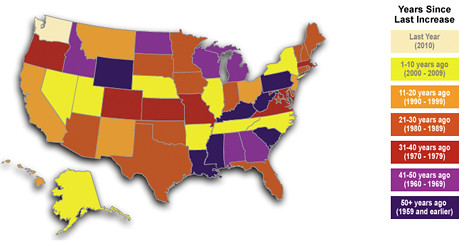
But that’s never stopped them before and it’s not stopping them now, as the latest shot over the bow from my friends at the Marin Institute was a press release today, Twelve States Stuck at Bottom of Beer Tax Barrel. It announces their new interactive map of Neglected and Outdated State Beer Taxes.

Here’s the entirety of the press release:

SAN FRANCISCO, Feb. 16, 2011 /PRNewswire-USNewswire/ — Marin Institute, the alcohol industry watchdog, launched its Neglected & Outdated Beer Taxes Map today. This new interactive tool helps those who want to raise beer tax rates to balance state budgets or erase deficits.

“Just point your cursor at a state and you can see the your current beer tax rate, the year of your last tax increase, and the loss of revenue from inflation,” said Bruce Lee Livingston, Marin Institute executive director and CEO. “We show the twelve states that have hit the bottom of the barrel in beer tax revenues and are the most overdue for an increase.”

The beer tax map quickly reveals states suffering the most from Big Beer’s influence. These are states that have beer taxes stuck at absurdly low rates set as long ago as the 1940s, and even the 1930s. “With almost every state struggling to find new dollars to fund critical programs, policymakers need to stop leaving beer tax revenue on the table,” said Sarah Mart, research and policy manager at Marin Institute.

The web site shows the twelve states with the “worst” beer tax rates in the nation, the “bottom of the beer barrel”: Georgia, Idaho, Kentucky, Louisiana, Michigan, Mississippi, Missouri, North Dakota, Pennsylvania, West Virginia, Wisconsin, and Wyoming. Six states (Kentucky, Louisiana, Mississippi, Pennsylvania, West Virginia, and Wyoming) have not raised their beer tax in 50 years or more.

The worst state is Wyoming, which has the distinction of the lowest tax rate – $0.02 per gallon – set in 1935, during FDR’s first term. Factoring for inflation, the value of Wyoming’s beer tax has decreased 94%. A simple 5 cents per drink increase in the state’s beer tax would yield $7.75 million in new revenue. Considering that Wyoming’s annual budget shortfalls are projected to hit $5 million by 2013, a modest beer tax increase would erase all budget shortfalls in the state, reduce drinking, and increase health and safety a little.

The map shows that in 47 states, the decrease in real value of the beer tax due to inflation ranges from 25 percent to more than 75 percent. “This is such a lose-lose scenario for the states,” added Mart. “States are losing revenue and cutting essential programs, especially those which mitigate alcohol-related harm, while the beer companies reap higher and higher profits. It’s time for states to stop their race to the bottom and raise beer taxes.”

And here’s their colorful map of beer taxes and when they were last raised, minus the interactivity. The interactive version you can see on their website.

mi-beer-taxes-date

But there are so many things wrong with their arguments that it’s hard to know where to begin. So I’ll start by being petty. Look at the first two words of the press release: “SAN FRANCISCO.” The Marin Institute is NOT in San Francisco, but in San Rafael, which is just north of the city in Marin County, hence their name. I’m sure that they used the more familiar San Francisco because nationwide, and especially worldwide, no one’s heard of San Rafael, but I can’t help but ponder that if they can’t even be accurate about where they’re located, what does that say about their commitment to the truth in more substantive issues?

First, let’s assume everything they say is correct (it’s not, but just for the sake of argument). The amounts realized according to their table of the states with the lowest taxes if their state excise taxes were increased by “10 cents a drink” ranges from $15.3 to $333 million, or an average of about $123 million per state. But state deficits are in the billions, with a “b.” The Center on Budget and Policy Priorities estimates around $350 billion. Even if you added up all twelve states, the additional taxes would be less than $1.5 billion, less than half a percent of the total (not a perfect number, but still indicative of the problem). The point is that raising the state excise taxes on alcohol comes no where close to doing anything meaningful about the budget shortfalls facing all but four or five of the states. All it does is punish and weaken one of the few functioning industries in a distressed economy.

Next, let’s talk about the idea that taxes should parallel inflation and be raised to match those levels. If that is indeed a public policy goal, shouldn’t it be applied across the board? If we accept that taxes should be raised every time inflation inches ever higher, then shouldn’t ALL taxes do likewise? Singling out the alcohol industry for such treatment is, again, just punishing one industry because one of their “watchdogs” doesn’t like them, despite all protestations to the contrary. I don’t want my taxes to go up anymore than I suspect you do, but if we need more money as a state, country and society, than I don’t see any other fair way to raise more money. Any scheme that falls disproportionally on any industry is de facto unfair to solve a problem that effects all of society. We should have done away with tax breaks for the rich, but that couldn’t even be talked about, much less implemented. Instead, let’s suggest the heavily regressive taxes on alcohol punish the poor even more than they already do.

The other unanswered question is how high to raise excise taxes and for how long? And while there’s no amount proposed at this time, since they’re merely providing the tools to sow discontent in individual states, I believe that’s because there’s really no amount too high for the anti-alcohol groups. Though unstated, it seems implicit in their rhetoric that no amount is enough and they’ll never be satisfied. I’ve never seen a discussion of what amount they might consider fair enough, or might balance the amount with their ability to stay in business (which is the only way companies could continue to actually pay their taxes). Is there an amount that might satisfy such organizations? If so, I’ve never seen it. Then, if fixing the economy is truly the aim of their proposals, should such taxes only be imposed as a temporary measure until the crisis is over? If you didn’t laugh when you read that, you don’t realize that taxes are almost never repealed, only imposed or increased. What I think this exposes is that this is simply a way to use current circumstances to harm the alcohol companies and make it harder for them to stay in business, falling especially hard on the small brewers.

What’s also conveniently left out of their argument, as always, is the current amount of taxes paid by alcohol producers. There’s more taxes paid on every bottle of beer than any other consumer good save tobacco. Those two products are the only remaining items that pay excise taxes, at both the federal and state level. And while I think most would agree that smoking offers no health benefits, beer (and alcohol more generally) in moderation most definitely does. If you drink one or two beers a day, the odds are you’ll live longer than either a teetotaler or a binge drinker.

I’ve tackled this before, so if you want background on the issue of beer taxes, see Abe Lincoln On Beer & Politics and Here We Go Again: Beer & Taxes.

How much does the brewing industry pay? As of 2008, business and personal taxes accounted for $35,283,148,850, consumption taxes account for another $11,172,946,867; or a total of $46,256,095,717 annually. The total economic impact of the beer industry alone pumps $198,152,918,964 into the national economy each year. And all those figures are not including wine and spirits which would push it significantly higher.

I think Defoe’s quote needs modifying to reflect modern society, adding that few things are more certain than anti-alcohol groups using a recession to further their own narrow agenda of making the alcohol industry pay for their perceived sins. I think I need one of Moonlight Brewing‘s tastiest beers, their black lager, Death & Taxes.

Filed Under: Editorial, News, Politics & Law Tagged With: Press Release, Prohibitionists, Taxes

When Did Valentine’s Day Become A Drinking Holiday?

February 11, 2011 By Jay Brooks

valentines
This just struck me as odd. The now neo-prohibitionist MADD is urging people to give the gift of being a designated driver for Valentine’s Day. I certainly think it’s always a good idea to have a DD, but associating this idea with Valentine’s Day, one of the few remaining non-drinking holidays, seems opportunistic in the way that they incessantly accuse the alcohol companies of exploiting holidays. See, it’s all about the love. Uh, huh.

In fact, it’s so much about the love that they’ve even trademarked the phrases “Give the Gift of a Designated Driver™” and “Tonight, I’m DD”™ lest they fall into the wrong hands. So be careful, if you actually use the phrase “Tonight, I’m DD”™ you may have to send them a quarter.

Filed Under: Beers, Editorial, Politics & Law Tagged With: Holidays, Prohibitionists

American Dietetic Ass’n Toasts Beer For Good Health During American Heart Month

February 10, 2011 By Jay Brooks

eat-right-ada
The Anti-Alcohol wingnuts of the world tend to go apoplectic anytime it’s suggested that alcohol might have any health benefits. It just doesn’t fit their world view. I’ve seen it happen. Oh, some of the comments I’ve gotten. But, of course, myriad studies have shown just that and even our government acknowledged that fact in the recent dietary recommendations. That didn’t stop the wingnuts from a letter writing campaign because they just couldn’t stand the idea of the Fed’s recommendation that it’s safe to drink more than two drinks a day, even on occasion. Oh, the horror! Believe it or not, it’s illegal for beer labels to make health claims, even if they’re true.

So I took great pleasure when I saw the American Dietetic Association today sent out a press release about an article that was published in their ADA Times extolling the benefits of beer, and its numerous nutrition and health benefits for American Heart Month, which is February.

From the press release:

While red wine is often touted as the heart-healthy libation, more evidence is showing beer has a great deal of nutrition and health-promoting qualities as well, according to an article published in the Winter 2011 issue of the American Dietetic Association’s member publication, ADA Times.

“Red wine enjoys a reputation for sophistication and health benefits, but as interest in artisan brewing gains momentum and emerging research reveals unique nutrition properties, beer is finding redemption not only as a classy libation with deep roots in many cultures, but as a beverage with benefits,” writes registered dietitian and ADA Spokesperson Andrea Giancoli.

February is American Heart Month, a time dedicated to raising awareness of the leading cause of death in the U.S. — cardiovascular disease. One in three adults has some form of heart/cardiovascular disease. Many of these deaths and risk factors are preventable and food choices have a big impact on your heart’s health, even if you have other risk factors.

Moderate consumption of any alcoholic beverage, including beer, has been shown to increase HDL cholesterol, lower LDL cholesterol and reduce the risk of blood clotting, Giancoli writes in ADA Times. Moderate alcohol consumption has also been associated with a lower incidence of gallstones, decreased risk of type 2 diabetes and improved cognitive function in older adults.

“Beer specifically has been associated with additional health outcomes, including lowering the risk of kidney stones in men compared to other alcoholic beverages, possibly due to its high water content and diuretic effect,” Giancoli writes. “Compounds in hops may also slow the release of calcium from bone that is implicated in kidney stones. Additionally, beer drinkers seem to have a more protective effect towards greater bone mineral density due to the high content of silicone in beer.”

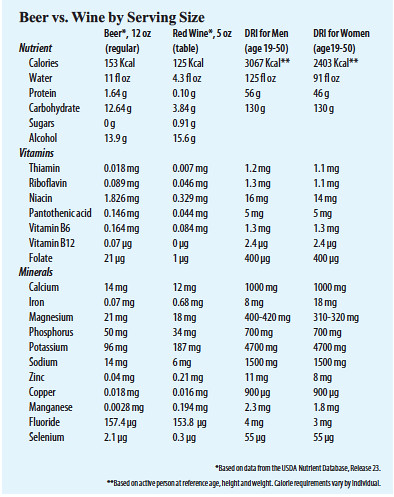
Like wine, beer is fat free. Carbohydrates, which make up about one-third of the calories in beer, mostly come from partially broken down starch. Protein, which is nearly non-existent in wine, is present in small amounts in beer — about 4 percent of the total calories.

Most beers are between 3 percent and 6 percent alcohol by volume, although some beers can contain as much as 10 percent alcohol, “and some are much higher.” Giancoli writes. “Wines are between 12 percent and 14 percent ABV. Because the average beer has a lower ABV and more than two and half times as much water, it contributes to fluid intake more so than wine.”

Although the USDA Nutrient Database lists beer’s fiber content as zero grams recent studies have shown lager contains up to 2 grams of soluble fiber per liter, while dark beers can contain up to 3.5 grams. “Although wine and beer are neck-and-neck when it comes to mineral composition, each providing some potassium, magnesium, phosphorus and fluoride (the latter presumably contributed through the water source), beer is the winner when it comes to selenium and silicon,” Giancoli writes.

Here’s a chart from the article comparing what’s in beer and wine.

beer-vs-wine-nutri

And here’s some more from the article itself:

A recent report from global research group Mintel shows that 33 percent of all beer drinkers in the U.S. are consuming less imported beer because they’re opting for domestic craft beer instead. in addition, nearly 60 percent of beer drinkers say they like to try craft or microbrew beers, and 51 percent would try more if they knew more about them, suggesting consumer education is the key to cultivating growth in the artisan beer market.

And about micronutrients:

Beer Outshines Wine with Many Micronutrients
One 12-ounce regular beer contributes folate, vitamin B6, niacin, pantothenic acid and riboflavin. Beer is also a plant source of vitamin B12, supplying about 3 percent of the recommended daily amount for adults, according to the USDA Nutrient database (although other sources claim higher B12 contents in beer).

So drink a toast to a healthy heart this month. And make sure it’s beer.

Filed Under: Beers, Editorial, News Tagged With: Health & Beer, Science

More On The Possibility Of An ABI / SABMiller Merger

February 9, 2011 By Jay Brooks

abib sabmiller
You’ll no doubt recall the Interwebs were lit up last week with the idea of an Anheuser-Busch InBev merger with SABMiller, which was started by Credit Suisse analysts engaging in speculation. While there were some reports to the contrary, the two mega-beer companies were not in talks.

Yesterday, apparently Credit Suisse followed-up their report by saying, after fueling such a flurry of speculation, that “nobody in our diverse pool of responders indicated that we are off the mark.” They further suggest that ABI “could come knocking” on SABMiller’s door before the end of this year.

As usual, there’s more to it, such as stakes in Grupo Modelo are part of the equation. You can read more about those at Beer Business Daily, which again I heartily recommend that everyone get a subscription to Harry’s newsletter.

Filed Under: Breweries, Editorial, News Tagged With: Anheuser-Busch InBev, Big Brewers, Business, Rumors, SABMiller

Session #48: Bottle, Can, Keg or Cask?

February 4, 2011 By Jay Brooks

beer-bottle-brown beer-can-beer keg cask-firkin
Our 48th Session is hosted by Simon Johnson of the Reluctant Scooper. He’s chosen as his topic the age-old question about which package is best: “Cask, Keg, Can, Bottle?.”

The method of beer dispense often raises the hackles of even the most seasoned beer drinker. Some evangilise about living, breathing cask as being the one true way. Others heartily support the pressurised keg. The humble tinny has its fans. Lovers of bottled beer, either conditioned or pasturised, can be equally voiciferous.

Perhaps you think that one method magnifiies a beer’s impact. Perhaps you won’t try a beer if it’s dispensed in a way you don’t agree with. Perhaps you’ve tried one beer that’s been dispensed every which way.

The question is simple but your answer may not be: Cask, Keg, Can, Bottle: Does dispense matter

session_logo_all_text_200

I’m not necessarily a champion of any one beer delivery system over the rest. It seems to me that each contributes something to the final product, the beer. And while I applaud CAMRA’s efforts, especially early on, they seem to be stuck in the past these days continuing to promote the idea that cask beer is the only beer, whereas many forward-thinking British brewers are making great beer that’s kegged and bottled. I personally feel they should embrace any beer that tastes good and lose their preoccupation with one delivery system. (I have been a member of CAMRA, but my membership is currently lapsed.) I should also say that’s only how CAMRA seems to me from 5,000 miles away, it’s just my perception. I could be totally off base on that.

keg-wooden That being said, I must confess a weakness for cask beer, and generally order a beer on cask or in a firkin if a bar offers one. But that has more to do with wanting to encourage every bar, or at least all the good ones, to keep at least some cask or firkin beer on their menu. That, and cask beer in the U.S. is still uncommon enough that I still get excited when I discover that a new place has some. I suspect if I lived in England where it is far more common, that my choices might be different. Certainly whenever I visit the UK I rarely order beer that’s not on cask, unless it’s something special that’s not available on cask, as is increasingly the case from small artisanal British and Scottish brewers.

I really do love cask beer, especially when comparing the same beer on cask and on keg or bottled. While many people complain about cask beer seeming flat, I think the lack of carbonation allows you to taste more of the flavors of the beer that are often masked by the CO2 in non-cask beer.

keg Which brings us to kegs, which for many, many beers work just fine, as far as I’m confirmed. Certainly nitrogen kegs have a smooth taste as a generality and many regular CO2 kegs have that bubbly carbonation that for some beers works quite well, many lager styles for example seem to me to be improved by the carbonation, which give them a cleanliness of sorts — scrubbing bubbles is how I often think of them.

beer-bottle-brown Bottles, of course, allow us to be able to drink many more beers from around the country and the world because they make it possible for the beer to travel farther and last longer. Of course, clear bottles and green bottles pervert those advantages with new problems, but brown seems to do a pretty good job. I once read that red bottles would actually offer the most UV light protection, but apparently they’re prohibitively expensive for some reason (or perhaps it’s just a matter of little or no demand?). I’ve actually only seen one red bottle, which was a specialty beer I picked up at the Trumer Brauerei in Salzburg, Austria. I’ve also seen white and blue bottles, too, but have no idea how they compare.

Then, of course, there’s bottle-conditioned beers, with live yeast in them that continue to ferment in the bottle. For me, they’re the preferred bottle for many, if not, most styles of beer. Interestingly, the Sierra Nevada Pale Ale in bottles — which is bottle-conditioned — uses a slightly different recipe for their kegged pale ale, and have been experimenting with essentially a keg-conditioned version that they’re hoping will more closely approximate the bottled version.

growler-2 Of course, the question also leaves out the hybrid package: growlers. Growlers are essentially a hand-bottled keg or cask beer that you can take home with you, but you have only a day or two in which to drink it. So it’s not exactly the best of both worlds, but it is a great way to try a draft-only beer in another setting.

beer-can-beer Cans are the wild card, I think. For so long, they were dismissed as a package. Back in the early days, brewers and other beer folk (myself included) hailed the brown beer bottle as the package for craft beer. So convincing was the argument at the time that I think it’s actually slowed the acceptance of craft beer in cans. Because the issues of beer in cans — specifically metal turbidity, which is metal leeching into the beer — have been largely solved. And beyond that, cans have many advantages over bottles. I’ve been involved in several side-by-side tastings of canned vs. kegged beer and the consensus in every case has been that no discernible difference can be detected. Is anyone yet doing a can-conditioned beer?

In the end, yes, I think the package does matter, but not to the point where I’d ever pass on a beer on that basis alone. Ultimately, it’s what the beer tastes like that’s most important. The package may determine that to some extent, and some do a better job with certain beers, but enough certainly seem suited to their primary package for it not to matter. As long as it ends up in my glass, I’m going to drink it, and I’ll probably enjoy it, too.

Filed Under: Beers, Editorial, The Session Tagged With: Bottles, Cans, Cask, Kegs

« Previous Page
Next Page »

Find Something

Northern California Breweries

Please consider purchasing my latest book, California Breweries North, available from Amazon, or ask for it at your local bookstore.

Recent Comments

  • Bob Paolino on Beer Birthday: Grant Johnston
  • Gambrinus on Historic Beer Birthday: A.J. Houghton
  • Ernie Dewing on Historic Beer Birthday: Charles William Bergner 
  • Steve 'Pudgy' De Rose on Historic Beer Birthday: Jacob Schmidt
  • Jay Brooks on Beer Birthday: Bill Owens

Recent Posts

  • Beer In Ads #5164: Spring’s Almost Here … And Everyone Feels Like A Millions Bocks March 14, 2026
  • Historic Beer Birthday: Anthony J. McGowan March 14, 2026
  • Beer In Ads #5163: It’s Here Genuine New Jersey Bock Beer March 14, 2026
  • Beer In Ads #5162: Bock Beer Time Is Here gain March 13-18 March 13, 2026
  • Beer Birthday: Joe Tucker March 13, 2026

BBB Archives

Feedback

Head Quarter
This site is hosted and maintained by H25Q.dev. Any questions or comments for the webmaster can be directed here.