Brookston Beer Bulletin

Jay R. Brooks on Beer

  • Home
  • About
  • Editorial
  • Birthdays
  • Art & Beer

Socialize

  • Dribbble
  • Email
  • Facebook
  • Flickr
  • GitHub
  • Instagram
  • LinkedIn
  • Pinterest
  • RSS
  • Twitter
  • YouTube

Powered by Genesis

Ominous Sign For The Future of Rock Bottom’s Beer

January 7, 2011 By Jay Brooks

rock-bottom
I’d been hearing rumors about how the merger between Gordon Biersch and Rock Bottom was going, and the news wasn’t all good. I’d heard there had been few changes for Gordon Biersch brewers, but that life was getting more difficult for Rock Bottom’s brewers, who were used to having a certain amount of freedom to choose what they brewed. It probably didn’t help that Allen Corey, who had been running Gordon Biersch, became President and CEO of the newly merged company consisting of both brewpub chains, plus a third chain. One chain’s philosophy was bound to be favored over the other.

That all seems to have come to a head, as John Fosyton reports in the Oregonian, the Portland Rock Bottom’s celebrated brewer, Van Havig, has been “asked to leave” the company. Havig had been brewing for Rock Bottom for 16 years and consistently brewed some of the best beer I’ve had at any brewery. Foyston speculates that Havig may have been shown the door for publicly voicing his concerns with the direction the company had been taking since the merger, and primarily the loss of freedom for the brewers, for the first time imposing standardization. That was one of the hallmarks of Rock Bottom, their independence, and was the reason they won so many awards at GABF over the years. That they’re now apparently losing that independence can’t be a good sign for the future of the chain’s beers, if not the chain itself.

But the real loss is Havig. Van’s a terrific brewer and not having him brew for Rock Bottom makes them all the poorer. If you know about a brewing job, preferably in Oregon, drop John Foyston a note and he’ll see that Van gets it.


Filed Under: Beers, Editorial, News Tagged With: Brewpubs, Oregon, Portland

When “The Cure” Is Worse Than The Disease

January 7, 2011 By Jay Brooks

ribbon-pink
This is only tangentially related to beer, so caveat lector — let the reader beware — and concerns some shenanigans by another breast cancer charity again. You may recall last year, a San Francisco-based one, Breast Cancer Action, threw beer under the bus and told the alcohol community they should be ashamed of themselves for raising money for the worthy cause of breast cancer awareness. In my write-up at the time, Biting the Hand That Feeds You, I remarked about a disturbing trend I’d been noting with large charitable organizations.

I’m really starting to believe that there’s now a “charitable industrial complex,” that these behemoth charities have become big business in their own right. And from what some of you have written, and from what I’ve seen, it appears that, like many big corporations, much of the profits go to the people who run them and only a little goes to shareholders, or in this case to the actual charitable cause itself. They seem to have become more about the money than the well-intentioned passion to do something about an issue that led to their formation.

More proof of my growing uneasiness with behemoth charities came to light recently, this time from Susan G. Komen For the Cure. They’ve started sending out cease and desist letters to over a hundred (possibly hundreds of) smaller charities threatening them with lawsuits if they don’t stop using their trademarked “for the cure” phrase in such organizations as “Kites for a Cure, Par for The Cure, Surfing for a Cure and Cupcakes for a Cure.”

Stephen Colbert Show on January 3 mentioned this in his “Tip of the Hat/Wag of My Finger” segment:

The Colbert ReportMon – Thurs 11:30pm / 10:30c
Tip/Wag – Susan G. Komen Foundation & Spider-Man Musical<a>
www.colbertnation.com
Colbert Report Full EpisodesPolitical Humor & Satire Blog</a>March to Keep Fear Alive

Well, the Huffington Post report referenced in the Colbert segment was also sent to me today by Natalie Cilurzo of Russian River Brewing, whose own campaign, All Hopped Up For the Cure, seems destined to get one of these threatening letters, too. After reading Susan G. Komen Foundation Elbows Out Charities Over Use Of The Word ‘Cure’, I think it’s even worse than Colbert’s piece suggested, and that was pretty bad.

The majority of the charities being threatened by Susan G. Komen appear to be small “Mom & Pop” charities with few resources to fight a lawsuit with the big law firms retained by Komen. They’ve apparently been spending a million dollars a year, money they received from donors which ironically did not go toward finding a “cure,” on legal fees alone.

They told one charity that “they own ‘cure’ in a name and we had to stop using it, even though we were raising money for an entirely different cause.” They told another to “never use the color pink in conjunction with their fundraising.” This is what I meant before. This is just bullying, plain and simple. I understand that companies have an affirmative duty to protect what they believe to be their trademarks or brands, but there are ways to do things, and ways not to do things. It’s seems to me that being a bully while at the same time claiming to be a charity could easily be a PR disaster.

What this ends up being about is protecting their own revenue stream, which if they were a “for profit” business would make perfect sense. But when protecting your own revenue stream also means taking money away from other charities, it’s not as black and white any longer, at least not to me. The charitable communities should, I think, be working together toward a common goal, even if they go about it in different ways. Curing cancer should be the only goal that matters, but Komen’s actions seem to show that it’s become more about “who” finds the cure or can muster the most money and resources to shut down their “competition” from using the same effective fund-raising tactics. It’s hard for me to support any charity whose goal seems to be more about the money and power than actually finding a cure.

I don’t care how “legal” their actions are or what side of the law their actions fall on, it still comes across badly. There’s the letter of the law and the spirit of the law. These now behemoth charities used to be about passionately trying to do good work in the world, whether fighting a disease or helping people in need, or what have you. But increasingly they seem no different than any other big business, using their large resources, political clout, etc. to throw their weight around with little regard for their original mission or purpose. As one of the women whose charity’s been targeted, Sue Prom ends the HuffPo article with the following.

“I used to give money to Komen all the time, but now I’m just kind of wary of them,” [Sue Prom] said. “I’m not buying Yoplait yogurt or anything that has the word ‘Komen’ on it. They seem to have forgotten what charity is about.”

Filed Under: Editorial, News Tagged With: Charity

Filling Your Beer From The Bottom

January 4, 2011 By Jay Brooks

bottoms-up-draft
Here’s an odd new innovation (sent in by my friend Mike C.) from GrinOn Industries of Montesano, Washington. They’ve created the Bottoms Up Draft Beer Dispensing System. As they claim, “GrinOn’s proprietary Bottoms Up Dispensing System is the fastest dispensing system in the world and fills at a rate of up to nine times that of traditional beer taps.” Take a look at in action below.

GrinOn lists a litany of benefits to their system, though the most obvious is that it “improves speed-of-service increases customer satisfaction and sales.” I don’t know about the “customer satisfaction” but an increase in sales makes sense in the right setting, such as an environment where long lines make speed a real issue, and one where plastics cups are the only option. It seems ideal for a sports stadium or a fair. The homepage features a video showing two people filling 44 cups of beer in one minute, without even breaking a sweat. There are also a number of additional videos on a separate page.

Below is what the dispenser base looks like.
beer-dispenser-close

They also claim that their system “reduces the stress and cost of ‘foamy beer problems.'” Filling the beer from the bottom does seem like it would produce head in a very different way, though in the video it certainly seems adequate for the type of beer being poured. It also must use a proprietary cup, though the website talks about there being a FDA approved MAG™ — a round magnet — at the bottom of the cup which seals the cup. It apparently can also be used after you drink the beer as a refrigerator magnet, and they even can sell you a customized magnet that can be a souvenir after the fact or otherwise used promotionally.

I can’t see it being used by small breweries or brewpubs, or even most beer bars, but where volume of just a couple of different beers — the big macros and high volume micros seem likeliest — is the key to the business, then it seems like it could be viable. What do you think?

Filed Under: Beers, Editorial, Just For Fun, News Tagged With: Draft Beer, Washington

BA Revises Craft Brewery Definition

January 3, 2011 By Jay Brooks

ba
Surprising no one who’s been paying attention, the Brewers Association today announced the revision of the definition of what it means to be a craft brewery, at least as far as the trade organization is concerned. In order to advocate for any specific group, it’s useful to know who is eligible to be a member. In 1976, Congress arbitrarily chose 2 million barrels for a tax differential and ever since the part of the definition that denoted a “small” brewery has been one making less than 2 million barrels annually.

From the BA press release:

In the BA’s craft brewer definition, the term “small” now refers to any independent brewery that produces up to 6 million barrels of traditional beer. The previous definition capped production at 2 million barrels.

The association cited several reasons for the change, including the recognition that “small” is a descriptive term relative to the overall size of the industry.

“Thirty-four years have passed since the original small brewers tax differential defined small brewers as producing less than 2 million barrels,” said Nick Matt, chair of the Brewers Association board of directors and chairman and CEO of F.X. Matt Brewing Company. “A lot has changed since 1976. The largest brewer in the U.S. has grown from 45 million barrels to 300 million barrels of global beer production.”

Matt added, “The craft brewer definition and bylaws now more accurately reflect and align with our government affairs efforts.” On the legislative front in 2010, the Brewers Association supported H.R. 4278/S. 3339, which sought to update the cap on an excise tax differential for small brewers to 6 million barrels per year in production for their first 2 million barrels.

Retaining Market Share for Craft Brewers

The industry’s largest craft brewer, The Boston Beer Company, is poised to become the first craft brewer to surpass 2 million barrels of traditional beer within the next few years. Loss of The Boston Beer Company’s production in craft brewing industry statistics would inaccurately reflect on the craft brewing industry’s market share.

In addition to Boston Beer, the current growth trajectory of other sizable BA member breweries places them on a course approaching the 2 million barrel threshold in the coming years.

“With this change to the craft brewer definition and BA bylaws, statistics will continue to accurately reflect the 30-year growth of market share for craft brewed beer,” said Matt. “Brewers Association statistics on craft brewers will continue to keep pace with the growth of the industry.”

Craft brewed beer market share is now approximately five percent of the U.S. beer industry, and growing. The BA has a stated mission of helping America’s craft brewers achieve more than five percent market share by 2013.

Matt added, “Rather than removing members due to their success, the craft brewing industry should be celebrating our growth.”

Filed Under: Breweries, Editorial, News, Politics & Law Tagged With: Business, Law, Taxes

Binge Drinking Excuses From The OLCC

December 29, 2010 By Jay Brooks

olcc
Just in time for New Year’s Eve — a.k.a. Amateur Drinking Night — the OLCC has released yet another PSA, this one featuring the message “Binge Drinking Doesn’t Start With A Drink. It Starts With An Excuse.” The video lists four presumably common excuses for drinking too much, though frankly I’ve never heard another living soul say them, not even a variation of them. I’m not saying the excuses aren’t something to avoid — they are — but they don’t seem all that reasonable to me. Perhaps I don’t hang around with enough binge drinkers, despite theoretically being one myself (at least at every five-course or more beer dinner I attend, since the federal definition is absurdly five drinks in a row). As a result, like their other PSAs, it appears well-meaning but unintentionally a little funny. I’m of the opinion that people who want to binge drink don’t need any made-up excuse. They do so for their own reasons, no excuse necessary.

And frankly, this needs to be said. If someone wants to drink a little too much on occasion — such as a holiday celebration — I say they should be able to, provided they don’t drive or otherwise put others at risk. As the saying goes, “Everything in moderation, including moderation.”

Filed Under: Beers, Editorial, Politics & Law Tagged With: Oregon, Video

The United States of Abstinence

December 13, 2010 By Jay Brooks

no-yes
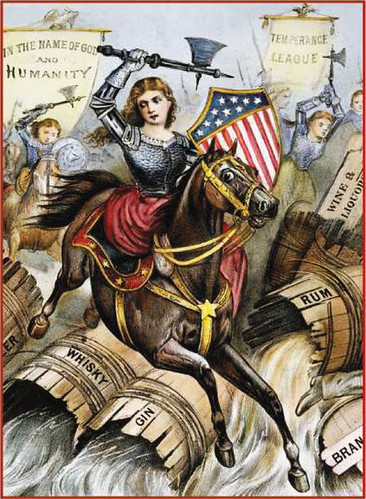
There was yet another interesting piece in his month’s Playboy, an essay toward the back by Jessica Warner, the author of a recent book, All or Nothing: A Short History of Abstinence in America. Her essay, The United States of Abstinence: How Saying No Became A Distinctly American Practice, is definitely worth seeking out, but here’s the salient bits.

She begins by outlining the history of the idea of abstinence itself.

In no place other than America has the idea of abstinence — whether from food, drink, drugs or sex — taken root so deeply. Your federal tax dollars are currently being used to tell kids to put off sex until they enter into a “biblical marriage relationship.” The 1980s gave us Nancy Reagan and her antidrug mantra “Just say no.” A century earlier, Anthony Comstock crusaded to outlaw smut, penny dreadfuls and contraceptives, while Frances Willard led America’s women in a fight against demon rum. There have been so many crusades it is easy to forget that at one time, in the 17th and 18th centuries, abstinence meant only one thing to Americans: no sex until marriage. The idea that people should abstain from all other vices first appeared in the 1830s. What began as a campaign against distilled spirits suddenly morphed into a campaign against all forms of alcohol and then against all other “stimulants” — tea and coffee, pickles and spices, meats and apple pie, fancy clothes and double entendres, narcotics and soft mattresses, and, last but not least, sex with oneself.

She then quickly outlines the early influences of religions, and how different Christian denominations reacted differently to temperance sentiments based on their own interpretations of scripture, and specifically a peculiar idea, or doctrine, known by different names, such as “Christian perfection, sanctification, the second blessing or holiness.” That notion was essentially the “touchstone for abstinence in America.”

That idea leads adherents “to believe [people] can overcome sin in its entirety” and so “Christian perfection and abstinence are mutually reinforcing concepts of extreme behavior.” These manifest themselves into “a declaration of all-out war on sin.”

temperance-rider

Not every denomination feels as strongly, but the stronger that commitment, “the more likely it encourages abstinence.” And in places like Great Britain, for those same reasons the idea of abstinence never caught on in the same way. There, church leaders like John Wesley — of the Methodists — believed their “religion does not lie in doing what God has not enjoined or abstaining from what he hath not forbidden.”

Among modern evangelicals, the Pentecostals have the strongest commitment to Christian perfection and the highest rate of teetotalism, reaching 70 percent. In contrast, Baptist churches vary in their commitment to perfection, and their overall rate of teetotalism, under 55 percent, is correspondingly lower.

And the Baptists, who over the last few years have had their leaders come out very publicly against alcohol, are not all in agreement at any rate.

When the Southern Baptist Convention recently attempted to reaffirm its “total opposition to the manufacturing, advertising, distributing and consuming of alcoholic beverages,” its younger members objected, complaining that the resolution needlessly “draws a line in the sand.” For the modern evangelical, abstinence effectively means one thing only: saying no to sex outside marriage. There is a certain irony in all this, for in drawing the line at the sins of the sexual revolution, modern evangelicals have, quite despite themselves, returned to the status quo ante, that is, to the looser moral code of America before the great evangelical revivals of the 1800s. The interesting question is whether the list of taboos will continue to shrink and, if so, what will be the next thing to go.

To me, that’s a fascinating question as anti-alcohol groups appear to be gaining influence, especially politically, while younger generations seem generally less interested in their rhetoric. I’ll be very interested to read the entire book, All or Nothing: A Short History of Abstinence in America, which I ordered right after I finished the article.

Filed Under: Beers, Editorial, Politics & Law, Related Pleasures Tagged With: History, Law, Prohibitionists

Eliminating Drunk Driving 100%

December 12, 2010 By Jay Brooks

car-transformer
So I was reading through the new issue of Playboy magazine that came last week when I came upon an article entitled 15 Innovations That Will Change the World. Some pretty impressive ideas, but the one that stood out for me was “Robocars,” cars that drive themselves using sophisticated sensors, omni-directional video-cameras, radar detectors and advanced GPS systems.

robocars

But what really surprised me was this. “[A]dvocates say robocars will be ferrying many of us hither and yon by 2020. Most major car companies have an autonomous car division, crafting future driverless cars right now.” Holy crap, we’re only a decade away from robocars! Even with them most likely being too pricey initially for most people, give them another ten years after introduction for the price to come down, and that means a majority of us will be able to afford them. That would mean in just twenty years it’s conceivable few people will be doing their own driving anymore.

That could mean the end of drunk driving, mobile phone distractions and all manner of driver error accidents. It’s somewhat surprising given how much potential there is for robocars to virtually eliminate DUIs that the anti-alcohol groups have been completely silent about them. Instead, MADD is pushing the ridiculous ignition lock technology. Why aren’t they supporting robocars? Why aren’t they and the other non-profits supposedly committed to curbing drunk driving and keeping the roads safer funding research into the technology to make robocars a reality even sooner?

That’s not a rhetorical question, I really want to know why they’re not doing more to support robocar technology. Could it be so cynical a reason as it would make them irrelevant and make it almost impossible for them to raise money? If I’ve learned anything about non-profits lately it’s that they’ve become permanent institutions whose paid employees are actually no longer incentivized to carry out their organization’s mission to its conclusion because doing so would put themselves out of work in the process. When was the last time a disease or societal problem was actually solved and/or eradicated? Polio? Small Pox? Yet there are so many more non-profits compared to thirty plus years ago, when I was a kid. But the only thing they seem effective at is creating scary statistics and propaganda to make whatever the issue is as dire as possible and raising money.

But back to the Robocars, meet Junior:

junior-1
Junior, a self-driving prototype, created using a mostly stock 2006 Volkswagen Passat, which is the same car I drive, though mine’s a few years older and doesn’t include an autopilot, sad to say.

VW is financing the creation of both Junior and his brother Stanley at Stanford’s Volkswagen Automotive Innovation Lab, and the car company is funding VAIL, too. The research center was dedicated last year.

junior-2
Inside the back of Junior.

junior-3
Inside the back seat of Junior.

And below is a video of one of Junior’s test drives.

Frankly, I can’t wait until the day I can stop driving and leave it to the computers. I’ll be able to drink more without having to worry at all, especially about the draconian laws associated with drinking and driving. They should be a thing of the past, though I imagine one or two groups will fight this new technology tooth and nail. Police and local governments will most likely hate this, because it will remove one of their biggest revenue streams. I’m willing to bet they’ll question the “safety” of the robot drivers and try to block their implementation as long as humanly possible.

But apart from that, this seems like it would be the proverbial win-win for everybody else. Brewers along with bars and restaurants that serve it would likely see a dramatic rise in business without the chilling effect of our current laws and lack of viable mass transit alternatives. In theory they could even save money by no longer having to spend marketing dollars on those “drive responsibly” campaigns.

MADD and the other anti-alcohol organizations should be in favor of it because it would literally eliminate drunk driving for everyone who purchases one of the Robocars. Unfortunately, I believe that some of the anti-alcohol folks, and especially MADD, are not really interested in stopping drunk driving, but instead have shifted their focus to eliminating alcohol altogether. Of course, that will also stop drunk driving, too, but at the expense of destroying so much more: the economy, people’s livelihoods, the health advantages of moderate drinking, quality of life and simply enjoying a drink.

But watching the actions and policy decisions of these groups for as long as I have, I honestly think they’d prefer that result to one which would actually eliminate needless deaths while keeping the alcohol industry intact and even benefiting its business. None that I’m aware of have ever done anything to encourage or support alternate modes of transportation such as building mass transit infrastructure as a way of keeping people who’ve been drinking off the roads. Between that and their silence on Robocars it makes it hard not to at least question their true motives. With the very real possibility that drunk driving could be eliminated 100% in just twenty years (or less) it seems reasonable to expect that supporting that technology would at least be part of their policy and/or strategy. That they don’t, I think, speaks volumes. Show me the Robocars!

Filed Under: Beers, Breweries, Editorial, Politics & Law Tagged With: Prohibitionists, Science

Please Help JB Shireman

December 10, 2010 By Jay Brooks

help
My friend and colleague Harry Schuhmacher of the Beer Business Daily wrote yesterday about his feelings for the beer industry:

This industry has been very good to me. I love this industry as if it were a treasured relative: I love it’s idiosyncrasies, I love the product itself, but most of all I love the people. I’ve made so many friendships in this business that I value deeply. This industry, I believe, has the best people of any industry on earth.

And I must agree. That’s how I feel as well. The beer world is a tight knit community, as close to a family as an industry could get. I spent several hours last night reminded of that fact at Anchor Brewery’s annual Christmas party seeing old friends, drinking some great beer and eating some terrific food. We’re there for each other and help out whenever we can. I love that about beer, how it brings people together. I bring this up because there’s a new opportunity for us to help one of our own, someone who really needs our assistance.

Perhaps many of you know JB Shireman, or perhaps you’ve only heard his name, perhaps not. Shireman worked for many years at New Belgium Brewing, and he was a big part of their rapid expansion, traveling extensively to build their distribution networks as they added state after state. Last year, he left New Belgium in order to spend more time raising his son, became a consultant for craft brewers, and also opened a bar, the Bar Double S in Laporte, Colorado.

bar-double-ss

Unfortunately, I learned the following from Harry, who learned it from Bump Williams, a well-known beer business expert with IRI Symphony.

Doctors have discovered a large tumor in JB’s brain. The good news is that the tumor is benign. The bad news is that it will take a very long, complex, and expensive surgery to remove the tumor. JB has only told a close circle of compadres about his situation, and of course he has not asked for any help.

Bump also told Harry about his idea for a fundraiser to help out JB Shireman, and especially the medical costs he and his family are facing. Beer Business Daily posted a letter from Bump Williams, which I reprinted in part below:

I need your help in trying to raise $10,000.00 between December 10th and January 10th (2011) for JB Shireman, a dear friend of the Beer business who has to undergo brain surgery in early January. The surgery is going keep him out of work for a longer period of time than any of us wants, and I’d like to ask for your help in getting him up, on his feet and back to work just as soon as humanly possible. The good news is that the surgeons performing JB’s operation are the best in the business and they all agree that the prognosis is very good for him.

You all know JB and all the work he has done while at New Belgium promoting Beer in general, Craft Beer in particular, Wholesaler training, helping the Retailer understand the dynamics of the Craft consumer and his new work in being Craft-Centric thinkers. We can’t afford to have him out of commission for too long! I expect JB to be laid up and unable to tend to the job he loves most — BEER — for about 8 weeks after his surgery; and that’s a long time for someone like him to be out of commission. You all know JB as well as I do, and you understand the need to get him back up and into the work environment before he goes stir-crazy just laying around in bed recovering and getting his strength back!

I’m asking everyone across this wonderful business who knows JB or who has worked with him for a small contribution to help defray a lot of the medical and recovery costs he is going to inherit after his surgery. I’d also like for you to include JB in your thoughts and prayers for a speedy recovery as he goes through this anxious time. He is a good friend of all ours; he’s a friend of the industry and a great father, too. If the tables were turned around and he knew that one of his friends needed help, he’d be the first person in line to lend a hand.

From December 10, 2010 (JB’s birthday) through January 10, 2011 (post surgery), our goal is to collect $10,000.00 to help JB defray his medical and recuperation costs.

Here is what you need to do if you are able to help:

  1. Please send this note to as many people as you can who might know JB, and let them know of JB’s situation and our fundraiser for him.
  2. Send me a donation to the address below (made out to Mr. John Shireman) before January 10, 2011 and I will deposit it into a separate savings account.
  3. After JB’s surgery, I will have the bank write a cashier’s check made out to JB and then hand-deliver it to him at his home in LaPorte, CO along with a card that bears the name of everyone who was able to make a donation.

Thanks for your consideration, I really appreciate it.

BUMP Williams
900 Beaver Dam Road
Stratford, CT 06614

I can’t begin to tell you how much I appreciate your kindness and help; and you all know JB well enough to know what it will mean to him. Be well, always,

BUMP

I would encourage anyone who knows JB or just wants to help out a worthy cause, to donate and help Bump reach his goal of raising $10,000 by January 10. Let’s help out a friend in need. It just feels like the right thing to do, especially during the holidays when I can think of no better way to celebrate than helping out our fellow man, make that our fellow “beer” man.

Please spread the word.

Filed Under: Editorial, News Tagged With: Charity, Colorado

Wikio Beer Blog Rankings For December

December 6, 2010 By Jay Brooks

wikio
At first I wasn’t sure why I was asked to get a sneak preview of the rankings for beer blogs by Wikio and blog about them, apart from Stan recommending me and Alan, but I got a pleasant surprise when they finally arrived in my inbox. For the category Beer Blogs, which appears to cover North America (or at least the U.S. and Canada), I apparently moved up from #4 last month to claim the top spot for December. I’d be lying if I said it didn’t feel good, especially because I have so much respect for the work done by the majority of the writers in the Top 20, and many of them are personal friends as well as colleagues. Who doesn’t welcome the validation that they’re doing a good job?

The new rankings for Beer Blogs will be released on Wikio this Wednesday, but here’s a sneak peek at the Top 20:

Wikio December Beer Rankings

1Brookston Beer Bulletin (+3)
2Beervana (-1)
3Brewpublic (+/-0)
4Drink With The Wench (+4)
5The New School (+2)
6Appellation Beer: Beer From a Good Home (-4)
7A Good Beer Blog (-1)
8Beer in Baltimore (+2)
9Seen Through a Glass (-4)
10Washington Beer Blog (+8)
11Seattle Beer News (+17)
12The Stone Blog (not in Top 100 in Nov.)
13Beeronomics (-1)
14KC Beer Blog (+2)
15Beer Therapy (+15)
16BetterBeerBlog (-2)
17It’s Pub Night (+3)
18Jack Curtin’s LIQUID DIET (-3)
19Thirsty Pilgrim (+/-0)
20Brouwer’s Cafe (-7)

Ranking made by Wikio

I added the relative movements of each blog from last month. Three blogs dropped off the Top 20, and three new ones appeared, of course, including one that hadn’t been ranked before.

Across the pond, Pete Brown re-captured the top spot in the UK’s beer and wine blog rankings.

I confess I never looked closely before at how the rankings are compiled, but essentially Wikio explains it like so:

The position of a blog in the Wikio ranking depends on the number and weight of the incoming links from other blogs. Our algorithm accords a greater value to links from blogs placed higher up in the ranking.

A blog linking another blog is only counted once a month i.e. if blog A links to blog B 10 times in a given month, it is only counted as having linked to that blog once that month. The weight of any link decreases over time. Also, if a blog always links to the same blog, the weight of these links is decreased.

Only links found in RSS feeds are counted. Blogrolls are not taken into account.

Not everybody seems to put much stock in the rankings, and I think that’s simply because it’s difficult to quantify such subjective notions as quality, authority, influence, knowledge of subject, effectiveness in communication, etc. Plus, they’re just getting started in North America. This is only the third month they’ve been tracking beer blogs here. Jeff Alworth, whose blog Beervana was No. 1 the last two months (and the first two to rank U.S. beer blogs), had a great analysis of the rankings in an October post entitled The Number One Beer Blog in America. And in November, Stan Hieronymus at his Appellation Beer Blog had a lively discussion about How Wikio Ranks the US Beer Blogs which also included some interesting comments.

But how should we be deciding such a complicated question? If not using weighted links from RSS feeds, what should the metric be? And for purposes of discussion, lets set aside what I assume will be the many arguments why we shouldn’t bother at all. What else should be included? Traffic? Should there be a BCS-like poll taken?

Also, I know there are other ways in which rankings are done, such as Alexa (which once you drill down to “beer” is all but useless for our purposes), Google PageRank (mine’s never changed in 6 years), and several where they only track blogs that register, making those ones also pretty useless. And for Twitter there’s WeFollow, which seems to never change. Anybody know of any others?

In the end, I think it’s good fun so long as we don’t take it too seriously. Maybe it makes me work a little harder now that I know I’m being judged against my peers. Doubtful, but it’s still something I’ll continue to at least look at. Like most people — I assume — I’m driven to do a better job all the time, constantly challenging myself to be a better writer, communicator, taster, etc. Comments, Facebook “Likes,” Re-Tweets, traffic, Google analytics and people coming up to me at beer festivals all provide different kinds of feedback about how I’m doing at my chosen profession. Having one more way by which to measure myself can’t be a bad thing. And especially not this month, where I got an early Christmas present. How cool is that? But congratulations to everybody on the list. I know it’s a cliche to say we’re all winners, but in fact I think that’s true. Over the past six years that I’ve been blogging, the number and quality of beer blogging has vastly improved. And that’s a good thing for beer, and for all of us. Happy holidays.

Filed Under: Editorial, Just For Fun, News Tagged With: Awards, Blogging, North America, Websites

Gilbert Arizona Declares Family & Beer Incompatible

December 5, 2010 By Jay Brooks

arizona
Thanks to Rob Fullmer (a.k.a. olllllo) at Beer PHXation for letting me know about this weirdness. Arizona recently relaxed its 2005 law regarding the sampling of beer, wine and spirits in grocery stores. But one town mayor, John Lewis of Gilbert, Arizona, isn’t happy that someone might be able to have an ounce or two of alcohol, especially if he happens to be in the vicinity of that tasting with his children.

According to the Arizona Republic, he thinks having his kids see people even sipping alcohol will have untold consequences and will undo his careful parenting to, presumably, keep his children from ever seeing demon alcohol anywhere throughout their lives. Here’s how the Gilbert mayor put it:

Lewis recently called on local grocers to “withstand the temptation” to offer free taste-testing of beer, wine and spirits at their stores. He said his family frequently shopped at Sam’s Club, for example, and he would not want his children to be in an atmosphere where alcohol could be sipped.

“For the image and preservation of what has been building Gilbert as a family-centered community, I hope we would not approve the sampling privileges in a family environment,” Lewis said.

I love Fullmer’s response in Beer PHXation:

Apparently Lewis, a grown man, finds the task of teaching his children about the responsible and legal enjoyment of alcohol (or the abstention of it for that matter) in the mere presence of adults tasting 1 or 2 ounces — while still maintaining a code of conduct suitable for the likes of a Sam’s Club — capable of erasing years worth of parental upbringing.

Having a family environment and an educational and informative environment for alcohol use are not mutually exclusive, in fact, the family environment IS the proper environment.

Precisely. What exactly is the problem with seeing adults having a simple taste of alcohol in a responsible, legal environment? This is the sort of modeling behavior we should want our kids to see. Lewis is so far off the deep end that he’s not just upset that his kids might actually see people drinking, he’s even bothered by “an atmosphere where alcohol could be sipped.” [my emphasis.] That means just the thought of there being a place where alcohol “could be sipped,” that there’s a possibility it might happen, is enough to worry him. That he could walk past even an empty roped off area, children in tow, is just too much for him to bear.

Not to get too personal, but according to his bio, he’s been married for 29 years, has 8 kids and 4 grandchildren. The likelihood that he even has impressionable little kids to actually walk through the grocery store with seems somewhat unlikely. So what he’s doing is just political grandstanding.

But his suggestion that somehow sampling alcohol is incompatible with family I find most offensive. I have a family. Countless brewers and beer lovers have families and see no contradiction with the two. That’s because there is no contradiction. Adults can enjoy a drink responsibly without damaging their family. People have being doing so for time immemorial. Why is is that some people believe that there is only one way to parent … their way?

When the bill passed the state legislature, only one representative voted against it, republican Andy Biggs, whose district includes — you guessed it — Gilbert. For him, it was all about the doughnuts, to wit:

“I go in with my kids to go get doughnuts at the Safeway,” Biggs said. “It’s one thing to walk through the liquor department to go to the bakery, but it’s something else when you’ve got people there serving alcoholic beverages.”

Seriously, it’s about his freedom to buy doughnuts without seeing alcohol? What exactly is wrong with these people? Why is it “something else,” whatever that even means, if there is beer sampling? I feel confident he could take another route to reach the bakery. But failing that, if it’s such a big deal couldn’t he just buy his doughnuts somewhere else? Nothing against Safeway, but they’re not exactly the gold standard for pastry.

It just feels like, based on their nonsensical comments, that this is personal for both politicians. And they’re using their positions to force their own issues with alcohol on the rest of the people they represent, in a way that feels out of touch with the average person’s opinion. Obviously, it’s hard to know how any community feels about so complex an issue as alcohol, but I feel confident in saying that a majority of people there do at least drink it.

The original impetus for the bill was to give local alcohol manufacturers a chance to compete locally by allowing Arizona beer and wines to be sampled. As you might expect, Todd Bostock, president of the Arizona Wine Growers Association, believes that “most families wouldn’t be offended by in-store sampling because they already consume alcohol at the dinner table in front of their children. The more kids are exposed to responsible drinking, it won’t be a foreign thing to them,” Bostock said. “It’s not taboo.”

It certainly shouldn’t be, and based on the 54-1 vote it would appear most people agree.

Filed Under: Beers, Editorial, Politics & Law Tagged With: Arizona, Law, Prohibitionists

« Previous Page
Next Page »

Find Something

Northern California Breweries

Please consider purchasing my latest book, California Breweries North, available from Amazon, or ask for it at your local bookstore.

Recent Comments

  • Bob Paolino on Beer Birthday: Grant Johnston
  • Gambrinus on Historic Beer Birthday: A.J. Houghton
  • Ernie Dewing on Historic Beer Birthday: Charles William Bergner 
  • Steve 'Pudgy' De Rose on Historic Beer Birthday: Jacob Schmidt
  • Jay Brooks on Beer Birthday: Bill Owens

Recent Posts

  • Historic Beer Birthday: Louis Burger March 15, 2026
  • Beer In Ads #5164: Spring’s Almost Here … And Everyone Feels Like A Millions Bocks March 14, 2026
  • Historic Beer Birthday: Anthony J. McGowan March 14, 2026
  • Beer In Ads #5163: It’s Here Genuine New Jersey Bock Beer March 14, 2026
  • Beer In Ads #5162: Bock Beer Time Is Here gain March 13-18 March 13, 2026

BBB Archives

Feedback

Head Quarter
This site is hosted and maintained by H25Q.dev. Any questions or comments for the webmaster can be directed here.