Brookston Beer Bulletin

Jay R. Brooks on Beer

  • Home
  • About
  • Editorial
  • Birthdays
  • Art & Beer

Socialize

  • Dribbble
  • Email
  • Facebook
  • Flickr
  • GitHub
  • Instagram
  • LinkedIn
  • Pinterest
  • RSS
  • Twitter
  • YouTube

Powered by Genesis

Abe Lincoln on Beer & Politics

October 28, 2008 By Jay Brooks

lincoln-logo
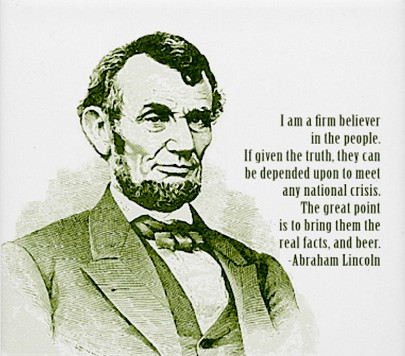
With a week to go before the U.S. Presidential election November 4, I thought I’d share one of my favorite quotes by our 16th President: Abraham Lincoln.

“I am a firm believer in the people. If given the truth, they can be depended upon to meet any national crisis. The great point is to bring them the real facts, and beer.”

          — Abraham Lincoln

Unless I hear otherwise from Bob Skilnik, I’m going to assume this is a quote that Honest Abe actually either uttered or wrote down on the back of an envelope. Though Lincoln is now generally reputed to have been a teetotaler, in his time some accounts do contradict that and say that on occasion he did drink in moderation. “Reliable testimony indicates that Lincoln was a light user of beverage alcohol.”

He was certainly pragmatic enough to understand beer’s importance to the economy, especially when during his first term he turned to the beer industry, among others, to help finance the Civil War. In Brewing Battles, by Amy Mittleman, she details how in July of 1861, the US Congress (or a least what was left of it in the north) levied the first income tax on the remaining states in order to raise money to fight the war with the southern states. By the end of the year, Congress realized it wasn’t enough and they needed a way to raise more funds for the war. In a special session in December 1861, Congress reviewed a request by the Secretary of the Treasury, Salmon P. Chase, to raise the percentage of income tax slightly and levy excise taxes on a number of goods, including beer, distilled spirits, cotton, tobacco, carriages (the automobiles of the day), yachts, pool tables and even playing cards, to name a few. The amendments passed, and Lincoln signed them into law July 1, 1862. They took effect September 1. Several weeks later, the first trade organization of brewers, the United States Brewers Association (USBA), was founded in New York. They held their first national convention in 1863 and elected Frederick Lauer as their first president. Lauer owned a brewery in Reading, Pennsylvania, my home town, and I remember the statue of him in City Park as a child. It was the first statue erected in Reading. But I digress.
lincoln-quote

Excise taxes are a “type of tax charged on goods produced within the country (as opposed to customs duties, charged on goods from outside the country).” The excise taxes were intended to be “temporary” but it was the beginning of temperance sentiments in the nation, and many people objected to alcohol on moral grounds. In the decade following the war, most were rescinded, but the taxes on alcohol and tobacco were the only two to remain in force, and in fact are still in effect today.

The only reason these excise taxes remained after the Civil War was primarily on moral grounds, coming from prohibitionist organizations. And I think that’s still relevant in 2008 because today’s neo-prohibitionists are also trying to use a moral sledgehammer to raise taxes on alcohol in an effort to put beer companies out of business and/or bring about another national prohibition. In state legislatures in many states, neo-prohibitionist groups are trying a variety of tactics to further their agenda. Usually it’s couched in propaganda that pretends they’re concerned for the children, or people’s health or some other hollow claim that hides their true aims.

I still find the argument strange that there should be higher taxes on products some people find morally objectionable. I find soda morally objectionable because it’s so unhealthy that it’s contributing to a nation of obese kids (and adults) — not to mention that beer in moderation is much healthier for you. But I wouldn’t argue pop should have an excise tax. The very concept of a so-called “sin” tax seems antithetical to the separation of church and state. Sin is a religious concept, and should play no role whatsoever in our government. Making people pay a higher price for goods that other people don’t like seems not only a little cruel, but also contrary to freedom of religion, because those are the morals people are using to deny people getting (or making prohibitively expensive) certain goods that not everyone agrees are sins. By using one set of morals as the basis for a particular law (in this case an excise tax) it ignores other sets of morals that differ from the prevailing one. That’s how a theocracy works, and we’re not one yet, despite recent efforts to make religion a central issue in government.

What would Abe Lincoln have thought about all this? Well, first I think he’d be horrified that for the most part the “truth” he felt the people needed to “meet any national crisis” is not much a part of our mainstream media nor of the political process in particular. There are very few “real facts” in play. What there is, is propaganda and the manipulation of quasi-factual information distorted to suit an agenda. All that’s left, really, is the beer.
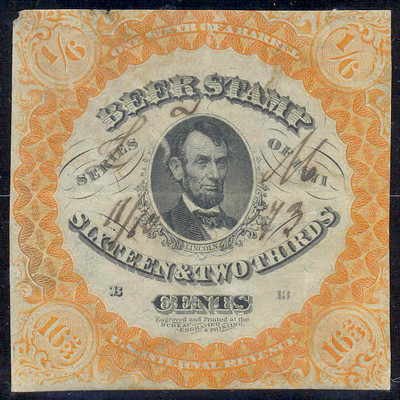
lincoln-beer-stamp

This beer stamp for 16 2/3 cents, to pay the tax on a 1/6 barrel of beer, depicting Abraham Lincoln, is believed to be from 1871.

Filed Under: Beers, Editorial, Politics & Law Tagged With: Prohibitionists, Taxes

Liquidated Liquid Lauded

September 4, 2008 By Jay Brooks

farmhouse-bc
I try not to pick on my fellow beer writers too much, especially as I’m acutely aware of my own imperfections and ability to make mistakes. I’m human, too, just like everyone else. But I make an exception for Todd Haefer, who writes the syndicated column “The Beer Man” for Gannett News Service. He took over for the original — and now Real Beer Man — Jim Lundstrom, when he left his position in 2005. You can read Jim’s account in a comment from a previous post I did about one of Haefer’s articles. I’ve written twice about Haefer spreading information I considered, um … unhelpful … back in the fall of 2006. One was about declaring barrel-aged beer dead and the other trashing Lagunitas’ labels.

Since then, I’ve pretty much ignored him. Whenever I see his byline come up in the wires, I just don’t look at it, figuring it’s not really worth my time. Maybe that’s unfair, but a Bulletin reader sent me his latest missive (thanks Doug) and I see I haven’t been missing much. It’s titled Farewell to Farmhouse Kolsch and sings the praises of a Kolsch brewed at least nine months ago, and probably even longer than that. Farmhouse Brewing was the brainchild of my friend Jeff Moses. He created the brand when he took over as GM of Coast Range Brewing in Gilroy, California several years ago. The Coast Range brand inexplicably didn’t sell well and so he figured a new brand name wouldn’t carry the same baggage. Coast Range’s brewer, Peter Licht, was quite talented and came up with some tasty beers under the Farmhouse label. Farmhouse beers did reasonably well, but it wasn’t enough to stave off the inevitable and Coast Range filed a Chapter 11 Reorganization bankruptcy in December of 2007, shuttering their doors at the same time. Having looked at the filing (I used to be in the bankruptcy business, believe it or not) it did not look good for their eventual successful reorganization owing primarily to some outstanding tax burdens accumulated over the years. Something like only one out of every ten Chapter 11 filings results in a successful reorganization. Most are converted to liquidation bankruptcies, with assets sold off to pay creditors.

Given their dire outlook, I stopped paying attention and right now don’t know where their case is at this point. It’s probably not over yet. These things tend to take a while. But in the meantime, whatever beer had been bottled before (or possibly just after) the filing is, according to the Beer Man, now being sold in Wisconsin, and he’s heard it’s also in Minnesota and New York, too. Undoubtedly, the Trustee got whatever he could for the beer and sold it at fire sale prices, probably cents on the dollar, just to get rid of it and get at least something for creditors.

Haefer speculates about their curious marketing of a Kolsch as a farmhouse ale — dude, there is no marketing for this beer, the company no longer exists. And when there was it was a brand name, a label, they never intended that anyone think all the beers were trying to be authentic farmhouse beers. All of the labels featured a crude folk-style painting of a barn from the area where the style of beer was originally brewed. Nobody was pretending that Kolsch or Porter or IPA was a farmhouse beer in terms of its style.

farmhouse-kolsch

Haefer goes on to give us his tasting notes on the beer, finding no fault with it whatsoever, and expressing his sadness in knowing that “it will no longer be made.” He finishes the article with some helpful hints to guide his readers on how they might find this elusive, all but extinct beer.

Since the brewery is no longer producing, the availability of Farmhouse Kolsch depends on whether local distributors took advantage of the liquidation sale. The brewery’s other beers that may pop up include a porter, saison, pale ale, imperial pale ale and a pilsner. It’s sad to have a beer like this and know it will no longer be made.

Many beers are available only regionally. Check the brewer’s Web site, which often contains information on product availability by mail.

Haefer knows they’re in bankruptcy and no longer brewing. What makes him think someone is updating the website with who’s carrying the liquidated beer outside of their home market? And couldn’t he have checked first? That way he would have discovered for himself that there’s almost no information about their availability on the website.

I guess I’m baffled by why any writer would choose to champion a beer that almost no one reading his work could find and even if they could, would be well past its prime, having been out-of-code for at least five months. Coast Range, like most craft breweries, did not pasteurize their beers, giving them a shelf life of roughly 3-4 months. That it’s so good to the Beer Man’s taste is either a testament to the craftsmanship and longevity of the beer itself, beating the odds and presumably having been handled spectacularly well every step of its long journey from brewery to warehouse to cross-country discount store, or to something else entirely — which decorum prevents me from saying. But I think you can figure it out. Beer man indeed.

Filed Under: Beers, Breweries, Editorial Tagged With: California, Writing

Agreement Reached For InBev Takeover Of Anheuser-Busch

July 13, 2008 By Jay Brooks

Well, folks, it’s all over. The deed is done, indeed. The deal for InBev to acquire Anheuser-Busch has been agreed upon in principle, for nearly $50 billion. It’s not really over, of course, because it still has to wind its way through the federal approval process. But for all intents and purposes, it’s probably just a matter of time now that the two parties have reached an accord.

The Wall Street Journal, Reuters, and the Financial Times are all now reporting that the parties have agreed to a deal. The new entity’s board will contain two A-B people, most likely including August A. Busch IV. Sadly, they decided to ignore my suggestion of calling the new company InBusch and went instead with the relatively boring and far too long name, Anheuser-Busch InBev.


Filed Under: Editorial, Politics & Law Tagged With: Business, Ingredients, International, Malt, National

Session #17: Drinking Anti-Seasonally

July 4, 2008 By Jay Brooks

This is now our 17th Session, and the topic is another thoughtful one, albeit a little rebellious. Our host, Rob DeNunzio, from Pfifft, titled the Session theme Going Against the Grain Bill. In his announcement, Rob described what he means thusly.

Drinking anti-seasonally. Think of this as the unorthodox cousin of such topics as “beer and food” and “beer and music”. Beer and weather, perhaps? More like beer despite the weather, I guess. Cracking open a Guinness on the beach, finishing a day of yardwork with a Speedway Stout, or whatever else you do that raises an eyebrow, do us all a favor an take a few moments to share your non-conformist tale.

Hmm, seasons out of time. Beers out of season. How often do I drink a beer better, or at least traditionally thought to be better, suited to a particular season? All the time. When I reflect on my own drinking patterns, I discover that I give almost no thought to seasonality.

Beer followed the seasons out of necessity for centuries, perhaps millennia, prior to the age of refrigeration and air conditioning. Because it was difficult — or in some cases impossible — to get cool enough temperatures during certain warmer times of the year to brew. So brewing cycles evolved to follow rising and falling temperatures throughout the year and became traditions. As a result, various beers became available only at specific times of the year. These were in effect the first seasonal beers, driven not by marketing, but by the limitations of technology. But this was obviously not a bad thing. Anticipation created excitement and celebrations were held to mark the return of these beers throughout the year. The beers themselves were also well-suited for their time of the season, with heavier stronger beers to warm those hearty cockles and lighter ones to beat the heat of a sweltering summer.

Over a century ago, in 1859 to be exact, refrigeration was invented, and by 1876 the relatively portable refrigerator was created by a German inventor, Carl Paul Gottfried von Linde. He received a U.S. patent for his process on May 12, 1903. But earlier than that, brewers were trying to figure out how to apply the scientific learning commercially to keep their breweries cooler. In 1856, for example, “James Harrison was commissioned by a brewery to build a machine that cooled beer.” That brewers were so far ahead of the technology and in fact were instrumental in providing motivation to solve the cooling problem illustrates just how important they thought it was to the modernization of brewing techniques.

But even after the problem was largely solved, the traditions held sway for decades. Even today, there are many beers which are released only seasonally. Usually this is for marketing reasons rather than technological ones. With only one exception I can think of — fresh hop beers — every known beer style can be brewed year-round. For example, some breweries release a marzen (a.k.a. Oktoberfest) beer in the fall while many others make the style throughout the year.

Christmas or holiday beer, to take another example, are often styles suited to winter but there is no reason they could not be made at any other time of the year. Holiday beers are an interesting example of marketing in modern times. There have been, of course, beers released to celebrate the holidays nearly as long as there have been breweries. But the modern era of Christmas beers undoubtedly begins — as so many new beers inevitably do — with Anchor Brewing. Their Christmas Ale, Our Special Ale, was first released in 1975. As recently as 10-15 years ago, what breweries there were who then made a holiday beer called it a Christmas beer, but a curious thing began happening.

With the exception of Anchor’s Christmas Ale, along with Sierra Nevada’s Celebration and Noche Buena (which Modelo has since stopped importing), holiday beers with the word “Christmas” on the label would literally stop selling on December 26. Like fireworks on July 5 or Halloween candy on the first of November, fickle consumers would shun these beers like they’d suddenly become poisonous. So many breweries removed the word “Christmas” and started referring to them as “holiday” beers or even “winter seasonals” in order to extend their shelf life. And remarkably, it worked. After that, many savvy breweries began having a year-round seasonal program with four or six seasonals — one after the other — such that there was always at least one seasonal beer at any given time. The seasonal segment, as tracked by IRI and Nielsen is now the number one category, even in grocery stores.

But that’s seasonal beers, what about anti-seasonal. At the same time seasonal beers are on the rise, for every seasonal release you could probably find dozens of examples of that same style available from other breweries all year long. So the reality of seasonality is that it’s largely market-driven, any bows to tradition are now mostly coincidental or at best a convenient story to sell the beer. With the original reason that created the traditions of certain beers at specific times of the year gone for a century or more, only the romance of those bygone days remain.

We live in a time when seasonality has lost its meaning, and not just with respect to beer. Any fruit, regardless of its growing season is available at the average supermarket, flown from around the world so that our every whim not go unfulfilled. Let no sales opportunity go to waste. Convenience is king. As consumers we believe that whatever we want should be available whenever we want it, because that’s the bill of goods we’ve been sold. Remember those bothersome watermelon seeds. Gone. Strawberries in the winter? Thank you Guatemala. We don’t like to wait for anything anymore. And usually we don’t have to, because there’s someone willing to sell us whatever we fancy, regardless of the season.

Philosophically, I may not like this fact, but I’m as guilty as anyone. Pandora’s box is wide open and hope is cowering in the corner hoping greed doesn’t beat her to a bloody pulp again. I drink whatever I want, whenever I want. And thanks to air-conditioning, fans and refrigeration, that means any beer, any time. I rarely even think about seasonality when I choose a beer. I rarely even consider the weather, because unless I’m in the woods camping, I can control my environment, at least to some degree.

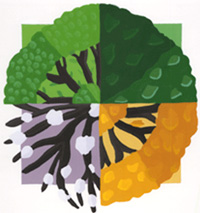
seasons-tree

The only factors I use are mood, food and ‘tude. Food is obvious, I’ll select a beer I think will go with what I’m eating, regardless of the season. If an imperial stout works, so be it. That leaves mood and attitude. They’re similar states, but different in a crucial way. My mood is how I’m feeling at a particular moment in time, whereas my attitude is how I feel toward the people around me, where I’m at, what I’m doing, etc. Mood is inward, attitude is outward.

But put a gun to my head, and the beers I’ll choose time and time again, regardless of the weather, are the complex ones: barley wines, sour beers, saisons and biere de gardes. I’m usually keen to try anything preceded by the designation “Imperial.” But I also love a delicate Mild or a refreshing Dunkelweiss. I like a good unfiltered Zwickel anything, but especially pilsners. The point is, I think, that without realizing it, I haven’t been drinking seasonally for a long time, if indeed I ever did. Do any of us, I wonder? Certainly I’m pleased when new seasonal releases arrive on my doorstep, but mostly because I’m always keen to try something new or different.

Clearly — as usual — my finger is nowhere near the pulse of America. Because lighter beers definitely do experience spikes in sales during the summer and darker, stronger beers sell better in cooler weather. But most sell well enough at all the other times of the year to justify them being on stores shelves year-round. So perhaps it’s simply driven by the bigger beer companies and retailers who create endless promotions based on holidays, backyard barbecues and what they believe people want. Consumers, of course, do react to products on sale, on endcaps or as a part of specific promotions and thus buy those beers at the times of year that they’re offered to them, perhaps putting no more thought into it than I do. Could seasonality be simply a self-fulfilling prophecy perpetuated by marketing? It seems likely, at a minimum. Because for everyone I know who chooses their beer carefully, weather is only occasionally a factor. Only when we can’t control it — at the beach, on the golf course, camping, places like that — are beers chosen because of the prevailing weather. And notice those are specific places, suggesting that may be the more important factor than weather or seasonality. Even as I sit here typing this, I’ve got a nice glass of Anchor Porter next to me, even though the thermometer is tipping 90°. I peered inside the refrigerator, and pulled it out without a moment’s hesitation. It just looked tasty. And so it is.

Filed Under: Beers, Editorial, Related Pleasures, The Session Tagged With: Seasonality

Beer For Easter

March 23, 2008 By Jay Brooks

easter
On St. Patrick’s Day a few years ago I wrote about how many American holidays have been ruined by by overzealous marketing campaigns by the big alcohol companies, suggesting that there were very few not tainted. Well, Easter is one of those that has few beer associations. Less than a couple dozen breweries, most from Europe, make a special beer for Easter.

sailer-jubelfest

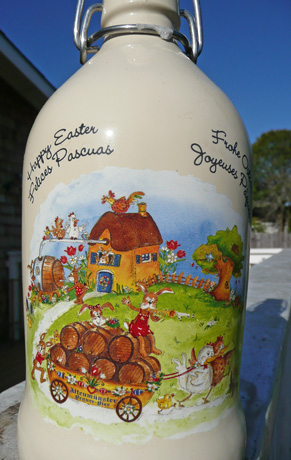
Given our track record for trying to ban labels for Christmas beers because they might also appeal to kids, it’s hardly surprising that so few of these beers make it to our shores. I’m frankly somewhat surprised this old bottle of Jubelfest from the now defunckt Privatbrauerei Franz Joseph Sailer in Germany I pulled off of my shelf managed to get label approval. Those are cartoons of bunnies on the label for chrissakes, children might pick one of these up and — gasp — look at it.

kingtaste08-08

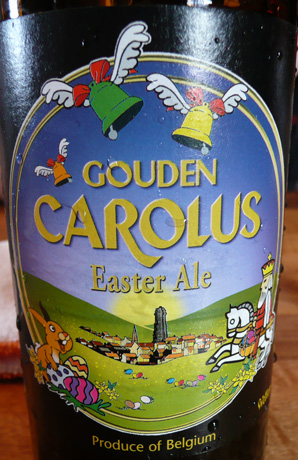
Goudon Carolus Easter Ale, a Belgian beer that I sampled at the annual Keene Tasting in Seattlefive years ago. This one, so far as I know, has not been imported to the U.S. (at least not with this label), and I suspect if they even tried it would make the average neo-prohibitionist’s head spin. You can at least buy the beer in Ontario, but because of the asinine regulation that “graphics that might be appealing to children” are forbidden, with a censorship sticker covering the bunny in the lower left-hand corner. You can read all about it by Greg Clow from Toronto’s beer, beats & bites post entitled LCBO: Let’s Censor Bunnies, OK? . I guess there’s some consolation in knowing we’re not the only idiots when it comes to these things.

Filed Under: Beers, Editorial, Just For Fun, Politics & Law Tagged With: Holidays

Pride Goeth Before A Fall

March 18, 2008 By Jay Brooks

The full quote from Proverbs 16:18, at least in the King James’ version, is “Pride goeth before destruction, and an haughty spirit before a fall” but the more common shortened version says it all. Essentially, the modern meaning of this proverb is not to be overly confident, especially in yourself, or you’re likely to have something bad happen to put you back in your place. If you allow yourself to become full of pride, you will find yourself humiliated. Be modest, that’s good advice to remember. It’s what happened to me on Sunday, and I offer up my cautionary tale by way of illustration.

I’ve done my fair share of prolonged drinking over the years, and rarely have I not been able to muddle through to the end. We (and by we I mean those of us who have been regularly attending GABF for many years) generally say about the Great American Beer Festival—by way of advice—that it’s a marathon, not a sprint to suggest that pacing is very important to a full enjoyment of the week’s events. So when I was invited to the 4th annual Keene Tasting on Sunday, the day after the Hard Liver Barleywine Fest at Brouwer’s Cafe, it simply never occurred to me that I wouldn’t be still standing after twelve hours and 150 beers. Alas, my body had other plans for me.

At 11:00 a.m., with our first beer of the day. Things went fine through the first 50 beers or so, when suddenly and quite unexpectedly I felt cold shivers shoot through my body. Initially undaunted, I assumed that the open windows letting in the fresh Seattle air had simply chilled the room so I put on my jacket and resumed tasting. But after another half-hour of involuntarily shivering it became obvious that all was not well and my body had decided to pitch a fit. I felt fine, apart from the chills, and struggled through until we almost reached the half-way point, 75 beers, and it was time for another break. I hunkered down in a comfy chair during the break and tried to will myself to warm up, but it did no good. When tasting resumed, I stayed put figuring I should not ignore my body’s tantrum, and still hoped it was just a temporary thing and my recovery was minutes away. A few kind souls asked if I was okay (perhaps I looked as bad as I felt) and I nodded and muttered that I was fine. But as more time passed and I was feeling worse, I decided to spare myself further humiliation and called in the evacuation troops — my wife — to come and collect me. About an hour later I was standing out front shivering in the cold and waiting for her arrival to whisk me to safety and nurse me back to health. This proved trickier than I might have imagined. Whether my weekend drinking had finally lowered my immune system to the point where I got the flu that’s been circulating in my friends and family for weeks or I simply drank too much, too fast, I can’t really say. All I know is that my chills turned to heat as I burned off a fever so bright that my wife said my skin was hot to the touch like an old-fashioned radiator and that she couldn’t even lie near me because I was radiating so much heat. By morning I only felt lousy, a distinct improvement. But that was nothing compared to the disappointment at not finishing the tasting. Perhaps I was at least a source of amusement for those I left behind, as I heard Bonney calling my name from the window above me as I waited for my ride. I called up, but I don’t think he heard me. C’est la vie. There’s always next year.


Our hosts, Vern and Bonney, the two Matts, during a toast to Michael Jackson’s memory with the beer made by Pike Brewing for the Michael Jackson Tribute dinner held the night before in Philadelphia. The first half of the tasting I enjoyed immensely, right up to the point where I had to leave or die.

For many more photos from at least the first half of the Keene Tasting, including some bottle shots of the beers sampled, visit the photo gallery.

Filed Under: Beers, Editorial, Just For Fun Tagged With: Personal, Photo Gallery, Seattle, Tasting, Washington

St. Patrick’s Day: Another Holiday Ruined By America

March 17, 2008 By Jay Brooks

Happy St. Patrick’s Day everyone. Enjoy your pint of Guinness, or Murphy’s, or Beamish, or whatever. In Ireland, they’ll be sitting down to a traditional family dinner, which while it may include a dry Irish stout, is not all about the drinking. But here in the United States, the supposed melting pot, we take everybody’s holidays and run them through the cultural meat grinder. When they come out on the other end they’re invariably bigger, glossier, brighter and most people probably think more fun, if your idea of fun is to drink yourself silly every time you have an extra day off. But whatever solemn purpose or commemoration or event is being celebrated it is all but completely erased and what remains is fun, fun, fun. Now I like fun as much as the next guy. I’m a curmudgeon, certainly, but I still like to have fun. But we’re talking about days set aside so that we don’t forget our heritage, the often selfless sacrifices people have made on our behalf or the celebration of religious traditions. And how do we treat those days, almost without exception? We drink. And not just a toast. We drink to excess. We drink until the streets run pink or brown or yellow or whatever with vomit. Of course, we do this to our own holidays, too. Unfortunately, I see this as fairly recent trend. I remember when Memorial Day wasn’t just an excuse to have a picnic or barbecue and drink. I remember when Halloween was just for children and not the biggest keg sales weekend of the year (which it actually is now).

Now I enjoy a party, a picnic, a barbecue as much as the next guy. Any excuse to get together with friends and family is a welcome event. That’s not what I object to. My objection is twofold. First there’s the general over-commercialization of holidays. Second, there’s the way in which the big breweries, mass market imports along with the wine and spirits industries have seized upon each and every holiday as a way to sell more booze. And, of course, I’m not anti-alcohol. I hope that goes without saying but just in case, feel free to read more of what I’ve written before and you should quickly realize that I don’t like the neo-prohibitionists as much as they no doubt dislike me.

As to the first point, the over-commercialization of holidays, I’m going to take it for granted that most people will agree that this has happened. It’s hard to miss that whatever commercial aspects are inherent in a given holiday, they have been wildly exploited and expanded upon. A stroll through the average card shop should be more than enough to drive this home. If not, then how about that stores start decorating for Christmas in October now, sometimes even earlier. Anyway, I don’t want to belabor this point too much because I think most people will accept it and my second point is, I think, more novel.

Before I dive into this further, a little more background is probably in order. I’m also something of a calendar geek and have an almanac blog, too. I started collecting dates about thirty years ago when I picked up a book on mixed drink recipes that had an appendix with a reason to celebrate and have a drink each and every day of the year. That got me thinking and I started keeping a notebook where I’d write down new holidays, famous birthdays and historical events I happened upon. As a result, I may be more sensitive to holidays than the typical person, if such a thing is possible.

Anyway, it seems to me what was once a solemn religious holiday celebrating the patron saint of Ireland on the date he was believed to have died, March 17, 461 C.E., has been perverted into a way to sell more Guinness and all manner of other Irish doo-dads. Several years ago, Guinness gave away an actual pub in Ireland to a winner in America. They did this for a few years running. What happened to the pub and the pub owners once they were out of the spotlight wasn’t always pretty and I suspect that’s why they stopped. Then there was the yearly attempts to break the world’s record — from the Guinness Book of World Records, naturally — for the largest number of people simultaneously toasting, which was accomplished with some elaborate coordination. I’m not even sure what they’re doing these days, since the parent company Diageo has had them off in bizarre directions which have not done the beer itself any favors, and I’ve pretty much given up on them as a brewery. They still seem to enjoy a good reputation, even among beer geeks. Of course, the stuff available here is brewed in Canada. That’s done so they can still put “imported” on the label. It’s a common trick. Foster’s does the same thing, as do a few other larger import beers. There are around 19 or 20 different Guinness beers worldwide, of course, and at least four different ones are sold here. The beer in the widget can, widget bottle (an abomination in my opinion), regular bottle and in kegs are not the same beer; I mean they’re not even the same recipe. I’m not saying there’s anything necessarily wrong with that. They’re fairly up front about it though still, I doubt most people are actually aware of it. So when somebody says they like Guinness, I have to wonder which one? I think it says a lot about peoples’ palates that so few realize they’re drinking completely different beers when they order a can or bottle of Guinness.

To be fair, St. Patrick’s Day isn’t the most egregious of these holidays by a long shot. At least dry Irish stout, which is what Guinness and most other Irish-made stouts are, is actually originally from Ireland. Many other non-Irish beer also advertise themselves for St. Patrick’s Day in about as shameless a fashion as one could imagine. Last weekend, while in Philadelphia, I witnessed part of their annual parade for St. Patrick’s Day. There were the requisite social organizations marching in their green colors, bands, floats for Irish bars and bagpipers. Oddly, one float was blasting the song 500 Miles by the Proclaimers. It’s a catchy little tune, but the band is Scottish, not Irish. To me, that’s a perfect illustration of how little we all know about our shared heritages. Nobody else seemed to notice they were celebrating Irish culture with a song from Scotland, least of all the people on the float who chose the music.

For most of its history, the holiday was a relatively quiet affair in Ireland, a time for family, church and reflection. There were shamrocks and other greenery, but it was mostly for the tourists who flocked to Dublin and other parts of the Emerald Isle.

Sadly, this may no longer be true in Ireland. In 1996, the government of Ireland began what has become a five-day celebration in Dublin known as the Official St. Patrick’s Festival, which this year began on the 13th and concludes today. The stated goal of the festival is the following.


  1. Offer a national festival that ranks amongst all of the greatest celebration in the world
  2. Create energy and excitement throughout Ireland via innovation, creativity, grassroots involvement, and marketing activity
  3. Provide the opportunity and motivation for people of Irish descent (and those who sometimes wish they were Irish) to attend and join in the imaginative and expressive celebrations
  4. Project, internationally, an accurate image of Ireland as a creative, professional and sophisticated country with wide appeal, as we approach the new Millennium.


That’s certainly a modern approach to raising revenues for the country through tourism but it feels a bit like a sell-out. Given that the Irish have been shedding their own blood over religion for centuries, it seems odd to me that they’d so cavalierly commercialize their national holiday. But perhaps the momentum was too great and they decided to go with it rather than fight a losing battle. America has a way of ruining almost everything it touches, remaking it our own image of bigger, glitzier and with an eye toward profit, always profit. But when profit is the prime motivator, the meaning of the traditions that binds a people become lost. No matter how rich we might become, nothing can rival the social connections that make us a society rather then a group of self-serving individuals who care nothing for their fellow man.

Happy St. Patrick’s Day! Enjoy it with friends and family.
 

Filed Under: Editorial, Events, News

Losing Their Share of Mind

February 9, 2008 By Jay Brooks

trkanim
Anheuser-Busch’s “100% share of mind” program is legendary. It started ten years ago, when A-B began offering incentives to their distributors so they’d care only about A-B products. Though I assume they never said so — wink, wink — they encouraged distributors to drop non-A-B brands and concentrate on only the important brands. And at that time, such was A-B’s market strength that many distributors did in fact tow the line. But lately as domestic sales have been static or slipping, distributors are adding non-Bud brands to their portfolios to stay at the same level of profitability. The Associated Press had an article last week about this recent phenomenon called Beer Distributors Want More Than One Best Bud.

As the article points out:

For consumers, it means greater choice at their local bars and liquor stores. Wall Street analysts say the movement signals a weakening of the St. Louis brewer’s clout in the marketplace, as small-batch “craft” beers and imports, as well as wine and spirits, wrest market share from mass-market brews like Budweiser.

Many of the 560 nationwide A-B distributors realized that as craft beer is increasingly in demand, that their competitors were having the last laugh, because they were free to pick up whatever brands they wanted and believed they could be successful selling.

While IRI general manager Bump Williams described the program as a “great business model,” not everybody was convinced that it was fair. The DOJ launched an investigation into anti-trust violations, but later abandoned it. Naturally, A-B continues to push the program with such statements as “[w]e want their efforts and focus aligned with ours.” Well, who wouldn’t? But that isn’t how the world works nor is it how it should work. It’s schemes like this one that gave A-B its reputation as a bully. And it appears that they still have that mindset. Again, from the AP article.

Still, Anheuser wasn’t happy with the way it learned of the Tennessee distributors’ decision. “We found out later (in their decision-making process) than we would have liked,” says Mr. Peacock. “When we don’t get early communication, it rubs us wrong.”

Now why would one business be rubbed the wrong way if another, supposedly separate and independent company, didn’t consult with them before making a business decision? The best illustration of this mindset comes from more than a decade ago, with the former head of A-B, August Busch III, sitting around a conference table at their Hawaiian distributor petulantly throwing bottles of craft beer against the wall, smashing them to bits, to show his displeasure with a separate business having the unmitigated gall to sell something he can’t profit from. It’s that arrogance, borne of being the market leader for such a long time, that leads a company to believe that whatever is in their best interest is in everyone else’s best interests, too.

But as the market changes, that’s becoming less and less tenable. Distributors are realizing that to remain successful, they have to stock brands that their customers want, regardless of who makes them. That only makes good business sense. Some industry analysts, like my friend Harry Schuhmacher who runs Beer Business Daily, are surprised that it has taken so long for this to begin happening. As he puts it. “It really hasn’t been a widespread national jailbreak.” But that’s the hold that A-B has traditionally had over its distributors. Now that it’s finally beginning to erode, it will be interesting to see what percentage share of mind Bud is left with.

Filed Under: Breweries, Editorial, News, Politics & Law Tagged With: Anheuser-Busch, Beer Distributors, Big Brewers, Business

Hacked

January 30, 2008 By Jay Brooks

If you did a search for the Bulletin lately, using Google or Yahoo, or any of the common search engines, clicking on the results would take you to a Web Pharmaceutical company. A big thanks to Keith Brainard, who first brought this to my attention almost two weeks ago. After determining that someone had hacked into my website and inserted an insidious script, we tried to remove it, but it kept coming back. It turns out that there was some even more pernicious code that kept re-inserting the script every time you removed it. Today we thought we finally solved it and I upgraded my software to — hopefully — make it more secure and make sure this doesn’t happen again but the code instead ended up bringing down the website for the better part of today. Obviously, we’re back up again but missing everything I’ve written since January 25. And I still have to try upgrading the software again. Hopefully, things will be back to normal in a day or two. Thanks for your patience.


Filed Under: Editorial, Just For Fun Tagged With: Southern States, Strange But True

Here Comes the Stagecoach

January 28, 2008 By Jay Brooks

It seems like there’s been a number of brewers taking the next bog step into packaging, and the latest one comes from Mantorville, Minnesota, a small town southeast of Minneapolis and not to far from the border of Iowa. Mantorville Brewing was founded in 1995 and, according to a story in their local Post-Bulletin, has had a difficult road to production. But now the Stagecoach Amber Ale, named for stagecoach stop that is a part of the small town’s history, has started to be delivered to local retailers throughout the area.


Filed Under: Editorial Tagged With: Business, Statistics

« Previous Page
Next Page »

Find Something

Northern California Breweries

Please consider purchasing my latest book, California Breweries North, available from Amazon, or ask for it at your local bookstore.

Recent Comments

  • Bob Paolino on Beer Birthday: Grant Johnston
  • Gambrinus on Historic Beer Birthday: A.J. Houghton
  • Ernie Dewing on Historic Beer Birthday: Charles William Bergner 
  • Steve 'Pudgy' De Rose on Historic Beer Birthday: Jacob Schmidt
  • Jay Brooks on Beer Birthday: Bill Owens

Recent Posts

  • Beer Birthday: Dave Alexander May 8, 2026
  • Historic Beer Birthday: Emil Christian Hansen May 8, 2026
  • Beer In Ads #5244: Southern Brewing Bock Beer May 7, 2026
  • Historic Beer Birthday: Anton Dreher May 7, 2026
  • Beer In Ads #5243: Union Brewery Bock Beer! May 6, 2026

BBB Archives

Feedback

Head Quarter
This site is hosted and maintained by H25Q.dev. Any questions or comments for the webmaster can be directed here.