Brookston Beer Bulletin

Jay R. Brooks on Beer

  • Home
  • About
  • Editorial
  • Birthdays
  • Art & Beer

Socialize

  • Dribbble
  • Email
  • Facebook
  • Flickr
  • GitHub
  • Instagram
  • LinkedIn
  • Pinterest
  • RSS
  • Twitter
  • YouTube

Powered by Genesis

Trash Talking Prop 26

September 8, 2010 By Jay Brooks

yes-on-26
This is a great example of what I hate about anti-alcohol organizations and the Marin Institute in particular. Given that they’re trying to impose a new tax on alcohol in San Francisco using a mechanism that came about through case law (the Sinclair decision) where calling what would otherwise be a tax a “fee” allows them to circumvent the normal two-thirds vote needed for a new tax, it’s no surprise that they’re against one of the propositions on the November ballot — namely Prop 26. That’s because Prop 26 seeks to do away with the Sinclair loophole where taxes masquerading as a fee will no longer require a simple majority, but will instead need two-thirds to pass, just like every other tax. That would be a big blow to their efforts to get more taxes imposed in other communities in California. So it’s entirely natural that they’d oppose it. I’d have been surprised to hear any other scenario.

But here’s what I didn’t, but perhaps should have, expected: the low down dirty politics and propaganda by which their opposition has taken shape. In an e-mail blast today, the Marin Institute is blaming “big alcohol” for the proposition and acting as if it’s happening in a vacuum, with no responsibility on their part. It’s shameless spin and as ugly a piece of propaganda as I’ve seen. If I’d had a beer in mouth when I was reading it, I most likely would have spit it out in surprise on more than one occasion.

First of all, they characterize the proposition as one which would “essentially absolve companies that pollute, or otherwise cause harm to the public, from paying for that harm by subjecting fees to the same impossible two-thirds vote that taxes must garner to be enacted.” Horseshit. What the proposition does is subject all taxes to the same standard, in effect closing the loophole that Sinclair opened. Calling them “fees” to get around the 2/3 standard was simply a way to circumvent the state tax law.

A stated by the Yes on 26 advocates:

State and local politicians have been using a loophole in the law to raise taxes by disguising them as “fees” — costing consumers billions of dollars in higher costs for goods like food, gas, and cell phones. Prop. 26 requires politicians to meet the same Constitutional requirement to pass these Hidden Taxes as to pass other taxes — with a two-thirds vote of the Legislature at the state level, and with a vote of the people at the local level.

Next the Marin Institutes note “a review of the Yes on Prop 26 website shows Big Alcohol’s fingerprints all over the measure.” By “all over,” of course, they mean are supporting it and/or have donated money to support it. They go on to add that “August saw an infusion of $800,000 to the Prop 26 campaign by the Small Business Action Committee (SBA). According to an article in Capitol Weekly, the SBA “revealed that it received more than $1 million from alcohol, tobacco and real estate groups. Altria, the parent company of Philip Morris USA, donated $500,000. Anheuser-Busch, which brews Budweiser, gave $200,000 and the Wine Institute chipped in another $50,000.”

Hmm, in August there was infusion of donations to support Prop 26? What might have triggered that? What is the Marin Institute not telling you? July and August is when every company who makes alcohol, distributes alcohol and sells and serves alcohol realized they were under attack by the Marin Institute, who was pushing Avalos and supplying him him with all the resources for the test case to add a new tax to alcohol in San Francisco. That’s when most us even became aware of Prop 26. Before that, I’d wager, hardly anyone in the alcohol industry had paid it much attention. When you’re being attacked, you tend to defend yourself.

But the Marin Institute also makes it sound as if “Big Alcohol” and “Big Oil” are behind Prop 26. They’re not. The proposition was sponsored by the California Chamber of Commerce and the California Taxpayers’ Association, not exactly radical organizations out to cheat the public the way the Marin Institute spins it. While the Marin Institute focuses on beer and wine companies, there are over 100 organizations who support the proposition, including nearly sixty chambers of commerce and tax organizations. The rest are primarily trade organizations from a wide range of businesses and industries. That alcohol companies seem over-represented is a direct result of the actions of the Marin Institute. So having caused this situation, using it in propaganda against the proposition without acknowledging it seems pretty shiftless to me.

But it’s their conclusion that has me sighing in exhausted frustration. “Instead of spending all that money to get out of paying for the harm its products cause, perhaps Big Alcohol could instead just pay its fair share to offset massive societal costs.” I’m so tired of this mantra of theirs. First of all, the harm isn’t caused by the products — alcohol — but by individual abusers, people who should take responsibility for their actions. And the vast majority of drinkers do not abuse it. Second, every good or service sold in the world has the potential to cost society something, and most in fact do. But the idea that only alcohol has to “pay” the costs that abusers cost society is maddening. Guns, red meat, high fructose corn syrup, oil, cars, fast food, and every freaking other thing gets a pass; economists even have a word for it — externalities. But the insistence that alcohol has to pay for the bad decisions by individual abusers just rankles, especially when that’s characterized as its “fair share.” Either everything — every company, every product, etc. — pays the individual costs to society that can somehow be ascribed to them or no one does. There’s nothing fair about making one pay while everyone else gets a pass.

Filed Under: Editorial, News, Politics & Law Tagged With: California, Prohibitionists

Drinking Less, Hurting More

September 8, 2010 By Jay Brooks

up-and-down
British beer writer Phil Mellows, who also specializes in alcohol policy, had an interesting observation in a recent post, Alcohol Consumption Down, Alcohol Harm Up. In his native England, as is happening here, overall alcohol consumption has been on a slow but steady decline for a number of years. The problems associated with alcohol abuse, however, have not. Yet the policies here and there are based on the anti-alcohol organizations and “the medical profession who say that to reduce alcohol harm we have to reduce overall consumption, [which is] the logic behind raising the price of alcohol and restricting its availability.” That’s also one of the reasons that these same people keep trying to impose more and more taxes on alcohol. Yet it’s not working. It’s never worked. Phil concludes by trying to make sense of it.

Rather than trying to get the whole population to drink less (which they are, in any case, already doing), alcohol policy should be focused on the growing minority of people, more stressed even than [the prime minister], who are quietly drinking themselves to death out of despair.

And that’s been the problem with alcohol policy here, too. They keep trying to punish the industry and the majority of people who drink it responsibly in order to stop the problem drinkers. It doesn’t work. It’s never worked. It ignores the underlying causes of alcohol abuse. The people who don’t abuse it and in fact enjoy it in moderation — which is a healthy choice — are the ones who pay the price. It’s frustrating. It’s ineffective. It ignores the real problems and punishes the innocent, not to mention it may damage one of the few healthy industries in the economy. But it keeps on happening. Someone has to say enough. I’m happy to start. Enough, already.

Filed Under: Beers, Editorial, Politics & Law Tagged With: Prohibitionists, UK

San Francisco Votes on Alcohol Tax

September 7, 2010 By Jay Brooks

no-beer-tax
For the second time, San Francisco supervisor John Avalos has gone back on his word. As the sponsor of the the new proposed tax on all alcohol sold in San Francisco ordinance, he first told the Small Business Commission that he would delay a hearing on the tax in mid-July. But because of Proposition 26 on the ballet having the potential to do away with the type of tax masquerading as a fee that he’s proposing, he changed his mind and went forward with the hearing anyway. Later, in late August, it looked like it was all but inevitable that he would send it back into committee for more review due to overwhelming opposition by the business community. Well that didn’t last long either, and he changed his mind again and later today, at 2:00 p.m., the San Francisco Board of Supervisors will vote on the new tax. It’s likely that it will get the required six votes to pass and at that point will be voted on a second time at another board meeting on September 14.

It will then go to mayor Gavin Newsom, who has ten days to either sign or veto it. The mayor is on the record saying he’ll veto it, at which point it will be sent back to the Board of Supervisors who can override Newsom’s veto with eight votes. That would most likely be in early October. Why Avalos keeps saying one thing and doing another is pure politics, of course. The strategy now is that “he wants to push for a veto override.” The likeliest reason is that someone — perhaps the Marin institute? — has whispered in his ear that they can flip two supervisors and get him the two additional votes he needs to override the anticipated mayoral veto. The Marin Institute has begun marshaling their base to contact the politicians against the alcohol tax in a web alert. Obviously, that works both ways and I’d suggest that if you’re against the new tax, you should contact them and ask them to continue to oppose it.

If you’re in the city today and want to oppose this tax, please consider attending the meeting and voicing your opposition. I’ll have more on this later on today, but wanted to get this out as soon as possible.

UPDATE: Today’s vote has been canceled due to some sort of mix-up with the clerks office. It has now been rescheduled for next Tuesday, September 14.

Filed Under: Beers, Breweries, Editorial, Events, News, Politics & Law Tagged With: California, Prohibitionists, San Francisco

KQED Debates SF Alcohol Tax

August 31, 2010 By Jay Brooks

kqed-forum
On KQED Radio this morning on the local show Forum with Michael Krasney held a defacto debate on the proposed Alcohol Mitigation Fee between San Francisco Brewers Guild president Rich Higgins and city supervisor John Avalos, who introduced the ordinance to tax alcohol sold in San Francisco. Rich held his own as best he could, but Avalos is a seasoned politician more used to dodging questions and spinning data his way. Plus, it seemed to me most of the callers were sympathetic to him and hostile to Rich, though most seemed more than a little uninformed (thanks local media). Same deal on the show’s web page, New Alcohol Fee for San Francisco?, where one commenter went so far as to call Rich unprepared because he didn’t know how to remedy the city’s financial problems, as if that’s his job. Unbelievable.

Perhaps most annoying was Michele Simon’s call. She’s an attorney and holds the position of Research & Policy Director for the Marin Institute, the organization that’s largely responsible for the proposed “fee” ordinance. She called to make it clear that their target was the big foreign alcohol companies and that she, too, likes beer or wine now and again so therefore the Marin Institute is not a neo-prohibitionist group, as she added that many of their critics have resorted to name-calling. Was she going for sympathy that anyone might have the temerity to be critical toward the organization? I call the Marin Institute a neo-prohibitionist because I sincerely believe that’s what they are, not because I’m on the playground in 5th grade. [Ms. Simon, in a comment (see below) also agrees that name-calling is a tired strategy. I would, however, counter that proper labeling of the character of any organization is useful, and even sometimes critical, to knowing their intentions. When I say the Marin Institute is a neo-prohibitionist group I do so not to simply lob a pejorative at them, but instead to characterize them as I indeed view them.]

Of course, their policies are what leads me to that conclusion. I know they keep saying they’re not anti-alcohol — and maybe they even believe it — but what they actually do is contrary to that. Actions speak louder than words. If it quacks like a duck, guess what it is? They may claim to be against just big alcohol, but their actions harm the small family breweries, wineries and distilleries far more than they ever hurt the big foreign corporations.

And they know it, too. Back when they were going after Alcopops, the big companies told them outright that if their legislation passed that every one of them would change the formula of their products so the new legislation would no longer apply to them. Who would it continue to apply to? All the small breweries who barrel-age their beers, that’s who. And they told the Marin Institute that fact directly to their face, in Sacramento. So they knew that their scheme would not do what they said it would and would instead directly harm people they claimed were not their target. What did they do? Crow about their hollow victory, that’s what.

Then there’s the fact that the Marin Institute gets at least a portion of its funding from the Robert Wood Johnson Foundation, which is most definitely not just a neo-prohibitionist group, but the neo-prohibitionist group. Read the Center for Consumer Freedom for their very different take on whether the Marin Institute is neo-prohibitionist or not. [Note: Ms. Simon writes that they no longer receive funding from the RWJF. The report I cited is from 2003, and it may well be they no longer do receive funding from them.]

I know that I’m not beloved in the halls of the Marin Institute, but that’s probably because they’re used to having most people, and particularly the media, swallow what they’re selling uncritically, often without examining it all. They enjoy widespread support because of the way they manipulate their information and shape propaganda to raise money from the faithful. Few politicians can stand up to them because of decades of demonizing alcohol on several fronts. And the media just seems to roll over rather than be seen as pro alcohol. That leaves mostly the industry to fight them, and they end up seeming too self-serving even if that’s not always the case. That’s how we got to where we are today, with alcohol paying more in taxes than any other consumer good — and still it’s not enough. It’s never enough.

Anyway, you can listen to the entire hour here, or you can go to the KQED archive and download it for later.

Still, overall I think Rich did much better than I would have done. I would have lost it on more than a few occasions. He at least kept his cool. Well done, Rich.

P1000429
Rich Higgins in his brewery at Social Kitchen.

Filed Under: Breweries, Politics & Law Tagged With: Beer Radio, Prohibitionists

Heavy Drinkers Outlive Abstainers

August 31, 2010 By Jay Brooks

binge-barney
Many different studies have shown that people who drink alcohol in moderation liver longer than binge drinkers and abstainers. Anti-alcohol groups, and especially AA, have petulantly insisted the reason that abstainers show up in the data as having shorter lifespans than moderate drinkers is because they are all former heavy drinkers who stopped drinking after the damage was done. A new study finally puts that self-serving lie to rest.

Late-Life Alcohol Consumption and 20-Year Mortality was recently published in the journal Alcoholism: Clinical and Experimental Research. The study examined “the association between alcohol consumption and all-cause mortality over 20 years among 1,824 older adults, controlling for a wide range of potential confounding factors associated with abstention.” The results, according to the abstract were the following;

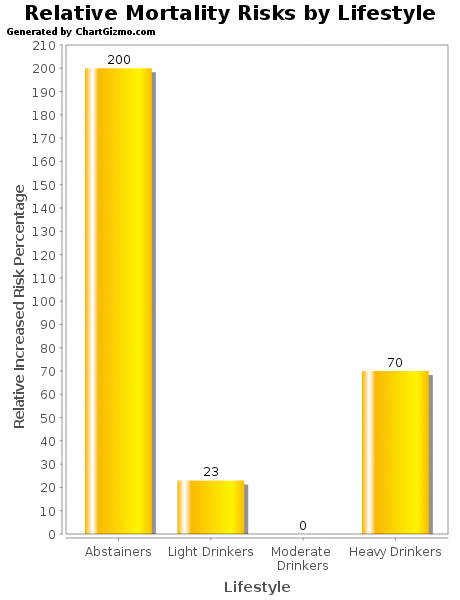
Controlling only for age and gender, compared to moderate drinkers, abstainers had a more than 2 times increased mortality risk, heavy drinkers had 70% increased risk, and light drinkers had 23% increased risk. A model controlling for former problem drinking status, existing health problems, and key sociodemographic and social-behavioral factors, as well as for age and gender, substantially reduced the mortality effect for abstainers compared to moderate drinkers. However, even after adjusting for all covariates, abstainers and heavy drinkers continued to show increased mortality risks of 51 and 45%, respectively, compared to moderate drinkers.

And here it is again in a handy chart I made:

mortality-risk

See, drinking is good for you. It is part of a healthy lifestyle. Drinking moderately is the best choice you can make to lead a healthier life. It’s better for you than drinking only occasionally, drinking heavily or not at all.

Here’s how Time Magazine put it.

But even after controlling for nearly all imaginable variables — socioeconomic status, level of physical activity, number of close friends, quality of social support and so on — the researchers (a six-member team led by psychologist Charles Holahan of the University of Texas at Austin) found that over a 20-year period, mortality rates were highest for those who had never been drinkers, second-highest for heavy drinkers and lowest for moderate drinkers.

They conclude:

These are remarkable statistics. Even though heavy drinking is associated with higher risk for cirrhosis and several types of cancer (particularly cancers in the mouth and esophagus), heavy drinkers are less likely to die than people who have never drunk. One important reason is that alcohol lubricates so many social interactions, and social interactions are vital for maintaining mental and physical health. As I pointed out last year, nondrinkers show greater signs of depression than those who allow themselves to join the party.

That said, the new study provides the strongest evidence yet that moderate drinking is not only fun but good for you. So make mine a double.

Of course, the researchers bend over backwards to make sure no one thinks they might be advocating for drinking. Heaven forbid. That’s been pretty much SOP for academic papers that have findings at odds with the anti-alcohol community for as long as I can remember. If they discovered tomorrow that chocolate cured cancer, do you think there would be warnings about the dangers of obesity attached to it? My point is everything has consequences but it seems that alcohol continues to carry a stigma that most others do not.

Still, this is great news.

Filed Under: Beers, Editorial, News, Politics & Law Tagged With: Prohibitionists, Science, Statistics

How Much Money Does The Government Make From Alcohol?

August 30, 2010 By Jay Brooks

tax
The Turbo Tax Blog last month had an interesting post looking at the question of How Much Money Does The Government Make From Alcohol? It’s an overview, of course, and doesn’t include some of the dirty details that make alcohol the most taxed consumer good out there (though tobacco is pretty high, too), but there certainly is some interesting information contained in the rather large infographic.

infograph-taxation

Filed Under: Beers, Breweries, Politics & Law Tagged With: Taxes

World Drinking Age Maps

August 29, 2010 By Jay Brooks

earthday
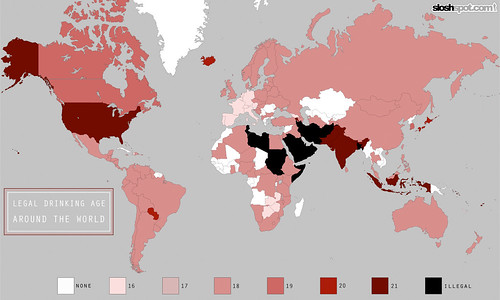
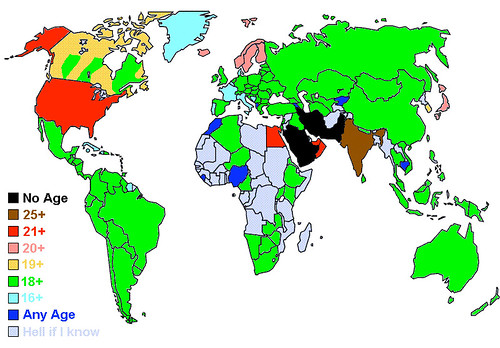
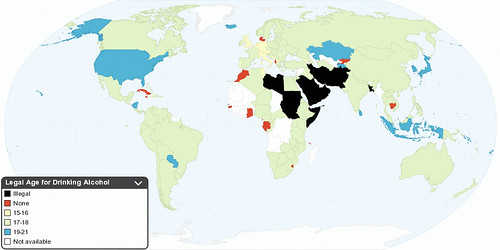
In a similar vein to yesterday’s hangover infographics, here are several more that show the minimum age that people can drink across the nations of the world. They show just how out of whack we are with the rest of the world, having one of the highest ages where people are permitted to drink: 21. The majority of the world is at 18 or below, with only a very few above eighteen (of those countries that permit their citizens to choose for themselves whether they want to consume alcohol).

infograph-drinking-age
For a larger view, click here.

One odd feature of this one is it shows India as a solid 21, whereas it’s actually 18-25 depending on the state. But it’s still pretty obvious that the world average, where drinking it allowed at all, is 18.

drinking-age-map
For a larger view, click here.

This one, too, shows a proliferation of 18 and under, where legal.

infograph-drinking-age-3
For a larger view, click here.

The last one, from Charts Bin, lumps together many of the ages of majority, which seems a little misleading. For example, it lumps 19-21 together making it seem like there’s many more that are on the high end whereas only five countries are as high as 21, including the puritanical U.S.

There are also a few decent lists of drinking ages, at the International Center for Alcohol Policies, Wikipedia and Alcohol Problems and Solutions.

Filed Under: Beers, Just For Fun, Politics & Law Tagged With: International, Statistics

Asia Overtakes Europe In Beer Consumption

August 23, 2010 By Jay Brooks

asia
For a long while Europe has led the world in beer consumption by continent and also by nation since the EU has increased in economic prominence as a single entity. According to new data by Credit Suisse, China now leads the world in terms of beer consumption, growing at a pace of about 10% per year. The Economist has more details in All Pints East.

beer-consumption-map-2010

Filed Under: Beers, Breweries, News, Politics & Law Tagged With: Asia, Europe, Statistics

Less Alcohol Advertising Makes No Difference

August 20, 2010 By Jay Brooks

upside-down-world
The world is turned upside down. All of the neo-prohibitionist groups have been complaining for a very long time, since 1933 in fact, that alcohol advertising has to be severely restricted. The moment the 21st Amendment passed, ending Prohibition, the temperance groups didn’t admit defeat and start minding their own business but simply changed tactics. Instead of trying to make alcohol illegal for everyone, they tried to make it harder and more expensive for the companies to do business and harder for the consumers who wanted it to find it and/or afford it.

That’s a strategy they’ve continued to push over the past 75+ years, and in fact they’ve really stepped up those efforts lately. That’s why the anti-alcohol groups are constantly trying to get taxes on alcohol raised. It’s also why they’re trying to to get more and more restrictions on how and where alcohol can be advertised. One of their most persistent claims is supposedly how harmful alcohol ads are to young people. They’ve even got their own “studies” to prove it.

A recent one by the Center on Marketing Alcohol and Youth (CAMY) begins with the premise that “there is growing evidence that youth (defined as 12-20 years olds) exposure to alcohol advertising increases the likelihood and quantity of underage drinking.” Back in 2003, because of the whining of the anti-alcohol groups, the major alcohol companies pledged to reduce their advertising in publications that also included underage readers.

So CAMY last week released the results of a study they conducted to see the Youth Exposure to Alcohol Advertising in National Magazines, 2001-2008. The study found the following:

  • From 2001 to 2008, youth exposure to alcohol advertising in magazines fell by 48 percent. Adult (age 21 and above) exposure declined by 29 percent and young adult (ages 21 to 34) dropped by 31 percent.
  • Alcohol advertising placed in publications with under 21 audiences greater than 30 percent fell to almost nothing by 2008.
  • Youth exposure in magazines with youth age 12-to-20 audience composition above 15 percent declined by 48.4 percent.

Overall, in other words, they found that there’s far less ads in publications which young people might read. Which is what they wanted, right? So you’d think they’d be happy, wouldn’t you? But here’s the thing. They continue to proselytize that young people are drinking more and more, even right in the study itself, which gives the following background. “More young people in the U.S. drink alcohol every month than smoke cigarettes or use any illegal drug. In 2008, 10.1 million young people between the ages of 12 and 20 reported drinking in the past month, and 6.6 million reported binge drinking.”

So let’s see if I have this straight. The study shows, as Health Day reports, “alcohol makers have largely met the industry’s voluntary standard (adopted in 2003) of not placing ads in magazines with 30 percent or more youth readership.” And yet underage drinking continues to soar according to these same groups. Is it just me, or does that seem contradictory? If kids seeing ads for alcohol is the huge problem they claim it is, wouldn’t you expect that if there are fewer ads directed at children, that underage drinking would decrease. But that’s not apparently what’s happened. So maybe it’s time for the neo-prohibitionists to admit these ads weren’t the big problem they claimed and their self-serving studies were as bogus as a three-dollar bill.

I shouldn’t even have to explain how ridiculous it is that a magazine should lose advertising at a time when all print publications are having a hell of time making ends meet just because what they write about appeals to both adults and people under 21. Why, for example, should Rolling Stone — with a 12-20 year-old readership of around 25% — not advertise to the 75% of its readers who are legal adults just because both adults and young people enjoy music. And who came up with the 12-20 range? I can’t imagine how a twelve-year old reacts to an alcohol ad is remotely similar to a twenty-year old. That they consider all kids in that age range as the same seriously calls into question the entire exercise. Eighteen-to-twenty year olds (who incidentally should be allowed to legally drink) might be swayed by alcohol advertising if they’re alcoholically active, but a twelve-year old? It’s absurd.

The study did show that while wine and liquor dropped across the board, beer did rise slightly to fill the void. But while this is undoubtedly an unpopular idea, I much prefer my kids might see a beer ad over something laden with high fructose corn syrup, like soda, pop or soft drinks. Beer at least is all-natural and is not loaded with chemicals like soda. And last time I checked, it was still illegal for kids to actually buy beer. So no matter how the little darlings react to the horror of seeing an advertisement for beer, it really shouldn’t matter one wit. They still can’t buy it. Before the angry comments begin, I realize that underage kids can manage to get their hands on booze, but that sill doesn’t change the fact that it’s already illegal. It’s still not a valid argument why adults shouldn’t be allowed to see a beer ad in a publication that someone under 21 might also happen to see. And guess what, it’s not working anyway. Reducing the ads themselves has not resulted in kids under 21 drinking less, in fact just the opposite if we accept the anti-alcohol faction’s own propaganda. Their own studies seem to show that reducing those ads — as they insisted was necessary — is having almost no impact on underage drinking.

Filed Under: Editorial, News, Politics & Law Tagged With: Prohibitionists, Statistics

The Extinction Of Returnable Beer Bottles

August 18, 2010 By Jay Brooks

returnable-carton
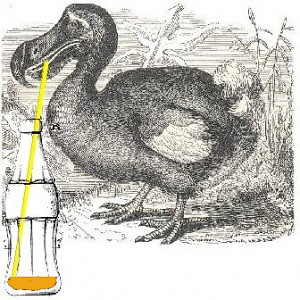
You know you’re old and curmudgeonly when you remember fondly returnable beer and soda bottles. They had a heft to them, felt heavier in your hand or carrying them to the car. That’s because they were made to last, to be used over and over again. I hadn’t really thought about it until this morning, but that was real recycling, well before the term had even been coined. But it was just practical to make things that could be re-used. It’s almost a cruel joke that as a society we’re so obsessed lately with recycling when without realizing it we were doing far more of it years ago before almost all packaging, including bottles and cans, became throwaways. If we really cared more about the environment and the world than our own selfish “convenience” then it would be easy to just return to … well, returnables.

Unfortunately, I’d say it would be almost impossible to change our collective habits at this point (yes, I’m a pessimist as well as a curmudgeon) despite the fact that many places around the world never stopped using returnable bottles. Germany is a prime example of this. All the beer bottles sold there are returnables and every brewery has huge stacks of cartons filled with bottles waiting to be cleaned and reused. Obviously, their economy hasn’t suffered and people haven’t decided to stop drinking beer because they might have to return the bottles rather than just throw them away. But I just can’t see that happening here where everything is about being fast and convenient, where it’s all about “instant” gratification. Lest you accuse me of being too self-righteous, I include myself among the lazy multitudes.

I bring this up because the Lehigh Valley [Pennsylvania] Morning Call has an interesting article about their local beer, Straub Brewery, and how Returnable beer bottles to become extinct if Straub doesn’t get back some cases. It’s not surprising that Straub is one of only two breweries who are still using returnable beer bottles — the other being Yuengling — and that both are in Pennsylvania, since the Commonwealth is the lone remaining (as far as I know) case state, meaning almost all beer is sold by the case at what are called “beer distributors.” This may have made sense in 1933, but it’s become an increasingly antiquated system as the years have rolled on.

From the article:

Straub Brewery, a 138-year-old family-owned business about 100 miles northeast of Pittsburgh, is begging customers mostly in Pennsylvania but also some in Ohio, New York and Virginia to return thousands of empty cases.

Without them, Straub says it will do as nearly every brewer has done over the years — eliminate returnable bottles from its inventory. Only one other major brewer and the nation’s oldest , D.G. Yuengling & Sons of Pottsville, still sells beer in returnable bottles. But it plans to phase out the practice by fall.

All major brewers, including Anheuser-Busch, Miller and Coors, gave up on returnable bottles years ago because their costs multiplied with national distribution. About 12 percent of all U.S. beer was sold in returnable bottles in 1981, but since 2007 the percentage has been negligible, according to the Beer Institute in Washington, D.C. In Pennsylvania, more than a quarter of all beer was sold in returnable bottles in 1981, but that was when state liquor control laws required most beers to be sold by the case through distributors which readily accepted the returns.

So hopefully their customers will heed the call and start returning their bottles so they can be used again. I know it’s a forgone conclusion that returnable bottles will die out at some point, but the nostalgic, romantic in me (a.k.a. old man) still thinks that the returnable is an idea that should be revisited, especially with the recent increased focus on being green. It would be hard to argue that reusing bottles and packaging wouldn’t ultimately be better for the environment than our current recycling efforts. But I think Dick Yuengling summed up the situation best.

“The consumer’s been indoctrinated; we’re a throwaway society,” Yuengling said. “Everybody’s environmentally conscious, but if you put a case of returnable bottles in front of them, they say, ‘What’s that?'”

dodo

Filed Under: Beers, Editorial, News, Politics & Law Tagged With: Bottles, Packaging, Recycling

« Previous Page
Next Page »

Find Something

Northern California Breweries

Please consider purchasing my latest book, California Breweries North, available from Amazon, or ask for it at your local bookstore.

Recent Comments

  • Bob Paolino on Beer Birthday: Grant Johnston
  • Gambrinus on Historic Beer Birthday: A.J. Houghton
  • Ernie Dewing on Historic Beer Birthday: Charles William Bergner 
  • Steve 'Pudgy' De Rose on Historic Beer Birthday: Jacob Schmidt
  • Jay Brooks on Beer Birthday: Bill Owens

Recent Posts

  • Historic Beer Birthday: William Cullen April 15, 2026
  • Beer In Ads #5222: O’Keefe’s Bock Beer April 15, 2026
  • Historic Beer Birthday: George Schmitt April 14, 2026
  • Beer In Ads #5221: Bowler Brothers’ Bock April 14, 2026
  • Historic Beer Birthday: George W. Bashford April 14, 2026

BBB Archives

Feedback

Head Quarter
This site is hosted and maintained by H25Q.dev. Any questions or comments for the webmaster can be directed here.