Our 28th Guinness poster by John Gilroy is part of the zoo animal series and features a elephant trying to take the zookeeper’s Guinness with the slogan “My Goodness — My Guinness.”
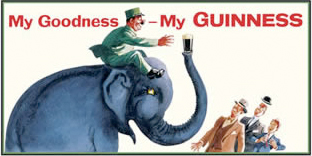

Our 28th Guinness poster by John Gilroy is part of the zoo animal series and features a elephant trying to take the zookeeper’s Guinness with the slogan “My Goodness — My Guinness.”

My wife pointed this one out to me, and it’s pretty funny despite highlighting some fairly ugly trends in beer advertising by the big breweries and imports towards women. From the Current TV show InfoMania, the clip is introduced as follows:
Everybody loves beer — men, women, children with fake IDs. But beer companies don’t want one of these groups to enjoy their beer: women. Modern Lady Erin Gibson is on the case of how beer companies like Miller, Budweiser, and Heineken have gone from depicting women in commercials as eye candy hanging out with Spuds MacKenzie to the target of aggression and humiliation.

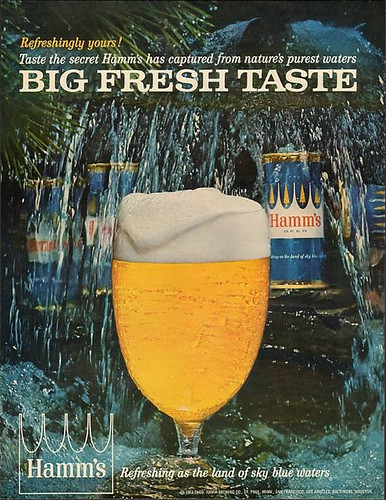
Friday’s ad is from 1963 and is for Hamm’s in the Land of Sky Blue Waters. The text is a wonderfully nonsensical mishmash of adspeak, beginning with “Refreshingly yours!,” whatever that means, followed by “Taste the secret Hamm’s has captured from nature’s purest waters.” Ooh, what could it be, what could it be? The answer, of course, is “BIG FRESH TASTE.” What great meaningless platitudes. And check out the head on that beer. Does that look like a comb over to anyone else?

Regular readers know I’m a huge fan of stand-up comedy, and that I often quote one of all-time favorites, Bill Hicks. In the Eighties I followed comedians like other people follow baseball players, but that ended when I got older and stopped going out every weekend. But I still love stand-up, and think it’s one of the few professions where people can tell the truth, and voice their real opinions, with little risk of retribution. Because it’s couched in humor, a lot of truth can get out that otherwise might not be expressed.
I often watch the Daily Show from the night before when I’m eating my lunch, but it’s in reruns, so I took a chance on Live at Gotham, a program showcasing new stand-up comedians. There wasn’t anybody on the show I knew by name, but I figured what the heck. As it happened, I watched the first episode from Season 1, from 2006.
The last comedian on was named Auggie Smith, originally born in Santa Rosa, California, but he grew up in Montana and now lives in Portland, Oregon. His set included a lot of material about social politics, things about smoking, gambling and drinking — generally pretty funny stuff, I thought. Below is his brilliant conclusion, an argument I’ve often made but never quite so humorously.
When we call drinking a sin, when we call smoking a sin, when we call gambling a sin it takes the responsibility off the people doing it. When we call drinking a sin it’s like saying that the problem is the booze. America, don’t blame the booze. Here’s the thing, no matter what your problems in life are, I assure you it is not the booze’s fault.
Let’s get this straight once and for all. If you’re a jackass when you’re drinking … it’s because you’re a jackass, okay. That’s what’s going on there. There ain’t no magical equation of add liquid, make jackass, no. In the insurance game it’s what they call a pre-existing condition.
Amen brother. If only the anti-alcohol folks could get that message.

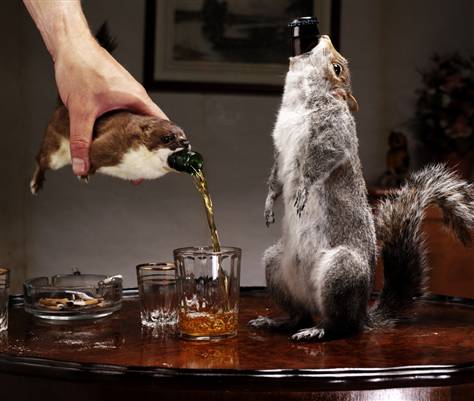
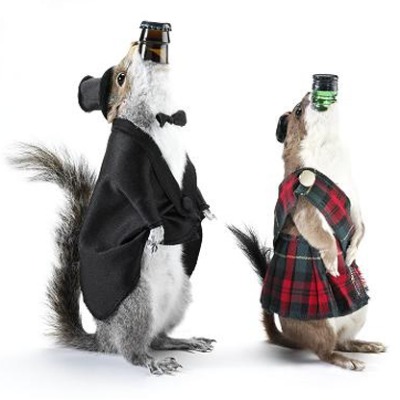
It’s hard not to chuckle a bit when BrewDog manufactures another controversy to get free publicity. Their latest, and possibly greatest, stunt is their new world-record beater — at 55% a.b.v. — The End of History. As if a 110 proof beer wasn’t enough, each of the limited bottles (only 12 were made) cost £500 (approx. $770 U.S.). And they sold out in mere hours to consumers from the Canada, Denmark, England, Italy, Scotland and the U.S. Why, you may ask — besides of course supply and demand? The answer is no doubt designed to bait the press and especially animal lovers, because each of the twelve bottles is inside a small stuffed animal. That’s right, a taxidermist placed a bottle inside the body of 4 squirrels, 7 weasels and 1 hare, all collected as roadkill.
The BBC was the first to weigh in, calling it “perverse.” They got a twofer of outrage from both Advocates for Animals and Alcohol Focus Scotland. Libby Anderson, policy director for Advocates for Animals was quoted as saying “[i]t’s just bad thinking about animals, people should learn to respect them, rather than using them for some stupid marketing gimmick,” forgetting that animals are nearly ubiquitous in advertising, from cute and cuddly to perverse and scary. Remember the Foster’s Farm chickens driving around hoping to be eaten? She adds “[i]t’s pointless and it’s very negative to use dead animals when we should be celebrating live animals. I think the public would not waste £500 on something so gruesome and just ignore it.” Sorry Libby, I guess you don’t know the public as well as you thought, because it sold out in less than a day. Others have called it “shocking” and in “bad taste.”
Here’s how BrewDog describes the beer:
The End of History, at 55%, is the final installment of our efforts to redefine the limits of contemporary brewing.
This blond Belgian ale is infused with nettles from the Scottish Highlands and Fresh juniper berries. Only 12 bottles have been made and each comes with its own certificate and is presented in a stuffed stoat or grey squirrel. The striking packaging was created by a very talented taxidermist and all the animals used were road kill.
To me, the proof that it’s a put up lies in this fact. If you read much philosophy, perhaps the title of the beer, The End of History, sounds familiar? It should, because it’s taken from a 1992 book by Francis Fukuyama, “The End of History and the Last Man,” which itself was based on an earlier essay published in the international affairs journal The National Interest. Fukuyama’s original 1989 essay is online, and a percentage of the later book can be read online through Google Books. In referencing the title, BrewDog comments that “this is to beer what democracy is to history.”
There’s also a pretty funny video about the End of History, you can find more about the beer at BrewDog’s website.
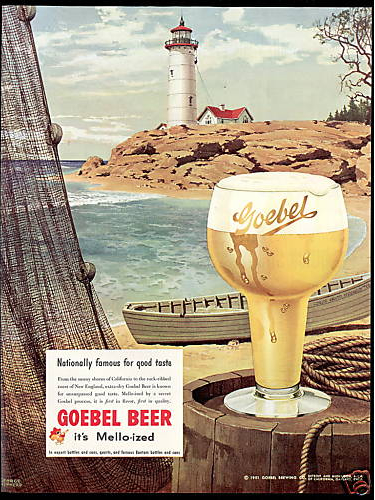
Thursday’s ad is from 1951 and is for Goebel Beer, a brewery in Detroit, Michigan from 1873 to 1964. Through the mergermania of the latter half of the 20th century it ended up being owned by Stroh’s. They did a series of ads featuring beautiful landscapes with a glass of Goebel’s in the foreground. My favorite part of the text is “Goebel Beer — It’s Mello-ized.”

A new study was just published online, and will be in print in next month’s journal Alcoholism: Clinical and Experimental Research with the nearly impenetrable title Sociodemographic Predictors of Pattern and Volume of Alcohol Consumption Across Hispanics, Blacks, and Whites: 10-Year Trend (1992–2002). CNN simplified the story’s title, originally from Health.com, to More Americans Drinking Alcohol. To me the most interesting thing about this is that it’s really two stories, one positive and one sort of negative, and it’s all in the way it’s framed.
As presented on CNN, the story begins with mainly the positive aspects of the story. More Americans Drinking (Alcohol) summarizes the study like this:
Between 1992 and 2002, the percentage of men and women who drank alcohol increased, as did the percentage of whites, blacks, and Hispanics, the study found.
Americans don’t seem to be drinking more, however, as the average number of drinks consumed per month remained steady.
“More people are drinking, but they seem to not be drinking heavily as frequently,” says Rhonda Jones-Webb, an epidemiologist and alcohol expert at the University of Minnesota School of Public Health, in Minneapolis.
So that’s good news, especially considering that moderate drinking is healthier for you than abstaining or over-indulging. So if more people are hitting the sweet spot, so to speak, that should be good news, eh?
Oh, but wait, here comes the other shoe:
Yet the study revealed an important exception to that trend: an uptick in the number of people who binge drink at least once a month. Binge drinking is defined as consuming five or more drinks in one day.
“We need to address this increase, which may be associated with alcohol abuse,” says Dr. Deborah Dawson, Ph.D., a staff scientist at the National Institute on Alcohol Abuse and Alcoholism, in Bethesda, Maryland. “We may need focus our attention on preventive measures that target binge drinking.”
Of course the main problem with all that alarm over binge drinking is the definition itself. Five drinks in one day is an absurd way to define binge drinking. Originally it was essentially a bender with no limits. Little by little the definition has been whittled down by organizations and our government keen to have a number they could use in compiling statistics. But that also means a five-course beer dinner creates an event where every single diner is a binge drinker. Even the new Dietary Guidelines just released have changed the standard from daily to weekly allowable amounts and changed the daily standard to four drinks for a male, so long as the weekly limit is not reached. So that means four drinks in one day is fine, but one more and you’re a dangerous binge drinker. It’s this sort of nonsense that allows neo-prohibitionist groups to use suspect statistics with the government imprimatur to give them more credibility than they rightly deserve.
Then there’s this chestnut:
The rise in the proportion of drinkers and in binge drinking could be a sign that society is more accepting of alcohol consumption (and overconsumption), says Dr. Stephen Bahr, Ph.D., a professor of sociology at Brigham Young University, in Provo, Utah.
“There has been much emphasis on drug education and treatment but not as much emphasis on alcohol misuse, which could signal a change in norms and explain the increase in the prevalence of drinkers,” he says.
I don’t know what planet Bahr lives on, but when my kindergartner is lectured to with MADD propaganda that alcohol is a drug and he comes home with the notion that his parents are drug users because they have a beer with dinner, I’d say there’s plenty emphasis on alcohol misuse. It’s absurd in light of all the anti-alcohol propaganda for anyone to suggest people are drinking more because they haven’t heard it might be bad for them. If anything, they’re preached to death.
The original Health.com piece, Survey: More Americans Drinking Alcohol, is under the section heading Alcoholism, subtly framing the story as if it’s about alcoholism, which of course it’s not. More people drinking does not automatically mean there are more alcoholics or even more people at risk of becoming alcoholics. But framed the way it is, that’s what it seems to presuppose.
Some of the other findings, as reported by Health.com:
The study itself only concluded the following, at least in the abstract:
The only common trend between 1992 and 2002 across both genders and 3 ethnic groups was a rise in the proportion of drinkers. There was also a rise in drinking 5 or more drinks in a day (Whites, Blacks, and Hispanics) and drinking to intoxication (Whites and Blacks), but this was limited to those reporting such drinking at least once a month. The reasons for these changes are many and may involve complex sociodemographic changes in the population.
I’m sorry, having five drinks on a given day once a month, or even once a week, is hardly a sign of the fall of civilization, even if a few more are now than they were ten years ago. I’m not even sure it’s all that newsworthy. But for reasons passing understanding — perhaps it’s simply the 24/7 news cycle — it became news and even got picked up by CNN.

James Spencer at Public CEO, a California government-focused blog, has an interesting read today about an e-mail he received from the Marin Institute and what he found when he looked closer at it. It’s entitled Who’s Really Behind the Booze Tax and Why? and it’s certainly great to see more people taking a critical look at San Francisco’s proposed new tax on alcohol and exposing it for what it really is.
His conclusion?
They hate alcohol and don’t want it around. Fair enough, but why weren’t they open from the start? The email should have read: “We are against alcohol and we don’t want you to drink it.” The Marin Institute isn’t looking out for the best interest of the city of San Francisco or its economy. It has its own interests. And if their true goal is to stop us from drinking alcohol, then they must understand that this tax is going to have a dramatic effect on reducing sales, right? Sounds like they are making the argument for why this additional alcohol fee would be a terrible idea.
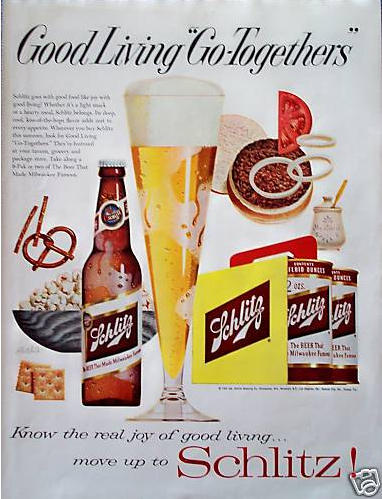
Wednesday’s ad is from the 1960 and is for Schlitz, featuring the slogan “Know the real joy good living … move up to Schlitz!” Some of the good living go-togethers include pretzels, popcorn, crackers and burgers.

According to a recent study by the NPD Group, a research firm, 5,204 restaurants have closed since the Spring of 2009, representing a 1% drop in the total number. As reported in the Nations Restaurant News, “[i]ndependent restaurants took the hardest hits, while chains kept their unit counts relatively stable.” As the Brewers Association revealed last week, brewpub openings increased slightly, reversing a trend where they’d been losing ground to the recession. Perhaps that’s tied to craft beer’s continuing increases, perhaps not. In any event, less restaurant visits means less opportunities to purchase beer, so that’s bad news for the production breweries who sell packaged and draft beer to restaurants.