Brookston Beer Bulletin

Jay R. Brooks on Beer

  • Home
  • About
  • Editorial
  • Birthdays
  • Art & Beer

Socialize

  • Dribbble
  • Email
  • Facebook
  • Flickr
  • GitHub
  • Instagram
  • LinkedIn
  • Pinterest
  • RSS
  • Twitter
  • YouTube

Powered by Genesis

Beer In Ads #144: Schlitz, Real Gusto In A Can

July 6, 2010 By Jay Brooks

ad-billboard
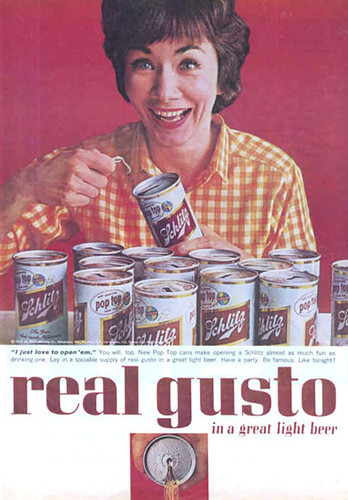
Tuesday’s ad is also for Schlitz and is from the 1960s. It features a woman with an odd look on her face opening the pull-top cans, just because she likes to, or as it says in bold print, “I just love to open ’em.” There are 14 open cans of beer shown in the ad. What do you think, did she drink them all?
schlitz-60s-2

Filed Under: Art & Beer, Beers Tagged With: Advertising, Cans, History, Schlitz

Fight The Fee

July 6, 2010 By Jay Brooks

cahj
If you read my rebuttal to San Francisco Chronicle columnist C.W. Nevius support of the proposed fee on alcohol in the city, then perhaps you recall that he interviewed the California Alliance of Hospitality Workers so he could appear to show both sides of the argument. It was not really in any way balanced, and in fact I think he used them as a straw man, though he did so in a way that I believe was incorrect at any rate.

Happily, the California Alliance of Hospitality Workers is fighting back, and is trying to get people to contact their local supervisor in San Francisco to have city residents ask their politicians to oppose the proposed fee. The e-mail to use is Board.of.Supervisors@sfgov.org. If you live in San Francisco and drink alcohol in moderation and responsibly, please contact your supervisor and ask him or her to oppose the ordinance.

cal-alliance-hjobs

You can also see their response to the proposed ordinance, Supervisors’ Short-Sighted Proposal to Tax Alcohol Will Hurt Hard-Working San Franciscans. They’ve also set up a Facebook page.

One additional important fact that they mention is that the required Nexus Study has still not been filed or made public. With the hearing to vote on the proposed ordinance a week away — July 14 — at the very least that’s stacking the deck and at the worst is complete bullshit.

Here’s just a few more reasons why this tax is unfair, particularly to craft beer:

  • This legislation taxes beer by alcohol strength, putting a huge and cumbersome burden on brewpubs, self-distributing small brewers and wholesalers because each and every beer is taxed at a different rate.
  • Craft brewers are not part of the problem. Craft beer is priced high and is a product of quality, not quantity. Craft beer drinkers do not abuse their beverages.
  • With the “margin chain” and price point consideration, the tax will be much higher than five cents a drink. At retail off-premise, the increase will be about 50-75 cents a six-pack and on premise about 75 cents to a dollar per pint.
  • Brewers are already heavily taxed. Small brewers already pay a state and a federal excise tax in addition to all other business and sales taxes. Combined, about 40-44% of the cost of a beer already goes to taxes.
  • Higher drink prices in a singular market such as San Francisco will lead consumers to not come into the City for dining and entertainment.
  • Higher taxes will lead to lost jobs, off-setting the new tax.
  • The proposed tax would hinder the ability of craft brewers in the City to grow, employ more people and positively contribute to City’s economic recovery.
  • Higher taxes will mean higher prices which means lower sales. If this tax in imposed, sales will decrease and craft brewers will not be able to sustain the ability to continue full employment or continue to invest in our business and community.

Filed Under: Beers, Editorial, News, Politics & Law Tagged With: California, San Francisco, Taxes

What (Pete) Brown Can Do For You

July 6, 2010 By Jay Brooks

Okay, I’m just having a bit of fun with UPS’ slogan and Pete Brown, UK beer writer. But today Pete has a nice overview of each of the big six beer companies that do business in the UK, entitled The Big Boys. It’s definitely worth a read. He talks primarily about their marketing efforts in the UK, but you get a sense of how he feels about the pros and cons of each company and the overall feeling that they’re not all the same.

Filed Under: Breweries, Editorial Tagged With: Big Brewers, Marketing, UK

Like Real Estate, Next Session About Location, Location, Location

July 6, 2010 By Jay Brooks

session-the
Our 42nd Session will be hosted by Derrick Peterman, from Ramblings of a Beer Runner. He’s chosen “A Special Place, A Special Beer” as his topic, which Derrick describes geographically:

The Session provides a unique opportunity to explore this connection between the beer in our glasses and the place it comes from with perspectives from all over the world

So I ask for this 42nd Session that you write about a special place in your life, and a beer or brewery that connects you to that place. It can be the beer from your childhood home, a place you once lived, your current hometown, a memorable vacation you once took, or a place you’ve always wanted to go to but never had the chance. Please take a few moments to think about the how the beer connects you to this place, and share this with us. Of course, the definition of “place” is rather open ended, and in some cases, highly debatable, so it will be interesting to see the responses on what constitutes a place.

So look around the world and then bring home your own post for the next Session, on Friday, August 6.

Filed Under: The Session Tagged With: Announcements

The Secret History Of Alcohol?

July 6, 2010 By Jay Brooks

conspiracy
I’m not quite sure what to make of this conspiracy theory, sent in by a friend and loyal reader (thanks Jeff). While I’m a natural skeptic, I do think at least parts of many conspiracy theories contain a grain of truth. But here’s one I’ve never encountered, and I’ve read a bit about Prohibition.

According to Hidden History, and specifically Rockefeller, Ford and the Secret History of Alcohol, at least part of the reason prohibition was successful had to do with business and money — are you shocked or surprised? — and a desire to eliminate the competition. To wit:

John D. Rockefeller, under the ruse of Christian temperance, gave 4 million dollars to a group of old ladies and told them to fight for Prohibition (they successfully used the money to buy off Congress). Why? Rockefeller owned Standard Oil, the main company pushing gas as an alternative fuel to alcohol.

Essentially, it killed ethanol as an alternative fuel, which has only been talked about again recently, at least in the mainstream media.

rockefeller

How true is this account? Beats me, but it’s got plenty of ancillary links to explore, such as this interesting one, Hydrocarbons versus carbohydrates: the continuing battle in the United States, at Before the Well Runs Dry. Who knows, but it’s fun to speculate.

Filed Under: Politics & Law, Related Pleasures Tagged With: History, Prohibitionists

Beer In Ads #143: Schlitz, That’s What I Call Real Beer

July 5, 2010 By Jay Brooks

ad-billboard
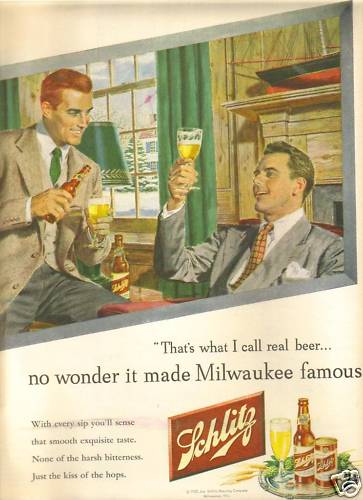
Monday’s ad is for Schlitz and will likely make anyone from CAMRA do a double take. Because the ad’s slogan is “That what I call real beer … no wonder it made Milwaukee famous.” But I don’t think most real ale or cask-conditioned fans are likely to agree. I’m not sure when the ads is from exactly, but given the scene I’d have to guess late 1940s or early fifties.

Schlitz-real_beer

Filed Under: Art & Beer, Beers Tagged With: Advertising, History, Schlitz

Manipulation Of The Crowd: Online Ratings

July 4, 2010 By Jay Brooks

science
The latest issue of Scientific American has an interesting article, Manipulation of the Crowd: How Trustworthy Are Online Ratings?, a topic of interest to any brewery who’s ever received a bad review from either Beer Advocate or Rate Beer. Intuitively, it’s seemed to me that the overall quality of the ratings on those sites have been improving as they’ve matured and built up the number of users and reviews.

According to Scientific American, the bad news is that while most review-driven websites don’t accurately reflect the expected statistical bell curve (which would imply their accuracy), the good news is that the beer reviews online prove the exception to the rule and are, in fact, more often fairly and reasonably accurate.

The philosophy behind such rating sites is known as the “crowdsourcing strategy” insofar as the “truest and most accurate evaluations will come from aggregating the opinions of a large and diverse group of people.” But according to Eric K. Clemons, at the Wharton School of the University of Pennsylvania, ratings sites like Amazon, TripAdvisor and Yelp “suffer from a number of inherent biases.”

  1. Disproportion: “People who rate purchases have already made the purchase. Therefore, they are disposed to like the product. ‘I happen to love Larry Niven novels,’ [professor Eric K.] Clemons says. “So whenever Larry Niven has a novel out, I buy it. Other fans do, too, and so the initial reviews are very high—five stars.” The high ratings draw people who would never have considered a science-fiction novel. And if they hate it, their spite could lead to an overcorrection, with a spate of one-star ratings.”
  2. Polarization: “People tend not to review things they find merely satisfactory. They evangelize what they love and trash things they hate. These feelings lead to a lot of one- and five-star reviews of the same product.”
  3. Oligarchy of the Enthusiastic: “A small percentage of users account for a huge majority of the reviews. These super-reviewers—often celebrated with ‘Top Reviewer’ badges and ranked against one another to encourage their participation—each contribute thousands of reviews, ultimately drowning out the voices of more typical users (95 percent of Amazon reviewers have rated fewer than eight products). ‘There is nothing to say that these people are good at what they do,’ [computer scientist Vassilis] Kostakos says. ‘They just do a lot of it.’ What appears to be a wise crowd is just an oligarchy of the enthusiastic.”

Yelp, the one I’ve heard more people consistently complain about, apparently has some of the worst transparency issues and there’s the “perception that the company itself might be manipulating the playing field.”

A separate look at Netflix user data, Dissecting the Netflix Dataset, found some of the same relationships in rating the films rented from Netflix. For example, the average rating for a film is 3.8 (out of 5), neatly fitting the average bell curve results, such as this study mentioned in Scientific American.

A controlled offline survey of some of these supposedly polarizing products revealed that individuals’ true opinions fit a bell-shaped curve—ratings cluster around three or four, with fewer scores of two and almost no ones and fives. Self-selected online voting creates an artificial judgment gap; as in modern politics, only the loudest voices at the furthest ends of the spectrum seem to get heard

A similar look at IMDb ratings, Mining gold from the Internet Movie Database, part 1: decoding user ratings, saw complimentary results and the same looking bell curve. The average rating on the IMDb was 6.2 (out of 10) and the median was 6.4.

It seems that the more popular a ratings website is, and consequently the more reviews it gets, the more reliable the results are, or at least the better they seem to fit the bell curve of expected distribution of reviews that usually result from non-online sources. The higher number of reviews, the more fringe reviews at either ends of the spectrum are less heavily weighed. Unless, of course, it just plain sucks or everyone agrees on how terrific it is, but that’s most likely a situation that’s pretty rare.

But, as I said at the outset, the good news is that those problem issues with online ratings are apparently not a problem for the beer ratings websites, which are specifically mentioned as an instance where the crowdsourcing model does work.

RateBeer.com, which has attracted some 3,000 members who have rated at least 100 beers each; all but the most obscure beers have been evaluated hundreds or thousands of times. The voluminous data set is virtually manipulation-proof, and the site’s passionate users tend to post on all beers they try—not just ones they love or hate.

I’m quite certain those numbers would be similar for Beer Advocate, too, of course, suggesting that for both of the most popular beer ratings websites, that the results have become reasonably reliable, especially for the beers that have been most heavily reviewed. For new beers with just a few reviews, obviously it wouldn’t automatically be as reliable, but the only way to build up reviews is start somewhere. And that’s where looking more carefully at the reviewers becomes more important. A review with only 5 reviews where all 5 reviewers are experienced would arguably be different from one where all 5 reviewers were rookies or had very little experience. Obviously, the number of reviews a person has done is no guarantee that his or her reviews are better or more reliable, but it stands to reason that anyone who takes something seriously and continues to practice it will improve over time. And like craft beer itself, the longer it’s been around, the better it gets. It’s nice to see some scientific support to confirm that intuition.

Filed Under: Beers, Editorial, Related Pleasures, Reviews Tagged With: Science

Beer In Art #83: Bob Kessel’s Charles Bukowski

July 4, 2010 By Jay Brooks

art-beer
Today’s works of art is part of a series of American Icons by Bob Kessel. It’s am abstract portrait of the writer Charles Bukowski, who was known to drink a little alcohol from time to time.

Bob_Kessel-charles_bukowski

Kessel writes of the portrait. “Appropriately, Buk is shown drinking a bottle of beer.” I love its simplicity of both palette — just red, white and blue plus yellow — and the imagery, capturing the essence of Bukowski in the portrayal of him hoisting a beer to his lips at a bar. It reminds me of a cross between Piet Mondrian and Roy Lichtenstein.

Below, it’s show with a frame to better see the white space intended to be around the exterior of the artwork. Limited edition prints are available of this, and other portraits from the series, American Icons.

Bob_Kessel-charles_bukowski-framed

To see more of Kessel’s work, check out his website and also his WordPress blog.

Also, below is a poem entitled Beer by Bukowski, from my Beer Poetry database.

Beer, by Charles Bukowski, from Love is A Mad Dog From Hell (1920 – 1994)

I don’t know how many bottles of beer
I have consumed while waiting for things
to get better
I don’t know how much wine and whisky
and beer
mostly beer
I have consumed after
splits with women—
waiting for the phone to ring
waiting for the sound of footsteps,
and the phone to ring
waiting for the sounds of footsteps,
and the phone never rings
until much later
and the footsteps never arrive
until much later
when my stomach is coming up
out of my mouth
they arrive as fresh as spring flowers:
“what the hell have you done to yourself?
it will be 3 days before you can fuck me!”

the female is durable
she lives seven and one half years longer
than the male, and she drinks very little beer
because she knows it’s bad for the figure.

while we are going mad
they are out
dancing and laughing
with horny cowboys.

well, there’s beer
sacks and sacks of empty beer bottles
and when you pick one up
the bottle fall through the wet bottom
of the paper sack
rolling
clanking
spilling gray wet ash
and stale beer,
or the sacks fall over at 4 a.m.
in the morning
making the only sound in your life.

beer
rivers and seas of beer
the radio singing love songs
as the phone remains silent
and the walls stand
straight up and down
and beer is all there is.

Filed Under: Art & Beer, Beers Tagged With: Connecticut, United States

Guinness Ad #25: Have A Crab

July 3, 2010 By Jay Brooks

guinness-toucan
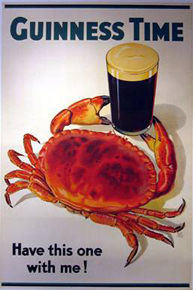
Our 25th Guinness poster by John Gilroy features a crab trying to figure out how to get hos claws around a pint of Guinness and, presumably, drink it. Perhaps that’s why the text at the bottom reads “Have this one with me!,” because he can’t do it alone.

guinness-time-crab

Filed Under: Art & Beer, Beers Tagged With: Advertising, Guinness, History

Session #41: Craft Beers Inspired By Homebrew

July 2, 2010 By Jay Brooks

homebrewing
Our 41st Session about how homebrewing has, and continues, to influence and inspire commercial brewing. Hosted by the Wallace Brothers, Jeff and Tom, at Lugwrench Brewing. Jeff describes their topic, Craft Beers Inspired by Homebrewing, as follows:

Session topics typically come from the host’s area of passion — something they have a strong affinity towards. For Tom and I, the real pathway in our appreciation of Craft Beer has been through the hobby of homebrewing. Not only has this hobby fostered yet another reason for two geographically-separated brothers to collaborate (the core concept for the Lug Wrench blog being “a fraternal bond over beer”), it was through homebrewing where we learned what makes a marginal beer and what makes an exceptional beer. It was the lauching pad for how we came to admire (and sometimes fanaticize) about “good” beer. So during our discussions of potential topics, the debate kept coming back to homebrewing and how craft beer is connected to the amateur brewing community.

The chosen topic: Craft Beers Inspired By Homebrewing. How has homebrewing had an affect on the commercial beer we have all come to love? Feel free to take the topic in any direction your imagination leads you.

Write about a beer that has its roots in homebrewing. Write about a commercial beer that originated from a homebrew.

Write about a professional brewer you admire who got their start in homebrewing before they went pro. Write about a professional brewer who still homebrews in their free time.

Write about a Pro-Am beer tasted either at a festival or a brewpub. Write about an Amateur / Professional Co-op you’ve had the pleasure of experiencing (such as The Green Dragon Project).

Write about commercial brewers using “Homebrewing” as part of the marketing. Write about the Sam Adams LongShot beers, whether good or bad.

session_logo_all_text_200

While there are many, many positive contributions I think homebrewing has made to commercial brewing and the wider beer community, the one that always resonates with me is the way in which the sharing of knowledge and technical assistance that is the hallmark of the homebrewing community has translated to commercial brewing, as well. It’s something I think we take for granted, but which is almost unique around the world. A few years ago, I did an article about collaboration beers, Brewing Togetherness, for All About Beer magazine and a little later took a trip to New Zealand, which resulted in another article, Kiwi Kerveza. One thing I learned while working on those two pieces is that one of the factors that allowed the rapid growth of our microbrewery scene stems from the fact that many, if not most, of the brewers who entered the field early on came to it from being homebrewers themselves. So they were used to the homebrew culture — and especially homebrew clubs — that invite and encourages people to share with one another, offer constructive criticism and assistance and simply be supportive. When those same homebrewers turned pro, so to speak, they continued to be as open with their fellow commercial brewers as they’d been in their homebrewing communities.

That was nearly a unique situation where in most other places that did not happen. In nations with older, more traditional brewing heritage, like Germany or England, most breweries were larger and their brewers came out of trade schools. They acted like most industries do, and trade secrets and other proprietary information was protected, and not freely shared. In New Zealand, I learned that its remoteness itself served to make people distrustful and unwilling to take or give advice or help. The effect of that in those places is it seems to have stunted a vibrant small brewery explosion. Those explosions are now taking place in most countries, especially those with rich brewing heritages. Any many I’ve spoken to credit the American craft beer scene for inspiration or influence. And that leads back to the openness of our craft brewers.

One brewer I interviewed for the collaboration article related a story from the Craft Brewers Conference, when it was in San Diego two times ago. He presented a seminar in which he shared brewing techniques with the audience, and the audience participated openly sharing their own experiences with the same techniques. After the seminar, a couple of German brewers came up to him and explained that such openness would never happen in Germany. Of course, they don’t have the homebrewing culture that America does.

So while homebrewing was the path most took to starting a craft brewery, it was that very culture of homebrewing that made them successful. Almost without exception, the early breweries that have not only lasted, but flourished, are the ones that were the most open and helped out their fellow small brewers. While counter-intuitive for most industries, it is one of the most important factors in turning our brewing reputation as a nation from laughingstock to one of envy in less than three decades, a remarkable achievement. And I believe it was thanks to homebrewing that it happened, and that it continues to be true. Thank you, homebrewers.

Filed Under: Beers, The Session Tagged With: Homebrewing

« Previous Page
Next Page »

Find Something

Northern California Breweries

Please consider purchasing my latest book, California Breweries North, available from Amazon, or ask for it at your local bookstore.

Recent Comments

  • Bob Paolino on Beer Birthday: Grant Johnston
  • Gambrinus on Historic Beer Birthday: A.J. Houghton
  • Ernie Dewing on Historic Beer Birthday: Charles William Bergner 
  • Steve 'Pudgy' De Rose on Historic Beer Birthday: Jacob Schmidt
  • Jay Brooks on Beer Birthday: Bill Owens

Recent Posts

  • Beer In Ads #5217: The King Of All Beers April 11, 2026
  • Historic Beer Birthday: Gambrinus April 11, 2026
  • Beer In Ads #5216: The Finest Bock, As Usual April 11, 2026
  • Historic Beer Birthday: Anton Heeb April 11, 2026
  • Beer In Ads #5215: Another Load Of “Milwaukee’s Choicest” April 10, 2026

BBB Archives

Feedback

Head Quarter
This site is hosted and maintained by H25Q.dev. Any questions or comments for the webmaster can be directed here.