Brookston Beer Bulletin

Jay R. Brooks on Beer

  • Home
  • About
  • Editorial
  • Birthdays
  • Art & Beer

Socialize

  • Dribbble
  • Email
  • Facebook
  • Flickr
  • GitHub
  • Instagram
  • LinkedIn
  • Pinterest
  • RSS
  • Twitter
  • YouTube

Powered by Genesis

Beer In Ads #4956: Primo Bock Beer

May 1, 2025 By Jay Brooks

Last year I decided to concentrate on Bock ads. Bock, of course, may have originated in Germany, in the town of Einbeck. Because many 19th century American breweries were founded by German immigrants, they offered a bock at certain times of the year, be it Spring, Easter, Lent, Christmas, or what have you. In a sense they were some of the first seasonal beers. “The style was later adopted in Bavaria by Munich brewers in the 17th century. Due to their Bavarian accent, citizens of Munich pronounced ‘Einbeck’ as ‘ein Bock’ (a billy goat), and thus the beer became known as ‘Bock.’ A goat often appears on bottle labels.” And presumably because they were special releases, many breweries went all out promoting them with beautiful artwork on posters and other advertising.

Thursday’s ad is for Primo Bock Beer and was published May 1, 1912. The brewery was the Primo Brewing & Malting Co. of Honolulu, Hawai’i, which was originally founded in 1897. This ad ran in The Honolulu Star Bulletin, also of Honolulu, Hawai’i.

Filed Under: Art & Beer, Beers, Breweries, Just For Fun Tagged With: Advertising, Bock, Hawaii, History

Historic Beer Birthday: Robert “Mac” MacTarnahan

May 1, 2025 By Jay Brooks

portland-wh
Today is the birthday of Robert “Mac” MacTarnahan (May 1, 1915-October 25, 2004), one of Oregon’s most famous athletes. Mac was one of the original investors in Portland Brewing Co., which was later named MacTarnahan’s Brewing in his honor. I met Mac twice, once in Portland at an event at the brewery, and once he visited me in California when I was still the beer buyer at BevMo. I hope I have half the energy he did when I’m in my eighties. A couple of years ago, my friend and colleague John Foyston wrote a nice remembrance of Mac in The Oregonian, which included the obituary he wrote in 2004. Raise a glass today to Mac’s memory.

mac-1
Brewer Alan Kornhauser, Mac and Portland Brewing co-founder Fred Bowman.

robertmactarnahan
Mac’s Oregon Sports Hall of Fame photo. Here’s his entry:

Oregon’s most accomplished Masters Athlete, Robert “Mac” MacTarnahan is the first masters competitor ever chosen for induction into the Oregon Sports Hall of Fame. His athletic feats are amazing. Mac is a four-time Masters world record holder with a national record in the mile plus three world record holders in the 3000-meter steeplechase. In the steeplechase, he is a six-time AAU National Masters champion, two-time USA National Senior Olympic champion, two-time World Senior champion. Mac is also a five-time National Masters wrestling champion. The wiry Scot owns more the 50 Masters Gold Medals.

Filed Under: Birthdays Tagged With: Birthdays, Oregon, Portland, Sports

Historic Beer Birthday: Frederick H. Krug

May 1, 2025 By Jay Brooks

krug-neb
Today is the birthday of Frederick H. Krug (May 1, 1870-1914). He was the son of Frederick Krug, who was the “German-immigrant founder of the Frederick Krug Brewing Company of Omaha, Nebraska. Krug is often cited as one of the early settlers of Omaha. In addition to operating the brewery for almost the entire duration of his life, Krug operated Krug Park in the Benson community and was the president of the Home Fire Insurance Company, which was founded in Omaha in 1884.” His son was involved in the business, and was treasurer, but passed away when he was only 44, five years before his father passed away.

Probably because he passed away so young and his contributions to the brewery were relatively modest, there’s no biographical information I could find on junior, not even the exact date he died.

fred-h-krug

“The Fred Krug Brewery was located at 2435 Deer Park Boulevard in Omaha, Nebraska. Founded in 1859, Krug Brewery was the first brewery in the city. Krug was one of the “Big 4” brewers located in Omaha, which also included the Storz, Willow Springs and Metz breweries. Later sold to Falstaff in 1936, the facility closed in 1987.

Krug-Brewery-1920
The brewery in 1920.

Krug-Brewery-sm
And in its heyday.
This is a short history of the brewery.

In 1859 Frederick Krug established the Krug Brewery with an original output of one and a half barrels a day. In 1878 the brewery was located on Farnam between 10th & 11th Streets in Downtown Omaha, and by 1880 it was brewing approximately 25,000 barrels a year. In 1894 the brewery moved to 29th & Vinton Street near South Omaha. It cost $750,000 and was reportedly one of the best equipped breweries in the country. Omaha’s historic Anheuser-Busch Beer Depot is the only remaining building from the original Krug Brewery.

You wouldn’t believe there was such difference in beers until you use one Krug’s popular brands. They are uniform perfectly brewed and well-aged absolutely pure and leave no bad after effects. The kind of beer that acts as a tonic and a system builder. Order a trial case and begin to enjoy. – Text from a 1910 advertisement by Fred Krug Brewing Company.
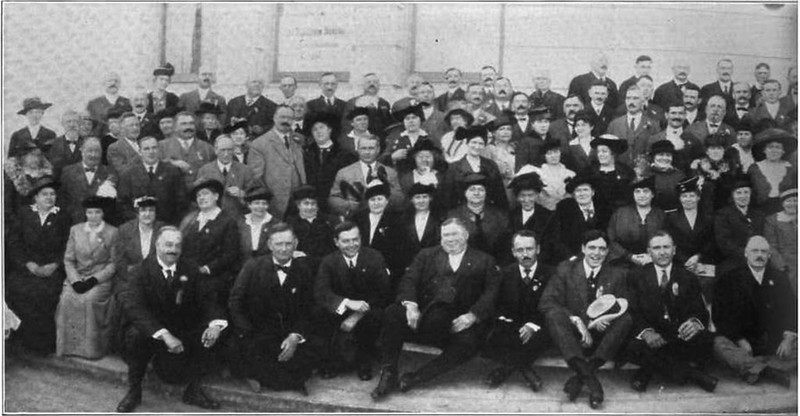
Krug brewed beer under several labels: Fred Krug, Cabinet, and Luxus. Krug supported an amateur baseball team called Luxus, taking them as far as the Amateur Baseball World Championship in 1915.

PaxtonHotel

Krug-Luxus-Beer--Labels-Fred-Krug-Brewing-Company

krug1

Filed Under: Birthdays, Breweries, Just For Fun Tagged With: History, Nebraska

Beer Birthday: Kyle Manigold

May 1, 2025 By Jay Brooks

Today is the 40th birthday of Kyle Manigold, who’s been brewing in the Bay Area for over a decade. He brewed for a time at Morgan Territory Brewing, but more recently is working the hoses at Faction Brewing in Alameda. He’s been instrumental at both places in bringing home medals from various competitions. Join me in wishing Kyle a very happy birthday

With his GABF medal.
In the tasting room at Morgan Territory.

Filed Under: Birthdays, Just For Fun

Historic Beer Birthday: Jacob Best

May 1, 2025 By Jay Brooks

jacob-best
Today is the birthday of Jacob Best (May 1, 1786-February 26, 1861). Best founded the brewery that eventually became Pabst Brewing Co., with his four sons in 1844. The Best family’s business was originally called “The Empire Brewery,” and then as the “Jacob Best & Sons Brewery” until 1859 when Phillip Best took over the firm and renamed it the “Phillip Best Brewing Company.” Upon Phillip’s retirement Frederick Pabst and Emil Schandein became the company’s president and vice-president in the mid-1860s and the brewery’s name was amended to Phillip Best & Company. After Schandein died, the company was renamed the Pabst Brewing Company in 1889.

jacob-best-sr

Here’s a short biography from Find a Grave:

Business Magnate. Jacob Best learned the brewer’s trade in his hometown of Hesse Darnstadt, Germany, and then moved on to operate a small brewery in Mattenheim. In 1840, two of Best’s four sons immigrated to America, settling in the Kilbourntown section of Milwaukee. They were joined by Jacob Best, his two younger sons and other family members in 1844. With his sons, Jacob Best opened the Empire Brewery producing lager beer, whiskey and vinegar. As demand increased of light lager beer, the firm changed its name to Best & Company. Retiring in 1853, Jacob Best transferred ownership to Lorenz and Phillip. After 1860, Phillip assumed sole control of the brewery which became the Pabst Brewing Company. While retired, Jacob Best held local political offices, first as a ward assessor and the school commissioner. He remained active until his death.
jacob-best

Immigrant Entrepreneurship has a lengthy article about the Bests, centered around Frederick Pabst, but with background that includes Jacob Best:

In 1844, Phillip Best (born September 26, 1814, in Mettenheim, Grand Duchy of Hesse; died July 17, 1869, in Altenglan, Kingdom of Bavaria), together with his father and three brothers, opened the Jacob Best & Sons Brewery in Milwaukee, Wisconsin. Twenty years later, Phillip’s son-in-law Frederick Pabst (born March 28, 1836, in Nikolausrieth, Kingdom of Prussia; died January 1, 1904, in Milwaukee, Wisconsin) joined the company and helped to transform it into the nation’s leading beer producer – first in 1874 and then again in 1879, a position that was maintained until the turn of the twentieth century. As the company’s president, the former ship captain led the firm through a remarkable period of growth and the Pabst Brewing Company (as it came to be called from 1889 onwards) became the epitome of a successful national shipping brewery. Pabst not only contributed to the firm’s (and Milwaukee’s) economic growth, he also left a permanent cultural and social mark both on the German-American community and on the public at large. A decade after the height of his success, Pabst died on New Year’s Eve of 1904, passing on his commercial and cultural legacy to his sons.

The Best family’s relocation from Mettenheim to Milwaukee went relatively smoothly. After spending a few weeks in the summer of 1844 looking for a suitable location, Jacob Sr. purchased two lots on Chestnut Street (today West Juneau Avenue) on September 10 and founded the Empire Brewery. Jacob Sr.’s sons, Charles and Lorenz, soon went on to establish independent brewing ventures, so Jacob Sr. formed a new partnership with his other two sons, Phillip and Jacob Jr., in 1851, which stayed in place until Jacob Sr. retired two years later. After several arguments about the expansion of the firm, Jacob Jr. sold out to Phillip on October 1, 1859, who continued the business as its sole proprietor under the name of the Phillip Best Brewing Company.

In its inaugural year, the Best brewery produced 300 barrels (one barrel equaling 31 US gallons). The firm initially produced ale and porter, but added German-style lager on February 22, 1845. In 1847, Phillip reported in a letter to his wife’s family that the business was developing well and selling 28-30 barrels of beer weekly for $4.50 per barrel ($5 if delivered). The brewery owned three horses for the malt grinding mill, as well as for deliveries in the city and county, and planned to buy another. By 1850, the company’s 2,500-barrel annual production classified it as a medium-sized producer, ranking fourth out of the twelve largest reported breweries in Wisconsin.

As production increased, the company acquired and built new facilities. In 1850, the family purchased a lot on Market Street between Biddle and Martin Streets (today East Kilbourn Avenue and East State Street). Five years later, the company built a new brick house on Market Street with a beer hall on the ground floor, and in 1857 it erected a new main brewery on the north side of Chestnut Street between Ninth and Tenth Streets with large storage cellars. The Milwaukee Sentinel reported on October 9, 1857, that the brewery had the “deepest cellars in the city” and it may be seen from almost any part of the city. The building is a fine looking one, and were it not for a life-sized figure of a sturdy Teuton which is perched on top, in the act of sipping a glass of lager, one would never suspect its being a brewery. It has much more the appearance of a public building of some sort.

The article went on to explain that demand for Best beer was not only “constantly increasing” locally but also across the whole nation: “Everybody has tasted Best’s beer, and it’s very generally acknowledged to be the best in the country.” Although the article certainly exaggerated the national impact of Best’s beer at mid-century, the company had begun to sell their brands outside Wisconsin in the early 1850s when it established a sales office in Chicago, Illinois. While Milwaukee and the surrounding region provided the main market for Best products throughout the second half of the nineteenth century, this early effort to serve the national and – beginning in the 1860s – international market was a distinctive feature of the company’s development.

Best’s production and profits increased during the nationwide economic boom of the 1850s, but the panic of 1857 and the economic disruption of the Civil War slowed the firm’s growth rate. At the height of its early prosperity in 1857, the brewery employed steam power to produce nearly 40,000 barrels a year and was valued at $50,000 (approximately $1.4 million in 2014$). It employed eight men and used ten horses for delivery. Not until after the Civil War would these production levels be reached again. But as the expansion of the family business began to stall, Phillip made his two sons-in-law, Frederick Pabst and Emil Schandein, equal partners in 1864 and 1866 – a decision which turned out to have a lasting impact on the future development of the company.

philip-best-brewery-1880
The Best’s brewery in 1880, a few years after Jacob died and it became the Philip Best Brewing Co.

philip-best-bock

Filed Under: Birthdays, Just For Fun Tagged With: Germany, History, Wisconsin

Beer In Ads #4955: Years To Your Life vs. Life To Your Years

April 30, 2025 By Jay Brooks

Last year I decided to concentrate on Bock ads. Bock, of course, may have originated in Germany, in the town of Einbeck. Because many 19th century American breweries were founded by German immigrants, they offered a bock at certain times of the year, be it Spring, Easter, Lent, Christmas, or what have you. In a sense they were some of the first seasonal beers. “The style was later adopted in Bavaria by Munich brewers in the 17th century. Due to their Bavarian accent, citizens of Munich pronounced ‘Einbeck’ as ‘ein Bock’ (a billy goat), and thus the beer became known as ‘Bock.’ A goat often appears on bottle labels.” And presumably because they were special releases, many breweries went all out promoting them with beautiful artwork on posters and other advertising.

Tuesday’s ad is for Decatur Bock Beer and was published April 30, 1905. The brewery was the Decatur Brewing Co. of Decatur, Illinois, which was originally founded in 1855. This ad ran in The Herald and Review, also of Decatur, Illinois. I love the balance that bock beer brings with the equation: “Years to Your Life” vs. “Life to Your Years.”

Filed Under: Art & Beer, Beers, Breweries, Just For Fun Tagged With: Advertising, Bock, History, Illinois

Historic Beer Birthday: Gustav Hodel

April 30, 2025 By Jay Brooks

germany
Today is the birthday of Gustav Hodel (April 30, 1875-July 3, 1966). Hodel was born in Emmendingen, Baden, Germany, the youngest of seven. His father, Christian Hodel, owned the local Hodel Brewery. One of his brother’s emigrated to America and became a maltser in Nebraska, then another brother came and became a brewer, and eventually so did Gustav, who everybody called “Gus.” He started in one brother’s brewery in Galena, Illinois but struck out on his own and either owned or worked for a number of different breweries over the course of a 56-year career in beer. He retired in 1946 to Santa Cruz, California to be closer to his daughters, where he remained until his death in 1966.

Brewery Gems has a great account of Hodel’s life, apparently with considerable help from Gus Hodel’s grandson, William “Bill” Whetton. And given that it’s the most complete source I could find, your best bet it to just go read it there.

This is an obituary for Hodel from the Santa Cruz Sentinel, July 5, 1966.

One of the breweries Hodel owned was the Lewistown Brewing Co., in Lewistown, Montana, which he acquired in 1912 and ran successfully until Prohibition, when in trying to survive got into a bit of trouble with the Federal government.

You can read all about those troubles at the National Archives, in a piece entitled “Run for the border: Beer Bootlegging during the Prohibition.”

Filed Under: Birthdays, Just For Fun Tagged With: Germany, History, Western States

Historic Beer Birthday: Lawrence Steese

April 30, 2025 By Jay Brooks

anchor-retro
Today is the birthday of Lawrence Steese (April 20, 1912-April 19, 1991). Steese is part of the more recent lore of Anchor Brewing. Originally from Mill Valley, in Marin County, he bought Anchor in 1960 when Joe Allen was retiring, though Allen stayed around to teach him how to make Steam Beer. Fifty-one percent of the brewery was then bought by Fritz Maytag, who eventually bought out Steese and assumed full control.


steese-barrels

Steese was from Mill Valley, and in the July 14, 1962 edition of the Daily Independent Journal, an article used the headline How a Marinite Rescued Steam Beer, which included the following in its coverage.

SOME THREE years ago the requiem for steam beer was being played, and the sad demise of a California tradition was being mourned. At that time Joe Allen, owner of Anchor Brewery, announced his retirement. There was no one skilled in the exacting art of steam beer brewing to take his place, and no one, it seemed, who cared to take the time and trouble to learn from the old master. No one, that is, until Lawrence Steese decided he’d like to try. Joe Allen was more than willing to teach. And since his official “retirement” these three years past, Allen has spent his days at the brewery as professor of steam beer brewing. The making of steam beer is not like the brewing of other beers. Steam beer is naturally carbonated; neither additives nor preservatives become it. “The Sincere Beer,” it is called by some. IT IS TRULY a “health food,” its devotees assert, containing more malt and hops than other beers, and without corn or rice to lighten it.


20150819-steam

And this account of Fritz Maytag buying Anchor from Steese is on their website:

By 1965, as America slaked its thirst with lighter, mass-produced, heavily marketed beers, the Old Spaghetti Factory had become one of Anchor’s last remaining accounts. Fred—ever loyal—even loaned the brewery money to help keep San Francisco’s beer afloat. In July 1965, he heard the news that Anchor—then known as the Steam Beer Brewing Company—was about to shut down.

Fred turned to a customer and friend who was living in the City by the Bay, twenty-seven-year-old Fritz Maytag—great-grandson of the founder of a well-known appliance company in Newton, Iowa. Fred knew that if Maytag paid a visit to the brewery, he might just fall in love with it. Sure enough, “it was as if,” Fritz reminisced, “someone said, ‘That’s the last cable car and it’s going out of business tomorrow unless you put up a few thousand dollars.’”

On August 2, Fritz Maytag shook hands with owner/brewmaster Lawrence Steese, purchasing 51% of the brewery (and its debt) and rescuing our brewery from imminent oblivion. Final papers were filed September 24. San Francisco’s iconic beer and “medieval brewery”—as Fritz fondly calls it—were saved!


steese-anchor
And this is Steese’s story, distilled to its essence on Anchor Brewery’s website today.

Filed Under: Birthdays, Breweries, Just For Fun Tagged With: California, History

Beer In Ads #4954: The Goat Is Here

April 29, 2025 By Jay Brooks

Last year I decided to concentrate on Bock ads. Bock, of course, may have originated in Germany, in the town of Einbeck. Because many 19th century American breweries were founded by German immigrants, they offered a bock at certain times of the year, be it Spring, Easter, Lent, Christmas, or what have you. In a sense they were some of the first seasonal beers. “The style was later adopted in Bavaria by Munich brewers in the 17th century. Due to their Bavarian accent, citizens of Munich pronounced ‘Einbeck’ as ‘ein Bock’ (a billy goat), and thus the beer became known as ‘Bock.’ A goat often appears on bottle labels.” And presumably because they were special releases, many breweries went all out promoting them with beautiful artwork on posters and other advertising.

Monday’s ad is for Valley Brew Bock and was published April 29, 1912. The brewery was the El Dorado Brewing Co. of Stockton, California, which was originally founded in 1855. This ad ran in The Evening Mail of Stockton, California.

Filed Under: Art & Beer, Beers, Breweries, Just For Fun Tagged With: Advertising, Bock, History

Historic Beer Birthday: Robert Cain

April 29, 2025 By Jay Brooks

cains-robt
Today is the birthday of Robert Cain (April 29, 1826-July 19, 1907). He “was the founder of the firm Robert Cain and Sons, a brewer in Liverpool, England,” which today is simply known as Cains.

cains-robert
This is his biography from his Wikipedia page:

He was born on Spike Island, County Cork, Ireland on 29 April 1826, the son of James Cain (1797–1871), a private soldier in the 88th Foot, a regiment of the British Army. There is some dispute over the identity of Cain’s mother. Later family records and stories claim that his mother was Mary Deane, the daughter of Alexander Deane, an architect and mayor of Cork. However, in the entry for his brother William in the Liverpool register of births his mother’s maiden name is listed as Mary Kirk (died 1864).

The story of the life of Robert Cain and Cains Brewery is told in Christopher Routledge’s 2008 history of the brewery, Cains: The Story of Liverpool in a Pint, which unpicks many of the mythologies that have developed around the Cain family. Many of these mythologies seem to date back to the 1920s and 1930s, when Cain’s sons William Cain and Charles Nall-Cain were given titles in the British honours system, and centre on the idea that the brewery’s founder had a background in the Irish gentry. Such a background would have made his sons more acceptable to the British establishment at the time. However, according to Routledge, Robert Cain was born in poverty in 1826, the son of a private soldier who would soon be forced to leave the army and travel to England to find work. Cain arrived in Liverpool with his parents in late 1827 or early 1828 and grew up in the slums of the Islington area of the city with his older sister Hannah and two younger siblings, Mary and William. When he was in his early teens Cain was indentured to a cooper on board a ship carrying palm oil from West Africa.

After working out his indenture Cain returned to Liverpool in 1844 where he set himself up first as a cooper and soon after, as a brewer. According to Routledge he met Ann Newall, the daughter of James Newall, a shoemaker, and they were married on 4 April 1847 in St. Philip’s Church, Hardman Street, Liverpool. He began brewing around 1848 on Limekiln Lane in the Scotland Road area, but soon expanded his operation to a nearby brewery on Wilton Street and finally moved to the existing Mersey Brewery (now known as the Robert Cain Brewery or Cains Brewery) on Stanhope Street, Liverpool in 1858. At the same time as he was developing his brewing business, Cain also made shrewd property deals and ran a hotel near to the brewery on Stanhope Street; as the company grew it expanded by buying out smaller brewers and taking control of their pubs.

Cain became one of Liverpool’s most successful businessmen with a passion for using the most modern techniques and equipment. He expanded the brewery several times, most notably in 1887 and in 1900–1902, when the landmark redbrick part of the brewery was constructed. By the time of his death on 19 July 1907 Cain was one of Britain’s richest men, leaving a personal estate of £400,000 (around £28 million at 2005 prices). He also had political influence, working behind the scenes to help the Conservative Party maintain control of Liverpool throughout the late nineteenth century. In fact he was so influential in the area of Toxteth Park, Liverpool where he lived that he became known as “King of the Toxteths”. Contemporary reports of his funeral and burial at St. James’s Cemetery suggest as many as 3,000 people attended.

The company, Robert Cain and Sons, owned over 200 pubs in Liverpool but is most notable for having built three of the most gloriously extravagant pubs in Britain: The Philharmonic Dining Rooms, The Vines and The Central. These highly ornate and elaborate pubs, built to celebrate Robert Cain’s own success and to demonstrate the skill of Liverpool craftsmen, remain landmark Liverpool buildings in the twenty-first century.

Robert_Cain_(brewer)
And this partial history is from the brewery’s Wikipedia page:

The Cains brewery was founded by Irishman Robert Cain in 1858 when he bought an established brewery. Cain had begun his brewing career aged 24 when he purchased a pub and brewed his own ales.

Within 25 years of founding his brewery, Cain had established 200 pubs, including the Philharmonic Dining Rooms, the Vines and the Central Commercial Hotel, which are currently listed as being of architectural merit. His personal mansion had each window arch inscribed with his monogram. In 1887 construction began on a second brewery.

In 1921, 14 years after Cain’s death, the Cains brewery merged with Walkers of Warrington, becoming Walker Cains. Then in 1923 the original Stanhope Street Brewery was sold to Higsons, who continued to brew Cains ales.

In 1985, Higsons was bought by Boddingtons of Manchester. Five years later Boddingtons opted to concentrate on pub ownership and sold all its breweries to Whitbread, at which point the Stanhope Street site was closed.

The company merged with Peter Walker & Son in 1921 to form Walker Cains. Peter Walker & Son had a large brewery in Warrington so sold its Liverpool brewery to Higsons in 1923. Boddingtons of Manchester took over in 1985. In 1990 Whitbread acquired Boddington’s brewing operations and closed the then Higsons Brewery in 1990. It was reopened by GB Breweries, who became part of Bryggerigruppen in 1991, and in 2002 was sold to Gardener-Shaw for £3.4 million.

The brewery closed in June 2013 with debts totalling more than £8m.

Cains-Mersey-Brewery-Liverpool

This account is from the Brewery’s website:

Liverpool in the first half of the 19th Century was one of the world’s most thriving ports – awash with visitors from all over the globe, money and opportunity.

This was reflected in the stunning rise of Robert Cain, from an entrepreneurial 24-year-old brewing his own ale in one pub, to a rich and influential businessman with the title of Lord Brocket and an estate of 200 pubs.

Purchasing the brewery and establishing Cains in 1858, he commissioned the current premises around 30 years later, determined that the business would endure a lot longer than he could.

And so his legacy is still evident today, not only in the beers which still bear his name, but in the distinctive design of the brewery itself – The ‘Terracotta Palace’ – and the stunning interiors of famous Liverpool pubs such as The Vines, The Central Commercial Hotel and The Philharmonic Dining Rooms, all listed as having special architectural merit.

Born in County Cork, Robert Cain took the path of many poor Irish immigrants and arrived in Liverpool to seek his fortune.

As a wide-eyed teenager arriving in the bustling city he could never have imagined a life which would see him create an enduring Liverpool brand, become wealthy, accept the title of Lord Brocket and marry the daughter of a former Lord Mayor of Liverpool.

When he died in 1907, over 3,000 people are reputed to have attended his funeral.

So how did this man make his fortune, what drove him to continually thrive to make his brewery, pubs and beers the most tasteful and memorable they could be?

Determined to establish the brewery, Robert Cain started with one pub at the age of 24, brewing his beer on the premises and saving towards the brewery he desperately needed to achieve his dream.

As well as this determination, Robert Cain was a perfectionist and a man with a strong belief in himself. If something had his name associated with it, he wanted it to be stylish and impeccable.

Even his self-designed home had his own initials etched into the glass of every single window.

It was this characteristic which led to the detail he insisted on in his pubs. Detail which has seen celebrated venues such as The Philharmonic Dining Rooms as famous for their ornate marble lavatories and incredible ceilings as they are for their beers.

He certainly left everyone involved with the brewery over the next two centuries a lot to live up to.

cains-formidable-coaster

And this account is by Chris Routledge, from his book Cains: The Story of Liverpool in a Pint, and provided to St. James Cemetery in Liverpool:

Robert Cain was born on April 29, 1826 on Spike Island, which is in the entrance to Cork Harbour on the south coast of Ireland. His father James Cain was a soldier in the 88th Regiment of the British Army, known as the 88th Foot “Connaught Rangers.” After his father left the army because of ill health the family moved to Liverpool and Robert went to sea on the Palm oil ships working the West African coast. Palm oil had replaced slaves as Liverpool’s primary trade with that part of Africa and the conditions were hostile and unpleasant. Many sailors died in minor battles and skirmishes, or from Malaria; it was known as the “white man’s graveyard.”

Robert Cain survived his time at sea and arrived in Liverpool in the late 1840s to set himself up as a brewer. He married Ann Newall, the daughter of a shoemaker in 1847 and in 1850 the couple began brewing on Limekiln Lane in the Scotland Road/Vauxhall area of the city. Within a few years the quality of Cain’s brews was such that he expanded the operation, moving to a small brewery on nearby Wilton Street. By 1858 the brewery needed to expand again and supported by his growing collection of pubs Cain bought Hindley’s brewery on Stanhope Street, Toxteth, where the current Cain’s brewery now stands.

The Stanhope Street brewery, which Cain named the Mersey Brewery, was much larger than Cain’s previous breweries and included a great deal of brewing equipment. Over the following decades Cain updated and developed the site, pulling down nearby court-style slum housing to expand. By the 1880s, when Cain and his large family (he had 11 children) were living in a mansion on Aigburth Road, the brewery was one of the largest in the city. Cain himself was an important figure in the powerful Constitutional Association and had considerable influence on local politics. He recruited brewery workers to campaign on behalf of Conservative candidates for the Council and became known as “King of the Toxteths.” He was generally well-liked and respected by his workers and the Cain family were well known in the area of Aigburth and St. Michaels.

Like other Victorian gentlemen Cain enjoyed having his portrait painted and was a patron of the arts. He sat for the well-known Liverpool artist William Daniels for at least two portraits and was also painted by George Hall Neale, a Manx painter who lived and worked in Liverpool in the late nineteenth century. Cain was also a collector of rare plants and was especially fond of orchids.

By 1896, when the company became Robert Cain and Sons Ltd, Cain was one of the wealthiest and most powerful men in the city. Cain’s “Superior Ales and Stouts” were available across Liverpool. After the death of his wife he moved to an even larger house near Hoylake and was followed by most of his children, who lived in their own flamboyant mansions nearby. As the twentieth century began Cain began to move control of the business to his sons Charles and William, who later became noted philanthopists, supporting medical charities, including the Women’s Hospital and the Bluecoat Hospital, as well as providing money for aircraft during World War I. William Cain donated his house at Hoylake, known as Wilton Grange, to the nation as a convalescent home for injured officers. Both sons became baronets and Charles Cain became Lord Brocket in 1933.

Robert Cain fell ill in late 1906 and after six months of declining health he died at home on July 19, 1907 during a heatwave. His lavish funeral on July 23 took place on a day of thunderstorms and torrential rain, but despite the bad weather a crowd of three thousand attended and had to be restrained by the police at the gates of St James’s. Official mourners included aldermen, city dignitaries and businessmen, including the brewer Daniel Higson, whose company would later buy Cain’s brewery and operate it for almost 70 years. Also in attendance was Cain’s friend George Hall Neale. Interestingly Cain’s father James, who died in poverty in 1871, and with whom Cain had very little contact after the 1840s, is also buried separately at St. James’s.

cains-christmas

Filed Under: Birthdays, Just For Fun Tagged With: England, Great Britain, History

« Previous Page
Next Page »

Find Something

Northern California Breweries

Please consider purchasing my latest book, California Breweries North, available from Amazon, or ask for it at your local bookstore.

Recent Comments

  • Ernie Dewing on Historic Beer Birthday: Charles William Bergner 
  • Steve 'Pudgy' De Rose on Historic Beer Birthday: Jacob Schmidt
  • Jay Brooks on Beer Birthday: Bill Owens
  • Steve 'Pudgy' De Rose on Beer Birthday: Charles Finkel
  • Steve 'Pudgy' De Rose on Beer Birthday: Bill Owens

Recent Posts

  • Beer Birthday: Chuck Silva February 14, 2026
  • Beer Birthday: Lew Bryson February 14, 2026
  • Beer In Ads #5201: Metzger’s Bock Beer February 13, 2026
  • Historic Beer Birthday: Mary of Burgundy February 13, 2026
  • Historic Beer Birthday: Henry C. Haefner Jr. February 13, 2026

BBB Archives

Feedback

Head Quarter
This site is hosted and maintained by H25Q.dev. Any questions or comments for the webmaster can be directed here.