Brookston Beer Bulletin

Jay R. Brooks on Beer

  • Home
  • About
  • Editorial
  • Birthdays
  • Art & Beer

Socialize

  • Dribbble
  • Email
  • Facebook
  • Flickr
  • GitHub
  • Instagram
  • LinkedIn
  • Pinterest
  • RSS
  • Twitter
  • YouTube

Powered by Genesis

Beer In Ads #20: Biere Chatelaine

January 12, 2010 By Jay Brooks

ad-billboard
Tuesday’s ad is from France, most likely in the first few decades of the 20th century. Despite the fact that you can see there’s a signature on the poster, no source I can find identifies who the artist is. Similarly, I don’t know what brewery the poster is advertising for. The poster reminds me a bit of the old Coppertone ad where the dog is trying to pull off the little girl’s bathing suit. But in this case the damn dog is pulling on the waitress’ dress and spilling the beer! Bad dog!
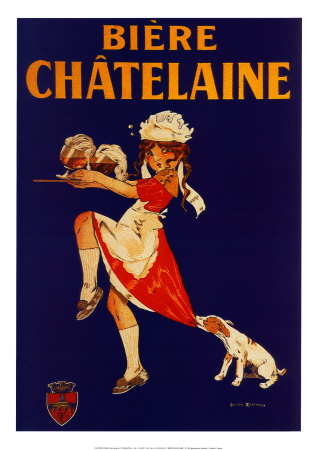
biere-chatelaine

Filed Under: Art & Beer Tagged With: Advertising, Europe, France, History

Stuff & Nonsense, Parts 2 & 3

January 11, 2010 By Jay Brooks

If you’ve been following along from my post yesterday, Stuff & Nonsense: The UK Health Select Committee Report On Alcohol, and more specifically Pete Brown’s wonderfully telling and insightful rebuke of it all — and you should be — then I’m happy to report that parts two and three are now available.

If this is new to you, start with Pete Brown’s Health Select Committee Report on Alcohol. Part One (of 10) was published yesterday, Alcohol consumption in the UK is increasing. Today, parts two, 25% of the UK population is drinking at hazardous or harmful levels, and three, Binge drinking is increasing, were published. Again, stay tuned.

Filed Under: Editorial, Politics & Law Tagged With: Prohibitionists, Statistics, UK

Beer In Ads #19: Budweiser, I See You Have Excellent Taste

January 11, 2010 By Jay Brooks

ad-billboard
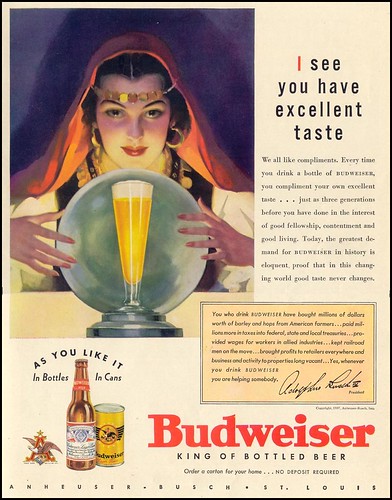
Monday’s ad is from 1937 and is again for Budweiser. The gypsy fortune teller must have seemed very exotic in the late 1930s. But I love the assertion that by buying Budweiser you’re complimenting “your own excellent taste.” And you, and three generations before you, have done so not because you liked the taste, not because you were thirsty, not even because you enjoyed beer, but for a more grand reason. You bought Bud “in the interest of good fellowship, contentment and good living.”

bud-life-09-27-1937-997-M

The inset box is signed by Adolphus Busch III, who’d taken over A-B from August A. Busch Sr. just a few years before, in 1934. It also contains some interesting statements. Obviously, the nation was still smarting from the effects of the Great Depression. Busch is insuring customers that buying Budweiser is helping American business; railroads, retailers and even farmers. He concludes with “whenever you drink Budweiser you are helping someone.” I imagine that’s true, but it’s still a bit odd that his focus is on that help going to someone other than A-B itself. I guess he didn’t want to come off like he was being self-serving.

The other thing I’m curious about is he mentions that A-B has “bought millions of dollars worth of barley and hops from American farmers.” Hops, I understand, to a point, at least. Today A-B owns hop farms in Idaho, but also in the Hallertau region of Bavaria, Germany. Obviously, the ad doesn’t claim they buy ALL their hops and barley from U.S. farmers, and they don’t even mention where the rice comes from. But did A-B buy more hops domestically in the past? Also, it’s my understanding that the vast majority of barley used by American breweries comes from Canada, though there is a small percentage grown in the U.S. for brewing. Has that shifted in the last 70+ years since this ad ran? Did brewers used to get more of their grain here in the States? Anybody know? You rarely see local grain touted as a point of pride in advertising, the only recent exception I can think of being Sierra Nevada’s Estate Brewers Harvest Ale. But with all the recent attention paid to buying locally and locavores, that has to be one of beer’s dirty little secrets: that most brewing grains come from outside the U.S., much less from local farmers.

Filed Under: Art & Beer Tagged With: Advertising, Anheuser-Busch

Beer In Art #60: Stained Glass Bier

January 10, 2010 By Jay Brooks

art-beer
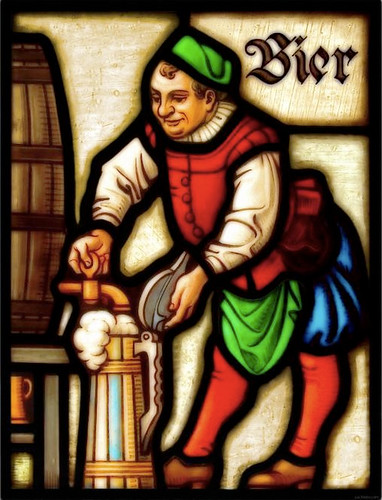
Today’s works of art is a stained glass sign from the late 19th century. It’s online because a professional photographer, Lar Matre, owns the sign and photographed it. It’s difficult to photograph stained glass, at least in my experience, and it is a great photo, but for my purposes I’m more impressed by the artistry of the signmaker. And I love stained glass, always have. But I imagine seeing the original of this, especially in the context of being at a German bar, would be stunning.

stained_glass-bier

According to Matre, on his website, his “great grandfather bought it in the late 1800s in Germany, or so [he’s been] told.” The photograph itself can be purchased online at Fine Art America.

You can see much more of Matre photos at his website and his Flickr page. As for more stained glass, start with Wikipedia. But there’s also the Corning Museum of Glass, Vidimus and the Stained Glass Museum.

Filed Under: Art & Beer Tagged With: Europe, Germany

Stuff & Nonsense: The UK Health Select Committee Report On Alcohol

January 10, 2010 By Jay Brooks

The stuff and nonsense that neo-prohibitionist groups incessantly attack the unsuspecting public with to further their misguided agenda continues to heat up in Great Britain. Happily, Pete Brown is once again on the case. Last week the Parliament Health Select Committee released a report on alcohol in the UK. Surprising no one, it’s riddled with misleading statistics and statements and even outright lies. I’m continually amazed at how gullible the media is when they want to be, swallowing their nonsense wholesale and not questioning it for reasons that pass understanding. In this interminable war between drink and dry, the dry side appears willing to do nearly anything, no matter how reprehensible. I realize I’m biased, but people who enjoy alcohol are on my mind generally more reasonable about this. We recognize and freely admit that some people abuse alcohol and may be a danger to themselves and others. That’s true not just of alcohol, but virtually everything. That’s the price if living in a free society. Not everyone will act, at least all the time, with the highest ideals and best interests at heart. People are … well, people. We’re human, which means fallible, prone to stupidity and even engage in self-destructive behavior from time to time. But while rational people accept his fact, neo-prohibitionists are determined to use this minority when it comes to alcohol to extrapolate their behavior and insist it means everyone who drinks is ruining society. Every single example of individual bad behavior seems to their addled minds to prove alcohol will and does have this effect on everyone equally. And they have the statistics to support that (never mind that they themselves created those statistics). But enough of my ranting.

Pete Brown gives his critique of the overall report, pointing out basic inconsistencies and fabrications. The initial takeaway for him — and me as well, frankly — is this:

Liam Donaldson told the committee (with his usual utter disregard of any factual substantiation whatsoever) that there are “no safe limits of drinking,” and that “alcohol is virtually akin to smoking as one of the biggest public health issues we have to face in this country.”

Bollocks of course. But officially published, sanctioned, and undisputed bollocks.

And that comparison with smoking is quite deliberate. Not all the measures listed above [see original post] will come to pass, but arguably the most important line in the report is this one:

“Education, information campaigns and labelling will not directly change behaviour, but they can change attitudes and make more potent policies more acceptable.”

Smoking hasn’t been banned form British society. But consistent campaigning against smoking eventually changed social attitudes towards it. The smoking ban came in because the majority of people were in favour of it. Nobody but the ad industry minded when advertising and sponsorship were banned. Making smoking socially unacceptable was far more effective than trying to ban it outright. The anti-drink lobby have learned from this, and this report is a naked attempt to make drinking socially unacceptable.

But drinking is NOT the same as smoking. The BMA itself acknowledges the beneficial effects of moderate drinking. Nevertheless, this report seeks to persuade people to treat it the same way, and is meeting with little resistance.

Pete’s become a man obsessed, definitely making him my kind of bloke, and promises to taking apart the arguments in the report in greater detail, with charts and logic, including at least the following topics. The first of the is now up, and it’s linked below. I’ll continue to update these as they come. Regardless of where you live, these are worth your time, because it’s become increasingly obvious that the tactics used cross national orders and are used universally.

  1. “Alcohol consumption in the UK is increasing”
  2. “Binge drinking is increasing”
  3. “25% of the UK population is drinking at hazardous or harmful levels“
  4. “Alcohol is becoming cheapermore affordable”
  5. “Alcohol related hospital admissions — and the cost to the NHS — are soaring”
  6. “Alcohol abuse costs the country £55bn a year”
  7. “The best way to reduce the harmful effects of alcohol is to reduce overall consumption“
  8. “Alcohol advertising and promotion must be tightly regulated because it encourages underage drinking”
  9. “Pubs are a problem“
  10. “Binge drinking has been made much worse by 24 hour licensing”

Stay tuned.

Filed Under: Editorial, Politics & Law Tagged With: Prohibitionists, Statistics, UK

Beer In Ads #18: Leonetto Cappiello’s Bieres de La Fauvette

January 8, 2010 By Jay Brooks

ad-billboard
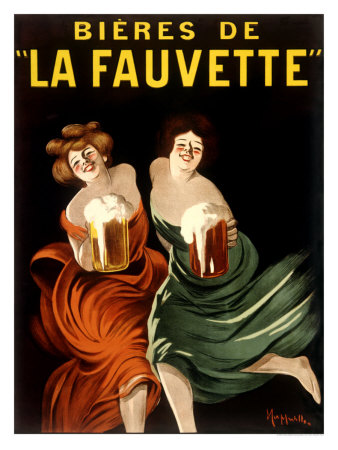
Friday’s ad is French, and most likely was created at the beginning 20th century. It was painted by Leonetto Cappiello, an Italian illustrator considered to be the father of modern advertising.

From one biography:

Cappiello was self-taught, began as a caricaturist and escalated to the early 20th century’s most acclaimed European artist. Cleverly linking products with vivid, memorable images, he produced 1,000 imaginative posters for beverages, ballet, literature, plays, travel and music halls in four decades. Leading the Art Deco movement, Cappiello’s techniques are still vital to modern advertising.

I don’t know what brewery this was done for, but essentially it translates as “Beer of the Warbler.”

leonetto-cappiello-bieres-de-la-fauvette

Filed Under: Art & Beer Tagged With: Advertising, Europe, France, History, Italy

Three-Year Session Anniversary To Feature A Cask Of Characters

January 7, 2010 By Jay Brooks

session-the
The next Session, to be held February 5, will mark our three-year anniversary of The Session. Our 36th Session will coincidentally take place on the first day of SF Beer Week this year. Our Host, Thomas Cizauskas of Yours For Good Fermentables, has chosen the topic Cask-Conditioned Beer, which he describes as follows:

Cask-conditioned ale —or “real ale” as it is called, somewhat boastfully, by the Campaign For Real Ale (CAMRA), a beer consumer advocacy group in the UK— is defined by that organization as

beer brewed from traditional ingredients, matured by secondary fermentation in the container from which it is dispensed, and served without the use of extraneous carbon dioxide.

Viewers of [his] blog have read [his] opinions on cask-conditioned ale, and probably once too often. So, let’s hear yours, and not only yours. Why not invite brewers and drinkers and bemused casked-spectators to contribute essays for the Session?

He offers several approaches one might take the topic, with a colorful cask of characters:

  • Ale vs. Lager Knockdown: “can lagers be cask-conditioned?”
  • Beer Ticker: “who makes the best, and who serves the best?”
  • Cellarmanship: “how should a pub handle a cask?”
  • Cultural Debate: “how Americans have ‘extremed’ the cask experience, or how Americans need further lessons from the British.”
  • Definitional: ” other than that CAMRA description, what ‘is’ cask-conditioned ale?”
  • Ecomium: “how cask-conditioned ale will transform the world.”
  • Geek: ” at what temperature to serve, to sparkle or not sparkle, and how clear should clear be?”
  • International: “where was the most unexpected place you drank a pint of cask-conditioned ale?”
  • Lifestyle Essay: “how you first lost your cask-conditioned ale virginity.”
  • Pesce PETA: “can one be a vegetarian and drink cask ale?”
  • Style Harangue: “why saisons, for example, should have no place in a cask, or should.”
  • Zymurgical & Practical: “how does your brewery commercially produce and transport cask-conditioned ale?”

But in the end …

Make it a sad story. Make it a love story. But … make it! And make it here, Friday, February 5.

Write your story, then link to it here on the 5th as a comment or at my own post that day. A few days later, I’ll collate, analyze, comment, and link back. Include some photos, too: of casks, of imbibing their contents, of filling them.

Above all, let’s have perspective folks, perspective! Cask-conditioned ale is not a matter of life and death; it’s much more.

So let’s see who can cask new light on this subject and who scrapes the bottom of the barrel.

Filed Under: Beers, The Session Tagged With: Announcements, Cask

Hickenlooper Gubernatorial Run A Possibility?

January 7, 2010 By Jay Brooks

colorado
For those of you, like me, who’ve known Wynkoop founder John Hickenlooper for a number of years, this is potentially great news. By all accounts, he’s been a very effective mayor for Denver, and has for some time been urged to run for Governor of Colorado, though so far he’s declined.

The most likely candidate for the next election had been thought to be Ken Salazar, currently Secretary of the Interior in the Obama administration. But according to the Denver Post today, Salazar will not be running, preferring to stay at his cabinet post, and has endorsed John Hickenlooper as a candidate for Colorado governor. There’s a picture on the Post’s website of both Salazar and Hickenlooper at the press conference where he made the announcement, fueling further speculation that the Denver mayor may indeed choose to run this time.

In a statement released by Salazar, he said of Hickenlooper. “John Hickenlooper is a uniter. He transcends political and geographic divides to bring people together to develop solutions. If he decides to run, he will make an excellent Governor for the State of Colorado.” Still no official word from Hickenlooper, but I assume he’s giving it careful consideration and we should know something soon. Finger crossed, I think a (former — he’s divested himself of Wynkoop) brewery owner governor would be great.

Filed Under: News, Politics & Law Tagged With: Colorado

Beer In Ads #17: Budweiser, The Hostess

January 7, 2010 By Jay Brooks

ad-billboard
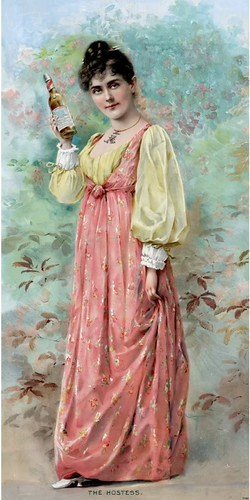
Thursday’s ad is from 1892 and is for Budweiser. I assume what she’s wearing was fashionable in the day, but I’d say that dress is a little too busy, especially against that garish background. There’s a small title at the bottom that reads “The Hostess,” perhaps suggesting this was part of a series? It’s hard to see in this size, but if you click through to see it full-sized, you can see she’s wearing a necklace of the Anheuser-Busch “A” and eagle logo. And take a look at the odd-looking crown and the red stripe below it. I’m no breweriana expert, but that looks very different to me, too.

budweiser-1892

Filed Under: Art & Beer, Beers Tagged With: Advertising, Anheuser-Busch

A Fermentation Question

January 6, 2010 By Jay Brooks

fermentation
I preordered Michal Pollan’s new book, Food Rules, so it arrived on the day it was published. At 112 sparse pages, it’s really more of a pamphlet but I’ve been enjoying reading it off and on for the last few days. When I reached Rule #33 (of 64) it stopped me in my tracks, and it started me thinking. Here’s the rule:

Rule 33

Eat some foods that have been predigested by bacteria or fungi.

Many traditional cultures swear by the health benefits of fermented foods — foods that have been transformed by live microorganisms, such as yogurt, sauerkraut, soy sauce, kimchi, and sourdough bread.

Pollan goes on to list essential nutrients, vitamins, etc. found in these foods. He ends by mentioning that probiotics are contained in many fermented foods, which studies “suggest improve the function of the digestive and immune systems,” and may combat allergies, too.

So here’s my question. If, as Pollan seems to suggest, that it’s fairly settled that fermented foods have health benefits, doesn’t it then follow that fermented beverages would, too?

In Rule 43 he suggests drinking wine with dinner, while not mentioning beer at all. And the man’s from Berkeley, for chrissakes. He appears to be following the old reservatrol canard in choosing wine over other alcohol, though he admits alcohol of any kind can be beneficial in moderation, something that’s becoming increasingly apparent in study after study.

That slight aside, isn’t fermentation fermentation? It’s an anaerobic process (meaning it takes place without oxygen) in which chemical reactions split complex organic compounds into more simple substances. And if it’s good in food, it should be similarly beneficial in beer, wine and spirits, too.

Beer has been called liquid bread since ancient times. It’s nourished men and women since civilization began, and increasingly is believed to have been the very reason for civilization’s beginnings. Some scientists now believe that our ancestor’s tolerance for alcohol in quantity was an important factor in their survival. So much so, that quite literally you and I owe our very existence to the fact that we have an unbroken chain of ancestors stretching back to the dawn of civilization whose ability to process alcohol insured they lived long enough to reproduce. If that had not been the case, I wouldn’t be here to write these words and you wouldn’t be here, reading them now.

Anyway, just some … ahem … food for thought. Any brewers, chemists or scientists out there know if there would be any substantial difference between fermented food and a fermented beverage? I certainly can’t think of any. If not, I would suggest that Food Rule #33 be amended to “Eat some foods or drink some beverages that have been predigested by bacteria or fungi.”

food-rules

Filed Under: Beers, Editorial, Food & Beer Tagged With: Science, Science of Brewing

« Previous Page
Next Page »

Find Something

Northern California Breweries

Please consider purchasing my latest book, California Breweries North, available from Amazon, or ask for it at your local bookstore.

Recent Comments

  • Bob Paolino on Beer Birthday: Grant Johnston
  • Gambrinus on Historic Beer Birthday: A.J. Houghton
  • Ernie Dewing on Historic Beer Birthday: Charles William Bergner 
  • Steve 'Pudgy' De Rose on Historic Beer Birthday: Jacob Schmidt
  • Jay Brooks on Beer Birthday: Bill Owens

Recent Posts

  • Historic Beer Birthday: Herman Zibold April 4, 2026
  • Beer In Ads #5204: Bock Beer! The First Genuine Bock Of The Season April 4, 2026
  • Historic Beer Birthday: Marcus Rapp April 4, 2026
  • Historic Beer Birthday: Henry Thrale April 4, 2026
  • Beer In Ads #5203: Now’s The Time To Say … Blitz Weinhard Bock For Me! April 3, 2026

BBB Archives

Feedback

Head Quarter
This site is hosted and maintained by H25Q.dev. Any questions or comments for the webmaster can be directed here.