7.7
Eldorado BBQ, Brews & Blues Festival (12th annual)
Eldorado Hotel & Casino, 345 North Virginia Street, Reno, Nevada
800.879.8879 [ website ]

7.7
Eldorado BBQ, Brews & Blues Festival (12th annual)
Eldorado Hotel & Casino, 345 North Virginia Street, Reno, Nevada
800.879.8879 [ website ]
With August Busch IV poised to deliver his first big “State of the Company” address to investors next week, he may have to do a little dancing to satisfy the concerns of shareholders and the financial analysts. According to Wall Street, profits from beer over the past two years have fallen an average of 1%, while Anheuser-Busch‘s profits have dipped around 12% during the same period.
Despite efforts to get the numbers on core brands up, sales did not rebound as hoped, with revenue up only 5%. Goldman Sachs analyst Judy Hong laid the blame on imports and craft beers, though recent reports have indicated that import sales are suffering the same declines and slowing as mainstream beer, leaving the craft segment as the only shining star in an otherwise dismal beer industry snapshot.
Hong also said that “Anheuser-Busch largely sat on the sidelines as the global brewing industry underwent a massive consolidation, and prospects of capturing significant growth abroad appear limited,” which seems strange since they appointed Bob Lachky last fall to specifically manage their international business and snapped up new import brands for their portfolio — including beers from international brewing giant InBev — yet a Forbes article echoed similar worries, suggesting that “the company has focused on operations abroad, though the chance to gain real exposure to international beer markets may have passed.”
A separate Forbes article, meanwhile, placed the blame for A-B’s woes on a “shift in consumer tastes to wine, spirits and microbrews” — there’s the craft beer segment again figuring heavily in business analysis. Staff writer Tom Van Riper also indicated A-B was struggling to overcome its “passé image” by spending wildly to reach a younger customer, presumably on such projects as Here’s to Beer, Bud.TV and Mingle Now.
Another state is looking to enhance their revenue by tapping brewers on the shoulder. According to a report in yesterday’s Milwaukee Journal Sentinel, “[t]wo Democratic legislators vowed Monday to try to tap the state’s beer drinkers by seeking approval of a fivefold increase in Wisconsin’s $2-a-barrel beer tax, which has not been raised in 38 years.” Berceau wants to raise the tax to $10 per barrel supposedly to fund programs to “fight drunken driving and treat alcohol addiction and mental illness.” As recent studies have indicated though, such raises rarely result in the goals intended. I’ll never understand why responsible drinkers and brewers who contribute positively to the economy are routinely targeted for this kind of punishment because of a few bad apples. We don’t tax sugar makers and soda companies to fund health centers to treat obesity. We don’t ask people who can enjoy one piece of chocolate cake to foot the bill for over-eaters and the health costs they add to society, nor should we. Berceau wants the tax on a six-pack to be 18 cents, up from its previous level of 3.6 cents, which would add as much as $48 million to the amount people would have to spend to buy the same amount of beer.
“Wisconsin’s beer tax hasn’t been raised since ‘man walked on the moon,’ said Berceau, whose efforts to raise the tax have failed in the past,” suggesting she’s been in bed with her sponsors for some time. Those sponsors, some of whom presumably have made campaign contributions, include “the Wisconsin Prevention Network; the American Society of Addiction Medicine; Mothers Against Drunk Driving; the Mental Health Association of Wisconsin; and the National Association for the Mentally Ill of Wisconsin.”
According to the national Beer Institute, Wisconsin ranked sixth in beer consumption in 2006, with an average of 38.2 gallons consumed for every person 21 and older. Wisconsin’s $2-a-barrel tax is third lowest in the nation, behind the 59-cent levy in Wyoming and the $1.86 tax in Missouri.
I’m not exactly sure who PS Prakasa Rao is. The best I can figure is he’s a scientist or doctor from India who frequently writes for his local newspaper. At any rate, he’s got an editorial piece titled “Beer Is Healthy Food” in today’s Central Chronicle from India.
In today’s editorial, he goes against conventional thinking and outlines how beneficial beer can be, stating that he believes beer to be “better than Milk.”
From the article:
Unless we have a tendency towards abuse, believe it or not, taken in moderation, Beer is actually a very healthy food. It’s full of vitamins and minerals that are good for nerve production, help you concentrate, increase blood circulation, and stimulate the metabolism. The hops, low alcohol content, and carbonation help relax the body.
He goes on to outline additional health benefits and, naturally, caution against binge drinking, along with a list of certain types of people who probably shouldn’t drink. I certainly prefer that to the neo-prohibitionist agenda that if one person can’t handle alcohol, no one else should be allowed to either. Way to go, Doc.
The first Raley Field Brewfest was put on by the Northern California Brewer’s Guild in an effort to raise funds for the fledgling organization. It was a good first fest at a great setting with perfect weather, especially for Sacramento. Because it was a festival by brewers for their own benefit, attendance was better than usual for a first-time event, and there were several breweries who rarely make an appearance at festivals, which made it more interesting than ones with only the usual suspects.
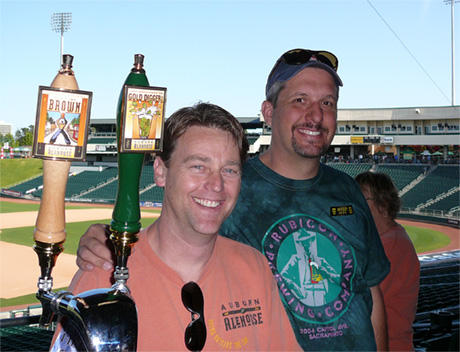
Brian Ford, who returns to the brewing community June 1, when his Auburn Alehouse Brewery & Restaurant is exected to open, with Glynn Phillips, owner of Rubicon and the festival organizer.

Melissa Myers, brewer at Drake’s, serving festival-goers.

Peter Hoey, from Sacramento Brewing, and Steve Altimari, from Valley Brewing.
For many more photos from the Raley Field Brewfest, visit the photo gallery.
Brasserie d’Achouffe, located in the small village of Achouffe in the heart of the Belgian Ardennes, is celebrating its 25th anniversary this year. It was August 27, 1982 that Brasserie d’Achouffe brewed the 1st batch of La Chouffe. From August 10-12, they’ll be a big party at the brewery, which they’re calling La Grande Choufferie, and they’ve set up a website just for the occasion, along with slideshow of thirty photographs that shows the brewery then and now, as well as photographs of the local countryside.
Oh, and did I mention their beer is quite excellent. I’ve got a magnum of the La Chouffe I’m holding onto, which I think I’ll open this August for their 25th anniversary.
The newest beer from Deschutes is in celebration of their latest anniversary. The 19th Anniversary Golden Ale is also part of the Bond Street Series, which are put out in 22 oz. bottles for a limited time. All of the brewers at Deschutes get together and each pitches a style/recipe of beer they want to make in the pilot system as the next Bond Street beer. The brewers then debate the choices and pick the one they all like best, which is then the next beer in the series.
|
From the press release:
“We felt we had to do something special to mark our 19th Anniversary,” said brewmaster Larry Sidor, “so we took a vow of silence and brewed our first Belgian style ale ever to be bottled.”
The straw colored Strong Golden Ale is made from an impressively international list of ingredients that acknowledge the diverse roots of craft beer. “We used Czech Saaz, Slovenian Golding, Pacific Northwest Liberty, and Brewers Gold hops,” said Sidor, “along with French pilsner malt, and Belgian white candy diamonds and bitter orange peel from the island of Curacao for a little extra kick and sizzle.”
The vow of silence, a nod to the Belgian monks who brew some of the world’s most revered beers, may have been the biggest challenge for the brewers at Deschutes. About half way through adding the 180 bags of malt, one of the brewers inadvertently exclaimed, “Good Lord, this is a lot of malt.” Keeping with the spirit of their Belgian counterparts, another brewer answered, “Amen, brother.”
Deschutes Brewery, a pioneer of Oregon’s craft beer industry, opened as a small brew pub in Bend in 1988. As the central Oregon town made the transition from timber and ranching to an outdoor lifestyle destination, the brewery expanded. Deschutes produces 160,000 barrels of craft beer in several distinctive styles which are available in bottles and on tap throughout the region. A new brewpub is scheduled to open in Portland next year.
The 19th Anniversary Belgian-style Strong Golden Ale will be available from June through September in 22-ounce bottles and limited draft.
Jennifer Talley, the head brewer at Squatter’s Pub Brewery, which is operated by Salt Lake Brewing, has brewed the state’s first certified organic beer, an amber ale. Squatter’s is already known for their ecological leanings, having been named a Utah recycler of the year in 2004. So creating an organic beer does seem like the next logical step for them to make. According to the Salt Lake Tribune, Talley used “organic pale and caramel malted barley and aromatic hops,” using “barley is grown from organic seeds, using natural methods of pest control such as lady bugs and composting rather than chemical fertilizers.”
The taste, says brewmaster Jenny Talley, is a caramel-like maltiness with a hint of sweetness. Organic certification requires high levels of cleanliness and sanitation that already were in place, said Talley. But it also requires strict segregation of ingredients “from grain to glass.”
In addition to the Squatters Pub in downtown Salt Lake City, the new organic amber ale is also available at Park City and at the Salt Lake City International Airport. It will also begin appearing on grocery store shelves throughout Utah beginning this summer.
I’ve very much enjoyed Talley’s other beers and am glad to see yet another organic beer from a well-established brewery.
Jenny Talley, brewmaster at Squatters, shows off her Squatters Organic Amber Ale, the Utah’s only certified organic beer.
(Photo by Paul Fraughton, The Salt Lake Tribune)
NOTE: For some reason, the Squatters website requires a username and password, meaning no one can actually visit their website, or it give the following error message, “Insufficient system resources exist to complete the requested service,” with the same result. Hopefully, this is a temporary error and will be fixed shortly.
As my grandfather was fond of saying, “the faster I go, the behinder I get.” I’ve only now gotten around to going through the rest of the photos that I took in Austin, Texas while attending the 2007 Craft Brewers Conference. They’re all pretty random, but they’re now posted at the photo gallery if you’re interested in seeing them.

The White brothers from White Labs bookending Chuck, from Green Fash Brewing, Natalie Cilurzo, from Russian River Brewing, John Harris, from Full Sail Brewing, and Vinnie Cilurzo, also from Russian River.

Greg Koch, me, and Justin Crossley, from the Brewing Network, along with Steve Mosqueda from the Drinking and Writing podcast and Pete Crowley, from Rock Bottom in Chicago.
For many more photos from the Craft Brewers Conference, visit the photo gallery.
Today’s Fresno Bee has a nice little profile of three area craft breweries, Brewbakers Family Restaurant, Full Circle Brewing and Sequoia Brewing. There also several cool, artistic photographs of the beer, such as the one below.
Full Circle Brewery’s Red Ale, top, and Cluster-Fuggle.
(Photo by Darrell Wong, The Fresno Bee)