4.27
Dinner with the Brewmaster: Steve Altamari of Valley Brewing
Cathedral Hill Hotel, 1101 Van Ness Avenue, San Francisco, California
415.674.3406 [ website ]

4.27
Dinner with the Brewmaster: Steve Altamari of Valley Brewing
Cathedral Hill Hotel, 1101 Van Ness Avenue, San Francisco, California
415.674.3406 [ website ]
By the time you read this, you can walk into the Lewes Arms in Sussex, England and once more order a pint of the local favorite, which is brewed down the road, Harveys Best Bitter. Since last December, when Greene King pub owner pulled Harvey’s tap because their own Greene King beer wasn’t selling nearly as well, the Friends of the Lewes Arms have been boycotting the pub asking for Harvey’s ale to be reinstated.
Throughout the boycott, the giant Greene King acted the part of bully with perfect arrogance and cluelessness. Their actions created something of a P.R. nightmare for them, and in the end doomed them to failure. Even when the writing was on the wall, they continued to act like bullies who could and would do whatever they wanted in the name of business. But eventually they capitulated, saying they would take another look at the issue. On April 20, they announced Harvey’s would be returned to the pub. Both the BBC and the Publican reported the news (as did fellow beer blogger Stonch), with Greene King making the following statement.
|
Today, Thursday April 26, Harveys Best Bitter will be on tap once more at the Lewes Arms, which is excellent news indeed. Congratulations to the Friends of the Lewes Arms.
Science Daily asks “When Are Minimum Legal Drinking-age And Beer-tax Policies The Most Effective?” in reporting on a new study about to be published in the May issue of “Alcoholism: Clinical & Experimental Research.” The study, “The Joint Impact of Minimum Legal Drinking Age and Beer Taxes on US Youth Traffic Fatalities, 1975-2001,” was funded by the National Institute on Alcohol Abuse and Alcoholism, a government agency and branch of the N.I.H. Their mission statement is to “provide leadership in the national effort to reduce alcohol-related problems.”
The study looked at the two most common ways in which government has tried to reduce alcohol-related societal problems: through the minimum drinking age and raising taxes on beer (notice how wine and spirits get yet another pass?). Most significant is the finding that “[w]hen it is illegal for youth to buy and consume beer — as it is now in all 50 US states — higher beer taxes are less effective.” Hear that Oregon legislators (and every other state official trying to extort money from small brewers)?
“Our findings suggest that some of the varying results across past research may simply indicate that a given public policy may not have the same effectiveness in all places and times,” said William R. Ponicki, one of the study’s authors. What that doublespeak means is essentially that for any given policy decision, many other factors determine whether the policy will work as intended or not. It’s not just a simple matter that raising the drinking age will cure underage drinking or that making beer more expensive will either. And that’s just looking at two very broad factors. Imagine all the others at work but not examined, such as peer pressure, alcohol’s perception in our culture, accessibility, and on and on.
What that suggests to me is that MADD and the other neo-prohibitionists were and are misguided in pushing for a higher minimum drinking age, tougher access for legal adults, higher taxes for alcoholic beverages and all the other harebrained ideas on their agenda without having any real notion of how they’ll effect society or even if they have a chance of working. There’s absolutely no reason that legal adults should have to pay more for legal products or have a harder time legally buying them, especially when such measures have not been shown to be effective in reducing any perceived problems. Frankly, I’m sick and tired of being in their petri dish of experimental legislation to mold society to their wishes. It’s my world, too. And yours, as well. We should try to remember that, I think, when fanatics try to remake it for their own benefit and worldview.
The Syracuse Post-Standard ran a nice article entitled “Good beer deserves the right glass” by staff writer Don Cazentre, who’s also a homebrewer. He provides a good rudimentary introduction to the importance of drinking beer not just from a glass, but from the proper glass. It’s another good example of better beer coverage by the media.
After being closed for several months, next Friday May 4th, Full Sail will be re-opening their Pub and Tasting Room. Here’s the press release:
Full Sail Tasting Room & Pub Grand Opening Friday, May 4th
Hood River — After months of planning, design, construction, remodeling and lot’s of recipe tastings, Full Sail Brewing is reopening their pub. The Grand Opening will be on Friday May 4th, 2007, in the same spectacular location with the same great beers. What is new is a more comfortable seating area that highlights the view of the Columbia River and the Gorge and a special menu designed to celebrate Full Sail’s beers.
The menu will include many dishes designed to share such as the brewmaster’s ploughman platter and hand cut Belgium style fries with a variety of sauces. Also on the menu is an assortment of sandwiches including two New Orleans specials – a muffuletta and a crispy shrimp poor boy. “Big dishes” include Session battered fresh Alaskan halibut and hand-cut fries with lemon-caper tartar sauce and Amber ale barbecued pork loin with hot mustard, grilled scallions, cilantro and coconut sticky rice. There will also be some delicious vegetarian dishes.
“To update our Pub after twenty years so that it celebrates and reflects the quality of beers as well as the growth of Hood River itself has been a very fun and satisfying project. It is a twentieth anniversary present for all of us at Full Sail and for our customers,” said Irene Firmat, Full Sail’s CEO & Founder. “Most of all we are thrilled to offer a menu that will complement our award winning brews and take advantage of the wealth and quality of local ingredients. We have also added several new members to the Full Sail crew – Chef Brian Hutchins, in the kitchen and Robert Carpenter as our front of the house manager. We are happy that our continuing investment in the brewery keeps offering the opportunity to create more employee owners,” added Firmat. Swing by the Full Sail Tasting Room and Pub to taste of Chef Brian’s tempting talents along with a cold pint of Full Sail.
The independent and employee-owned Full Sail brewery is perched on a bluff in Hood River, Oregon, overlooking the most epic wind and kite surfing spot in the world. At this very moment 47 specialists in the liquid refreshment arts are crafting barley and hops into your next beer. The Full Sail crew has been fermenting godlike nectar since 1987. Their award winning brews are now available in 17 states. The Full Sail Tasting Room and Pub is open seven days a week. Swing by for a pint, grab a bite, tour the brewery, or just soak up the view. The Tasting Room and Pub will be open daily from 11:30 am for lunch and dinner. Brewery tours are still available daily, free of charge at 1, 2, 3 and 4pm.
Each year, Beer Serves America, a joint venture by the National Beer Wholesalers Association and the Beer Institute, put together statistics on just how much money and jobs the brewing industry directly and indirectly pumps into the U.S. economy. It’s a pretty staggering amount, really, and is broken down in a variety of ways to give you a good idea of just where the contributions to the economy come from.
It’s an excellent rebuttal to the neo-prohibitionist position that alcohol does nothing for society, and I’ve rarely seen any of their groups address these positive statistics that show year after year how much is contributed to our society by beer and brewers.
Here’s the press release:
New Study Shows Beer Industry Contributes Billions Annually to U.S. Economy
Report Tallies Jobs, Wages, and Overall Economic Impact
WASHINGTON, D.C. – America’s beer industry, made up of brewers, beer importers, beer distributors, brewer suppliers, and retailers, directly and indirectly contributes nearly $190 billion annually to the U.S. economy according to a new economic impact study. The industry’s economic impact includes more than 1.7 million jobs—paying almost $55 billion in wages—as well as more than $36 billion in federal, state, and local taxes. The study of 2006 data was commissioned by the Beer Institute and the National Beer Wholesalers Association (NBWA).
“This study shows that more than ever, America’s brewers play a pivotal role in promoting strong and robust economic growth throughout our country,” said August A. Busch IV, president and chief executive officer, Anheuser-Busch Companies, Inc., and chairman of the Beer Institute. “Brewers in all 50 states have been supporting the economy in their communities for generations, creating jobs for their neighbors, tax revenue for public services, and promoting alcohol awareness responsibility initiatives for retailers, schools, and families.”
According to the study, the direct output of brewers, importers, beer distributors, and retailers into the American economy is almost $90 billion each year. The beer industry directly employs more than 900,000 Americans, paying them more than $25 billion in wages. Large and small brewers and beer importers employ 47,000 people, and the nation’s 2,750 beer distributors employ approximately 91,000 individuals across the country. Beer is a key driver of profitability for the more than 531,000 licensed beer retailers, according to TDLinx, a service of The Nielsen Company and the recognized leader in location information management. Beer sales help support roughly 800,000 jobs at these retailers, which include supermarkets, convenience stores, restaurants, bars, and other outlets.
“Beer distributors are independent family businesses like mine that provide a wide selection of fresh, quality beer to the nation’s retailers and strengthen the U.S., state, and local economies. Over 90,000 hard-working men and women across the country are employed by America’s beer distributors. These people do not work for minimum wage. They earn quality wages and benefits,” said Betty Buck, NBWA board chair and president of Buck Distributing Co. in Upper Marlboro, Maryland.
The production of beer helps support other segments of the economy as well. For example, the study showed more than $4 billion in economic contributions for the agricultural sector, including malting barley ($537.8 million), hops ($280.7 million), brewers rice ($222.9 million), and brewers corn ($58.4 million).
“These figures demonstrate that the beer industry extends beyond those who make and distribute our products,” said Jeff Becker, president of the Beer Institute. “As the single largest purchaser of rice in the country and one of the leading purchasers of other agricultural goods, the beer industry’s contributions to America’s farm economy are helping support rural families and small businesses coast to coast.”
“Millions of hard-working Americans earn their livelihood in brewing or beer distribution. This is an industry that takes great pride in the fact that its employees have good wages, employer-provided health care, and good benefits,” said NBWA president Craig Purser. “America’s beer distributors also work within a framework of individual state laws to ensure their products are sold only to licensed retailers who in turn are responsible for selling only to adults of legal drinking age.”
In addition to strengthening the U.S. economy, the industry plays a significant role in promoting responsible consumption of its products. Brewers, importers, and independent beer distributors have invested hundreds of millions of dollars in communities across the country to develop and implement numerous programs to promote responsibility and help fight alcohol abuse. These efforts, along with those of parents, law enforcement, educators, federal and state alcohol beverage regulators, and other community groups, have contributed to declines in illegal underage drinking and drunk driving over the past two decades, according to a variety of independent and government data.
The complete Beer Serves America Economic Impact study, including state-by-state and congressional district breakdowns of economic contributions, is available at the Beer Serves America Web site, www.beerservesamerica.org.
Vinnie Cilurzo gave the keynote address at this year’s Craft Brewers Conference in Austin, Texas. Hoping to spark a new tradition, like Sam Calagione last year, he served some of his own beer so everyone assembled could drink a toast to craft beer’s success and to everyone’s efforts that led to that success. He set out bottles of the second batch of Russian River’s Beatification.

Vinnie spoke in part about innovation and the innovative contributions of many of the early pioneers of craft brewing. The video below is a little more than half of Ciilurzo’s speech from near the beginning until the toast. My memory card ran out at that point.
Last year, my friend and author Maureen Ogle was having a book release party at Anchor Brewery in San Francisco and she asked me to help her put together the guest list since I lived here and she was in Iowa. When she sent me her preliminary list of guests I was very surprised to see Jack McAuliffe’s name and address among them. It had been quite some time since anyone knew where McAuliffe was and I had heard he’d made it abundantly clear he wanted to keep it that way. I immediately asked about Jack, and Maureen told me that in the course of working on her book Ambitious Brew that she’d become good friends with him.
I mentioned all of this to Vinnie Cilurzo of Russian River Brewing a week or so later and he told me that Jim Koch was looking for McAuliffe because he wanted the Brewers Association to honor him and New Albion Brewery for his great contribution to the craft beer industry. At GABF I let Koch that Maureen knew how to reach McAuliffe and the rest, as they say, is history. At this year’s Craft Brewers Conference, the Brewers Association Recognition Award was given to Jack McAuliffe, founder of New Albion Brewing Company in Sonoma, California.
From the press release:
The Brewers Association Recognition Award went to Jack McAuliffe, founder of New Albion Brewing Company. McAuliffe’s inspiration, enthusiasm and support have contributed to the development of American craft beer movement.
Steve Bradt, Head Brewer at Free State Brewing Company and Brewers Association Board of Directors member says, “As founder of what author Maureen Ogle calls ‘…the most important failed brewery industry’s history, the New Albion Brewing Co.’ Jack McAuliffe epitomizes the kind of tough, ingenious, and fiercely independent men and women who have come since in the Craft Brewing world. In fact, probably find reason to present him with each of the awards presented today, not just this one.”
Even though New Albion Brewery lasted only a few short years, it’s influence on the future of microbreweries cannot be underestimated. We all owe Jack a debt of gratitude. Pick up Ambitious Brew for the most thorough account of that period of history. Unfortunately, McAuliffe could be coaxed out of his self-imposed isolation. Instead, his assistant brewer, Don Barkley, was on hand to accept the honor on his behalf. After New Albion closed in 1982, Barkley went on to success as Mendocino Brewing’s brewer.

Bradt giving the Brewers Association Recognition Award to Don Barkley, who accepted it on behalf of Jack McAuliffe, founder of New Albion Brewing Company, who was unable to be present.
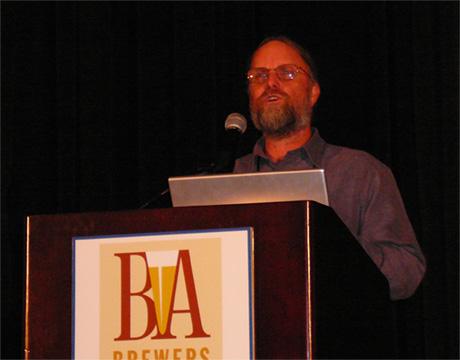
Don Barkley reminisced about working at New Albion and about McAuliffe. Maureen Ogle asked me take a picture since she wasn’t able to be there either, and I decided I could make her feel more like she was actually there my shooting some video with my camera, so that’s what I did and it’s below here.
There’s a new budget bill before the Ohio state legislature that was intended to allow self-distribution of wine to retailers along with mail order wine. That’s all well and good, but somebody snuck into the amendment a provision “barring brew pubs from selling takeout bottles and sealed jugs of beer.” The author of the budget amendment, House Finance Chairman Matt Dolan (Republican), claims to have no idea how or who put in the anti-brewpub language.
The Wholesale Beer & Wine Association is reluctantly supporting the measure (they’re opposed to the direct sale of wine), but only if the brewpub language is deleted.
It was first noticed and reported on April 20, and by the next day several trade groups were in talks with lawmakers. On Saturday, the Cleveland Plain Dealer was editorializing how bad it would be for the state’s small brewers and had elicited a promise from the bill’s sponsor, Matt Dolan, “keep the brew pub provision out of the bill.”
Curiously, some early reporting highlighted the benefit to the wine business while ignoring the potentially mortal blow being dealt to brewpubs and the beer community. Luckily, most are now reporting about the problems that will be created by the newly inserted language, such as an AP report entitled “Wine-sales amendment called flawed.” It appears likely now that the anti-beer language will be removed, but if you’re in Ohio, I’d recommend contacing your representative and urging him or her to make sure that it does get taken out. We can’t be too careful about these things. As this episode so aptly illustrates, neo-prohibitionists will stoop low to damage the beer industry if they think they can get away with it
When the dust settles on this, I’d really like to see them investigate who it was that was so hostile to beer and tried to effectively kill Ohio’s brewpub business. We should all know what or who we’re up against in the fight against neo-prohibitionists, but it’s even worse when they don’t show their face and work clandestinely under cover of darkness.
The San Francisco Chronicle reprinted one of George Will’s editorials, “Licensed to Drink,” from the Washington Post. In it, he critiques Choose Responsibility, the new advocacy organization founded by John M. McCardell Jr., the former Dean of of Middlebury College in Vermont. Having watched young people at his college, he decided that the drinking age of 21 was making the problem worse rather than helping it, which was the goal of raising it. I don’t often agree with George Will and in my opinion he’s sometimes a right wing nutjob, albeit more articulate than most, but he has some thoughtful ideas expressed in this piece, and surprisingly he isn’t against it. Given that he was a speech writer for Ronald Reagan, who gave in to MADD and came up with “Just Say No,” that was a something of a surprise to say the least. But this is a debate that’s not going away, and it’s interesting to hear about from so unlikely a source.