Brookston Beer Bulletin

Jay R. Brooks on Beer

  • Home
  • About
  • Editorial
  • Birthdays
  • Art & Beer

Socialize

  • Dribbble
  • Email
  • Facebook
  • Flickr
  • GitHub
  • Instagram
  • LinkedIn
  • Pinterest
  • RSS
  • Twitter
  • YouTube

Powered by Genesis

Beer Birthday: Lisa Morrison

July 11, 2025 By Jay Brooks

belmont-station

Today is the 62nd birthday of my good friend Lisa Morrison (a.k.a. the The Beer Goddess). Lisa did a radio show, Beer O’Clock with The Beer Goddess, was the Portland correspondent for the Celebrator, and is also the author of Craft Beers of the Pacific Northwest: A Beer Lover’s Guide to Oregon, Washington, and British Columbia. More recently, she shifted her focus and became a co-owner of Portland’s best beer store, Belmont Station. Join me in wishing Lisa a very happy birthday!

Me, Alan Sprints and Lisa at Hair of the Dog Brewery in 2022.
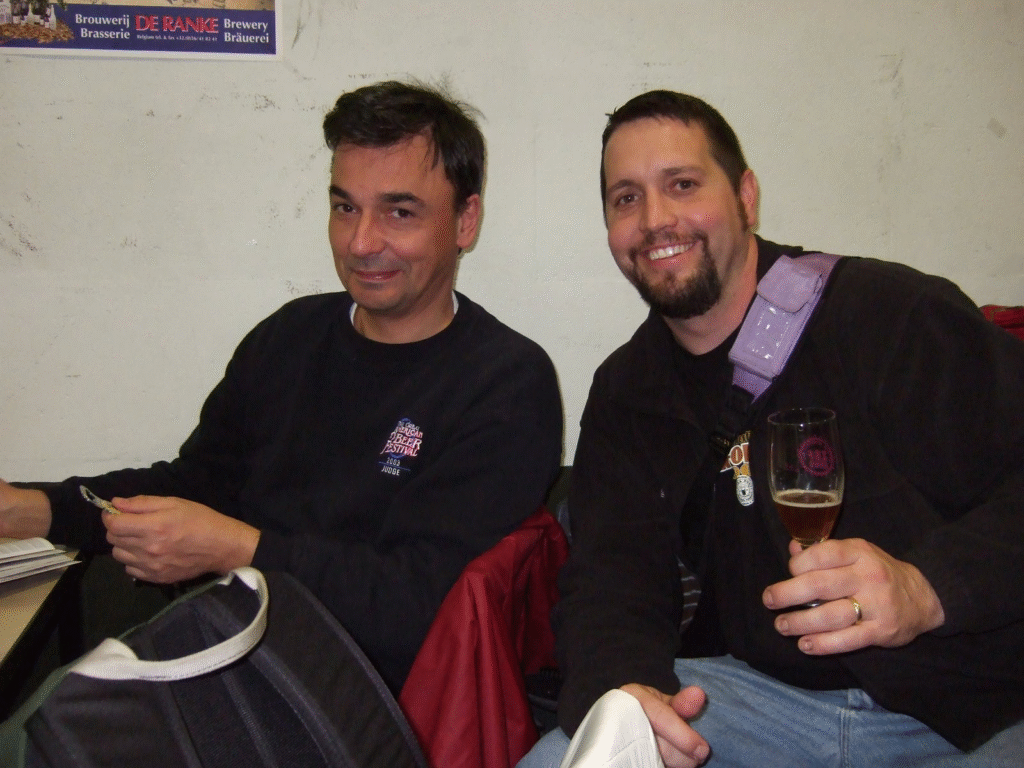
Me (behind the camera) Lisa and Luc De Raedemaeker toasting.
Taking Lisa and Mark to Russian River’s new Windsor brewery.
Me, John Holl, Bob Townsend, Don Russell, Lisa, Tony Forder and Jason Alstrom in Boston judging the old Samuel Adams’ Longshot Homebrew Competition in 2015.
Having our daily tea for our annual Tea Advent Calendar, but in person a few years ago.
Lisa enjoying a Westy at the source a few years ago, or at least across the street from the Abbey.
Lisa and me in Iceland a couple of years back.
Having fun with the giant opener at the Brussels Beer Challenge.
beer-goddess-01
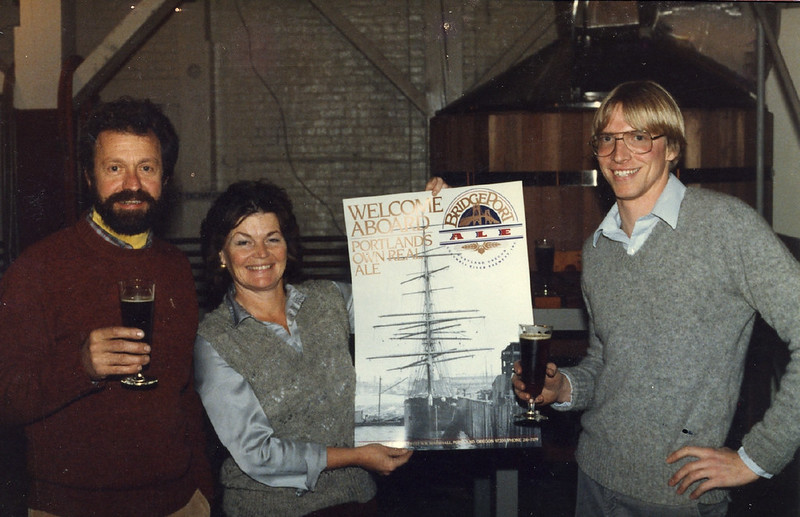
In front of BridgePort with promotional goddess Chris Crabb, who handles PR for the brewery and also the Oregon Brewers Festival.
beer-goddess-02
Lisa with fellow Portland beer writer Fred Eckhardt.
dick-c-1
With Dick Cantwell at an Elysian event during OBF.
obf-concordia
Me, Celebrator publisher Tom Dalldorf, Lisa’s husband Mark & Lisa in front of the three pink elephants. There’s an interesting story about this mural at Concordia Public House in Portland. It turns out that the building used to be a speakeasy called the Pink Elephant. The mural was discovered during renovations hidden behind several layers of wallpaper and paint along with an old matchbook that gave away the original name.
lisa-and-me-lux
Lisa and me in Luxembourg several years ago.

Filed Under: Birthdays Tagged With: Oregon, Portland

Historic Beer Birthday: Don Younger

July 11, 2025 By Jay Brooks

horsebrass
Today would have been publican extraordinaire Don Younger’s 84th birthday. He ran the famed Horse Brass pub in Portland, Oregon, along with a few others, for many years. Don was a wonderful person and his early and continuing support of craft beer helped make Portland the great beer town it is today. As you undoubtedly recall, Don passed away unexpectedly in January, ten years ago, in 2011. Join me in wishing Don a very Happy birthday and raising a toast to his memory.

Me and Don outside on the street somewhere.
A motley crew at Falling Rock.
Tom Dalldorf and DOn.
younger-silva
Don and Mark Silva, co-owner of realbeer.com and realbranding.com.
jewbel2
Don Younger and me outside the Falling Rock in Denver, Colorado.
dyoung-1
Don with braided hair with Shaun O’Sullivan from 21st Amendment Brewery.
10, 20, 30: The same year, Dave Keene (center) was celebrating his 20th anniversary, flanked by Don Younger (on the left), whose bar the Horse Brass in Portland celebrated its 30th anniversary, and Chris Black (on the right), whose Denver, Colorado bar, The Falling Rock, celebrated its 10th anniversary.
gabf07-48
Don bookended by Robin and Jonathan Surratt, who ran beermapping.com, displaying his excellent taste in attire at the Falling Rock during GABF week 2007.
A toast to the master.

Filed Under: Birthdays Tagged With: Oregon, Portland

Beer In Ads #5021: Olympia Bock Beer

July 10, 2025 By Jay Brooks

Last year I decided to concentrate on Bock ads. Bock, of course, may have originated in Germany, in the town of Einbeck. Because many 19th century American breweries were founded by German immigrants, they offered a bock at certain times of the year, be it Spring, Easter, Lent, Christmas, or what have you. In a sense they were some of the first seasonal beers. “The style was later adopted in Bavaria by Munich brewers in the 17th century. Due to their Bavarian accent, citizens of Munich pronounced ‘Einbeck’ as ‘ein Bock’ (a billy goat), and thus the beer became known as ‘Bock.’ A goat often appears on bottle labels.” And presumably because they were special releases, many breweries went all out promoting them with beautiful artwork on posters and other advertising.

Thursday’s poster is for Olympia Bock Beer, and was published around the 1910s. This one was for the Pilsen Brewing Co. of Chicago, Illinois, which was originally founded in 1903 by a group of Bohemian tavern owners.

Filed Under: Art & Beer, Beers, Breweries, Just For Fun Tagged With: Advertising, Bock, Chicago, History, Illinois

Historic Beer Birthday: Francis Showering

July 10, 2025 By Jay Brooks

babycham
Today is the birthday of Francis Showering (July 10, 1912-September 5, 1995). Showering was an English brewer. His family company, Showerings, invented Babycham, a light, sparkling perry, launched in 1953 and originally marketed as “genuine champagne perry”.

Mr-Showering-1

Here’s Showering’s obituary from The Independent in 1995:

Francis Showering was a remarkable man who achieved extraordinary success in the drinks industry over many years. He was still in harness as chairman of the drinks company Brothers Drinks at the time of his death, aged 83.

Born at Shepton Mallet, in Somerset, in 1912, Francis Showering was one of four brothers whose first employment at an early age was with their parents, who were innkeepers in Shepton Mallet, brewing beer and cider to their own requirements and for sale to other licensed houses in the district. Business was highly competitive. As a small concern they were overshadowed by the regional and national brewers and were also unable to sell their ciders against the national brands. During the Second World War they kept the business going in spite of shortage of raw materials and somehow built up a delivery fleet of mainly elderly vehicles which were sustained by an innovative transport department.

After the war they again suffered the frustration of lacking outlets for their products, and Francis Showering, by then managing director, turned to Perry as a potential for breaking into the brewer-dominated licensed trade. Sparkling Champagne Perry in baby bottles became the brand Babycham, and in due course became the drinks industry’s marketing success of the century.

babycham-coaster-3

First, however, it had to be established as a quality product and Showering excelled in the meticulous supervision of the production process to give an attractive sparkling drink well packaged and with a long shelf-life. Marketing and customer service received his equally uncompromising attention, with the result that, after extensive testing in local markets, Babycham was launched nationally in the early 1950s and became a cult drink for women in pubs and clubs. With the sprightly little Bambi deer symbol, Babycham glasses and cocktail cherry, this was exactly the drink that millions of women were waiting for. The simple slogan “I’d love a Babycham” said it all, and they loved it enough to consume over 4 billion bottles in the next 30 years.

The Showerings offered shares to the public in 1959. The issue was over- subscribed. Not only did it increase the wealth of the family but the creation of a public company gave Francis Showering and his brothers the means of acquiring other companies in the drinks industry. William Gaymer, Vine Products, Whiteways, and Britvic fruit juices were among those acquisitions, and the largest came in 1966 with the takeover, after a considerable battle, of Harvey’s of Bristol which brought with it world-wide interests in wines and spirits.

babycham-coaster-2

In 1968 Allied Breweries, already much involved in the drinks industry apart from brewing, made an agreed bid for Showerings Vine Products and Whiteways Ltd of pounds 108m. Thus the original shareholders in the Showerings company were rewarded yet again, and Francis Showering could take all credit for that.

Initially, the marriage was not an easy one. The different cultures of the two groups had to be reconciled and that took several years, but in no way inhibited the continued growth of the combined company. Showering’s nephew Keith Showering (later Sir Keith) became chairman in 1975. After seven years in office he died suddenly in 1982, when Francis became vice- chairman and continued to support the company in every possible way.
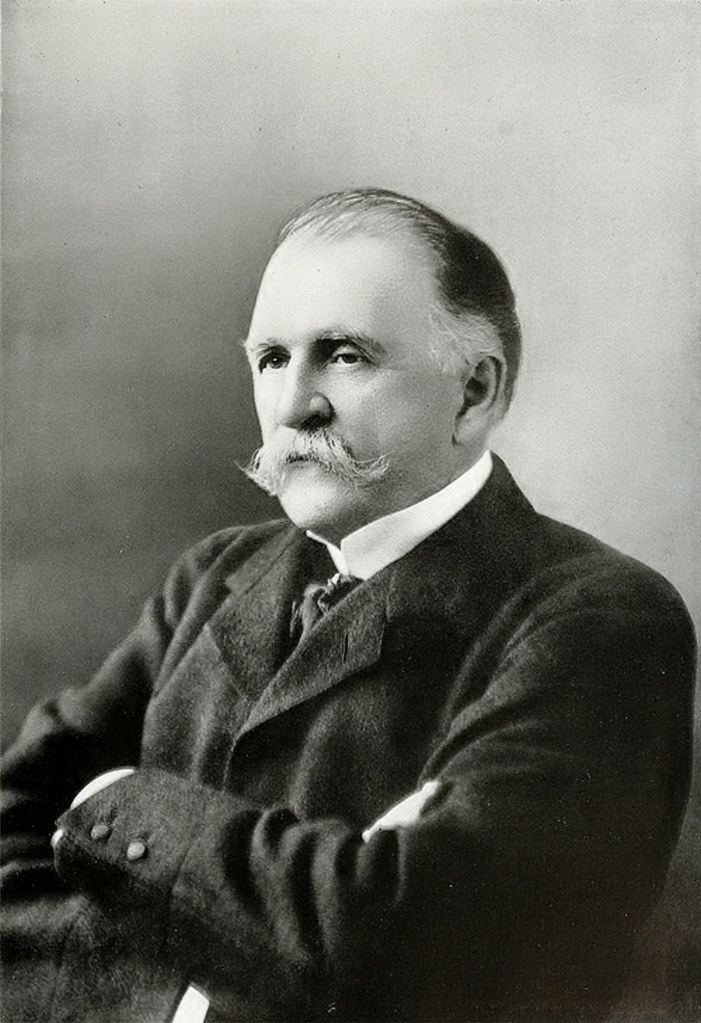
Francis Showering was a man of great determination and strength of character. The success of Babycham entitled him to have uncompromising views on the production and marketing of drinks generally, and the activities of the group in particular, and he could be relied upon to make those views known. Yet he was also a good listener, and when convinced of the loyalty of his colleagues gave it back in full measure.

babycham-coaster-1

He was also generous to the extreme. His loyalty and generosity to Shepton Mallet are evident in the modern development of the town centre, at his own expense. One of his great pleasures was entertaining at his house on the Beaulieu River, and aboard his motor cruiser Silver Cavalier, which gave him further opportunities to pursue perfection in maintenance and navigation.

Showering was appointed CBE in 1982; it was a reflection of his work for the community in West Country agriculture and at Shepton Mallet as well as his success in building a whole business structure on that little bottle of Babycham.

Sir Keith Showering had two daughters and four sons. In his closing years, through the formation with these four great-nephews of a new drinks company, Brothers Drinks, which he chaired, Francis Showering saw and encouraged, the possibility of an experience for them such as he and his brothers had had, and so much enjoyed.

Showerings
From left; Ralph and Keith Showering, R. N. Coate, Herbert, Francis and Arthur Showering, at the time of the ‘merger’ of the two cider makers.

This is a short history of Babycham from his Wikipedia page:

In the 1940s, the company developed a process to produce perry — a form of cider made from fermented pear juice – and created a low-alcohol sparking drink that was christened Babycham. The new drink was marketed mainly at young women, and sold in small bottles to be served in a champagne saucer – “the genuine champagne perry sparkling in its own glamorous glass”. After disputes with French champagne produces, including a court case in 1978, H P Bulmer Ltd v J Bollinger SA which held that marketing of a similar sparkling cider was not confusing, the reference to champagne was eventually prohibited by EU rules on protected designation of origin.

The drink became very popular, with its advertising slogan “I’d love a Babycham” and logo of a small deer. To serve the burgeoning demand, the company bought pear orchards across the West Midlands, and planted new pear orchards in Somerset. Output in Shepton Mallet reached 108,000 bottles an hour in 1966, and new plants were opened in Ireland and Belgium.

babycham-advert

Babycham

Filed Under: Birthdays, Just For Fun Tagged With: Cider, Great Britain, UK

Historic Beer Birthday: Frank Yoerg

July 10, 2025 By Jay Brooks

yoerg
Today is the birthday of Frank Yoerg (July 10, 1867-July 13, 1941). He was the third oldest son of Anthony Yoerg, who founded Minnesota’s first brewery in 1848. He “attended MIT (Massachusetts School of Technology) in Boston and worked as an architect for four years before he joined the family trade where he was a ‘collector’ from 1893-1896, the bookkeeper from 1899-1904, Vice President from 1904-1905, President from 1905-1934 and secretary from 1934 until his death in 1941.”

frank_yoerg
The brewery was known as the Anthony Yoerg Brewery from its beginning until 1896, when its founder passed away, then it was changed to simply the Yoreg Brewing Co. The brewery opened after prohibition ended, and continued in business until 1952.

Yoergs-Beer-Labels-Yoerg-Brewing-Company-1933
A Yoerg’s Cave Aged Beer label from 1933, when Frank was still president.
A new Yoerg’s Beer started up again in Saint Paul in 2015, with plans to offer the first beer shortly, and according to their Facebook page, the beer is in the bottle and they’re awaiting federal label approval, with plans to introduce Yoerg’s Bock this Fall.

yoergs_snow_skiing_-1915
Frank and Anthony Yoerg Jr. with their wives at the St. Paul Winter Carnival in 1915

Filed Under: Birthdays, Just For Fun Tagged With: History, Minnesota

Historic Beer Birthday: Jack “Legs” Diamond

July 10, 2025 By Jay Brooks

moonshine
Today is the birthday of Jack “Legs” Diamond (July 10, 1897–December 18, 1931). He was “also known as ‘Gentleman Jack,’ [and] was an Irish American gangster in Philadelphia and New York City during the Prohibition era. A bootlegger and close associate of gambler Arnold Rothstein, Diamond survived a number of attempts on his life between 1916 and 1931, causing him to be known as the “clay pigeon of the underworld”. In 1930, Diamond’s nemesis Dutch Schultz remarked to his own gang, “Ain’t there nobody that can shoot this guy so he don’t bounce back?”

jack-legs-diamond-2

Here’s his biography from Find-a-Grave:

Gangster bootlegger. Born Jack Moran on July 10, 1897, in Philadelphia, Pennsylvania, to an Irish immigrant family. After his mother, Sara’s death, Diamond moved with his father and brother to Brooklyn, New York. Growing up impoverished, Diamond turned to street gangs and became involved in theft and violent crime as a teen. He later began to work for gangsters Arnold Rothstein and Jacob “Little Augie” Orgen. Jack set up shop as an extremely violent and murderous figure. He earned his “Legs” nickname either due to his quickness when running from a scene or because of his excellent dancing skills. He also married Alice Schiffer in 1926. She remained devoted to Jack through his strings of crime and mistresses, which included a notable affair with Ziegfeld showgirl Kiki Roberts. In August, 1927, Jack played a role in the murder of “Little Augie” (Jacob Orgen). Jack’s brother Eddie was Orgen’s bodyguard, but Legs Diamond substituted for Eddie that day. As Orgen and Jack were walking down a street on the Lower East Side of Manhattan, three young men approached them and started shooting. Orgen was fatally wounded and Jack was shot two times below the heart. He was taken to Bellevue Hospital, where he eventually recovered. During the late 1920s, Prohibition was in force, and the sale of beer and other alcohol was illegal in the United States. Jack traveled to Europe to score beer and narcotics, but failed. He did score liquor which was dumped overboard in partially full barrels which floated into Long Island as ships entered New York. Following Orgen’s death, Jack went to work overseeing bootleg alcohol sales in downtown Manhattan. That brought him into conflict with Dutch Schultz, who wanted to move beyond his base in Harlem. He also ran into trouble with other gangs in the city. In 1930, Jack and two henchmen kidnapped Grover Parks, a truck driver in Cairo, New York, and demanded to know where he had obtained his load of hard cider. When Parks denied carrying anything, Jack and his men beat and tortured Parks, eventually letting him go. A few months later, Jack was charged with the kidnapping of James Duncan. He was sent to Catskill, New York for his first trial, but was acquitted. However, he was convicted in a federal case on related charges, and he was sentenced to four years in jail. In a third trial, in Troy, New York, he was acquitted. On October 12, 1930, Jack was shot and wounded at the Hotel Monticello on the west side of Manhattan. Two men forced their way into his room, shot him five times, and then fled. Still in his pajamas, he staggered out into the hallway and collapsed. On December 30, 1930, Jack was discharged from Polyclinic. On April 27, 1931, Jack was again shot and wounded, this time at the Aratoga Inn, a road house near Cairo, New York. He was eating in the dining room with three companions when he walked out to the front door. A gunman with a shotgun shot him three times, and Jack collapsed by the door. On December 18, 1931, Jack’s enemies finally caught up with him, At 4:30 am, Jack went back to the rooming house and passed out on his bed. Two gunmen entered his room around 5:30 AM. One man held Jack down while the other shot him three times in the back of the head. No other gangster of the bootlegging era of 1920’s survived more bullet wounds than Legs. He was known as “The Clay Pidgeon of the Underworld”. On July 1, 1933, Jack’s widow, Alice Kenny Diamond, was found shot to death in her Brooklyn apartment. It was speculated that she was shot by Jack’s enemies to keep her quiet.
BE033346

This is about his arly life from his Wikipedia page:

Diamond was born July 10, 1897, to Sara and John Diamond, who emigrated from Ireland in 1891 to Philadelphia, USA. In 1899, Jack’s younger brother Eddie Diamond was born. Jack and Eddie both struggled through grade school, while Sara suffered from severe arthritis and other health issues. On December 24, 1913, Sara died from complications due to a bacterial infection and high fever. John Diamond, Sr. moved to Brooklyn shortly afterwards.

Diamond soon joined a New York street gang called the Hudson Dusters. Diamond’s first arrest for burglary occurred when he broke into a jewelry store on February 4, 1914, with numerous arrests following through the remainder of his life. Diamond served in the U.S. Army during World War I, but deserted in 1918 or 1919, then was convicted and jailed for desertion.

Once free of jail, Diamond became a thug and later personal bodyguard for Arnold Rothstein in 1919.

On October 16, 1927 Diamond tried to stop the murder of “Little Augie” (Jacob Orgen). Diamond’s brother Eddie was Orgen’s bodyguard, but Legs Diamond substituted for Eddie that day. As Orgen and Diamond were walking down a street on the Lower East Side of Manhattan, three young men approached them and started shooting. Orgen was fatally wounded and Diamond was shot two times below the heart. Diamond was taken to Bellevue Hospital, where he eventually recovered. The police interviewed Diamond in the hospital, but he refused to identify any suspects or help the investigation in any way. The police initially suspected that Diamond was an accomplice and charged him with homicide, but the charge was later dropped. The assailants were supposedly hired by Louis Buchalter and Gurrah Shapiro, who were seeking to move in on Orgen’s garment district labor rackets.

Diamond was known for leading a rather flamboyant lifestyle. He was a very energetic individual; his nickname “Legs” derived either from his being a good dancer or from how fast he could escape his enemies. His wife Alice was never supportive of his lifestyle, but did not do much to dissuade him from it. Diamond was a womanizer; his best known mistress was showgirl and dancer Marion “Kiki” Roberts. The public loved Diamond; he was Upstate New York’s biggest celebrity at the time.

jack-legs-diamond-6

And this is about his time during “Prohibition and the Manhattan Bootleg Wars:”

During the late 1920s, Prohibition was in force, and the sale of beer and other alcohol was illegal in the United States. Diamond traveled to Europe to score beer and narcotics, but failed. He did obtain liquor, which was dumped overboard in partially full barrels, which floated onto Long Island, as ships entered New York. He paid the children a nickel for every barrel they brought to his trucks.

Following Orgen’s death, Diamond went to work overseeing bootleg alcohol sales in downtown Manhattan. That brought him into conflict with Dutch Schultz, who wanted to move beyond his base in Harlem. He also ran into trouble with other gangs in the city.

In 1930, Diamond and two henchmen kidnapped Grover Parks, a truck driver in Cairo, New York, and demanded to know where he had obtained his load of hard cider. When Parks denied carrying anything, Diamond and his men beat and tortured Parks, eventually letting him go. A few months later, Diamond was charged with the kidnapping of James Duncan. He was sent to Catskill, New York, for his first trial, but was acquitted. However, he was convicted in a federal case on related charges, and sentenced to four years in jail. In a third trial, in Troy, New York, he was acquitted.

legs

And this is about the many assassination attempts, prosecution attempts, and his eventual death:

On October 12, 1930, Diamond was shot and wounded at the Hotel Monticello on the west side of Manhattan. Two men forced their way into Diamond’s room, shot him five times, and then fled. Still in his pajamas, Diamond staggered out into the hallway and collapsed. When asked later by the New York Police Commissioner how he managed to walk out of the room, Diamond said he drank two shots of whiskey first. Diamond was rushed to the Polyclinic Hospital in Manhattan, where he eventually recovered. On December 30, 1930, Diamond was discharged from Polyclinic.

On April 21, 1931, Diamond was arrested in Catskill, New York, on assault charges for the Parks beating in 1930. Two days later, he was released on $25,000 bond from the county jail.

On April 27, 1931, Diamond was again shot and wounded, this time at the Aratoga Inn, a road house near Cairo, New York. Diamond was eating in the dining room with three companions when he walked out to the front door. A gunman with a shotgun shot Diamond three times, and Diamond collapsed by the door. A local resident drove Diamond to a hospital in Albany, New York, where he eventually recovered. While Diamond was still in the hospital, New York State Troopers on May 1 seized over $5,000 worth of illegal beer and alcohol from Diamond’s hiding places in Cairo and at the Aratoga Inn.

In August 1931, Diamond and Paul Quattrocchi went on trial for bootlegging. That same month, Diamond was convicted and sentenced to four years in state prison. In September 1931, Diamond appealed his conviction.

On December 18, 1931, Diamond’s enemies finally caught up with him. Diamond had been staying in a rooming house in Albany, New York while on trial in Troy, New York, on kidnapping charges. On December 17, Diamond was acquitted. That night, Diamond, his family and friends were at a restaurant. At 1:00 a.m., Diamond went to visit his mistress, Marion “Kiki” Roberts. At 4:30 a.m., Diamond went back to the rooming house and passed out on his bed. Two gunmen entered his room around an hour later. One man held down Diamond while the other shot him three times in the back of the head.

There has been much speculation as to who was responsible for the murder; likely candidates include Dutch Schultz, the Oley Brothers (local thugs), the Albany Police Department, and relatives of Red Cassidy, another Irish American gangster at the time. According to William Kennedy’s O Albany, Democratic Party Chairman Dan O’Connell, who ran the local political machine, ordered Diamond’s execution, which was carried out by the Albany Police.

Marion-
Legs’ best known mistress was showgirl and dancer Marion “Kiki” Roberts, who was with him the night he was murdered.

Filed Under: Birthdays, Just For Fun, Related Pleasures Tagged With: History, New York, Pennsylvania, Philadelphia, Prohibition

Historic Beer Birthday: Adolphus Busch

July 10, 2025 By Jay Brooks

a-b
Today is the birthday of Adolphus Busch (July 10, 1839-October 10, 1913). He was born in Kastel, Germany, and co-founded Anheuser-Busch, along with his father-in-law, Eberhard Anheuser. The twenty-first of twenty-two children, his family was in the wholesale business, specializing in winery and brewery supplies. Like all of his his brothers he was sent to college, and graduated from the Collegiate Institute of Belgium in Brussels.

He moved to St. Louis in 1857, when he was eighteen, and eventually got a sales job with Charles Ehlermann Hops and Malt Co. After a distinguished stint as a soldier during the Civil War, he returned to his brewery supply job and married Lily Anheuser, the daughter of Eberhard Anheuser. Together, they had thirteen children, including Adolphus Busch II and August A. Busch. After marrying Lily, he joined the family business, then known as E. Anheuser Co.’s Brewing Association, and eventually became a partner. When Lily’s father passed away in 1879, Adolphus took control of the business and changed the name to Anheuser-Busch.

portrait-of-Adolphus-Busch

In St. Louis, Adolphus Busch was busy transforming his father-in-law’s (Eberhard Anheuser’s) once-failing brewery into a grand empire. Adolphus, perhaps more than any other brewer, became known for his flamboyant, almost audacious persona. Tirelessly promoting his Budweiser Beer, he toured the country in a luxurious railroad car immodestly named “The Adolphus.” In place of the standard calling card, the young entrepreneur presented friends and business associates with his trademark gold-plated pocket knife featuring a peephole in which could be viewed a likeness of Adolphus himself. His workers bowed in deference as he passed. “See, just like der king!” he liked to say.

adolphus-busch-1869
Adolphus as a young man, in 1869.

Here’s a biography of Adolphus Busch from the Immigrant Entrepreneur Hall of Fame:

“A truly American tale. Freedom. Opportunity. Progress. Words that seized the imagination of people all over the world and brought them to the Land of Liberty. It’s a uniquely American story, told in chapter after chapter of hardship, hard work and hard-won success. The Budweiser story is no exception.”

Photo of Adolphus BuschSo begins the tale of Adolphus Busch, the founder of Anheuser-Busch and creator of Budweiser beer, as stated on the Budweiser website. He was an immigrant who not only created personal wealth and success but also made a landmark contribution to American society.

Born the second youngest of 22 children in Germany, Busch was educated in Brussels and immigrated to the United States in 1857. Settling in St. Louis, he married Lilly Anheuser and had 13 children of his own.

After completing his enlistment in the Union Army during the Civil War, Adolphus joined his father-in-law in the operation of E. Anheuser & Co. Brewery. The company was later restructured with Anheuser as president and Busch as secretary. As full partner, Busch took on greater responsibility for the operation of the brewery. To recognize his efforts, in 1879 the company name was changed to the Anheuser-Busch Brewing Association.

Busch was a man of many firsts. Apart from founding America’s first national beer brand, Budweiser, in 1876, he is credited with revolutionizing the shipment of beer (in refrigerated railway cars), being one of the first to bottle beer and implementing a method to pasteurize beer to keep it fresh.

Today, Anheuser-Busch captures the largest market share in the U.S. with 47.6 percent share of U.S. beer sales to retailers. It brews the world’s top-selling beer brands, Budweiser and Bud Light, at 12 breweries across the United States.

After he died while on vacation in Germany, his body was brought back to St. Louis to be buried. It was a fitting resting place for the man who created one of America’s most iconic brands.

Adolphus-Busch-photog

Busch married Elise “Lilly” Eberhard Anheuser, the third daughter of Eberhard Anheuser, on March 7, 1861 in St. Louis, Missouri. They had thirteen children; eight sons, including Adolphus Busch II, August Anheuser Busch I and Carl Busch, and five daughters. The Busches often traveled to Germany where they bought a castle. They named it the Villa Lilly for Mrs Busch. It was located in Lindschied near Langenschwalbach, in present-day Bad Schwalbach.

adolphus-and-lily-1865-to-75

And here’s his biography from the German-American Hall of Fame:

Busch, Adolphus
1839-1913
Inducted: 2007
Area of Achievement: Business & Industry

American businessman and philanthropist, b. Mainz, Germany. To U.S. (1857); joined St. Louis brewery of Eberhard Anheuser (1861); president of Anheuser-Busch Brewing Association (1879-1913); introduced Budweiser brand; pioneered in pasteurization of beer.

Adolphus Busch was born July 10, 1839 in Kastel (near Mainz, Hesse), Germany. He was second-to-youngest of twenty-two children of Ulrich Busch and Barbara Pfeiffer Busch.

In 1857, Adolphus Bush emigrated to the United States with no plans, no destination, and nothing but his own ambition and abilities. Three of his brothers had already headed for St. Louis, Missouri. His brother John had opened his own brewery in nearby Washington, Missouri.

Young Adolphus joined Ernst Wattenberg to sell equipment and supplies to breweries. This venture led him to forge several strategic partnerships. Most important, he met his future bride, Lily Anheuser. At the same time, his brother Ulrich became enamored with her older sister, Anna.

Their father, Eberhard Anheuser, a skilled St. Louis soap and candle-maker, had recently purchased the failing Bavarian Brewery in St. Louis. He reopened the brewery as E. Anheuser & Co.

On March 7, 1861, the Anheuser-Busch interests were formally joined, both professionally and matrimonially. Eberhard Anheuser escorted both daughters down the aisle in double nuptials to the two Busch brothers. At the time, Busch was working for Anheuser as a salesman. (The future malt mogul and his brother married his boss’ daughters.)

Eventually, Busch and Anheuser became partners and equals. It was the perfect match. Busch was the consummate marketer, and Anheuser was a skilled manufacturer. Working for his father-in-law, Busch developed pasteurization of beer and began marketing the Budweiser brand, which was named after Bmische Budweis, a town in his homeland of Germany. In 1876, Busch enlisted the help of his friend Carl Conrad (a liquor bottler) to develop this Bohemian-style pilsner beer.A fierce rivalry developed between Anheuser-Busch’s Budweiser beer and an old Czech brand from Budejovice. Since the 16th Century, the Czechs had called their product “The Beer of Kings,” so Busch began marketing his as “The King of Beers.”

By 1879, Busch was president of the Anheuuser-Busch Brewing Association. He held this position for more than 30 years.

His extravagant spending and elaborate lifestyle have become American folklore. Busch owned an expansive St. Louis manor, plus two palatial homes near Pasadena, California. He also had a country estate and a hops farm near Cooperstown, New York (not far from the Baseball Hall of Fame), two country villas in Germany, and his own private railroad car. His landscaping was famous for its fairy tale figurines, as Busch was a fan of the famed Grimm Brothers.

In 1911, when Adolphus and Lily marked their 50th wedding anniversary, he presented his queenly with a diamond tiara. U.S. President Theodore Roosevelt, the emperor of Germany, and other world leaders sent lavish gifts as well.

He died October 10, 1913 near Langenschwalbach, Germany. His son August took the reins of the company until his death in 1934. The company has been headed by a family succession ever since.

Incidentally, the famous Anheuser-Busch Clydesdale horses did not join the clan until after his death. In 1933, at the end of Prohibition, a team of Clydesdales were hitched up to pull the first load of legal beer from the St. Louis brewery. Company President August Busch (Adolphus’ son) was so taken by the sight that the horses became a favorite company trademark.

adolphus-busch-1905
Adolphus later in life, around 1905.

And there’s a few more thorough accounts of his life at Encyclopedia.com, the State Historical Society of Missouri’s Historic Missourians, and and a four part story “originally published in The American Mercury, October, 1929,” entitled The King of Beer by Gerald Holland.

Filed Under: Birthdays, Just For Fun Tagged With: Germany, History, Missouri, St. Louis, United States

Beer In Ads #5020: A Rare July Treat

July 9, 2025 By Jay Brooks

Last year I decided to concentrate on Bock ads. Bock, of course, may have originated in Germany, in the town of Einbeck. Because many 19th century American breweries were founded by German immigrants, they offered a bock at certain times of the year, be it Spring, Easter, Lent, Christmas, or what have you. In a sense they were some of the first seasonal beers. “The style was later adopted in Bavaria by Munich brewers in the 17th century. Due to their Bavarian accent, citizens of Munich pronounced ‘Einbeck’ as ‘ein Bock’ (a billy goat), and thus the beer became known as ‘Bock.’ A goat often appears on bottle labels.” And presumably because they were special releases, many breweries went all out promoting them with beautiful artwork on posters and other advertising.

Wednesday’s ad is for Brandon & Beal Bock Beer, which was published on July 9, 1902. This one was for the John Brandon & George Beal Brewery of Leavenworth, Kansas, which was originally founded in 1887. This ad ran in The Leavenworth Times, also of Leavenworth, Kansas.

Filed Under: Art & Beer, Beers, Breweries, Just For Fun Tagged With: Advertising, Bock, History, Kansas

Historic Beer Birthday: Peter Grant Hay

July 9, 2025 By Jay Brooks

carlton-and-united
Today is the birthday of Peter Grant Hay (July 9, 1879–August 29, 1961). He “was an Australian brewer, landowner, pastoralist and thoroughbred racehorse breeder. He founded the Richmond N.S. Brewing Co. Ltd. in Melbourne Australia,” which upon his death was sold to Carlton & United Breweries. “He is responsible for both the introduction of pasteurization to Australia’s dairy industry and the introduction of the Swiss Nathan System of brewing to Australia.”

peter-grant-hay

Here’s his biography from his Wikipedia page:

Grant Hay was born in Bright, Victoria, the son of James Grant Hay, partner of Melbourne shipping firm, Coulson Hay & Co. and Catherine Margaret (née Cox), daughter of Irish distillery founder, Charles Cox. The Grant Hay’s owned hop farm estates in Bright, Victoria and the Derwent Valley in Tasmania and were the main supplier of hops to Carlton & United Breweries in Victoria.

Upon the death of his father in 1914, Grant Hay traveled to America by steamship to San Francisco on board the USS American, meeting Tooheys Brewery manager Arnold Resch. The two agreed to inspect the major American breweries of Milwaukee, including the Valentin Blatz Brewing Company, Joseph Schlitz Brewing Company, and the Miller Brewing Company and Anheuser-Busch brewing company in St Louis. Grant Hay then sailed to London to inspect the Courage Brewery plant and its hotels.

He then flew to Zurich and met with Dr Leopold Nathan, a Swiss chemist, who had invented a new brewing system. Grant Hay drove to Munich and attended Oktoberfest in the company of the Reinheitsgebot before the outbreak of war and returned to Australia.

In 1918 he married Margaret Glover, cousin of Australian landscape artist John Glover. Grant Hay was forty. They had four children, Patricia, Kathleen, Alison and Peter. The Grant Hay’s settled at Sackville Street, Kew and later moved to ‘Egoline’ at Albany Road in Toorak, Victoria. The family also owned ‘Kilby Park,’a one hundred acre dairy farm and thoroughbred racehorse stud at Kew, Victoria.

By age fifty Grant Hay was already one of Victoria’s wealthiest hop merchants when the Victorian beer wars began in 1925. Carlton & United Breweries had grown into Australia’s largest brewer and began to use monopolistic practices of lowering the cost of supply to hop growers, including Grant Hay’s ‘Kentdale’ hops from the Derwent Valley.

kentdale-invalid-stout

And this is a history of his brewery, the Richmond N.S. Brewing Co.:

The Kentdale Hop Estate was one of the finest properties in Tasmania. It was located fifty kilometres from Hobart and harvested thirty hectares of finest-quality hops. In 1927 a business disagreement took place between Grant Hay and Carlton & United Breweries over the price and quantity of hops, causing Carlton to cancel its contract with Kentdale.

Resentful of Carlton’s unfair business practices, Grant Hay proceeded to off-load his hops successfully to Carlton’s interstate rival, Tooheys. He then summoned a meeting of his hop estate managers from Bright in Victoria and the Derwent Valley in Tasmania for a meeting at Coulson Hay & Co. headquarters in Melbourne to establish his own brewery.

On 4 April 1927, Grant Hay wired a cable to Dr Nathan Leopold in Zurich, Switzerland for the order of the first Swiss Nathan Brewing System to be shipped to Melbourne and to be accompanied by Master Swiss Brewer, Heinrich Walter Haenggi of Zurich. Over the course of three months, Grant Hay proceeded to buy up five industrial sites adjoning his Church Street property. He then ordered a consignment of three thousand units of purified gin to be shipped from British Army headquarters in Lahore and resold the rebottled gin to American bootleggers in prohibition controlled Chicago, netting Coulson Hay & Co. a million pounds. The deal set Grant Hay up for life, and bankrolled the construction of the brewery.

On 13 August 1927, Grant Hay’s application for permit to build a brewery on the site at Church Street Richmond was approved by the Richmond City Council. Grant Hay then hired contractors to excavate the site in preparation of the brewery’s construction, when the excavation was delayed, Grant Hay proceeded to dynamite the site himself using three tonnes of dynamite.

On the morning of 23 August 1927, the sound of percussion could be heard as far away as Brighton, and was said to have woken the Mayor of Melbourne from his sleep. When nearby Richmond residents objected, Grant Hay sued the residents and offered to buy their homes. Eventually, council sided with the residents and sought an injunction against Grant Hay to the detonation, but Grant Hay won on appeal and continued unabated.

Mr Grant Hay retained Brigadier Sir Eugene Gorman KBE, MC, QC as his full time barrister and confidant. Litigous by nature, Grant Hay later sued the Camberwell City Council on its liquor licensing trading laws on appeal before the Privy Council, UK. Mr Gorman’s rooms in the Equity Chambers building on Melbourne’s Bourke Street are named Gorman Chambers in his honour.

On 24 October 1927, Heinrich Walter Haenggi and his wife arrived at Port Melbourne aboard the SS Modolva bringing with them the single largest steel works consignment for disembarkation. Three transports were used to unload and deliver the Swiss brewing plant machinery and equipment to Church Street. Mr Grant Hay drove the Haenggi’s to their hotel in his new 1927 Packard Roadster and held a dinner in honour of their arrival at his home.

By Easter of 1928, the construction of the Richmond Brewery was completed and a toast was held on the assembly line by Mrs Grant Hay and included two hundred guests, from growers, hoteliers and workers. The brewery began its first run of Richmond Lager and Bitter Beer on 24 April 1928 with 88 dozen bottles of output per week which continued to grow to 200 dozen bottles of output per week by 1929. The quality of the beer, and the fact that it had been produced free of any combine commended the beverage to the public’s taste. With his own hop supplies, Grant Hay had lowered his costs of production and unit costs considerably. He then followed Courage Brewery’s example by purchasing his own pubs and hotel outlets across Australia, exclusively serving Richmond beer.

The Richmond Brewery was a remarkable success. By 1940 shipments of Richmond Lager were eagerly consumed in Melbourne, Perth, Sydney, Brisbane and Adelaide. By 1950 annual tunrover revenues in the Richmond Brewery had grown to almost three million pounds. Exports to India and Brazil soon followed, with the bottle labels Richmond Pilsener, Lager Bitter and Stout all sporting the illustrated Tiger’s head logo, designed by Mrs Grant Hay.

During World War II, Grant Hay negotiated the supply of Richmond Beer to Australian troops in North Africa and American troops stationed at Sandown Racecourse, which he owned. He also purchased land on Flinders Island in Tasmania where he stood Fourth Hand, winner of the 1927 Irish 2,000 Guineas and bred champion Australian racehorse Counsel, winner of the 1944 Caulfield Cup and champion American racehorse, Warra Nymph at Del Mar. Grant Hay also owned the seventy-two foot ketch, “Jane Moorhead” which was used by General Douglas MacArthur for the Allied troop landings in the Pacific.

By 1960 the brewery continued to prosper controlling sixteen per cent of Victorian beer sales and eight per cent of Australian beer sales nationally. Mr Grant Hay’s health was however deteriorating and no succession plan was put in place, despite his only surviving son. A charismatic autocrat and fierce business competitor, Mr Grant Hay would not allow the company to be controlled by anyone but himself. He refused to publicly list the company and repeatedly rejected merger offers from Courage Brewery and Carlton & United Breweries.

Upon his death in 1961, Mrs Grant Hay negotiated the sale of the Richmond Brewery between bidders Courage Brewery, Asahi Breweries and Carlton & United Breweries, accepting a final offer to purchase the brewery from Carlton & United Breweries on January 26, 1962.

Richmond-Special-Lager-Labels-Richmond-NS-Brewing-Co-Pty

Richmond-Special-Bitter

Here’s another history of Hay’s brewery from the Nathan Institute:

richmond-ns-brewing

richon-non-pasteurized
This must have been interesting….

Filed Under: Birthdays, Breweries, Just For Fun Tagged With: Australia, History

Historic Beer Birthday: Jacob Perkins

July 9, 2025 By Jay Brooks

frig
Today is the birthday of Jacob Perkins (July 9, 1766–July 30, 1849). He “was an American inventor, mechanical engineer and physicist. Born in Newburyport, Massachusetts, Perkins was apprenticed to a goldsmith. He soon made himself known with a variety of useful mechanical inventions and eventually had twenty-one American and nineteen English patents. He is known as the father of the refrigerator. He was elected a Fellow of the American Academy of Arts and Sciences in 1813.”

jacob-perkins

While from what I can tell, Perkins didn’t work directly on refrigeration for breweries, but his work on the subject of refrigeration paved the way for all of your beers to be stored colder.

This biography of Perkins is from the History of Refrigeration:

Jacob Perkins (1766 – 1849) was an American inventor, mechanical engineer and physicist. He held many patents, among which was a patent for refrigerator. Because of that he is considered the father of the refrigerator.

Jacob Perkins was born in Newburyport, Massachusetts, and went to school in Newburyport until he was 12. After the school he was an apprentice to a goldsmith in Newburyport called Davis. When Davis died three years later, Jacob continued the business of making gold beads and he also added the manufacture of shoe buckles. When he was twenty-one he was given a job by the master of the Massachusetts mint to make a die for making copper coins – cents bearing an eagle and an Indian. Three years later he improved and made machines for cutting and heading nails for which he was granted a patent in 1795. Jacob married on Nov. 11, 1790 to Hannah Greenleaf of Newbury and they, in time, had nine children. During the War of 1812 he worked on machinery that bored out cannons. He invented a bathometer (or piezometer) which measured the depth of the sea by measuring pressure of the water at certain depth. He also made steel plates and created some of the best steel plates which he used to start a printing business with engraver Gideon Fairman. They printed school books and legal currency for a Boston Bank. Perkins bought from Asa Spencer in 1809 the stereotype technology which was used as a method of prevention from counterfeiting and registered the patent. He later employed Asa Spencer. In 1816 he bid on the printing of currency for the Second National Bank in Philadelphia. At the same time English had a problem with forged notes when the Royal Society, a learned society for science, noticed high quality of American bank currency that was made by Perkins. In 1819, Perkins, Gideon Fairman, and Asa Spencer went to England to try and win the £20,000 reward for “unforgable notes”. After initial disputes they win the job and form the partnership “Perkins, Fairman and Heath” with English engraver-publisher Charles Heath. Partnership was later renamed into “Perkins Bacon”, when Charles Heath’s son-in-law, Joshua Butters Bacon, bought out Charles Heath. Company “Perkins Bacon” printed money for many banks, and postage stamps for many foreign countries.

In 1816, Jacob Perkins had worked on steam power with Oliver Evans in Philadelphia and in 1822 he made an experimental high pressure steam engine that worked at pressures up to 2,000 psi but that was not practical for the manufacturing technology of the time. This technology was used in another invention, the steam gun – an early fully automatic machine gun powered by steam with a high magazine capacity and a firing rate of 1,000 rpm. This idea was rejected by the Duke of Wellington as “too destructive”.

The idea for a refrigerator had come from Oliver Evans, also an American inventor. He conceived it in 1805 but he never built it. Perkins was granted the first patent for the vapor-compression refrigeration cycle, on August 14, 1834 with title: “Apparatus and means for producing ice, and in cooling fluids.”

1826_JacobPerkins_byThomasEdwards_BostonMonthlyMagazine_v1_no11

Here’s the description of his patent:

perkins-patent-ice-machine

jacob-perkins-ice-machine

1835_Perkins_AmericanMagazine_v2_December

Filed Under: Birthdays, Just For Fun, Related Pleasures Tagged With: History, Science

« Previous Page
Next Page »

Find Something

Northern California Breweries

Please consider purchasing my latest book, California Breweries North, available from Amazon, or ask for it at your local bookstore.

Recent Comments

  • Bob Paolino on Beer Birthday: Grant Johnston
  • Gambrinus on Historic Beer Birthday: A.J. Houghton
  • Ernie Dewing on Historic Beer Birthday: Charles William Bergner 
  • Steve 'Pudgy' De Rose on Historic Beer Birthday: Jacob Schmidt
  • Jay Brooks on Beer Birthday: Bill Owens

Recent Posts

  • Historic Beer Birthday: Sebastian Didas June 20, 2026
  • Beer In Ads #5273: The Best Bock Beer! June 19, 2026
  • Beer Birthday: Carla Jean Lauter June 19, 2026
  • Historic Beer Birthday: Alan Cranston June 19, 2026
  • Historic Beer Birthday: Angelo Poretti June 19, 2026

BBB Archives

Feedback

Head Quarter
This site is hosted and maintained by H25Q.dev. Any questions or comments for the webmaster can be directed here.