Today is the birthday of George Fix (May 10, 1939-March 10, 2002). Fix was primarily a mathematician “who collaborated on several seminal papers and books in the field of finite element method. For my purposes, he’s much more well know in the beer community as “a beer and homebrewing enthusiast and educator, as well as the author of several books about brewing. He died of cancer in 2002.”
Here’s the beer part of his Wikipedia entry:
Fix also applied his talents to amateur beer brewing. He won hundreds of awards across the United States for his beers, and was named Homebrewer of the Year in 1981 by the American Homebrewers Association (AHA). He was a consultant to numerous microbreweries and brewpubs, and served as an expert witness in brewing-related litigation. He served on the Board of Advisors of the AHA, the editorial board of Brewing Techniques magazine, the steering committee of the Masters Championship of Amateur Brewing, and was a member of Beer Judge Certification Program, the American Association of Brewing Chemists, and the Master Brewers Association of America. In 1999, he wrote Principles of Brewing Science, considered a standard reference for home- and craft-brewers. He also co-authored two books about homebrewing with his wife Laurie, including An Analysis of Brewing Techniques in 1998.
For his achievements and role as an educator in the field of home brewing, Fix was honoured with the AHA Recognition Award in 1991, the Distinguished Service Recognition Award by the Association of Brewers in 1991, and the Ninkasi Award by the AHA in 1997.
The late George Fix will be remembered as a pioneer in finite element methods, phase field methods and for numerous other contributions to numerical analysis and applied mathematics. He also distinguished himself as the chairman of three mathematics departments.
George had a second concurrent and distinguished career as a practitioner and scientist in the brewing of beer. He was named Homebrewer of the Year in 1981 by the American Homebrewers Association. He wrote two books with his wife, Laurie, An Analysis of Brewing Techniques and Vienna, Märzen, and Oktoberfest.
In addition, he authored a scientific treatise titled Principles of Brewing Science, which has gone through two editions. He was awarded the Distinguished Service Recognition Award by the Association of Brewers in 1991 and the Ninkasi award by the AHA in 1997, the highest honors bestowed by these organizations at the time.
Last year I decided to concentrate on Bock ads. Bock, of course, may have originated in Germany, in the town of Einbeck. Because many 19th century American breweries were founded by German immigrants, they offered a bock at certain times of the year, be it Spring, Easter, Lent, Christmas, or what have you. In a sense they were some of the first seasonal beers. “The style was later adopted in Bavaria by Munich brewers in the 17th century. Due to their Bavarian accent, citizens of Munich pronounced ‘Einbeck’ as ‘ein Bock’ (a billy goat), and thus the beer became known as ‘Bock.’ A goat often appears on bottle labels.” And presumably because they were special releases, many breweries went all out promoting them with beautiful artwork on posters and other advertising.
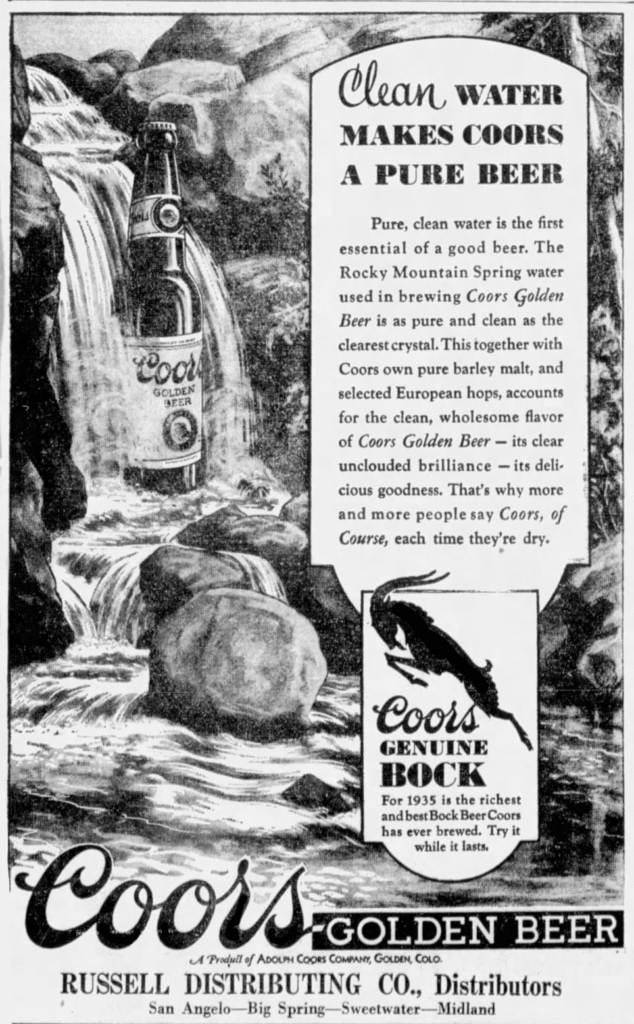
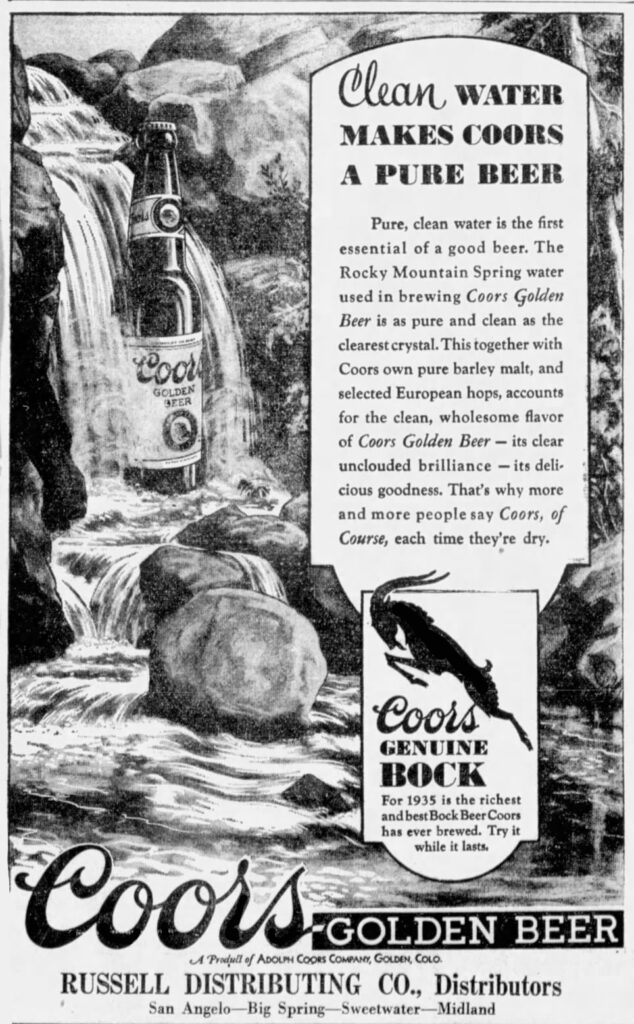
Friday’s ad is for Coors Bock Beer and was published May 9, 1935. The brewery was the Coors Brewing Co. of Golden, Colorado, which was originally founded in 1873. This ad ran in The San Angelo Evening Standard, of San Angelo, Texas.
Last year I decided to concentrate on Bock ads. Bock, of course, may have originated in Germany, in the town of Einbeck. Because many 19th century American breweries were founded by German immigrants, they offered a bock at certain times of the year, be it Spring, Easter, Lent, Christmas, or what have you. In a sense they were some of the first seasonal beers. “The style was later adopted in Bavaria by Munich brewers in the 17th century. Due to their Bavarian accent, citizens of Munich pronounced ‘Einbeck’ as ‘ein Bock’ (a billy goat), and thus the beer became known as ‘Bock.’ A goat often appears on bottle labels.” And presumably because they were special releases, many breweries went all out promoting them with beautiful artwork on posters and other advertising.
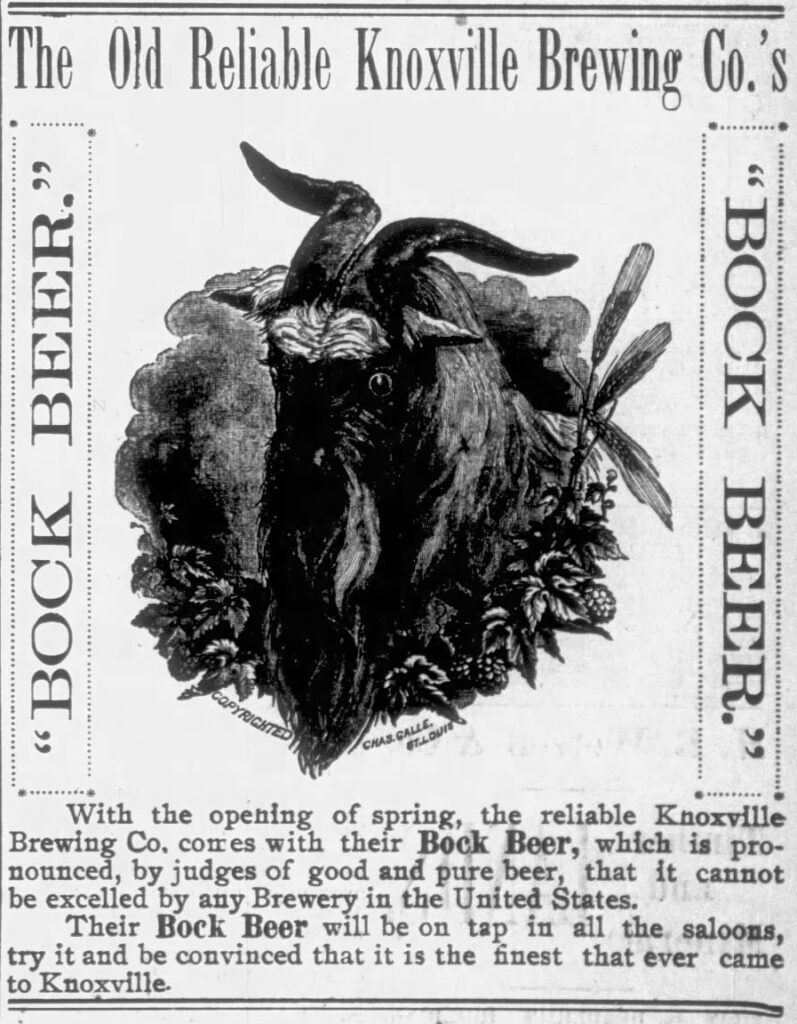
Thursday’s ad is for Knoxville Bock Beer and was published May 8, 1892. The brewery was the Knoxville Brewing Co. of Knoxville, Tennessee, which was originally founded in 1878. This ad ran in The Journal and Tribune, also of Knoxville, Tennessee.
Last year I decided to concentrate on Bock ads. Bock, of course, may have originated in Germany, in the town of Einbeck. Because many 19th century American breweries were founded by German immigrants, they offered a bock at certain times of the year, be it Spring, Easter, Lent, Christmas, or what have you. In a sense they were some of the first seasonal beers. “The style was later adopted in Bavaria by Munich brewers in the 17th century. Due to their Bavarian accent, citizens of Munich pronounced ‘Einbeck’ as ‘ein Bock’ (a billy goat), and thus the beer became known as ‘Bock.’ A goat often appears on bottle labels.” And presumably because they were special releases, many breweries went all out promoting them with beautiful artwork on posters and other advertising.
Wednesday’s ad is for Rieker’s Bock Beer and was published May 7, 1913. The brewery was at the time the F.A. Rieker Brewing Co. of Lancaster, Pennsylvania, which was originally founded in 1867 under another name. Frank Rieker appears to have become involved by 1874 and in 1876 the name was changed to the Frank A. Rieker’s Star Brewery. It was later known as the Penn-Star Brewery, but closed for good in 1938. This ad ran in The News Journal, which I believe was in Wilmington, Delaware.
Last year I decided to concentrate on Bock ads. Bock, of course, may have originated in Germany, in the town of Einbeck. Because many 19th century American breweries were founded by German immigrants, they offered a bock at certain times of the year, be it Spring, Easter, Lent, Christmas, or what have you. In a sense they were some of the first seasonal beers. “The style was later adopted in Bavaria by Munich brewers in the 17th century. Due to their Bavarian accent, citizens of Munich pronounced ‘Einbeck’ as ‘ein Bock’ (a billy goat), and thus the beer became known as ‘Bock.’ A goat often appears on bottle labels.” And presumably because they were special releases, many breweries went all out promoting them with beautiful artwork on posters and other advertising.
Tuesday’s ad is for Santa Cruz Bock Beer and was published May 6, 1908. The brewery was the Santa Cruz Brewing Co. of Santa Cruz, California, which appears to have been located on Neary Street and was in business from the late 19th century until prohibition. This ad ran in The Santa Cruz Evening News, also of Santa Cruz, California.
Last year I decided to concentrate on Bock ads. Bock, of course, may have originated in Germany, in the town of Einbeck. Because many 19th century American breweries were founded by German immigrants, they offered a bock at certain times of the year, be it Spring, Easter, Lent, Christmas, or what have you. In a sense they were some of the first seasonal beers. “The style was later adopted in Bavaria by Munich brewers in the 17th century. Due to their Bavarian accent, citizens of Munich pronounced ‘Einbeck’ as ‘ein Bock’ (a billy goat), and thus the beer became known as ‘Bock.’ A goat often appears on bottle labels.” And presumably because they were special releases, many breweries went all out promoting them with beautiful artwork on posters and other advertising.
Monday’s ad is for Pickwick Bock Beer and was published May 5, 1951. The brewery was the Haffenreffer Brewery of Boston, Massachusetts, which was originally founded in 1870. It was located in the Jamaica Plain area of Boston, and today the site of the brewery is where the Boston Beer Co. has operates one of its breweries. This ad ran in The Morning Union, of Springfield, Massachusetts.
Last year I decided to concentrate on Bock ads. Bock, of course, may have originated in Germany, in the town of Einbeck. Because many 19th century American breweries were founded by German immigrants, they offered a bock at certain times of the year, be it Spring, Easter, Lent, Christmas, or what have you. In a sense they were some of the first seasonal beers. “The style was later adopted in Bavaria by Munich brewers in the 17th century. Due to their Bavarian accent, citizens of Munich pronounced ‘Einbeck’ as ‘ein Bock’ (a billy goat), and thus the beer became known as ‘Bock.’ A goat often appears on bottle labels.” And presumably because they were special releases, many breweries went all out promoting them with beautiful artwork on posters and other advertising.
Sunday’s ad is for J. Ruppert’s Bock Beer and was published May 4, 1884. The brewery was the Jacob Ruppert Brewery of New York, New York, which was originally founded in 1867. This ad ran in The Sun, also of New York, New York.
Last year I decided to concentrate on Bock ads. Bock, of course, may have originated in Germany, in the town of Einbeck. Because many 19th century American breweries were founded by German immigrants, they offered a bock at certain times of the year, be it Spring, Easter, Lent, Christmas, or what have you. In a sense they were some of the first seasonal beers. “The style was later adopted in Bavaria by Munich brewers in the 17th century. Due to their Bavarian accent, citizens of Munich pronounced ‘Einbeck’ as ‘ein Bock’ (a billy goat), and thus the beer became known as ‘Bock.’ A goat often appears on bottle labels.” And presumably because they were special releases, many breweries went all out promoting them with beautiful artwork on posters and other advertising.
Saturday’s ad is for Renner & Weber Bock Beer and was published May 3, 1915. The brewery was the Henry Weinhard Brewing Co. of Portland, Oregon, which was originally founded in 1856. This ad ran in The Astoria Evening Budget, of Astoria, Oregon.
Last year I decided to concentrate on Bock ads. Bock, of course, may have originated in Germany, in the town of Einbeck. Because many 19th century American breweries were founded by German immigrants, they offered a bock at certain times of the year, be it Spring, Easter, Lent, Christmas, or what have you. In a sense they were some of the first seasonal beers. “The style was later adopted in Bavaria by Munich brewers in the 17th century. Due to their Bavarian accent, citizens of Munich pronounced ‘Einbeck’ as ‘ein Bock’ (a billy goat), and thus the beer became known as ‘Bock.’ A goat often appears on bottle labels.” And presumably because they were special releases, many breweries went all out promoting them with beautiful artwork on posters and other advertising.
Friday’s ad is for Renner & Weber Bock Beer and was published May 2, 1912. The brewery was the Renner & Weber Brewing Co. of Mansfield, Ohio, which was originally founded in 1855. This ad ran in The News Journal, also of Mansfield, Ohio. I’m still not entirely sure about what the text means above the photo of the brewery, which reads: “I Am Glad to See This Building in Mansfield. I Boom Mansfield by Drinking Mansfield Beer.”
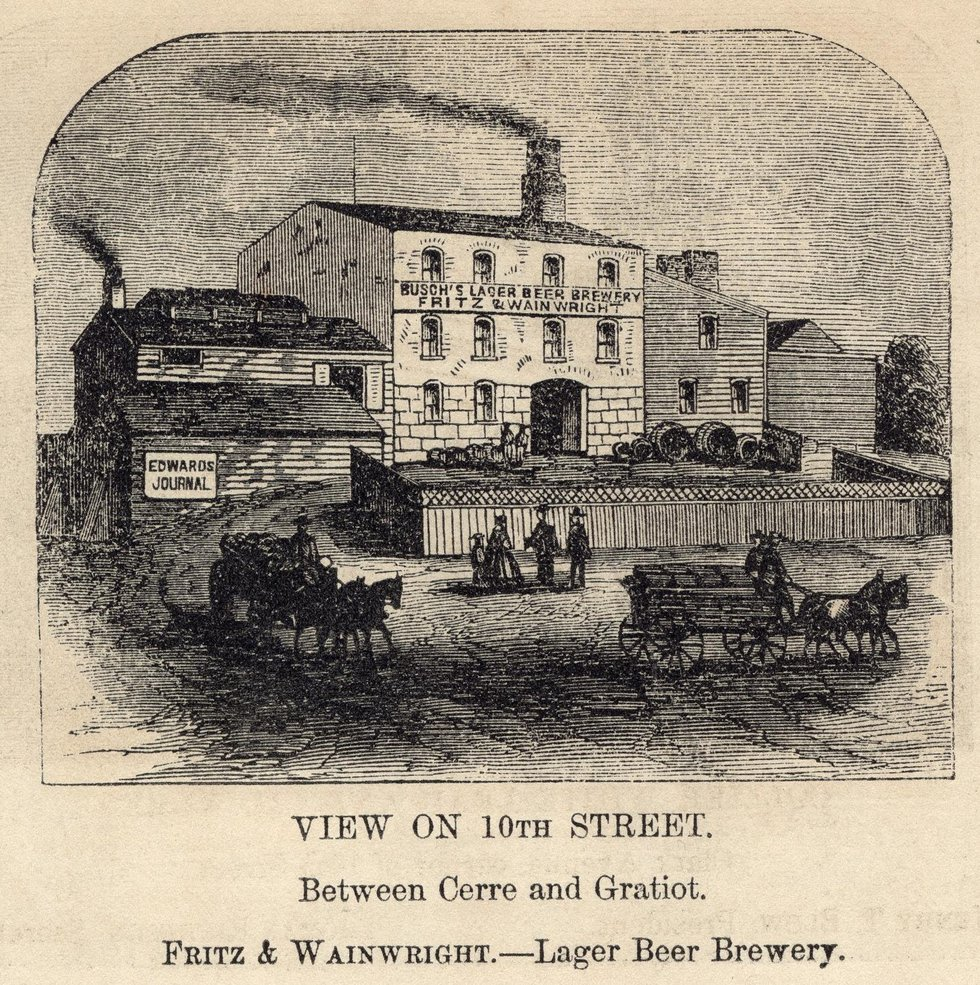
Today is the birthday of Lorenz Lampel (May 2, 1831-March 26, 1888. He was born in Bavaria, Germany, where he was trained as a brewer. In 1853, he emigrated to the U.S. and settled in St. Louis, Missouri, where he worked for several local breweries. Eventually, in 1870, he became a partner in the Samuel Wainwright & Company brewing firm and helped manage the business for another 15 years. He was also later elected president of the United States Brewers Association in 1891.
Here’s a short biography from Find-a-Grave:
Brewery Businessman. Born in Bavaria, Lorenz served an apprenticeship in the brewer’s trade before immigrating to the U.S. in 1853. He came to St. Louis in 1855, where he was employed as brew master and foreman by prominent beer manufacturers of St. Louis such as Lemp, Waggoner, Fritz & Wainwright, Anheuser-Busch. In 1870, he became a partner in the Samuel Wainwright & Company brewing firm and was actively connected with the management of that business for another 15 years. He was elected president of the United States Brewers Association at its 31st annual convention in 1891. [Note: that 1891 date must be wrong since he passed aay in 1888, three years before.
[Charles A.] Fritz lasted until 1870, when two new partners joined: Lorenz Lampel and Robert Jacob, and the brewery changing to Wainwright & Co. Contrary to what is often the case for many of these anonymous partners, Lampel is well-documented in St. Louis history. Born on May 2, 1831, in Bavaria, he was trained as a brewer, coming to America in 1853 and then to St. Louis in 1855. He even worked for Anheuser-Busch as a foreman and brewmaster in addition to the Wainwright Brewery and was not just an owner and investor. Lampel was involved in the Wainwright Brewery for 15 years, dying in 1886 after an extensive visit to Germany.