Today is the birthday of George Saintsbury (October 23, 1845–January 28, 1933). He “was an English writer, literary historian, scholar, critic and wine connoisseur.
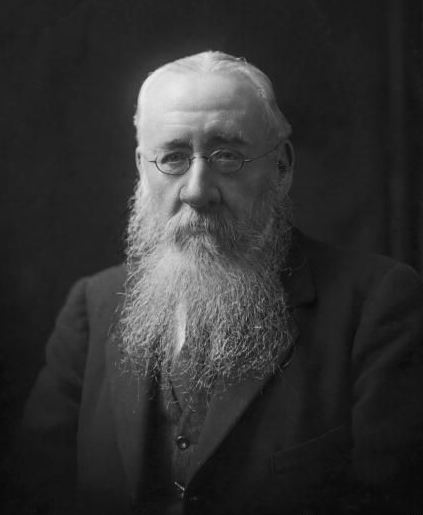
Although Saintsbury was best known during his lifetime as a scholar, he is also remembered today for his Notes on a Cellar-Book (1920), one of the great testimonials to drink and drinking in wine literature. When he was close to death, André Simon arranged a dinner in his honour. Although Saintsbury did not attend, this was the start of the Saintsbury Club, men of letters and members of the wine trade who continue to have dinners to this day.
Part of his work, Notes on a Cellar Book, was a chapter entitled “Beer and Cider.”
This is the introduction to this chapter, from a later volume of various works called “Modern Essays,” and edited by Christopher Morley. It was originally published in 1921, one year after Saintsbury’s death.
How pleasant it is to find the famous Professor Saintsbury — known to students as the author of histories of the English and French literatures, the History of Criticism and History of English Prosody — spending the evening so hospitably in his cellar. I print this — from his downright delightful Notes on a Cellar Book — as a kind of tantalizing penance. It is a charming example of how pleasantly a great scholar can unbend on occasion.
George Saintsbury, born in 1845, studied at Merton College, Oxford, taught school 1868-76, was a journalist in London 1876-95, and held the chair of English Literature at Edinburgh University, 1895-1915. If you read Notes on a Cellar Book, as you should, you will agree that it is a charmingly light-hearted causerie for a gentleman to publish at the age of seventy-five. More than ever one feels that sound liquor, in moderation, is a preservative of both body and wit.
BEER AND CIDER
By George Saintsbury
THERE is no beverage which I have liked “to live with” more than Beer; but I have never had a cellar large enough to accommodate much of it, or an establishment numerous enough to justify the accommodation. In the good days when servants expected beer, but did not expect to be treated otherwise than as servants, a cask or two was necessary; and persons who were “quite” generally took care that the small beer they drank should be the same as that which they gave to their domestics, though they might have other sorts as well. For these better sorts at least the good old rule was, when you began on one cask always to have in another. Even Cobbett, whose belief in beer was the noblest feature in his character, allowed that it required some keeping. The curious “white ale,” or lober agol—which, within the memory of man, used to exist in Devonshire and Cornwall, but which, even half a century ago, I have vainly sought there—was, I believe, drunk quite new; but then it was not pure malt and not hopped at all, but had eggs (“pullet-sperm in the brewage”) and other foreign bodies in it.
I did once drink, at St David’s, ale so new that it frothed from the cask as creamily as if it had been bottled: and I wondered whether the famous beer of Bala, which Borrow found so good at his first visit and so bad at his second, had been like it.
On the other hand, the very best Bass I ever drank had had an exactly contrary experience. In the year 1875, when I was resident at Elgin, I and a friend now dead, the Procurator-Fiscal of the district, devoted the May “Sacrament holidays,” which were then still kept in those remote parts, to a walking tour up the Findhorn and across to Loch Ness and Glen Urquhart. At the Freeburn Inn on the first-named river we found some beer of singular excellence: and, asking the damsel who waited on us about it, were informed that a cask of Bass had been put in during the previous October, but, owing to a sudden break in the weather and the departure of all visitors, had never been tapped till our arrival.
Beer of ordinary strength left too long in the cask gets “hard” of course; but no one who deserves to drink it would drink it from anything but the cask if he could help it. Jars are makeshifts, though useful makeshifts: and small beer will not keep in them for much more than a week. Nor are the very small barrels, known by various affectionate diminutives (“pin,” etc.) in the country districts, much to be recommended. “We’ll drink it in the firkin, my boy!” is the lowest admission in point of volume that should be allowed. Of one such firkin I have a pleasant memory and memorial, though it never reposed in my home cellar. It was just before the present century opened, and some years before we Professors in Scotland had, of our own motion and against considerable opposition, given up half of the old six months’ holiday without asking for or receiving a penny more salary. (I have since chuckled at the horror and wrath with which Mr. Smillie and Mr. Thomas would hear of such profligate conduct.) One could therefore move about with fairly long halts: and I had taken from a friend a house at Abingdon for some time. So, though I could not even then drink quite as much beer as I could thirty years earlier a little higher up the Thames, it became necessary to procure a cask. It came—one of Bass’s minor mildnesses—affectionately labeled “Mr. George Saintsbury. Full to the bung.” I detached the card, and I believe I have it to this day as my choicest (because quite unsolicited) testimonial.
Very strong beer permits itself, of course, to be bottled and kept in bottles: but I rather doubt whether it also is not best from the wood; though it is equally of course, much easier to cellar it and keep it bottled. Its kinds are various and curious. “Scotch ale” is famous, and at its best (I never drank better than Younger’s) excellent: but its tendency, I think, is to be too sweet. I once invested in some—not Younger’s—which I kept for nearly sixteen years, and which was still treacle at the end. Bass’s No. 1 requires no praises. Once when living in the Cambridgeshire village mentioned earlier I had some, bottled in Cambridge itself, of great age and excellence. Indeed, two guests, though both of them were Cambridge men, and should have had what Mr. Lang once called the “robust” habits of that University, fell into one ditch after partaking of it. (I own that the lanes thereabouts are very dark.) In former days, though probably not at present, you could often find rather choice specimens of strong beer produced at small breweries in the country. I remember such even in the Channel Islands. And I suspect the Universities themselves have been subject to “declensions and fallings off.” I know that in my undergraduate days at Merton we always had proper beer-glasses, like the old “flute” champagnes, served regularly at cheese-time with a most noble beer called “Archdeacon,” which was then actually brewed in the sacristy of the College chapel. I have since—a slight sorrow to season the joy of reinstatement there—been told that it is now obtained from outside. And All Souls is the only other college in which, from actual recent experience, I can imagine the possibility of the exorcism,
if lay-brother Peter were so silly as to abuse, or play tricks with, the good gift.
I have never had many experiences of real “home-brewed,” but two which I had were pleasing. There was much home-brewing in East Anglia at the time I lived there, and I once got the village carpenter to give me some of his own manufacture. It was as good light ale as I ever wish to drink (many times better than the wretched stuff that Dora has foisted on us), and he told me that, counting in every expense for material, cost and wear of plant, etc., it came to about a penny a quart. The other was very different. The late Lord de Tabley—better or at least longer known as Mr. Leicester Warren—once gave a dinner at the Athenæum at which I was present, and had up from his Cheshire cellars some of the old ale for which that county is said to be famous, to make flip after dinner. It was shunned by most of the pusillanimous guests, but not by me, and it was excellent. But I should like to have tried it unflipped.
I never drank mum, which all know from The Antiquary, some from “The Ryme of Sir Lancelot Bogle,” and some again from the notice which Mr. Gladstone’s love of Scott (may it plead for him!) gave it once in some Budget debate, I think. It is said to be brewed of wheat, which is not in its favor (wheat was meant to be eaten, not drunk) and very bitter, which is. Nearly all bitter drinks are good. The only time I ever drank “spruce” beer I did not like it. The comeliest of black malts is, of course, that noble liquor called of Guinness. Here at least I think England cannot match Ireland, for our stouts are, as a rule, too sweet and “clammy.” But there used to be in the country districts a sort of light porter which was one of the most refreshing liquids conceivable for hot weather. I have drunk it in Yorkshire at the foot of Roseberry Topping, out of big stone bottles like champagne magnums. But that was nearly sixty years ago. Genuine lager beer is no more to be boycotted than genuine hock, though, by the way, the best that I ever drank (it was at the good town of King’s Lynn) was Low not High Dutch in origin. It was so good that I wrote to the shippers at Rotterdam to see if I could get some sent to Leith, but the usual difficulties in establishing connection between wholesale dealers and individual buyers prevented this. It was, however, something of a consolation to read the delightful name, “our top-and-bottom-fermentation beer,” in which the manufacturer’s letter, in very sound English for the most part, spoke of it. English lager I must say I have never liked; perhaps I have been unlucky in my specimens. And good as Scotch strong beer is, I cannot say that the lighter and medium kinds are very good in Scotland. In fact, in Edinburgh I used to import beer of this kind from Lincolnshire, where there is no mistake about it. My own private opinion is that John Barleycorn, north of Tweed, says: “I am for whisky, and not for ale.”
“Cider and perry,” says Burton, “are windy drinks”; yet he observes that the inhabitants of certain shires in England (he does not, I am sorry to say, mention Devon) of Normandy in France, and of Guipuzcoa in Spain, “are no whit offended by them.” I have never liked perry on the few occasions on which I have tasted it; perhaps because its taste has always reminded me of the smell of some stuff that my nurse used to put on my hair when I was small. But I certainly have been no whit offended by cider, either in divers English shires, including very specially those which Burton does not include, Devon, Dorset, and Somerset, or in Normandy. The Guipuzcoan variety I have, unfortunately, had no opportunity of tasting. Besides, perry seems to me to be an abuse of that excellent creature the pear, whereas cider-apples furnish one of the most cogent arguments to prove that Providence had the production of alcoholic liquors directly in its eye. They are good for nothing else whatever, and they are excellent good for that. I think I like the weak ciders, such as those of the west and the Normandy, better than the stronger ones, and draught cider much better than bottled. That of Norfolk, which has been much commended of late, I have never tasted; but I have had both Western and West-Midland cider in my cellar, often in bottle and once or twice in cask. It is a pity that the liquor—extremely agreeable to the taste, one of the most thirst-quenching to be anywhere found, of no overpowering alcoholic strength as a rule, and almost sovereign for gout—is not to be drunk without caution, and sometimes has to be given up altogether from other medical aspects. Qualified with brandy—a mixture which was first imparted to me at a roadside inn by a very amiable Dorsetshire farmer whom I met while walking from Sherborne to Blandford in my first Oxford “long”—it is capital: and cider-cup who knoweth not? If there be any such, let him not wait longer than to-morrow before establishing knowledge. As for the pure juice of the apple, four gallons a day per man used to be the harvest allowance in Somerset when I was a boy. It is refreshing only to think of it now.
Of mead or metheglin, the third indigenous liquor of Southern Britain, I know little. Indeed, I should have known nothing at all of it had it not been that the parish-clerk and sexton of the Cambridgeshire village where I lived, and the caretaker of a vinery which I rented, was a bee-keeper and mead-maker. He gave me some once. I did not care much for it. It was like a sweet weak beer, with, of course, the special honey flavor. But I should imagine that it was susceptible of a great many different modes of preparation, and it is obvious, considering what it is made of, that it could be brewed of almost any strength. Old literary notices generally speak of it as strong.