Brookston Beer Bulletin

Jay R. Brooks on Beer

  • Home
  • About
  • Editorial
  • Birthdays
  • Art & Beer

Socialize

  • Dribbble
  • Email
  • Facebook
  • Flickr
  • GitHub
  • Instagram
  • LinkedIn
  • Pinterest
  • RSS
  • Twitter
  • YouTube

Powered by Genesis

Patent No. 2440276A: Brewing Method Using Albedo In Wort

April 27, 2016 By Jay Brooks

patent-logo
Today in 1948, US Patent 2440276 A was issued, an invention of Abraham Arnold Klein, for his “Brewing Method Using Albedo In Wort.” There’s no Abstract, although in the description it includes this summary:

According to the present invention albedo from fruit of the genus Citrus, particularly from grapefruit or citron, is used instead of, or in addition to, hops in the manufactured beer. I have found that the lupulin of hops has in many cases undesirable effects on the human organism. Furthermore hops deteriorate easily. Albedo from citrus fruit can be used instead of hops and the bitter flavour imparted by it to the wort is of a mild and agreeable character.

So this is essentially using grapefruit or other citrus almost 70 years before Ballast Point Grapefruit Sculpin. But not the whole fruit, or even the rind, the albedo is the white, fleshy inner later in between the thinner, top rind layer and the inside fruit. That spongy material is, according to this patent, used in place of or with hops in the brewing process. I wonder if anybody used this method to produce commercial beer?
Orange_cross_section_description
grapefruit

Filed Under: Beers, Breweries, Just For Fun, Politics & Law, Related Pleasures Tagged With: History, Hops, Law, Patent, Science of Brewing

Beer In Ads #1893: Getting Ready For Christmas

April 26, 2016 By Jay Brooks


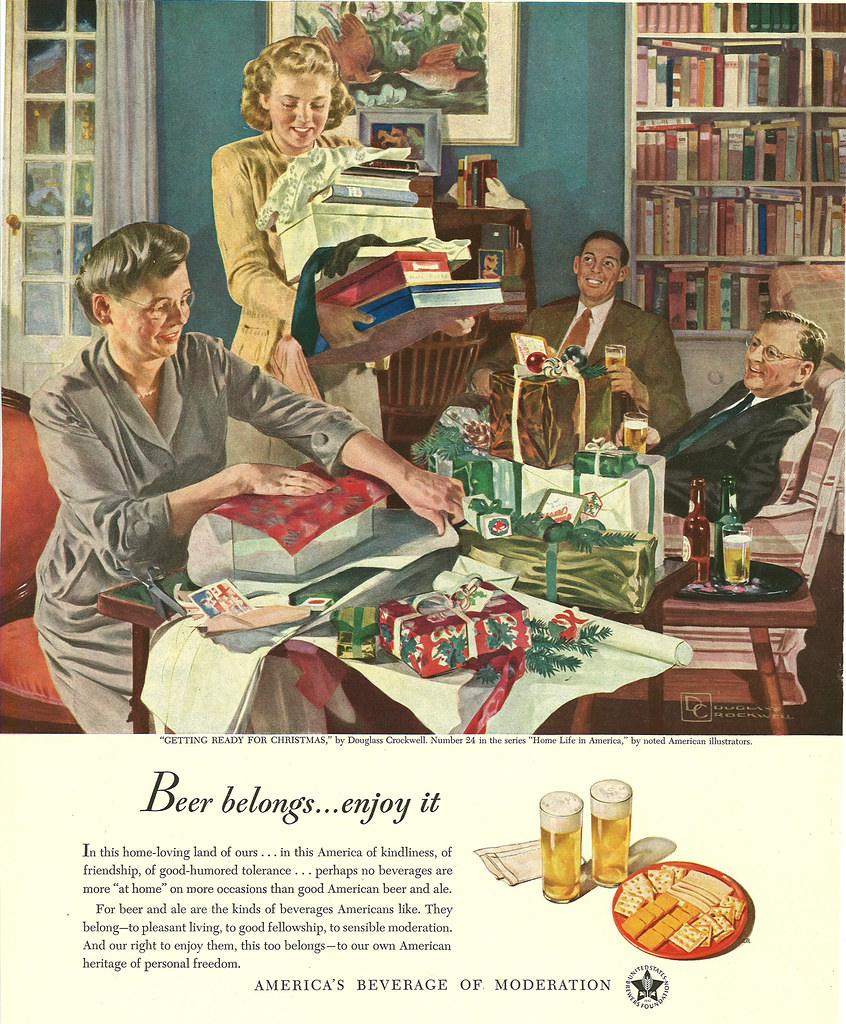
Tuesday’s ad is entitled Getting Ready For Christmas, and the illustration was done in 1948 by Douglass Crockwell. It’s #24 in a series entitled “Home Life in America,” also known as the Beer Belongs series of ads that the United States Brewers Foundation ran from 1945 to 1956. In this ad, the womenfolk are preparing to wrap all of the Christmas presents while the men sit, smiling and drinking beer. Hopefully they’re at least cheering them on so they;re not completely useless.

024. Getting Ready for Christmas by Douglass Crockwell, 1948

Filed Under: Art & Beer, Beers, Just For Fun Tagged With: Advertising, Christmas, History

Patent No. 473737A: Beer-Drawing Apparatus

April 26, 2016 By Jay Brooks

patent-logo
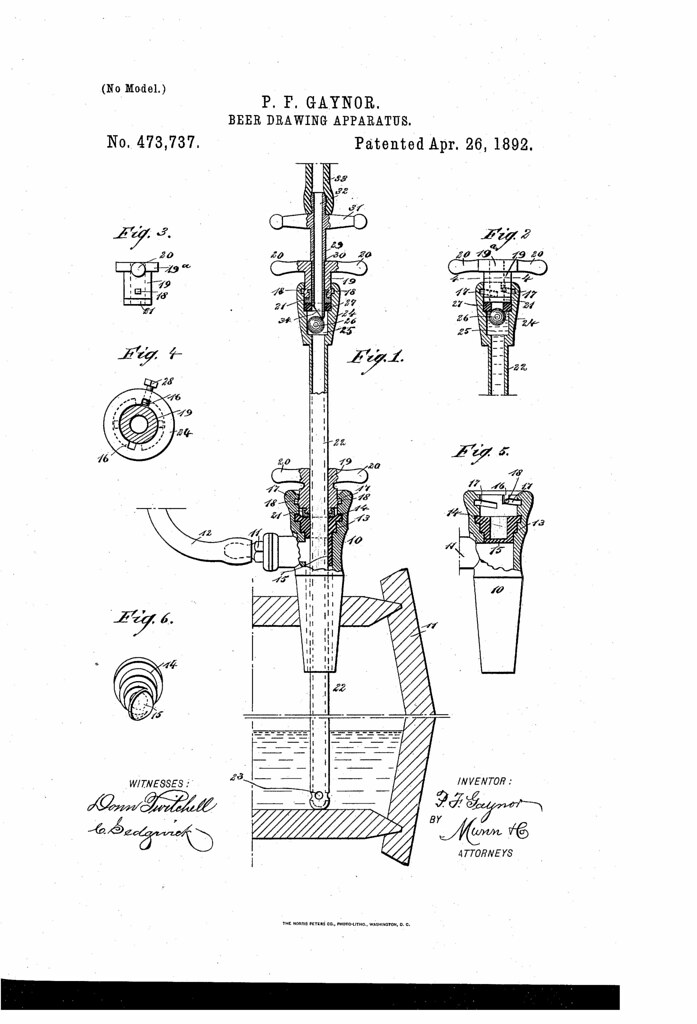
Today in 1892, US Patent 473737 A was issued, an invention of Peter F. Gaynor, for his “Beer-Drawing Apparatus.” There’s no Abstract, although in the description it includes this summary:

My invention relates to improvements in beer-drawng apparatus and the object of my invention is to produce a simple apparatus by means of which beer may be conveniently drawn under pressure from the cask and which may be inserted in the cask without spilling any beer or freeing any gas.

US473737-0

Filed Under: Art & Beer, Beers, Just For Fun Tagged With: History, Kegs, Law, Patent

Beer In Ads #1892: Thanksgiving

April 25, 2016 By Jay Brooks


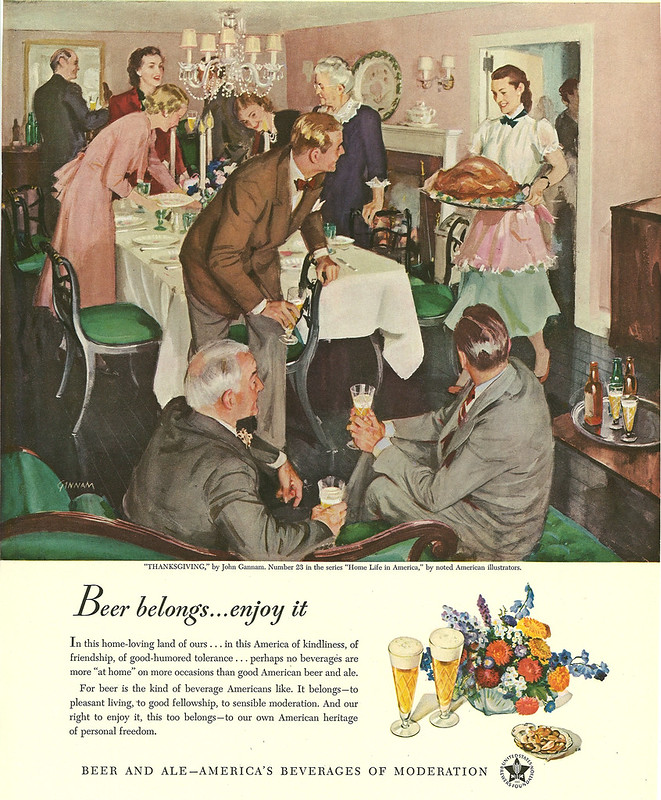
Monday’s ad is entitled Thanksgiving, and the illustration was done in 1948 by John Gannam. It’s #23 in a series entitled “Home Life in America,” also known as the Beer Belongs series of ads that the United States Brewers Foundation ran from 1945 to 1956. In this ad, a large family gathers for Thanksgiving dinner. I count at least eleven people. As one woman carries in the turkey from the kitchen, the rest appear to be finishing setting the table. All five of the men seen in the ad, are doing nothing whatsoever to help, and every one of them has a beer in one hand. One’s even pouring himself another beer. I’m a little surprised he didn’t have one of the womenfolk pour it for him.

023. Thanksgiving by John Gannam, 1948

Filed Under: Art & Beer, Beers, Just For Fun Tagged With: Advertising, History

Beer In Ads #1891: Wedding Anniversary

April 24, 2016 By Jay Brooks


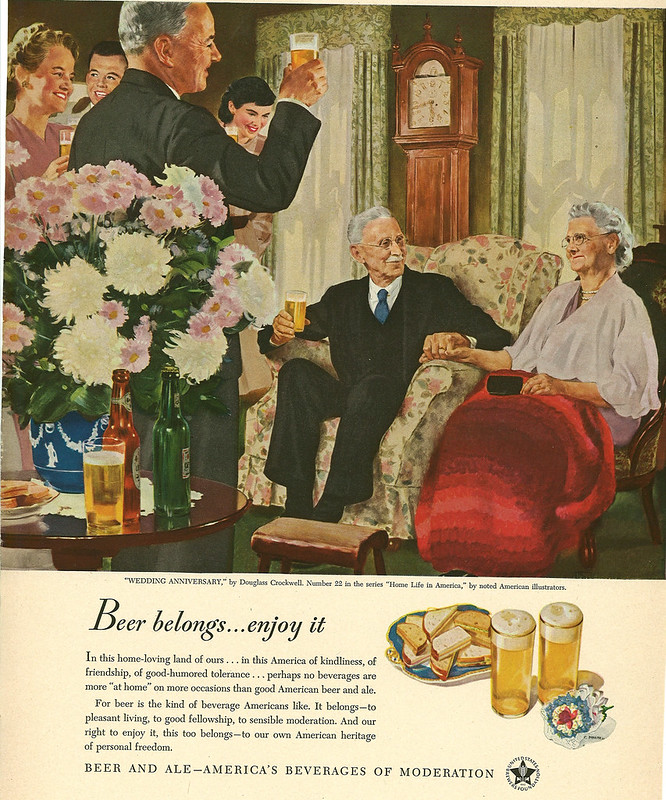
Sunday’s ad is entitled Wedding Anniversary, and the illustration was done in 1948 by Douglass Crockwell. It’s #22 in a series entitled “Home Life in America,” also known as the Beer Belongs series of ads that the United States Brewers Foundation ran from 1945 to 1956. In this ad, an older couple is celebrating their wedding anniversary, and is being toasted with beer, presumably by their own kids, grandkids and other relatives. Granddad has a beer, but curiously Grandma does not, what’s up with that?

022. Wedding Anniversary by Douglass Crockwell, 1948

Filed Under: Art & Beer, Beers, Just For Fun Tagged With: Advertising, History

Patent No. EP2583934A1: Reusable Beer Keg

April 24, 2016 By Jay Brooks

patent-logo
Today in 2013, US Patent EP 2583934 A1 was issued, an invention of Thomas W. Bates, Dan Morgan, and Leslie W. Ross, for their “Reusable Beer Keg.” Here’s the Abstract:

A reusable beer keg (1) is disclosed comprising a hollow beer keg body (2) with a dispenser tube assembly (10) having a dispenser valve (11), dispenser tube (12), and a disposable bladder (13). The dispenser valve (11) is releasably attached to a top portion of the keg body (2) and the dispenser tube (12) and bladder (13) extend into the interior of the keg body (2). When beer flows through the open dispenser valve (11) and into the bladder (13), the beer causes the bladder (13) to expand until it contacts the inside surface of the keg body (2). When the beer keg (1) has been emptied it can be returned to the brewery for reuse by cleaning the dispenser valve (11), dispenser tube (12) and disposing of the used bladder (13). The beer keg body (2) does not need to be cleaned, however, because the beer only comes in contact with the disposable bladder (13) and not the keg body (2). The beer keg parts can then be reassembled, using a new bladder in place of the used bladder.

2583934-imgaf001

Filed Under: Beers, Just For Fun, Politics & Law, Related Pleasures Tagged With: History, Kegs, Law, Patent

Patent No. 20030075208A1: The Beerbrella

April 24, 2016 By Jay Brooks

patent-logo
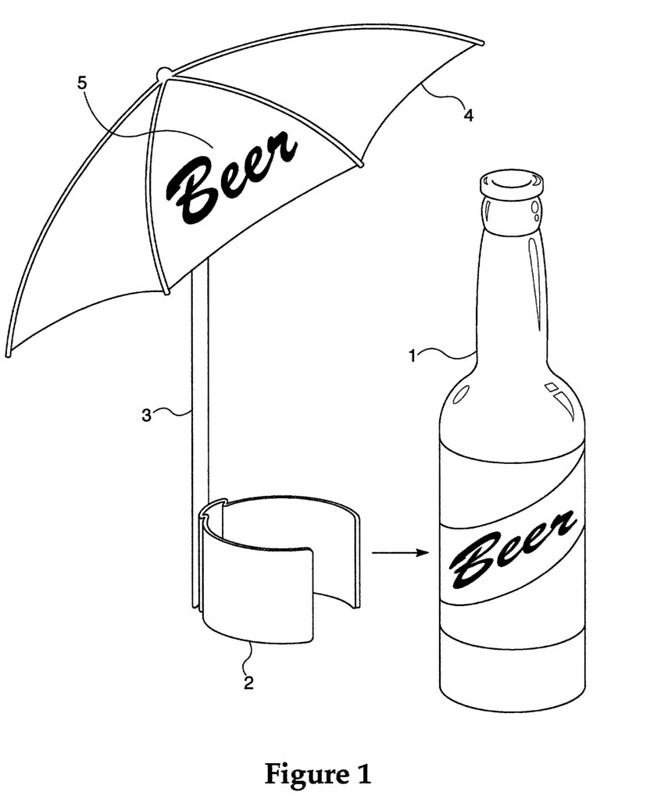
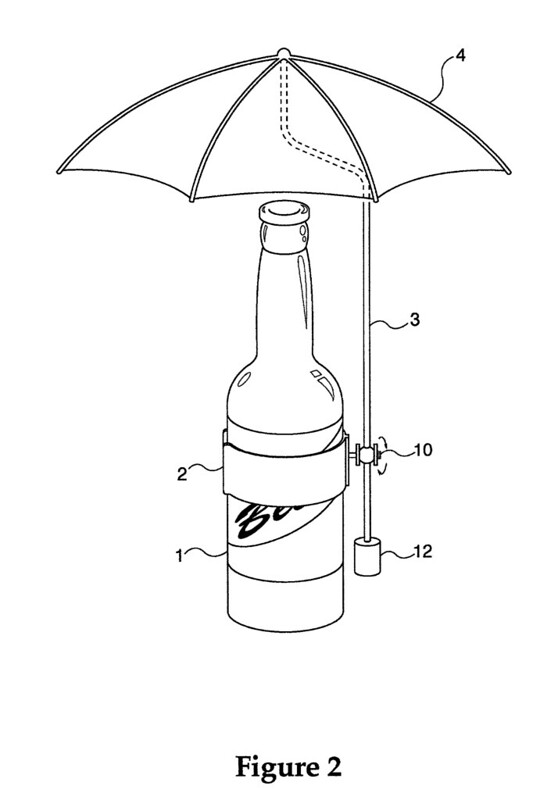
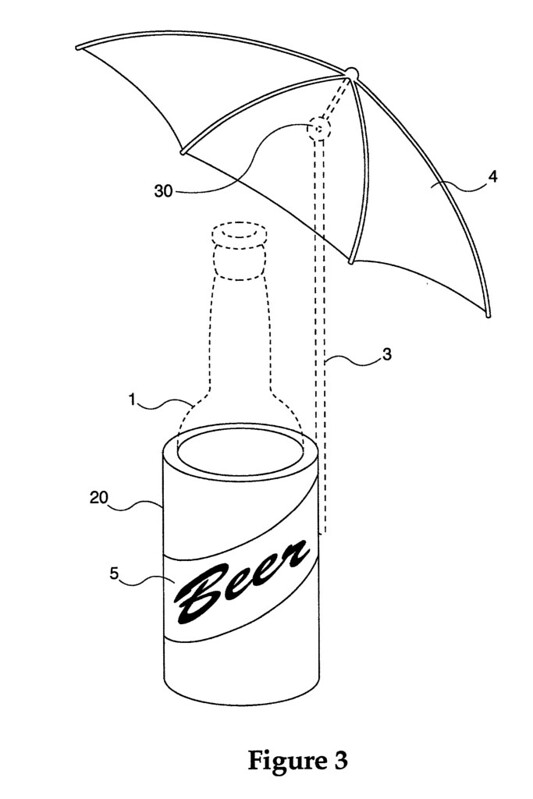
Today in 2003, US Patent 20030075208 A1 was issued, an invention of Mason McMullin, Robert Bell, and Mark See, for their “Beerbrella.” Here’s the Abstract:

The present invention provides a small umbrella (“Beerbrella”) which may be removably attached to a beverage container in order to shade the beverage container from the direct rays of the sun. The apparatus comprises a small umbrella approximately five to seven inches in diameter, although other appropriate sizes may be used within the spirit and scope of the present invention. Suitable advertising and/or logos may be applied to the umbrella surface for promotional purposes. The umbrella may be attached to the beverage container by any one of a number of means, including clip, strap, cup, foam insulator, or as a coaster or the like. The umbrella shaft may be provided with a pivot to allow the umbrella to be suitably angled to shield the sun or for aesthetic purposes. In one embodiment, a pivot joint and counterweight may be provided to allow the umbrella to pivot out of the way when the user drinks from the container.

US20030075208A1-20030424-D00001

US20030075208A1-20030424-D00002

US20030075208A1-20030424-D00003

US20030075208A1-20030424-D00004

Filed Under: Beers, Just For Fun, Politics & Law, Related Pleasures Tagged With: History, Law, Patent

Beer In Ads #1890: Trying Out The New Camera

April 23, 2016 By Jay Brooks


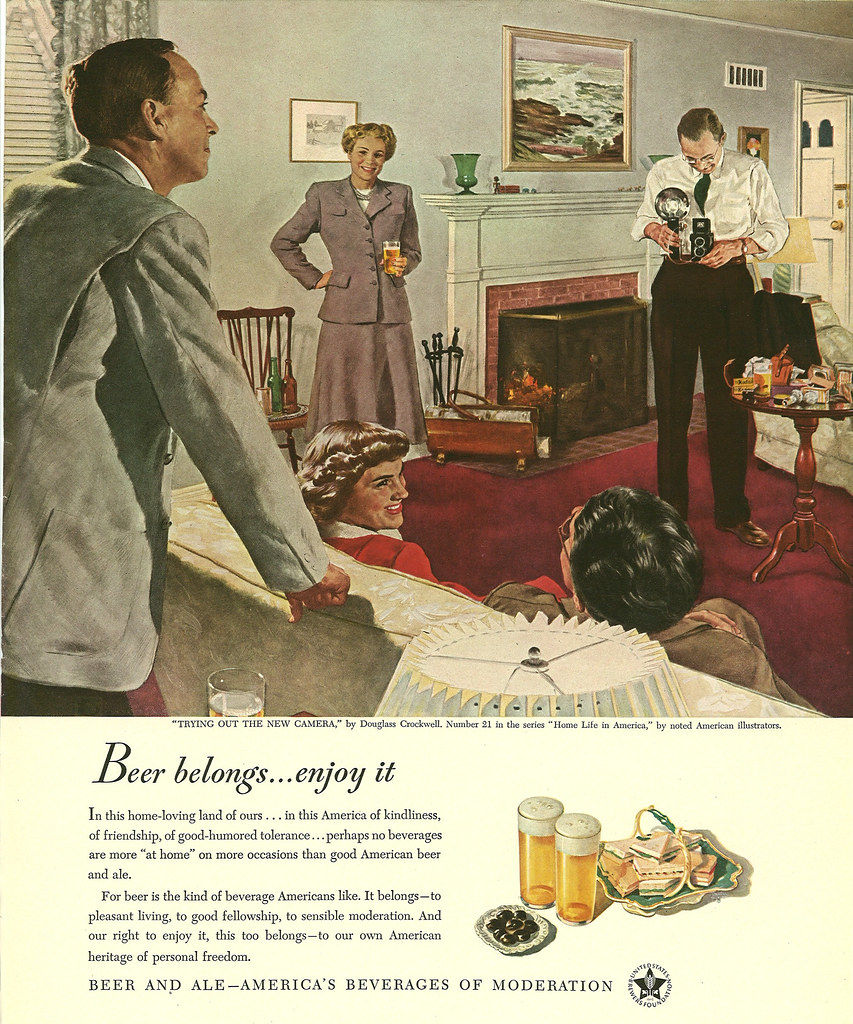
Saturday’s ad is entitled Trying Out The New Camera, and the illustration was done in 1948 by Douglass Crockwell. It’s #21 in a series entitled “Home Life in America,” also known as the Beer Belongs series of ads that the United States Brewers Foundation ran from 1945 to 1956. In this ad, a group of people are drinking beers in a living room. One of them is trying out his new — gasp — film camera. Remember film? This one doesn’t even have an automatic flash, but uses single bulbs, which have to be replaced each time. I still have a camera that uses them, although to be fair I haven’t actually used it in a long, long time.

021. Trying Out the New Camera by Douglass Crockwell, 1948

Filed Under: Art & Beer, Beers, Just For Fun Tagged With: Advertising, History

500th Anniversary Of The Reinheitsgebot

April 23, 2016 By Jay Brooks

reinheitsgebot bavaria-coa
It’s hard to believe it’s been 500 years since Bavaria signed what’s considered the first food purity law, the Reinheitsgebot, also known as the Bavarian Beer Purity Law, and later the German Beer Purity Law. That’s because in 1516, when the law was decreed, Germany did not yet exist, and wouldn’t for nearly 300 years, with the formation of the German Confederation in 1815, longer if you go by the German Empire, founded in 1871. Modern Germany consists of sixteen federal states, called Bundesländers, of which Bavaria is one.
reinheits-500
And it was in Bavarian town of Ingolstadt on April 23, 1516, that William IV, Duke of Bavaria wrote and signed the law, along with his younger brother Louis X, Duke of Bavaria. That 1516 law was itself a variation of earlier laws, at least as early as 1447 and another in independent Munich in 1487. When Bavaria reunited, the new Reinheitsgebot applied to the entirety of the Bavarian duchy. It didn’t apply to all of Germany until 1906, and it wasn’t referred to as the Reinheitsgebot until 1918, when it was coined by a member of the Bavarian parliament. But while today most people think of it as all about food purity, that was in reality only a small part of it, and probably not even the most important.

reinheitsgebot

Here’s a translation of the Reinheitsgebot, from a 1993 issue of Zymurgy:

We hereby proclaim and decree, by Authority of our Province, that henceforth in the Duchy of Bavaria, in the country as well as in the cities and marketplaces, the following rules apply to the sale of beer:

From Michaelmas to Georgi [St. George’s Day], the price for one Mass [Bavarian Liter 1,069] or one Kopf [bowl-shaped container for fluids, not quite one Mass], is not to exceed one Pfennig Munich value, and

From Georgi to Michaelmas, the Mass shall not be sold for more than two Pfennig of the same value, the Kopf not more than three Heller [Heller usually one-half Pfennig].

If this not be adhered to, the punishment stated below shall be administered.

Should any person brew, or otherwise have, other beer than March beer, it is not to be sold any higher than one Pfennig per Mass.

Furthermore, we wish to emphasize that in future in all cities, markets and in the country, the only ingredients used for the brewing of beer must be Barley, Hops and Water. Whosoever knowingly disregards or transgresses upon this ordinance, shall be punished by the Court authorities’ confiscating such barrels of beer, without fail.

Should, however, an innkeeper in the country, city or markets buy two or three pails of beer (containing 60 Mass) and sell it again to the common peasantry, he alone shall be permitted to charge one Heller more for the Mass or the Kopf, than mentioned above. Furthermore, should there arise a scarcity and subsequent price increase of the barley (also considering that the times of harvest differ, due to location), WE, the Bavarian Duchy, shall have the right to order curtailments for the good of all concerned.

Notice that the first two decrees have to do with pricing and when beer can be sold. It isn’t until paragraph six, the second last one, that the issue of what ingredients will be allowed comes up. If it had been the most important part, is seems more likely they would have led with it. Even then, it wasn’t about purity, but again commerce. Barley was designated as the only grain so that others, notably wheat and rye, were set aside to be used for baking bread.

Also, a lot of hay has been made about it not mentioning yeast, with the idea that it was because yeast wasn’t discovered until Louis Pasteur in the 19th century. But early brewers did know something about yeast, even if they didn’t have the full scientific understanding that came later. Otherwise, they wouldn’t have been able to make consistent batches of beer. At the end of your brew, you’ll find a layer of billowing foam and other indeterminate matter at the bottom of the fermenter, which the Germans called “Zeug,” which means “stuff.” And early German brewers had a person, called a “hefener,” whose job it was to scoop out the Zeug, which was in effect the leftover yeast, and pitch it in the next batch of beer. So it’s hard to say they didn’t have some understanding of yeast.

Reinheitsgebot-Bier-stamp
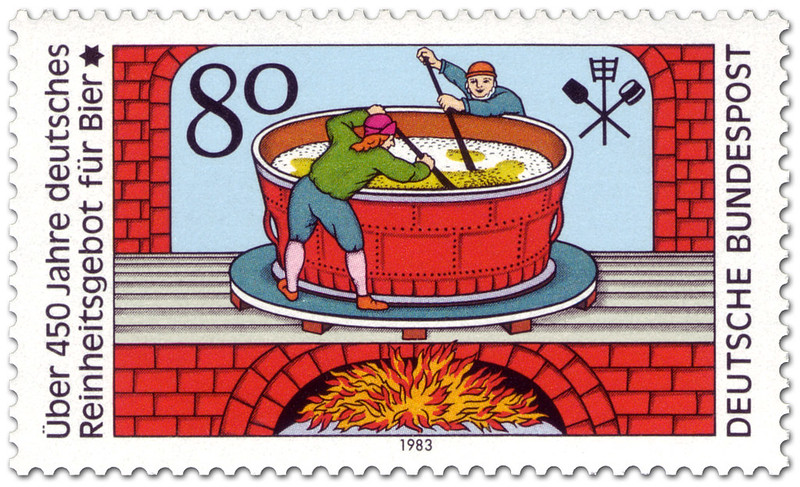
A German postage stamp celebrating the 450th anniversary of the Reinheitsgebot in 1983.

The Germans, of course, have set up a website for the 500th anniversary, and so does the Bayerischer Brauerbund, which is a a Bavarian brewers trade group along with the German Brewers Group. They also created a 50-second film marking the anniversary.

And the media is covering the Reinheitsgebot’s Quincentenary. A few examples include the BBC, Food and Wine, NPR, Spiegel, and Wired. But by far the most thorough examination of the Reinheitsgebot was by Jeff Alworth in All About Beer magazine, Attempting to Understand the Reinheitsgebot.

reinheitsgebot-replica

It’s great that it’s been 500 years, and that German brewers are justly proud of the Reinheitsgebot. It’s clearly helped create the unique German beer scene and their many native styles. But it’s also been used as a shameless marketing tool, been used as an exclusionary tactic, and has even had little-known exceptions to its rules for years, ones that most people are not even aware of, not to mention the use of other items in the brewing process that are also not mentioned by the law, but which because they’re not strictly “ingredients” more modern brewers have interpreted as not being prohibited.

Many people have voiced criticisms against it over the years. One that’s particularly thorough is The German Reinheitsgebot — Why it’s a Load of Old Bollocks. The German magazine Spiegel’s recent coverage is entitled Attacking Beer Purity: The Twilight of Germany’s Reinheitsgebot.

Back in 2001, Fred Eckhardt wrote an entertaining tale for All About Beer entitled The Spy who Saved the Reinheitsgebot, about how a brewer was able to prove Beck’s was using adjuncts and was not in adherence with the German law.

In another recent article in First We Feast, Sam Calagione, of the Dogfish Head Craft Brewery, is quoted with an opinion I suspect many American brewers hold. “I hate the concept of the Reinheitsgebot, but I am essentially happy it exists.”

Reinheitsgebot-Bier-stamp-2016
Deutsche Post’s 2016 commemorative stamp.

Filed Under: Beers, Events, Just For Fun, Politics & Law Tagged With: Bavaria, Germany, History, Law

ABI Buys Birra Del Borgo

April 23, 2016 By Jay Brooks

ABI birra-del-borgo-blk
Anheuser-Busch InBev announced yesterday that they’ve notched another brewery, this time it’s Italy’s celebrated Birra del Borgo. Under the terms of the deal, Birra del Borgo will become a wholly-owned subsidiary of AB InBev, though the price was not disclosed.

From the press release:

Birra del Borgo is happy to announce that it has decided to partner with Anheuser-Busch InBev (AB InBev). The partnership will give Birra del Borgo, one of the leading craft brewers in Italy, a unique opportunity to make the necessary investments for expansion while continuing to independently manage its business and define how to grow.

AB InBev will provide the support to allow Birra de Borgo to expand its brewery know how and infrastructure, continue to innovate and bring new great beers on the market through its distribution system. Founder Leonardo Di Vincenzo will continue to lead Birra Del Borgo as CEO of the company.

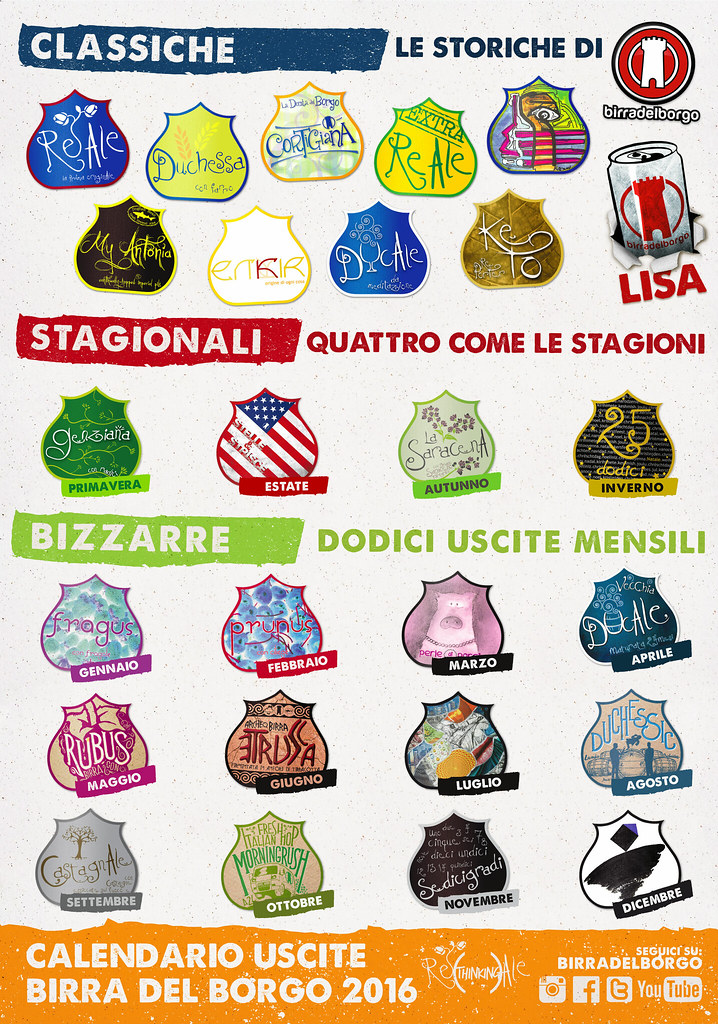
In 2005, Birra Del Borgo was founded by Leonardo Di Vincenzo in Borgorose, a small town in the province of Rieti on the border between Lazio and Abruzzo in Italy. Leonardo started brewing beer at home for enjoyment while at University studying biochemistry. He traveled frequently throughout Europe to explore the traditional beer styles; getting to know the German and Belgium master brewers was crucial to his education. One of Leonardo’s most formative experiences was brewing at the Starbess brewery in Rome, which later led to his conception of Birra del Borgo. Leonardo’s initial inspiration comes from English & Belgian beers, but he then reinvented the styles to root them in the Italian gastronomy culture. Leonardo currently produces ten beers year round, some famous such as ReAle, Duchessa, DucAle. Other Birra del Borgo products include 4 Seasonals inspired by local ingredients and several unique beers brewed with original techniques, under the “Bizzarre” family. Leo’s inspiration is dictated by the moment and seasonality related to the main ingredient, with a passion to reinvent styles and push boundaries.

Leonardo will remain the CEO of Birra Del Borgo.

Leonardo Di Vincenzo said: “Our voyage since we started in 2005 has been a great adventure. Today the beer sector has become very competitive and it necessary for us to make a next step to ensure that we can continue to evolve in terms of brewing techniques and in terms of the complexity and taste variation we can offer to consumers. We believe partnering with AB InBev is a great opportunity to do exactly that: it will allow Birra del Borgo to grow in a sustainable way while staying true to our unique identity and the philosophy that we have followed since the very beginning.

The partnership with AB InBev will bring us many advantages, from technological improvements and access to scientific research to the possibility to grow from a commercial point of view. Moreover, this partnership also means that we will be able to focus much more on what we enjoy most and do best: creating and experimenting with exciting new beers and pushing the boundaries of beer evolution in Italy.

He added: “We will continue brewing all of our beers in Borgorose, which will allow us to grow by continuing to invest in our local community, as we have always done. At Birra del Borgo, we have a great team with enormous enthusiasm and love for what we do every day. It is with this team that we start this exciting second chapter in Birra del Borgo’s history. The heart and soul of Birra del Borgo will remain unchanged and it is with the very same passion and love for beer that we will continue Re(Thinking) Ale”.

Simon Wuestenberg, Country Director for AB InBev Italia, said: “We have been very impressed by what Leonardo and his team have built since 2005. They have been at the forefront of redefining beer in Italy, bringing a unique mix of inspired innovation, quality and consistency. Leonardo’s vision for beer and his passion for brewing will be great inspirations to our whole team, and we’re very excited about partnering up and growing together. As a challenger on the Italian market, we have been successfully developing our business with a great portfolio of premium and specialty brands in the last few years. Today, that portfolio becomes even stronger with some of the best of “Made in Italy.”

del-borgo-2016

Filed Under: Breweries, News, Politics & Law Tagged With: Anheuser-Busch InBev, Business, Italy

« Previous Page
Next Page »

Find Something

Northern California Breweries

Please consider purchasing my latest book, California Breweries North, available from Amazon, or ask for it at your local bookstore.

Recent Comments

  • Bob Paolino on Beer Birthday: Grant Johnston
  • Gambrinus on Historic Beer Birthday: A.J. Houghton
  • Ernie Dewing on Historic Beer Birthday: Charles William Bergner 
  • Steve 'Pudgy' De Rose on Historic Beer Birthday: Jacob Schmidt
  • Jay Brooks on Beer Birthday: Bill Owens

Recent Posts

  • Historic Beer Birthday: Bernard “Toots” Shor May 6, 2026
  • Historic Beer Birthday: Jacob F. Kuhn May 6, 2026
  • Beer In Ads #5242: Tell Your Paw To Ask Hochgreves To Send A Case Of Their Bock Beer May 5, 2026
  • Historic Beer Birthday: Louis von Schwanenfluegel May 5, 2026
  • Beer Birthday: Bill Covaleski May 5, 2026

BBB Archives

Feedback

Head Quarter
This site is hosted and maintained by H25Q.dev. Any questions or comments for the webmaster can be directed here.