Brookston Beer Bulletin

Jay R. Brooks on Beer

  • Home
  • About
  • Editorial
  • Birthdays
  • Art & Beer

Socialize

  • Dribbble
  • Email
  • Facebook
  • Flickr
  • GitHub
  • Instagram
  • LinkedIn
  • Pinterest
  • RSS
  • Twitter
  • YouTube

Powered by Genesis

Beer In Ads #1652: If You Want To Feel Heroic …

August 18, 2015 By Jay Brooks


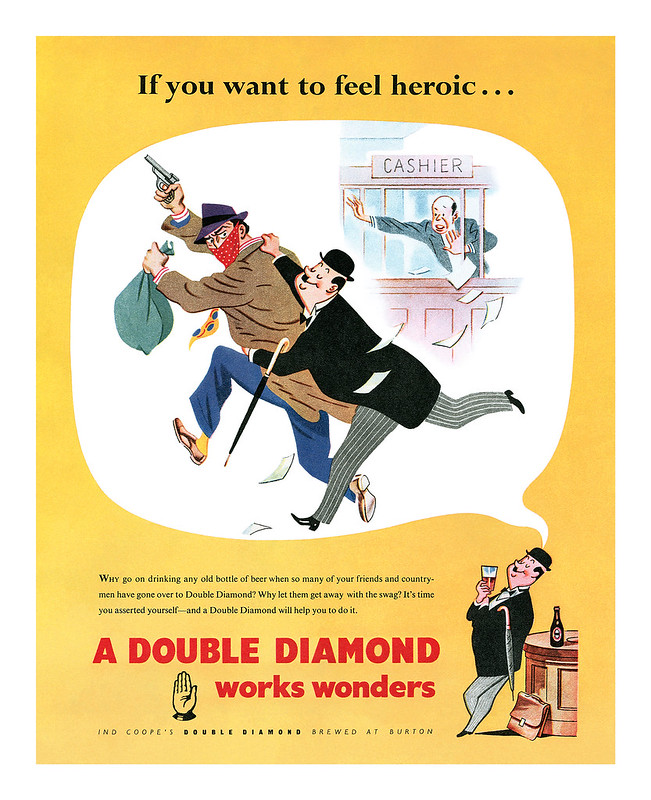
Tuesday’s ad is for Double Diamond, from 1951, which by that time was part of Ind Coope. It’s part of their “works wonders” series featuring the “Double Diamond Man.” After drinking a Double Diamond, it appears that DDM believes he can stop an armed bank robber singlehandedly. The DDM reminds me of a cross between John Cleese and Rumpole of the Bailey. The ad copy almost sounds like their encouraging such behavior. Dutch courage is one thing, but I’m not sure suggesting drinking a beer will make you a hero is necessarily a good message.
Double-Diamond-1951-robber

Filed Under: Art & Beer, Beers Tagged With: Advertising, History, UK

Patent No. D46298S: Design For A Bottle-Opener

August 18, 2015 By Jay Brooks

patent-logo
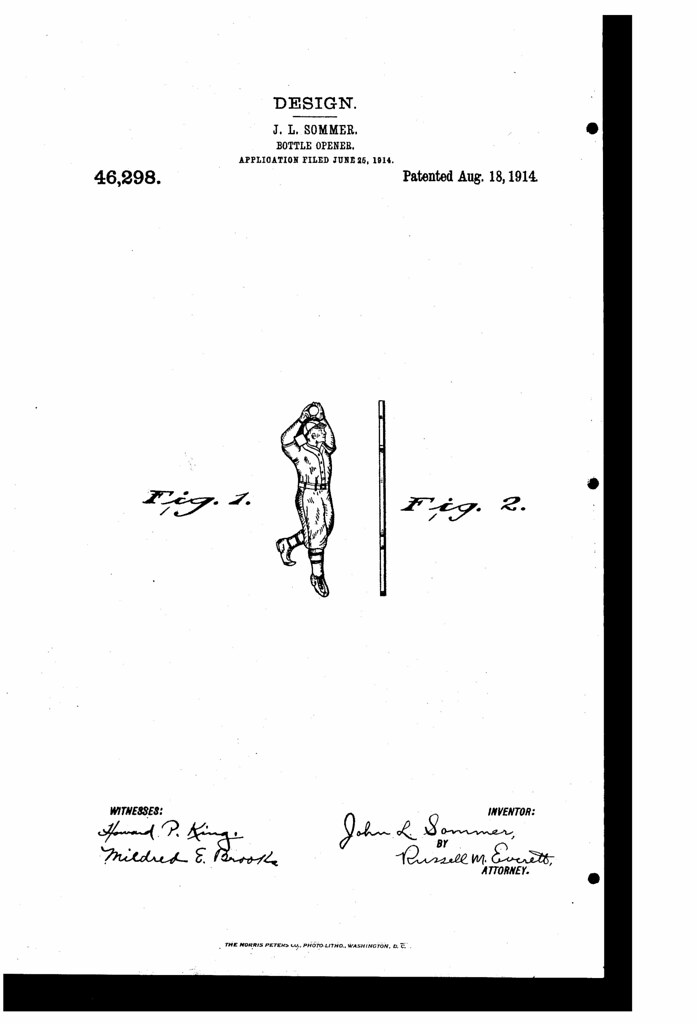
Today in 1914, US Patent D46298 S was issued, an invention of John L. Sommer, for his “Design for a Bottle-Opener.” There’s no Abstract, although in the description it includes this very short description, claiming that he has “invented a new, original and ornamental Design for a Bottle-Opener.” I bet you could make these today and they’d still be popular.
Untitled

Filed Under: Beers, Just For Fun, Politics & Law, Related Pleasures Tagged With: gadgets, History, Law, Packaging, Patent

Patent No. PP20227P3: Hop Plant Named ‘Super Galena’

August 18, 2015 By Jay Brooks

patent-logo
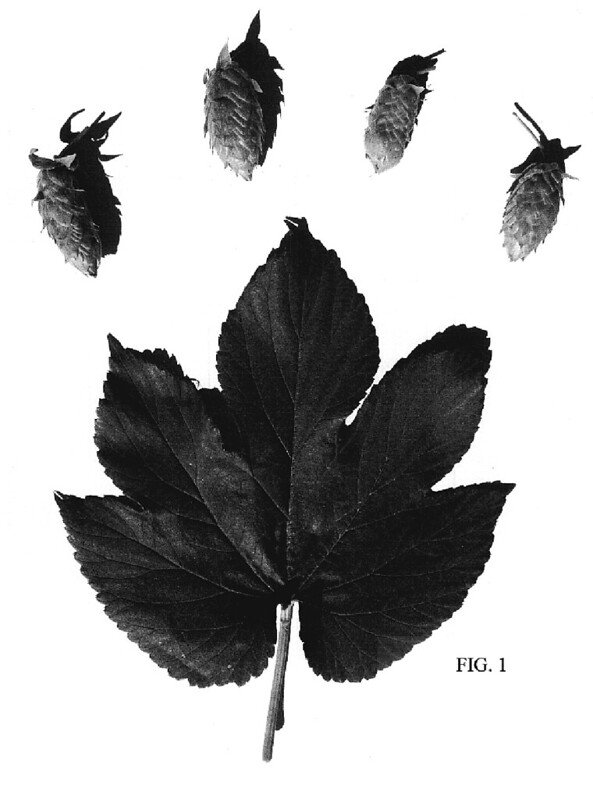
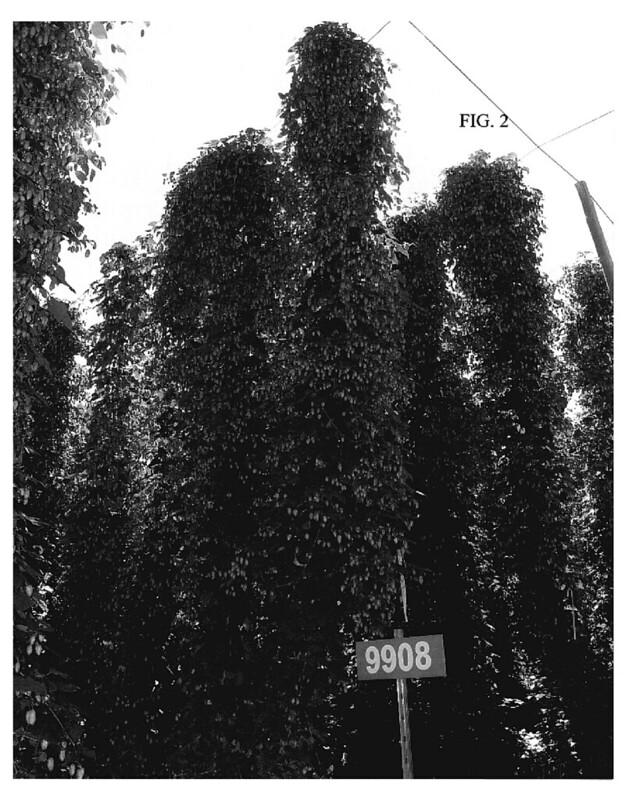
Today in 2009, US Patent PP20227 P3 was issued, an invention of Roger D. Jeske and Joe Brulotte, assigned to S.S. Steiner, Inc., for their “Hop Plant Named ‘Super Galena.'” Here’s the Abstract:

A novel variety of hop, Humulus lupulus L., named “Super Galena” is disclosed. “Super Galena” has relatively high contents of bitter acids, beta-acids, total oil, and humulene, and a moderate, pleasant aroma. “Super Galena” is comparable to Galena in its aroma and bitterness profile but offers a substantially higher yield and complete resistance to hop powdery mildew strains found in Washington, United States. The new variety was discovered among the progeny of a sexual cross made in 1998 in Yakima, Wash., United States and has been asexually reproduced and assessed in field plots in Prosser, Wash., United States.

Untitled
Untitled

Filed Under: Beers, Just For Fun, Politics & Law, Related Pleasures Tagged With: History, Hops, Law, Patent

Beer In Ads #1651: Have A Glass Of Guinness When You’re Tired

August 17, 2015 By Jay Brooks


Monday’s ad is for Guinness, from 1945. I’m not sure who looks sadder, the camel laden down with ten levels of boxes, barrels and sacks or the dude trying to lead the ship of the desert. I guess neither of them is moving until they get a beer. The illustration feels different then many of the classic Guinness ads, but it was done by John Gilroy, who did most of their iconic ads.

Guinness-1945-camel-tired

Filed Under: Art & Beer, Beers Tagged With: Advertising, Guinness, History

Patent No. 2447122A: Hop Picking Machine

August 17, 2015 By Jay Brooks

patent-logo
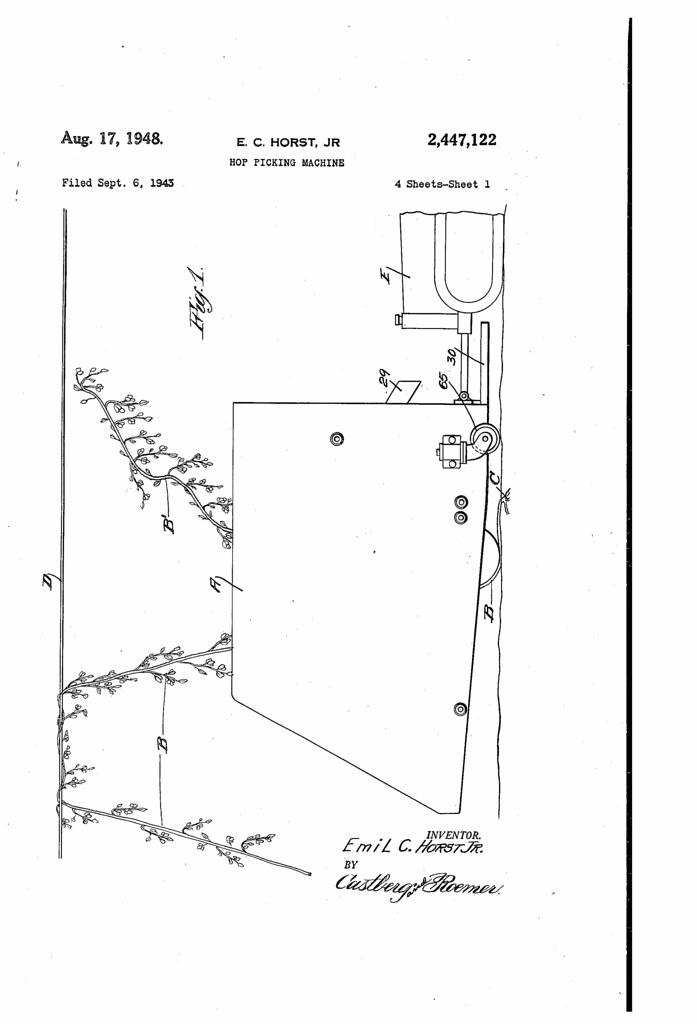
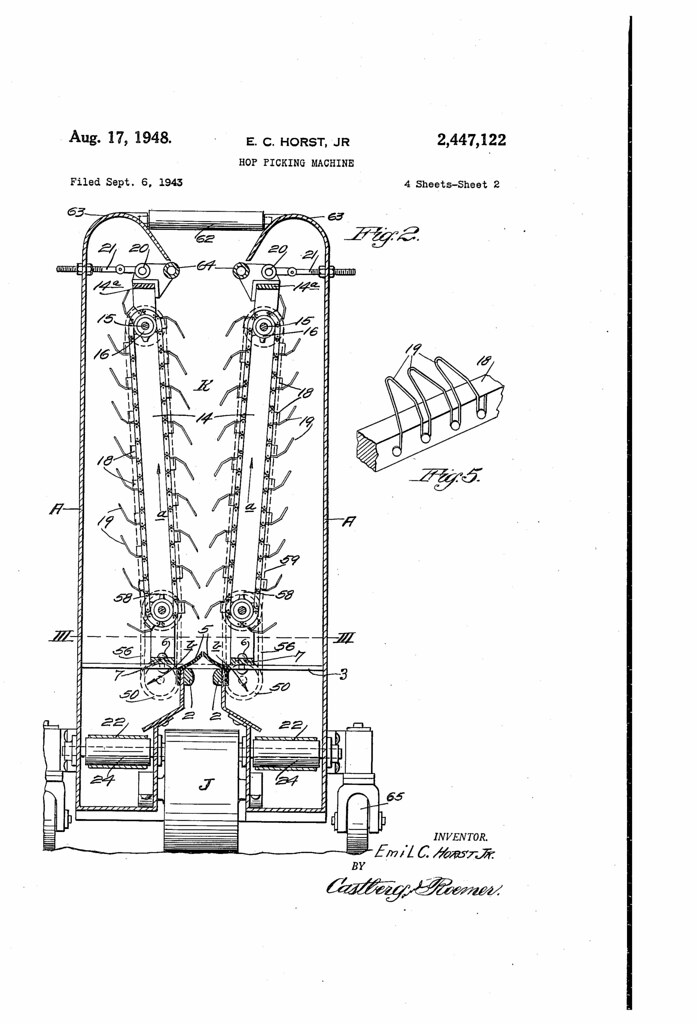
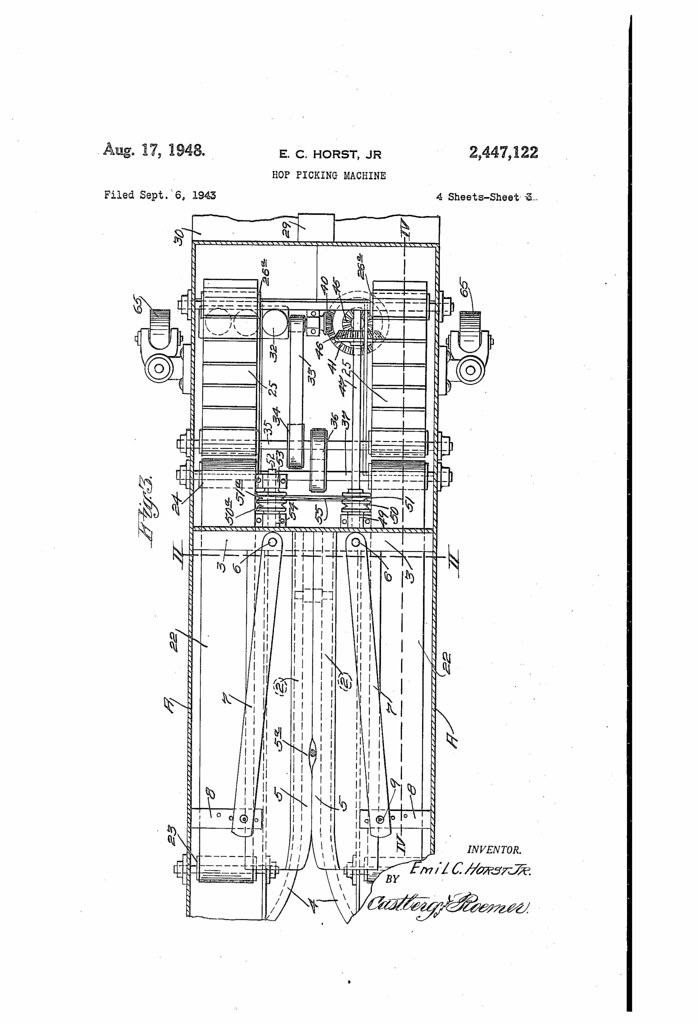
Today in 1948, US Patent 2447122 A was issued, an invention of Emil C. Horst Jr., for his “Hop Picking Machine.” There’s no Abstract, although in the description it includes this summary:

There are two types of hop picking machines in general use at the present time, to wit, a stationary and a portable type. Where stationary machines are used, the hop vines are cut ofi in the fields and loaded on trucks or wagons and hauled into the stationary machine where they are removed and attached to grasper bars which pull the hop vines between revolving drums or traveling belts equipped with V-shaped wire fingers which comb the vines and strip or remove the hops and most of the leaves. The picked hops and leaves are then delivered to separator belts where the leaves and stems and other foreign material are separated from the hops, and clean hop-s are finally obtained.

The portable type of machine operates in substantially the same manner, the principal difference being that the portable machine travels in the fields where the hops grow, and as the machine advances, the hop vines are cut down and attached directly to grasper bars which pull the vines through the machine with the result that the hops and leaves are stripped on and then delivered to separators to finally obtain the clean hops.

From the foregoing, it will be noted that whether a portable or stationary machine is employed, the hop vines must be cut off and attached to grasper bars in order to feed or pull them through the machines where the stripping operation takes place.

The object of the present invention is to provide a new method and machine whereby hops can be picked directly from the vines in the field without the necessity of cutting the vines free from the plant or root from which they grow; to provide a portable machine which straddles and travels along a row of hop vines and as it travels, combs the hop vines in an upward direction thereby more efficiently removing the which can singly and in clusters generally beneath the leaves and arms of the hop Vines; and further, to provide a machine in which grasper bars together with associated mechanism is entirely eliminated and the machine proper very materially simplified, this being accomplished by providing a roller which rolls over the stalk the vine and with sufficient traction to pull the vine downwardly through the combing or picking fingers of the machine as the machine advances.

Untitled
Untitled
Untitled
Untitled

Filed Under: Beers, Just For Fun, Politics & Law, Related Pleasures Tagged With: History, Hops, Law, Patent

Patent No. 166742A: Improvement In Beer-Refrigerators

August 17, 2015 By Jay Brooks

patent-logo
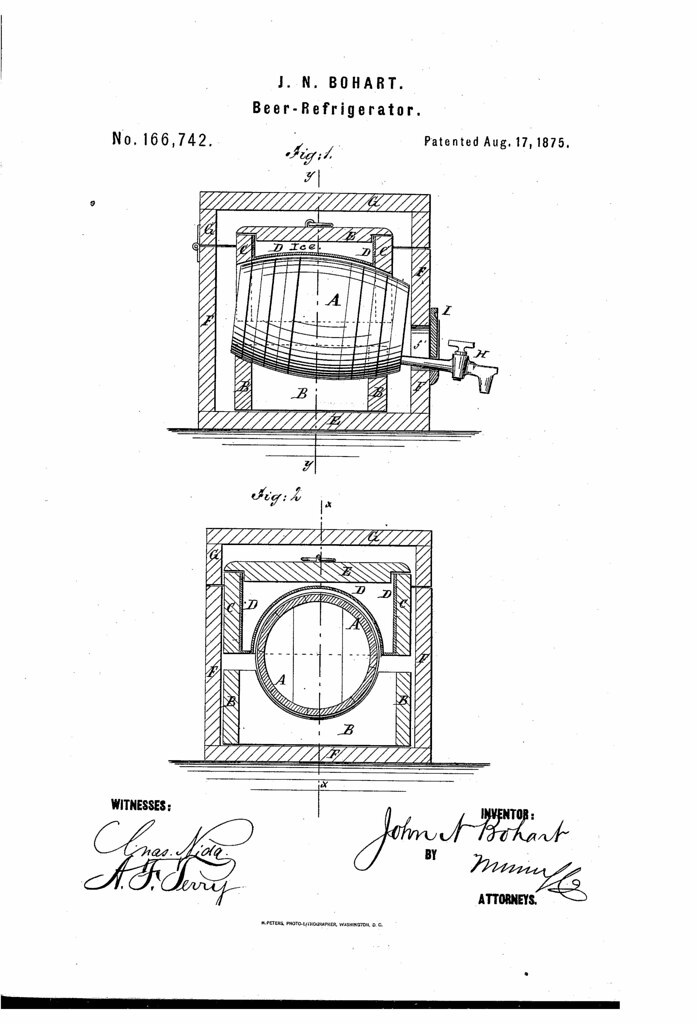
Today in 1875, US Patent 166742 A was issued, an invention of John K. Bohaet, for his “Improvement in Beer-Refrigerators.” There’s no Abstract, although in the description it includes this summary:

The object of this invention is to furnish an improved refrigerator for cooling lager-beer in the keg, and which shall be so constructed as to cool the beer quickly, and keep it cool for a long time with a small quantity of ice, and which shall be simple in construction, convenient in use, and very compact, requiring but little space. The invention consists in the beer-refrigerator formed of the skid, the ice-box, and the outer box or case, constructed as hereinafter fully described, to adapt it to receive a beer-keg, as set forth.

US166742-0

Filed Under: Beers, Just For Fun, Politics & Law, Related Pleasures Tagged With: History, Kegs, Law, Patent

Beer In Ads #1650: Take Away The Beer You First Thought Of

August 16, 2015 By Jay Brooks


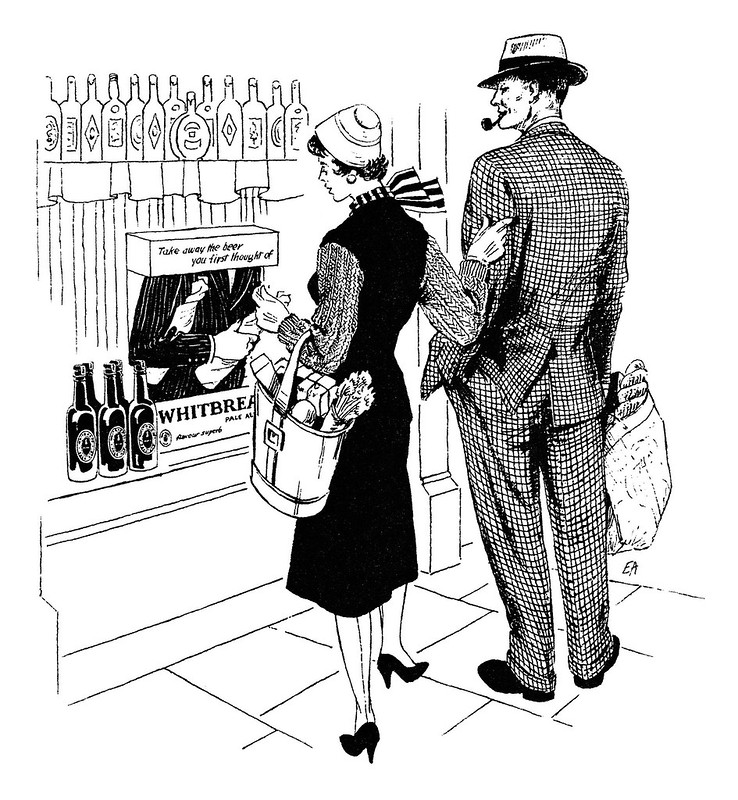
Sunday’s ad is for Whitbread Pale Ale, from 1958. A couple who appears to have been doing some shopping have stopped to peer in a window displaying Whitbread Pale Ale in the window. The sign has the curious phrase “Take away the beer you first thought of.” “Take away” I understand, for which we usually say “to go,” but the rest I don’t understand. “The beer [I] first thought of?” When? Just now? When I had my very first thought about beer? I assume it’s a British idiom that makes sense to an Englishmen, but is incomprehensible to us crass Americans.

Whitbread-1958-take-away

Filed Under: Art & Beer, Beers Tagged With: Advertising, England, History, UK

Patent No. 3266263A: Concentration Of Aqueous Solutions By Crystallization With Sonic Defoaming

August 16, 2015 By Jay Brooks

patent-logo
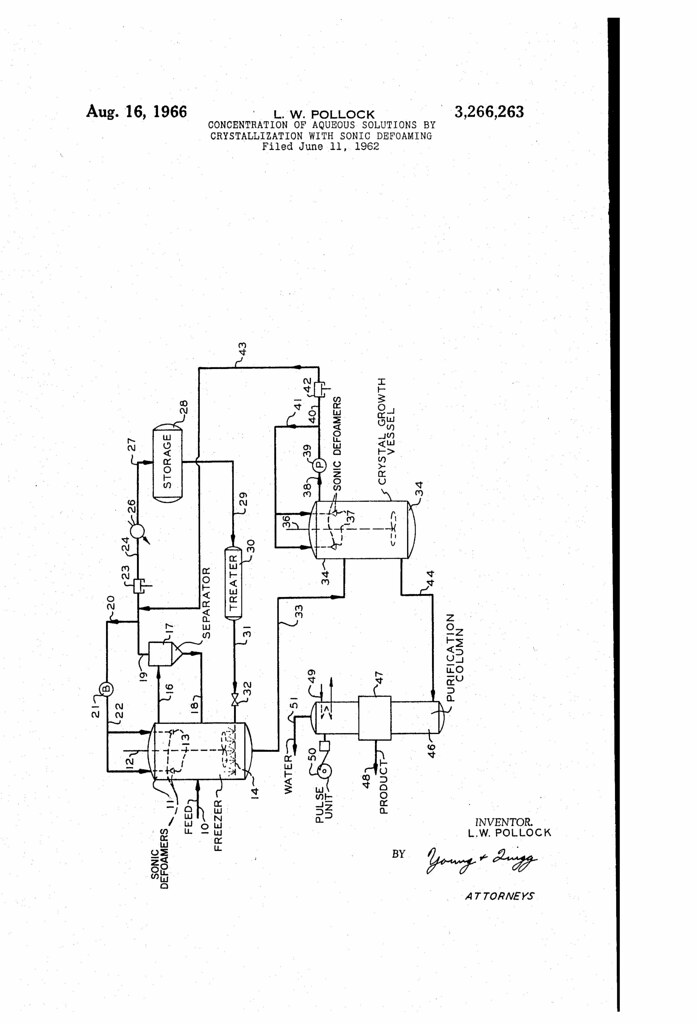
Today in 1966, US Patent 3266263 A was issued, an invention of Lyle W. Pollock, for his “Concentration of Aqueous Solutions by Crystallization with Sonic Defoaming.” There’s no Abstract, although in the description it includes this summary:

Conventionally, aqueous solutions can be concentrated by crystallization involving chilling the aqueous solution to form ice crystals with subsequent separation of the ice crystals from the mother liquor. This method as `applied to the concentration of food products has become commercially acceptable as it can be carried out without damaging the taste of the food product. In this respect, concentration by crystallization represents a considerable improvement over evaporative processes which rely upon heat and/or extremely low pressure. The removal of water by evaporation also results in the removal of much of the essential oils and esters, many of which are not recoverable, so that the concentrated product can never be restored to its original freshness and flavor. Concentration by crystallization can be employed to advantage in the processing of such food products and beverages as milk, fruit juices, vegetable juices, vinegar, beer, wine, liquors and the like.

A method of concentrating by crystallization involves chilling the aqueous solution in a chiller to form a slurry of ice crystals and mother liquor and then forcing the resulting slurry into a crystal purification column such as described in the patent to Schmidt, Re. 23,810, and the patent to R. W. Thomas, 2,854,494, and comprising an elongated confined concentration zone. The crystals are moved in a compact mass into a body of crystal melt which is formed by heating the crystals in a downstream portion of the concentration zone. A portion of the crystal melt is displaced back into the advancing crystal mass. The purification column includes an upstream liquid removal zone, a middle reflux zone and a downstream melting zone. Mother liquor is removed from the crystals in the liquid removal zone and the crystals :are melted in the melting zone.

In the chilling step, a scraped-surface stainless steel chiller is conventionally employed. The scraped-surface stainless steel chiller represents a major investment cost and an overall major process expense. It would be desirable, therefore, to eliminate the scraped-surface chiller and thus substantially `reduce the process cost of concentrating aqueous solutions by crystallization.

The inventive process can be employed to advantage in the processing of such food products and beverages as milk, fruit juices, vegetable juices, vinegar, beer, wine, liquors, and the like. The inventive process is particularly applicable to the concentration of beer as the beer 3,266,263 Patented August 16, 1966 ICC withdrawn from the fermenters usually contains 1 to 2 volumes of carbon dioxide at standard temperature and pressure (60 F. and l atmosphere) per volume of liquid beer. Therefore, contacting the 4beer with carbon dioxide does not involve the introduction of a new component to the beer.

The invention will hereinafter be described as applied specifically to the concentration of beer, although it is the temperature of the beer feed is lowered to form a slurry of ice crystals. The temperature within freezer 11 can range from about 0 to 32 F. and the pressure can range from about to 50 p.s.i.g, The weight ratio of liquid carbon dioxide to beer passed to freezer 11 can range from about 1:2 to about 2: 1.

Freezer 11 is provided with a means for mixing 12 the carbon dioxide and beer feed streams. In order to prevent foaming, conventional sonic defoamers 13 are employed. Reference is made to lChemical Week, May 6, 1961, page 52, for a discussion of the effectiveness of sonic defoamers as applied to the beer industry.

Untitled

Filed Under: Beers, Breweries, Just For Fun, Politics & Law, Related Pleasures Tagged With: History, Law, Patent, Science of Brewing

Patent No. 4042142A: Beer Keg Cooling Container

August 16, 2015 By Jay Brooks

patent-logo
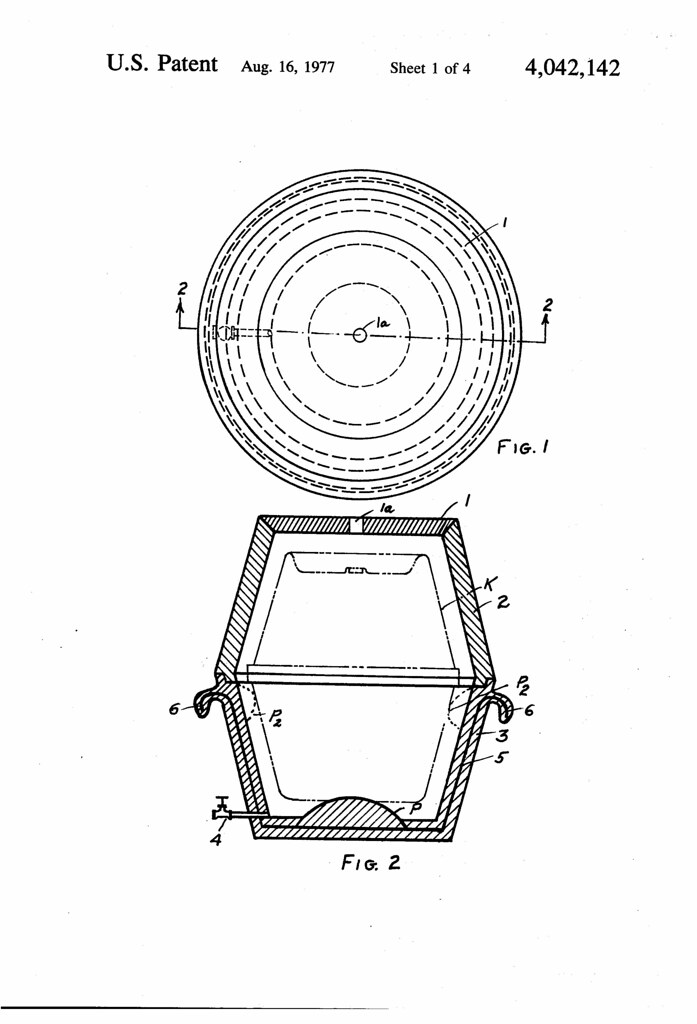
Today in 1977, US Patent 4042142 A was issued, an invention of Robert W. Ruano, for his “Beer Keg Cooling Container.” Here’s the Abstract:

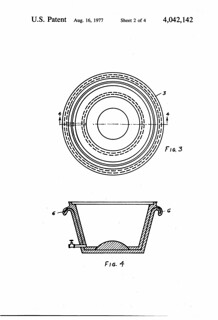
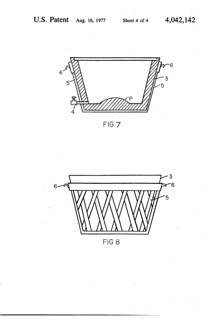
A beer keg container of insulating material, such as styrofoam, subdivided into three parts, a lid with a hole through which the shaft of the tap extends, an upper half, and a bottom half, which halves are detachably connected by an interlocking joint. The bottom half is reinforced with a wire basket having handles to facilitate carrying of the insulating container and enclosed beer keg. The diameter of the beer keg is smaller and spaced from the inner diameter of the container so that the space there between may be packed with ice cubes or crushed ice to keep the beer keg cold.

Untitled

Untitled Untitled

Filed Under: Beers, Just For Fun, Politics & Law, Related Pleasures Tagged With: History, Kegs, Law, Patent

Beer In Ads #1649: The Call Is For Carlsberg

August 15, 2015 By Jay Brooks


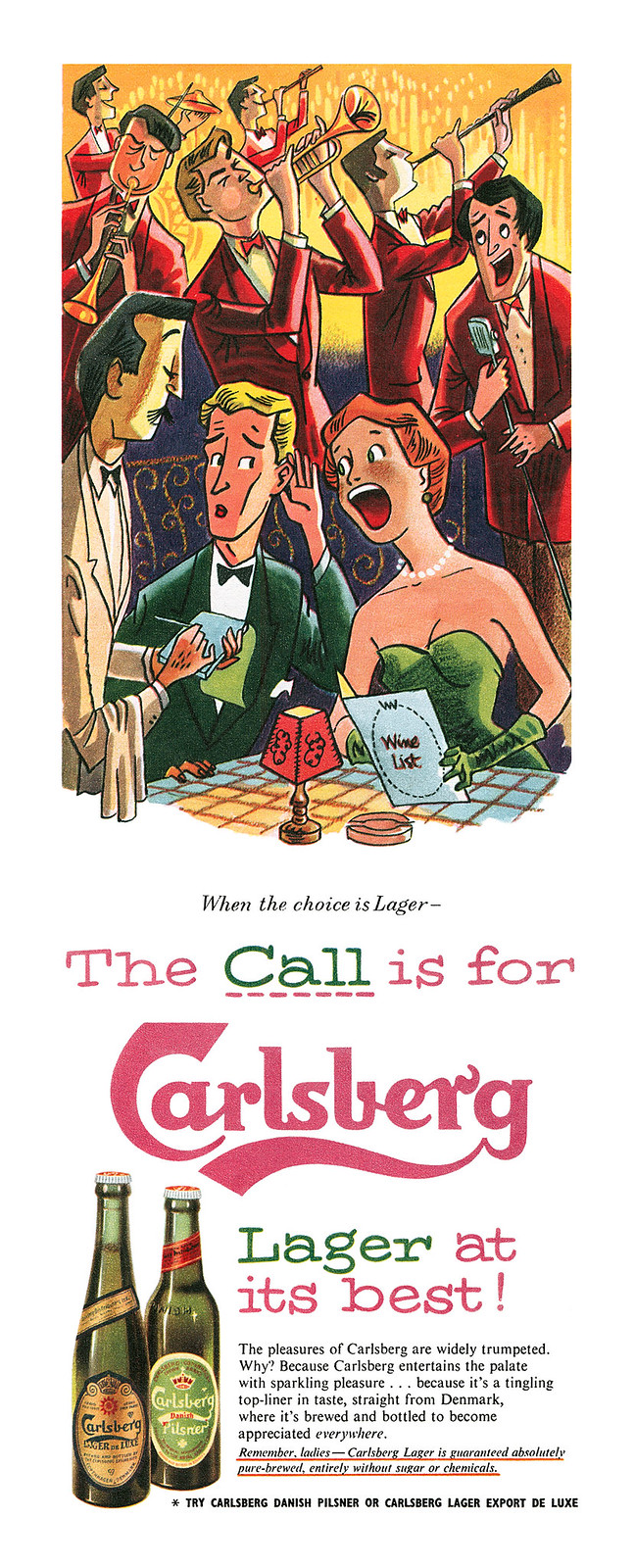
Saturday’s ad is for Carlsberg, from 1956. I guess the band is playing pretty loudly, since the woman at the club has to shout to give her order, and even her date seems to be struggling to understand her. Some of the text is great, including saying that the “pleasures of Carlsberg are widely trumpeted” because it “entertains the palate with sparking pleasure.” “It’s a tingling top-liner in taste.” But the best part is the final sentence, reassuring the womenfolk. “Remember, ladies — Carlsberg Lager is guaranteed absolutely pure-brewed, entirely without sugar or chemicals.”

Carlsberg-1956-club

Filed Under: Art & Beer, Beers Tagged With: Advertising, Carlsberg, History

« Previous Page
Next Page »

Find Something

Northern California Breweries

Please consider purchasing my latest book, California Breweries North, available from Amazon, or ask for it at your local bookstore.

Recent Comments

  • Bob Paolino on Beer Birthday: Grant Johnston
  • Gambrinus on Historic Beer Birthday: A.J. Houghton
  • Ernie Dewing on Historic Beer Birthday: Charles William Bergner 
  • Steve 'Pudgy' De Rose on Historic Beer Birthday: Jacob Schmidt
  • Jay Brooks on Beer Birthday: Bill Owens

Recent Posts

  • Beer In Ads #5205: Moerlein’s Celebrated Bock Beer, An Easy Winner April 5, 2026
  • Historic Beer Birthday: Fritz Funke April 4, 2026
  • Historic Beer Birthday: Herman Zibold April 4, 2026
  • Beer In Ads #5204: Bock Beer! The First Genuine Bock Of The Season April 4, 2026
  • Historic Beer Birthday: Marcus Rapp April 4, 2026

BBB Archives

Feedback

Head Quarter
This site is hosted and maintained by H25Q.dev. Any questions or comments for the webmaster can be directed here.