Brookston Beer Bulletin

Jay R. Brooks on Beer

  • Home
  • About
  • Editorial
  • Birthdays
  • Art & Beer

Socialize

  • Dribbble
  • Email
  • Facebook
  • Flickr
  • GitHub
  • Instagram
  • LinkedIn
  • Pinterest
  • RSS
  • Twitter
  • YouTube

Powered by Genesis

Patent No. 2894844A: Canning Process And Product

July 14, 2015 By Jay Brooks

patent-logo
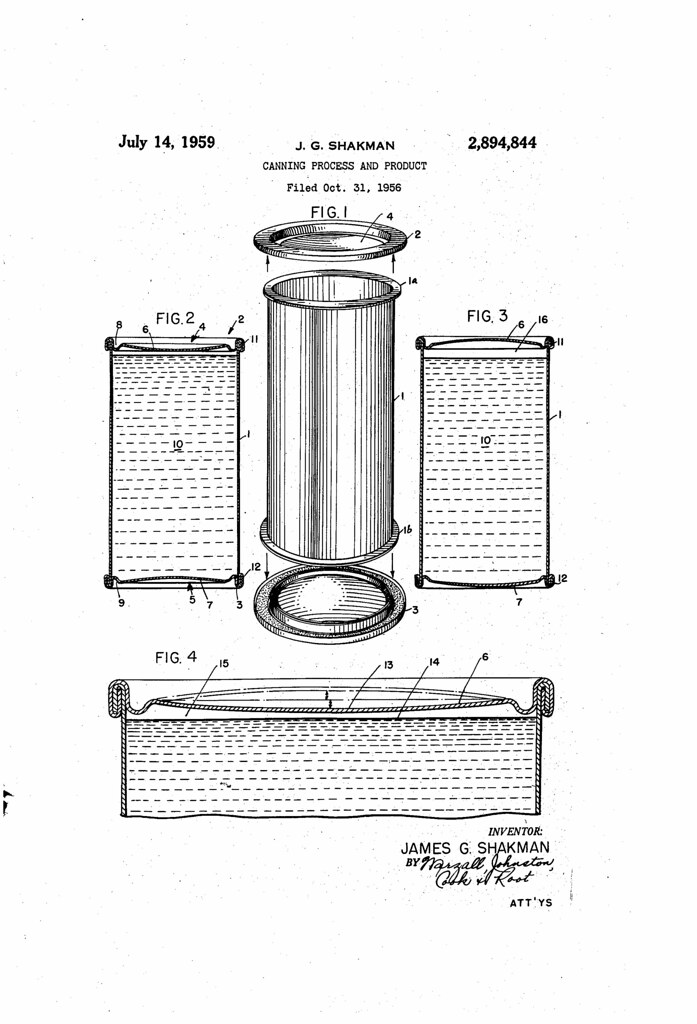
Today in 1959, US Patent 2894844 A was issued, an invention of James G. Shakman, assigned to the Pabst Brewing Co., for his “Canning Process and Product.” There’s no Abstract, although in the description it includes this summary:

[This invention is for an] improved process for canning substances which are processed during the general course of canning and which contain a gas, or contain vaporizable liquid, or are capable of expanding and so are capable of producing internal pressure in the can during such processing.

A more specific object of the invention is to provide a new and improved process for canning carbonated liquids, such as beer and other carbonated beverages, which are normally canned with a head space above the liquid level.
Untitled

Filed Under: Beers, Breweries, Just For Fun, Politics & Law, Related Pleasures Tagged With: Brewing Equipment, Cans, History, Law, Patent

Zion, Illinois: City To God, Destroyer Of Beer

July 14, 2015 By Jay Brooks

illinois
Here’s a curious bit of history, centering in the Illinois town of Zion, which was founded today in 1901, and a year before on July 14, 1900, is essentially when the history of the town begins. Here’s their history from the Zion Historical Society:

After the organization of the Christian Catholic Church in Zion [in 1896], [founder John Alexander Dowie] dreamed of a city where his congregation would be free from the evils of the world, a city where God would be the ruler. He first looked for land south of Chicago in the Blue Island area, but the land was not suitable so he looked north of the city. In the fall of 1899, Dowie visited the land north of Waukegan and envisioned what he would come to name “Zion City”. After successfully securing options on approximately 6,600 acres of land, he unveiled his plan for Zion City at the Watchnight Service the eve of the New Year 1900. It would be a city where his congregation could worship, work, and play free from the temptations of the world. Zion City was the only city, besides Washington D.C., that had plans completed before the first spade of dirt was turned. There would be places of employment – he imported a lace mill from England — schools, and recreational facilities, all controlled by John A. Dowie. The land would be leased to the people, with definite restrictions, for 1,100 years. Dowie reasoned that Christ’s return was to be within 100 years and then the millennium, after which there would be no need for leases.

The people would share in the profits of the industries in Zion City and the profits, tithes, and offerings would be sufficient for the support of the Christian Catholic Church in Zion.

On July 14, 1900, hundreds of people came to what would be Zion City for an all day affair which culminated in the dedication of the City to God. The next year was spent surveying the city, laying out all the lots, planning for the utilities, and preparing for the opening of the City to the people. July 15, 1901 was the date that the City lots were made available to the public. The first house was built shortly thereafter in August, 1901. Dowie and his family came to Zion City from Chicago in July, 1902 and moved into Shiloh House, his newly constructed home.

Zion City never reached the potential that Dowie dreamed of having suffered financial troubles early on. In September, 1905, Dowie suffered a stroke and never fully regained his strength. While in Jamaica trying to regain his health, Dowie recalled Wilbur Glenn Voliva from Australia to be the Deputy General Overseer giving Voliva full power of attorney. With Voliva’s arrival in Zion City, he became aware of the dire financial condition of the City. He took steps to relieve Dowie by exercising the power of attorney given to him by Dowie. Dowie was asked to quietly resign from his office of General Overseer. Dowie chose not to relinquish control and a court battle ensued. The court ruled that the people could choose the successor and the great majority chose Voliva. Dowie was deposed and spent the last year of his life at Shiloh House surrounded by a small group of loyal followers. He died at Shiloh House in March, 1907, a few months before his 60th birthday. He is buried in Lake Mound Cemetery, Zion, Illinois.

Zion is located in Lake County, in the northeast corner of the state of Illinois, at one point even touching the border to Wisconsin, though most of it lies a bit south of the line separating the states. Zion also appears to be smack dab in the middle between Chicago and the more beer-friendly Milwaukee, also along Lake Michigan.

So the town was created to be a religious sanctuary, a Christian utopia. As these things generally go, it didn’t quite work out that way. Trying to create a place that’s “free from the evils of the world” seems impossible, especially since there’s no universal agreement on what those evils might be. Not surprisingly, however, alcohol was almost certainly among the evils Dowie wanted his town to be free from. And as far as I can tell, there are still no bars in Zion City and the town’s Liquor Control Commission only allows “the sale of alcoholic liquor at retail primarily to the sale in its original package or by restaurants, recreational facilities or hotels,” which seems to suggest no draft and therefore no bars. There are certainly no bars listed in the directory of the Zion businesses, not as a category and not by any obvious names, although they do have at least one chain restaurant that typically includes a bar: Applebee’s.

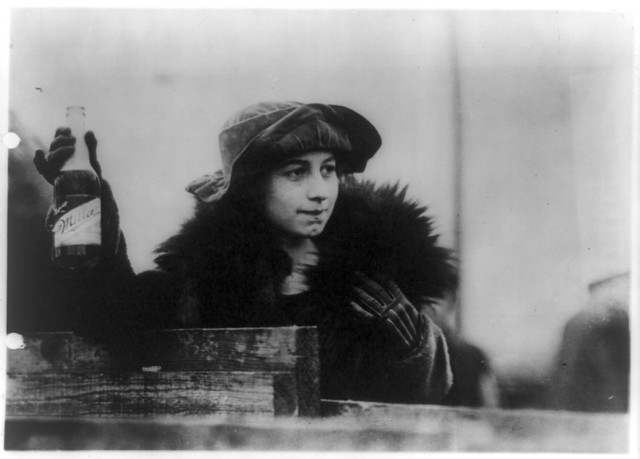
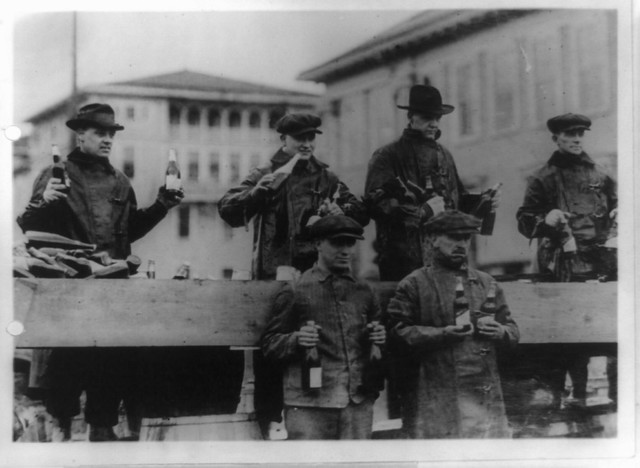
But Zion also seems to be part of the legacy of Prohibition, too. The National Photo Company Collection, which is in the Library of Congress, has some photos taken in Zion, Illinois sometime during the Prohibition years. The photos were originally taken by the Press Illustrating Service of New York. Surprisingly, they’re not sure exactly when the photos were taken, the Library of Congress believing it was “between 1921 and 1932,” which is a pretty wide range.

As far as I can piece together from the captions in the Library of Congress collection, trucks bound for the more populous and gregarious Chicago, just fifty miles to the south along Lake Michigan, were stopped in pious Zion, and confiscated. The City, apparently under federal authority, took it upon themselves to destroy the beer that they captured from the bootleggers. Maybe it was some kind of vigilante citizens force, determined to keep illegal hooch out of their paradise. Apparently, Zion destroyed around 80,000 sixteen ounce beer bottles. At any rate, all that remains of this story appears to be these three photos.

zion-1
Zion City, Ill., destroys 80,000 pint bottles of beer. Mrs. Graze Knippen of Zion City holding up bottle of beer as she helps get rid of the beer.

zion-2
W. Hurd Clendinen, mayor of Zion City, pouring away two bottles of beer. Apparently Clendinen made sure the press was on hand to witness, and photograph, his city’s commitment to the Prohibition movement.

zion-3
Six men holding bottles of beer from a captured truck. Truck loads of beer enroute to Chicago, which were waylaid and captured at Zion City, Ill. … all bottles were destroyed.

Filed Under: Beers, Just For Fun, Politics & Law Tagged With: History, Prohibition

Patent No. 322318A: Beer-Faucet

July 14, 2015 By Jay Brooks

patent-logo
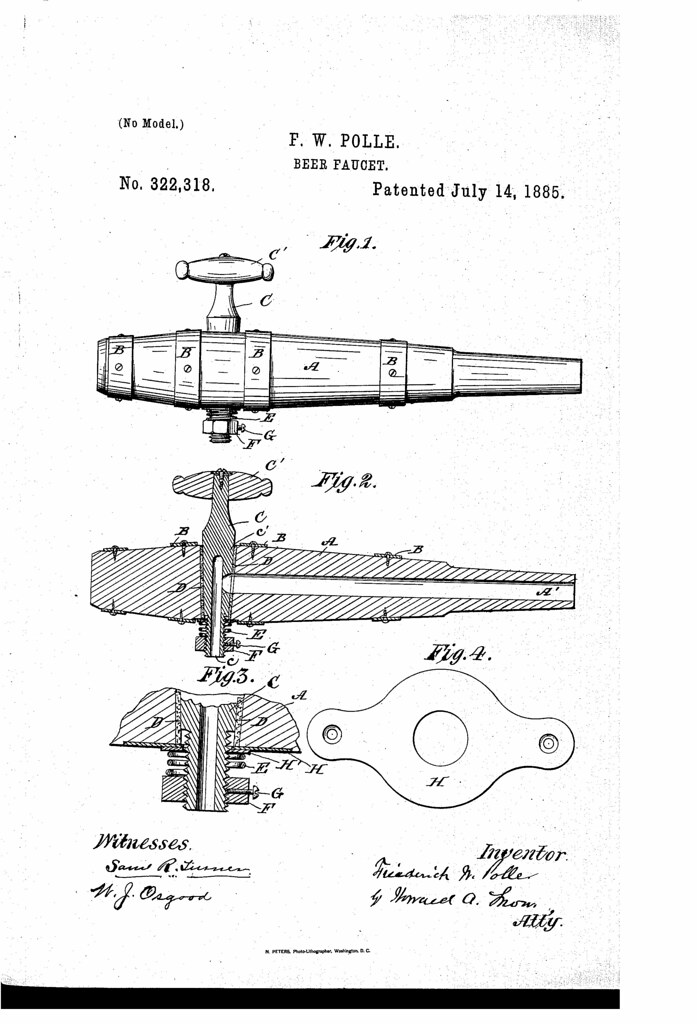
Today in 1885, US Patent 322318 A was issued, an invention of Friedrich W. Polle, for his “Beer-Faucet.” There’s no Abstract, although in the description there’s not really a summary, all that’s really said generally is that he’s “invented a new and useful Improvement in Beer-Faucets.”
Untitled

Filed Under: Beers, Just For Fun, Politics & Law, Related Pleasures Tagged With: History, Kegs, Law, Patent

Beer In Ads #1615: Harrison Ford For Kirin Lager

July 13, 2015 By Jay Brooks


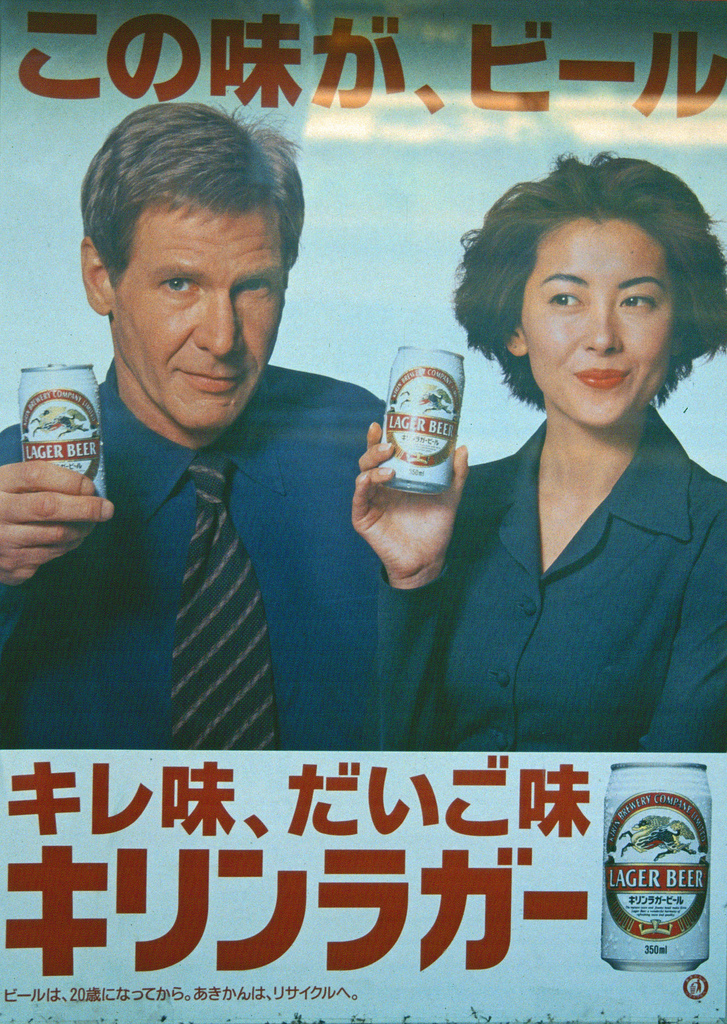
Monday’s ad is for Kirin Lager, from the early 1990s, probably 1994. I’m guessing 1994, because Ford also did a television commercial for Kirin that year. Featuring actor Harrison Ford, whose birthday is today, the poster is advertising Kirin Lager. According to one account, here is a translation of the poster, which was seen in a convenience store window:

Harrison Ford endorsing Kirin beer, Fukushima 福島

“Kono aji ga, biiru.” = “This taste, beer.”
“Kire aji, daigo aji” = “cutting edge taste, the epitome of taste”
“Kirin ragaa.” = “Kirin lager.”

Kirin-Harrison-Ford-1
And apparently the small letters at the bottom here translate as: “You have to be 20 years old for beer and recycle the empty cans.”

Filed Under: Art & Beer, Beers Tagged With: Advertising, History, Japan, Kirin

Patent No. 927893A: Beer-Pipe-Cleaning Apparatus

July 13, 2015 By Jay Brooks

patent-logo
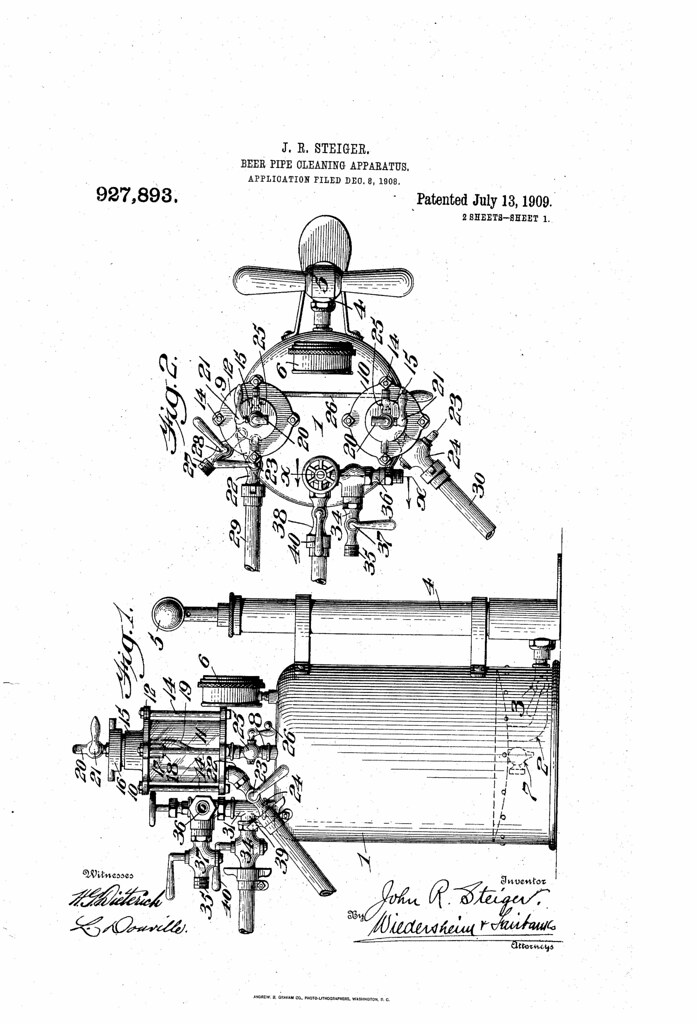
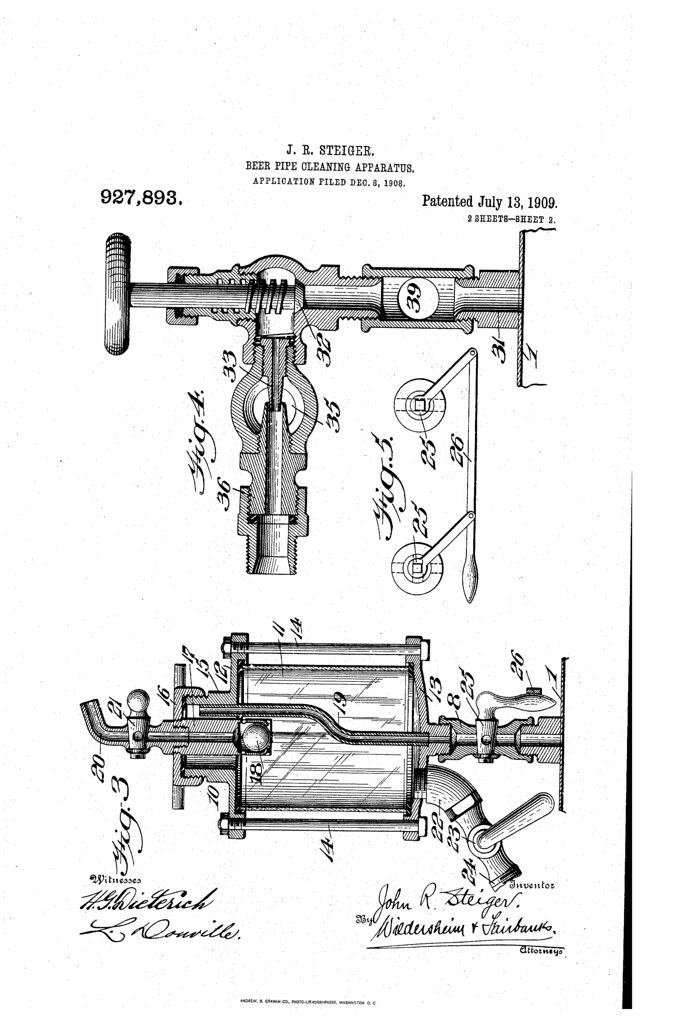
Today in 1909, US Patent 927893 A was issued, an invention of John R. Steiger, for his “Beer-Pipe-Cleaning Apparatus.” There’s no Abstract, although in the description it includes this summary:

My invention relates to a new and useful beer pipe cleaning apparatus and consists in providing means whereby a circulation of the cleansing material may be made through the pipes. It further consists of means for directing the flow of the cleansing material first in one direction and then in the other through the pipes. It further consists in providing an ejector for forcibly directing water and air through the pipes.

Untitled

Filed Under: Beers, Breweries, Just For Fun, Politics & Law, Related Pleasures Tagged With: Brewing Equipment, History, Law, Patent

Patent No. 586323A: Bung-Starter

July 13, 2015 By Jay Brooks

patent-logo
Today in 1897, US Patent 586323 A was issued, an invention of Henry Sternkopf, for his “Bung-Starter.” There’s no Abstract, although in the description it includes this summary:

The object of this invention is to provide improved means for starting or withdrawing bungs from barrels, casks, kegs, and like receptacles.

Untitled

Filed Under: Beers, Just For Fun, Politics & Law, Related Pleasures Tagged With: Cask, History, Kegs, Law, Patent

Patent No. 2324312A: Bottle Feeding Mechanism

July 13, 2015 By Jay Brooks

patent-logo
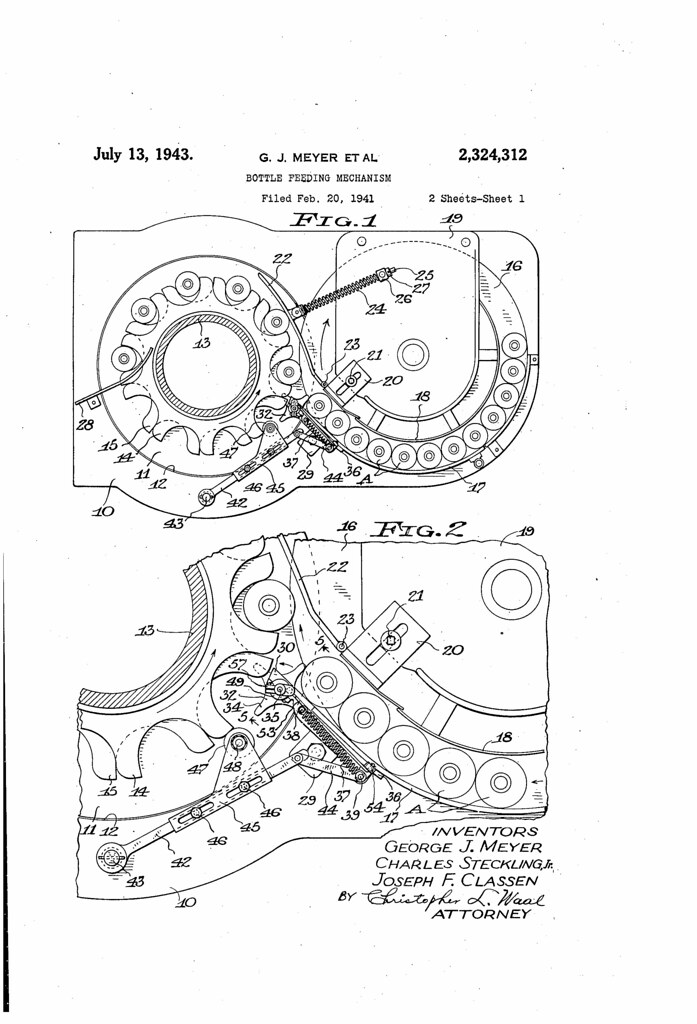
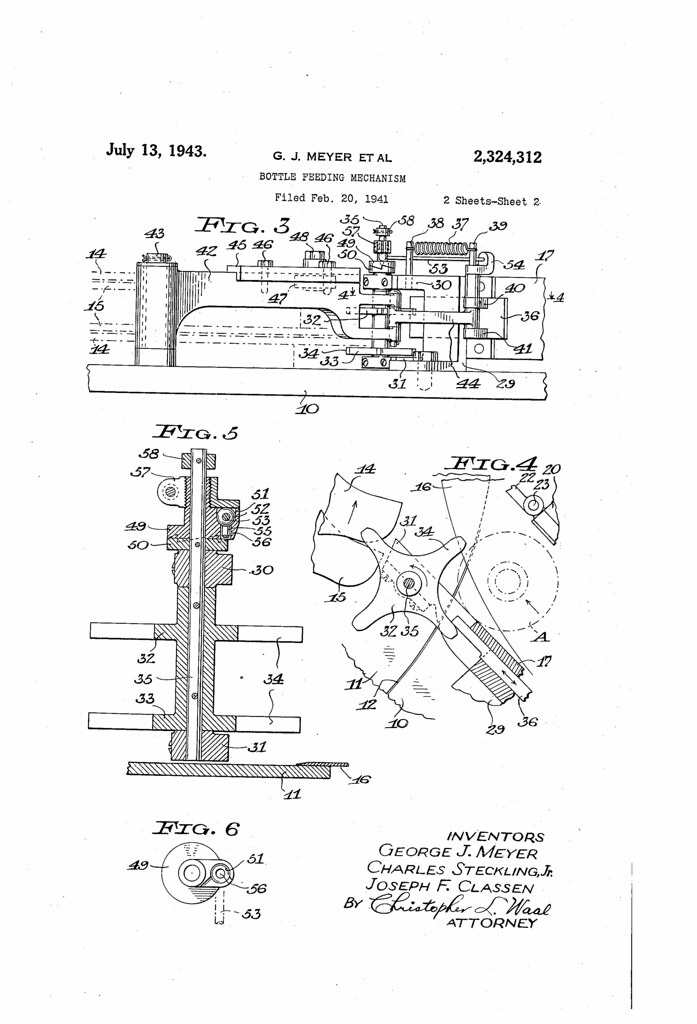
Today in 1943, US Patent 2324312 A was issued, an invention of George J. Meyer Jr., Charles Steckling, and Joseph F. Classen, for their “Bottle Feeding Mechanism.” There’s no Abstract, although in the description it includes this summary:

The present invention relates to feeding mechanism adapted for use in connection with bottle handllng machines, such as cappers, fillers and labelers, although the invention is also applicable to the feeding of cans and other articles.

A bottle-handling machine, such as a capper, is commonly provided with a traveling carrier having means for holding the upstanding bottles in spaced relation to present the bottles successively to the operation of the machine. It is also common practice to provide the machine with a conveyer for conducting the bottles to the carrier, the successive bottles on the conveyer being usually in abutting or closely spaced relation. The spacing of the bottles on the carrier is ordinarily somewhat greater than the bottle diameter and because of this and other factors it is necessary to provide some means for controlling the feed of the bottles to the carrier, so as to suit the bottle spacing or bottle pitch of the carrier. Various mechanisms have heretofore been devised for this purpose, but they have been open to certain objections, such as relatively complicated construction and excessive rubbing and agitation of the bottles.

It is an object of the invention to provide an improved form of feeding mechanism which will effect the safe and accurate transfer of bottles to the traveling carrier of a capping machine or other bottle-handling machine, which will minimize rubbing or marking of the outer walls of the bottles, which will reduce agitation or jostling of the bottles, which is adapted for high-speed operation, which will accommodate bottles of different diameter, and which is capable of inexpensive manufacture and easy mounting.

US2324312-0
US2324312-1

Filed Under: Beers, Breweries, Just For Fun, Politics & Law, Related Pleasures Tagged With: Bottles, Brewing Equipment, History, Law, Packaging, Patent

Beer In Ads #1614: For That Smoother Taste —

July 12, 2015 By Jay Brooks


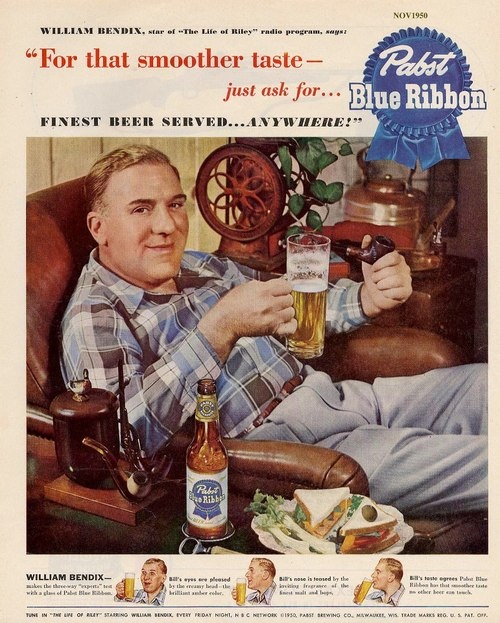
Sunday’s ad is for Pabst Blue Ribbon, from 1950. Featuring actor William Bendix, who did mostly character roles but also played the Babe in The Babe Ruth Story, it shows him relaxing in his den, pipe in one hand and a mug of beer in the other. Pabst must have been a sponsor of his radio show at the time, “The Life of Riley.” Bendix tended to play everyday guys, blue collar toughs with street smarts, masculine men, so that may be what Pabst was trying to associate themselves with, especially in that setting with its leather chair, and other manly accouterments.

pabst-1950-william-bendix

Filed Under: Art & Beer, Beers Tagged With: Advertising, History, Pabst

Patent No. 366207A: Beer-Pitcher

July 12, 2015 By Jay Brooks

patent-logo
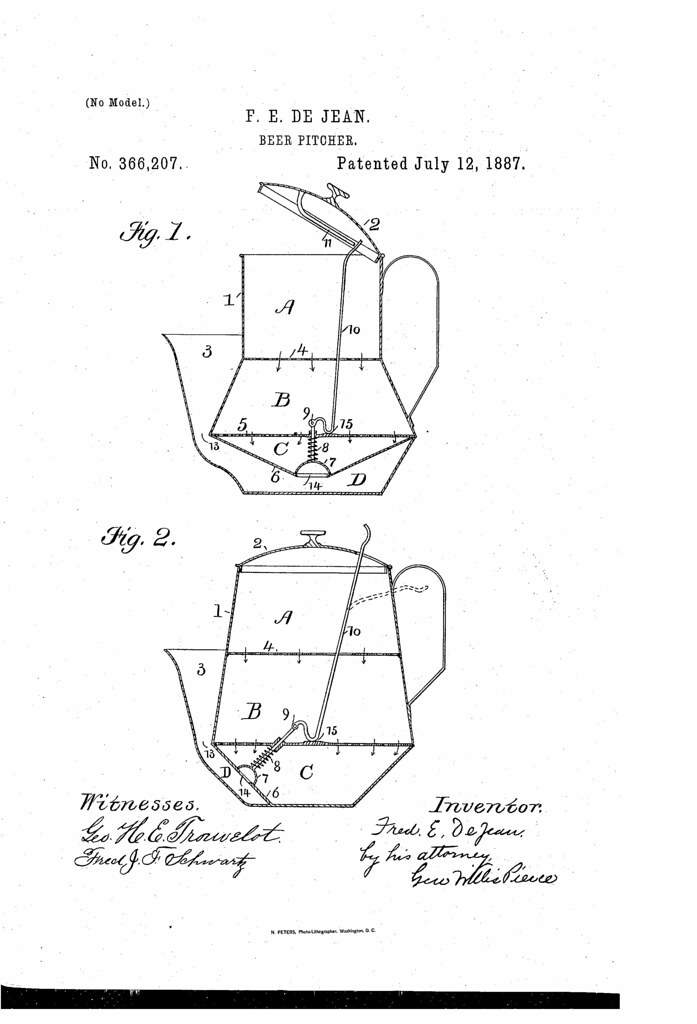
Today in 1887, US Patent 366207 A was issued, an invention of Fred E. De Jean, for his “Beer-Pitcher.” There’s no Abstract, although in the description it includes this summary:

This invention relates to pitchers into which frothy drinking liquids-such as ale, beer, &c.aredrawn, and from which they are poured for consumption.

It is well known that in drawing beer, etc., from a barrel much froth is formed on its surface, which causes delay in pouring the same into tumblers and tankards, and time has to be allowed for the beer to settle, and in no case is the beer perfectly clear and liquid.

My invention has for its object to obviate these annoyances, and to cause the beer or other liquid to be strained and settled immediately, and to be drawn from the bottom of the pitcher in any desired quantity, free from froth or any annoyance.

Untitled

Filed Under: Beers, Just For Fun, Politics & Law, Related Pleasures Tagged With: Glassware, History, Law, Patent

Patent No. 765112A: Beer-Cooler Tank

July 12, 2015 By Jay Brooks

patent-logo
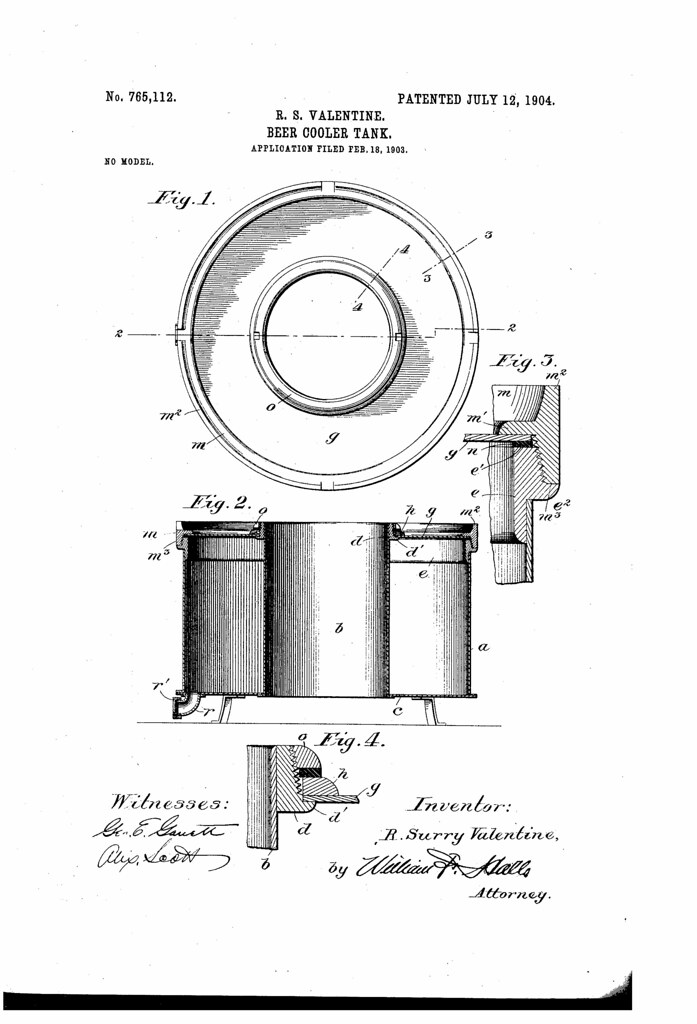
Today in 1904, US Patent 765112 A was issued, an invention of Robert Surry Valentine, for his “Beer-Cooler Tank.” There’s no Abstract, although in the description it includes this summary:

The object of the invention is to provide a construction of tank of the type referred to which will admit of the thorough cleansing thereof with facility; and to this end the invention includes the combination and arrangement of parts to be hereinafter described, and particularly pointed out in the claims.

Untitled

Filed Under: Beers, Breweries, Just For Fun, Politics & Law, Related Pleasures Tagged With: Brewing Equipment, History, Law, Patent, Science of Brewing

« Previous Page
Next Page »

Find Something

Northern California Breweries

Please consider purchasing my latest book, California Breweries North, available from Amazon, or ask for it at your local bookstore.

Recent Comments

  • Bob Paolino on Beer Birthday: Grant Johnston
  • Gambrinus on Historic Beer Birthday: A.J. Houghton
  • Ernie Dewing on Historic Beer Birthday: Charles William Bergner 
  • Steve 'Pudgy' De Rose on Historic Beer Birthday: Jacob Schmidt
  • Jay Brooks on Beer Birthday: Bill Owens

Recent Posts

  • Historic Beer Birthday: George F. Gund April 5, 2026
  • Historic Beer Birthday: John Friedrich Wiessner Jr. April 5, 2026
  • Beer Birthday: Steve Wagner April 5, 2026
  • Beer In Ads #5206: For The Feast Of Easter April 5, 2026
  • Historic Beer Birthday: Hew Ainslie April 5, 2026

BBB Archives

Feedback

Head Quarter
This site is hosted and maintained by H25Q.dev. Any questions or comments for the webmaster can be directed here.