Brookston Beer Bulletin

Jay R. Brooks on Beer

  • Home
  • About
  • Editorial
  • Birthdays
  • Art & Beer

Socialize

  • Dribbble
  • Email
  • Facebook
  • Flickr
  • GitHub
  • Instagram
  • LinkedIn
  • Pinterest
  • RSS
  • Twitter
  • YouTube

Powered by Genesis

World’s Drunkest Countries

January 3, 2015 By Jay Brooks

world-map-3
An online article today on Business Insider examines the World Health Organization’s most recent Global status report on alcohol and health 2014. Entitled Here Are The Drunkest Countries In The World, it gives the highlights of the WHO report. Unfortunately, in my experience WHO tends to lean on the side of prohibitionists in their approach to alcohol, highlighting primarily the bad aspects while ignoring the positive. As a result, WHO tends to be all doom and gloom about alcohol in the world. It’s a somewhat odd position. At any rate, they use the map below, showing per capita alcohol consumption by country, as of 2010 (but it’s the same data in the 2014 report).

world-alcohol-map-2010-1
See the chart full size.

One thing to notice is that despite the hue and cry from U.S.-based anti-alcohol groups, American consumption has been flat or down since its 1980 high point, and worldwide we’re pretty much in the middle of the consumption scale, not the lowest or the highest, as they’d have us believe. Canada drinks more than we do. So does Australia and most of Europe, especially Eastern Europe and Russia.

But even with WHO’s very conservative view of drinking alcohol, American patterns of risky drinking is even lower than average, squarely in the second-lowest category. For example, Mexico may drink less than Americans per capita, but still manages to drink in a more risky manner, and Canada and us are the same, despite out-drinking Americans. Likewise, Western Europe, which drinks more than most, engages in the least risky behavior, at least as WHO defines it.

world-alcohol-map-2010-2
See the chart full size.

So if we accept the way WHO comes up with that statistic — stated as by considering “the usual quantity of alcohol consumed per occasion, proportion of drinking events when drinkers get drunk, proportion of drinkers who drink daily or nearly daily, festive drinking, drinking with meals, and drinking in public places — then overall there’s a lot less risky drinking in the world than the first chart would have us believe. While per capita consumption seems to follow the expected bell curve, risky behavior does not, with far less dark spots. The riskiest countries are concentrated in just a few nations, and looks even larger than it really is because one of the countries is geographically very big. The countries in the second-riskiest tier looks to be less than ten nations, suggesting that a majority of places to do not engage in a great deal of risky drinking, which is frankly what I’d expect. Either way, I’m not sure hardly any deserve the title “drunkest countries.”

Filed Under: Beers, Editorial, Politics & Law Tagged With: Health & Beer, International, Prohibitionists, Statistics

Patent No. 2967107A: Continuous Fermentation Process

January 3, 2015 By Jay Brooks

patent-logo
Today in 1961, US Patent 2967107 A was issued to Kenneth H. Geiger and John Compton, assigned to John Labott Ltd, for their “Continuous fermentation process.” According to the application the “invention relates to a novel continuous fermentation process for the production of potable beer.”

Figure 1 is a schematic illustrating a type of fermentation vessel which may be used in carrying out the process of the invention indicating typical fittings and controls.
US2967107-0

Continuous fermentation processes have already been utilized in connection with the production of industrial grade alcohols, and the desirability of continuous fermentation in the production of potable beer has long been recognized in the art. The principal obstacle to the adaptation of existing continuous fermentation methods to the production of potable beer has been the inability of such processes to provide adequate control of flavour. As is well recognized, the control of flavour is of paramount importance insofar as the production of potable beer is concerned.

The present invention provides a continuous fermentation process in which the control of flavour is readily achieved, and in which a number of additional advantages are to be found in addition to those important ones which might normally be expected to fiow from the conversion of what has previously been a batch operation into a continuous one.

Figure 2 is a schematic fiowsheet illustrating apparatus used for carrying out the process of the invention with one yeast propagation vessel and two alcohol producing vessels in the product formation stage.
US2967107-1

According to the present invention, potable beer is produced by the yeast fermentation of a fermentable carbohydrate which is carried out in stages. A first stage is provided in which aerobic conditions favourable to yeast growth are maintained, and a second stage is provided in which anaerobic conditions favourable to carbohydrate attenuation are maintained. Preferably according to the invention, the yeast concentration in the second stage of the process is maintained substantially constant at a concentration which is in excess of the maximum level normally obtainable or commonly used under batch fermentation conditions. This level of yeast concentration is maintained by separating at least a portion of the yeast from the efliuent of the second stage and recycling it through the second stage.

Operating in this manner, the first stage of the process serves primarily as a continuous yeast propagator under predetermined aerobic conditions while the second stage which may be, and preferably is, carried out in a series of separate series connected vessels serves primarily for ICC attenuation of the fermentable carbohydrates to alcohol under predetermined anaerobic conditions. For convenience hereinafter, we refer to the first stage of the process as the yeast propagation stage and the second stage as the product formation stage.

The inherent advantages of the continuous fermentation process described above are manifold, and of substantial practical importance. For instance, the growth rate of yeast and feed rate of fermentable substrate are equillbrated and controlled under steady state conditions in the first stage, so that the extent or rate of metabolism unconnected with yeast cell growth and/or reproduction is not critical. The maintenance of any predetermined high yeast concentration in the second stage is independent of flow rate, while, provided a relatively high concentration of yeast is present in the second stage, the rate of product formation will be for all practical purposes independent of yeast growth and, provided the substrate is satisfactory, almost entirely dependent on total quantity of yeast present and temperature.

Because the process of the invention makes for more efiicient substrate utilization, less is used for yeast production than in normal batch fermentations.

Furthermore, a very rapid fermentation is possible, with a holdup time appreciably less than in other conventional fermentation systems, batch or continuous, without concommitant adverse eifects on the quality of the product.

Figure 3 is a general schematic fiowsheet illustrating the process of the invention as it would be carried out using four separate vessels in the product formation stage.
US2967107-2

Filed Under: Beers, Breweries, Just For Fun, Related Pleasures Tagged With: Patent, Science of Brewing

Beer In Ads #1423: Ski Patrol To The Rescue

January 2, 2015 By Jay Brooks


Friday’s ad is for Michelob Light, from 1978. The ad features Monique St. Pierre, who was Playboy magazine’s Playmate of the Month for the November 1978 issue and the 1979 Playmate of the Year. The German-born model is portraying a a member of the ski patrol, but her St. Bernard “Suds” has a six-pack of Michelob Light around his neck, rather than the traditional barrel of brandy. Unfortunately the brandy barrel being carried by a St. Bernard to warm trapped skiers or hikers in the Alps is a myth.

Michelob-1978-PMOM-Monique-St-Pierre

Filed Under: Art & Beer, Beers Tagged With: Advertising, Anheuser-Busch, History, Michelob

Session #95: Beer Books Yet To Be Written

January 2, 2015 By Jay Brooks

book
Our 95th Session is hosted is Alan McLeod — his third time at the reins — who writes A Good Beer Blog. He’s chosen a very simple topic, but one with as many possibilities as their are books in the Library of Congress. The January topic can be expressed in one simple sentence. “What beer book which has yet to be written would you like to see published?” But for a bit more about what he’s looking for, read through his explanatory I Answer The Call! Again I Host!!!

What is the book you would want to write about good beer? What book would you want to read? Is there a dream team of authors your would want to see gathered to make that “World Encyclopedia of Beer and Brewing”? Or is there one person you would like to see on a life long generous pension to assure that the volumes flow from his or her pen? Let us know.

session_logo_all_text_200

For me, what’s missing in the world of beer books, are craft beers intruding into fiction. Brands of all kinds help define characters, perhaps more so in fiction than in reality, because they can be a code for the kind of person an author has created that we all understand. It goes back, in my mind, to something that Michael Jackson used to say when explaining why beer deserved more respect. He’d use the analogy that no one goes into a restaurant and asks the waiter to bring him some food the way that people are so often portrayed in books, television and movies as sidling up to a bar and saying “gimme a beer.”

Whenever I saw Michael, one of the topics that inevitably came up was books. One of the first I remember him recommending to me was The Last Fine Time, a novel by Verlyn Klinkenborg published in 1990. It tells the tale of a family in Buffalo, New York who own a bar and how it changes over several generations. It was years ago that I read it, but I recall enjoying it a great deal.

But it reminds me that most books in which beer appears are either older and use old brands or generic beer. I have seen a few book that have beer in them, but not really as much more than an afterthought, unless they’re a memoir. That always seemed strange since beer is so popular and is the most popular adult beverage. You’d think it would figure more highly in literature, and yet it seems curiously absent. To be fair, I don’t read nearly as much fiction as I did when I was younger, so maybe I’m just missing it.

Several times over the years I’ve suggested to various beer magazine publishers that they start including short stories involving beer and have even suggested an annual contest, similar to Playboy’s annual college fiction contest, for the best short story involving beer as a central feature of the tale. Sadly, none have ever agreed, though I don’t know why. It always seemed like a natural to me.

I’ve also thought a Granta-like book/magazine, perhaps annually, that collected beer fiction could work, too, but I’m not sure I’m up to the task of taking on another project. Still, I’d really love to see more beer-fueled fiction. Somebody needs to write the Great American Beer Novel.

the-beer-book

But failing fictive folios, what beer books would I like to see? I certainly like Alan’s suggestion for a “World Encyclopedia of Beer and Brewing,” but otherwise I’m at a loss, beyond my own list of book ideas I want to pitch.

Books shelf

I have at least a dozen book ideas in various stages of development, but personally I can’t wait to do my coffee table book featuring all of my photographs of brewery hoses that I’ve taking at breweries around the world for more than ten years. I expect to sell maybe twenty copies, but I still want to do it as a labor of love. I may have to self-publish that one. I’m fairly certain there aren’t a great number of people waiting for that one.

Filed Under: Beers, Just For Fun, Related Pleasures, The Session Tagged With: Beer Books, Books

Beer In Ads #1422: A Happy New Year

January 1, 2015 By Jay Brooks


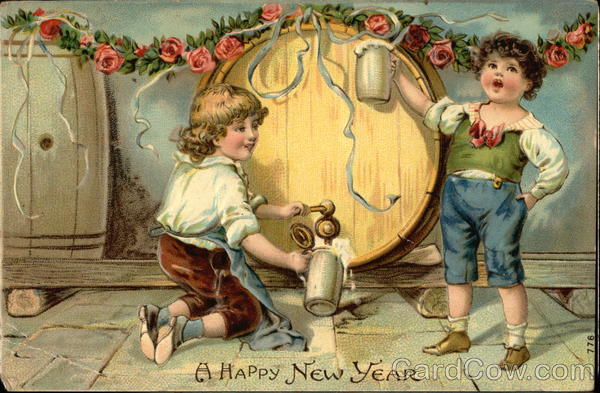
Thursday’s holiday ad is a postcard from 1908 entitled simply “A Happy New Year.” The postcard shows a pair of young lads tapping a decorated wooden keg and filling their mugs to toast in the new year.

happy-new-year-1908

Filed Under: Art & Beer, Beers Tagged With: Advertising, History, Holidays

Patent No. 3782609A: Keg Tapping Assembly

January 1, 2015 By Jay Brooks

patent-logo
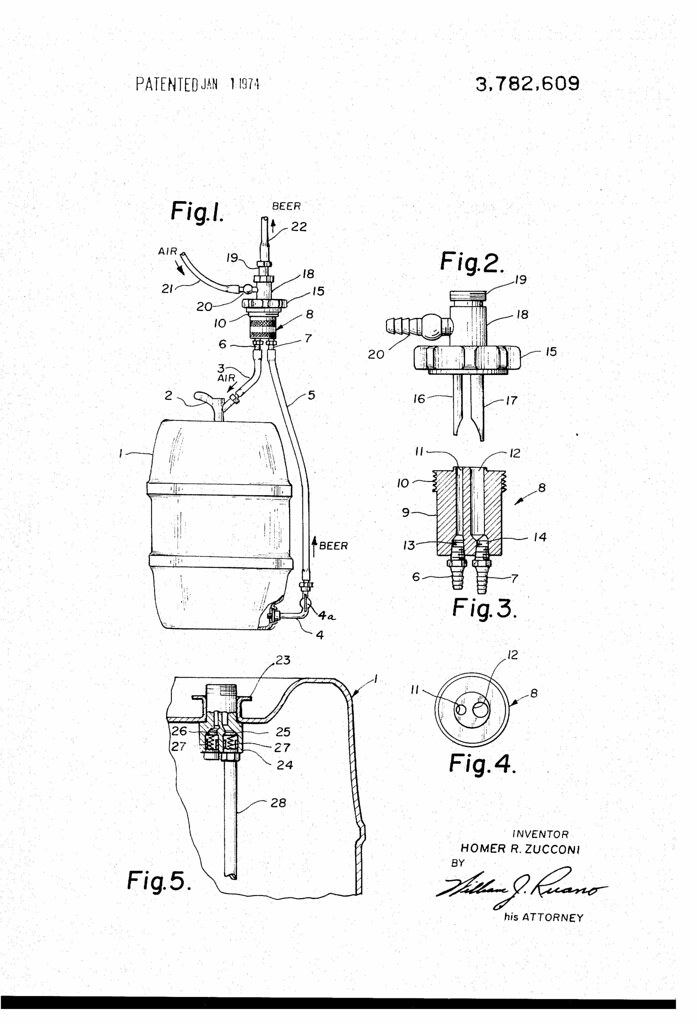
Today in 1974, US Patent 3782609 A was issued, an invention of Homer R. Zucconi, for a “Keg Tapping Assembly.” Here’s the Abstract:

A keg tapping assembly comprising a tavern unit having two prongs which are sleeve-like with tapered ends to unseat the two spring closed valves of a permanently attached keg unit detachably connected to the top central hole of a keg, upon insertion into the keg unit. The invention embodies an attachment having two bores through which said prongs are detachably fitted and having serrated terminal connections onto which hoses may be slip-fitted for attachment, respectively, to a tap rod insertable in the top center opening and to a valved outlet connection at the bottom of the keg. By simply unplugging the tavern unit from the keg unit and plugging it into said attachment it is selectively usable on either a conventional single connection tap or on the older double connection tap.

US3782609-1

Filed Under: Beers, Just For Fun, Related Pleasures Tagged With: Kegs, Patent

Patent No. 395468A: Apparatus For Making Malt

January 1, 2015 By Jay Brooks

patent-logo
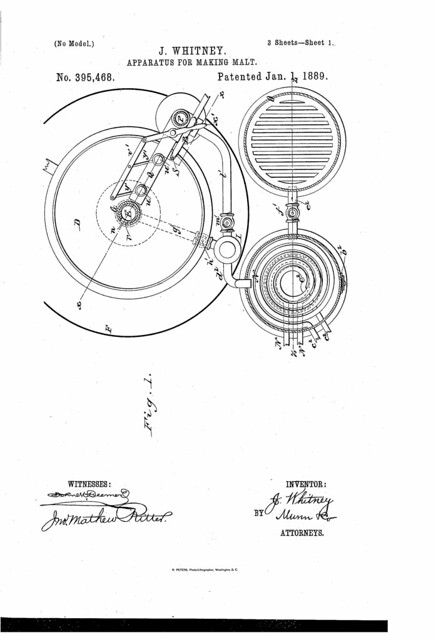
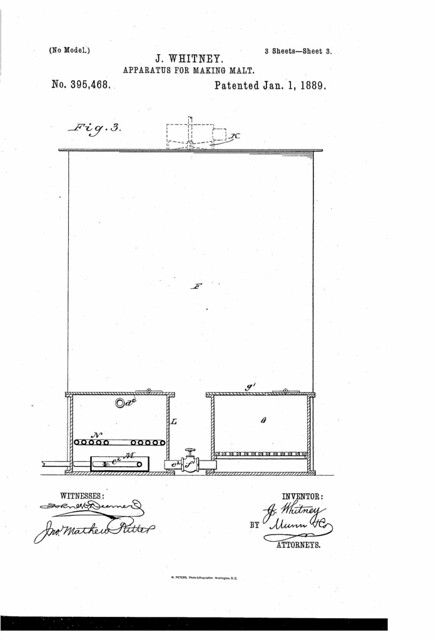
Today in 1889, US Patent 395468 A was issued, an invention of Justin Whitney, for an “Apparatus For Making Malt.” There’s no Abstract for this one, but you can read the full description about his “novel means and apparatus for making malt” at the patent page.

US395468-0

US395468-1

US395468-2

Filed Under: Beers, Just For Fun, Politics & Law, Related Pleasures Tagged With: Malt, Patent

Beer In Ads #1421: Handsome Gift For The New Year

December 31, 2014 By Jay Brooks


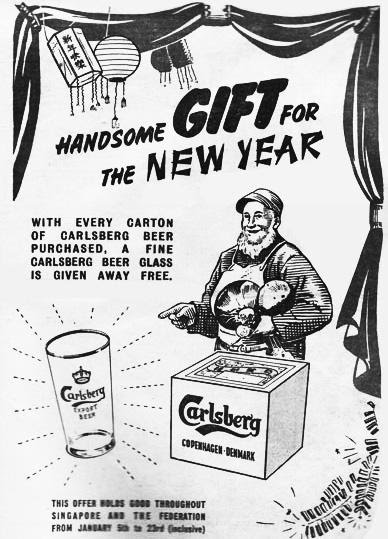
Wednesday’s holiday ad for Carlsberg, from who knows when. Admittedly it’s an ad for the Chinese New Year, but there’s a distinct lack of New Year’s Eve ads that I haven’t used before. This ad was for Singapore and “the Federation” which may help identify its age. Your “Handsome Gift for the New Year” is a free Carlsberg pint glass with every carton you buy.

Carlsberg-Chinese-New-Year-Beer

Filed Under: Art & Beer, Beers Tagged With: Advertising, History, Holidays

The Drunkometer

December 31, 2014 By Jay Brooks

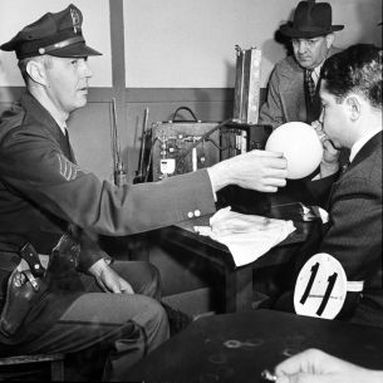
balloon-blowing
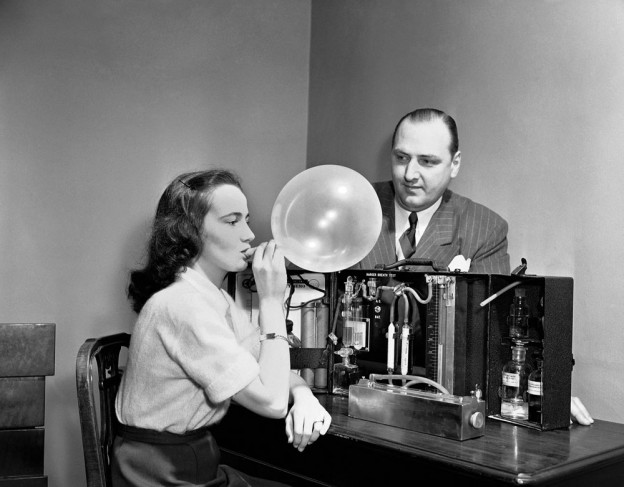
Here’s an interesting piece of history. Today, New Year’s Eve, in 1938, police in Indianapolis, Indiana used the first commercial test to discover scientifically if a person had been drinking alcohol and if so, how much. December 31, 1938 saw the debut of the Drunkometer, designed by Rolla Neil Harger, a chemistry professor at Indiana University. He began working on the device in the 1930s, and patented it in 1936.

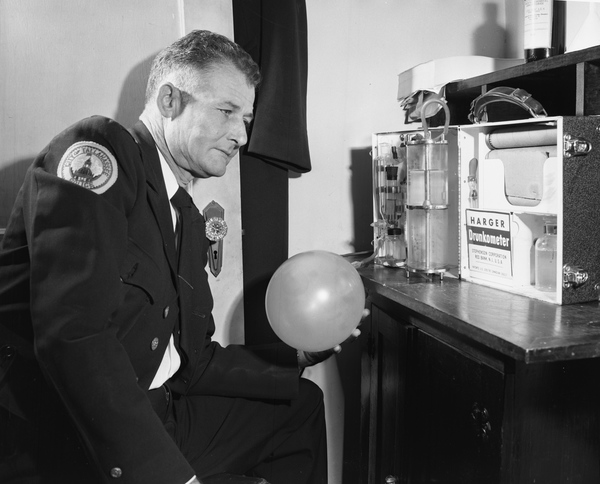
The drunkometer collected a motorist’s breath sample directly into a balloon inside the machine. The breath sample was then pumped through an acidified potassium permanganate solution. If there was alcohol in the breath sample, the solution changed color. The greater the color change, the more alcohol there was present in the breath. The drunkometer was manufactured and sold by Stephenson Corporation of Red Bank, New Jersey.

drunkometer-1
Dorothy Brengel helps W.D. Foden, Chairman of Statler Safety Committee, demonstrate the “Drunkometer”, a breath tests for alcohol, on display at the Greater New York Safety Council, Hotel Statler, March 28, 1950. For the preliminary test, the breath of the suspect is collected in a balloon and passed through a purple fluid (potassium permanganate and sulphuric acid) to see if it changes color. The breath of a non-drinking person will cause no change. If the purple color disappears, the amount of breath required to accomplish this indicates the approximate accumulation of alcohol in the blood. (AP/Carl Nesensohn)

In 1938, on New Year’s Eve, police in Indianapolis put a new piece of technology through its first practical test.

They used a breath analyzer to determine if someone had been drinking. What was then called the “Drunkometer” was based on the same idea as modern breathalyzers: a person blows into a bag, which contains chemicals that react according to how much alcohol is on a person’s breath.

drunkometer-4

The Daily Dose gives a good account of its early use:

Thanks to the end of Prohibition and a boom in car sales, drunk driving had become a fast-growing problem in America in the 1930s. But on this New Year’s Eve, police in Indianapolis, Indiana went out armed with a new weapon to fight against people who had gotten behind the wheel after having too much to drink.

It’s a contraption called a “drunkometer” and it’s the invention of an Indiana University chemist named Rolla Harger. He had been working on the device since the early 1930s and had patented it two years earlier. The concept behind the drunkometer was pretty basic. Drivers suspected of being drunk were asked to breathe into a rubber balloon, which was attached to a tube of purple liquid—a weak solution of potassium permanganate in sulphuric acid.

If there was alcohol on their breath, the chemical solution changed color–the darker it got, the more alcohol they had in their system. From the shade of the liquid, the cops could use a simple equation to estimate the alcohol level in a person’s bloodstream. Previously, the only way police could check a driver’s alcohol level was to get a blood or urine sample; Neither was a very practical option on the roadside. While the drunkometer looked a bit like a mini chemistry set, it was portable, able to fit into a small suitcase.

Harger made the device as simple as possible so that judges and juries would understand how it worked and police officers could easily be trained to use it. He also made the drunkometer hard to beat. Experiments showed that no illness affected the result, and that nothing a person might eat – garlic, cloves, strong onions – would make any difference. Once police started using it, the drunkometer was found to have another advantage. A dramatic change in the color of the liquid could often make people admit how much they had drunk.

Sometimes Harger would ride along with the police to see how his invention was being used. What he discovered was that a lot more people were driving drunk than he ever imagined.

The drunkometer was used by police departments all over the country until the 1950s when it was replaced by the breathalyzer, invented by another Indiana University professor, Robert Borkenstein. The breathalyzer is a much smaller and more sophisticated device that uses infrared spectroscopy to measure blood alcohol levels.

drunkometer-3
Tallahassee police officer with a Harger “Drunkometer” breathalyzer machine, photo taken in 1953.

The Drunkometer was replaced by the Breathalyzer in 1954, but for sixteen years was the way police nabbed drunk drivers. But who came up with that name? Happy New Year! Be careful out there.

Filed Under: Beers, Just For Fun, Politics & Law Tagged With: Science

Beer In Ads #1420: The Pabst Ski Lodge

December 30, 2014 By Jay Brooks


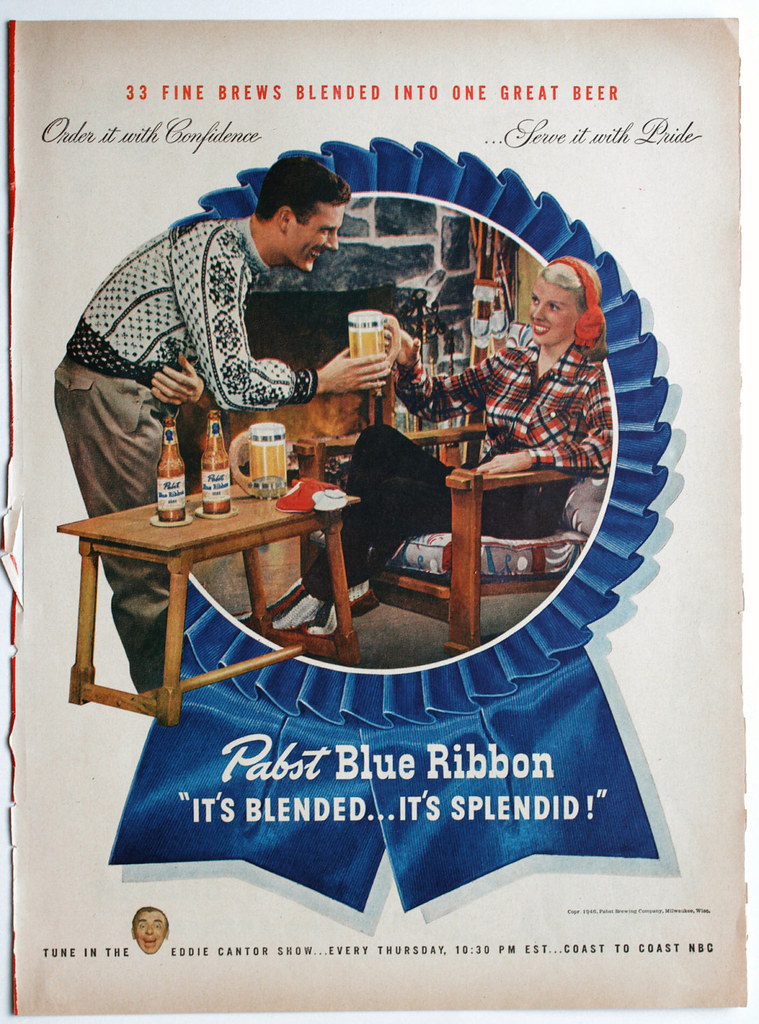
Tuesday’s holiday ad for Pabst Blue Ribbon, from 1946. IN a scene that looks like it’s after a long day skiing, a couple is relaxing back in the lodge, by the fireplace, as the man is serving mugs of Pabst. “Order it with Confidence … Serve it with Pride.” I’m not sure about the smile on him, it looks a little creepy to me. So maybe they’re not a couple after all, her smile seems a bit forced, so maybe this is a pickup attempt?

Pabst-1946-ski-lodge

Filed Under: Art & Beer, Beers Tagged With: Advertising, History, Holidays, Pabst

« Previous Page
Next Page »

Find Something

Northern California Breweries

Please consider purchasing my latest book, California Breweries North, available from Amazon, or ask for it at your local bookstore.

Recent Comments

  • Bob Paolino on Beer Birthday: Grant Johnston
  • Gambrinus on Historic Beer Birthday: A.J. Houghton
  • Ernie Dewing on Historic Beer Birthday: Charles William Bergner 
  • Steve 'Pudgy' De Rose on Historic Beer Birthday: Jacob Schmidt
  • Jay Brooks on Beer Birthday: Bill Owens

Recent Posts

  • Historic Beer Birthday: Constant Vanden Stock June 13, 2026
  • Beer Birthday: Charlie Bamforth June 13, 2026
  • Beer In Ads #5266: Special Bock Beer — Light & Dark June 12, 2026
  • Historic Beer Birthday: John Hemrich June 12, 2026
  • Historic Beer Birthday: Johan Hallgren June 12, 2026

BBB Archives

Feedback

Head Quarter
This site is hosted and maintained by H25Q.dev. Any questions or comments for the webmaster can be directed here.