

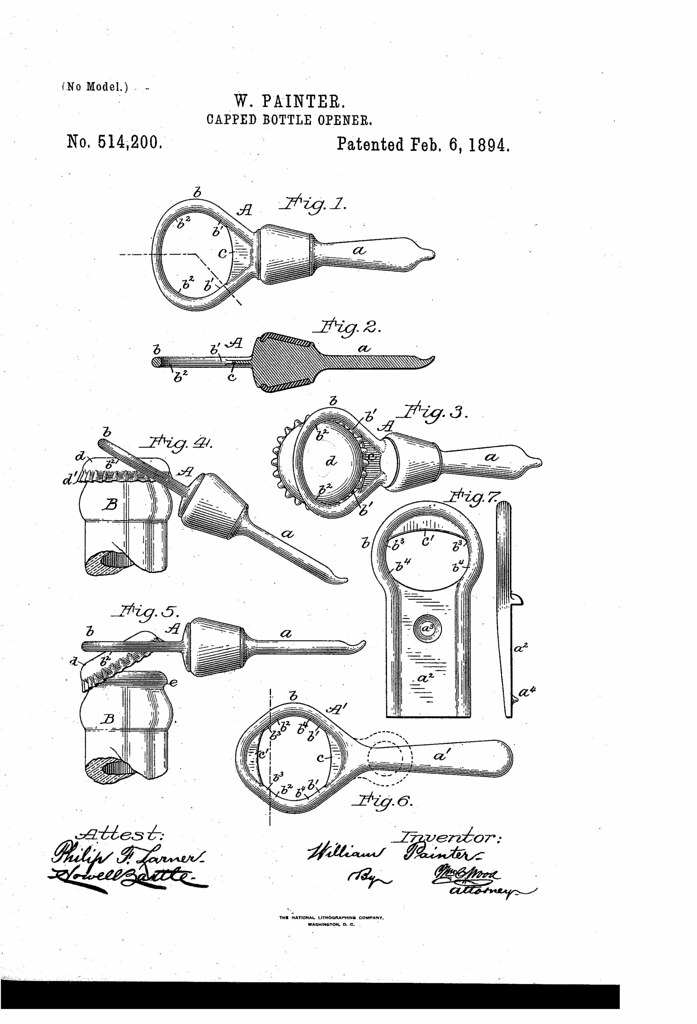
Today in 1894, US Patent 514200 A was issued, an invention of William Painter, for his “Capped-Bottle Opener.” There’s no Abstract, but in the introduction of his application, Painter states his “bottle opener essentially embodies a handle, having at one end thereof, a cap centering gage, and also a cap engaging lip, and however these three elements may be formed and combined, the centering gage should also afford a fulcrum, with respect of the handle and the cap engaging lip, and the latter should be substantially in line with the handle, so that when the opener is applied to a capped bottle, the gage will assure an appropriate bearing or fulcrum on top of the cap, with the lip located beneath or underlying a portion of the cap, and so enable the handle to serve as a lever for removing the cap from the bottle. Although without departure from my invention these three essential elements may be separately constructed and combined to form my bottle opener, they are more economically constructed integrally of iron or other suitably strong metal, as by molding or casting the opener in one piece, and it is in this form that my opener will be more particularly described.” After having patented the crown two years earlier, I guess he needed to invent a way to open the bottles, too.
Beer In Ads #1457: Real Harmony

Thursday’s ad is another one for Budweiser, this time from 1934, just a year after prohibition. Showing an older gentlemen with his violin, the real harmony of the ad, they say, is a bite to eat and a beer. And this is great ad copy. “There are many times when just a simple sandwich and a bottle of Budweiser strike the right note.” But post-depression, he looks more like a man playing for his meal. I wouldn’t be surprised if that open case was in front of him on the ground. To me, it looks like his suit is too big, maybe from losing weight from not having enough to eat? And he’s reaching out his hand longingly for that beer, but it’s really too far away, isn’t it? Kind of sad ad, in the end.

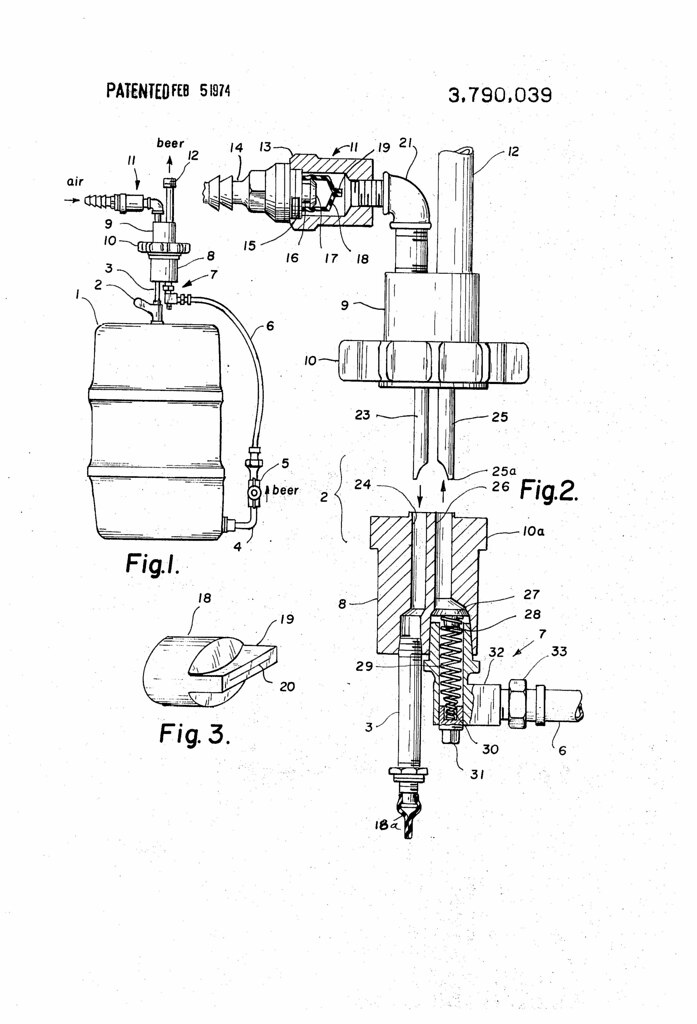
Patent No. 3790039A: Keg Tapping Assembly
Today in 1974, US Patent 3790039 A was issued, an invention of Homer R. Zucconi, for his “Keg Tapping Assembly.” There’s no Abstract, but this application apparently continues from a previous filing, and it “relates to an attachment for enabling the use of a conventional tapping attachment for application to two different tapping systems, namely, one in which a single tapping connection is made at the top (central) hole axially of the keg, or to one in which a connection is made not only at the top central hole, but also at a bottom side hole, which double connections have been used for many years in the industry.”
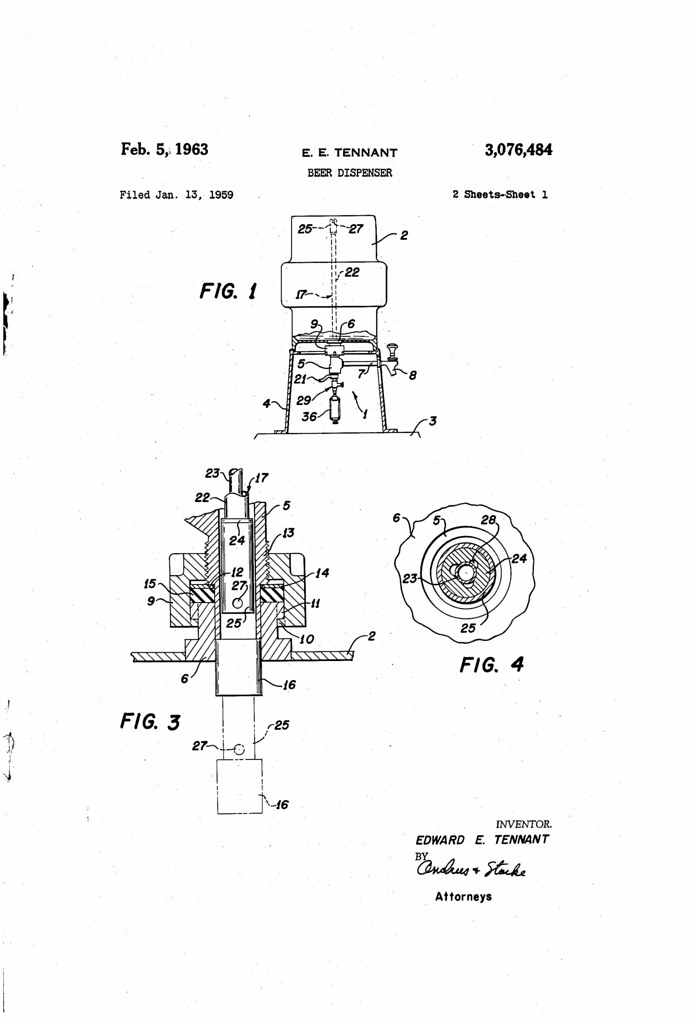
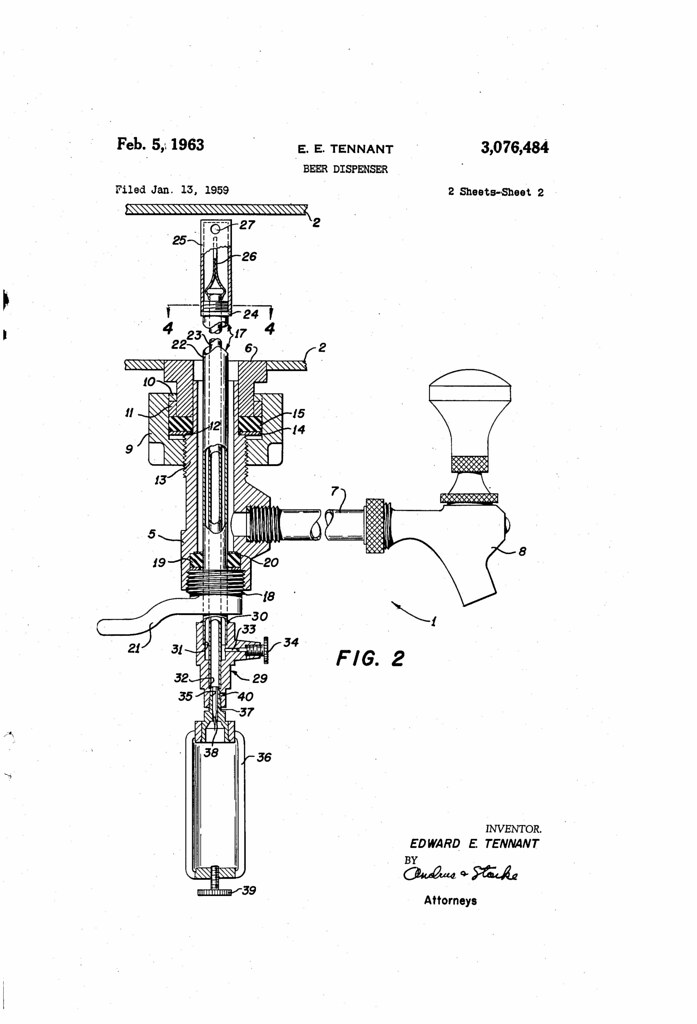
Patent No. 3076484A: Beer Dispenser
Today in 1963, US Patent 3076484 A was issued, an invention of Edward E. Tennant, assigned to Schlitz Brewing Co., for his “Beer Dispenser.” There’s no Abstract, but the application describes it, saying the “dispenser of the present invention is adapted for use with beer kegs or the like, such as are frequently used for party, picnic and other related applications where no regular beer dispensing equipment is available. The present device is of the general type utilizing gravity flow of the contained beverage which type of dispenser is highly desirable inasmuch as no hand pump or other pressure device is required to force the beer from the keg. The dispenser of the invention constitutes an improvement over gravity feed devices previously employed for dispensing beer.”
Beer In Ads #1456: Half Quarts & Popcorn
Wednesday’s ad is for Budweiser, from the 1960s. Part of the “where there’s life” series of ads, this one focuses on the big cans, half quarts or as they jokingly say, “king size.” And each king size can apparently fill two glasses. It’s certainly captured the guy’s attention as he smirks and gives an intent sideways glance at the beer being poured, as he continues to eat from the bowl of popcorn in front of him. Maybe it’s just me, but who sits at a table and eats popcorn? Isn’t popcorn a watch something sort of food?

Patent No. D6383S: Design For Beer-Mugs
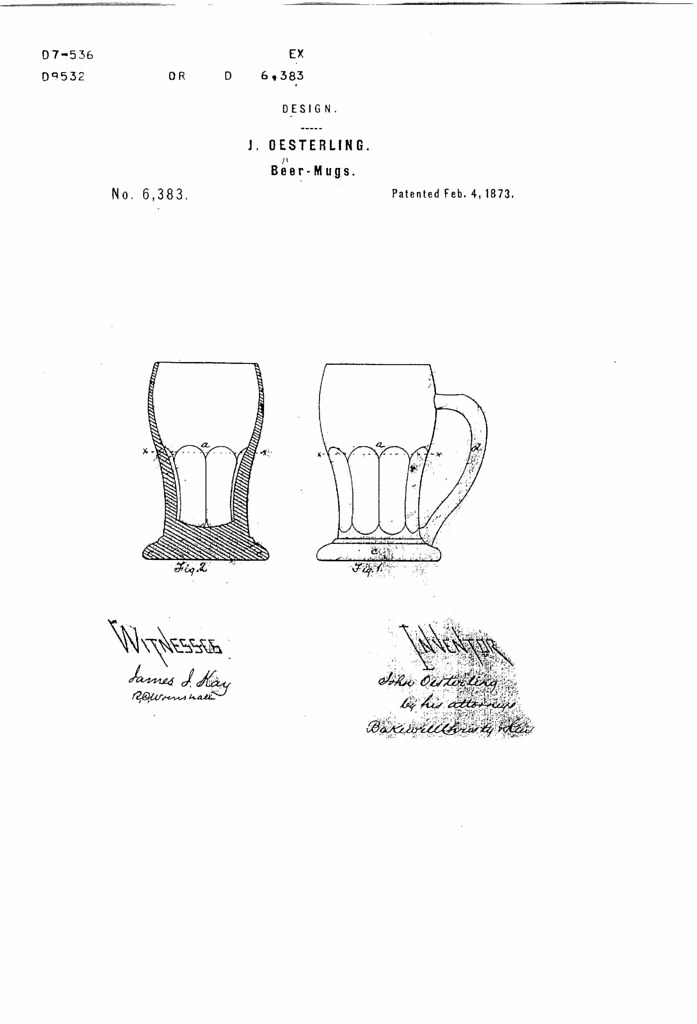
Today in 1873, US Patent D6383 S was issued, an invention of John Oesteeling, for his “Design for Beer-Mugs.” There’s no Abstract, but the application describes it, stating that the “design consists in making the upper half of the body of the beer or ale glass barrel shaped, and the lower half of a reduced diameter, with straight or slightly-concave sides, so as to present the appearance of a stem.” Looks more like an ice cream float glass than a beer mug, though.
Beer In Ads #1455: Every Golden Drop
Tuesday’s ad is for Budweiser, from 1949. In the windy bleachers, watching a baseball game does look like an appetizing way to spend a day, especially if you have a hot dog and a beer. It’s too bad this idyllic picture of American life doesn’t really exist anymore, if indeed it ever did, because the beer and dog will run you some serious coin these days. Did they ever actually carry bottles around the stadium? I do miss the white paper hats worn by the vendors, though. There’s even one subversive rebel in this illustration. Do you see him? That fella in the middle, he’s not wearing a hat. He’s really living life, “every golden minute of it,” as the ad suggests, before ending with this ad copy. “Enjoy Budweiser, every golden drop of it.”

Where Is Beer Country & Wine Country?

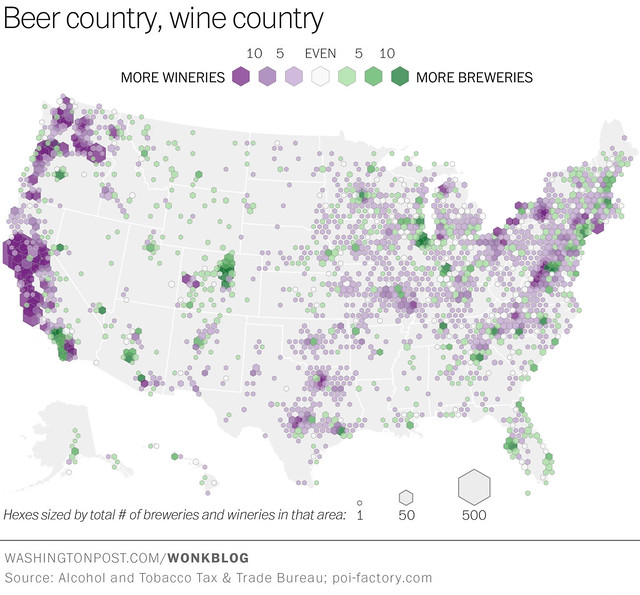
Someone posted a link in a comment last week, and I’d been meaning to take a closer look it. It’s from the Washington Post’s Wonkblog: Do you live in beer country or wine country? These maps will tell you.
I love the idea that there’s a Wonkblog, but it has taken liberties in analyzing its data in the past, and this one seems to continue that trend. Still, there is some interesting information here. But the map of where both wineries and breweries are located is somewhat misleading, because it covers over the one with fewer, even if there are a lot of both kinds there, which is the case.
More revealing, I think, is comparing the two individual maps, grape color is wine, hop green is beer. What becomes clear from looking at the two separately that’s lost in the map with both is that fermentation takes place, whether beer or wine, in higher concentrations in roughly the SAME locations nationwide.
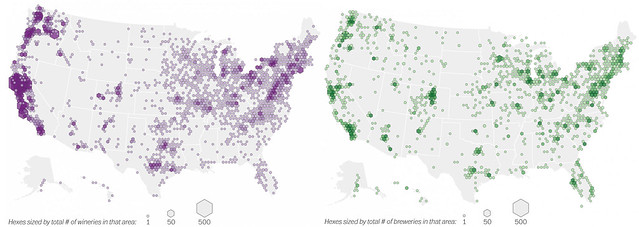
With very few exceptions, areas that have heavy concentrations of wineries also have a lot of breweries, too. That can’t be a coincidence, can it? To me, that leads to the inescapable conclusion that there is no wine country or beer country, but instead pockets of fermentation, or fields of fermentation. I would not be surprised to learn that there is also a lot of cheese-making going on in the exact same areas, too. Fermentation, it seems, follows fermentation. But that makes sense, intuitively.
And here is beer wine individually, so you can see them in more detail closer up.
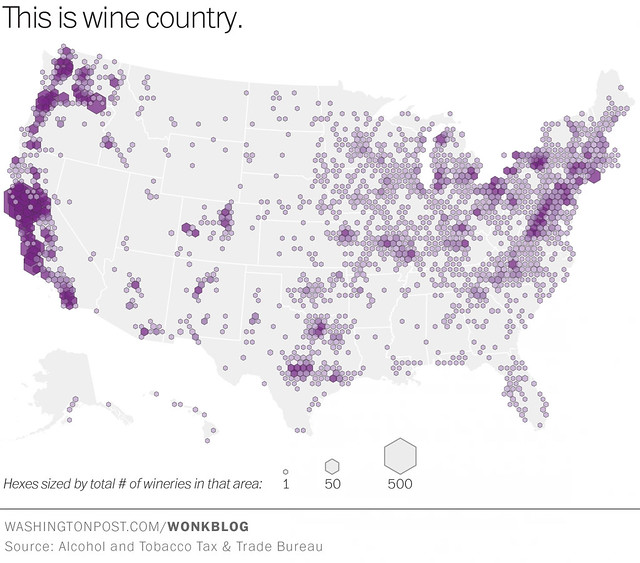

Also, curiously the Pacific Northwest is ignored in their analysis. In the text, they state that “beermaking dominates in the Denver region, and along the Southern California coast. Tucson may be wine country, but brewers rule in Phoenix. Brewers are strongly represented along the coast of Lake Michigan, and in most of Florida. Brewing is big in East coast cities too.” But three of the biggest, and darkest, green areas are the San Francisco Bay Area, Portland, Oregon and Seattle, all three with bigger concentrations of breweries than any other areas mentioned, with the exception of Denver and San Diego, which look roughly equal. So why the did? Beats me.
Wonkblog concludes with a chart showing trends in the numbers of new wineries and breweries, at least from 1998 through 2012. Was there really no data yet for 2014, or even 2013? And why did they use U.S. Census data for this chart, rather than where they got the other datasets for the maps? Also, I remember sower growth in the early 2000s, but the chart shows negative growth in the number of breweries from 2001 to 2010. Can that be correct? Or does that have something to do with it being Census data? Curious.

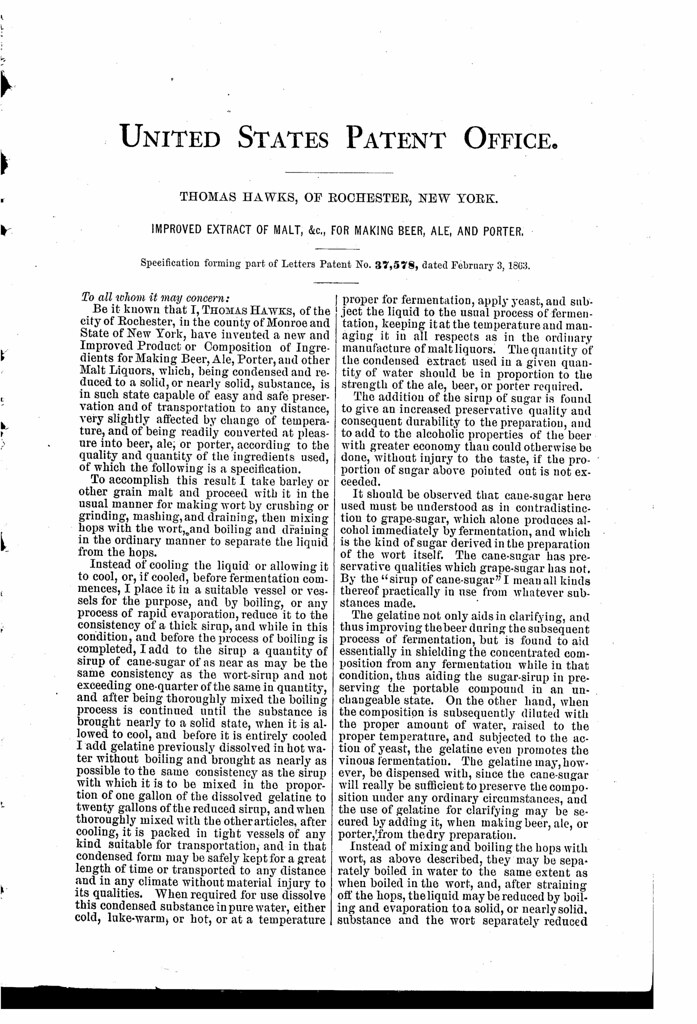
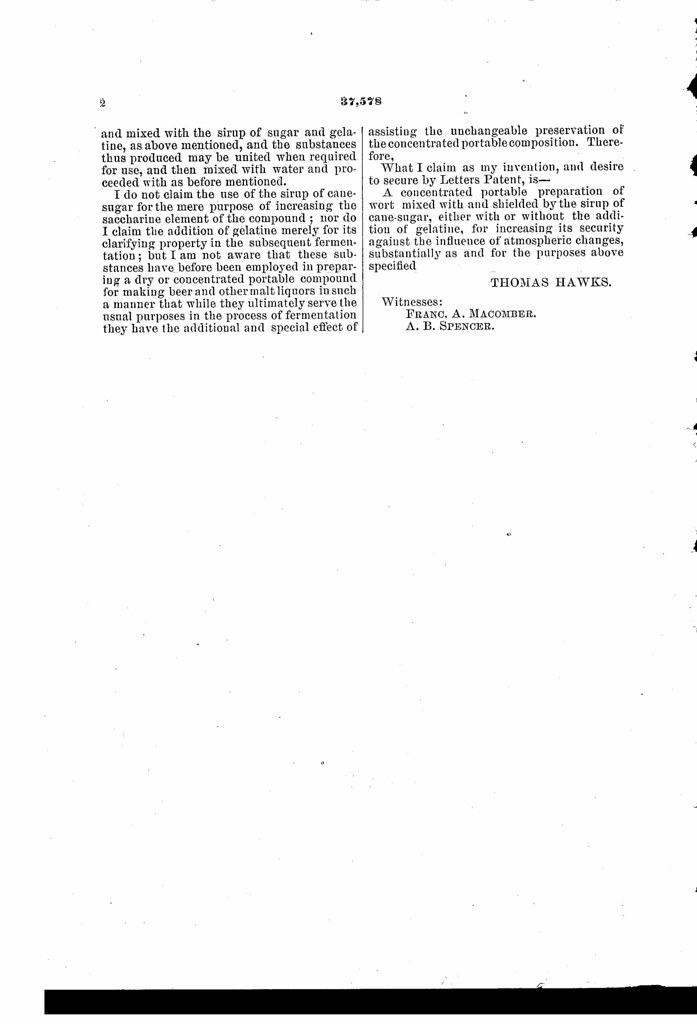
Patent No. 37578A: Improved Extract Of Malt
Today in 1863, US Patent 37578 A was issued, an invention of Thomas Hawks, for his “Improved Extract of Malt.” There’s no Abstract, but the entire application is rendered as a two-page image. This is a very old patent, older than most commercial breweries still with us, issued in the middle of the Civil War.
Beer In Ads #1454: Light-Hearted Living
Monday’s ad is for Falstaff, from what looks to be the 1950s or early 1960s, when bowling still was king. Two couples locked in a bowling struggle, intently watching … what, she still has the ball in her hand and yet they’re all looking down the lane. I especially love how the next round, all four bottles on that tray, are perfectly displayed with their labels facing out. That is impressive.
