Brookston Beer Bulletin

Jay R. Brooks on Beer

  • Home
  • About
  • Editorial
  • Birthdays
  • Art & Beer

Socialize

  • Dribbble
  • Email
  • Facebook
  • Flickr
  • GitHub
  • Instagram
  • LinkedIn
  • Pinterest
  • RSS
  • Twitter
  • YouTube

Powered by Genesis

Beer In Ads #1241: Friendly, Fresh’ning, Happily Dry

July 3, 2014 By Jay Brooks


Thursday’s ad is for Rheingold Beer, from 1961, when beer, and other things, were still “friendly.” In this case, not just friendly, but also “fresh’ning” and “happily dry,” too. Interesting to see pizza and beer, I remember pizza still be fairly exotic at least until the 1970s.
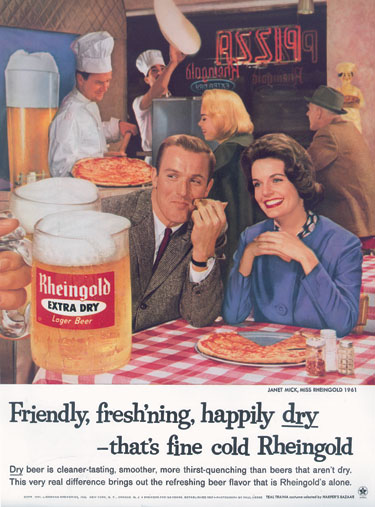
Rheingold-1961-pizza

Filed Under: Art & Beer, Beers Tagged With: Advertising, History

We Totally Let You Win! Newcastle Brown Ale’s Hilarious Independence Eve Campaign

July 3, 2014 By Jay Brooks

newcastle
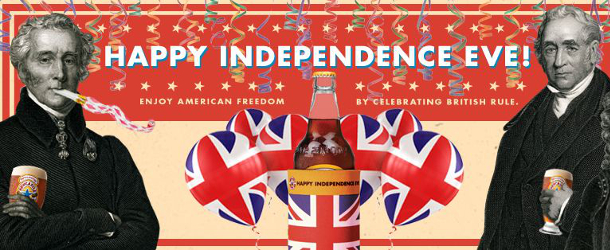
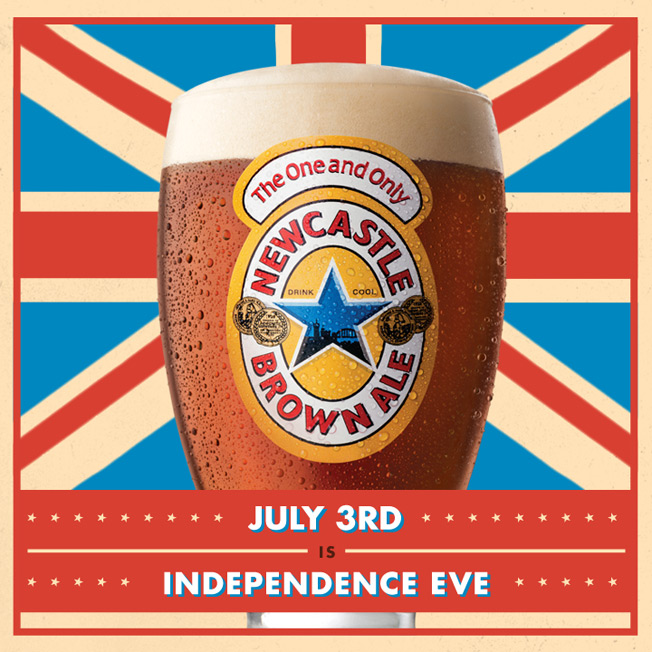
Happy “Independence Eve” everybody. If you’ve never heard of “Independence Eve,” that’s because Newcastle Brown Ale made it up. But it’s so brilliant, I’m going to start observing it, and maybe even will start a tradition of drinking a British ale every July 3. Perhaps even a Newcastle Brown Ale just to say thanks for this hilarious series of ads.

Newcastle-banner-ind-eve

There’s maybe fifteen ads on YouTube or at the dedicated website Newcastle set up for the promotion: If We Won. The latest is below, though I’d encourage you to go back and watch them all. Here’s the most recent one, and they keep adding news ones every few hours.

And here’s another favorite one, with Britsh comedian and writer Stephen Merchant. There’s also ones with Elizabeth Hurley and Zachary Quinto. You can check out all fifteen (at last count) at Newcastle’s YouTube channel.

AdWeek has a story about the advertising campaign, Newcastle Ambushes July 4 by Inventing ‘Independence Eve,’ Celebrating British Rule The Redcoats Get Revenge. From the article:

British brands, understandably, don’t have much to say around the Fourth of July—until now. Newcastle Brown Ale, among the cheekiest of U.K. marketers, has turned America’s most patriotic holiday to its advantage by inventing a new, completely made-up holiday: Independence Eve on July 3. The idea of the tongue-in-cheek campaign, created by Droga5, is to “honor all things British that Americans gave up when they signed the Declaration of Independence,” Newcastle says.

“Newcastle is a very British beer, and needless to say, it doesn’t sell that well on July 4. So why not establish it as the beer you drink on July 3?” says Charles van Es, senior director of marketing for Heineken USA portfolio brands. “Unlike the Redcoats in the 18th century, we’re picking our battles a little more wisely. By celebrating Independence Eve, we’re taking liberties with America’s liberty to create a new drinking occasion and ensuring freedom on July 4 tastes sweeter than ever.”

independence-eve-1

But not to worry, they’re returning to American beer promptly at the stroke of midnight, when it’s no longer Independence Eve, but officially the Fourth of July, and Independence Day.

Filed Under: Beers, Breweries, Just For Fun, Politics & Law Tagged With: England, Great Britain, Holidays, Humor, UK

Beer In Ads #1240: Rheingold Pheasant Hunting

July 2, 2014 By Jay Brooks


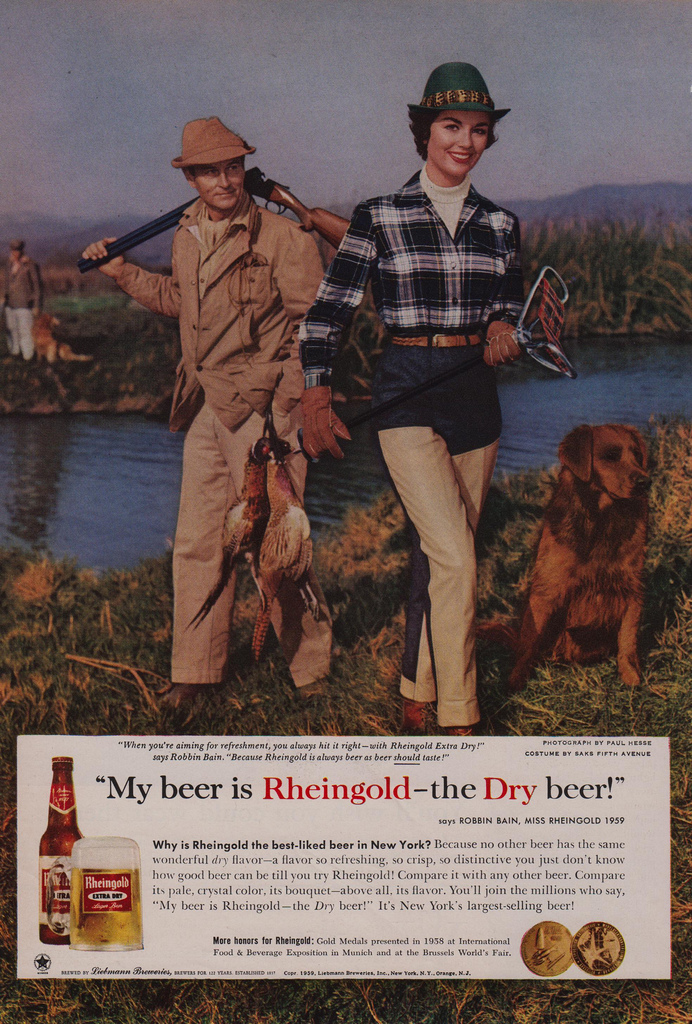
Wednesday’s ad is yet another one for Rheingold Beer, this one also from 1959, and features Miss Rheingold from that year, Robbin Bain. In this ad, she’s “aiming for refreshment,” but the guy behind her is carrying the gun, while she’s got a portable chair in her two gloved hands. And how about that nifty green hat?

Rheingold-1959-hunting

Filed Under: Art & Beer, Beers Tagged With: Advertising, History

The International Organisation of Good Templars

July 2, 2014 By Jay Brooks

iogt-new
Just when I think prohibitionists can’t possibly get any scarier, I found out something new to give me the willies. I saw a odd set of letters retweeted by the good nut jobs at Alcohol Justice yesterday; the letters in question were the IOGT. I figured if they were in bed with AJ they would be worth knowing about. I’m not sure how I missed this group. They’re not exactly a secret, despite having all the trapping of a secret society. The IOGT was originally the “International Order of Good Templars,” a temperance organization founded in the 1850s. They eventually changed their name to the International Organisation of Good Templars in the 1970s because they felt Organisation sounded less like a scary secret society than Order. They also dropped the secret rituals and, I assume, got rid of the secret handshake. It didn’t help, and that’s probably why today they just use the initials IOGT.

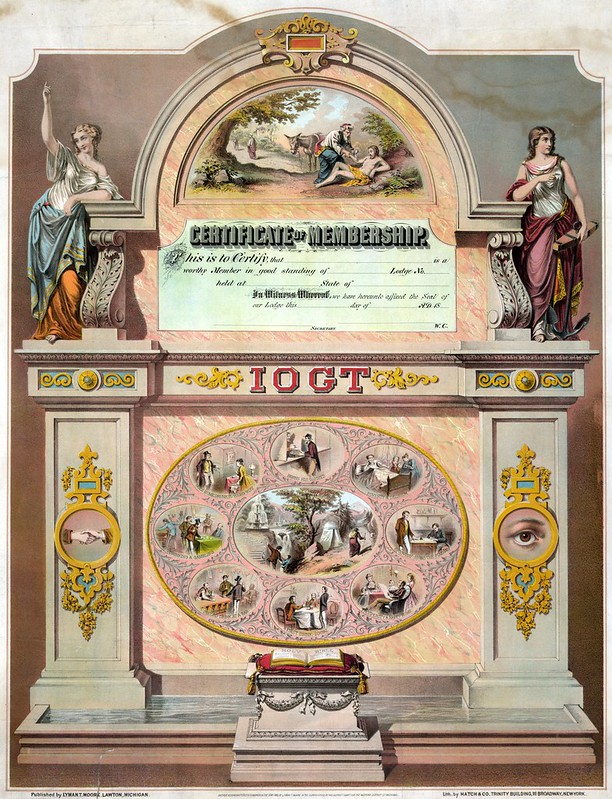
International_Organisation_of_Good_Templars_membership_certificate_1868
An 1868 membership certificate from a chapter in Michigan. Looks harmless enough.

Apparently, it’s “structure [was] modeled on Freemasonry, using similar ritual and regalia. Unlike many, however, it admitted men and women equally, and also made no distinction by race.” Except in the American South, of course, where folks naturally demanded there be separate lodges for black and white members. So you know they were good people. Nothing furthers a stated goal of “liberation of peoples of the world leading to a richer, freer and more rewarding life” by “promot[ing] a lifestyle free of alcohol and other drugs” like continuing racism after the abolishment of slavery.

In 1875, after the American Civil War, the American senior body voted to allow separate lodges and Grand Lodges for white and black members, to accommodate the practice of segregation in southern US states. In 1876, Malins and other British members failed in achieving an amendment to stop this, and left to establish a separate international body. In 1887 this and the American body were reconciled into a single IOGT.

Throughout the late 19th century, chapters were formed all over the world and today they’re headquartered in Sweden, where it’s known as the IOGT-NTO, and other hyphenated suffixes are used in the forty nations with a chapter.

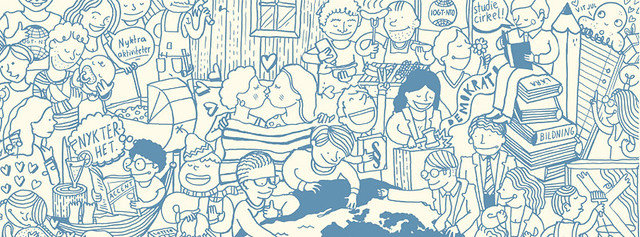
Fyll-livet-banner-liggande
Apparently they’re fine with perpetuating stereotypes of wine for women, beer for men.

Here in America, it’s IOGT-USA, where there are 21 local chapters in only five states. On the plus side, “women were admitted as regular members early in the history of the Good Templars. In 1979, there were 700,000 members internationally, though only 2,000 in the country of the IOGTs origin, the United States.” I didn’t see any more recent membership figures, so who knows how many Good Templars there are now in the 21st century.

They have a somewhat unintentionally comic petition up on a separate website, with the headline “United to Expose the Alcohol Industry.” They go on: “It tears families apart, trashes personal ambition and holds back developing countries. Still, no one has looked deeper into the alcohol industry and demanded that they take responsibility for their actions. It’s time we expose them.” Seriously, “no one has looked deeper into the alcohol industry and demanded that they take responsibility for their actions?” Isn’t that what the IOGT, and all of the other prohibitionist groups have been doing for well over 150 years? But now “it’s time we expose them?” Maybe it’s because their history is rooted in being a secret society, but what exactly is there to expose? What exactly is secret about the global beer industry that hasn’t been written about, endlessly dissected, debated and discussed?

Down a little farther on the petition page, they claim that the “alcohol industry still rule people and markets without being watched, examined or globally questioned by media or lawmakers.” Um, Alcohol Justice is doing just that; styling themselves as the “industry watchdog.” And they’re hardly alone. Countless organizations are keeping a careful watch on the alcohol industry. It’s one of the most tightly regulated industries in the U.S., and I suspect that’s true in most other places, too.

I get that you don’t like alcohol, and think everybody should just stop drinking it, but let’s not pretend this idea just occurred to you last week. Or that brewers are part of some secret cabal to ruin your world. Because really, it’s not “your” world, it’s “ours,” by which I mean “everybody’s.” And many of us like a nice beer, thank you very much. You don’t want to drink alcohol? Fine, don’t drink it. No one is telling you that you must, I only wish you’d extend us the same courtesy and stop telling us about every problem drinker, as if we’re all the same. There are troubled people everywhere, doing all sorts of bad things, many of them worse than drinking too much. Like virtually every aspect of human existence, there is good and bad, and everyone should have the right to choose their own path. For every anecdote about an alcoholic, there are 99, or 95, people who aren’t; good people who are drinking responsibly, holding down jobs, raising families and getting on with their lives. They don’t deserve to have you condemning them every chance you get.

IOGT-NTO
Examples of non-alcoholic fun. I have fun without alcohol all the time, but only in moderation.

Filed Under: Beers, Politics & Law Tagged With: International, Oddities, Prohibitionists, Sweden

Beer In Space: Ninkasi’s Space Program

July 2, 2014 By Jay Brooks

nsp
Space … the Final Frontier … for Beer. These are the voyages of the Starship Ninkasi. Its 8-year old mission: to brew strange new beers, to seek out new life and new civilizations to drink beer, to boldly brew where no man has brewed before.
ninkasi-spaceship

Alright, it’s possible I’ve exaggerated a little, but Ninkasi Brewing in Eugene, Oregon announced their new Ninkasi Space Program, a collaboration with CSXT (Civilian Space eXploration Team), “a team of around 30 civilians interested in private spaceflight.” As a longtime space geek, it’s a pretty cool idea.

Mission One

NSP’s first task is to test the viability of yeast in space. This volatile organism, the living ingredient from which beer is born, requires precise conditions to thrive. Will 16 strains of brewer’s yeast survive Mission One, in which they are jettisoned outside Earth’s atmosphere on a rocket? Once we know, NSP will be one step closer to the ultimate brewery…in space.

Mission one will be launched later this month, around thirteen days from today, according to the countdown clock on the NSP website.

More from the press release:

“NSP is a very serendipitous project,” explains Nikos Ridge, CEO and co-founder of Ninkasi. “I don’t think you could have planned a more perfect pairing of beer and space geekery.”

Introduced through a mutual friend, Ridge met with Bruce Lee, of CSXT, at an amateur rocket launch competition in 2013 where the idea first came about.

“As a result of meeting Nikos, CSXT is pleased to include Ninkasi as a team member for the launch,” says Bruce Lee, principle and range safety officer for CSXT. “Launching brewer’s yeast into space will be an interesting experiment – something we’ve never done before.”

With almost a year of planning, NSP will finally get off the ground this month. Ninkasi’s lab technician, Dana Garves, and RapidMade, a Portland, Ore. company specializing in 3D printing, worked hand-in-hand to design and create a payload container built specifically to safely carry the 16 yeast strains into space and back to Earth for brewing—the first to do so.

“I couldn’t contain my excitement when I first heard of NSP,” says Garves. “We spent hours researching, developing and testing what we think will ensure that the yeast travels safely and returns to us healthy enough to brew with.”

After the launch, CSXT will retrieve the payload and immediately hand off the yeast samples to Garves who will analyze the yeast on-site with a microscope used in conjunction with her smartphone.

“Since we’ll be off-the-grid for the launch, I had to figure out a way to examine the samples remotely,” explains Garves. On-site, Garves will be testing for the viability of the yeast, analyzing the number of dead and live yeast cells.

If successful, the NSP team will return to the brewery with healthy yeast, ready to make its way into a very special beer for craft beer and space aficionados alike.

“Obviously, the fact that we’ve never launched yeast into space presents many challenges in itself even with months of planning,” says Ridge. “While we have confidence in our partners and the process, this is uncharted territory on several fronts and I can’t wait to see how it all unfolds on launch day.”

Filed Under: Beers, Breweries, Just For Fun, News

Hangover Science

July 2, 2014 By Jay Brooks

ahrg
If you’re interested in hangovers, or in avoiding them, believe it or not there’s a scientific organization devoted to them. The Alcohol Hangover Research Group, describes themselves as “an international expert group composed of active researchers in the field of alcohol hangover. The “goal of the AHR-Group is to elucidate the pathology, treatment and prevention of the alcohol hangover.”

The Atlantic recently had an interesting article, Hangovers, Why, all about a recent conference held in Seattle devoted to the science of hangovers, “a bit of a neglected field.” The article includes an interview with Richard Stephens, a member of the AHR-Group, and a professor of psychology at the UK’s Keele University, in which he reveals “some of the most surprising things scientists have learned recently about” hangovers.

ahrg

Filed Under: Beers

Beer In Ads #1239: Talk About Pleasant Traditions

July 1, 2014 By Jay Brooks


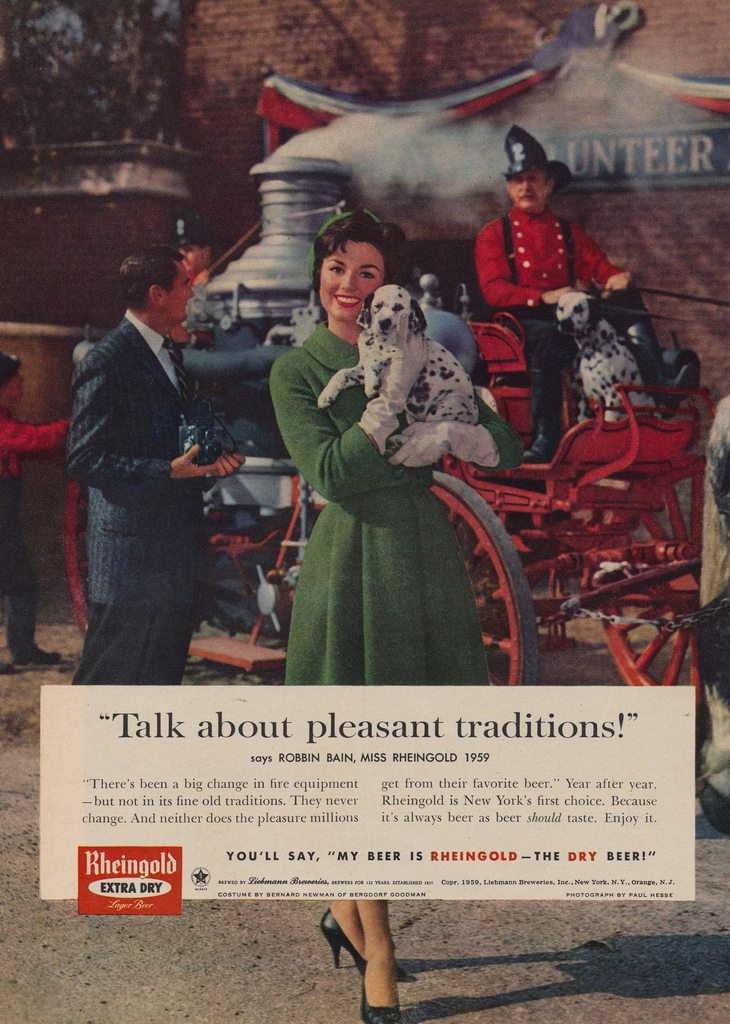
Tuesday’s ad is another one for Rheingold Beer, this one also from 1959, and features Miss Rheingold from that year, Robbin Bain. In this ad, she’s holding a Dalmatian puppy in front of a scene of an old-fashioned fire truck. Even the fireman is wearing a retro firefighter’s uniform, and I wonder if that’s the puppy’s Mom on the truck with him?

Rheingold-1959-fire

Filed Under: Art & Beer, Beers Tagged With: Advertising, History

Beer In Ads #1238: … And Follow Through With Rheingold!

June 30, 2014 By Jay Brooks


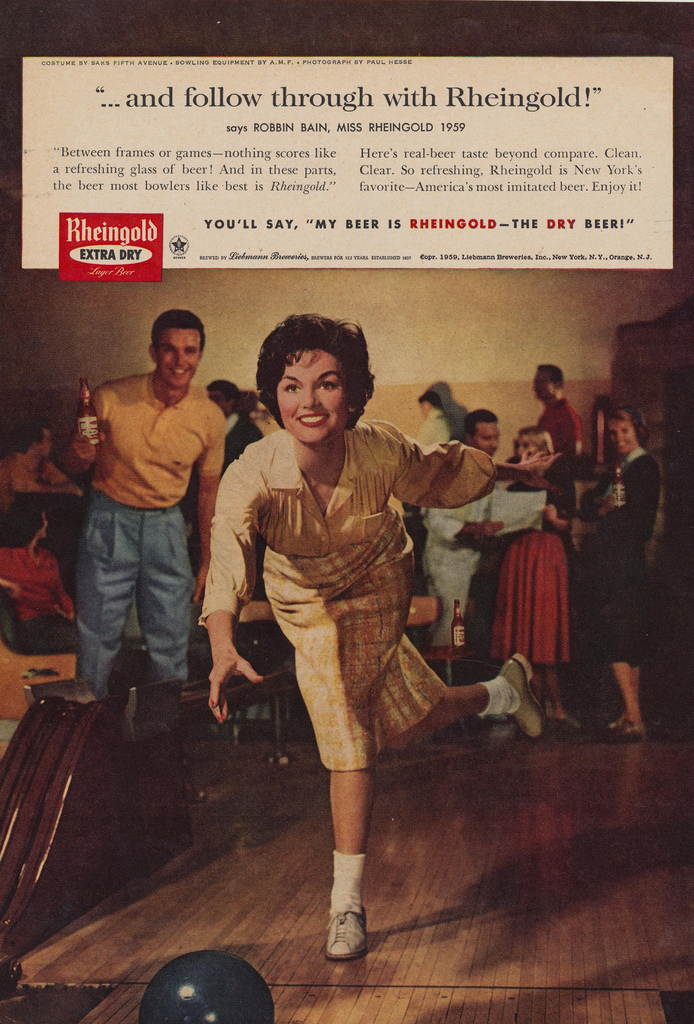
Monday’s ad for Rheingold Beer, this one from 1959, and features Miss Rheingold from that year, Robbin Bain. In this ad, she’s out for a night of bowling, then a far more popular pastime. “Between frames or games — nothing scores like a refreshing glass of beer!”

Rheingold-1959-bowling-2

Filed Under: Art & Beer, Beers Tagged With: Advertising, History

Blaming Alcohol For Rape

June 30, 2014 By Jay Brooks

rape
Despite the title of this post, this is not about rape, it’s about alcohol, and prohibitionists. Okay, that’s not exactly true. It’s a little bit about rape, but it’s more about how alcohol is being blamed for it. Rape is without question one of the worst crimes there is, in some ways worse than murder because its effect on the victim never really goes away. Our society, however, doesn’t really take it as seriously as it should, especially if the rapist is from a prominent family, or plays sports. Having a mother, a wife and a daughter, I don’t really understand why we treat it so cavalierly, and often blame the victim, too. Since every man has a mother, and almost every one of them also has at least an aunt, sister, wife, daughter, niece, female cousin, etc., I really don’t get our society’s casualness with rape.

Yes, some other countries are even worse they we are, but that shouldn’t really matter, or excuse it. Time magazine recently put the topic on the cover of their magazine, in their May 26, 2014 issue, focusing on rape on college campuses. It’s a start. And at least it’s getting more attention, which it definitely should. I’ve seen a number of news outlets discussing it. And even the White House weighed in with a report, Not Alone, subtitled “The First Report of the White House Task Force to Protect Students From Sexual Assault.”

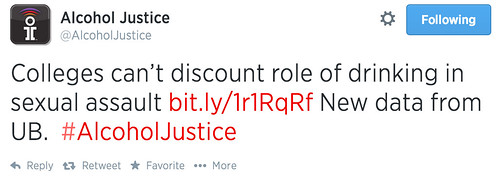
Unfortunately, it’s not all good. For example, it’s increasingly true that George Will is not just an out-of-touch old white man, but an asshole, too. But worse still, others are using the increased awareness of this abhorrent phenomenon for their own terrible purpose. Enter Alcohol Justice (AJ), who can’t help but see rape as alcohol’s fault, not as a crime of violence and power, like it actually is. Here’s what they’re tweeting:

aj-tweet-rape

To be fair, they didn’t come up with the title “Colleges can’t discount role of drinking in sexual assault,” but they certainly jumped on it to flog their faithful with more tales of the scourge of alcohol. They took it from an internal UB Reporter website and spread it far wider, in order to further their agenda. The “new data from UB,” as if anybody would know who UB is, comes from the University of Buffalo’s Research Institute on Addictions (RIA).

What’s upsetting the RIA, and by extension AJ, is that the White House report didn’t focus enough attention on binge drinking, which they believe is the heart of the problem. Just stop people binge drinking, and that will solve the rape issue on college campuses, goes the thinking.

“Research consistently shows that heavy alcohol use is a factor in a majority of college sexual assault cases,” Livingston says. “Therefore, reduction of binge drinking on campuses must be recognized as a crucial goal in assault prevention efforts.”

Not everybody agrees, of course, and the lone comment to the UB article is from an Anne Taylor, who takes exception:

The researchers are going about this wrong. Men who commit acts of rape and sexual assault will commit these crimes regardless of whether or not alcohol is present. Clearly, these researchers are ignorant about rape culture and its effects on society at large. Men who are rapists use alcohol (and drugs) as an aid to committing acts of rape. Do these researchers honestly believe that reducing binge drinking will reduce the number of men who are rapists? No, these men will simply find another way to prey on their chosen victims.

Maybe these researchers ought to do a little research on rape culture and the patriarchy before conducting their study? As a survivor of sexual assault myself, I am absolutely livid at these researchers for perpetuating one of the many myths of rape culture (i.e., that alcohol and “drunk women” are the only reasons why men rape, never mind the fact we live in an extremely sexist society that devalues women’s bodily autonomy).

The RIA does seem to acknowledge some of what Taylor expresses, when they say. “Some advocates worry that acknowledging the role of binge drinking in assaults is tantamount to blaming the victim, but our common goal here is to prevent sexual assaults by better understanding the conditions under which they are likely to occur.” But I think blaming the alcohol is exactly what they’re doing. At a minimum, that’s the result of shifting the focus from the crime to the question of whether anyone had been drinking. Not only does it blame the victim, but it also provides an excuse for the rapist. And while I’m certain that some students do use drinking alcohol as their way to take advantage of another person, making it about the alcohol removes the responsibility of the rapist, allowing him, and society, to blame it all on binge drinking. Whether binge drinking, or any drinking, is involved muddies the waters and shifts the focus of the rape away from where it belongs: on the heinous crime itself.

The RIA has apparently “conducted groundbreaking research on the association between binge drinking and college sexual assault,” and there’s a link to a fact sheet entitled Alcohol and Sexual Assault. Unfortunately, and not to take away from their efforts, there’s nothing “groundbreaking” here, it’s just an overview of some research and factoids addressing their displeasure with the White House report not making enough of drinking. Even if some of it were true, which no doubt some of it is, it ends up being an excuse for why it was acceptable in the mind of, in some cases, both parties. But this is one of the instances where there should be no ambiguity, a strict liability. Drinks or no drinks, it’s completely unacceptable, so why make it about the drinking?

Blaming alcohol, as RIA and AJ seem to be doing, is doing exactly what they’re claiming not to be doing, making the “role of alcohol” a “stumbling block when discussing prevention efforts.” Because a crime is a crime, whether someone’s been drinking or not. If we discovered that more robberies were perpetrated by people who’d been drinking, would we focus our attention on stopping everyone from drinking, or continue trying to stop robbers from committing the crime? If it was found that criminals who’d been drinking considered robbery more acceptable morally than sober criminals, would that in any way change our view of the crime? And I think that’s why the more serious reports, including the White House’s, are concentrating on stopping the crime, not looking for a bogeyman.

Here’s another way in which one of the rape myths is addressed, from Chapter 7: Violent Crimes Committed Against Women and Children of the Office of the Attorney General for the State of California Department of Justice.

Many people have the wrong idea about sexual assault. They mistakenly believe that rapists are overcome with sexual desire or that a woman who is raped may have dressed too seductively or “asked for it” in some manner. These ideas assume that rape is only a sexual act, a crime that is motivated by desire. It is not. Rape is a violent crime, a hostile act, and an attempt to hurt and humiliate another person. Sex is used as a weapon, and rapists use that weapon against women, strangers and acquaintances of all ages, races and body types.

People may think of it as somehow “okay,” but that doesn’t change what it really is: a terrible crime. You can find information about rape being a violent crime all over the place, from Abstract Nonsense, the Minnesota State University and even the National Institute of Justice. Anybody claiming that they thought it was okay, or was okay if they were drunk, is a Neanderthal that should be removed from society, period. I know that’s not how our society currently approaches rape and sexual assault, but making this a question about how alcohol does or doesn’t contribute to the state of mind of either party to this crime is not helping. In fact I think it’s doing more harm, because not everyone who drinks, or even binge drinks, is a rapist, or thinks sexual assault is acceptable. But that’s the most common prohibitionist tactic. If anything bad ever happens, even just once or twice, and someone involved had been drinking, then the only possible response is for everyone to stop drinking. It must be the alcohol’s fault, and personal responsibility apparently doesn’t really exist. If one person can’t handle their booze, then no one should ever be allowed to drink. The fact that we don’t approach any other societal problem in this manner never seems to matter, and there’s always some excuse about “alcohol” being somehow different because it has, well, alcohol in it. Or it’s a sin, or toxic, or some other ridiculous notion. Oh, and did you hear? It’s made with antifreeze, too, because brewers want to kill all their customers.

When you read more about this, it’s clear that there are a minority of sexual predators on college campuses, and some of them use alcohol as a weapon. According to research as early as 2002, we’ve known this to be the case. In a respected study at the University of Massachusetts, they found that rapes were perpetrated by only 6.4% of the male college students, but that each of them was a serial rapist, with an average of almost six sexual assaults. As is the case with a lot of social problems, alcohol included, a small number of people are making it awful for the rest of us. And our usual response it to let those bad actors determine our response, which inevitably punishes everyone. The White House was right, I think, in focusing on the crime itself, and not on any of the weapons, or on other distractions.

What AJ, and possibly the RIA conveniently seems to forget, is that one of the major causes of binge drinking on college campuses is that prohibitionists forced the minimum age from 18 to 21 by getting Congress to tie it public highway funds. In a sense, binge drinking on college campuses was an unintended consequence of trying to curb drunk driving. The RIA does acknowledge that “underage drinkers who are victimized may fear legal or disciplinary consequences for alcohol use.” That’s what drives college drinking underground, and into secret, and creates the conditions where binge drinking can flourish, and so can sexual predators. So if their real goal was to stop binge drinking in college, they should at the very least be questioning the minimum age and talking about how it would help bring drinking into the open, and thereby possibly reducing many of the negative aspects of binge drinking that they believe are increasing sexual assaults. That’s the entire point of the Amethyst Initiative, which has 136 chancellors and presidents of universities and colleges across the United States signed up to change the law for that very reason. I understand why AJ would never entertain that idea. It’s simply not possible for them to view alcohol in anything but the most negative way imaginable, but I’m baffled why the RIA wouldn’t at least suggest it as one possible solution.

Obviously, education is suggested by everybody, but alcohol education is all but nonexistent, apart from the “just say no” variety, which does no good whatsoever. In some states, it’s actually illegal to teach children about alcohol, even by their own parents. Changing the age from 21 back to 18, along with allowing parents (or others) to give teens real information about alcohol and its effects might go a long way toward reducing binge drinking in college, though I suspect it would have only a minimal effect on sexual assault. But that doesn’t mean we shouldn’t try it, or at least just talk about it.

According to RAINN (The Rape, Assault, Incest National Network), in 30% of sexual assaults the perpetrator was intoxicated with alcohol. That also means in 70% of cases, the rapist was not drunk. I accept that it’s possible that the figure is higher among assaults on college campuses. I’m not trying to downplay the crime here; just the opposite in fact. The point I’m trying to make is that the drinking should be beside the point. It should definitely not be the focus, because it simply shouldn’t matter if either victim or rapist was drinking, or drunk. And that’s what pisses me off about Alcohol Justice. In their rush to highlight anything negative about alcohol, they’re shamelessly blaming alcohol for rapes on college campuses, when it’s clear that bad people are are responsible for them. Good people don’t turn into rapists by drinking too much. Bad people are already bad, whether they drink alcohol or give it to their victims. I just wish Alcohol Justice, and the other prohibitionists, would stop blaming alcohol for every problem facing society.

Filed Under: Editorial, Politics & Law Tagged With: Law, Prohibitionists

Film History: Old Man Drinking A Beer

June 30, 2014 By Jay Brooks

film
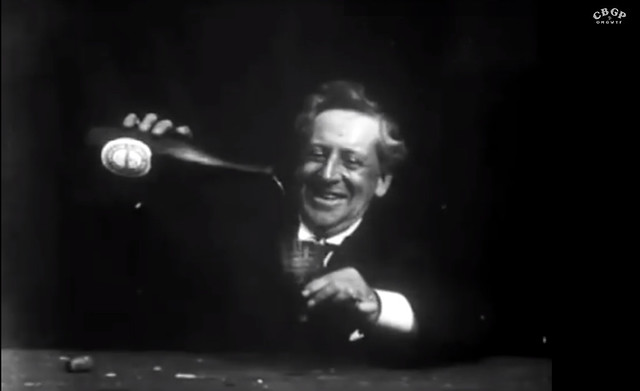
Here’s a curious piece of film (and beer) history. I don’t know if it’s the first time someone was filmed drinking a beer, but I imagine it has to be one of the first. The film is from 1898 (or 1897), and is known as Old Man Drinking a Glass of Beer, though it’s also sometimes known as Comic Face. Frankly, he doesn’t look that old to me.

smith-green-1

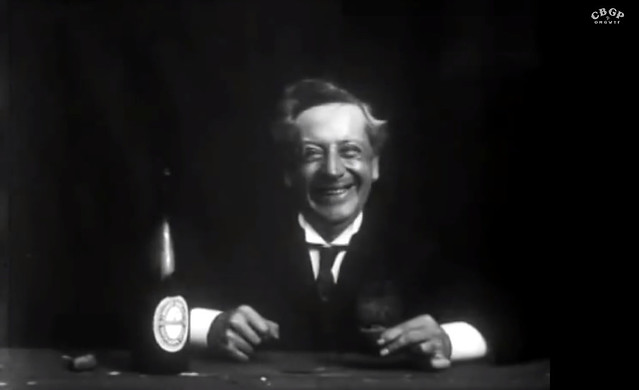
It was made by legendary British filmmaker George Albert Smith and features a close-up of comedian Tom Green drinking a beer and making faces. Green was a local Brighton comedian and was known for his “pantomime harlequinades at the Brighton Aquarium.” He went on to appear in many subsequent films made by Smith.

smith-green-2

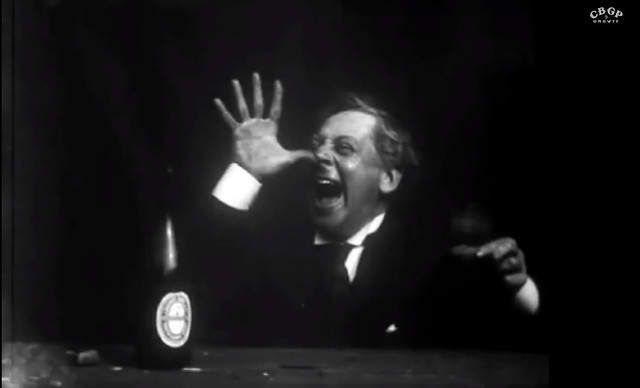
This was apparently a groundbreaking development in film, showing the actor close up making changing facial expressions and this type of film became known as a “facial,” defined as “a work showing a variety of facial expressions to the audience.” According to one source, “the ability to get close up to the star was a great advantage that film had over the stage and early filmmakers were keen to exploit it,” and in this one Green is shown in a single shot “drinking a glass of beer whose face and hands become increasingly lively as a result.”

smith-green-3

Here you watch the entire 38-second silent film:

Filed Under: Beers, Just For Fun, Related Pleasures Tagged With: England, Film, History, UK, Video

« Previous Page
Next Page »

Find Something

Northern California Breweries

Please consider purchasing my latest book, California Breweries North, available from Amazon, or ask for it at your local bookstore.

Recent Comments

  • Bob Paolino on Beer Birthday: Grant Johnston
  • Gambrinus on Historic Beer Birthday: A.J. Houghton
  • Ernie Dewing on Historic Beer Birthday: Charles William Bergner 
  • Steve 'Pudgy' De Rose on Historic Beer Birthday: Jacob Schmidt
  • Jay Brooks on Beer Birthday: Bill Owens

Recent Posts

  • Beer In Ads #5219: Good Old Point Special Bock Beer April 12, 2026
  • Beer In Ads #5218: The “Butter-In” Of The Season April 12, 2026
  • Beer In Ads #5217: The King Of All Beers April 11, 2026
  • Historic Beer Birthday: Gambrinus April 11, 2026
  • Beer In Ads #5216: The Finest Bock, As Usual April 11, 2026

BBB Archives

Feedback

Head Quarter
This site is hosted and maintained by H25Q.dev. Any questions or comments for the webmaster can be directed here.