Brookston Beer Bulletin

Jay R. Brooks on Beer

  • Home
  • About
  • Editorial
  • Birthdays
  • Art & Beer

Socialize

  • Dribbble
  • Email
  • Facebook
  • Flickr
  • GitHub
  • Instagram
  • LinkedIn
  • Pinterest
  • RSS
  • Twitter
  • YouTube

Powered by Genesis

Beer Birthday: Morgan Cox

October 5, 2025 By Jay Brooks

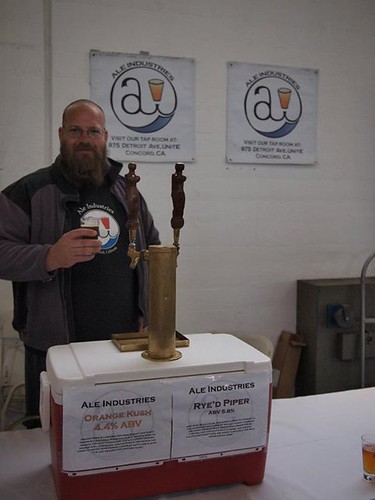
Today is the 48th birthday of Morgan Cox, founder and brewmaster of Ale Industries in Concord, California. Morgan started homebrewing at an early age, and washed kegs for Dave Heist at HopTown, before brewing at E.J. Phair. After eight years there, he left to open his own brewery, Ale Industries, where he had been making inventive, tasty beers. Unfortunately, more recently, in late 2023, he closed the brewery. Join me in wishing Morgan a very happy birthday.
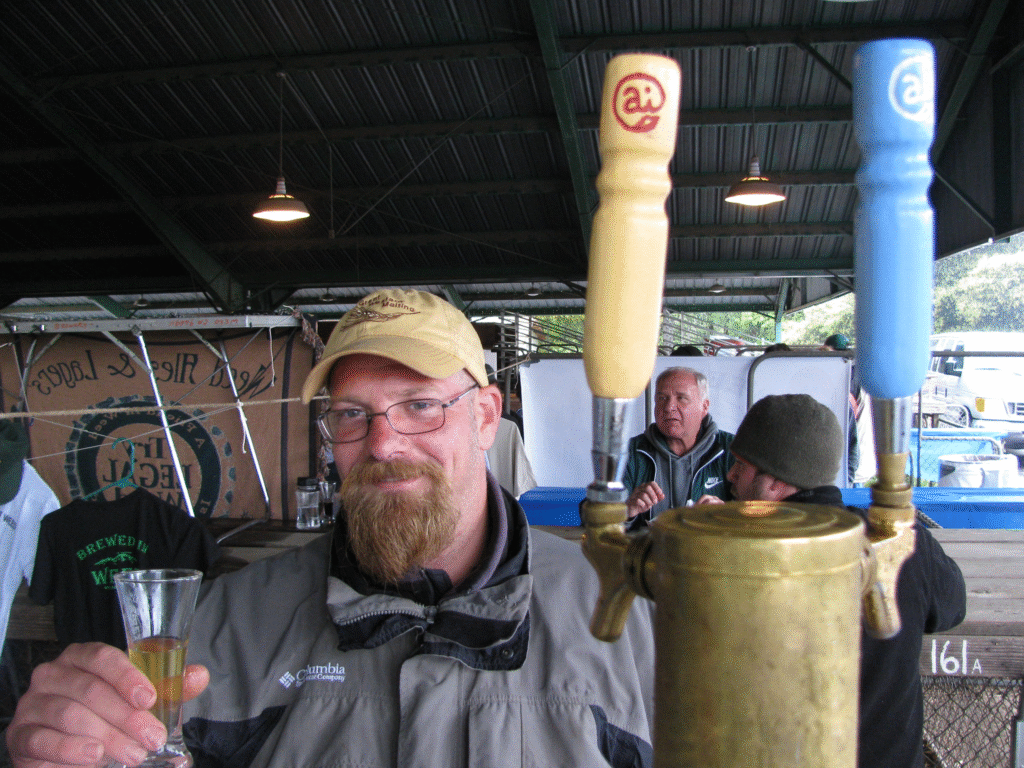
Morgan at the rainy Boonville Beer Festival in 2009.
Cox-1
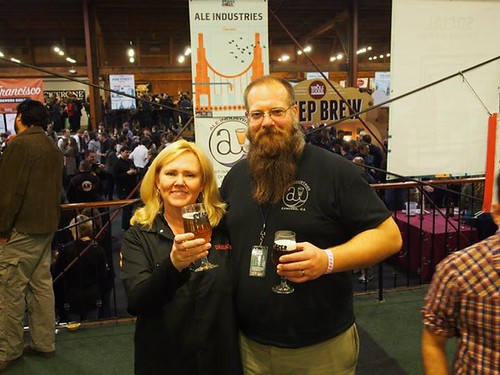
Morgan with Annie, of Annie N Crew, at the opening gala for SF Beer Week several years ago.
Cox-2
Morgan pouring at the Breastfest in 2012.

Note: the last two photos purloined from Facebook.
Filed Under: Birthdays, Just For Fun Tagged With: Bay Area, California

Historic Beer Birthday: Alexander Keith

October 5, 2025 By Jay Brooks

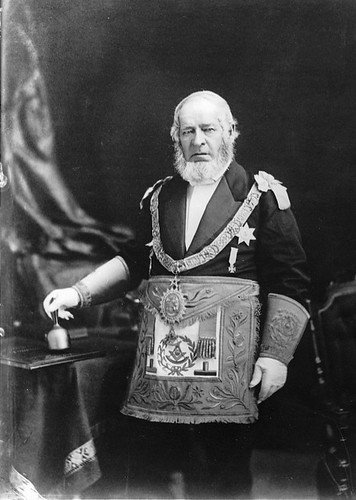
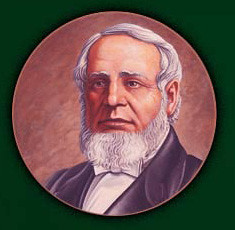
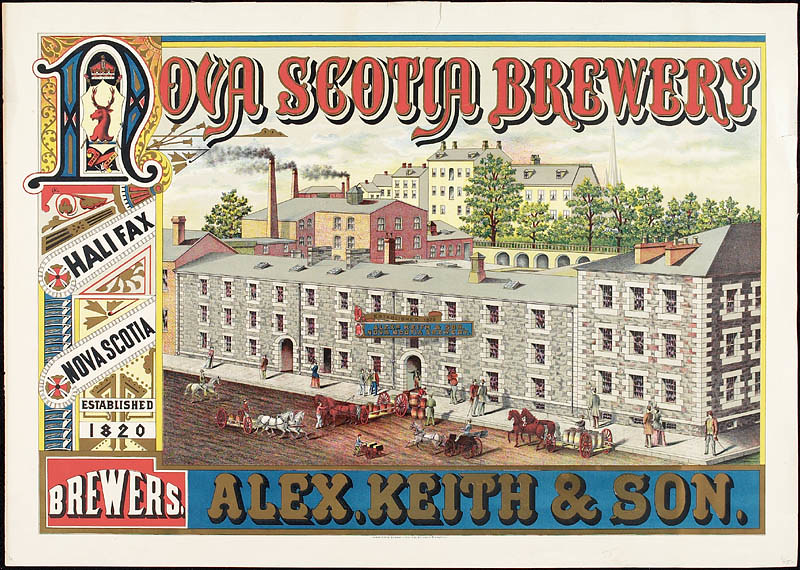
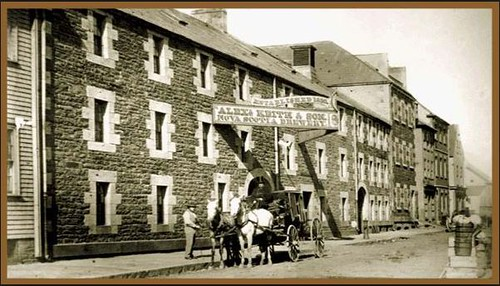
Today is the birthday of Alexander Keith (October 5, 1795–December 14, 1873). He was born in Scotland, where he was trained as a brewer. He settled in Canada, specifically Halifax, Nova Scotia, in 1820, where he founded the Alexander Keith Brewery.

Here’s his biography from his Wikipedia page:

Keith was born in Halkirk, Caithness, Highland, Scotland, where he became a brewer. He immigrated to Canada in 1817 and founded the Alexander Keith’s brewing company in Halifax, Nova Scotia in 1820, moving to a three-storey building on Hollis Street at Lower Water in the downtown area in 1820. Keith had trained as a brewer in Edinburgh and London. His early products included ale, porter, ginger wine, table and spruce beers.

Alexander Keith served as mayor in 1843 and in 1853-54 and president of the Legislative Council (provincial parliament) from 1867 to his death in 1873.

Throughout his career Keith was connected with several charitable and fraternal societies. He served as president of the North British Society from 1831 and as chief of the Highland Society from 1868 until his death. In 1838 he was connected with the Halifax Mechanics Library and in the early 1840s with the Nova Scotia Auxiliary Colonial Society. Keith was also well known to the Halifax public as a leader of the Freemasons. He became Provincial Grand Master for the Maritimes under the English authority in 1840 and under the Scottish lodge in 1845. Following a reorganization of the various divisions in 1869, he became Grand Master of Nova Scotia. There are four masonic lodges named in his honour: Moncton, New Brunswick, and Halifax, Stellarton, and Bear River in Nova Scotia.

Alexander Keith died in Halifax in 1873 and was buried at Camp Hill Cemetery at the corner of Spring Garden Road and Robie Streets. His birthday is often marked by people visiting the grave and placing beer bottles and caps on it (or, less frequently, cards or flowers).

And this more thorough biography is from the Dictionary of Canadian Biography:

KEITH, ALEXANDER, brewer and politician; b. 5 Oct. 1795 in Caithness-shire, Scotland, son of Donald Keith and Christina Brims; d. 14 Dec. 1873 in Halifax, N.S.

When Alexander Keith was 17, his father sent him to an uncle in northern England to learn the brewing business. Five years later, when Keith migrated to Halifax, he became sole brewer and business manager for Charles Boggs, and he bought out Boggs’ brewery in 1820. On 17 Dec. 1822 he married Sarah Ann Stalcup, who died in 1832. On 30 Sept. 1833 he married Eliza Keith; they had six daughters and two sons. One son, Donald G. Keith, became a partner in the brewing firm in 1853.

In 1822 Keith moved his brewery and premises to larger facilities on Lower Water Street and in 1836 he again expanded, building a new brewery on Hollis Street. In 1863 he began construction of Keith Hall which was connected by a tunnel to his brewery. Keith Hall, now occupied by Oland’s Brewery, is in the Renaissance palazzo style, with baroque adornments, pillars of no particular style, and a mansard roof. This peculiar combination of styles resulted from the fact that the designs were probably derived from books with plans of buildings in Great Britain and the United States. Keith’s appointment as a director of the Bank of Nova Scotia in 1837 along with William Blowers Bliss is an indication of his importance in the Halifax business community. Beginning in 1837, he also served as a director, at various dates, of the Halifax Fire Insurance Company. In 1838 he helped found the Halifax Marine Insurance Association, and in the 1840s he was on the board of management of the Colonial Life Assurance Company. He was also a director of the Halifax Gas, Light, and Water Company, incorporated in 1840, and in 1844 helped incorporate the Halifax Water Company, becoming a director in 1856. By 1864 Keith was a director of the Provincial Permanent Building and Investment Society. At the time of his death his estate was evaluated at $251,000.

Keith’s interest in utilities and insurance was but part of his general involvement in the public life of Halifax. He was unsuccessful in the general election of 1840 when he stood as a Conservative candidate for the town of Halifax but was elected to the first city council in 1841. In 1842 he served as a commissioner of public property and in 1843 was selected mayor of Halifax. He continued as a member of council until he again served as mayor, by election, in 1853 and 1854. In December 1843 he was appointed to the Legislative Council and in June 1867 he accepted the appointment of president of the council, declining a seat in the Canadian Senate. As a supporter of confederation and president of the council, he was helped at first by the fact that before 1 July 1867 Charles Tupper* had filled several seats in the upper house with known confederates. Although the premier, William Annand*, appointed to the upper house in November 1867, had complete control of the lower house, he did not dare introduce a resolution into the upper chamber in 1868 calling for repeal of union. The anti-confederates gradually secured control of the upper house, however, and Keith was unable to prevent passage, in 1871, of a particularly flagrant bill which took the vote from all federal officials in provincial elections. It was perhaps a commentary on Keith that he was not actively involved at this time with the Conservative party organization which was run by such party stalwarts as Philip C. Hill* and James MacDonald*.

Throughout his career Keith was connected with several charitable and fraternal societies. He served as president of the North British Society from 1831 and as chief of the Highland Society from 1868 until his death. In 1838 he was connected with the Halifax Mechanics Library and in the early 1840s with the Nova Scotia Auxiliary Colonial Society. Keith was perhaps best known to the Halifax public as a leader of the freemasons. He became provincial grand master for the Maritimes under the English authority in 1840 and under the Scottish lodge in 1845. Following a reorganization of the various divisions in 1869, he became grand master of Nova Scotia.

This short history of Keith’s brewery is from their Wikipedia page:

Founded in 1820, Alexander Keith’s is a brewery in Halifax, Canada. It is among the oldest commercial breweries in North America. (The oldest surviving brewing enterprise in Canada was established by John Molson in Montreal in 1786 while the oldest in the US, Yuengling, originally called Eagle Brewing, was founded in 1829 in Pottsville, PA.)

Keith’s was founded by Alexander Keith who emigrated from Scotland in 1817. Keith moved the facility to its final location, a three-storey building on Hollis Street at Lower Water in the downtown area, in 1820. Keith had trained as a brewer in Edinburgh and London. His early product included ale, porter, ginger wine, table and spruce beers. Alexander Keith was mayor in 1843 and in 1853-54 and president of the Legislative Council from 1867 to his death in 1873.

Keith’s was sold to Oland Breweries in 1928 and to Labatt in 1971. Today, the brewery is under the control of this subsidiary of Anheuser–Busch InBev which took the brand national in 1990’s. Keith’s also produces Oland Brewery beers, distributed in Eastern Canada.

In April 2011, Anheuser–Busch InBev began selling Alexander Keith’s beer in the United States after nearly two centuries of being available only in Canada.

AB InBev produces Keith’s India Pale Ale, currently the most popular product in this line,[6] as well as Keith’s Red Amber Ale, Keith’s Premium White, and Keith’s Light Ale.[7] Products sold in the United States are labelled Keith’s Nova Scotia Style Pale Ale, Keith’s Nova Scotia Style Lager, and Keith’s Nova Scotia Style Brown Ale.[8] Seasonal products have included Keith’s Ambrosia Blonde, Keith’s Harvest Ale, and Keith’s Tartan Ale. Although Alexander Keith products were originally produced in the Halifax brewery only for sale in the Maritimes, they are now national products, mass produced at AB InBev plants across Canada and in Baldwinsville, New York.

Filed Under: Birthdays, Breweries, Just For Fun Tagged With: Canada, History, Nova Scotia, Scotland

Historic Beer Birthday: Karl Strauss

October 5, 2025 By Jay Brooks

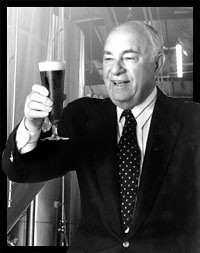
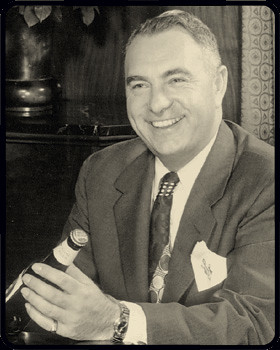
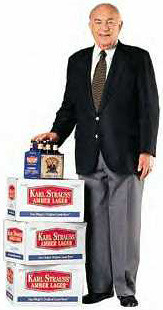
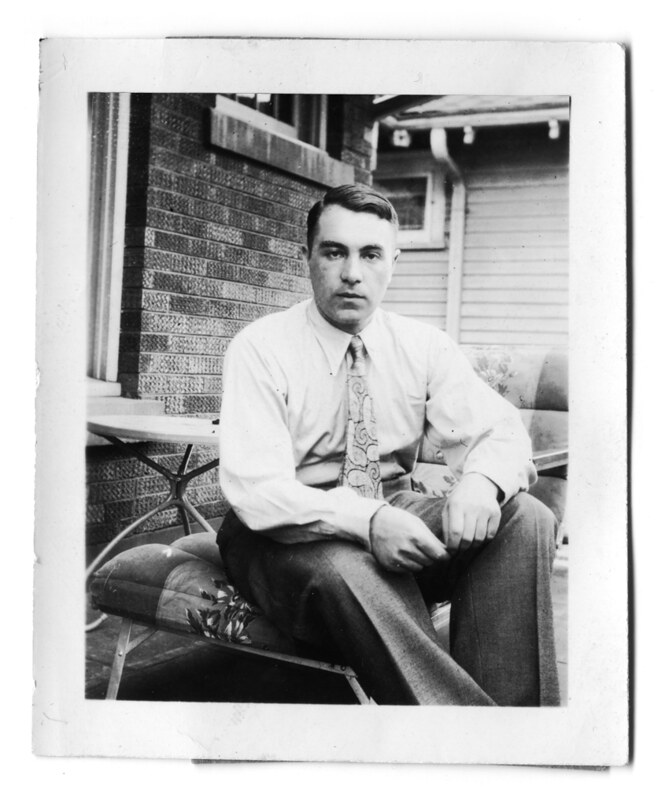
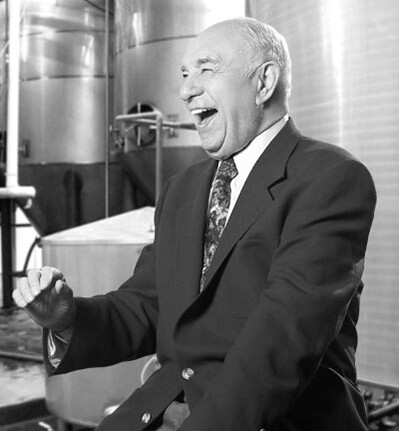
Today is the birthday of Karl Strauss (October 5, 1912-December 21, 2006). He “was a German-American brewer. He fled Nazi Germany in 1939, and went on to become a brewer, executive, and consultant in the American brewing industry. He received numerous awards during his career, which spanned both the large national brewery and the microbrew segments of the industry. Karl Strauss Brewing Company, which he helped found in 1989, continues to bear his name.”

I only met Karl one time (I think) in the latter half of the 1990s during my BevMo days. In 2006, my Karl Strauss rep. from that time sent me an e-mail letting me know that Karl has passed, and I wrote the following in the blog ten years ago. “Yesterday, Karl Strauss passed away in Milwaukee at age 94. Born in Germany, and a graduate of Weihenstephan, Strauss worked for Pabst for decades before retiring as a vice-president. In 1989, along with cousin Chris Cramer and Matt Rattner, Strauss founded the San Diego microbrewery that bears his name. It was San Diego’s first one and today the company operates a brewery and six brewpubs.”

Here’s the more thorough story from the brewery website:

Karl Strauss was destined to brew beer. Born in 1912 on the premises of his father’s brewery in Minden, Germany, he spent his childhood playing amid beer barrels and sacks of fresh hops and barley. At age 19, he left home for Bavaria, the brewing capital of Germany, to attend the Technical University of Munich-Weihenstephan. There he earned a degree in the science and practice of malting and brewing, as well as a Master Brewer certification. Given the political situation in 1930s Germany, Karl had to look abroad for work. In February of 1939, he boarded the SS Manhatten and set sail for America, in pursuit of opportunity. His job search led him to Milwaukee, Wisconsin, home to one of the most famous breweries in the United States.

Karl began his career at Pabst Brewing Company on the bottling line in May, 1939. But with his strong work ethic and educational background, he quickly worked his way up the brewing ranks. In the 1950s, he was part of the team that reformulated the recipe for Pabst’s Blue Ribbon beer. The improved version catapulted sales for the company, and PBR remains an American brewing icon to this day. In 1960, Karl became Vice President of Production, overseeing all brewing operations across the country. He held the position until he retired in 1983, after 44 years with the company.

Not content to rest after his retirement, Karl launched a new career as a brewery consultant, providing expert advice to breweries all over the world. In 1986, he was approached by his cousin Chris in San Diego about starting a microbrewery. Karl thought it was a great idea. He helped design the brewery, train the brewers, and create recipes for the first beers. He was so passionate about the project that he even lent his name, face and voice to the enterprise. Karl served as Master Brewer from 1989 to 2006, remaining involved in brewery operations until his passing.

Karl was very active in the brewing community throughout his life. He was president of the Master Brewers Association of the Americas (1961-1963) and founder and director of the Museum of Beer and Brewing in Milwaukee. He is the only person to have received the MBAA Award of Merit (1981), Award of Honor (1992), and the Distinguished Life Service Award (2003). Karl also believed it was important to pass on the techniques and traditions of his craft to young brewers. We created the Karl M. Strauss Brewers Education Fund in honor of his work.

Karl had a contagious enthusiasm that inspired everyone around him. He was driven by a belief that everyone should enjoy life, preferably with good friends and good beer. Over the course of his 70 plus years as a brewer, he brewed more than seven billion servings of beer, enough for everyone on the planet to have a Karl Strauss Beer.

Karl_Strauss_1960

Here’s much more, from Wikipedia:

Early Life

He was born October 5, 1912, on the second floor of the administration building of the Feldschlösschen Bräu, a brewery in Minden, Germany, of which his father was president. The second born of two boys and a girl to Albrecht and Mathilde Strauss, he attended the Oberrealschule in Minden where he received his Abitur. During his young life he assisted his father as a brewer and intern while living in the family quarters at the brewery. At age 19, he went to the Technical University of Munich at Weihenstephan, where he received a degree in the science and practice of malting and brewing. In addition, he received Master Brewer certification, allowing him to teach apprentice brewers. With his diploma in hand, he began working at breweries including the Falkenkreuz Brauerei Lippert in Detmold, Westphalia; the Bauer Brauerei in Lübeck, Holstein; and the Altstädter Malzfabrik in Altstadt, Thuringia.

With the rise of the Nazis, Germany was not a safe place for the Jewish Strauss family, and work became scarce. “I graduated from college while Hitler was in power and as a Jew could not find employment in the brewing industry,” he wrote in 1943. Thanks to family living in the United States, he was able to secure sponsorship to emigrate. But other members of his family were not so lucky. The last time he saw his mother was the night he left Germany. She later was killed in a concentration camp. His brother was killed in a Nazi raid on the Polish underground.

Career in America

In 1939, Strauss left Germany for the United States, followed soon by his first wife, Irene Vollweiler. He had planned to join family members in San Francisco, California, but stopped in Milwaukee, Wisconsin, at the urging of an uncle to visit family friends. While there he applied for a job with the Pabst Brewing Company, which he intended to be temporary. “I arrived in Milwaukee on St. Patrick’s Day, 1939,” he later recalled. “I started to work at Pabst on May 11, 1939, and I worked for Pabst for 44 years.”

He began his work at Pabst feeding bottles to the bottle soaker. However, “once Pabst realized that it had a Bavarian brew master in its employ, Strauss quickly advanced.” Within a few months he was promoted to foreman of filtration. He continued to quickly move up the corporate ladder, becoming an assistant superintendent and later malt house superintendent. In 1942, he was transferred to Pabst’s brewery in Peoria, Illinois, as the plant production manager. Within a few years he was made head maltster in Milwaukee and was assistant superintendent of the malt house and brewhouse. In 1948, he was promoted to superintendent of Pabst’s newly purchased plant in Los Angeles, and remained there until 1956. He was named technical director of Pabst in 1958, and promoted to vice-president of production in 1960. He helped Pabst reformulate its beer, as well as create a new Pabst Blue Ribbon. He continued as vice-president until retiring from Pabst in 1983.

His first wife died in 1978. He married his second wife, Marjean Schaefer, in 1980.

Post-retirement

In the 1980s, Strauss began a new career as a brewery consultant, providing services for both large breweries and microbreweries throughout the world. He had clients in Europe, Asia, and North America, including Molson, Tsingtao, The Boston Beer Company, and Goose Island Beer Company. He helped design more than 50 brewpubs and microbreweries.

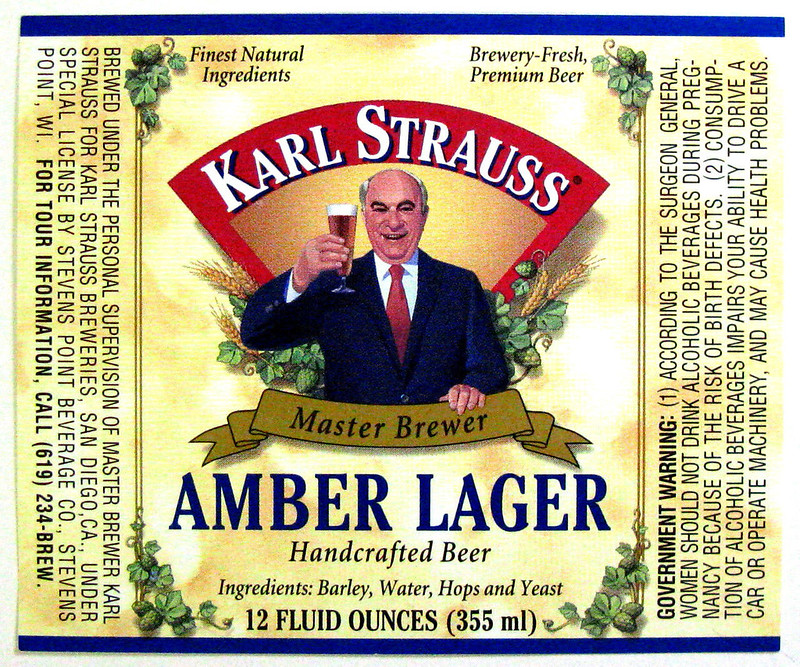
In 1987, a cousin, Chris Cramer, and Cramer’s college roommate, Matt Rattner, asked Strauss to help them develop a brewpub in San Diego, California. Strauss not only designed the brewery and trained the brewers; he also formulated the original beer recipes and lent his name to the endeavor. Opening on February 2, 1989, Karl Strauss Brewing Company became the first brewery in San Diego in more than fifty years and is credited with having launched the craft brewing industry in San Diego. Strauss served as the brewmaster and corporate image of Karl Strauss Brewing Company. As corporate spokesman he made radio commercials in his thick German accent, always concluding “…or my name isn’t Karrrrl Strrrrrauss!”; on the technical side he was heavily involved in the design of the company’s new properties and brewing of new beers. He remained actively involved with the company until his death in Milwaukee on December 21, 2006, at the age of 94. He is buried at Mount Sinai Memorial Park in Los Angeles.

Strauss co-authored a book, The Practical Brewer, published by the Master Brewers Association of the Americas.

strauss-amber-label

Legacy

Strauss was president of the Master Brewers Association of the Americas from 1961–63. He is the only person to receive all three of the highest awards given by the association: the Award of Merit (1981), given to an individual or individuals who made an outstanding contribution to the brewing industry; the Award of Honor (1992), given to a member who has rendered outstanding service to the association; and the Distinguished Life Service Award (2003), which recognizes MBAA members who have given exceptional service to the association.

Karl was a founder and director of the Museum of Beer and Brewing in Milwaukee. The museum now presents an annual Karl Strauss Award to individuals for lifetime contributions to the industry.

In 2006, Karl Strauss Brewing Company set up the Karl Strauss Brewers Education Fund with the Jewish Community Foundation of San Diego. The fund provides financial educational support to aspiring southern California brewers pursuing a career in the field of brewing.

karl-strauss-coaster

And finally, here’s a video celebrating what would have been Karl’s 100th birthday in 2012.

Filed Under: Birthdays, Just For Fun Tagged With: California, Germany, History, San Diego

Beer In Ads #5096: Pabst October Bock

October 4, 2025 By Jay Brooks

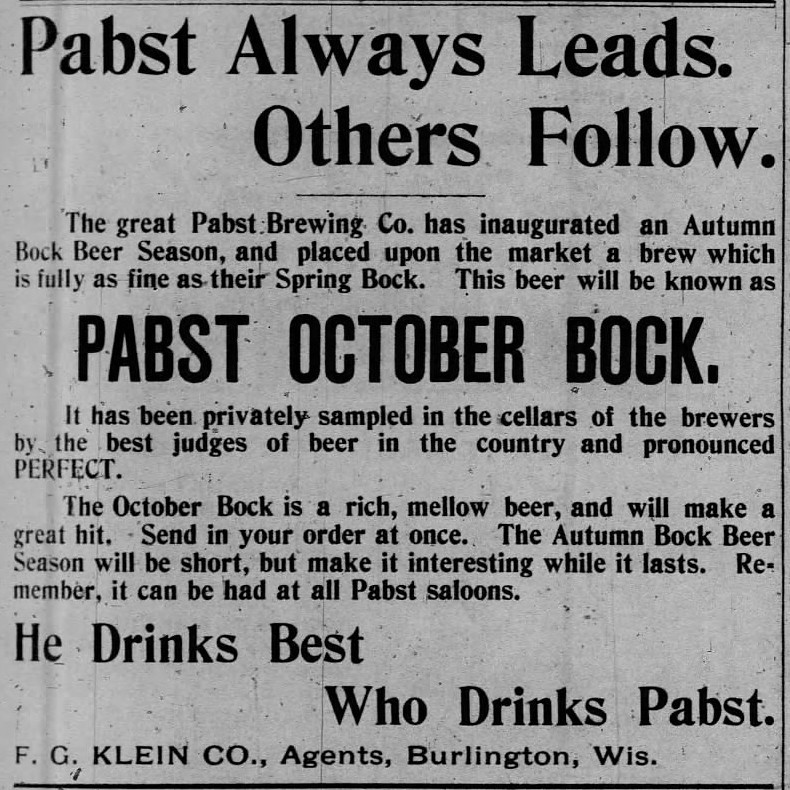
Last year I decided to concentrate on Bock ads. Bock, of course, may have originated in Germany, in the town of Einbeck. Because many 19th century American breweries were founded by German immigrants, they offered a bock at certain times of the year, be it Spring, Easter, Lent, Christmas, or what have you. In a sense they were some of the first seasonal beers. “The style was later adopted in Bavaria by Munich brewers in the 17th century. Due to their Bavarian accent, citizens of Munich pronounced ‘Einbeck’ as ‘ein Bock’ (a billy goat), and thus the beer became known as ‘Bock.’ A goat often appears on bottle labels.” And presumably because they were special releases, many breweries went all out promoting them with beautiful artwork on posters and other advertising.

Saturday’s ad is for Pabst October Bock Beer, which was published on October 4, 1899. This one was for the Pabst Brewing Co. of Milwaukee, Wisconsin, which was originally founded in 1844. This ad ran in The Burlington Free Press, from Burlington, Wisconsin.

Filed Under: Art & Beer, Beers, Birthdays, Just For Fun Tagged With: Advertising, Bock, History, Milwaukee, Vermont, Wisconsin

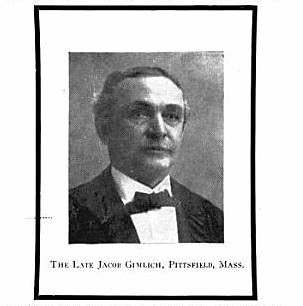
Historic Beer Birthday: Jacob Gimlich

October 4, 2025 By Jay Brooks

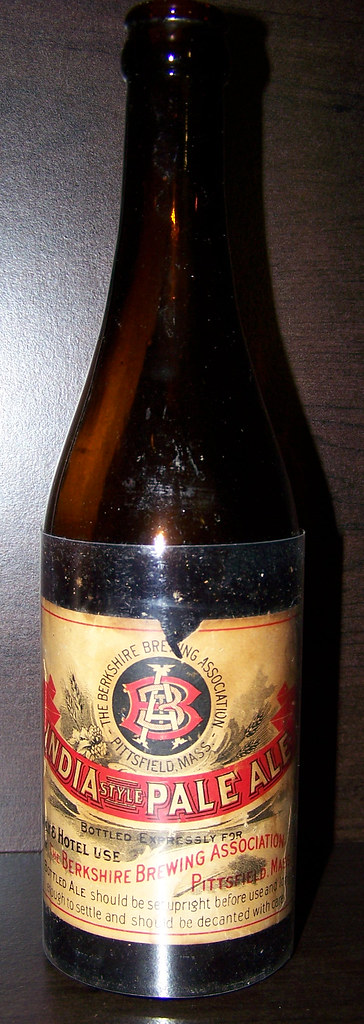
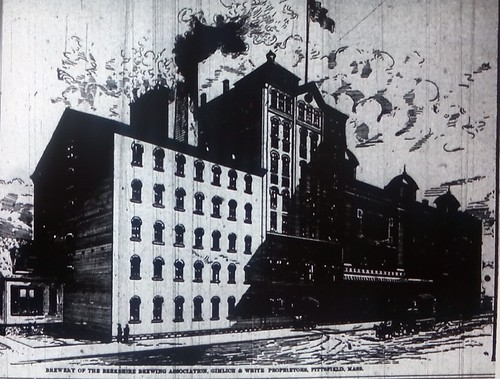
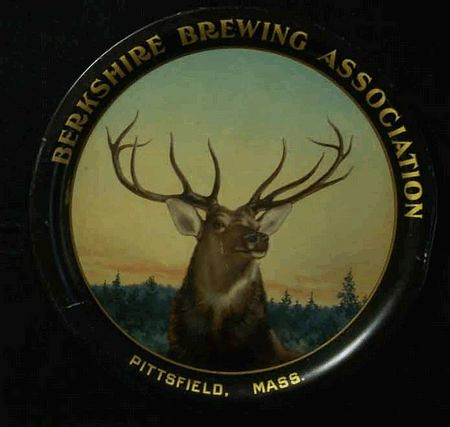
Today is the birthday of Jacob Gimlich (October 4, 1845-January 21, 1912). He was born in Weisenheim, Bavaria, but came to Massachusetts and bought the M. Benson Brewery of Pittsfield, with business partner John White, in 1868, only one year after it opened. They renamed it the unimaginative Jacob Gimlich & John White Brewery. In 1891, they changed its name to the Berkshire Brewing Association, and that remained its name until it closed due to prohibition in 1918 or 1919. “The brewery produced beers such as Greylock Ale, Mannheimer Lager, Lenox Half Stock Ale, Berkshire Lager, Berkshire Ale, and Superior Old Porter. In addition to beer, Mineral Water, Soda, and Malt Extracts were also produced. The brewery was a great success producing 75,000 barrels a year and distributed all over the northeast and as far south as the Carolinas.”

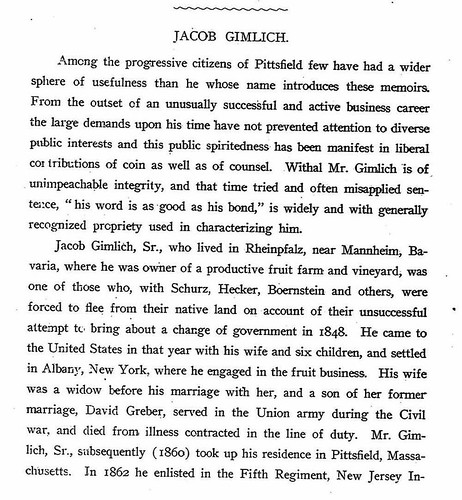
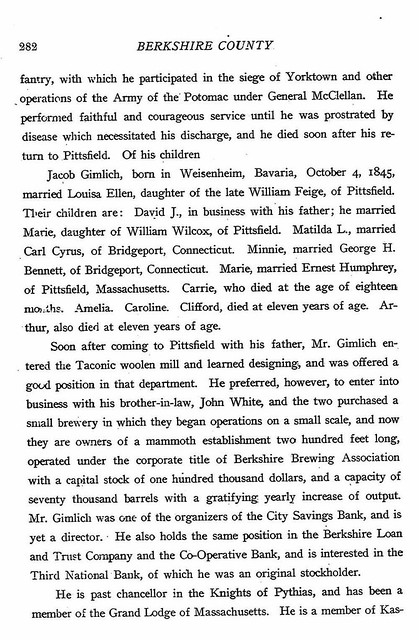
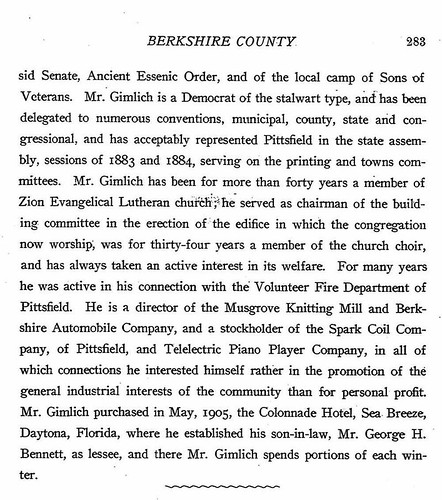
Here’s a history of Gimlich, from “Historic homes and institutions and genealogical and personal memoirs of Berkshire County, Massachusetts,” published in 1906:

Here’s a story of the brewery iBerkshires.com:

One can only wonder what John White and Jacob Gimlich would have thought as federal officers poured 15,000 gallons of locally crafted beer into the sewer on an early May morning in 1922.

Gimlich and his brother-in-law White had first purchased a small brewery on Columbus Street in 1868 from Michael Benson. First called simply “Jacob Gimlich & John White,” the business began at an output of just six barrels a day, but would grow to be a major manufacturer in the West Side Pittsfield neighborhood.

Both men had immigrated to the country from Germany in their youth, and both served tours in the Civil War. Gimlich worked briefly for the Taconic Woolen Mills before going into the beer business with his sister Rachel’s husband.

By 1880, operating as Gimlich, White & Co., the brewers erected a much larger facility in a five-story brick building measuring 40 by 80 feet. The expanded plant employed from 15 to 20 men and was shipping about 16,000 barrels a year.

Gimlich and White built houses directly across the road from their plant on John Street, and as their fortunes grew became increasingly prominent members of the community. Gimlich in particular became enmeshed in a variety of financial and civic affairs. From 1884-1885, he served as the city’s representative in the Legislature, and was one of the organizers and directors of City Savings Bank. Gimlich likewise served on the board of the Berkshire Loan and Trust Co. and of the Co-Operative Bank, was a past chancellor of the local lodge, Knights of Pythias, and member of the Grand Lodge of Massachusetts and of the local Sons of Veterans.

“Pittsfield has been pleased with the success of Gimlich & White and they are counted among the town’s leading, liberal, and most public spirited citizens,” states one Pittsfield Sun editorial of the time.

By the early 1890s the torch was being passed to the next generation, with sons David Gimlich along with Fred and George White taking on more leadership of the company when it reincorporated as Berkshire Brewing Association in 1892. An additional four-story building was added, with the brewing complex now taking up the full block along Columbus Avenue between Onota and John Street to Gilbert Avenue.

Among Berkshire Brewing’s most popular products were Mannheimer Lager Beer, Berkshire Pure Malt Extract, Lenox Half Stock Ale, and Berkshire Pale Ale, considered to be one of the finest India pale ales then on the market. The plant also churned out bottled mineral waters, ginger ale and other soft drinks.

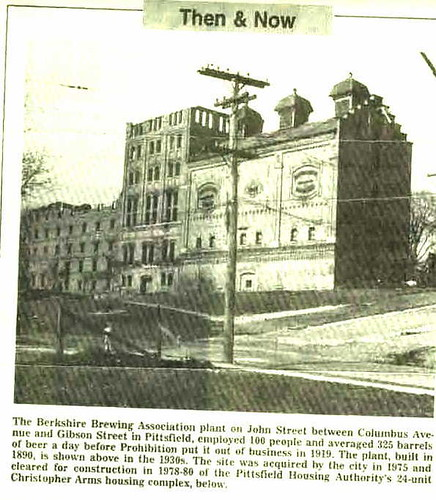
The elder Gimlich and White passed away in 1912 and 1916, respectively, but the enterprise they founded continued to see steady growth. The only brewery of the kind within 50 miles of Pittsfield, Berkshire Brewing Association had something of a monopoly in the region, along with a thriving distribution throughout the east coast as far south as the Carolinas. At its peak, it employed 150 workers and put out 75,000 to 100,000 barrels worth of beer annually. Records indicate between 1910 and 1920, Berkshire Brewing Association paid $1 million in federal taxes, in addition to state and local taxes and fees, including $1,200 a year for a brewer’s license and $800 for an annual bottling license.

The company was not without its occasional hiccups, such as a lengthy strike in the fall of 1911 by the Pittsfield Brewers Union, culminating in the reinstatement of a dismissed employee.

Real crisis came at the end of the decade, as increasing restrictions on alcohol grew into total national prohibition. They first ceased brewing beer temporarily in December 1918, after a directive from the National Food Administration following the passage of the the Wartime Prohibition Act. Even after the passage of the Volstead Act the following fall, BBA voted to remain in business, focusing on bottled soft drinks while hoping the ban to be a brief legislative phase.

They also continued to brew beer, as did several major brewers throughout the country at first, seeing the government’s lack of resources tasked to enforce the rule. Finally in spring 1922, federal officers arrived to turn off the taps, disposing of 15,000 gallons worth and estimated $15,000 to $20,000 at the time.

Ironically, the company waited it out until nearly the end of the failed domestic policy, the board of directors voting to close down in January 1929.

The brewery building was dismantled soon after; for a time, the Siegel Furniture Co. operated out of the former bottling building, which later became the Warehouse Furniture Co. In 1975, this, too, was cleared as the land passed to the Pittsfield Housing Authority, which developed the Christopher Arms housing project that occupies the former site of the brewery today.

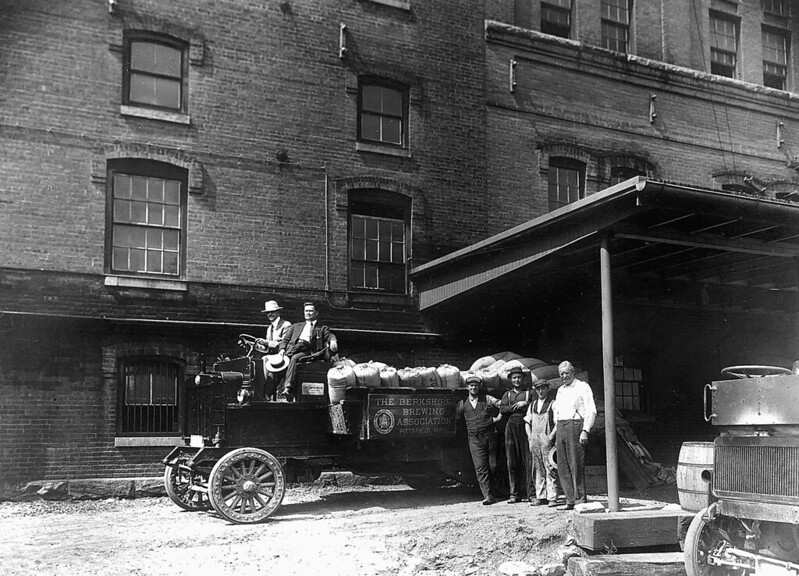
berkshire-beer-truck


A brewery delivery truck around 1905.

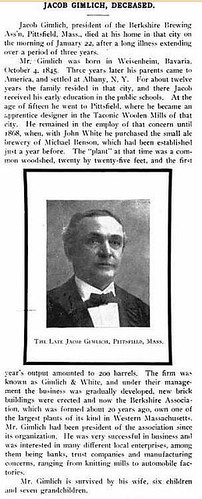
And here’s Gimlich’s obituary:

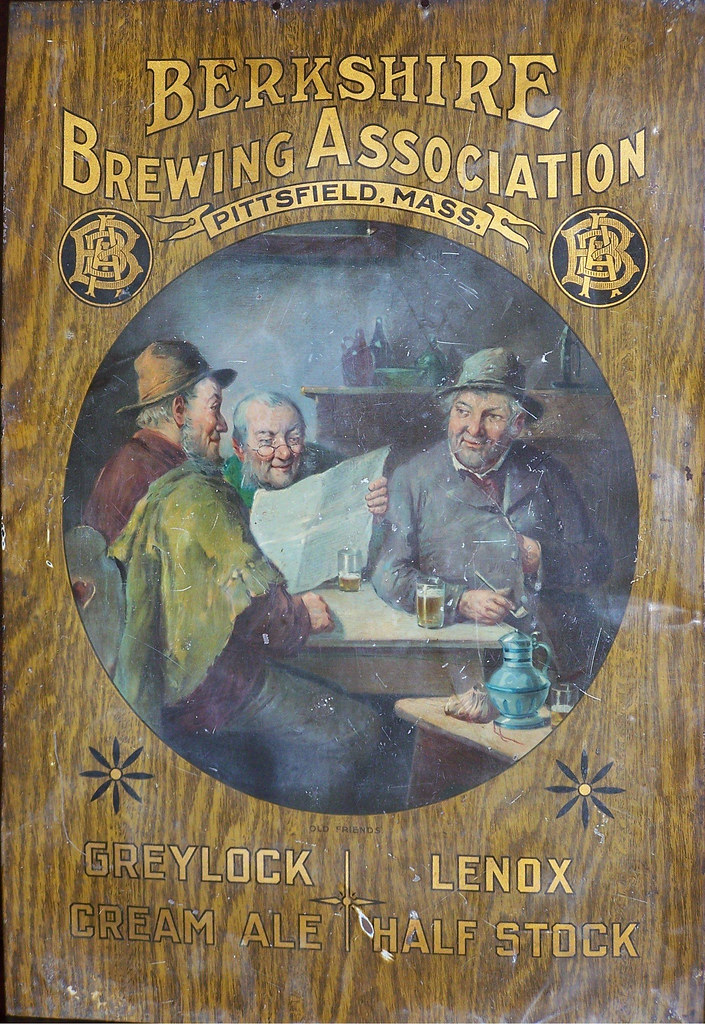
berkshire-brewing-sign

Filed Under: Birthdays, Just For Fun Tagged With: Germany, History, Massachusetts

Beer Birthday: Maureen Ogle

October 4, 2025 By Jay Brooks

Today is the 72nd birthday of historian Maureen Ogle, who wrote Ambitious Brew, which was published in 2006. Her next book was In Meat We Trust, but apparently she’s returning to beer for her next as of yet untitled book. So that’s something to look forward to. I first met Maureen shortly after Ambitious Brew was published when she asked me for some help putting together an invitation list for event at Anchor Brewing, and we’ve been good friends ever since. Please join me in wishing Maureen a very happy birthday.
Me and Maureen at GABF in 2006.
With Jack McAuliffe and Julie Johnson in San Francisco in 2011.
With Bryan Roth.
Charlie Papazian and Maureen.

Filed Under: Birthdays, Just For Fun Tagged With: Iowa, Writing

Beer In Ads #5095: Couple With Bock Beer

October 3, 2025 By Jay Brooks

Last year I decided to concentrate on Bock ads. Bock, of course, may have originated in Germany, in the town of Einbeck. Because many 19th century American breweries were founded by German immigrants, they offered a bock at certain times of the year, be it Spring, Easter, Lent, Christmas, or what have you. In a sense they were some of the first seasonal beers. “The style was later adopted in Bavaria by Munich brewers in the 17th century. Due to their Bavarian accent, citizens of Munich pronounced ‘Einbeck’ as ‘ein Bock’ (a billy goat), and thus the beer became known as ‘Bock.’ A goat often appears on bottle labels.” And presumably because they were special releases, many breweries went all out promoting them with beautiful artwork on posters and other advertising.
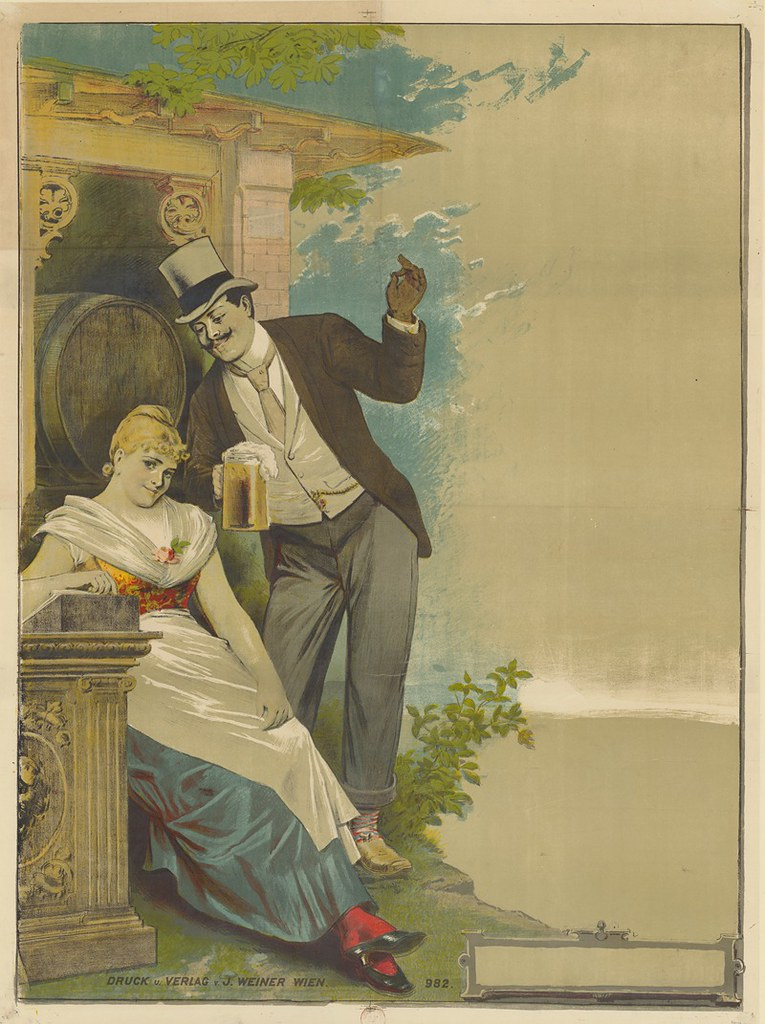
Thursday’s work is for an unknown Bock Beer, which was created around 1890-1900. This one was for an unknown brewery in Austria, or at least it was created in Austria. The artist who created this poster was J. Weiner, a prominent graphic designer who was also from Austria, and always used his first initial only.

Filed Under: Art & Beer, Beers, Just For Fun Tagged With: Advertising, Austria, Bock, History

Historic Beer Birthday: Fred Horix

October 3, 2025 By Jay Brooks

akron
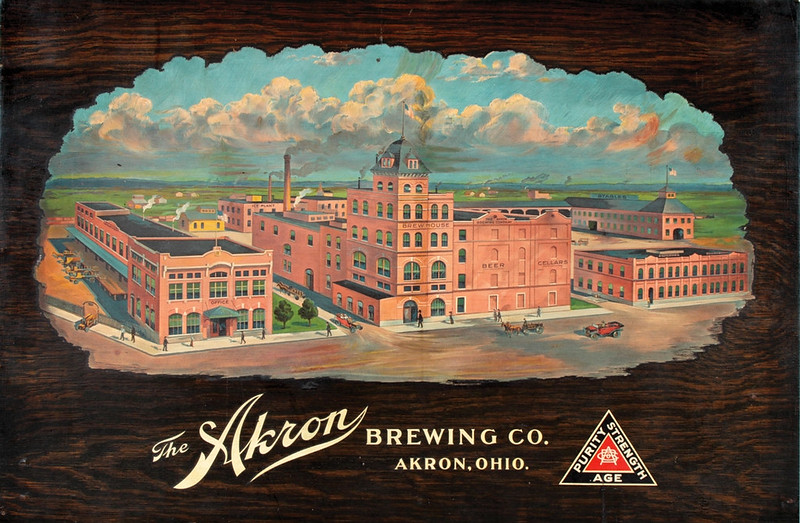
Today is the birthday of Fred Horix (October 3, 1843-1929+?). Horix was born in Hesse-Darmstadt, Germany, but came to America in 1868, eventually settling in Akron, Ohio. In 870, he and John Kirn formed the Fred Horix & John Kirn Brewery, and three years later he bought out Kirn, renaming it the Fred Horix Brewery. Unfortunately, the brewery closed in 1879. Horix then bought another brewery which he named the Frederick Horix Brewery, but a decade later he sold it to George J. Renner. He later became part-owner of the Akron Brewing Co., along with over 50 local saloonkeepers, and spent the remainder of his career as its Vice-President. Unfortunately, there’s not much biographical information I could find on Horix, not even his date of death or a photo.

Akron-Brewing-Company-lg

After his first brewery closed, he bought another, as detailed in “Brewing Beer In The Buckeye State, Volume I” by Dr. Robert A. Musson:

At this point, [brewery owner Frederick] Oberholtz found himself $30,000 in debt to several parties, and he subsequently lost ownership of the plant. The brewery changed hands twice more while sitting idle, until September 1876, when it was purchased by John A. Kolp. He operated it briefly before defaulting on several loans himself. It was then sold at a sheriff’s auction in January 1879 to Fred Horix, for $8,334, or two-thirds of its appraised value. Oberholtz later moved to Kansas City for a time before returning to Akron, where he died of consumption in 1888.

Horix had successfully operated a small brewery on East Exchange St. for several years. When he took ownership of this plant, it consisted only of an icehouse, a small storage building, and the main brewhouse with a potential annual capacity of 20,000 barrels. Horix was immediately able to invest a significant amount of money into the plant, and brewing operations began again by mid-1879.

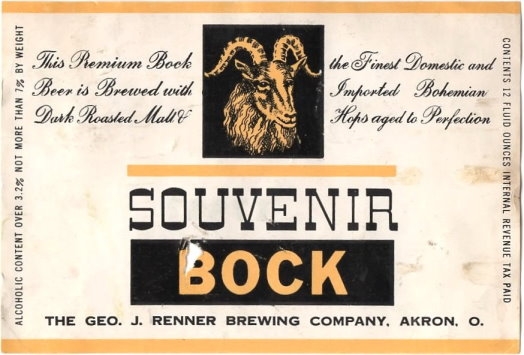
Souvenir-Bock-Beer-Labels-Geo-J-Renner-Brewing-Company

Just one year later, in August 1880, a second fire struck the plant. Beginning late at night in the boiler room, it quickly spread through the plant. Horix, who lived in a house next door to the plant, saw the fire and ran up the Forge Street hill in his nightclothes to the nearest firebox a half mile away. Despite a rapid response by the fire department, the top two floors of the plant were gutted, with a loss of nearly $12,000. This time, however, the plant was fully insured, and was quickly rebuilt.

Within several years, the plant had increased in size to seven buildings, and annual production had increased to nearly 7,000 barrels; the brewery was finally operating at a profit. In 1888, however, Horix chose to sell the plant for $45,000 to George J. Renner. The deed of transfer mentioned that while Renner would take ownership of the entire plant and house, Horix would retain his personal records, family furniture, and “a spotted horse called Dick”. Horix then spent a year in Germany before returning to Akron, where he was involved in several different business ventures before opening a delicatessen on South High St. After the turn of the century, he would return to the brewing business, becoming involved with the newly formed Akron Brewing Company.

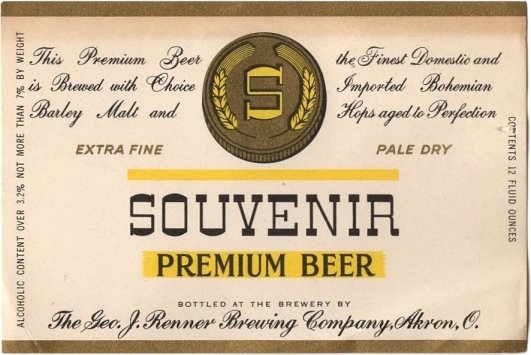
Souvenir-Premium-Beer-Labels-Geo-J-Renner-Brewing-Company
And his final job was with the Akron Brewing Co., again told in “Brewing Beer In The Buckeye State, Volume I” by Dr. Robert A. Musson:

At the outset of the twentieth century, the predominant trend in the brewing industry was toward the formation of stock companies, many of which were operated by local saloon owners. The Akron Brewing Company began as one of these, when in October 1902, approximately fifty saloonkeepers from the Akron area banded together to create a new brewery in the city. Many of them had argued for years that the prices they had to pay for beer from the existing breweries were too high, which made it more difficult to realize a profit. Therefore, with the creation of their own company, they would have a guaranteed supply of beer at a reasonable cost. It was also assumed that many of the 250 saloons in Summit County would also patronize this new establishment.

The new company was incorporated in April 1903, with a capital stock of $200,000. The initial president was John Koerber, the owner of the Bank CafÈ in downtown Akron, and who had previously been involved with the formation of other brewery stock companies elsewhere before coming to Akron. Vice-president was Fred Horix, who had previously operated a small brewery on East Exchange Street, as well as what was now known as the Renner brewery on North Forge Street. A native Prussian, he had more experience with the brewing of beer than anyone else in the group, and was currently the operator of a small delicatessen and saloon on South High Street.

The company’s treasurer was John Lamparter, a local real estate dealer and owner of the Palace Drug Store. Secretary and general manager was F. Wm. Fuchs, the proprietor of the Buckeye Supply House, who had previously been an Akron agent for the L. Schlather Brewery of Cleveland. Other initial directors included John Backe, Ed Kearn, Christian Koch, Jacob Gayer, Adolph Kull, George Good, William Evans, Frank Selzer, William Carter, Sam Woodring, Ed Curran, and brothers Jacob, John, and Louis Dettling, all of whom were local businessmen or saloon owners.

Construction of a new modern brewery building, costing $150,000, began in September. The site was at 841-869 South High St., at the corner of Voris St., although High St. was renamed South Broadway in later years. This new plant, made primarily of steel, was considered to be fireproof and it contained storage cellars that were made of enameled steel. Eliminating wood from the storage vats meant no need for frequent varnishing, and the beer would never taste like wood. The plant’s five-story brewhouse initially had an annual capacity of 30,000 barrels, but it could be enlarged to 100,000 barrels if necessary.

The plant’s brewmaster was John Hau, and his first brew took place on February 24, 1904. Three months later, White Rock Export Beer made its debut in the Akron market. In addition to sales in many local saloons, the beer was also bottled and marketed heavily for home consumption, the latter being an emerging trend in the industry at the time. A decade later, Wurzburger Beer would make its appearance as an alternative to White Rock.

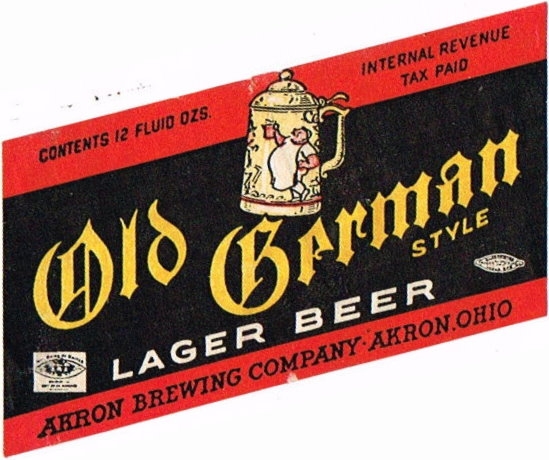
Old-German-Lager-Beer-Labels-Akron-Brewing
In 1906, Koerber sold his share in the company and was subsequently replaced by John Backe, another saloon owner. Koerber then moved to Ionia, Michigan, where he purchased and rebuilt a small local brewery that had recently burned. The rebuilding was successful, but when the county voted itself “dry” by local option in 1909, the business collapsed, and Koerber was ruined. He died of kidney disease just two years later. His family remained in the business, however, later operating the Koerber Brewing Co. in Toledo and two breweries in Michigan after Prohibition ended.

By 1911, Louis Dettling had become president of the brewery. With his brothers Jacob and John, Dettling was the proprietor of The Rathskeller, a prominent restaurant and tavern in downtown Akron. When Louis died in 1917, he was replaced as president by his brother Jacob. Also joining the company during this period was new master brewer Ernst Hafenbrack. He was replaced shortly thereafter by Walter Gruner, who would eventually become the company’s president in 1921 upon the death of Jacob Dettling.

In 1913 came the appearance of the Diamond Land and Improvement Co., a real estate development company owned by the brewery’s stockholders. It began as a management office for the 82 saloons in Akron that were owned by the brewery, although other non-saloon properties were later acquired by the company.

Despite indications that Prohibition was inevitable, the company undertook a major ex-pansion in late 1916, building a large new four-story brewhouse and expanding the cellars into the original brewhouse. This radically changed the appearance of the plant, as it lost a great deal of the original ornate architecture. Soon after this, the company’s capital stock was increased to $400,000.

When statewide Prohibition took effect in May 1919, the company reincorporated as the Akron Beverage and Cold Storage Co., with capital stock of $500,000. This would continue to produce White Rock Cereal Beverage, with less than 0.5% alcohol, as well as a new cereal beverage known as Tiro, which apparently met with disappointing sales, as it did not last for long. In addition, the original bottling house was converted into the new White Rock Dairy, producing a wide range of dairy products. Walter Gruner remained president of the company until 1923, when he was replaced by Fred W. Fuchs, son of F. Wm. Fuchs, one of the company’s original officers. Fred had begun working for the brewery in 1914 upon graduating from nearby Buchtel College, later known as the University of Akron.

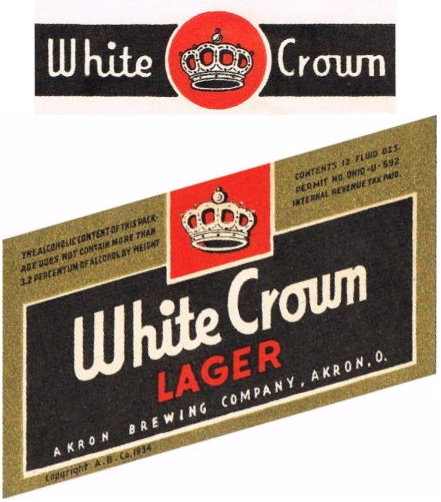
White-Crown-Lager-Beer-Labels-Akron-Brewing-Company

Filed Under: Birthdays, Breweries, Just For Fun Tagged With: Germany, History, Ohio

Historic Beer Birthday: F.D. Radeke

October 3, 2025 By Jay Brooks

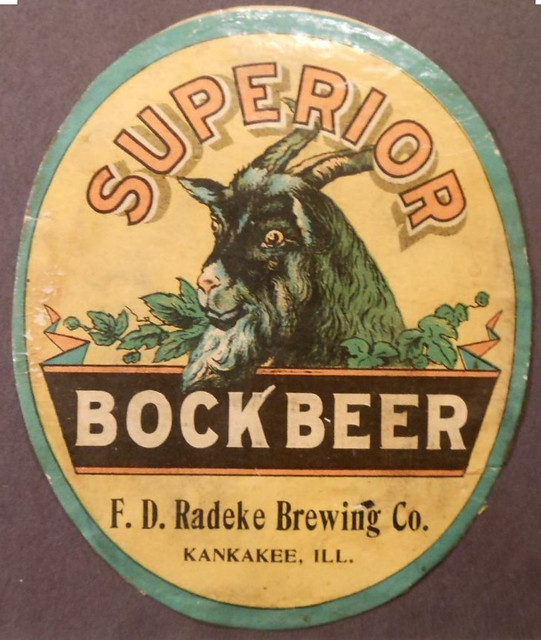
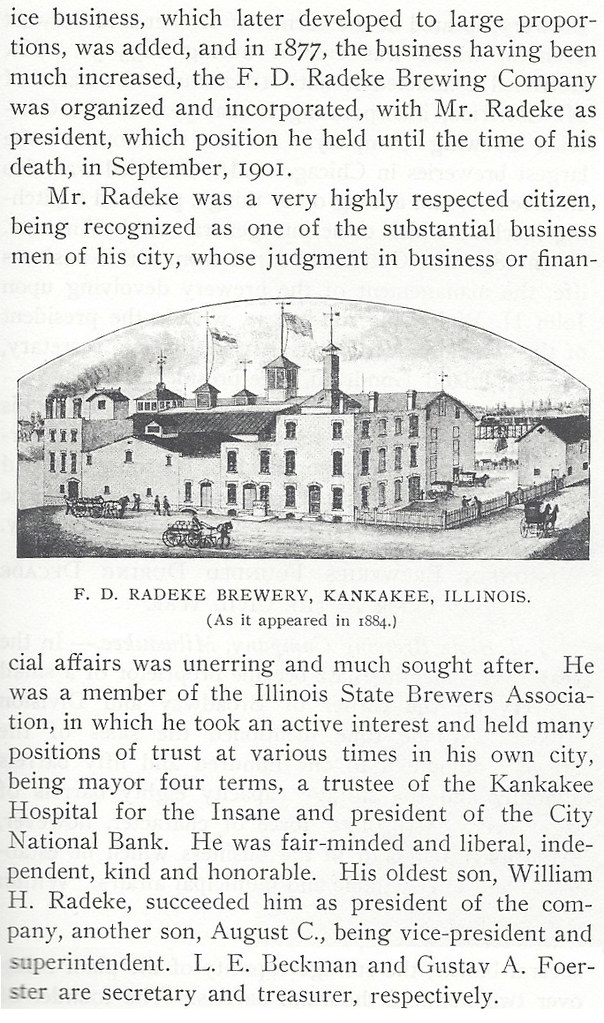
Today is the birthday of Frederick D. Radeke (October 3, 1843-September 24, 1901). He was born in Oyle, Hanover, Germany, but came to America when he was 24, in 1867, settling in Kankakee, Illinois. He initially became a grocer, but when it burned down, he joined his brother-in-law in the brewery business he’d bought, and by 1873 it had been reorganized as the F. D. Radeke Brewing Co. It was closed by prohibition, reopened under a series of names after repeal, but closed for good in 1937.

Frederick-D-Radeke-portrait

This obituary is from “The Kankakee Daily-Journal,” dated November 29, 2016.

Frederick Radeke moved to Kankakee in 1867. The previous year his sister, Margaret Radeke Beckman and her husband, Fredrick, bought the Riverside Brewery. Radeke quickly became involved in the local business community.

Within a year, he had purchased a grocery store on Court Street, opened a billiards parlor and set up a bottling works to produce ginger ale and carbonated water. Shortly after fire destroyed both his store and billiards parlor in 1870, Radeke joined Beckman in the brewery operation. In 1873, the Riverside Brewery was reorganized and renamed as the F.D. Radeke Brewing Company.

During the first two decades of the 20th century, the brewery was highly successful. In the year 1913, for example, a workforce of 125 people produced 40,000 barrels of beer, and the bottling department filled and capped 30,000 bottles per day. Radeke brewed bottles of beer with names such as Wiener Export and Royal Pale. F.D. Radeke Brewing Company advertised itself as “Brewers and Bottlers of High Grades of Beer.”

On Jan. 1, 1920, brewing of Radeke beer came to a halt because of the Volstead Act. After Prohibition the brewery reverted from root beer back to regular beer, but never recovered from the years of Prohibition and eventually closed in 1936.

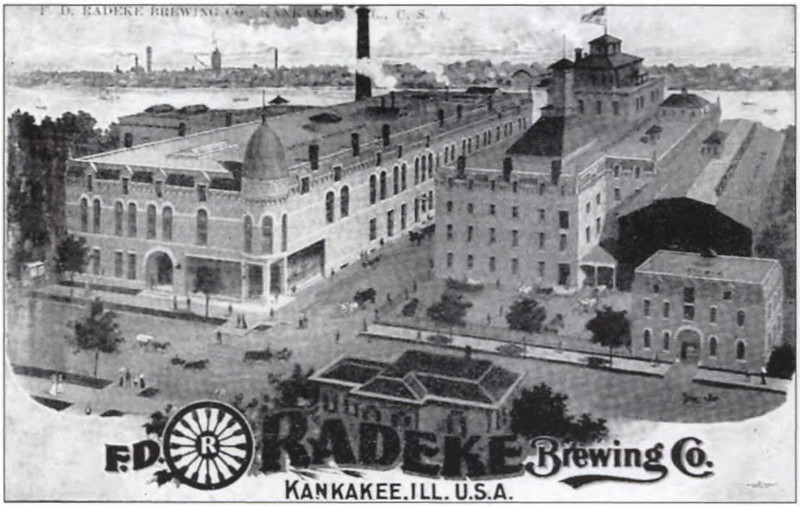
Radeke-postcard

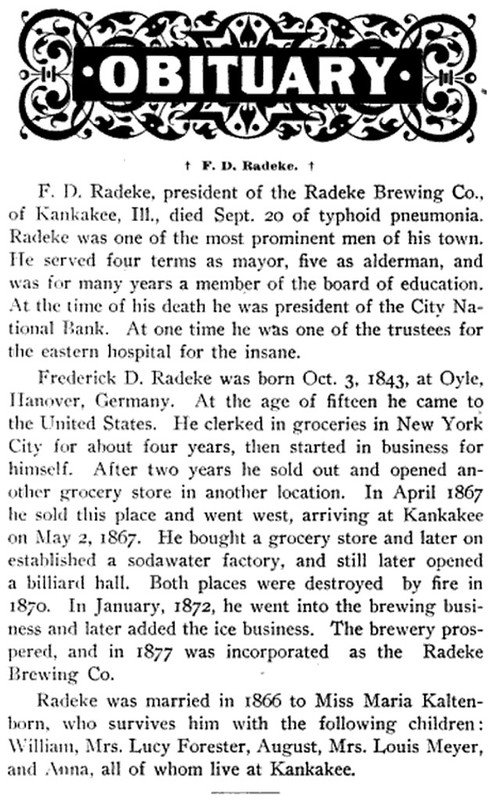
And here’s another obituary, this one from the American Brewers’ Review:

Radeke-brewery-workers
F.D. Radeke Brewing Co. workers.

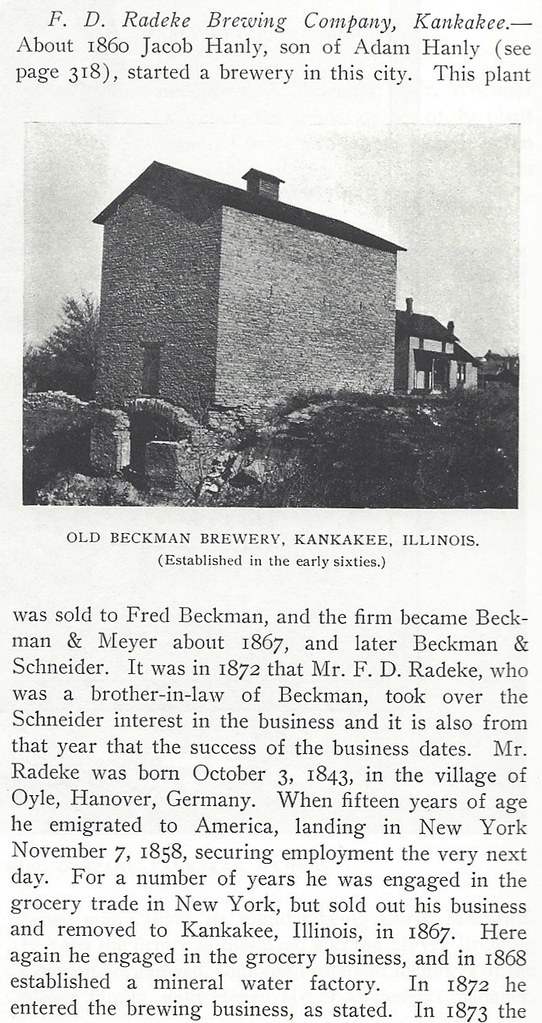
This history of the brewery is from “100 Years of Brewing.”

Radeke-beer-label

FD-Radeke-Brewery-1883

Filed Under: Birthdays, Breweries, Just For Fun Tagged With: Germany, History, Illinois

Historic Beer Birthday: John Gorrie

October 3, 2025 By Jay Brooks

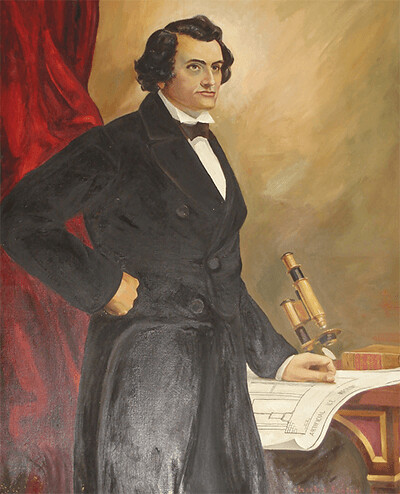
Today is the birthday of John Gorrie (October 3, 1803-June 29, 1855). He “was a physician, scientist, inventor, and humanitarian,” and most importantly, is credited with creating one of the very first refrigerators, an important development for the brewing industry.

Here’s one brief account, from a history of refrigeration on The Sun:

The man credited with developing the first actual “fridge” was an American doctor, John Gorrie, who built an ice-maker in 1844 based on Evans’ work of decades earlier. He also pioneered air conditioning at the same time, since his idea was to blow air across the ice-making machine to cool hospital patients suffering from malaria in Florida.

Gorrie did not make the fortune he deserved. His business partner died and his leaky machines were mocked by the Press and the ice-producing firms to whom he could have been a threat. He died sick and broke aged 51.

Here’s his story from his Wikipedia page:

Since it was necessary to transport ice by boat from the northern lakes, Gorrie experimented with making artificial ice.

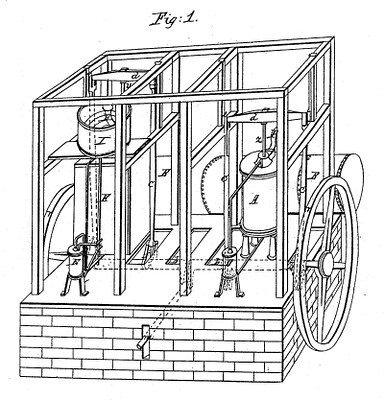
After 1845, he gave up his medical practice to pursue refrigeration products. On May 6, 1851, Gorrie was granted Patent No. 8080 for a machine to make ice. The original model of this machine and the scientific articles he wrote are at the Smithsonian Institution. In 1835, patents for “Apparatus and means for producing ice and in cooling fluids” had been granted in England and Scotland to American-born inventor Jacob Perkins, who became known as “the father of the refrigerator.” Impoverished, Gorrie sought to raise money to manufacture his machine, but the venture failed when his partner died. Humiliated by criticism, financially ruined, and his health broken, Gorrie died in seclusion on June 29, 1855. He is buried in Magnolia Cemetery.

Another version of Gorrie’s “cooling system” was used when President James A. Garfield was dying in 1881. Naval engineers built a box filled with cloths that had been soaked in melted ice water. Then by allowing hot air to blow on the cloths it decreased the room temperature by 20 degrees Fahrenheit. The problem with this method was essentially the same problem Gorrie had. It required an enormous amount of ice to keep the room cooled continuously. Yet it was an important event in the history of air conditioning. It proved that Dr. Gorrie had the right idea, but was unable to capitalize on it. The first practical refrigeration system in 1854, patented in 1855, was built by James Harrison in Geelong, Australia.

And this account, entitled “Dr. John Gorrie, Refrigeration Pioneer,” is by George L. Chapel of the Apalachicola Area Historical Society in Apalachicola, Florida, which is the location of the John Gorrie State Museum:

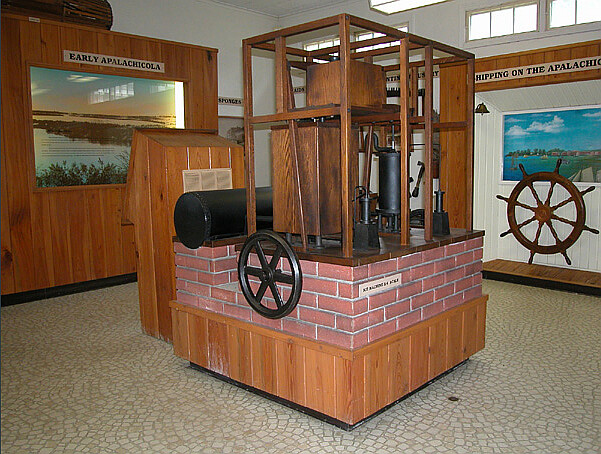
Dr. John Gorrie (1803 – 1855), an early pioneer in the invention of the artificial manufacture of ice, refrigeration, and air conditioning, was granted the first U.S. Patent for mechanical refrigeration in 1851. Dr. Gorrie’s basic principle is the one most often used in refrigeration today; namely, cooling caused by the rapid expansion of gases. Using two double acting force pumps he first condensed and then rarified air. His apparatus, initially designed to treat yellow fever patients, reduced the temperature of compressed air by interjecting a small amount of water into it. The compressed air was submerged in coils surrounded by a circulating bath of cooling water. He then allowed the interjected water to condense out in a holding tank, and released or rarified, the compressed air into a tank of lower pressure containing brine; This lowered the temperature of the brine to 26 degrees F. or below, and immersing drip-fed, brick-sized, oil coated metal containers of non-saline water, or rain water, into the brine, manufactured ice bricks. The cold air was released in an open system into the atmosphere.

The first known artificial refrigeration was scientifically demonstrated by William Cullen in a laboratory performance at the University of Glasgow in 1748, when he let ethyl ether boil into a vacuum. In 1805, Oliver Evans in the United States designed but never attempted to build, a refrigeration machine that used vapor instead of liquid. Using Evans’ refrigeration concept, Jacob Perkins of the U.S. and England, developed an experimental volatile liquid, closed-cycle compressor in 1834.

Commercial refrigeration is believed to have been initiated by an American businessman, Alexander C. Twinning using sulphuric ether in 1856. Shortly afterward, an Australian, James Harrison, examined the refrigerators used by Gorrie and Twinning, and introduced vapor (ether) compression refrigeration to the brewing and meat packing industries.

The granting of a U.S. Patent in 1860 to Ferdinand P.E. Carre of France, for his development of a closed, ammonia-absorption system, laid the foundation for widespread modern refrigeration. Unlike vapor-compression machines which used air, Carre used rapidly expanding ammonia which liquifies at a much lower temperature than water, and is thus able to absorb more heat. Carre’s refrigeration became, and still is, the most widely used method of cooling. The development of a number of synthetic refrigerants in the 1920’s, removed the need to be concerned about the toxic danger and odor of ammonia leaks.

The remaining problem for the development of modern air conditioning would not be that of lowering temperature by mechanical means, but that of controlling humidity. Although David Reid brought air into contact with a cold water spray in his modification of the heating and ventilating system of the British Parliament in 1836, and Charles Smyth experimented with air cycle cooling (1846 – 56), the problem was resolved by Willis Haviland Carrier’s U.S. Patent in 1906, in which he passed hot soggy air through a fine spray of water, condensing moisture on the droplets, leaving drier air behind. These inventions have had global implications.

Dr. Gorrie was honored by Florida, when his statue was placed in Statuary Hall in the U.S. Capitol. In 1899, a monument to Dr. Gorrie was erected by the Southern Ice Exchange in the small coastal town of Apalachicola, where he had served as mayor in 1837, and had developed his machine.

Reportedly born October 3, 1803 in Charleston, South Carolina, of Scots – Irish descent, he was raised in Columbia, S.C. He attended the College of Physicians and Surgeons of the Western District of New York, in Fairfield, New York, from 1825 to 1827. Although the school lasted only a few decades, it had a profound influence, second only to the Philadelphia Medical School, upon the scientific and medical community of the United States in the 19th century. Young Asa Gray, from Oneida County, New York, who by 1848 would be ranked as the leading botanist in the United States, and who in time would become a close friend of Dr. Alvin Wentworth Chapman of Apalachicola, the leading botanist in the South, served as an assistant in the school’s chemical department. In later years, Dr. Gray had distinct recollections of Gorrie as a “promising student.”

Dr. Gorrie initially practiced in Abbeville, South Carolina, in 1828, coming to the burgeoning cotton port of Apalachicola in 1833. He supplemented his income by becoming Assistant (1834), then Postmaster in Apalachicola. He became a Notary Public in 1835. The Apalachicola Land Company obtained clear title to the area by a U.S. Supreme Court decision in 1835, and in 1836 laid out the city’s grid-iron plat along the lines of Philadelphia, Pennsylvania. Gorrie, who served as Vice-Intendant in 1836, and Intendant (Mayor), in 1837, would be an effective advocate for the rest of his life for draining the swamps, clearing the weeds and maintaining clean food markets in the city. He first served as Secretary of the Masonic Lodge in 1835, was a partner in the Mansion House Hotel (1836), President of the Apalachicola Branch Bank of Pensacola (1836), a charter member of the Marine Insurance Bank of Apalachicola (1837), a physician for the Marine Hospital Service of the U.S. Treasury Department (1837 – 1844), and a charter incorporator and founding vestryman of Trinity Episcopal Church, Apalachicola (1837).

Dr. Gorrie married Caroline Frances Myrick Beman, of a Columbia, South Carolina family, the widowed proprietress of the Florida Hotel in Apalachicola, on May 8, 1838. Shortly thereafter, he resigned his various positions in Apalachicola, and the family left the city not to return until 1840. He was named Justice of the Peace in 1841, the same year that yellow fever struck the area.

Mal-aria, Italian, “bad air”, and yellow fever, prevailed in the hot, low-lying, tropical and sub-tropical areas where there was high humidity and rapid decomposition of vegetation. Noxious effluvium, or poisonous marsh gas was thought to be the cause. The “putrid” winds from marshy lowlands were regarded as deadly, especially at night. The specific causes were unknown, and although one had quinine for malaria, the gin and tonic of India, there was no cure nor preventive vaccine, for yellow fever. The legendary Flying Dutchman was founded on the story of a ship with yellow fever onboard.

Malaria would start with shaking and violent chills, followed by high fever, and a drenching sweat. Insidious, it could recur in the victim as well as kill. Yellow fever did not recur; one either died or survived. It came in mysterious, vicious waves, killing anywhere from 12 to 70 percent of its victims. It started with shivering, high fever, insatiable thirst, savage headaches, and severe back and leg pains. In a day or so, the restless patient would become jaundiced and turn yellow. In the terminal stages, the patient would spit up mouthfuls of dark blood, the terrifying “black vomit” (vomito negro), the body temperature would drop, the pulse fade, and the comatose patient, cold to the touch, would die in about 8 to 10 hours. So great was the terror, that the victims would be buried as quickly as possible. Areas would be quarantined, and yellow flags flown. Gauze would be hung over beds to filter air; handkerchiefs would be soaked in vinegar; garlic would be worn in shoes. Bed linens and compresses would be soaked in camphor; sulfur would be burned in outdoor smudge pots. Gunpowder would be burned, and cannons would be fired. And, later, when it was over, the cleaning and fumigating would occur.

It would not be until 1901 in Havana, Cuba, that Drs. Walter Reed, Carlos Finlay and William Crawford Gorgas, with others, would demonstrate conclusively that the Aedes Aegypti, or Stegomyia Fasciata mosquito was the carrier of the yellow fever virus. It would be about the same time that the English physician, Sir Ronald Ross in India, would correctly identify the Anopheles mosquito as the carrier of the malaria protozoa. As early as 1848, in Mobile, Alabama, however, Dr. Josiah Nott first suggested that mosquitos might be involved. The yellow fever epidemic of 1841, and the hurricane and tidal wave, known locally as the “Great Tide” of 1842, destroyed Apalachicola’s rival cotton port of St. Joseph some thirty miles to the west on the deep water sound of St. Joseph’s Bay. Using Florida’s first railway (1837) to transport cotton from the Apalachicola River, St. Joseph had hosted Florida’s Constitutional Convention in 1838.

Dr. Gorrie became convinced that cold was the healer. He noted that “Nature would terminate the fevers by changing the seasons.” Ice, cut in the winter in northern lakes, stored in underground ice houses, and shipped, packed in sawdust, around the Florida Keys by sailing vessel, in mid-summer could be purchased dockside on the Gulf Coast. In 1844, he began to write a series of articles in Apalachicola’s “Commercial Advertiser” newspaper, entitled, “On the prevention of Malarial Diseases”.

He used the Nom De Plume, “Jenner”, a tribute to Edward Jenner, (1749 – 1823), the discoverer of smallpox vaccine. According to these articles, he had constructed an imperfect refrigeration machine by May, 1844, carrying out a proposal he had advanced in 1842. All of Gorrie’s personal records were accidentally destroyed sometime around 1860.

“If the air were highly compressed, it would heat up by the energy of compression. If this compressed air were run through metal pipes cooled with water, and if this air cooled to the water temperature was expanded down to atmospheric pressure again, very low temperatures could be obtained, even low enough to freeze water in pans in a refrigerator box.” The compressor could be powered by horse, water, wind driven sails, or steampower.
Dr. Gorrie submitted his patent petition on February 27, 1848, three years after Florida became a state. In April of 1848, he was having one of his ice machines built in Cincinnati, Ohio, at the Cincinnati Iron Works, and in Octobcr, he demonstrated its operation. It was described in the Scientific American in September of 1849. On August 22, 1850, he received London Patent #13,124, and on May 6, 1851, U. S. Patent #8080. Although the mechanism produced ice in quantities, leakage and irregular performance sometimes impaired its operation. Gorrie went to New Orleans in search of venture capital to market the device, but either problems in product demand and operation, or the opposition of the ice lobby, discouraged backers. He never realized any return from his invention. Upon his death on June 29, 1855, he was survived by his wife Caroline (1805 – 1864), his son John Myrick (1838 – 1866), and his daughter, Sarah (1844 – 1908). Dr. Gorrie is buried in Gorrie Square in Apalachicola, his wife and son are buried-St. Luke’s-Episcopal Cemetery, Marianna, Florida, and his daughter, in Milton, Florida.

John Gorrie Ice Machine

Filed Under: Birthdays, Just For Fun, Related Pleasures Tagged With: Florida, History, Science, Science of Brewing, Scotland

« Previous Page
Next Page »

Find Something

Northern California Breweries

Please consider purchasing my latest book, California Breweries North, available from Amazon, or ask for it at your local bookstore.

Recent Comments

  • Bob Paolino on Beer Birthday: Grant Johnston
  • Gambrinus on Historic Beer Birthday: A.J. Houghton
  • Ernie Dewing on Historic Beer Birthday: Charles William Bergner 
  • Steve 'Pudgy' De Rose on Historic Beer Birthday: Jacob Schmidt
  • Jay Brooks on Beer Birthday: Bill Owens

Recent Posts

  • Beer In Ads #5205: Moerlein’s Celebrated Bock Beer, An Easy Winner April 5, 2026
  • Historic Beer Birthday: Fritz Funke April 4, 2026
  • Historic Beer Birthday: Herman Zibold April 4, 2026
  • Beer In Ads #5204: Bock Beer! The First Genuine Bock Of The Season April 4, 2026
  • Historic Beer Birthday: Marcus Rapp April 4, 2026

BBB Archives

Feedback

Head Quarter
This site is hosted and maintained by H25Q.dev. Any questions or comments for the webmaster can be directed here.