

Today’s beer video is part two of the film The American Brew that was produced by Anheuser-Busch’s Here’s To Beer campaign in 2008. The DVD is still actually available from Amazon. Enjoy.
Beer In Ads #1059: Bud Sailing

Thursday’s ad is for Budweiser, from either the 1950s or early sixties. Showing two couples sailing, well one of them is, while everybody’s drinking bottles of Budweiser. I always thought bottles weren’t allowed on boats; shouldn’t they be drinking from cans? But I love this copy. “An off-shore breeze, cool spray on your face, the swirl of water slushing in her wake. On sailing days like this, you’ll find Budweiser an ever welcome addition to your crew. Lift its foaming, bubbling goodness to your lips and each sip will tell you ….”

Moderation Is Better Than Abstinence

I’ve long believed that AA, while obviously effective for some, is not the only way to treat problem drinking. Especially given that drinking moderately can increase one’s longevity over those who abstain, I’ve always believed that a better goal would be to take people who can’t moderate their drinking and teach them how to do just that. That’s an approach often taken in other countries, but is one that can’t even be discussed here in the U.S. without an uproar from the addiction community and the anti-alcohol wingnuts. Several years ago, I wrote about this in a long post entitled Tipping The Sacred Cows Of Addiction. And Adi Jaffe, Ph.D. echoed the same sentiment in All About Addiction, a piece for Psychology Today.
The New York Times published an op-ed piece on New Year’s Day entitled Cold Turkey Isn’t the Only Route. In it, author Gabrielle Glaser also noted how entrenched Americans are in abstinence as the only cure for alcoholism.
The cold-turkey approach is deeply rooted in the United States, embraced by doctors, the multibillion-dollar treatment industry and popular culture. For nearly 80 years, our approach to drinking problems has been inspired by the 12 steps of Alcoholics Anonymous.
Developed in the 1930s by men who were “chronic inebriates,” the A.A. program offers a single path to recovery: abstinence, surrendering one’s ego and accepting one’s “powerlessness” over alcohol.
Despite the fact that studies have shown that AA doesn’t work, it’s undoubtedly the dominant treatment method in America. So much so, that most people do in fact believe that if you’re an alcoholic you can never ever touch a drop of alcohol for the rest of your life. But the obvious problem with that point of view is that it suggests that a cure is not only difficult but actually impossible. Because learning to deny yourself something you have trouble moderating is hardly a cure. It’s a band-aid at best that may remove some of the negative aspects of one’s drinking problem, but being based on the concept of “powerlessness” means not only giving up on yourself but it actually removes any possibility of real help. It’s a bad bargain, in my opinion. But that’s where the money is, sad to say. Addiction clinics, retreats, programs, along with insurance companies, etc. don’t make their money by curing people, they make money by treating them. And if the treatment lasts the rest of their lives, then that’s the best thing for the bottom line.
Despite the dominance of abstinence-based treatments, there are a growing number of alternatives, apparently, including Moderation Management, Moderate Drinking and others. Amazon now lists many books claiming to help people achieve moderate drinking, which is encouraging.
But I love her conclusion. “We don’t treat cancer, depression or asthma with the same tools we used in 1935. We need to get away from the one-size-fits-all approach to drinking problems.” Indeed, A.A. has changed little since its inception, while our understanding of addiction, its underlying causes and the benefits of moderate drinking have all grown immeasurably. It would be great if as a society we could eradicate alcoholism, but we can’t do that by simply burying our heads in the sand and just removing alcohol from the equation. If prohibition taught us anything, it’s that such an approach is doomed to fail. It’s time to change the goal from abstinence, a nation of teetotalers, to a society filled with only moderate drinkers. That would certainly make the world a better place.
Beer Film #2: The American Brew, Pt. 1
Today’s beer video is part one of the film The American Brew that was produced by Anheuser-Busch’s Here’s To Beer campaign in 2008. The DVD is still actually available from Amazon. Enjoy.
Beer In Ads #1058: A New Year’s Resolution That A Man Can Keep
Wednesday’s New Year’s ad is for Guinness, from 1935. A glass of Guinness every day, that’s all they ask. I suppose there’s worse ways to spend a year.

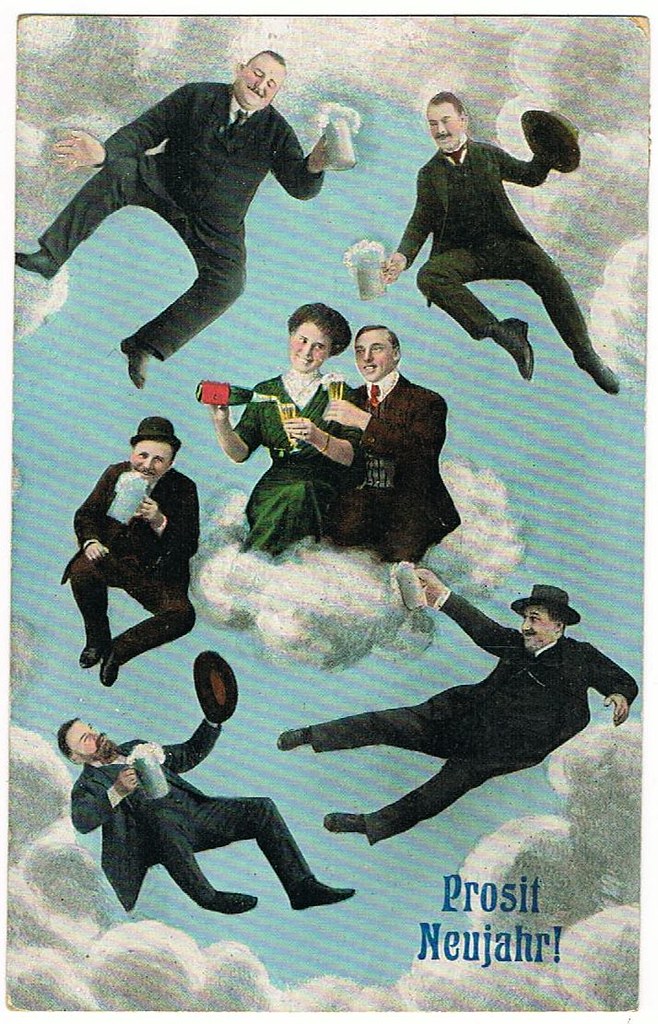
Prosit Neujahr

Prosit Neujahr, or Happy New Year, from an old German postcard circa 1916. Wishing you and yours a very good 2014.
Beer Film #1: As We Like It
This year I decided to feature a new video about beer each day. Today’s beer video is from 1952 and was sponsored by the United States Brewers Foundation. The ten-minute film, As We Like It, is a fun little overview of beer’s history and its positive aspects.
Beer In Ads #1057: Party With Mathäser-Bräu
Tuesday’s ad is for Mathäser-Bräu, from 1928, a Berlin brewery and the operator of the city’s largest beer hall in their heyday. They were bought by Löwenbräu in 1907. It looks like it must have one decadent New Year’s Eve party.

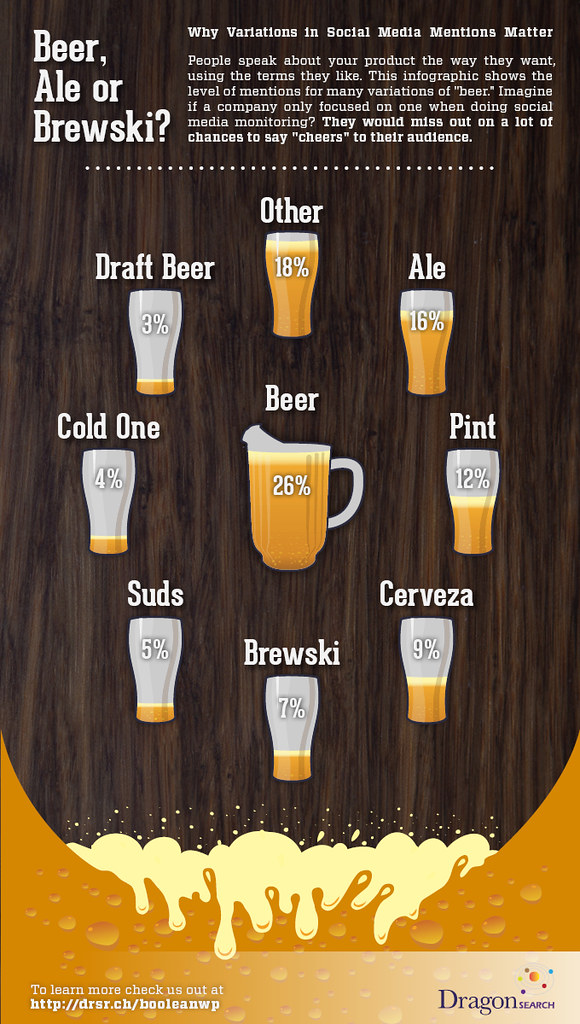
Beer, Ale Or Brewski?

Today’s, and indeed this year’s, final infographic is entitled Beer, Ale or Brewski? Created by Dragon Search Marketing, it shows the most common terms used to refer to beer by people using social media, and the popularity of each of them. I set out at the beginning of 2013 to see if I could post a new infographic every day, and it turned out to be easier than I anticipated. Certainly, they ranged in quality quite a bit. Some were truly epic while others were filled with errors, somewhat unattractive or even truly awful. Oh, well. It was fun. Happy 2013 everybody. See you next year, wehn I’m sure you’ll be able to find me drinking a beer, an ale or even a brewski.
Good News From Monitoring The Future

Here’s one story you won’t likely see spread by Alcohol Justice or any of the other prohibitionist organizations. Since 1975, the National Institute on Drug Abuse (NIDA), a division of the National Institutes of Health (NIH), has done a survey of “drug, alcohol, and cigarette use and related attitudes among adolescent students nationwide.” This year, “45,449 students from 395 public and private schools participated” in the annual Monitoring the Future survey, which is conducted by the University of Michigan.
This year’s findings, at least in regards to alcohol, are encouraging, according to the survey’s authors, as detailed in their Monitoring the Future Survey, Monitoring the Future Survey, Overview of Findings 2013.
5-year trends continue to show significant decreases in alcohol use among all grades and across nearly all prevalence periods. For example, from 2008 to 2013, current use of alcohol declined from 15.9% to 10.2% among 8th graders, from 28.8% to 25.7% among 10th graders, and from 43.1% to 39.2% among 12th graders. From 2012 to 2013, decreases were observed in binge use of alcohol (defined as five or more drinks in a row in the last 2 weeks) among 10th graders, with a 5-year trend showing a significant decrease in all three grades.
That, in fact, has been the trend over the past few years.
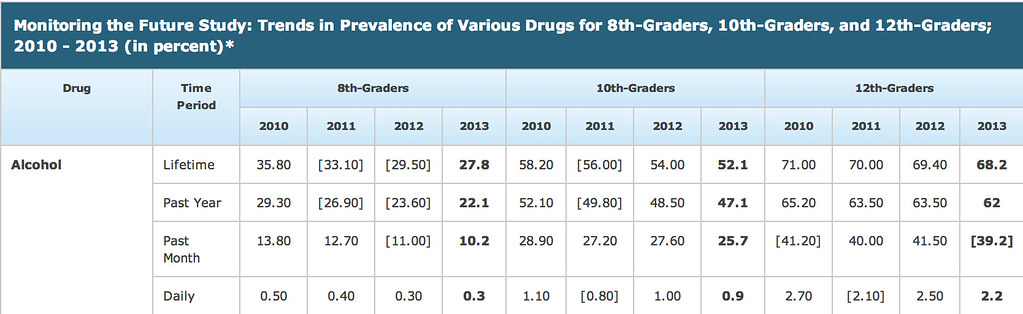
They’re more concerned about the use of prescription drugs among our nation’s youth, along with pot and smoking tobacco in a hookah, all of which are on the rise. But I don’t hear the prohibitionists trying to remove prescription drugs from the marketplace on the off chance kids could get their hands on them. I haven’t heard them trying to restrict Viagra or other legal drug ads because kids might see them, or restrict the displays and shelves of drugs because the kiddies might walk by and see them, and in seeing them they would undoubtedly want them, not being able to help themselves. It sounds silly doesn’t it, but that’s the general argument the prohibitionists use to argue against beer ads and beer on store shelves where children might see them.
But while they’ve been incessantly claiming beer ads make kids start drinking and responsibility efforts by the alcohol companies don’t work and all of us in the beer world are the spawn of satan, kids have been drinking less and less, year after year. You’d think that it would be cause for celebration by the groups that are working tirelessly to punish the alcohol companies for their wickedness and claim to want to put a stop to underage drinking. But that might put a dent in their fundraising efforts, so that, I believe, is why you’ll never see a positive story from a prohibitionist organization.