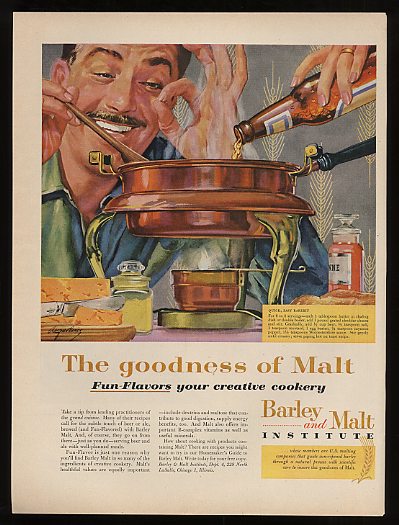
Wednesday’s ad is for Schlitz Malt Liquor, from — guessing by the pull-tab — around the 1960s or early 70s. The bull logo and the skirt design around the bottom look positively Aztec. But the bull in the ad, he just looks mad.

By Jay Brooks
By Jay Brooks
![]()
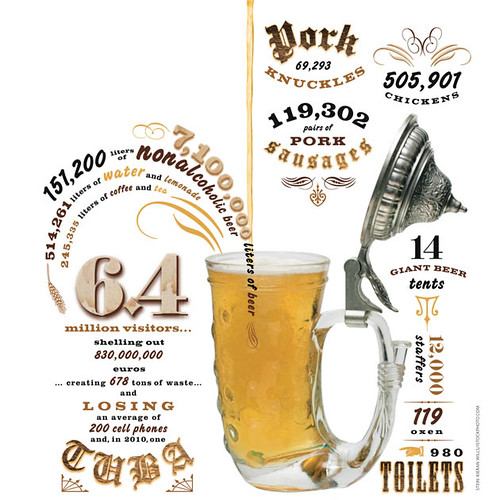
Today’s infographic is a series of them done for a Spanish brewery, Cervesa Moritz. Today is also the beginning of La Tomatina, which takes place each year on the last Wednesday of August in Bunol, Spain. La Tomatina is essentially the world’s biggest food fight, so it seemed the perfect day to feature posters from Spain. They were created by Brands & Roses, a Spanish ad agency in 2011. A total of six were apparently done, and there are three shown below. You can see more of the project at Relaja Elcoco.

Click here to see the infographic full size.

Click here to see the infographic full size.

Click here to see the infographic full size.
By Jay Brooks

Tuesday’s ad is for Grain Belt, from 1953. According to the ad, Grain Belt is “America’s Party Beer.” But my favorite part of the ad copy is that Grain Belt is also a “friendly” beer, a term common in 1950s advertising. So if you want to have a kick ass party, you’ll need “the friendly Beer with the friendly flavor.”

By Jay Brooks

For a number of years, Whole Foods Market has carried a decent selection of craft beer and better imports, and has been steadily increasing their commitment to good beer. They have an especially decent selection for a national chain. Last week, they announced that they were taking it one step father, and opening a “6,000-square-foot, two-story craft beer brewery and tap room,” according to a story in the Silicon Valley Business Journal. This will be their first grocery store to include a brewery. The 27,291-square-foot grocery store where the brewery will occupy the rooftop, will be located at 700 The Alameda in San Jose. The company broke ground on Wednesday, and expects to include “a wall for growing hops.” The San Jose Whole Foods & Brewery is expected to open in the summer of 2014.

By Jay Brooks

Today’s infographic is a chart for pairing cheese with beer, and other alcohol, put together by Artisanal Premium Cheese, with four basic kinds of cheese and some general suggestions. Offhand, their suggestions actually aren’t that sound. If there’s anything I’ve learned about pairing cheese and beer, it’s that you can’t really make generalities. They also have a plate and pairings page that attempts to provide more information, but even that seems woefully simplistic. But at least they’re acknowledging that beer and cheese can be paired.
By Jay Brooks

Monday’s ad is an another early ad for the Italian brewery Birra Pedavena, which closed in 1937, but reopened again in 1998 as La Bierreria Pedavena. The man struggling with the giant beer glass looks to me like he might be King Gambrinus.

By Jay Brooks

Working on another project, which I can’t yet talk about, I used some research I did for an article a few years ago about some of the gods and goddesses of beer and brewing, and ended up digging a little deeper. In the process, I put together a long list that’s hopefully, but probably in no way, a complete list of beer gods and goddesses, but is at least the biggest list I know of, with just over one hundred of them. To be fair, I made up one of them, and a couple others are bogus, but there’s still at least 100 remaining that are legitimate. Or at least they’re legitimately deities for some group of people, their connection to beer or alcohol you could question, by why bother? It’s just a bit of fun. Drink a toast to them. Because their followers believed in them, we still have beer to drink today. Enjoy.
If you know of one I missed, please send me an e-mail with as much as information as you can. If I screwed up any of the info here (and I’m confident I must have) please let me know but please bear in mind that this exercise is meant to be celebratory and fun, so please keep it civil, and remember that with ancient legends and history, accounts vary widely and I simply had to choose the stories I liked or which worked best for my purposes. I’ll keep updating the page with new gods or goddesses as I find them, and will make relevant changes that make sense, but not to this post. Instead, the most current and up-to-date version of this list will live on a permanent page, Beer Gods & Goddesses.

Long before the catholic church and related christian religions started declaring beer and brewing saints, many different civilizations and peoples had deities dedicated to beer or brewing, or some related endeavor. Below is a list of the beer gods and goddesses that I know of, along with other mythological creatures or people with an association to beer, brewing or a related aspect. Try as I might, I couldn’t find any gods or goddesses associated with either hops or yeast specifically, probably because by the time we were using them in beer, or had a better understanding of them, civilization was well past creating gods. Perhaps we need to make some up? There are also many more deities associated with water, but it’s unclear if any of them can be linked to brewing water, and many are gods of the sea, which also didn’t seem appropriate. So far, I’ve found over 100 different deities to drink a toast to, celebrate or worship with a glass of beer. If you know of one I’m missing, please drop me a line.


This is an aspect of the Hindu god Shiva, however the one with a nasty temper. Legend has it that Shiva couldn’t handle the idle boasting of Brahma claiming to be the supreme creator, and cut off one of his 5 heads in order to make a point. After, when cooler heads prevailed, Shiva made a remorseful vow of redemption, and was cast out as a beggar under the new guise of Bhairava. He also had the skull of the decapitated head fused to his hand to use as a begging bowl, and a reminder for anger management. Oddly enough the Newar culture of the Kathmandu valley have a unique festival where they set up a large mask of Bhairava to dispense beer from its mouth. This beer is considered sacred, and bestows powerful blessings on whoever manages to get a sip of it.
Holiday: Bhairava Ashtami, 8th lunar day (ashtami) in the fortnight of the waning moon (Krishna paksha) in the Hindu month of Kartik (November 23, in 2013)
Links: Godchecker / Wikipedia

Domestic kobolds are linked to a specific household. A bieresal, kobolds who live in the beer cellars of inns, bring beer into the house, clean the tables, and wash the bottles and glasses. This association between kobolds and work gave rise to a saying current in 19th-century Germany that a woman who worked quickly “had the kobold.” In return, the family must leave a portion of their supper (or beer, for the bierasal) to the spirit and must treat the kobold with respect, never mocking or laughing at the creature. A kobold expects to be fed in the same place at the same time each day. Kobolds bring good luck and help their hosts as long as the hosts take care of them.
I’m not sure, but it sounds like kobolds are mischievous little creatures, and I wouldn’t be surprised they were related to leprechauns.
Holiday: Kobold Luring Day, December 27
Links: Encyclopedia Mythica / Wikipedia


Here’s the Irish Legend of the Dagda’s Harp:
Long ago, the Tuatha de Danaan, supernatural beings, blond and blue-eyed and carrying heavy spears, came from the north to the land known as Ireland. When their king, Nuada, was injured in battle, a man called the Dagda became their new leader.
Like his people, the Dagda possessed magical gifts learned in the northern lands, and though he could sometimes be oafish or silly, he was also a man of immense power and goodness. Among his many possessions were a magic club and a cauldron of abundance known as Undry; this cauldron was a bottomless source of life.
Even more amazing than the Undry was his magical harp. It was among the Dagda’s most cherished possessions, hewn of oak and encrusted with jewels and gold. The harp held exquisite, commanding music. Simply by plucking its strings, the Dagda could create many wonders. He could put the seasons in order; when it was time to fight his enemies, the Dagda plucked the strings of that harp and every warrior was instantly ready for battle, prepared to defend their people.
It wasn’t only a call to battle the Dagda could play upon that harp. When his warriors returned from battles, the Dagda played his harp again. This time the magic music soothed every wound. Men forgot their injuries and their sorrows. They let every woe vanish in the mist. As the music of healing played, the warriors thought not of suffering but of honor and of the love they had for their children and wives and for their friends lost to battle. They remembered glory. They celebrated their king.
And it’s the harp that provided the inspiration for the stringed symbolism so prominent in Irish history, including the Irish coat of arms and the Guinness logo. Although the actual harp was owned by Brian Boru, Ireland’s king from 1002–1014, and today is at Trinity College, Dublin. The Guinness harp faces right instead of left, so it “can be distinguished from the Irish coat of arms.” But all this Harpiness can be traced back to The Dagda.
Holiday: Imbolc (Feast of Brigid), February 1; Féile Pan Cheilteach (or Pan Celtic Festival), April 2-7 (Week after Easter); Guinness Brewery founded, December 31 (1759)
Links: Godchecker / Tell Me A Story / Wikipedia


Ode to Eight Immortal Drinkers by Tu Fu showed a joyful and interesting feast, and described the “eight immortal drinkers” with different characters vividly. There is an ancient saying that: “When two scholars are talking, they are surely exchanging marvelous opinions”. What spectacular event was it when “eight immortal drinkers” gathered together? We can only image such a scene through Tu Fu’s poem. “Eight immortal drinkers” included the poet He Zhizhang, Ruyang Prince Li Jin, Left Prime Minister Li Shizhi, the beauty Cui Zongzhi, the vegetarian Su Jin, Immortal Poet Li Po, the calligrapher Zhang Xu and the master-hand in debating Jiao Sui.
The “eight immortal drinkers” were all celebrities at that time. They may be officials at the same Court, make friends with each other due to poetry or literature, or just find each other congenial. Such feast may be at day or night. They may drink together to their hearts’ content at uninterrupted autumn rain or thunder of spring. Tu Fu recorded such scene by poem, which was passed down to later ages.
Holiday: Feast of Eight Immortal Drinkers, 8th Day of the 8th Lunar Month (September 12, in 2013).
Links: Confucius Institute / Du Fu

They placed food in front of him, they placed beer in front of him; Enkidu knew nothing about eating bread for food, and of drinking beer he had not been taught.
The harlot spoke to Enkidu, saying: “Eat the food, Enkidu, it is the way one lives. Drink the beer, as is the custom of the land.”
Enkidu ate the food until he was sated, he drank the beer — seven jugs! — and became expansive and sang with joy! He was elated and his face glowed. He splashed his shaggy body with water, and rubbed himself with oil, and turned into a human. He put on some clothing and became like a warrior!
You read that correctly. Enkidu drank seven jugs of beer and became human. That must have been some pretty spectacular beer. In the image above, Enkidu is on the left, with his friend Gilgamesh on the right.
Holiday: Feast of Fabulous Wild Men, January 12
Links: Godchecker / Wikipedia


Regardless of who the real Gambrinus was, he is believed to be the inventor of hopped malt beer. Burkart Waldis, a German poet, explained in a 1543 poem that Gambrinus had learned the art of brewing from Isis, the Egyptian goddess of motherhood and fertility.
According to legend, Gambrinus began life in poverty as the apprentice to a glassmaker in the kingdom of Flanders. But he fell in love with his master’s daughter, Flandrine, who rejected him. So he ran away to become a poet and musician, finding renown at both. But while performing one day, he saw Flandrine and began to shake, playing so poorly that his audience chased him away. He ran into the forest, bent on ending his life. But the devil appeared to Gambrinus and offered him a deal. The devil offered to make him forget Flandrine in exchange for getting his soul for thirty years.
Gambrinus accepted the bargain and his passion for Flandrine was replaced by gambling, at which he excelled. He grew rich and once more his thoughts turned to Flandrine. Thinking she might now return his love because of his wealth, she again refused him because no matter how much money he had, he still wasn’t of noble birth. Gambrinus returned to the forest, more determined than ever to take his own life, when again the devil appeared. He chastised Satan for not living up to his end of the bargain. Suddenly, in front of him, a field appeared lined with tall poles with flowing green plants hanging from them that gave off a strong, pleasant aroma. The devil told Gambrinus they were hops and beyond the field was a hophouse and a brewery. “Come on,” said the devil. “I will teach you how to make beer, and you will forget all about Flandrine.”
After learning to brew, Gambrinus asked the devil how he could have his revenge on the audience that chased him away when he playing badly. The devil suggested an instrument no one could resist, and taught him to play the chimes. Returning to the town, he planted hops and made more beer. Once it was ready, he returned to the town square and began playing this chimes and offered his new beer for people to try. They found it too bitter initially and also too strong. But after Gambrinus had played the chimes for several hours and they had danced themselves thirsty, they tried his beer again. This time, they decided it was the best dink they had ever tasted, and his success spread far and wide. Everywhere he went, Gambrinus planted hops, brewed beer and entertained people on his chimes. The king of Flanders offered to make him a duke in order to thank him, but Gambrinus preferred the nickname he had already been given by his customers: The King of Beer.
He did indeed forget all about Flandrine, and in fact did not even recognize her when she paid him a visit many years later. Gambrinus’ beery rule lasted for thirty years, when at last the devil came to collect his soul. But he began to play the chimes, and the devil could not stop dancing. Eventually the devil begged Gambrinus to stop playing and he broke their agreement. When he finally passed away, a beer barrel was found at the spot where he normally spent his days, and that’s why Gambrinus has no tombstone.
Holiday: Birthday of Gambrinus, April 11; Gambrinus Night (Ireland), August 18
Links: Beer Advocate / Froth-N-Hops / Wikipedia


There are many, many different versions of the story, which began appearing at least as early as 1568. While they differ slightly, the substance of the song has remained largely the same. The Scottish poet Robert Burns published his own take on the story in 1782.
Here, for example, is the part of the song that takes place after he’s planted in the ground until the beginning of the harvest.
They’ve plowed, they’ve sown, they’ve harrowed him in,
Threw clods upon his head.
And these three men made a solemn vow:
John Barleycorn was dead.They’ve let him lie for a very long time,
Till the rains from heav’n did fall.
And little Sir John sprung up his head,
And so amazed them all.They’ve let him stand ’till midsummer’s day,
Till he looked both pale and wan.
And little Sir John’s grown a long, long beard,
And so become a man.They’ve hired men with scythes so sharp,
To cut him off at the knee.
They’ve rolled him and tied him by the waist,
Serving him most barb’rously.
It’s strange imagery. It sounds so brutal, but they’re just talking about the cereal grain barley. John Barleycorn is not a real person, or is he? To read more about John Barleycorn, and see several full versions of the song, see my John Barleycorn page.
Holiday: Midsummer’s Day, June 24; Lughnasadh Grain Harvest Festival, July 31-August 1 (begins at sunset); Lammas Grain Harvest Festival, August 1; Coquetdale John Barleycorn Festival, England, 2nd Weekend in August
Links: Cottagepedia / Evolution and Folk Song / Omniscrit / Wikipedia


“Osmotar, the beer-preparer,
Brewer of the drink refreshing,
Takes the golden grains of barley,
Taking six of barley-kernels,
Taking seven tips of hop-fruit,
Filling seven cups with water,
On the fire she sets the caldron,
Boils the barley, hops, and water,
Lets them steep, and seethe, and bubble
Brewing thus the beer delicious.”
To read the entire beer brewing section, Rune XX, see my Kalevala page.
Holiday: Kalevala Day, February 28
Links: Godchecker / Wikipedia

The hearth goddess of the Ainu people of Japan is Kamui-fuchi. She presides over the home, is a goddess of female fertility and is also a beer goddess. Fermentation of yeast and brewing of beer are done with prayers and offerings to her. The first brew of the fermented rice or millet is poured out on the hearth as an offering to her, to ask for her protection from negative energies and bad spirits. Mugwort is also placed as offerings and chewed during the brew fermenting process by the tribes people.
Holiday: Festival of Hettsui No Kami of the Hearth, November 8
Links: Hearth Goddesses / Wikipedia


The Celts also ‘exported’ their beer to Thrace during the eastern expansion of the 4th/3rd c. BCE, and the fact that the liquid nectar was ‘worshipped’ among the Balkan Celts is testified to in the name of the local God (epithet of Apollo) – Κυρμιληνός – in an inscription from Ezerovo, Bulgaria, the Celtic epithet of the Greek God being yet another example of the synthesis of cultures in Thrace during this period. Besides Κυρμιληνός, the element also occurs in many Celtic personal names such as Curmillus, Curmissus etc., indicating that these individuals were probably brewers by profession. The last word on this subject undoubtedly belongs to a Pannonian Celt called Curmi-Sagius, whose name literally means ‘The Beer Seeker’ / ‘He Who Searched For Beer’ – apparently a particularly devoted disciple of the Great Beer God.
Not much else is known about Κυρμιληνός, and I couldn’t find any additional references.
Holiday: Zadoushnitza (Bulgarian All-Souls’ Day), February 14; Makaveyan Days (for 3 days, or more, villages are trimiryat, which is a celebration where hunger and thirst are purified), August 1-3
Links: Balkan Celts / Wikipedia


Speak into it. If you are going on a journey, kiss it. She is very partial to bread, wine and beer. Drop and pour it down. Don’t be stingy. And if you plow a furrow round your house at night you will be plague-free.
Other names she’s been known by include Matka, Mata Syra Zjemlja, Matushka Zemlia, Mokos and Mokosh.
Holiday: Mati-Syra-Zemlya Pregnancy Day (no plowing), May 1; Zemlya’s Night (when she would “take human form and appear as a dark skinned Slavic woman dressed in brightly colored ribbons and ornaments, she would then visit homes bestowing blessings), June 24; Mati-Syra-Zemlya Day, August 1.
Links: Godchecker / Wikipedia


Holiday: Festival of the Goddess Ninkasi, September 23
Links: Godchecker / MatriFocus / Wikipedia

Her first meeting with Enlil was not as expected, he had raped her because he found her beauty unimaginable and she had conceived water, which had flown down all the rivers and gave new life. She also had a shown that flown down the water stream, he was known as Seun, the soon to be god of the moon and light.
She also gave birth to the god of death and sadness as well as the god of rivers itself. All of these were after she and Enlil have gotten married and ruled the thrones of the highest god chambers themselves. She is also known for winter storms, as many ancient Sumerians thought it was her will when the storms would rock by passed them. Enlil grew to be fond of his wife and basked her onto a meadow of bright flowers and let her roam the woods creating many more trees in the process.
In Assyria, she was known as Mullissu, or Mulliltu, and later in life (Some say after death) was considered the “Lady of the Air” or air goddess.
Holiday: Mesopotamian/Sumerian Grain Festival, March 20; Sumerian New Year, October 7
Links: Godchecker / Wikipedia


The Iroquois legend tells us that one day when Onatha was out gathering dew, She was abducted by evil spirits who carried Her off into the Underworld. Eithinoha pleaded with the sun for help in finding Her missing daughter, and, for weeks on end, the sun radiated warmth upon the land, producing a heat wave to rescue Her; hence, the drying out the soil allowed Onatha to rise from the earth like corn. Unfortunately, the demons come back for her every year when the sun turns his back, and he must search for her again every spring.
Goddess A Day says that she “rose from the earth like wheat,” instead of corn. Yet another account, the Encyclopedia of Goddesses and Heroines offers that “men, attracted by Oniata’s loveliness, fought over Her. When the Iroquois women complained, Oniata explained that She never wished for men’s attentions. To ensure that the men would return to their families, She left the earth, leaving behind only spring wildflowers.”
Holiday: Green Corn Festival (Santa Ana Pueblo, Albuquerque, NM), July 26; Ganondagan’s Spirit Dancers/Iroquois Social Dancing Festival (Victor, NY), July 27-28, in 2013 (Last Weekend); Iroquois Indian Festival (Albany, NY), August 31-September 1, in 2013 (begins on last Saturday)
Links: Godchecker / Wikipedia


[The people of Lewis (Leòdhas) and Harris in the Outer Hebrides honored] Seonaidh by a cup of ale in the following manner. They came to the church of St. Mulway (Mael rubha), each man carrying his own provisions. Every family gave a pock (bag) of malt, and the whole was brewed into ale. One of their number was chosen to wade into the sea up to his waist, carrying in his hand the cup full of ale. When he reached a proper depth, he stood and cried aloud:
“Seonaidh, I give thee this cup of ale, hoping that thou wilt be so good as to send us plenty of seaware [flotsam and jetsam] for enriching our ground during the coming year.”He then threw the ale into the sea. This ceremony was performed in the night-time. On his coming to land, they all repaired to church, where there was a candle burning on the altar. There they stood still for a time, when, on a signal given, the candle was put out, and straight-away, they adjourned to the fields where the night was spent mirthfully over the ale. Next morning, they returned to their respective homes, in the belief that they had insured a plentiful crop for the next season.
Similarly, the Encyclopedia of Celtic Mythology and Folklore suggests that on “Samhain the fisher folk of the island would carry out a mug of ale and pour it into the ocean, calling out to Shoney to accept the mug in return for filling the boats with fish.”
Holiday: Samhain, October 31-November 1
Links: Encyclopedia of Celtic Mythology and Folklore / Wikipedia


A goddess of the Dogon people residing in Western Africa, Yasigi was born from the Kinder Egg of the supreme creator god Amma and hidden away from her evil twin brother. It’s a good thing, since she managed to grow up to affiliate herself with fun stuff, like beer, dancing and masks. Masks were important to this culture since they represented the gods and ancestors that were used in ceremonial dances that were fueled with beer. Yasigi herself would preside over the most significant ritual, the Sigi ceremony that was held every 60 years and would last 7 years in duration by transferring from one village to another. Affectionately called the sister of the masks, she showed humanity how to brew beer for the first Sigi ritual, and even cultured the red hibiscus plant for the mask dancers to make their skirts out of.
Holiday: Bulo Festival, May 15; Sigi ceremony, held every 60 years, and lasting for 7 weeks, the next will take place in 2027
Links: Godchecker / Wikipedia

Ancient Norwegian terms for this substance are suggestive of how it was thought of — its meaning: gjar — working, gjester — foaming, berm — boiling, kveik — a brood that renews a race, nore — to kindle a fire, bryggjemann — brewing man, and fro — seed. All the terms are suggestive: there is a boiling, a fire being kindled, a new race being born. The commonness of terms associated with burning, boiling, and kindling a fire, for instance, are interesting. Yeast works through a rapid oxidation of the sugar, a kind of burning. And when they are their most active the brew, the wort, actually bubbles energetically. And this association is clearly a part of older terms for yeast. A term meaning “boiling” is used throughout the world. And when preserved yeast is added to new batches of beer, it is a brood renewing a race that has been dormant (and it is interesting that kveik comes from the same root word as kvaser — the Nordic being from whose blood the original beer, the “mead of inspiration,” was made).
The Charoti of South America view the moment of yeast activity as “the birth of the good spirit” in the wort. But the Charoti say that there are many bad spirits that will try and prevent this birth. So they sing and play musical instruments while exhorting the fermentation to begin. Once the good spirit enters the wort, they say, it is powerful enough to stop any bad spirits from getting into the beer. Throughout the ceremony of encouraging the good spirit to enter and begin fermentation the Charoti singers keep their attention focused on the essence of the good spirit, calling its intelligence into awakening, urging it to hear their call, exhorting it to come to them and settle into the home they have prepared for it. Hearing this without prejudice and comparing it to the perspectives of Western brewers, it is not so very different. We wish only one yeast, the good one, to come and ferment our beer. And we take steps to prevent the bad ones from getting there first. We know, too, that once the good yeast is in the wort, it is very difficult for a bad one to gain entry. We place our emphasis on sterility and using store-bought yeast. But those cultures who depend on wild yeasts use prayer to influence its appearance. Though superstitious to our Western way of thinking what is truly surprising is not only the prevalence of this belief among the world’s peoples but the effectiveness of the brewing based on it.
Similarly, the Ainu/Japanese goddess Kamui Fuchi uses mugwort to frighten away bad spirits. “In making their rice and millet beer, prayers and offerings to Kamui Fuchi, hearth goddess and guardian spirit to protect from bad spirits.”
Links: The Yeast of the Ancients / Wikipedia

*NOTE: Happily, many of the dates listed above are in fact accurate and were found through diligent research. A few, however, I had to piece together from what little I could find. This was further confounded by the fact that most ancient civilizations didn’t use our Gregorian calendar or even keep accurate records about when festivals or other celebrations took place. Some were simply “at harvest time” or in the spring, or some other vague day. In those cases, I made a command decision to fix a date that made sense. A conceit? Perhaps, but since the idea is simply to celebrate these ancient gods, goddesses and spirits who are related to brewing, I felt I should fix a date. I tried my best to choose dates that seemed to fit each god or goddess. If you know of a better one, or better still, an actual one with sources you can send me, that would be best. Cheers.
By Jay Brooks
![]()
Today’s infographic was originally created for Valentine’s Day earlier this year, by Save on Brew. I picked today to feature it because it’s Women’s Equality Day. Entitled Beers The Ladies Love, it gives tips for beers to give to the lady or ladies in your life. I’m not sure about their list of “10 Top Rated Craft Beer,” and especially the three that are imports, but they’re pretty good beers, at least. And there’s not a fruit beer in the bunch. It’s certainly better than many other attempts at this sort of thing I’ve seen.
By Jay Brooks
![]()
Today’s infographic crudely shows the Body Effects of Alcohol. Having been posting a new infographic every day for nearly a full eight months, I think this is probably the ugliest and least well-designed infographic to date.

Click here to see the infographic full size.
By Jay Brooks
![]()
Today’s infographic shows the beer market worldwide in 2010, created by Alexander Antoshkiv on March 25, 2011. The language of the infographic is Ukranian — Ринок пива 2010. Інфографіка — and today is their Independence Day.

Click here to see the infographic full size.