Today’s infographic is more a work of art than anything else, and illustrates 6 of the World’s Biggest Parties, one of which is all about beer, and during at least three more of them, beer is fairly prominent.
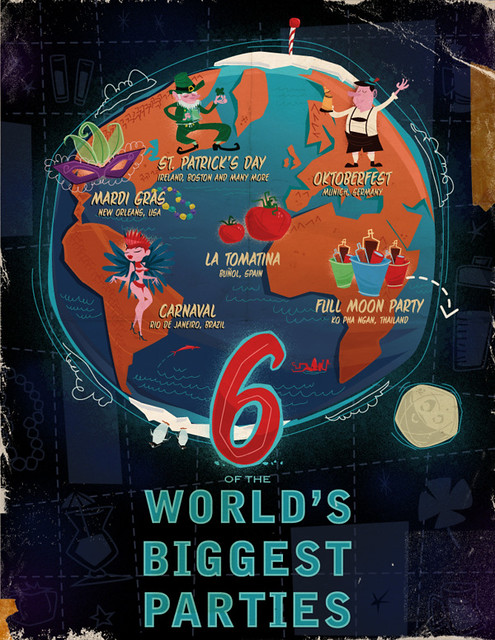
Click here to see the map full size.

Today’s infographic is more a work of art than anything else, and illustrates 6 of the World’s Biggest Parties, one of which is all about beer, and during at least three more of them, beer is fairly prominent.
Click here to see the map full size.

Cantillon just announced both the date — September 14 — and the participating bars for this year’s Zwanze Day. If you’re not familiar with it, here’s an overview I wrote about last year’s Zwanze Day for my newspaper column.
Belgium has essentially two separate regions, with the northern half known as Flanders. The language spoken there is a dialect of Dutch, known by the same name as the people of Flanders: Flemish. The word “zwanze” is unique to Flemish, has its origins in Yiddish, and essentially means a self-deprecating type of humor that’s typified by sharp-edged, playful jokes, usually good-natured. It’s said that this type of humor has become “a characteristic, defining trait” of the Flemish themselves, and for some a way of life. A “zwanze” is a joke, a “zwanzer” a joker.
It was with that same playful spirit that Cantillon approached the concept of making a Zwanze beer. The goal was to create a fun beer; something a little unusual, using non-traditional ingredients. This year’s Zwanze beer is made with rhubarb. The base beer is a Lambic, with two seasons, or summers, in wooden barrels. That’s then moved into a stainless steel conditioning tank where 300-grams of rhubarb per liter — about 2/3-pound — are added and aged for roughly three months, and then it’s kegged directly from the tank.
The first Zwanze beer was made in 2008, and was also a rhubarb beer. In subsequent years they’ve made it with elderflowers, pineau d’aunis (a red wine grape) and last year they brewed a sour witbier, made with the traditional coriander and orange peel. This is the only repeat so far, which was necessitated when the originally planned 2012 version — a Lambic take on a Trappist Abbey Ale — didn’t mature in time. Van Roy decided instead to make the rhubarb Lambic again, primarily because it was his wife’s favorite.
As a result, while it’s not been announced, I believe this year’s Zwanze Day beer will most likely be that Lambic take on a Trappist Abbey Ale that wasn’t quite ready last year.

A worldwide toast of the rare, unique beer will be held simultaneously at 46 beer bars and breweries across the globe, in 14 countries, mostly European. By far, the U.S. has the most, with 22, including four in California:
You can find the full list at Cantillon’s website.

Today’s infographic explores The Effect Our Significant Other Has On Our Drinking Habits. Since today is my 17th wedding anniversary — which is furniture or a watch, how romantic — so I’m posting For Better Or Worse, which shows how your marital status, by gender, affects your drinking patterns. Almost humorously, the infographic was created by Total Divorce.

Click here to see the poster full size.

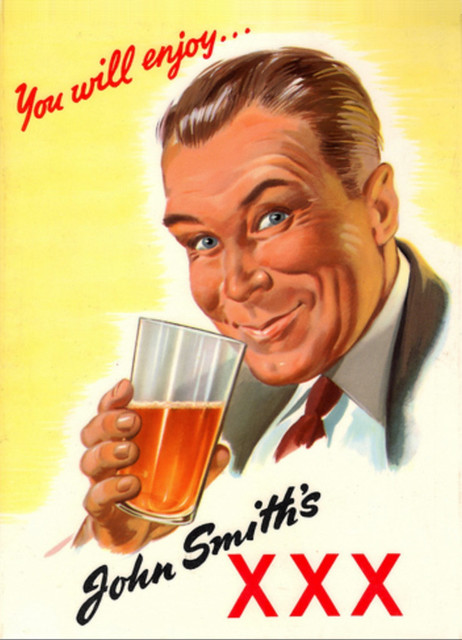
Friday’s ad is another British one, this time for John Smith’s XXX. I’m not sure when it’s from, but the 1950s seems a safe bet. I have a friend named John Smith, and he always likes these ads. The smirking face is a little unsettling, I think. It’s almost like he’s trying to hypnotize us. “You Will Enjoy … You Will Enjoy ….”

The CNBC show Closing Bell had Brewers Association Craft Beer Program Director Julia Herz on the program earlier today. Despite the host showing some ignorance of beer and asking a few hostile questions, Julia held her own and did beer proud.

According to the UK Telegraph, a worldwide effort is underway to create Synthetic Yeast, which scientists believe will allow brewers to “make beer cheaper and stronger.”
From the article:
Researchers, who have been awarded £1 million of government funding for the project, will first attempt to recreate a slimmed down version of Saccharomyces cerevisiae, the yeast used in the brewing industry to ferment beer.
It will be the first time a genome has been built from scratch for a eukaryotic organism, the branch of the evolutionary tree that includes plants and animals.
The scientists then aim to redesign parts of the yeast genome so that it can perform functions that are not possible naturally.
Professor Paul Freemont, from the centre for synthetic biology and innovation at Imperial College London who is helping to lead the British part of the project, said they could help make yeast more efficient so they required less energy and could tolerate more alcohol before dying, allowing beer to be made stronger.
He said: “The brewing industry is very interested in this project for any new opportunities it may present as they use yeast to manufacture beer.
“One of the aims of the project is to develop this yeast strain as a vehicle that you can put in new chemical pathways and directly manipulate it in a way that is not possible at the moment.
“Clearly there are strains of yeast that are highly resistant to alcohol, but they all die off as the alcohol gets higher, so making more alcohol resistant strains will be very useful for that industry in terms of cost value.
“Strains that are metabolically more optimal and don’t require as much energy will also be useful.”
The synthetic yeast project, also known as Sc2.0, will draw together expertise from around the world.
I can’t quite decide yet whether I think this is a good idea, offering brewers many more choices and opportunities to create unique beers or a Frankenstein moment of science going too far in manipulating an essentially natural process. I guess time will tell.

I just saw this interesting item on Drinks Business, a European news organization covering … well, the drinks business. When I think of the beer Costco sells, I tend to think of those ginormous 30-packs of megabrand cans or bottles. Many of those multi-packs were created just for Costco, Sam’s Club and other warehouse chains. But according to the article, “Costco has announced that craft beer now accounts for 30% of the company’s total beer sales.” That’s over 4-1/2 times the national average and over twice California’s market share. Impressive.

Today’s infographic, an overview of Craft Beer, Taking Over America’s Taste Buds, is not strictly about Ohio, but its creator, Molly Denning is from Columbus and created it as an Ohio State school project to be used in the Craft Beer Village at the Bunbury Music Festival, which begins today in Cincinnati.
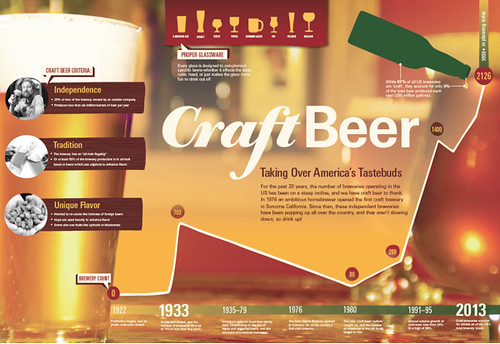
Click here to see the infographic full size.

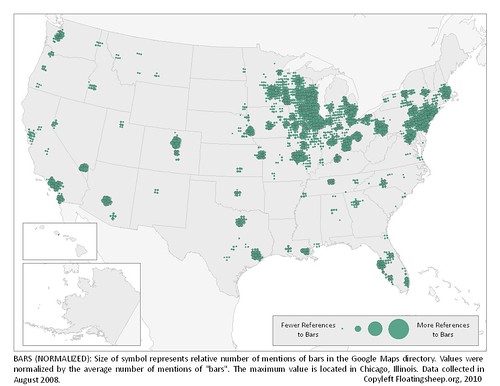
Today’s infographic is part three of three, created by Floating Sheep in 2010, using data collected in 2008. It’s from a post entitled the Beer Belly of America. The third map shows a more normalized version of yesterday’s map, showing the “relative mentions of bars in the Google Maps directory,” which was accomplished using the average number of bar mentions.
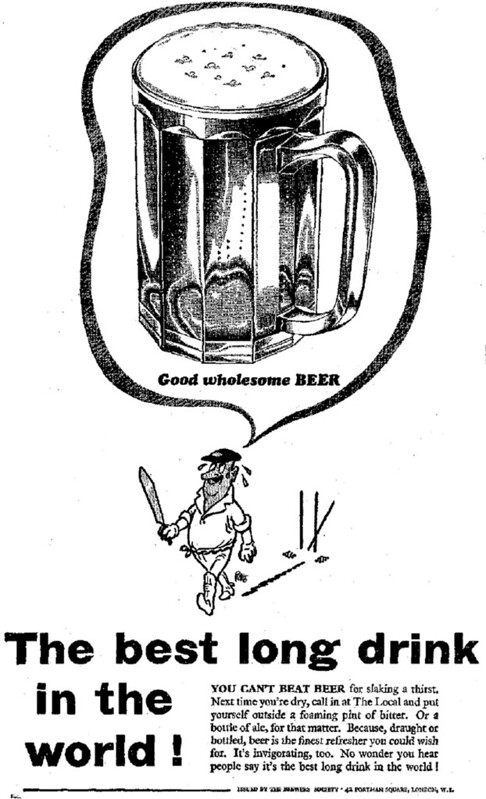
Thursday’s ad for beer generally, from the 1950s. It was created for the Brewers Society, presumably a brewing industry trade organization in Great Britain. It appears that the Brewers Society became the British Beer & Pub Association in the 1990s. A quick search reveals that they did a series of ads in the 1950s using a tagline referring to beer as “The Best Long Drink in the World.” Hopefully some of British friends can explain what the hell that means?