Today’s infographic was created by Gene Ullery-Smith for the Michigan men’s magazine NM3. You can also buy a copy of it on Cafe Press.
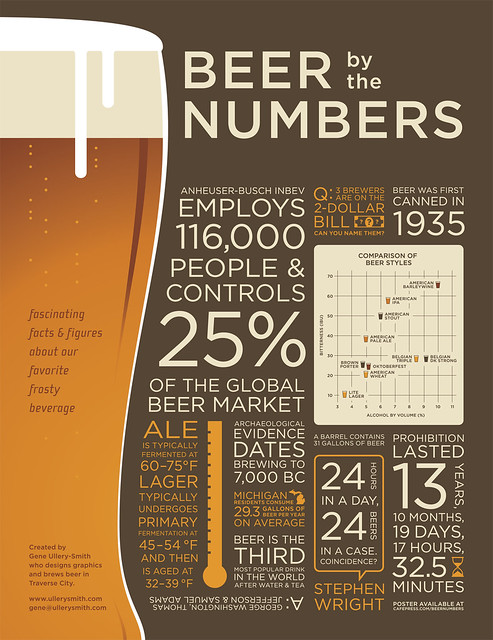
You can see a larger version of it here.

Today’s infographic was created by Gene Ullery-Smith for the Michigan men’s magazine NM3. You can also buy a copy of it on Cafe Press.
You can see a larger version of it here.

If you’ve ever been to the loft that overlooks the Lagunitas Brewery, you’ve probably seen this orange couch. I’ve sat in it on numerous occasions. As I remember it, it’s a pretty comfy sofa, and you sink right into it.
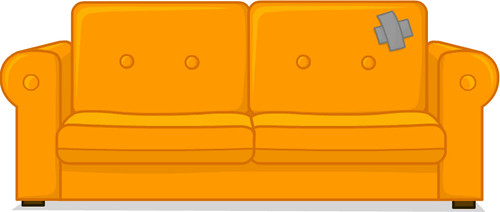
But I guess I’ll have to travel to Chicago if I want to sit on it again. Check out its journey in this humorous video from Lagunitas.

This is an interesting piece of breweriana I stumbled upon. It’s from around 1900 and apparently is “an instruction manual how to efficiently drink Pilsner Urquell.” Although Google Translates it as “A glass of Pilsner Urquell in one fell swoop,” so I’m not entirely certain. It looks like a postcard to me.
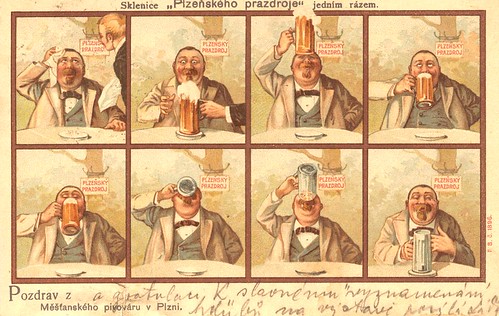
Click here to see the advertisement full size.

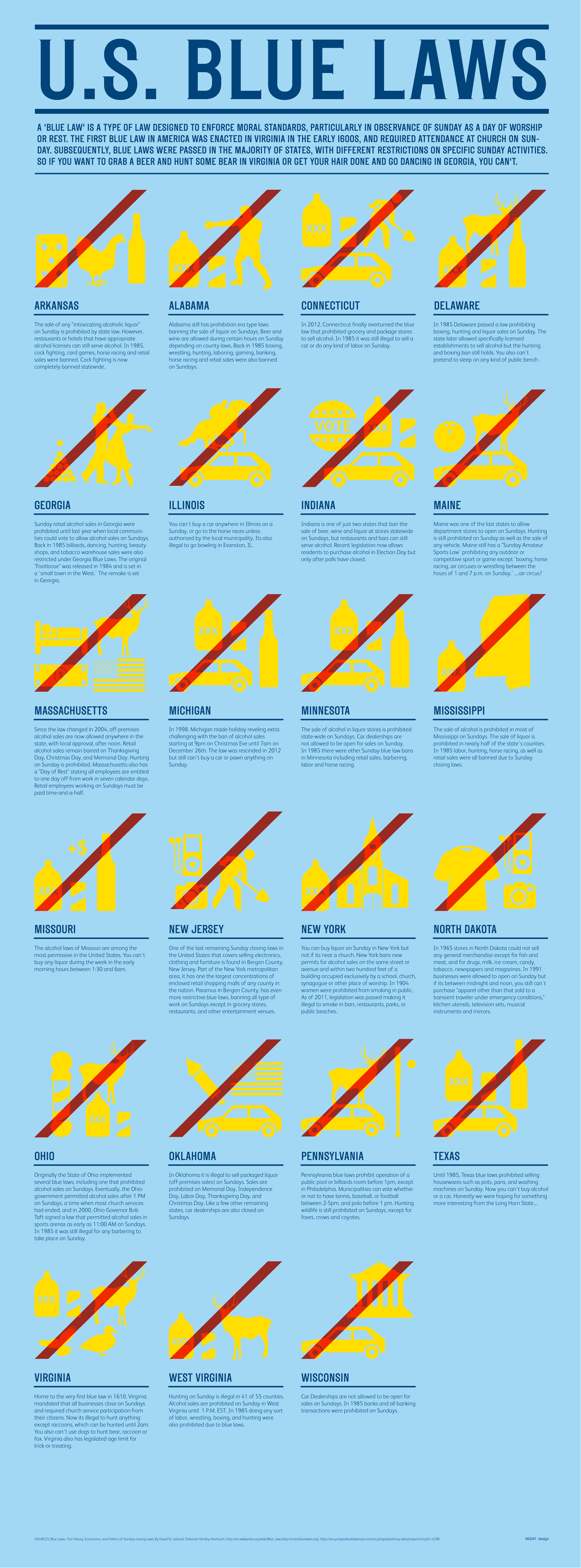
Given it’s a Sunday, when Blue Laws are usually in effect, I thought I’d share this comic strip by Danny Lewis, who’s an artist living in Massachusetts. Blue Laws, of course, are antiquated laws, usually religiously based.
A blue law is a type of law designed to enforce religious standards, particularly the observance of a day of worship or rest. In the US, most blue laws have been repealed, declared unconstitutional, or are simply unenforced; though prohibitions on the sale of alcoholic beverages or prohibitions of almost all commerce on Sundays are still enforced in many areas. Blue laws often prohibit an activity only during certain hours and there are usually exceptions to the prohibition of commerce, like grocery and drug stores. In some places, blue laws may be enforced due to religious principles, but others are retained as a matter of tradition or out of convenience.
While most have been repealed, not all of them have been, and his comic strip talks about some of the remaining ones.
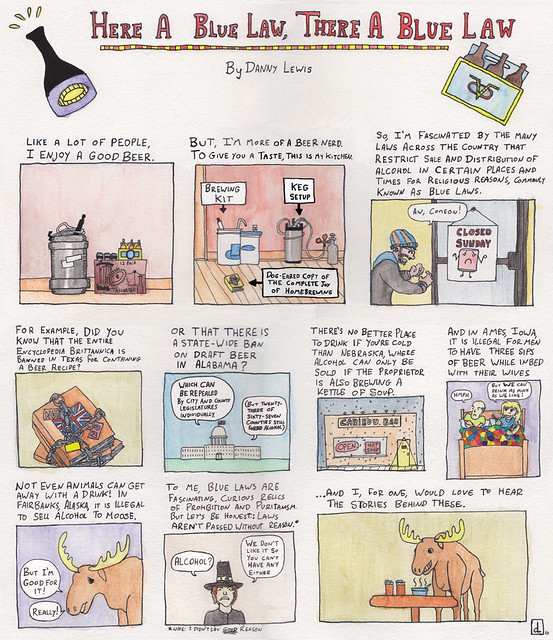
Click here to see the cartoon full size.

File this one in the pile of obscure, antiquated words that we should try to resurrect. I found this one on the blog, Obsolete Word of the Day.
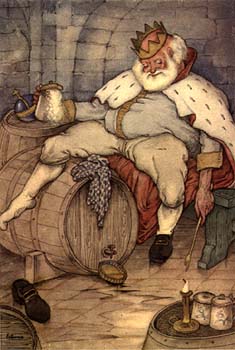
Gambrinous adj. Drunk; full of beer.
There’s also a secondary meaning according to Wordnik, which is “adj. Of or pertaining to Gambrinus.”

Hat tip to Rob DeNunzio for this one, who used to write the beer blog Pfiff!, but has taken some time off since his second child Leo was born, almost three years ago. Happily, he knows me well enough to know that I would love this list of Collective Nouns. In case you were absent that day from school, or have the memory of Ten-second Tom (see 50 First Dates), a collective noun is “the name of a number (or collection) of people or things taken together and spoken of as one whole.” Well-known examples include a “pride of lions,” a “murder of crows” or a “school of fish.” When you think of collective nouns, it seems that most of them have to do with animals, though that’s not necessarily the only ones. There are even a few beer- or drink-related ones, such as a “round of drinks,” I was thrilled to learn. I haven’t run into these before but will be sure to add them to my quiver of arrows (see, there’s another one) for writing about beer.
And when my colleagues and I get together, we become a “worship of writers.” If only.
At the bottom of the list they also suggest some that may not have caught on yet, such as a “bevy of alcoholics.” I’m not so sure about that one.
In doing some further searching, other suggestions have been made, such as a “case of beer” or a “keg of beer,” but those don’t seem like collective nouns as I understand the definition. Those are simply packages that denote size, though those are tame compared to the silly beer, beers and brewers suggestions at all-sorts, a linguistic experiment.
Here’s another list of The Collective Nouns, with ones that people of submitted, a few of which are truly inspired. And Wikipedia has a list, too.
Did I miss any? Any you can think of?

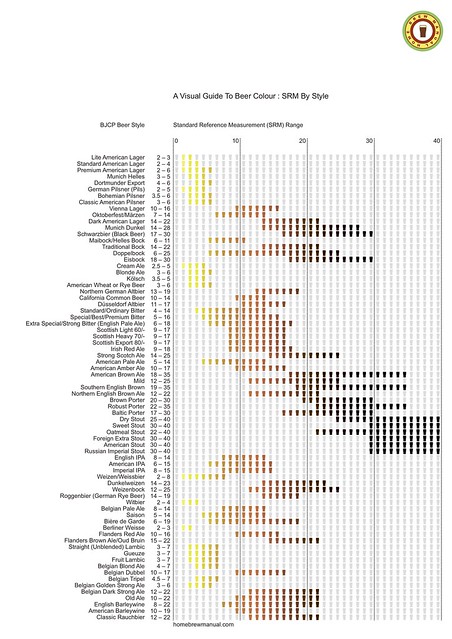
Today’s infographic is from the BJCP, showing the color range for each of their defined styles, though I found the chart through a link at the Home Brew Manual, where you can download a very large pdf. It’s got their logo on it, so it’s probable they created it with the BJCP data.

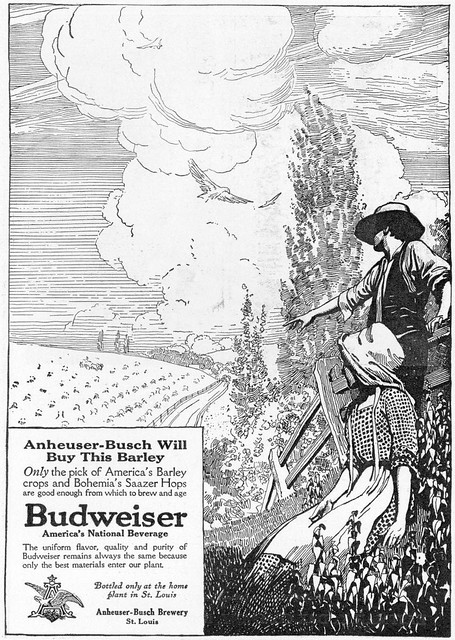
Friday’s ad is for Anheuser-Busch, from 1913. It’s a beautiful illustration, but the way the boy is pointing down at the field coupled with the authoritarian-sounding “Anheuser-Busch Will Buy This Barley” (say it with a Colonel Klink accent), it almost feels ominous. And does anybody know if A-B only uses Bohemia’s Saazer hops, or ever did exclusively? Stan? But a cool image.

While I had a logic class in college, and dabbled in debate, I’ve probably forgotten more than I ever learned. But I still love the notion of breaking down the thought process. My son, who’s 11 and autistic, often has trouble understanding humor. As a result, I increasingly find myself trying to explain the punchline of a joke — why it’s funny — and I’ll break it down for him. What invariably happens, of course, is that in that process, the joke is stripped of its humor and is no longer funny. For some reason, that never deters me. I’ve always had a thing for jokes and thinking about why they’re funny. If I wasn’t so damn shy I would have loved to have tried my hand at stand-up comedy back when I was a younger man. I think that’s why I loved The Aristocrats so much. Ninety minutes breaking down and re-telling one joke. What’s not to love?
So check out the comic strip below. It’s mildly amusing, at least to me. You most likely won’t laugh out loud, but you may smile, at least. But from the point of view of logic, it’s also quite correct, and instructional. It was originally posted by Spiked Math Comics, who admits he doesn’t know the strip’s original creator.
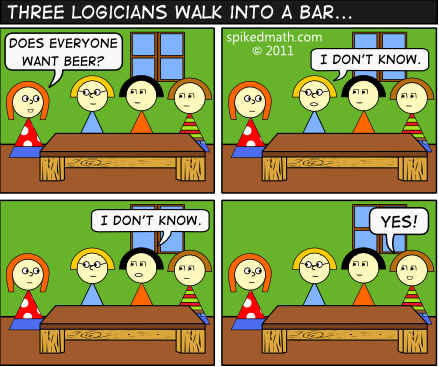
But here’s where it veers headlong into geekdom. It was picked up by a Danish University linguistics student, Emil Kirkegaard, who posted Three Logicians Walk Into a Bar: A Formal Explanation, a breakdown and analysis of the joke, complete with formulas, and explanation of the logic principles behind it.
Here’s one expressing the root problem: E↔(Wa∧Wb∧Wc)
The whole explanation is just as funny as the original strip, to me at least, in its own right and certainly does explain the joke, although if you didn’t think it was funny to begin with, this probably isn’t going to help. But us geeks have to stick together, no matter what geekworld we belong to.