Friday’s ad is for Schlitz, also from 1962. It’s from their “Real Gusto” campaign, and in this one a man with a crewcut is downing his beer, while holding a sandwich in one hand.
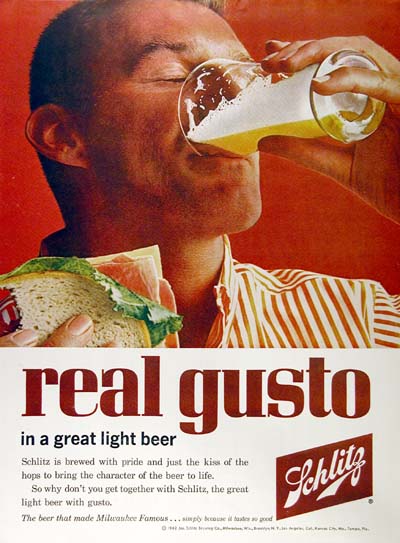

Friday’s ad is for Schlitz, also from 1962. It’s from their “Real Gusto” campaign, and in this one a man with a crewcut is downing his beer, while holding a sandwich in one hand.

Anchor Brewery is teasing us. Earlier today they tweeted this enigmatic photo that vaguely hints at a new series of beers from the oldest craft brewery in America. All the tweet says is that we have to wait until Monday. “We’re brewing up a special announcement for Monday, January 23. Here’s a little taste…” Can’t wait.

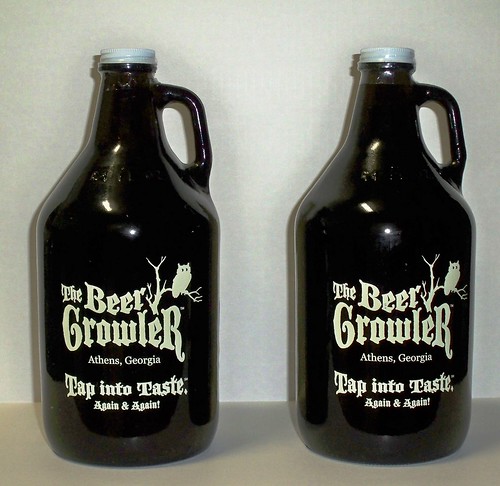
Our 60th Session returns to all things beer, and specifically Growlers Galore! That’s the topic chosen by this month’s host, Kendall Jones, of the Washington Beer Blog. Here’s what he’s thinking about growlers:
These days people take growlers for granted. In my neck of the woods, growlers are a relatively new phenomenon. I don’t know exactly when or why they appeared on the local beer scene, but it could not have been more than eight or ten years ago. Maybe they existed in obscurity before but today growlers are everywhere. I think. Growlers are very common around the Pacific Northwest, anyway. I cannot speak to their popularity in other beer regions. I’d love to know.
Tell us about your growler collection. Tell us why you love growlers or why you hate them. What is the most ridiculous growler you’ve ever seen? Tell us about your local growler filling station. Ever suffer a messy growler mishap? Anything related to growlers is acceptable.
I happen to prefer draft beer over bottled or canned beer and growlers make it very easy for me to enjoy draft beer at home. My growler collection is quite enormous and I even have a special device installed in the back seat of my car to securely transport up to three growlers at a time.
So put down that bottle or can and fill up a growler … and the page with your take on growlers. See you here next month — February 3, 2012 — where you can growl all you want about growlers.
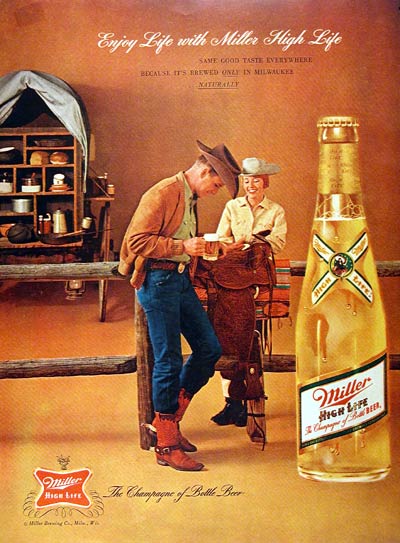
Thursday’s ad is for Miller High Life, also from 1962. It’s a very fake-looking western setting, just a studio with a few props — a wagon, fence and saddle. Couldn’t they have done the same shot at an actual farm or even better, a cattle ranch? Our “cowboy,” mug of beer in hand, is looking down at his new boots as the little filly on the other side if the fence looks on. I’m just not buying it.

We all know good labels, packaging and artwork can help a beer sell. I may not like that a mediocre beer might sell better than a great one if it has more eye-catching artwork, but it happens all the time. It was especially true in the early days of craft beer when many people who were passionate about the beer they were making believed that was enough. They thought all they had to do was make great beer, and people would buy it. And so a lot of good breweries failed for no better reason than they weren’t good businesspeople, as well as good brewers. These days, as we close in on the 2,000th American brewery, most brewers now understand they have to do something to get noticed on the shelf. Good beer in the bottle or can will undoubtedly keep people buying your beer, but you have to get them to try it first. And so most at least try to be clever, artistic or interesting with their packaging. If they have the means, they hire inventive, capable people and agencies to help them.
As an unabashed art lover, a great label or package will impress me. As I’ve said, the beer inside ultimately has to deliver, but great art is an all but necessary first step. That said, I recently came across some of the most impressive new art for a beer I’ve seen in a long time. It’s for an Australian beer I’d never heard of, which makes sense since it’s brand new. It’s a new, separate brewery launched by the Melbourne brewery Little Creatures. It’s located in Healesville in the Yarra Valley, in Victoria, which is in the southeast corner of the continent of Australia. Victoria is the smallest Australian state and Melbourne is its capital.
The name of the brewery is the White Rabbit Brewery. (Note: their website was up and running yeasterday, but today is not.) The Facebook page, however, is working. The design for the beer that a design agency, BrainCells, came up with is just brilliant. This was their mission:
Little Creatures Brewing in 2009 commissioned the White Rabbit Brewery in the Yarra Valley Victoria. The new initiative is focused on delivering a unique dark ale using traditional European open fermenters that bring mysterious wild yeast character into play. brainCELLS was asked to develop the brand look and feel representative of the product, the region, and the eccentricity of the process.
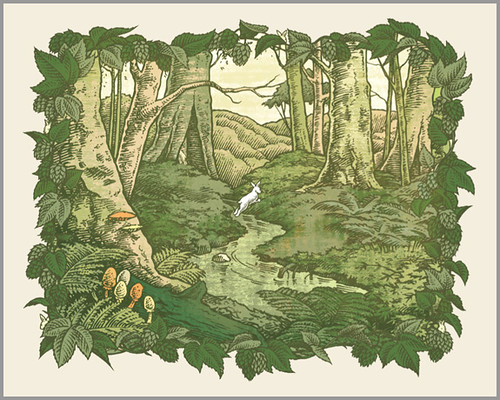
I may be biased, I love rabbits. Always have. I’ve owned a few as pets over my lifetime. And it also doesn’t hurt that I love the works of Lewis Carroll, have a daughter named “Alice,” and my son’s first stuffed animal was a white bunny named “bunny” I bought him his first week (and which is still his favorite). Truth be told, my first stuffed animal when I was a kid was also a rabbit, but it had a much more embarrassing name, one that no amount of beer will ever ply from my lips.
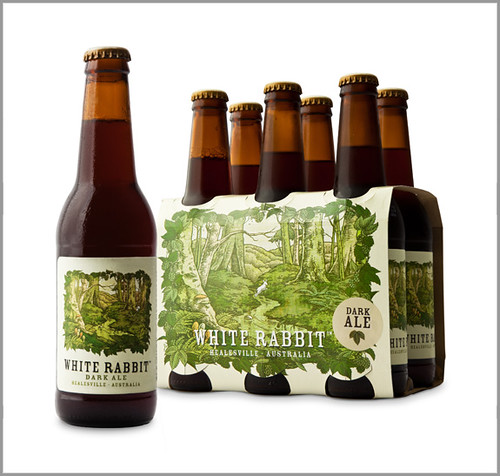
Still, it’s such a beautiful scene, with the white rabbit jumping through the hop forest. It looks great on the six-pack carrier and the bottle, as well. If you look closely, you can see the rabbit is in a different spot on the bottle than the side of the sixer.
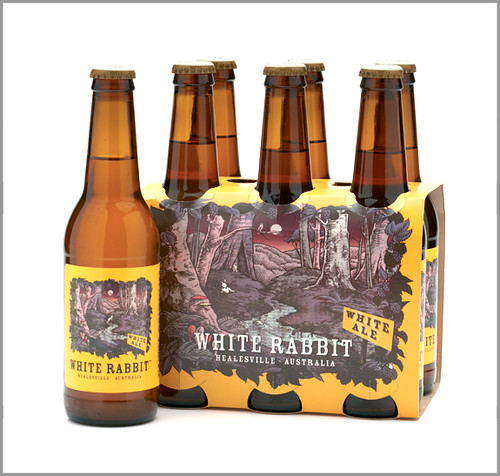
And below is the packaging for the white ale, which is ironically a night setting, while the dark ale is a daytime scene.
Even the glassware is cool, using a clever, and simple, two-fingered rabbit hand as a logo. It’s one that’s immediately recognizable.
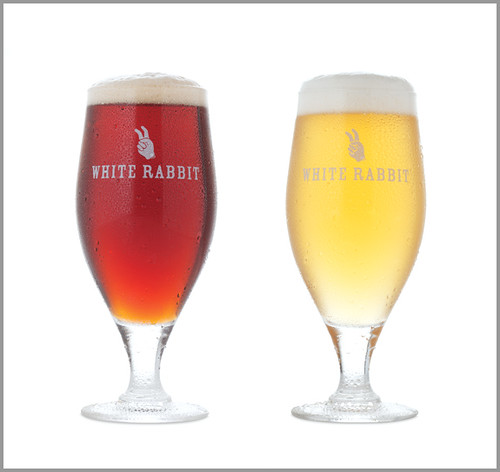
I sure hope they paid as much attention to the beer as the design for the packaging. If the beer is even half as good as the artwork, it should be terrific beer. If anyone in Australia wants to send me some of the beer, or can tell me how to get some, I would be a very happy camper. I am loving the White Rabbit.
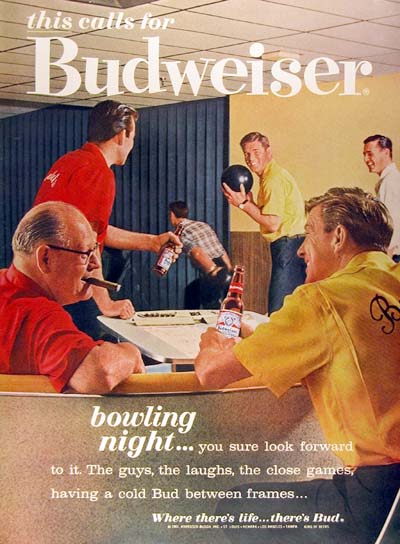
Wednesday’s ad is another one for Budweiser, this time from 1962. Showing a half-dozen men of varying ages out for a night of bowling — league night, no doubt — and also drinking a few beers “between frames.” It seems likes everybody was in a bowling league in the 1950s through the 1970s. My Mom was, I was as a kid. It was always fun. I also had a girlfriend briefly in high school who loved bowling — she was on the school’s team — and so spent a lot of time bowling with her, too.
There was a book a few years ago, Bowling Alone, that was all about how people no longer go out and do things in their community, instead just stay in and watch TV. It used the popularity of bowling and its recent slide as a metaphor for the collapse of the American community. It was an interesting idea, I only read part of it, but liked what I read. Hmm, I think I need to go bowling again, and soon.

Here’s an odd little story from Virginia, sent in by an alert reader (thanks Jeff). In many places, there’s a growing debate about plastic bags, paper bags or no bags at the grocery store. In Virginia, there currently is no law regarding them, but that hasn’t stopped stores all along the southeastern coast of Virginia — an area known as Hampton Roads — from insisting that customers get a plastic bag, if they’re buying beer, that is. It’s not the law, of course, as confirmed by Kathleen Shaw, a spokeswoman for the state Department of Alcoholic Beverage Control.
According to a story in the local Daily Press, apparently “[c]ashiers are either erroneously told by their employer that Virginia requires them to bag alcohol or they mistakenly equate store policy to state law. Either way, beer is bagged at nearly every supermarket and convenience store in Hampton Roads.” As the article, entitled The ABCs of plastic bags and beer shopping in Virginia, points out, in many places outside the area, stores are actually prohibited from using plastic bags, while still others champion their use.
But whether you think plastic, paper or your own bag is the way to go at the grocery store, that’s not what caught my eye. It’s the notion that it’s “beer” that has to be covered before it leaves the store. As for why that might be the case, multiple 7-11 franchise owner Raj Gupta, had this to say: “it’s convenient for the customer [and] it deters customers from drinking alcohol in the store parking lot.” Uh-huh. Whether it’s more “convenient” is debatable, and a bit beside the point if it’s mandatory at all of his stores. And as for deterring customers from ripping open the thin plastic bag and starting to drink in the parking lot, I can’t believe placing the six-pack into a bag is really going to do much good. Gupta certainly doesn’t care about the environment, as he also states. “If they don’t want the bag, they can throw it out in the trash can when they leave the store.” And then start drinking it, one presumes, which is what he was claiming the bag prevented.
But since those reasons are as flimsy as the plastic the bags are made out of, it seems more likely it’s his third reason why “he requires cashiers to bag six-packs, bottles of wine, and single cans and bottles of alcohol.” And it’s a doozy. “[I]t prevents minors from seeing people carrying alcohol.” Holy crime wave, Batman, thank goodness Gupta’s on the scene. We wouldn’t want the little kiddies “seeing people carrying alcohol.” Goodness knows what untold harm that might cause. He doesn’t mind selling alcohol, but he doesn’t want children seeing it. If parents bring their children into his stores, do employees have to cover the kid’s eyes? Or is alcohol on a shelf safe; it’s only dangerous when an adult is carrying it? Or when it’s outside the sanctuary of the store.
Yes, I’m making fun of him, but only because he deserves it. Yes, he’s free to run his stores any way he sees fit, just as anyone is free to not shop at any of his stores. But it points out a deeper issue, which is that he has some weird, unhealthy issues with alcohol. They’re obviously deep enough that he believes that children seeing adults carrying alcohol is such a problem that he’d make it his “company policy” to avoid it happening. As I pointed out, not enough of an issue that he’d voluntarily stop selling alcohol, but still. Why that might be, I can’t fathom, but I’m curious enough to want to know. It has to have something to with the way alcohol is demonized by certain factions of our society. It has to have something to do with our society only hearing one side of the story, with neo-prohibitionist groups spreading their biased propaganda, and doing everything in their power to prevent anyone else from having their say, telling the opposite side of that tale. How else to explain a businessman who sells alcohol believing it’s in his best interests to make sure that children don’t get the idea that people buy alcohol. What possible benefit could he derive from that “company policy?” Frankly, I’m stumped. I can’t think of one reason that’s not fanatical, based on erroneous information or just plain looney.
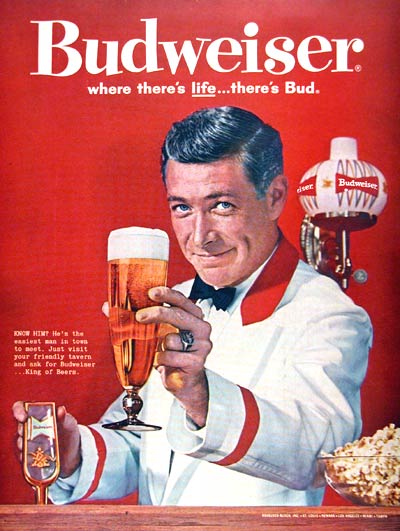
Tuesday’s ad is for Budweiser, from 1961. The very-red ad shows a greasy-haired bartender in uniform, handing you a glass of Budweiser. There’s a bowl of popcorn on the bar and a Bud lamp on the wall behind. The ad is part of A-B’s long-running “where there’s life … there’s Bud” campaign, showing their beer in a variety of settings. One thing I’m starting to notice is how unusual the glassware is in so many of the ads of this time period. I’m so used to the ubiquitous pint or shaker glass, but I can’t say when it became the standard bar glass. I spent a lot of time in bars as a kid in the late 1960s and 1970s (I had an alcoholic stepfather) and I can’t say I remember there being much in the way of unusual glassware, though I was young and not paying that close attention, so there’s that to consider.

For the third straight year, beer had a bigger presence at the Winter Fancy Food Show, held each January in San Francisco. The Brewers Association once again had a booth pouring beer from a variety of craft brewers, through their Export Development Program (EDP). I went the first year, too, and this year it again appeared to be one of the most popular booths at the giant food show that features high-end, specialty foods. Hopefully not by coincidence, the BA’s craft beer booth was located next to most of the cheese, which made finding divine pairings quite easy. There are few things better than great beer and cheese together.
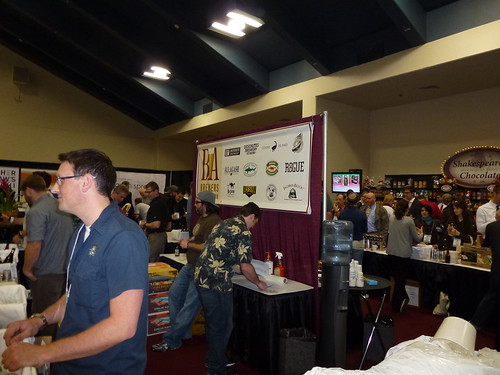
In talking with Bob Pease, COO of the BA and head of EDP, it was clear this was the right crowd to help build craft beer. Attendees were by and large retailers who carry not just ordinary grocery fare, but high-end, specialty foods. Craft beer, of course, is a high-end, specialty food and these days, any specialty food retailer carrying better cheese, bread, chocolate, charcuterie, etc. but not craft beer, is missing out. And many people there seemed to understand that.
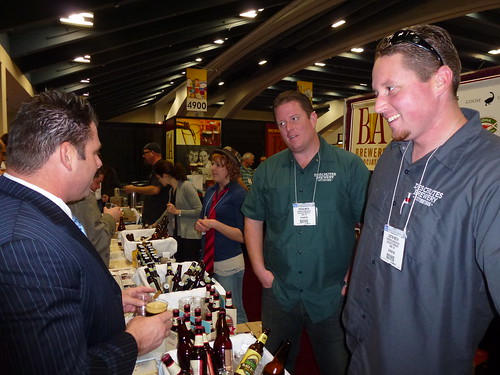
People lined up to try the beers, and unlike your average beer festival, most asked good questions not just about the beer, but what foods it went with, how to market it, etc. In several conversations I eavesdropped on, retailers admitted not knowing much about craft beer, but seemed to understand it was now part of the specialty food world and were eager to learn more and understand how it could fit into their own businesses.

Nancy Johnson, Event Director for the BA, sampling people on Dogfish Head’s beer.
Having had most of the beers from the dozen breweries at the BA’s booth, I wanted to see what else was being featured at the show, so I spent a few hours walking the aisles and stuffing my face with countless delicious samples being offered at nearly every booth.
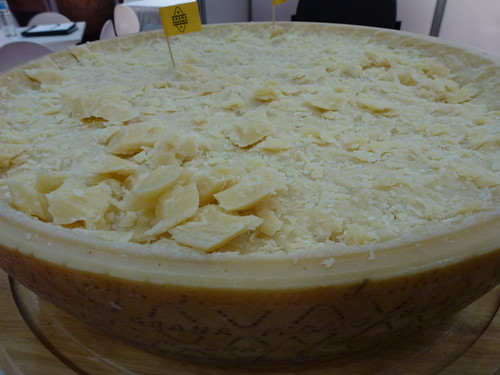
I was in heaven with all the different cheese available for sampling. I must have eaten at least a pound or more of cheese in the aggregate.
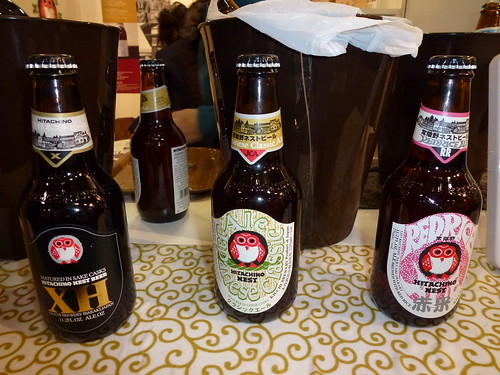
There was an entire area devoted to Japan’s cuisine, and among those booths I discovered that Hitachino Nest Beer was sampling people on three of their beers.

I also noticed this clever carrying-case to transport a twelve-pack to your next tasting.
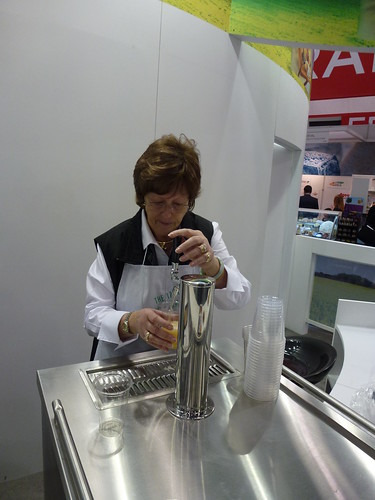
Not surprisingly, they were also pouring beer — Spaten — in the German cuisine area.
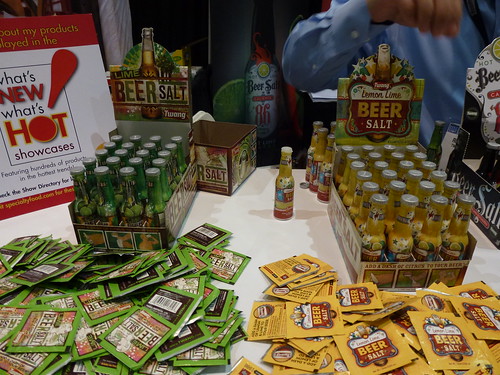
And last, though in this case possibly least, there was also a booth featuring beer salt. Though I suppose if you’re stuck drinking Corona, with a wedge of lime and some beer salt, you’d have the makings of a beer margarita.
Anyway, the Fancy Food Show was great fun, and it was amazing to see so many innovative foods, and the way they were being presented. There was food from a dizzying number of countries, and many new ways of eating more traditional fare. But what was really terrific to witness, is how many people were so accepting of beer as a part of the great panoply of food. I don’t so much like the word “fancy” as a way of describing either craft beer or most of the foods at the show, and I suspect that’s a name with a history that they’re somewhat stuck with now. The Fancy Food Show is put on by the National Association for the Specialty Food Trade, and that’s a much better way of looking at it. Because none of the food there could be considered ordinary, it was all pretty special. And that’s one way to look at beer, too. There’s ordinary beer — well-made but fairly bland without much flavor — and then there’s craft beer — loaded with flavor and in endless variety. Give me the specialty beer every time. Life’s just too short to settle for the ordinary.
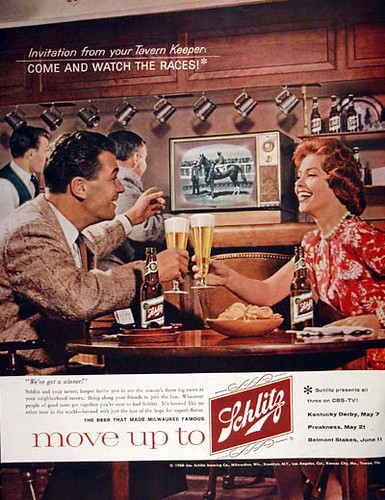
Monday’s ad is for Schlitz, also from 1960. The ad was suggesting that instead of staying home to watch the big horse races, that tavern keepers instead invite you “Come and Watch the Races.” It looks to me like the couple drinking Schlitz must have won their race, they look so happy.