Brookston Beer Bulletin

Jay R. Brooks on Beer

  • Home
  • About
  • Editorial
  • Birthdays
  • Art & Beer

Socialize

  • Dribbble
  • Email
  • Facebook
  • Flickr
  • GitHub
  • Instagram
  • LinkedIn
  • Pinterest
  • RSS
  • Twitter
  • YouTube

Powered by Genesis

Session #56: Thanks To The Big Boys

October 7, 2011 By Jay Brooks

big-brewers
Our 56th Session is a nod of the head, acknowledging the positive aspects of the big, multinational brewers that we so often admonish and criticize. Our host, Reuben Gray at Tale of the Ale, calls his topic Thanks to the Big Boys, which he describes as follows:

What I’m looking for is this. Most of us that write about beer do so with the small independent brewery in mind. Often it is along the lines of Micro brew = Good and Macro brew, anything brewed by the large multinationals is evil and should be destroyed. Well I don’t agree with that, though there may be some that are a little evil….

Anyway I want people to pick a large brewery or corporation that owns a lot of breweries. There are many to chose from. Give thanks to them for something they have done. Maybe they produce a beer you do actually like. Maybe they do great things for the cause of beer in general even if their beer is bland and tasteless but enjoyed by millions every day.
session_logo_all_text_200

While I don’t necessarily like most of the products made by the remaining larger brewers, what they do make is incredibly difficult to brew consistently. They have perfected the science side of brewing, however in doing so I believe they have lost a lot of the artistic side of the equation. To me the best beers contain an equal mix of both the brewer’s art and science. Craft brewers are the modern alchemists, turning base materials into liquid gold. One of alchemy’s goals was to find an “elixir of life.” In craft beer’s innovation, creativity, diversity; ultimately producing a panoply of flavorful beer, I don’t think it’s a stretch to suggest they have found that mythic elixir.

But the science that the big brewers bring to to the table is, at least in part, what allowed the new generation of brewers to — as Sam Calagione is fond of saying — “let their freak flag fly.” From the dawn of the industrial revolution, all of the big brewers (which, for the most part, was ALL of them) introduced innovation after innovation into the brewing process. Refrigeration became commonplace. Thanks to Pasteur, yeast was finally understood and could be controlled. Industrialization allowed for so many advancements into the process that an ancient brewer would hardly recognize one today. From the mid-1800s to the present, brewing has changed more than in the thousands of year before that time. And for that, we can thank all of the big breweries who invested heavily in improving the way their beer was made. R&D suddenly became a much bigger part of an operating brewery, and the trade literature of that time is crammed full of one latest innovation after another.

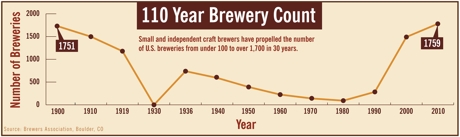
In fact, the breweries that innovated better than their competitors and adapted to the new technologies began to dominate the beer industry. While there were certainly other factors at work, it does partly explain the sharp drop in the number of breweries in America which peaked around 1873 with 4,131. After the decade of the 1870s, improved efficiencies in the brewhouse meant that breweries could serve a wider geographic territory and the more successful started swallowing up the weaker. By 1900, the number of breweries was below 1,800.
2011-ba-brewery-counts

For the next century, both before Prohibition and then after (ignoring that blip of re-openings in 1933) the number of operating breweries continued to fall until around 1980, when thanks to the new microbrewery revolution they began to rise once more. By that time it was less about efficiencies and more about the bigger trying to squelch the competition. Maybe it had always been strictly about “business,” but in the 1970s and 80s it seemed more more ugly, at least to me, as I watched one regional brewery after another close all around me.

But for their part, the remaining companies did keep the history of beer alive, with many having extensive libraries, collections of breweriana and a desire to celebrate the fact that the had survived at least up to that point. By the time I joined the beer industry in some fashion, and was no longer a civilian, there were only three really big brewers, and few more remaining regionals. Like the old nursery rhyme, Ten Little Indians, “then there were three.” The Big 3, as they were often referred to. It seemed like there would always be the Big 3. I was a surprised as anyone when Coors and Miller decided to merge their U.S. operations. “Three little Injuns out on a canoe, One tumbled overboard and then there were two.” I rarely hear anyone refer to the remaining ABI and MillerCoors as the Big 2, now they’re just the big brewers. And Pabst could easily become another third, if only they’d just buy their own brewery and become a legitimate player.

bud-coors-miller

So I think we have much to thank the big boys for, from the science and modern technology they embraced to their reluctant role as the keepers of brewing history. Not to mention that they could easily have stopped the legal change that gave a tax break to small brewers way back when. It was certainly within their political clout to kill it, but they worked with the small brewers instead. Whether it was because they didn’t consider them a threat or whether they genuinely welcomed them into their fraternity it unclear, but doesn’t really matter in the end.

One thing many beer geeks, I think, don’t realize is that there are many, many really good people working at the big breweries. We spend so much energy criticizing their products, their advertising, their marketing, their toxic and often bullying practices, that many people overlook that fact. The big breweries are alike with the small ones insofar as the entire industry is comprised of a nearly universal group of good people, certainly a cut above any other I’ve worked in or knew people who did. And the beer business is a people business, as much as it’s about anything else. So while I may not raise a toast to everything they do, and I may not use one of their beers for that toast, I will very much raise a toast to the people, and especially the brewers, that comprise the largest segment of the beer industry: the big boys. This one’s for you.

Filed Under: Breweries, News, The Session Tagged With: History, Science of Brewing

Oxford Companion To Beer Published Today

October 7, 2011 By Jay Brooks

oxford-univ-press
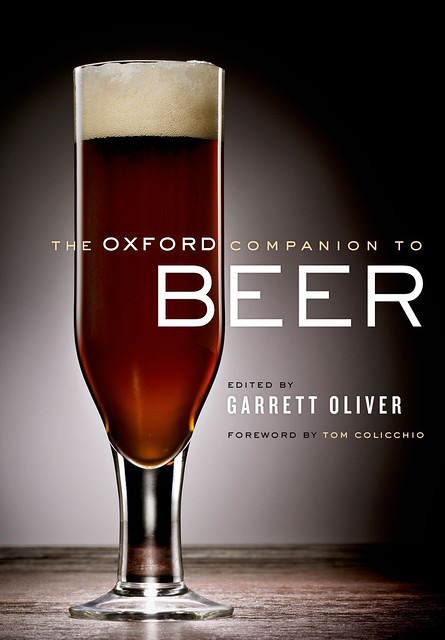
While it’s actually been available for purchase for a few weeks already, today is the “official” publication date of The Oxford Companion to Beer, the new encyclopedic reference book on all things beer. It was put together by my friend and colleague, Garrett Oliver, who’s the brewmaster at Brooklyn Brewery in in New York, and the author of the seminal beer and food book, The Brewmaster’s Table.

The actual authors include something like 166 beer writers, brewers, suppliers, brewing scientists and researchers; experts in their fields one and all. In the interest of full disclosure, I was one of the contributors, too, and wrote around 25 of the 1,100 entries in the 900-page book. As a result, I don’t think it’s fair for me to review it, though I must say it’s getting fairly good press already, including a rave by the New York Times’ Eric Asimov, who called it the “ultimate beer guide.”

Published by the Oxford University Press (OUP), it’s already one of their most successful reference books. Perhaps the best evidence that the world was waiting for a book like this is the fact that it sold out, twice, before today’s official publication date. According to the OUP — who considers a reference book a success if it sells a few thousand copies — they sold out of the initial 10,000 print run from pre-orders, printed another 5,000 which also immediately sold out, and are now on the third printing, all before today’s publication date.

P1000081
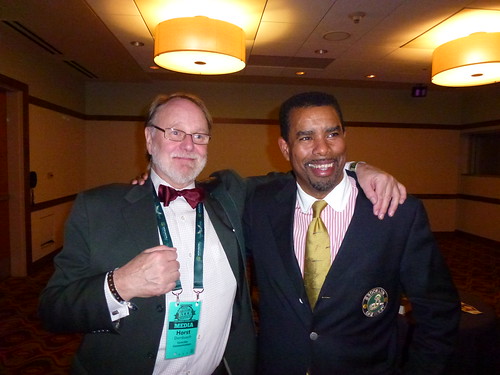
Associate Editor Horst Dornbusch and Editor-in-Chief Garret Oliver at a reception for the book’s launch during GABF week in Denver.

During GABF, OUP had a nice reception for all of the authors who were attending the beer festival this year, and so there were quite a few of us there to see the book for the first time and try the new wheat wine, named Companion, that was a collaboration between Garret and Horst brewed at the Brooklyn Brewery. Apparently it will only be available if you purchase the boxed set of the new book, which comes with a bottle of the beer and the book, a companion to the companion.

Oxford-Companion-Beer

Filed Under: Beers, Breweries, Just For Fun, Related Pleasures Tagged With: Beer Books

Beer In Ads #449: Say O’K For O’Keefe’s

October 6, 2011 By Jay Brooks


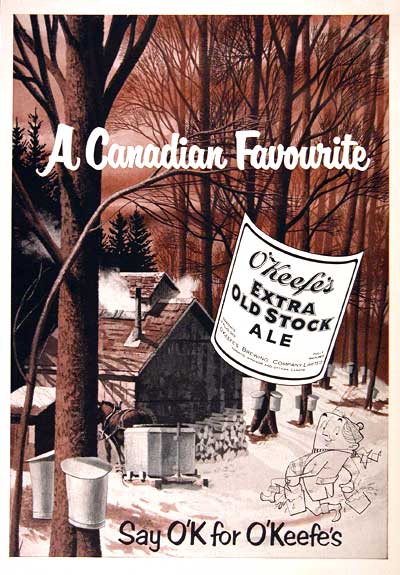
Thursday’s ad is again from 1955, and is for another Canadian beer, this time O’Keefe’s Extra Old Stock Ale. The ad seems a little bit busy to me, with too much going on. Besides the sepia tone-like maple syrup farm background, there’s the floating label, below the “A Canadian Favourite” tagline, and the cartoon syrup farmer in the bottom right-hand corner. Then the bottom slogan, “Say O’K for O’Keefe’s.”

55okeefemaple

Filed Under: Art & Beer, Beers Tagged With: Advertising, Canada, History

Wikio Beer Blog Rankings For October 2011

October 6, 2011 By Jay Brooks

wikio
The October 2011 standings have been released for Wikio’s Beer Blogs. No changes at the Top 2 spots, with Jeff, from Beervana and The New School at 1 and 2 again. Here’s what happened to the Top 20 over last month:

Wikio October 2011 Beer Blog Rankings

1Beervana (=)
2The New School (=)
3Appellation Beer: Beer From a Good Home (+6)
4Brookston Beer Bulletin (+1)
5Washington Beer Blog (+3)
6Drink With The Wench (-3)
7Brewpublic (-1)
8Hoosier Beer Geek (+2)
9Beer 47 (Not in Top 20 in September)
10The Daily Pull (+4)
11Road Trips for Beer (Not in Top 20 in September)
12It’s Pub Night (+1)
13BetterBeerBlog (+4)
14A Good Beer Blog (-7)
15The Brew Site (-4)
16Beer PHXation (Not in Top 20 in September)
17The Session Beer Project™ (-1)
18Seen Through a Glass (-3)
19KC Beer Blog (-7)
20San Diego Beer Blog (Not in Top 20 in September)

Ranking made by Wikio

As usual, I included the relative movements of each blog from last month. Four new blogs emerged in the Top 20 that weren’t there last month. Otherwise, only a few moderate swings. For the most part, things to move around too much this month. As always, I continue to stress that this is just a bit of fun and that we shouldn’t take it too seriously. Until next month ….

Filed Under: Just For Fun, News Tagged With: Awards, Blogging, North America, Websites

Beer In Ads #448: Victory Isn’t Always To The Strong

October 5, 2011 By Jay Brooks


Wednesday’s ad is also from 1955, and is for the Canadian beer, Molson Golden Ale. Their anthropomorphized mascot, — “Goldie” — a man with the head of a lion, says modestly that “Victory isn’t always to the strong.” Based on his expression, and the happy-looking woman next to him, I’d say he’s getting beat pretty bad at bowling.

55molsongoldie1

Filed Under: Art & Beer, Beers Tagged With: Advertising, Canada, History

Propaganda Masquerading As A Report

October 5, 2011 By Jay Brooks

alcohol-justice
When is a report not a report? When it’s created as propaganda by an organization with the sole purpose of advancing its anti-alcohol agenda. In fact, just calling such propaganda a “report” seems dishonest in and of itself. Witness today’s press release from the self-appointed sheriff of Alcohol Alley, the newly renamed Alcohol Justice (f.k.a. the Marin Institute) entitled “Drunk With Power: Industry Kills Alcohol Mitigation Fees in California in 2010.” Talk about a loaded title. To my mind, a “report” should at least pretend to be an impartial, unbiased examination of a set of data. But as the title suggests, those of us in the alcohol industry are all “drunks,” abusing power and indiscriminately “killing.” That’s how we’re portrayed, as pure evil. Yeah, that describes me and just about everybody I know in the beer world. I hate kids and dogs, and just love pulling the wings off of flies, just for the fun of it.

The press release explains that the “report” examines the political lobbying by alcohol companies and money spent by them. Now I’m not a big fan generally of the corporate influence of our current political system, but it’s not illegal. The reason Alcohol Justice (AJ) is able to compile the lobbying money spent is because it has to be disclosed at all levels. It is, in plainer terms, legal and transparent. Nobody’s done anything wrong. They claim it “details the ever-present dominance of the alcohol industry and its lobbyists on California policymakers in 2010.” But dominance over whom? Over what? It’s not as if alcohol companies are the only people or organizations spending money on lobbying. Every company and/or industry does so. Their corporate charters all but demand that they engage in lobbying. Like it or not, it’s a part of doing business in California and the United States.

The majority of the AJ “report” includes a long list of money received by California politicians from alcohol lobbyists or as political contributions. And they’re drawing the conclusion that they therefore must have been bought off. But their “report” proves no direct correlation between receiving money and how a politician votes on legislation having to do with alcohol regulation. In fact, some of their data seems to contradict that idea.

Just looking at money received from one sector ignores any money they may also have received from any other, possibly even competing, industry or interest. And it doesn’t take into account what portion of the total money any politician received comes from alcohol and/or who else gave them contributions.

Maybe I’m jaded, but even the amounts themselves seem small, especially as a percentage of the total they received. Total lobbying expenditure by all alcohol companies is $1.3 million, according to AJ. One figure I found said that there was $552.6 million spent on lobbying in California in 2008. So that means the alcohol portion, even if they spent that much three years ago, is only 0.23% of all lobbying dollars spent. Hardly the “drunk with power” that AJ churlishly decries. That hardly demonstrates a “dominance of the alcohol industry and its lobbyists,” as they characterize it. More like a drop in the pint glass that is California politics.

The executive summary of the “report” claims that alcohol companies spent $5 million on both lobbying, campaign contributions and other political spending in 2010. Given how big our economy is, that also seems like a vanishingly small amount, especially when it is claimed that it bought so much. According to Follow the Money, California campaign contributions totaled $716,750,583 for 2010. AJ claims that of that $5 million figure, $1,572,939 was spent on candidate contributions. That means that a mere 0.22% of campaign contributions come from alcohol companies. Again, that hardly indicates the undue influences that AJ claims in their “report.”

To me, it’s just as likely that many, if not most, of the politicians don’t view the alcohol companies as pure evil, the way Alcohol Justice does. They probably see them as job creators, having a positive impact on a depressed economy and providing some enjoyment to their customers, quite necessary when so many people are out of work and their spirits so low. Not everybody who drinks abuses it, in fact most people don’t.

The politicians are most likely just people like you and me who like a drink once in a while. They’re part of the majority of people who drink moderately and responsibly, and therefore they can see the legislation for what it is: the work of fanatics who see compromise as a weakness, view all alcohol as bad, believe moderation is not the answer, and for whom only total prohibition is the only result that will satisfy them. And so they vote against it, like they should; like any reasonable person would. The majority of their constituents don’t agree with the radical ideas of neo-prohibitionists. Like most reasonable people, these politicians and the people they represent, don’t see alcohol as inherently bad; the only negative is the abuse of it by a small minority that is rarely addressed by legislation claiming to be for that purpose.

The “mitigation fees” they claim were killed by lobbying are not even a true metric. The idea that the companies that make and sell alcohol should have to pay for the damage caused by its abuse by a minority of individuals is not exactly a time worn idea. NRA lobbyists are not working to insure that gun makers don’t have to pay to mitigate the “harm” done by people shooting one another with their guns. Likewise, the red meat industry isn’t working to insure that cattle ranchers and meat packing plant owners don’t have to pay to mitigate the “harm” done by people who eat too much steak and hamburgers. Those are, quite properly, matters of personal responsibility. But according to the AJ, there is no personal responsibility for the actions of people who abuse alcohol. In that case, it’s always the fault of the people who make and sell it.

The “report” also claims that “only $10,000 was reported being spent by the industry in San Francisco to defeat Supervisor John Avalos’ Charge for Harm fee” (emphasis added), which made me laugh. Avalos may have introduced it, but it was really a Marin Institute (now AJ) initiative from start to finish. But they mention that because they think more money was spent, and wasn’t disclosed. Talk about being a sore loser.

The report also singles out a couple of politicians for their association with the alcohol industry. For example, they detail how former San Francisco mayor Gavin Newsom is, in their words, “firmly entrenched in the alcohol industry.” And that is offered as the only proof that he is somehow beholden to the interests of alcohol companies. It’s incredibly insulting to suggest that someone in politics is incapable of being impartial if they also derive some of their income from the alcohol trade. It could simply be, as Newsom himself suggested, that he saw through the “charge for harm” fiasco and viewed it for what is was — a bad idea that unfairly punished the majority of law-abiding responsible citizens — as so many others did.

The “report” begins, and ends, with the conclusion that “[t]he alcohol industry continued its ever-present dominance at all levels of California politics in 2010.” But the numbers they cite in their self-fulfilling “report” are meaningless in the vacuum of their reasoning without placing them in the larger context of the much more complicated state of politics in California. $5 million sounds like a lot of money until you actually think about how little that is compared to everything else that the state is facing. The alcohol industry in California isn’t drunk with power in California. Hell, it isn’t even tipsy.

In the same year that the alcohol industry spent $3,683,148 (the AJ’s $5 million figure minus lobbying), California agriculture spent $9,658,149, the computer industry spent $30,749,507, the energy industry spent $72,667,630, finance, insurance and real estate interests spent $64,002,966, the health care industry spent $18,759,752 and labor unions spent $76,563,954. Those industries spent 2.6, 8, 20, 17, 5 and 21 times the alcohol industry, respectively. Geez, just general business interests (not part of a specific industry) spent $29,912,733, over 8 times what the alcohol industry spent. Maybe it’s not the alcohol industry after all that’s drunk with power.

Filed Under: Editorial, Politics & Law Tagged With: Prohibitionists, Statistics

Beer In Ads #447: World’s Most Famous Taste In Beer

October 4, 2011 By Jay Brooks


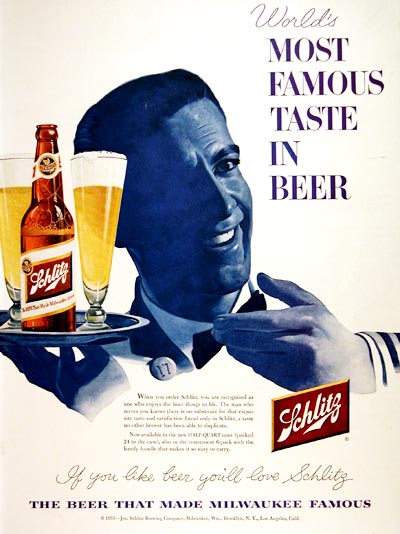
Tuesday’s ad is from 1955, years before the Blue Man Group. It’s for Schlitz, and shows a blue skinned server holding a tray containing two full pilsner glasses of beer and a half-empty bottle of Schlitz. Is it just me, or does that math not quite work? The tagline is the “World’s Most Famous Taste In Beer.”

55schlitzbeer4

Filed Under: Art & Beer, Beers Tagged With: Advertising, History, Schlitz

Interactive GABF Winners Map

October 4, 2011 By Jay Brooks

gabf-2011
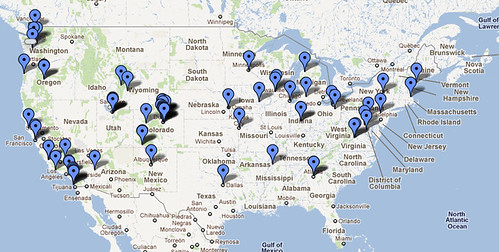
This is pretty cool, an R. Lewis created a Google Map of all the GABF gold medal winners from this year.

gabf-google-2011

Filed Under: Breweries, Events, Just For Fun Tagged With: Awards, GABF

Next Session Thanks The Big Boys

October 4, 2011 By Jay Brooks

session-the
Our 56th Session is a nod of the head, acknowledging the positive aspects of the big, multinational brewers that we so often admonish and criticize. Our host, Reuben Gray at Tale of the Ale, calls his topic Thanks to the Big Boys, which he describes as follows:

What I’m looking for is this. Most of us that write about beer do so with the small independent brewery in mind. Often it is along the lines of Micro brew = Good and Macro brew, anything brewed by the large multinationals is evil and should be destroyed. Well I don’t agree with that, though there may be some that are a little evil….

Anyway I want people to pick a large brewery or corporation that owns a lot of breweries. There are many to chose from. Give thanks to them for something they have done. Maybe they produce a beer you do actually like. Maybe they do great things for the cause of beer in general even if their beer is bland and tasteless but enjoyed by millions every day.

I can think of two right away that I would like to thank (don’t feel the need to limit yourself to one). If you can’t think of any well then here is one quick one. Diageo and Arthur’s Day. At the very least, this is a worldwide celebration of beer. It may be Guinness* orientated but anything that gets people drinking beer and not alcopops is a good thing in my book. If you honestly have nothing good to say about a large brewer, then make something up. Some satire might be nice, It will be a Friday after all.

So put away your poison pen, at least for the day, and wax poetic about a big brewer. Let’s hear your positive vibes for the next Session on Friday, October 7. And yes, that’s this Friday, just three days away.

Filed Under: Breweries, Just For Fun, News, The Session Tagged With: Announcements, Big Brewers

Beer In Ads #446: 33 Fine Beers Blended Into One Great Beer

October 3, 2011 By Jay Brooks


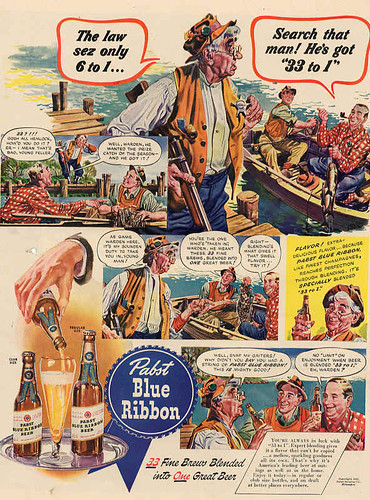
Monday’s ad is for Pabst, possibly from the later 1940s or 50s, and is a busy, colorful cartoon. It’s set in a fishing boat by a pier, where we learn that Pabst blends their beer, from 33 different beers no less, to make it “like finest champagne.” And it’s not just blended, but specially blended.

photo_1226012425

Filed Under: Art & Beer, Beers Tagged With: Advertising, History, Pabst

« Previous Page
Next Page »

Find Something

Northern California Breweries

Please consider purchasing my latest book, California Breweries North, available from Amazon, or ask for it at your local bookstore.

Recent Comments

  • Bob Paolino on Beer Birthday: Grant Johnston
  • Gambrinus on Historic Beer Birthday: A.J. Houghton
  • Ernie Dewing on Historic Beer Birthday: Charles William Bergner 
  • Steve 'Pudgy' De Rose on Historic Beer Birthday: Jacob Schmidt
  • Jay Brooks on Beer Birthday: Bill Owens

Recent Posts

  • Historic Beer Birthday: George Muehlebach April 24, 2026
  • Historic Beer Birthday: Max Hassel April 24, 2026
  • Beer Birthday: Jeremy Cowan April 24, 2026
  • Beer In Ads #5228: To Clarify The “Bock Beer Date” Question April 23, 2026
  • Historic Beer Birthday: Anton Schwartz April 23, 2026

BBB Archives

Feedback

Head Quarter
This site is hosted and maintained by H25Q.dev. Any questions or comments for the webmaster can be directed here.