Brookston Beer Bulletin

Jay R. Brooks on Beer

  • Home
  • About
  • Editorial
  • Birthdays
  • Art & Beer

Socialize

  • Dribbble
  • Email
  • Facebook
  • Flickr
  • GitHub
  • Instagram
  • LinkedIn
  • Pinterest
  • RSS
  • Twitter
  • YouTube

Powered by Genesis

Amish Beer For Rumspringa

March 9, 2011 By Jay Brooks

amish-fightin
I love contradictions, especially when they have to do with the Amish. I grew up right around the Pennsylvania Amish, and in fact on my mother’s side, I am partly Amish, so to speak. From my grandfather’s generation and before, my family was Mennonite and operated a farm, having come to America from Bern, Switzerland in 1745 as Anabaptists. The Amish and the Mennonites both share an Anabaptist heritage. The Amish are the more well-known of the two, and eschew many modern conveniences such as electricity and cars. Mennonites on the other hand, at least the ones I observed growing up, drove cars but painted all the chrome black so as to avoid anything flashy or showy. Whenever you visit Amish tourist areas, the ones operating the gift shops and tourist attractions who look Amish, are more likely to be Mennonites.

As a result of that childhood, I love all things Amish and we even have a large hex sign on our house in California, if for no better reason than to confuse people — plus, I just think they’re cool. When I play fantasy sports, I often use as a team name: the “Fightin’ Amish,” again because I love the contradiction. The Amish are conscientious objectors and don’t fight, and even have an exemption for military service. Likewise, there’s a great band I like called The Electric Amish that nicely plays on the contradictions between the Amish and modern life. I bring this up because Lancaster Brewing, in the heart of Pennsylvania’s Amish country, has announced their latest seasonal beer, in a can, to be called Rumspringa Golden Bock.
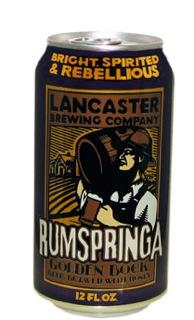
lancaster-rumspringa
Rumspringa is essentially adolescence, from around age 16 until 18, when an Amish teen has to decide to be baptized and join the church or be “shunned” (ostracized by their community for the rest of the lives — no pressure there). Not surprisingly, most join the church. During the Rumspringa, teens have more freedom then before or after, and though it varies by sect, it’s often thought of as the time when they can “sow their wild oats,” find a spouse, get a little crazy. While I’ve seen documentaries where drinking and other taboos do take place, for most it’s simply a time to decide what to do with their lives, at least as I understand it. The Amish, of course, don’t drink alcohol so I love the apparent contradiction of naming a beer for this time in the Amish life cycle. Plus it’s just a good name for a spring beer. And I’m doubly glad they’re canning it so I may even have a shot at trying some.


Filed Under: Beers, Breweries, Editorial, Just For Fun Tagged With: Cans, new release, Pennsylvania, Religion & Beer

A Puzzling Beer Mug

March 9, 2011 By Jay Brooks

beer-mug
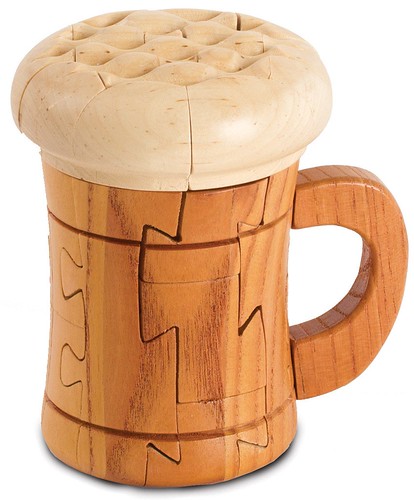
This morning I was perusing the new X-Treme Geek catalog — yes, I’m that kind of geek, too — that arrived in the mail a few days ago, when I happened upon this kinda cool puzzle.

beer-mug-puzzle-1

When you manage to get all the pieces of the puzzle together — voilà — it’s a beer mug. Remember when lots of comfy bars used to have puzzles and games on the bar for patrons? This one seems like a natural for any of those kinds of bars.

beer-mug-puzzle-2

If you’re iPhone user, old or new, they also have a bottle opener built into an iPhone case. That certainly seems geeky, but also potentially useful, as well.

iPhone-opener

Filed Under: Beers, Just For Fun Tagged With: Gift Ideas

Beer In Ads #326: Budweiser, Say When

March 8, 2011 By Jay Brooks

ad-billboard
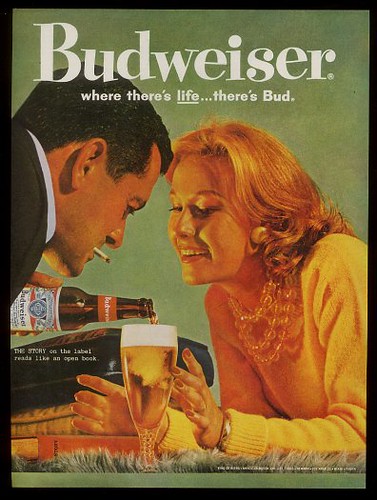
Tuesday’s ad is for Budweiser, from 1960, and it’s one of their “where’s there’s life … there’s Bud” series. This one shows a couple enjoying an evening on the floor. Cigarette hanging from his mouth, the man is pouring a bottle of Budweiser while his lady friend watches expectantly. Holding her hands on either side of the filling beer glass, her expression seems to be waiting to say “when.”

Bud-1960

Filed Under: Art & Beer, Beers Tagged With: Advertising, Budweiser, History

The Impact Of Texture On Taste Perception

March 8, 2011 By Jay Brooks

sense-taste
On Food Navigator, there was an interesting short interview with Matthew Patrick, VP of R&D for TIC Gums where he suggests that “food and beverage product developers spend a shockingly low amount of time examining how texture may impact a finished product.” In beer, of course, texture is more often referred to as “mouthfeel.” And while when judging beer, mouthfeel is a consideration it’s usually not the primary one. Honestly, I’m really not sure how often brewers tinker with their recipes specifically to get a particular mouthfeel though it’s clear that many beers have great ones and many otherwise solid beers suffer for having a less than pleasant or ideally suited mouthfeel.

He’s talking primarily about texture in food and non-alcoholic beverages, though he singles out what he refers to as “low-viscosity beverages” like “tea” as products who didn’t give much thought to their texture. Beer’s viscosity has quite a range, from thin pilsners and golden ales to thick, rich oatmeal and imperial stouts so I can’t say where beer falls in TIC Gums’ viscosity scale. But there’s no doubt that mouthfeel is at least one of the many factors that add up to a beer’s overall taste profile. What a brewer can, or should, do about it seems like a worthy discussion to have.

The impact of texture on taste perception

There’s also a summary of the interview from the Food Navigator website:

Speaking to FoodNavigator-USA at the Research Chefs Association conference and expo in Atlanta, Patrick explained that texture can have wide-ranging influence on consumer perception of a food or beverage product.

For example, texture can influence the way saltiness or sugariness is perceived, meaning that different textures can make a product seem more or less sweet or salty even if the level of sugar or salt remains the same. That effect is something that product developers need to be particularly aware of, as many are cutting sugar or salt in products in response to demand for healthier foods and drinks.

Patrick added that low-viscosity beverages, such as teas, represent one area in which there is particular potential for enhancing consumer experience of a product through subtle textural differences.

Filed Under: Beers, Food & Beer, Related Pleasures Tagged With: Interview, Science of Brewing, Tasting

Beer In Ads #325: Schlitz, Cowboy Music

March 7, 2011 By Jay Brooks

ad-billboard
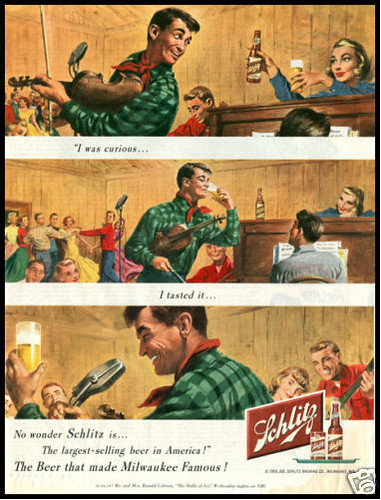
Monday’s ad is for Schlitz, from 1950, and is one of a series of three panels ads that Schlitz created through the 1940s and 50s using as captions for the panels, “I was curious …,” “I tasted it …,” “No wonder Schlitz is …” blah, blah, blah. This one shows a country musical group. The fiddle player/snger tries some Schlitz and then the whole band starts smiling and playing again.

Schlitz-music-1950

Filed Under: Art & Beer, Beers Tagged With: Advertising, History, Schlitz

More Absurdity From The Lunatic Fringe

March 7, 2011 By Jay Brooks

nut
In another missive from the increasingly well-named Professor David Nutt, today in the UK Guardian he announed that There is no such thing as a safe level of alcohol consumption and then proceeded to claim that the reasons he believes that “the idea that drinking small amounts of alcohol will do you no harm is a myth” are fourfold:

  1. Alcohol is a toxin that kills cells.
  2. Although most people do not become addicted to alcohol on their first drink, a small proportion do.
  3. The supposed cardiovascular benefits of a low level of alcohol intake in some middle-aged men cannot be taken as proof that alcohol is beneficial.
  4. For all other diseases associated with alcohol there is no evidence of any benefit of low alcohol intake.

He elaborates slightly more on each of these, though not much more, and then follows up those grand sweeping pronouncements with the following:

“Hopefully these observations will help bring some honesty to the debate about alcohol.”

That’s one of those comically-spit-out-your-drink sort of statements, because what he just said was nowhere near honest. It would almost be funny except that mainstream media in Great Britain keep giving him a bully pulpit to proselytize from and people seem genuinely uncritical of what he has to say, which is even more baffling. Some of the comments to the Guardian article from supporters are downright scary, as they seem to believe he has science and evidence to support his wackadoodle claims. He doesn’t. Last year, when he proclaimed, to equal fanfare, that beer is more dangerous than heroin, his scientific evidence consisted of gathering together a group of like-minded individuals (that is people already predisposed against alcohol), many of whom were members of the made-up organization he started after the UK government sacked him — The Independent Scientific Committee on Drugs — and they sat together in a room one weekend and assigned arbitrary numbers for the amount of harm to society for various drugs based on their life experience, no actual data necessary. That’s what passes for science, and that they got the previously respected Lancet to publish it is downright bewildering.

Just a few thoughts about what’s wrong with every one of his four “proofs,” off the top of my head. At least I’m admitting I’m not researching these.

1. Sure, 100% rubbing alcohol will kill you. It’s 200 proof. Most chemical substances, compounds, etc. will kill you in sufficient doses. Most of the medicines we use to treat diseases will kill you if the dose is too high. That’s why they have warning labels and are doled out by doctors and pharmacists with specific instructions of how many, and when to start and stop taking them. For alcohol, we have the TTB and various state agencies to perform that role. Even things that are good for us become bad for us in higher doses — red meat, salt, vitamins, bacon (well, maybe not bacon). If we got rid of everything in the world with the potential to kill us, we’d be left with pretty much nothing.

2. Since Nutt claims we can’t predict who will become addicted to alcohol with the very first taste, then he suggests “any exposure to alcohol runs the risk of producing addiction in some users.” And that differs from everything else how? Assuming his anecdotal “evidence” that such immediate addiction is even possible — which seems unlikely at best — it’s hardly a basis for public policy. Not everybody reacted well to penicillin when it was introduced; should we have left all those people with diseases who could be cured by penicillin die just because less than 1% had an adverse reaction to it? This is just a post hoc fallacy of the worst kind.

3. Saying that the cardiovascular benefits are not proof ignores the many, many, many other studies that show positive health benefits for a myriad range of health concerns. The big enchilada, of course, is the numerous studies that show that total mortality is improved by the moderate consumption of alcohol; that is you’ll most likely live longer if you drink moderately than if you either don’t drink at all or drink too much. And a recent study seems to suggest that given a choice, drinking too much instead of abstaining will still lead to a better result. The FDA in its most recent dietary guidelines acknowledges this fact, yet Nutt completely ignores it and every other study that doesn’t fit his world view. Singling out one study to bash — his straw man — is about as dishonest a way to “bring some honesty to the debate” as I can imagine.

4. He concludes by just dismissing the vast body of medical and health studies that do in fact conclude there are health benefits to the moderate consumption of alcohol. He does this apparently by simply pretending they don’t exist, saying “there is no evidence of any benefit of low alcohol intake.” But just saying there are no benefits in the face of a mountain of contrary evidence is not, as his supporters seem to believe, scientific proof of any kind. It’s just the opposite, in fact.

I’m all for an honest debate about the positives and negatives surrounding alcohol, but if this is what passes for “honesty,” I think I’ll have to wait a little longer for that conversation.

Filed Under: Beers, Editorial, News, Politics & Law Tagged With: Prohibitionists, UK

Wisconsin Historian Compares Current State Politics To Prohibition

March 6, 2011 By Jay Brooks

wisconsin
Here’s an interesting op-ed piece by Wisconsin historian John Gurda entitled Smashing ‘Demon Government’ in which he examines the many parallels between the current political climate in his state and the temperance movement that led to Prohibition. Thanks to Wisconsin Bulletin reader Jason H. for sending me the link. Subtitled “Walker’s small-government zeal resembles that of the prohibitionists,” here’s a few choice excerpts below:

MJS prohibition

In its moral fervor, its contempt for compromise, its demographic base and even its strategies, today’s new right is the philosophical first cousin of prohibitionism.

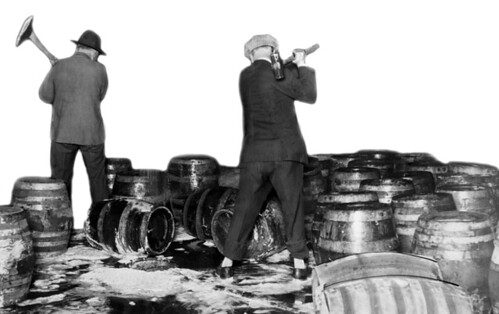
Consider a few of the parallels. The prohibitionists went after “Demon Rum,” while the tea party attacks Demon Government. The Anti-Saloon League preached that barrooms were destroying America’s moral fiber, while the new right declares that onerous taxation and excessive regulation are doing precisely the same thing. Carrie Nation smashed whiskey barrels, while today’s conservatives want to smash the welfare state. Addiction to spending, they might argue, is ultimately as destructive as addiction to alcohol.

Like the temperance movement of the last century, the tea party draws heavy support from Protestant evangelicals such as Walker himself, and their political playbook is a throwback as well. The prohibitionists were media-savvy opportunists, taking advantage of every opening to advance their cause.

When the United States entered World War I, they wasted no time demonizing beer as “Kaiser brew” and even accused Milwaukee’s producers of spreading “German propaganda.” When food shortages loomed during the conflict, the dry lobby convinced Congress to divert America’s grain supply from breweries and distilleries to less objectionable industries. The result was “wartime prohibition,” a supposedly temporary measure that went into effect in 1919 and soon gave way to the 18th Amendment. The national drought would last for 14 years.

It’s worth noting that America wasn’t alone in using the conflict of World War I to push anti-alcohol agendas. Like-minded measures in several countries led to similar alcohol prohibitions, many of which lasted far longer than ours, such as Australia, Canada, Finland, Hungry, Iceland, New Zealand, Norway and Russia. In each of those nations, temperance groups took advantage of wartime circumstances to push their plans on the rest of the populace in their respective places.

In much the same way that prohibitionists turned World War I to their advantage, the current crop of conservatives is making political hay from another temporary phenomenon: the global economic recession. The need for fiscal austerity has rarely been more obvious, but it’s being used as a pretext for advancing the new right’s legislative agenda.

We’re seeing that happen in most, if not every state, with anti-alcohol groups turning our nation’s economic adversity into an opportunity to raise taxes on beer, already the most heavily taxed consumer good (along with tobacco). The Marin Institute has even created propaganda showing the “worst” ten states, with “worst” meaning the states with the lowest taxes on beer, completely out of context and with no understanding whatsoever of why each individual’s states excise taxes are set where they are. Shortly after Governor Walker created Wisconsin’s deficit by giving tax cuts to the wealthy, Michele Simon of the Marin Institute tweeted that beer should make up the difference. “Dear Gov. Walker: Wisconsin has not raised its beer tax since 1969. At .06/gallon, among lowest in nation. Just one of many ideas.” If that’s not what Gurda was talking about, I don’t know what is. That’s using a grave political situation to further an unrelated agenda.

Walker began with a demand that public employees pay more for their pensions and health insurance – a necessary step to which they have agreed – and then proposed to strip them of their collective bargaining rights. That’s an epic non sequitur that makes sense only when you invoke tea party logic: If taxes are bad, then the people we pay with tax dollars must be brought to heel, even if it means freezing a new teacher at first-year wages until retirement.

But the new right’s agenda goes far beyond public employee unions. With solid majorities in the state Legislature, Walker first declared a budget emergency and then cut taxes by $140 million, which is equivalent to taking blood from a patient with severe anemia. In last week’s budget message, he pronounced the patient so sick that amputations are necessary. Walker’s juggernaut of tax cuts and service cuts, combined with his no-bid privatization plans, trends in one direction and one direction only: dismantling government one line item at a time, regardless of the consequences.

It is here, finally, that prohibitionism and tea party conservatism find common ground: Both are ideologies. They represent fixed, blinkered views of the world that focus on single issues and dismiss all other positions as either incomplete or simply wrong-headed. Get rid of alcohol, the prohibitionists promised, and the U.S. would become a nation of the righteous and a beacon of prosperity to the world. Just cut government to a minimum, the new right contends, and you will usher in a brave new era of freedom and opportunity.

And that’s how I see all of the neo-prohibitionist and anti-alcohol groups, as “ideologies.” All of the anti-alcohol groups that I’m aware of do everything in their power to punish alcohol companies because of their perceived sins and because they want to tell you and me how to live our lives. They do so without thinking through the consequences and overall use an “ends justify the means approach,” especially in the way they frame and distort their propaganda. Simply put, I believe that they think they know better than everybody else, there’s a certain smugness in their position; in its unwavering certainty, their righteousness that borders on religious fervor.

They’re convinced that there’s no free will, people are incapable of ignoring advertising, or knowing their limits when drinking. And while there are a few tragic figures who may fit that description, they’re the tiny minority that such groups are fixated on to make their case. The vast majority who drink alcohol do so responsibly and in moderation. Most people take personal responsibility for their actions, as they should. But personal responsibility rarely, if ever, figures into alcohol abuse if you listen only to anti-alcohol rhetoric and propaganda. It’s always the fault of the alcohol itself, and usually beer because it plays better to the people with money who fund such organizations (they drink wine after all). An op-ed piece in the UK Telegraph by Brendan O’Neil recently shed a light on the class issue in anti-alcohol efforts. If they’re not going after the children, then they’re preying on the weak-minded with the most effective advertising the world has ever wrought. Earlier this year, the hue and cry was because there were 3.5 minutes of beer commercial during the nearly four hours of the Super Bowl and — gasp — the little kiddies might see it.

But anti-alcohol rhetoric single-mindedly focuses on only the negative. I’ve never heard any of them say one word that was positive about any alcohol company. Even when Anheuser-Busch packaged cans of water and sent then to earthquake-ravaged Haiti, one anti-alcohol group criticized them for the deed, because they put their logo on the cans and sent out a press release (oh, the horror). Let no good deed go unpunished, indeed. That alone should convince us they’re idealogues.

I suspect they might say the same of me, but I understand and acknowledge that there are some people who should not drink. That such people can and do cause problems for themselves and often the people around them. I don’t write about it very much because I don’t have to; there’s plenty of lopsided anti-alcohol rhetoric already. I’m just trying to balance the conversation, though more often than not I feel like the lone voice in the wilderness.

But back to Wisconsin. My wife is a political news junkie, and she informs me that a careful reading of the facts reveals that Scott Walker’s entire political career has been in service to a single ideology: union busting. He apparently promised that was not his agenda throughout his campaign for governor, and the media swallowed that wholesale with few examining or reporting the discrepancy between what he said while campaigning and his entire career leading up to that point. In that, there’s yet another parallel between the new prohibitionists and the new political conservatives. Most mainstream news media also take the side of the well-funded anti-alcohol groups and parrot their propaganda without questioning it or providing any meaningful views from the other side of this debate.

As to Gurda’s comparisons, I think he’s right about anti-alcohol groups’ unwillingness to compromise and being self-righteous with “blinkered views of the world that focus on single issues and dismiss all other positions as either incomplete or simply wrong-headed.” That’s certainly been my experience. So as if there wasn’t enough reasons to support the protesters in Wisconsin, if this political test case is successful, not only will we see more unions busted in other states, but I suspect anti-alcohol groups are also closely watching this to see how they might use the same bullying tactics in furtherance of their own agenda. And that may be the scariest prospect of all. As usual, I’m with the Green Bay Packers on this one.

Filed Under: Beers, Editorial, News, Politics & Law Tagged With: History, Law, Prohibitionists, Wisconsin

Beer In Art #117: Michael Marcinkowski’s Nectar Of The Gods

March 6, 2011 By Jay Brooks

art-beer
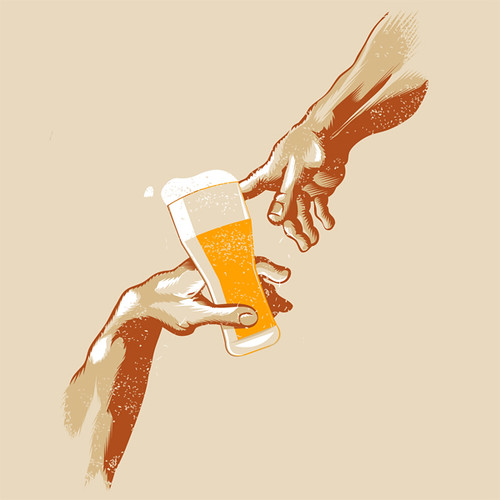
This week’s work of art is by a French illustrator, Michael Marcinkowski, who created a fun play on a portion of Michelangelo’s painting of the Sistine Chapel. He calls his work Le Nectar Des Dieux or Nectar of the Gods and it shows God giving beer to Adam, presumably right after he gave him life.

LE NECTAR DES DIEUX

Today is actually the birthday of Michelangelo (a.k.a. Michelangelo di Lodovico Buonarroti Simon), who was born in 1475 near Tuscany in what today is Italy. Marcinkowski took the hands from a portion of Michelangelo’s painting of the ceiling of the Sistine Chapel, which is meant to represent God giving life to Adam.

Michelangelo-creation-hands

That scene makes up the central portion of the fresco in the Vatican showing Adam and God.

Michelangelo-creation

Filed Under: Art & Beer, Beers Tagged With: France, Italy, Religion & Beer

Brew Minions, A Brew Masters Parody

March 5, 2011 By Jay Brooks

ska
The folks at Ska Brewing, from Durango, Colorado, have made a hilarious spoof of Sam Calagione’s Discovery Channel series Brew Masters. In fact, Sam even makes a cameo appearance in the 22-minute video. The plot of the video involves making a special commemorative beer for the 30th anniversary of one of their favorite ska bands, The Toasters, using — you guessed it — toast. Ska co-founder David Thibodeau is great in it, and I especially loved his “there’s Adam Avery.” Don’t worry, it will make sense when you see it. Enjoy.

Filed Under: Beers, Just For Fun Tagged With: Colorado, Film, Humor, Video

Wikio Beer Blog Rankings For March 2011

March 5, 2011 By Jay Brooks

wikio
The March 2011 standings have just been released for Wikio’s Beer Blogs. For an embarrassing fourth straight month, I’m still clinging to the top spot. Here’s what happened to the Top 20 over last month:

Wikio March 2011 Beer Blog Rankings

1Brookston Beer Bulletin (+/-0)
2Beervana (+/-0)
3Brewpublic (+/-0)
4The New School (+/-0)
5Appellation Beer: Beer From a Good Home (+/-0)
6Drink With The Wench (+5)
7A Good Beer Blog (+/-0)
8Washington Beer Blog (-2)
9Beer 47 (+4)
10Stone Blog (Not in Top 20 for Feb.)
11Seen Through a Glass (+6)
12The Session Beer Project (+4)
13Seattle Beer News (-3)
14BetterBeerBlog (-2)
15The Daily Pull (Not in Top 20 for Feb.)
16It’s Pub Night (-7)
17Brewer’s Log (Lost Abbey Blog) (Not in Top 20 for Feb.)
18The Not So Professional Beer Blog (-10)
19Brewed For Thought (-5)
20Jack Curtin’s Liquid Diet (Not in Top 20 for Feb.)

Ranking made by Wikio

I again added the relative movements of each blog from last month. This month, four new blogs cracked the Top 20 (though one has been here before but dropped off) and four dropped off. There was also very little movement near the top, as the first five blogs stayed in their same places from last month. And fellow curmudgeon Jack Curtin finally made the Top 20 this year. It will interesting to hear his thoughts on being successful and cracking the top twenty. Again, I will continue to stress that this is just a bit of fun and that we shouldn’t take it too seriously.

Filed Under: Just For Fun, News Tagged With: Awards, Blogging, North America, Websites

« Previous Page
Next Page »

Find Something

Northern California Breweries

Please consider purchasing my latest book, California Breweries North, available from Amazon, or ask for it at your local bookstore.

Recent Comments

  • Bob Paolino on Beer Birthday: Grant Johnston
  • Gambrinus on Historic Beer Birthday: A.J. Houghton
  • Ernie Dewing on Historic Beer Birthday: Charles William Bergner 
  • Steve 'Pudgy' De Rose on Historic Beer Birthday: Jacob Schmidt
  • Jay Brooks on Beer Birthday: Bill Owens

Recent Posts

  • Historic Beer Birthday: Henry Thrale April 4, 2026
  • Beer In Ads #5203: Now’s The Time To Say … Blitz Weinhard Bock For Me! April 3, 2026
  • Beer Birthday: Dave Bonighton April 3, 2026
  • Historic Beer Birthday: Frederick Hinckel Jr. April 3, 2026
  • Beer In Ads #5202: The Bock Beer Time Is Near, And It Comes But Once A Year April 3, 2026

BBB Archives

Feedback

Head Quarter
This site is hosted and maintained by H25Q.dev. Any questions or comments for the webmaster can be directed here.