Brookston Beer Bulletin

Jay R. Brooks on Beer

  • Home
  • About
  • Editorial
  • Birthdays
  • Art & Beer

Socialize

  • Dribbble
  • Email
  • Facebook
  • Flickr
  • GitHub
  • Instagram
  • LinkedIn
  • Pinterest
  • RSS
  • Twitter
  • YouTube

Powered by Genesis

Historic Beer Birthday: Johann Peter Griess

September 6, 2025 By Jay Brooks

allsopps

Today is the birthday of Johann Peter Griess (September 6, 1829-August 30, 1888). He was born in Kirchhosbach (now part of Waldkappel), Germany. He was “an early pioneer of organic chemistry.” While known for his work on synthetic dyes, and he was the first to develop “the diazotization of aryl amines (the key reaction in the synthesis of the azo dyes), and a major figure in the formation of the modern dye industry.” He also “worked for more than a quarter of a century at the brewery of Samuel Allsopp and Sons in Burton upon Trent, which, owing to the presence of several notable figures and an increase in the scientific approach to brewing, became a significant centre of scientific enquiry in the 1870s and 1880s.”

This is his biography from his Wikipedia page:

After he finished at an agricultural private school, he joined the Hessian cavalry, but left the military shortly after. He started his studies at the University of Jena in 1850, but changed to the University of Marburg in 1851. During his student life he was several times sentenced to the Karzer (campus jail) and was also banned from the city for one year, during which time he listened to lectures of Justus Liebig at the Ludwig Maximilians University of Munich. After most of the family possession had been spent, he had to start working at the chemical factory of Oehler in Offenbach am Main in 1856. This was only possible after the recommendation of Hermann Kolbe, who was head of the chemistry department in Marburg. The devastating fire of 1857 ended the production of chemicals at the factory and a changed Peter Griess rejoined Hermann Kolbe at the University of Marburg. His new enthusiasm for chemistry yielded the discovery of diazonium salts in 1858. The discovery of a new class of chemicals convinced August Wilhelm von Hofmann to invite Griess to join him at his new position at the Royal College of Chemistry. During his time at the Royal College, he studied the reactions of nitrogen-rich organic molecules. It took him quite long to become accustomed to his new home in England, but the fact that he married in 1869 and founded a family made it clear that he did not intend to return to Germany, even though he was offered a position at the BASF. He left and started a position at the Samuel Allsopp & Sons brewery in 1862 where he worked until his retirement. His wife died after a long, severe illness in 1886; he survived her for two years and died on August 30, 1888. He is buried in Burton upon Trent.

In 1858 he described the Griess diazotization reaction which would form the basis for the Griess test for detection of Nitrite. Most of his work related to brewing remained confidential, but his additional work on organic chemistry was published by him in several articles.

And this short piece is from the journal “Brewery History,” from 2005. The article was called “The Brewing Connection in the Oxford Dictionary of National Biography: Part II,” and was written by Ray Anderson:

Another man whose activities extended far beyond his brewery work was Griess, (Johann) Peter (1829-1888), chemist to Samuel Allsopp & Sons for 26 years from 1862 until his death. Griess’s inclusion in the dictionary rests on his discovery and subsequent work on ‘a new and versatile chemical reaction which could provide a route to a wide range of new compounds’. These diazo compounds, so called because they contained two atoms of nitrogen per molecule, were to be widely utilised in the production of azo dyes, and the dictionary hails Griess’s synthesis of them as ‘perhaps the greatest single discovery in the history of the dyestuffs industry’. Historians of chemistry place Griess in the front rank of Victorian chemists.

And this is an Abstract from an article, entitled “Johann Peter Griess FRS (1829–88): Victorian brewer and synthetic dye chemist” is from “Notes and Records, The Royal Society Journal of the History of Science,” by Edwin and Andrew Yates:

The German organic chemist Johann Peter Griess (1829–88), who first developed the diazotization of aryl amines (the key reaction in the synthesis of the azo dyes), and a major figure in the formation of the modern dye industry, worked for more than a quarter of a century at the brewery of Samuel Allsopp and Sons in Burton upon Trent, which, owing to the presence of several notable figures and an increase in the scientific approach to brewing, became a significant centre of scientific enquiry in the 1870s and 1880s. Unlike the other Burton brewing chemists, Griess paralleled his work at the brewery with significant contributions to the chemistry of synthetic dyes, managing to keep the two activities separate—to the extent that some of his inventions in dye chemistry were filed as patents on behalf of the German dye company BASF, without the involvement of Allsopp’s. This seemingly unlikely situation can be explained partly by the very different attitudes to patent protection in Britain and in Germany combined with an apparent indifference to the significant business opportunity that the presence of a leading dye chemist presented to Allsopp’s. Although his work for the brewery remained largely proprietary, Griess’s discoveries in dye chemistry were exploited by the German dye industry, which quickly outpaced its British counterpart. One less well-known connection between brewing and synthetic dyes, and one that may further explain Allsopp’s attitude, is the use of synthetic dyes in identifying microorganisms—the perennial preoccupation of brewers seeking to maintain yield and quality. Developments of Griess’s original work continue to be applied to many areas of science and technology.

That’s just the abstract, of course, but you can read the whole article online.

Filed Under: Birthdays, Just For Fun, Related Pleasures Tagged With: Germany, History, Science, Science of Brewing

Historic Beer Birthday: Joseph Haefner

September 3, 2025 By Jay Brooks

haefner
Today is the birthday of Joseph Haefner (September 3, 1848-January 10, 1916). He was born in near Bamberg, Germany. When he was 24, in 1872, he came to America, working in several breweries for fourteen years, before buying out Lawrence Knapp’s Empire Steam Brewery in 1886. He renamed it the Joseph Haefner Brewery, although it was also known as the Empire Brewery, and it’s best-known brand was Tivoli Beer. It reopened after prohibition as Haefner Brewing Co. and remained in business until 1946, when it became the Lancaster Brewing Co. for another three years, closing for good in 1949.

haefners-brewing-company-beer-delivery-truck

This biography is from the “Biographical Annals of Lancaster Co., Pa.,” published in 1903 by J. H. Beers & Co.:

JOSEPH HAEFNER, proprietor of the Empire Brewery, one of the largest enterprises of the kind in Lancaster, is a native of Germany, born in Ganstadt bei Bamberg, Sept. 3, 1848, son of John B. and Barbara (Stall) Haefner.

John B. Haefner, father of Joseph Haefner, was also a native of Germany, and for twenty years conducted a brewery in his native country, doing a large business and performing the duties of a prominent citizen. His death took place in 1899, when he was aged seventy-eight years. His wife died in 1893, at the age of seventy-two years. Both were worthy members of the Catholic Church. Mr. and Mrs. Haefner had the following children: John B. (deceased) also followed the brewing business; Peter resides in Germany and follows the butcher business; Joseph is mentioned below; Lizzie married Gottleib Smith, a farmer in Montgomery county, Pa.; Anna married William Kurtz, who conducts a hotel in Lancaster; Lena married Lawrence Rateline, a farmer in Germany.

Joseph Haefner learned his trade in Germany with his father, with whom he remained until he was sixteen years of age, then securing work in other breweries, where he continued until coming to America, in 1872. For two years he was employed in Rupert’s brewery, in New York, going then to Union Hill, N. J., where he remained one year. Coming to Lancaster, he served one year in Henry Frank’s brewery, and then went to Reading, where his knowledge of the business secured him a good position with Fred. Lauer, with whom he remained six years. Mr. Haefner then went to Pottsville, and in partnership with Peter Lauer and Lawrence Smith operated the Archard brewery for two years, and then for about five years was in Philadelphia. In 1886 Mr. Haefner returned to Lancaster and bought of Florence Knapp his present plant, which he has enlarged to thrice its original dimensions, and has more than trebled its producing capacity. This immense plant covers at present a half acre of ground and gives employment to twenty men. It is fitted with all modern improvements and is the only brewery in the locality which manufactures its own ice. This business was established in 1868 by Lawrence Knapp, and since Mr. Haefner became its proprietor has grown in importance until it ranks with the leading industries of the city.

Mr. Haefner is independent in politics. He takes a deep interest in everything looking to the advancement of the community, and votes for those whom he deems will best carry out his ideas. Fraternally he belongs to the B. P. 0. E. and the Brewers’ Association. In person Mr. Haefner exemplifies the best class of prosperous German- American citizens. Genial, pleasant, liberal in his benefactions and charitable to the poor, he has many in Lancaster who delight to call him friend. He has won his way to success through his own efforts, and well deserves the good fortune which has attended him.

In 1874, in Lancaster, Mr. Haefner was united in marriage to Margaret Fisher, daughter of Raphael Fisher, who operated a hotel in Lancaster for a number of years. He died in 1893, at the age of seventy-four years, and his wife died in 1884. They were members of the Catholic Church, and were interred in the Catholic cemetery. The following named children were born to Mr. and Mrs. Haefner: Mary, who died at the age of four years; Miss Elizabeth, at home; and Anna, Joseph, Catherine, Lauer and Margaret. Mr. Haefner built his present fine home, opposite his place of business, in 1890.

And this is from the “American Brewers’ Review,” for 1916:

Filed Under: Birthdays, Breweries, Just For Fun Tagged With: Germany, History, Pennsylvania

Historic Beer Birthday: August Uihlein

August 25, 2025 By Jay Brooks

schlitz-globe
Today is the birthday of August Uihlein (August 25, 1842-October 11, 1911). He was born in Wertheim am Main, Baden, Germany. He came to the U.S. with his grandfather and August was educated as a brewer in the U.S., working initially for the Uhrig Brewery in St. Louis. In 1867, he returned to Milwaukee, Wisconsin, where his grandfather had settled, and “joined what was now the Joseph Schlitz Brewing Company, the same brewery that had been founded by his uncle August Krug in the 1840s (Krug’s widow, Anna Maria, had married Joseph Schlitz in 1858).”

On the death of Schlitz in 1875, control of the firm passed into the hands of Uihlein and his brothers. When Mrs. Schlitz died in 1887, the Uihlein brothers acquired complete ownership of the corporation. Uihlein was secretary and chairman of the board (1874–1911). He was also actively involved in banking, real estate, and many other Milwaukee businesses.


Here’s a biography of August Uihlein from Find-a-Grave:

Brewer and business executive. He was the first of the Uihlein dynasty that owned and operated Joseph Schlitz Brewing Co. over the years. Born Georg Carl August Ühlein, son of Josef Benedikt Ühlein and Katherina Krug, in Wertheim am Main, Baden, Germany. At age eight he endured a rough immigration on the way to Milwaukee, Wisconsin, in 1850, traveling with his grandfather, Georg Krug. He survived the mid-Atlantic fire and sinking of the S.S. Helene Schlomann, during which his grandfather managed to save him and $800 in gold that was subsequently used to expand his uncle August Krug’s brewery and to hire a bookkeeper, Joseph Schlitz. He attended Milwaukee’s German-English Academy, then studied at St. Louis University in Missouri (1855 to 1857). His uncle, August Krug, died in 1856 and Schlitz became the manager of the brewery and two years later married Krug’s widow and changed the name to Joseph Schlitz Brewing Co. In 1858, at age 16, Uihlein convinced Schlitz to hire him as a bookkeeper after only 60 days training in the subject in St. Louis. August proposed to take a company inventory and revamp the brewery’s accounting system from single to double-entry bookkeeping. While holding down a full-time job (age 17) at the Second Ward Savings Bank (now First Wisconsin) without salary, he applied this training to the brewery’s accounting during evenings. For his efforts at the bank, he received a gold pen from Valentine Blatz after a year of service. He then worked the Uhrig Brewery in 1860 in St. Louis (the Uhrig family had a summer home in Milwaukee) as a bookkeeper, collector, and shipping clerk for $20 a month and two years later, shortly before his 20th birthday, he was promoted to the position of general manager. Returning to Milwaukee in 1867, he became the bookkeeper for the Joseph Schlitz brewery, and on the death of Schlitz in 1875, management control of the firm passed into the hands of him and his brothers, all nephews of the brewery’s original founder, August Krug. Along with his brothers Henry and Edward, he continued the business strategies initiated by Schlitz. The company developed a system of agencies across the United States to sell beer, and developed its own vast rail distribution network. When Mrs. Schlitz died in 1887, the Uihlein brothers acquired complete ownership of the enterprise. From a ranking of tenth largest US brewer in 1877, their national marketing plan propelled the company to third by 1895. Sitting among the top three breweries was little comfort when prohibition came about. The company met the challenge as did others, restructuring the brewery as Joseph Schlitz Beverage Co. to produce near beer, yeast, soft drinks, malt syrup and a chocolate candy named “Eline” (a phonetic play on the family name). Returning to brewing in 1933, the company launched an acquisition plan and new construction that led them to second and then first place in US beer production. For the next 40 the years the company would remain near the top and at one point was ranked as the largest in the world. August Uihlein was Schlitz company secretary from 1874 and also chairman of the board from 1880 until his death in 1911, and was prominently identified with banking, real estate, and many other Milwaukee enterprises. Interested in racing horses, he maintained a large stock farm near Kenosha and was the owner of the famous trotting-horse champion, “Harvester.” Noted for his local philanthropy, he donated large sums to the German-English Academy and to the Milwaukee Public Library. He died while visiting in Germany.


schlitz-postcard


Uihlein-family-1880
Uihlein family photo, early 1880’s – bottom row, from left; Charles, superintendent of the bottling works; Edward, vice president in charge of developing the Chicago markets; Henry, president. Top row, from left; William J., assistant superintendent of the brewery; Alfred, superintendent and brewmaster; August, secretary and chief operating officer.


Filed Under: Birthdays, Breweries, Just For Fun Tagged With: Germany, History, Schlitz, Wisconsin

Historic Beer Birthday: Louis Wiegand

August 24, 2025 By Jay Brooks

new_york
Today is the birthday of Louis Wiegand (August 24, 1840-March 2, 1912). He was born in Frankfort, Germany, he emigrated to America when he was 27, in 1867. He was initially in the meat business but in 1878, along with partners Carl Durr and William Wagner, he founded the Oswego German Brewing Co. in Oswego, New York. A few years later, in 1882, he bought out his partners, and renamed if the Wiegand Brewing Co. and then the Louis Wiegand Brewing Co. When his sons joined him in the business in 1896 it became known as Louis Wiegand & Son. It was closed by prohibition in 1916 and never reopened.

This is his obituary, from the Oswego Daily Times, for Monday, March 4, 1912:

The death of Louis Wiegand senior member of L Wiegand & son brewers, which occurred at his home, No 166 East Second street, Saturday evening at 4:45 o’clock, will be received with sorrow by citizens generally. Mr. Wiegand had been in failing health since last May and for several months had been confined to his home. Born in Wirthheina, near Frankfort, Germany, in 1840, Mr. Wiegand came to Oswego in 1867, He engaged successfully in the meat business in East Bridge street for several years. In 1882, Mr. Wiegand organized the Germania Brewing Company and shortly thereafter took over the business, which he has successfully conducted ever since. Deeply interested in the St. Peter’s Cemetery association and one of its organizers, Mr. Wiegand was zealous in promoting it. He had been president of the society for several years. When It was desired to acquire more property for the extension of the cemetery, the funds on hand were not sufficient. Mr. Wiegand purchased the property and sold it to the association without profit to himself. He was a constant visitor to the cemetery and gave much of his time to plans for beautifying it.

Mr. Wiegand’s first wife died several years ago. He is survived by his second wife, formerly Miss Catherine Stoke; one son, Louis X, and a sister, Mrs. Margaret Cook, all of Oswego. The funeral will be held tomorrow morning from his home and at St Peter’s church.

Unfortunately, apart from his obituary, there was almost nothing else I could find about him, his sons or his brewery, not even any photos or breweriana.

Filed Under: Birthdays, Breweries, Just For Fun Tagged With: Germany, History, New York

Beer In Ads #5060: Hospitality Demands Our Pale Bock Beer

August 22, 2025 By Jay Brooks

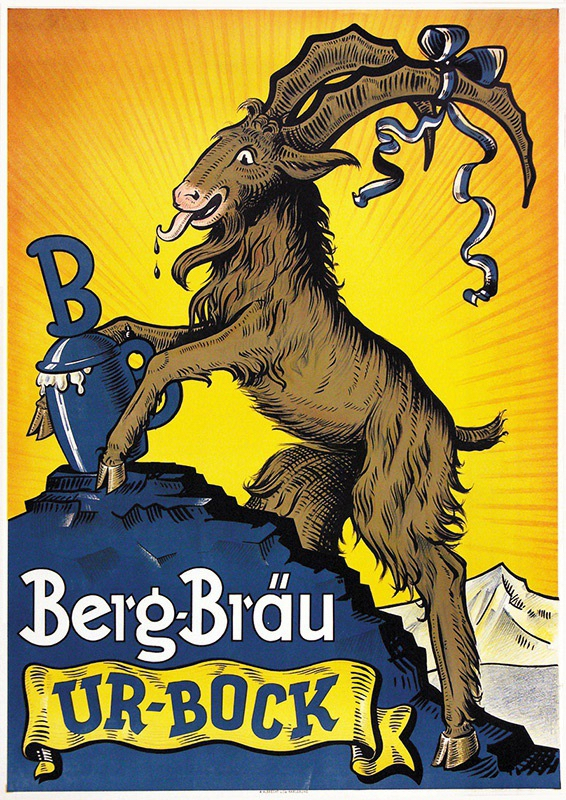
Last year I decided to concentrate on Bock ads. Bock, of course, may have originated in Germany, in the town of Einbeck. Because many 19th century American breweries were founded by German immigrants, they offered a bock at certain times of the year, be it Spring, Easter, Lent, Christmas, or what have you. In a sense they were some of the first seasonal beers. “The style was later adopted in Bavaria by Munich brewers in the 17th century. Due to their Bavarian accent, citizens of Munich pronounced ‘Einbeck’ as ‘ein Bock’ (a billy goat), and thus the beer became known as ‘Bock.’ A goat often appears on bottle labels.” And presumably because they were special releases, many breweries went all out promoting them with beautiful artwork on posters and other advertising.

Friday’s ad is for Thomas Brau Bock Beer, which was published on August 22, 1935. This one was for the Gebrüder Thomas Bierbrauerei of Munich, Germany, which was originally founded in the Middle Ages, but merged with Paulaner in 1928. To be fair, it’s really a small part of a full-page ad for a market chain called “George W. Loft Markets,” in upstate New York, with locations in New Rochelle, White Plains, and the Bronx. This ad ran in The Standard-Star, of New Rochelle, New York, and the exact same ad also ran in the Daily Reporter of White Plains.

Filed Under: Art & Beer, Beers, Breweries, Just For Fun Tagged With: Advertising, Bock, Germany, History, New York

Historic Beer Birthday: Carl Funke

August 22, 2025 By Jay Brooks

Today is the birthday of Carl Funke (August 22, 1855-April 15, 1912). While he’s best known as “a German industrialist, President of the Chamber of Commerce, City Councilor in Essen, Germany, and a Privy Councilor of Commerce, he was also involved running the Stern-Brauerei, in Essen. In 1890, he took over his father’s shares in the brewery, “and became chairman of the supervisory board of the Actien beer brewery in Essen an der Ruhr, which later became the Stern brewery. He held the office until his death in 1912.”

Here’s a biography of Funke from Wikipedia:

As the son of the industrialist Fritz Funke, Carl Funke attended the Humboldtschule secondary school in Essen with an upper secondary school leaving certificate. He then studied linguistics at the University of Geneva. This was followed by commercial training at the Kalk Chemical Factory in Cologne and at the AG for the Chemical Industry in Gelsenkirchen-Schalke.

Carl Funke married the wealthy Katharina geb. Waldthausen, which made a significant contribution to the assets of the Funke family. They had four children together, with the son Fritz Funke (1888–1975) successfully continuing the family legacy.

At the age of 22, Carl Funke took over the management of the Pörtingsiepen colliery in Fischlaken, a later district of Essen. Among other things, he decisively increased their sales through a railway connection. In 1884, at the age of 29, he took over his father’s stake in the mine and continuously expanded his property in the following years by acquiring additional shares. Carl Funke was a member of the supervisory boards of a total of twenty companies and unions, including Deutsche Bank. In 1906 he completed his coal – mines the Essen coal mines AG together, whose supervisory board chairman he became. This year the Heisinger Tiefbau colliery on the Ruhr was named the Carl Funke colliery.

By taking over his father’s shares in 1890, Funke also became chairman of the supervisory board of the Actien beer brewery in Essen an der Ruhr , which later became the Stern brewery. He held the office until his death in 1912.

Since 1882 Funke was a city councilor in the city council of Essen and a member of the Essen district council. As a member of the Essener Verkehrsverein, Funke played a key role in the construction of the Kaiserhof Hotel on Lindenallee around 1900, bringing representative space to Essen for congresses and conferences. The building was badly damaged in World War II and finally abandoned in 1973. Today the SEB Bank, also known as the Lindencenter, is located here. In 1910 Funke was elected as a member of the Prussian provincial parliament. From 1910 to 1912 he followed Max Rötger as President of the Chamber of Commerce.

In the Protestant Church, Funke was involved in the presbyteries of the parishes of Essen-Altstadt, Rellinghausen – Heisingen and Dorstfeld.

Funke received several awards through numerous foundations and donations to charitable purposes such as schools, a hospital, a lung sanatorium and the Karl-Funke-Stiftung parish hall as well as the Carl and Katharina-Funke Foundation for the Essen Realgymnasium. In 1899 he was appointed to the Commerce Council, nine years later to the Secret Commerce Council. He received the Order of the Red Eagle III. Class.

When Carl Funke died in 1912 after an otitis media, he was buried in the family crypt of the Funke and Schürenberg families in the cemetery at Kettwiger Tor. The funeral procession on the afternoon of April 19, 1912 was followed by several thousand people, including representatives of the Ruhr industry, employees of its trade unions and high city officials. After the cemetery was closed in 1955, the common crypt was moved to the Ostfriedhof Essen.

Filed Under: Birthdays, Breweries, Just For Fun Tagged With: Germany

Historic Beer Birthday: Christian Diehl

August 21, 2025 By Jay Brooks

diehl-round
Today is the birthday of Christian Diehl (August 21, 1842-1928). He was born in Hessen-Darmstadt, Germany and moved to the U.S. when he was 28, in 1870, settling in Defiance, Ohio. There, Jacob Karst and Joseph Bauer hired Diehl to be the brewmaster for their Defiance Brewery, which Karst had founded in 1867. The next year, Diehl bought out Karst and the brewery became known as the Bauer & Christian Diehl Brewery. Shortly after Bauer died, and in 1885 it became the Christian Diehl Brewery and later the Christ. Diehl Brewing Co., with Diehl as sole owner. The brewery reopened after prohibition and remained in business for another twenty years, closing for good in 1955.

christian-diehl-portrait

Here’s a portion of an article about Diehl, by Carl Miller, entitled What A Diehl! from the Defiance Crescent News.

The Legacy Begins

On October 21, 1870, a twenty-eight-year-old Christian Diehl arrived in Defiance to take a position as brewmaster at the local brewery. He had learned the art of brewing beer in his hometown of Hessen-Darmstadt, Germany before emigrating to America in 1861. European-trained brewers like Christian found employment easily in mid-nineteenth century America due to the hundreds of small breweries operating throughout the east and midwest.

The young Christian Diehl took full advantage of the demand enjoyed by his profession, traveling from state to state exploring his newly adopted country. Before coming to Ohio, he worked in breweries in New York, Pennsylvania, Illinois and Missouri. Just prior to his arrival in Defiance, he had been employed by a Toledo brewer.

The brewery which lured Christian Diehl to Defiance was established in 1867 by German immigrant Jacob Karst. Known simply as the “Defiance Brewery,” the works was situated on North Clinton street just near the Maumee River. In 1869, local saloonkeeper Joseph Bauer purchased an interest in the brewery, and it was the firm of Karst and Bauer which hired Christian as brewmaster in 1870. By the following year, Christian had accumulated resources enough to buy Karst’s share in the brewery, and the partnership of Bauer and Diehl was established. Aside from a brief participation in the business by Bauer’s son, the brewery operated basically unchanged until the passing away of Joseph Bauer in 1883. Christian, who had apparently achieved a certain degree of financial success with the brewery by this time, purchased Bauer’s interest from his family in 1885.

Centennial-Beer-Labels-The-Christ-Diehl-Brewing-Co--Post-Prohibition-1909

The Next Generation

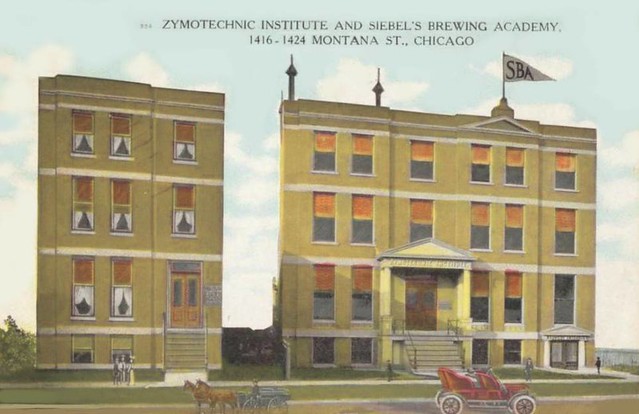
In 1896, three of Christian’s sons — Christian Jr., John C., and Albert F. Diehl — were initiated into the brewery’s management. The young men had virtually grown up inside the brewery and each was already well acquainted with the business. Christian Jr., in fact, had shown such an early “adaptability for business” that he was put in charge of the firm’s books at age thirteen. John C. Diehl, having graduated from the American Brewing Academy in Chicago, took over his father’s post as Diehl brewmaster.

Although the elder Christian Diehl officially continued to fill the office of brewery president, he gradually relinquished control of the family business to his sons. After the turn of the century, Christian spent much of his time tending to the family farm just outside Defiance, where he died in 1928.

The young Diehls lead the brewery into what was perhaps the most prosperous period in its history. By 1899, the Diehl brewery employed 21 men and produced annually about 12,000 barrels of beer (32 gallons per barrel), a nearly five-fold increase over the brewery’s early days. And production continued to climb well into the new century.

The great majority of Diehl beer was consumed within Defiance County in the years before Prohibition. However, a small portion of the brewery’s product was shipped to outside markets. Proximity to the Maumee River provided easy transportation to, among other locations, Ft. Wayne and Toledo. The latter city was quite possibly the brewery’s largest market outside of Defiance. By 1911, sales of Diehl beer in Toledo had justified the construction of a brewery-owned distribution depot in that city. The brewery was said to have sent beer as far north as Grand Rapids before the onset of Prohibition.

Nevertheless, the Diehl brewery’s lifeblood was its local market. In fact, the brewery’s long-time feature brand of beer was named in honor of the city itself: Centennial Beer was introduced in 1894 to commemorate the 100th anniversary of Fort Defiance. Early bottle labels for Centennial Beer depicted General Anthony Wayne engaged in the Battle of Fallen Timbers. Other early Diehl brands included Hofbrau and Diehlgold. All were advertised as being “Diehlicious.”

The Big Drought

By about 1910, it had become apparent that prohibitionist groups such as the Anti-Saloon League and the Women’s Christian Temperance Union were rapidly gaining ground in their quest to abolish the manufacture of alcoholic beverages. The Diehl brothers, having fostered significant growth and expansion of the brewery throughout the early years of the century, were now charged with guiding the family business through what promised to be uncertain times ahead.

The Diehls felt it prudent to begin investigating alternative fields of business in the event that the brewing industry suffered a fatal blow. The milk condensing business emerged as a promising option due to the surrounding farmland, the lack of local competition, and the compatibility of the brewing equipment. Christian Jr. traveled to Wisconsin to observe state-of-the-art condensories in operation and returned with a glowing account of the condition of the industry.

The Prohibition crusade, in the meantime, had reached its peak. A 1918 statewide referendum left Ohio completely dry beginning in May of 1919. And, shortly thereafter, ratification of the 18th Amendment marked the beginning of National Prohibition. Brewers nationwide scrambled to find new areas of business in hopes of being among the lucky few who survived.

Although the Diehls’ plans to enter the milk condensing business had not fully materialized by the time Prohibition came, the proposed venture had attracted a significant amount of local interest. By 1922, several investors with experience in milk condensing had been recruited, and the Defiance Dairy Products Company was soon in full operation in a portion of the old brewery. The Crescent News called the opening of the condensory “a milestone in the commercial life of Defiance.” Indeed, the milk condensory — still owned and operated by the Diehl family — is today one of the city’s largest enterprises.

Incidentally, the brewery was kept in operation well into Prohibition, making “near beer,” a de-alcoholized version of real beer. The bottling works remained active as well, packaging a wide variety of soft drinks.

And this history of the brewery is from “100 Years of Brewing:”

Centennial-Beer-Tip-Trays-3-6-inches-The-Christ-Diehl-Brewing-Co--Post-Prohibition

Filed Under: Birthdays, Breweries, Just For Fun Tagged With: Germany, History, Ohio

Historic Beer Birthday: Bernhard Stroh

August 20, 2025 By Jay Brooks

stroh-coa
Today is the birthday of Bernhard Stroh (August 20, 1822-June 24, 1882). He was born in Rheinland-Pfalz, Germany, and after a detour in Brazil, emigrated to the U.S. and settled in Detroit.

This biography is from Find-a-Grave:

Businessman. He left Germany in 1848, and joined a group of German settlers in Brazil for three years before arriving in America. He landed in Buffalo, New York heading by way of the Erie Canal. The boat he was on docked in Detroit. So Stroh took it upon him self to venture into the city. He liked what he saw and decided to stay. With a few hundred left from the Brazilian business venture he started a small brewery at 57 Catherine Street in Detroit. Soon after establishing his German brewery local patrons in Detroit aquired a desired taste for his German lager beer. Bernhard Stroh would have his sons personally cart small kegs of beer to his customers by wheelbarrow. For over a century now, local Detroiters have enjoyed the same “fire-brewed” taste that the Stroh Family created over 150 years ago.

Stroh-family-1871
The Stroh family around 1871.

This is what Wikipedia has to say about Stroh’s early days through Julius Stroh’s tenure:

The Stroh family began brewing beer in a family-owned inn during the 18th century in Kirn, Germany. In 1849, during the German Revolution, Bernhard Stroh (1822-1882), who had learned the brewing trade from his father, emigrated to the United States. Bernhard Stroh established his brewery in Detroit in 1850 when he was 28 and immediately started producing Bohemian-style pilsner, which had been developed at the municipal brewery of Pilsen, Bohemia in 1842. In 1865, he purchased additional land and expanded his business and adopted the heraldic lion emblem from the Kyrburg Castle in Germany and named his operation the Lion’s Head Brewery. (The lion emblem is still visible in its advertising and product labels.)

Bernhard Stroh’s original beer selling operation consisted of a basement brewing operation and was then sold door-to-door in a wheelbarrow. The new beer (Stroh’s) sold door-to-door was a lighter-lager beer, brewed in copper kettles.

Stroh-brewery-1864-scan
The Stroh Brewery around 1864.

This short account about Bernhard is from the Entrepreneur Wiki:

The Stroh family has a long history of brewing beer, which first began in Germany. However, due to the German Revolution, in 1849, Bernhard Stroh moved the business to the United States after three years of living in Brazil. He started his company with a budget of $ 150.00.

Stroh selected Detroit, Michigan as the location for his brewery and settled there in 1850. Stroh was 28 years old at the time. The company was known for making a Pilsner (also known as Pilzen) style beer. Pilsner beers are fire-brewed and lighter than traditional beers. In 1855, the company increased in size, and then shortly thereafter became known as Lion’s Head Brewery. The company had been known as Stroh’s Brewery until this time.

The most popular beer sold, Stroh’s, was first peddled via wheelbarrow. The new beer was brewed in copper kettles to enrich the flavor. The company name was then changed to B. Stroh Brewing Company when Bernhard passed in 1882, and his son, Bernhard Junior, took over the business. In 1988, Forbes estimated that the Stroh family had an estimated worth of 700 million dollars. The brewing company stayed in the Stroh family until the year 2000.

bernhard-stroh

Filed Under: Birthdays, Breweries, Just For Fun Tagged With: Germany, History, Michigan

Historic Beer Birthday: Johann Casper Bruckmann

August 17, 2025 By Jay Brooks

Today is the birthday of Johann (“John”) Casper Bruckmann (August 17, 1829-August 12, 1887). He was born in “Berka von der Hainich, Wartburgkreis, Thuringia, Germany.” the son of Hartmann Bru(e)ckmann and Christina Maria Braun.

In 1856, with his brother, Frederick Bruckmann, he founded the Cumminsville Brewery, of Cincinnati, Ohio, which was also known as the Frederick Bruckmann Brewery, but by 1872 was called the John C. Bruckmann Brewing Co., although still also known as the Cumminsville Brewery.

Filed Under: Birthdays, Breweries, Just For Fun Tagged With: Germany, History, Ohio

Historic Beer Birthday: Adam Eulberg

August 15, 2025 By Jay Brooks

eulberg-bros

Today is the birthday of Adam Eulberg (August 15, 1835-May 20, 1901). He was born in Nassau, Germany but moved to Portage, Wisconsin with his family when he was 19, in 1854. In 1884 he and his brother Peter bought the City Brewery, which had been founded in 1852 by Carl Haertel. His brother Peter passed away suddenly shortly thereafter and Adam carried on the business alone, at least until his two sons were old enough to join him. Adam and Peter renamed the brewery Eulberg Bros. Brewery, but Adam’s family changed it to the Eulberg Brewing Co. in 1907. They survived prohibition making soda, and resumed beer production after repeal, but the Eulbergs sold the business in 1944. It closed for good in 1958.

Adam-Eulberg

This is Eulberg’s obituary from the American Brewers’ Review:

Adam-Eulberg-obit
Eulberg-brewery-1880
The Eulberg Brewery before he bought it, in 1880.

This short history of the brewery is from the Wisconsin Historical Society:

Milwaukee dominated Wisconsin’s early brewing industry, but successful breweries were found in communities throughout the state. In 1852, German immigrant Carl Haertel began producing beer in Portage, Wisconsin. In 1884, brothers Adam and Peter Eulberg, also originally from Germany, acquired the Haertel Brewery. The Eulberg Brewing Company remained in the family until 1944 and shut its doors permanently in 1958.

Eulberg-crown-select

And here’s another history of the brewery building itself, which is still standing in downtown Portage, Wisconsin.

Eulberg-building
Eulberg-picnic-beer

As far as I can tell, he’s not related to Caspar Eulberg, who was born in roughly the same area of Germany, and started a brewery in Galena, Illinois called C. Eulberg & Sons.

Eulberg-old-portage
Eulberg-can

Filed Under: Birthdays, Breweries, Just For Fun Tagged With: Germany, Wisconsin

« Previous Page
Next Page »

Find Something

Northern California Breweries

Please consider purchasing my latest book, California Breweries North, available from Amazon, or ask for it at your local bookstore.

Recent Comments

  • Ernie Dewing on Historic Beer Birthday: Charles William Bergner 
  • Steve 'Pudgy' De Rose on Historic Beer Birthday: Jacob Schmidt
  • Jay Brooks on Beer Birthday: Bill Owens
  • Steve 'Pudgy' De Rose on Beer Birthday: Charles Finkel
  • Steve 'Pudgy' De Rose on Beer Birthday: Bill Owens

Recent Posts

  • Beer In Ads #5203: Robert Portner’s Bock Beer February 15, 2026
  • Beer Birthday: Daniel Satterthwaite February 15, 2026
  • Beer In Ads #5202: Here’s To You Our Valentine Fidelio Bock Beer February 14, 2026
  • Historic Beer Birthday: Benedict Frank Haberle February 14, 2026
  • Beer Birthday: Chuck Silva February 14, 2026

BBB Archives

Feedback

Head Quarter
This site is hosted and maintained by H25Q.dev. Any questions or comments for the webmaster can be directed here.