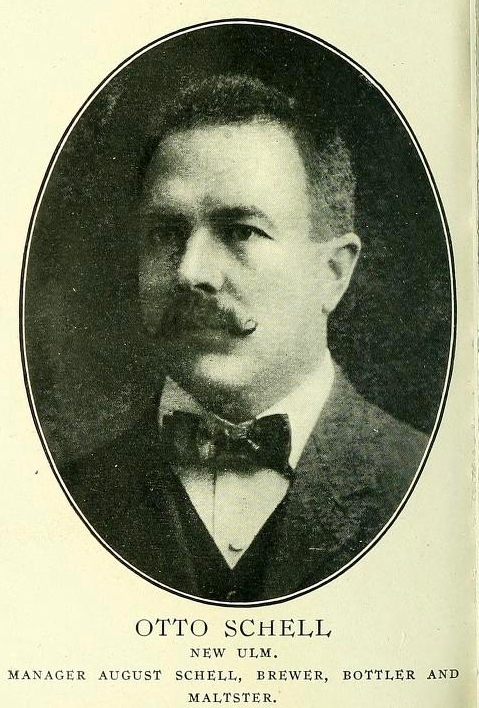
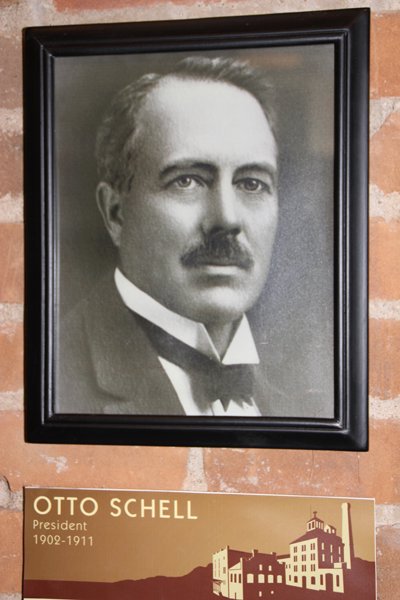
Today is the birthday of Otto Schell (July 15, 1862-January 14, 1911). He was born in New Ulm, Minnesota, the son of August Schell, who founded August Schell Brewing Co. Schell’s Brewery is still in business today, and is still owned by the family who started it. “It is the second oldest family-owned brewery in America (after D. G. Yuengling & Son) and became the oldest and largest brewery in Minnesota when the company bought the Grain Belt rights in 2002.” When August died in 1891, he left the brewery to his wife Theresa, with his son Otto as manager of the brewery. “While the brewery mourned the loss of its founder, Otto became its driving force. In 1902 the brewery was incorporated and Otto was elected president, his mother Theresa was elected vice-president, and his brother-in-law George became secretary-treasurer. Otto was president from 1902 until his untimely death in 1911.
This is his obituary from the New Ulm Review, for January 18, 1911:
It would be difficult to call in mind the death of any citizen in this community that came with more shocking effect and produced a more sincere mourning throughout the entire city than does that of Otto Schell. Is it possible that the man of sturdy physique and with healthy and pleasant countenance, seen on our streets but the day before, greeting his friends and acquaintances in his usual pleasant way should now lie cold in death? Yes it is true. Otto Schell died about 10 o’clock, apparently of no other cause than a choking spell which according to the first reports, was due to a severe cold he contracted some time ago. An autopsy held over his body however revealed the fact that his sudden death was cause by uraemic poison due to kidney trouble of severeal years standing. Even on the morning of the day of his death he resumed his regular duties at the office of the brewery continuing same until noon. Before going home he called on his aged mother who lies at the point of death. This was his daily custom. Being somewhat indisposed he remained at home that afternoon, but was able to partake of a hearty supper. At about 8 o’clock, however, his condition became such as to necessitate a physician who promptly responded, but whose help was of no avail, The end came at 10 o’clock.
In the death of Mr. Schell New Ulm loses one of its most prominent and public spirited citizens. Having been born and reared in this city its welfare was always uppermost in his mind. His ardent love for the beauties of nature prompted him to convert the surroundings of his home and establishment into a veritable beauty spot. This trait also made him valuable to the community at large in the capacity as park commissioner, which office he held for several years. His loss is furthermore keenly felt by various enterprises in which he was interested in a financial and social way, such as the New Ulm Stone Co.; the Brown County Agricultural Society; the Citizens State Bank; the New Ulm-Maennerchor; the 2nd Regiment Band; the Sons of Hermann Lodge; the Freemasons; the Arbelterverein, etc. The State Horticultural Society elected him a Life-member. He also belonged to the State Brewmasters Association. Although he never held a political office he was ever ready to be of servce to the community by lending his assistance with his practical knowledge, ability and experience.
The relation of the deceased as employer of his employees was such as to give evidence to his manly character and kindness of heart. This sincere sorrow manifested by them at the announcement of his death gave ample proof of the high esteem in which he was held by everyone in his employ.
The highest tribute, however that can be paid to any man is his ideal attitude toward the immediate members of his family. And in this respect too much can not be said in honor of the deceased. Although the loss of Mr. Schell is a heavy blow to the community it will be most keenly felt by his wife, children and all relatives. A loyal and true husband, a loving, kind and affectionate father, a dear brother, a devoted son, a good neighbor will be missed in the Schell home.
He had the rare faculty of strictly attending to his own business and never allowing himself to be unduly influenced by any faction sentiment. Herein lies the secret of the fact that he was probably as popular a man in all factions as as ever lived in the confines of this city.
Otto Schell was born July 15,1862 in New Ulm. He received his education in the public schools of this city. At the age of 16 years he went to St. Paul, attending a business college in that city. Completing this course he became a student at the Mankato Normal School. Having finished his business education he worked in his father’s office for about one year. When 19 years old he made a journey to Germany, visiting his father’s native town where he remained a little over a year. On his return he resumed the office work at his father’s brewery.
On the 6th of October, 1885 he was married to Miss Adelia Schwertfeger of New Ulm. After the death of his father, August Schell, the deceased managed the extensive business for his mother. When in the year 1903 the brewery was converted into a stock company he became the president and business manager of the new concern, which position he held up to the time of his death. In 1901 he made another trip to Germany being accompanied by his wife and two children.
Mr. Schell is survived by his wife and two children, Walter. 16 years and Mrs. Cleveland Frederich of Springfield; his aged mother, Mrs. August Schell; three sisters, Mrs. Geo. Schneider, Mrs. Geo. Marti of this city and Mrs. Yoerg, of Winthrop and one brother, Adolph of Portland, Oregon.
And this is the portion of the Schell story from Immigrant Entrepreneurship that discusses Otto’s involvement in the brewery:
August Schell navigated the challenges of developing a rural business by strengthening family ties in the brewery’s operation. Like many small business founded by immigrants, family dynamics played a large role in the company as the children grew older. They would play a more crucial role in brewery operations as August Schell became increasingly unable to walk due to steadily worsening rheumatoid arthritis. He turned over day-to-day operations to his family in the late 1870s. The first family member to emerge within the company was Schell’s oldest son, Adolph. Adolph traveled to Chicago to learn brewing techniques and train at another brewery before coming back to New Ulm. By 1879, Adolph was directly involved in managing the company. Though August Schell initially appointed his younger son, Otto, as master brewer for the firm, by the mid-1880s he had decided that Otto was better suited than Adolph to take the reins of the company.
After attending public school in New Ulm, Otto attended business college in St. Paul and completed a business education degree at nearby Mankato Normal College. When he was nineteen years old, Otto lived for a year in his father’s German hometown while studying brewing. After returning to the U.S., he began working in the brewery’s business office. The exact reasons behind August Schell’s decision to groom his younger son as his successor are no longer known, but soon after Adolph’s brief period as brewmaster and Otto’s return to New Ulm, Adolph was shifted out of key leadership roles in the company and given a variety of other jobs. Adolph then established his own business distributing Schell beer in areas a few hours west of New Ulm, and later moved to California in 1889 to start a fruit and chicken ranch. Though newspaper reports highlighted Adolph’s desire for a better climate as the deciding factor in his move, family reports emphasized the growing enmity between the brothers. By the early 1880s, Otto Schell had taken control of the brewery’s operations. When August Schell died after becoming increasingly weakened by arthritis at the age of 63 in 1891, he had ensured that his company would continue to prosper while still remaining in family hands.
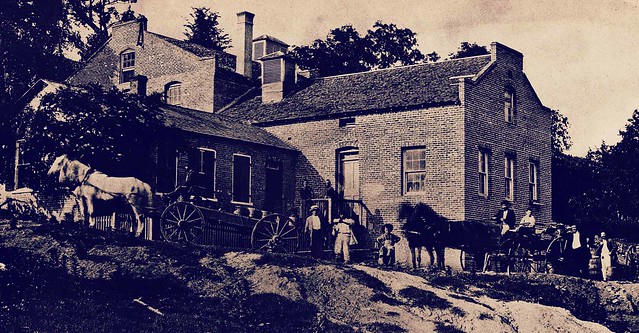
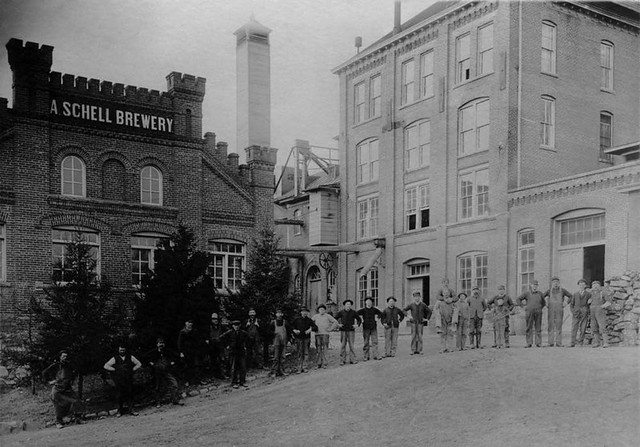
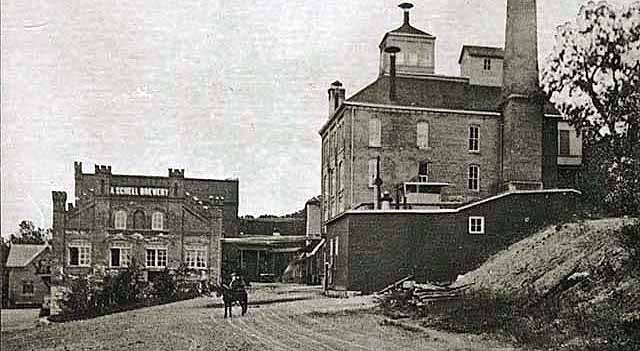
Such family politics along with the frontier challenges and his growing competition spurred August Schell and his son, Otto, to expand and innovate. By 1879, August Schell’s continuous expansion had created a massive brick brewery with several outbuildings on the bluffs of the Cottonwood River. The main brewery was 150 feet long and from 30 to 80 feet in depth. Two main copper brew kettles dominated the brewery – one with a 25-barrel capacity and the other with a 12-barrel capacity. Underneath the main floor of the brewery were seven separate stone cellars for lagering beer and malting barley. There were four ice houses capable of storing 700 tons of ice. The ice was harvested from the Cottonwood River which ran 100 feet below the brewery at the bottom of the cliff. Each block of ice would be attached to tongs and hauled by a team of horses to the cellars via a rope and pulley system.
Schell Brewing Company’s physical plant grew even more once Otto Schell took over daily operation of the company and initiated a major renovation of the brewery. In 1887, the company installed bottling equipment in order to reach broader regional markets and appeal to retailers and consumers who did not wish to purchase an entire barrel of beer at one time. The brewery kept expanding the market for its beer as railroads made transporting beer into new regions easier. For example, in 1890, the company built an ice house in St. James, Minnesota, (about 30 miles south of New Ulm) as a distribution point. In the fall of 1890, Schell erected a new two-story brick building to house beer and ice, as well as a barley storage house to take the place of an older framed building, at a cost of $7,000 for both ($179,000 in 2011 dollars). By 1891, Schell’s produced nearly 9,000 barrels of beer a year. Otto Schell proposed to more than double the brewery’s capacity so that it could produce over 20,000 barrels a year. The expansion would take the company to a production level that only a few other breweries in the state could match, even in the Twin Cities. With plenty of cash netted from doing a brisk business over the previous several years, Schell plowed the money back into the physical plant. He hired a Chicago architect to design the changes. Throughout much of the fall and winter of 1892-1893, the brewery shut down in order to complete the rebuilding effort. For approximately six weeks, new roads were built around the facility. Shell spent almost $20,000 ($510,000 in 2011 dollars) on constructing this modernized and expanded brewery. Most of the new expansion was completed just as the Panic of 1893 derailed the United States’ economic engine. Without having to rely upon loans or banks to stay solvent, however, the Schell Brewing Company weathered the Panic of 1893 remarkably well.
Otto Schell both expanded the brewery’s physical plant and invested heavily in new, expensive machinery to stay at the head of the crowded brewing industry in New Ulm. In 1895, the company again expanded by building a four-story malting house adjacent to the brewery with the intent of manufacturing malt on a commission basis. In the mid-1890s, the brewery upgraded its machinery including a new copper kettle able to produce 125 barrels of beer at a time, steel mash tubs and tanks, and other up-to-date equipment. In 1897, Otto Schell traveled to St. Louis, a city with a sizeable German-American community, to buy ice machines for better refrigeration of beer and improved ventilation. Otto Schell invented and patented a new machine and a new method for separating hops from beer in 1902. This innovation cut the costs associated with filtering the beer in half, which further increased revenue in the long term.
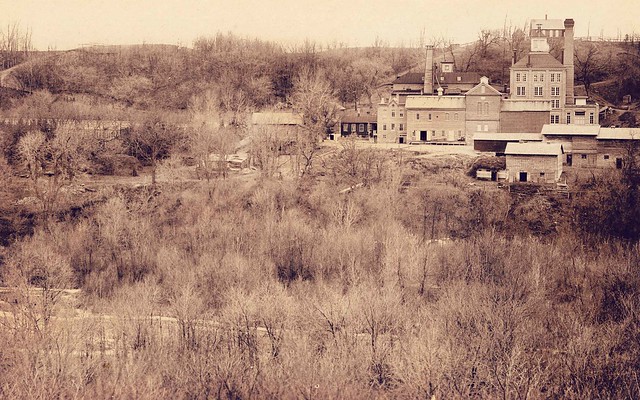
The Schell brewery seen from a distance.
When Otto Schell incorporated the August Schell Brewing Company in October of 1902 at $300,000 ($8,090,000 in 2011 dollars), he established a tradition of appointing only family members to the board of directors. The original board of directors listed Otto Schell as president, Theresa Schell, his mother and the wife of founder August Schell, as vice-president, and George Marti as secretary and treasurer. When Otto Schell died at the age of 48 in 1911, George Marti, August Schell’s son-in-law, took over as president of the August Schell Brewing Company. Operation of the company has remained within the Marti family ever since.
Though August Schell Brewing Company remained a relatively small regional brewery (one among many prior to Prohibition) compared to giants such as Anheuser-Busch and Schlitz, the close ethnic ties cultivated by German immigrants and organizations in New Ulm helped the firm to maintain a distinct identity and regional appeal. Continued family connections also played a role in sustaining the August Schell Brewing Company during Prohibition when it produced root beer (1919 Root Beer) and candy to stay afloat. Considering how few breweries remained viable outside of the large corporate breweries in post-Prohibition and post-World War II America, the fact that New Ulm boasted two breweries into the 1960s is noteworthy but also reflects the regional support for local brewing operations. After over 100 years in business, Hauenstein Brewing Company, Schell’s closest and most direct competition in its marketplace, closed its doors permanently in 1969. Such persistence proved stronger in rural ethnic communities like New Ulm where linguistic ties held people closer to others like them compared to similar sized ethnic communities in larger cities.
Social Status, Networks, and Public Life
Although the Turnverein organization aided August Schell’s initial rise in Cincinnati and later New Ulm society, Schell’s growing wealth and regional prominence soon made him a respected public figure beyond his status as a Turner. By the late 1870s, August Schell could indulge in developing his interests outside of business. He spent considerable wealth to design and create a new family mansion and elaborate gardens in the 1870s. Acting the part of a respected member of society, August Schell became a patron of the arts by hiring a young, and eventually notable, artist, Anton Gag, to help in the creation of his mansion. Like his father, Schell delighted in the outdoors and everything associated with it. He continually added to his deer park, the symbol of his brewery, which eventually grew to include sixteen deer by the time of his death in 1891. Every time an animal was added to his menagerie, the newspapers reported it. For example, while there were plenty of native deer in the area, Schell imported a tame fawn from Wisconsin to inhabit his backyard. Numerous wild animals from the Upper Midwest increasingly called the Schell deer park home, including wild geese, cranes, and pheasants. Schell’s tastes in animals ran to the exotic as he got older. In 1890, the newspaper reported that Schell’s pet monkey had escaped from its cage and was only captured five days later.
As August Schell rose in public prominence, he gradually separated himself from the local Turnverein. Schell remained a member of the Turners until his mid-fifties in 1884. Neither of his sons became members of the New Ulm Turnverein (though his son-in-law, George Marti, who eventually took over the family business in the early twentieth century became a member in 1879). Even prior to 1884, though Schell may have remained a member of the Turners, he became less prominently involved in the organization. Due to rising tensions between Turners and non-Turners in the region, Schell’s actions are not surprising. Small-town, frontier societies, in particular, breed familiarity and close ties but also sharp resentments among a population where everyone was a known quantity. The stark differences in worldviews of the Catholic German-Bohemians (who formed the bulk of the working class in New Ulm) and the liberal Turners like Schell who disdained organized religion bred underlying tensions within the community. Schell and his fellow Turners dominated the public life of New Ulm for decades. Even into the 1890s, the Turners still controlled the six-member school board that set the curriculum, hired teachers, managed the land owned by the school district, and planned construction of new schools. The total removal of religion from the schools, enforced by Turner school board members, angered many citizens of New Ulm. The Turners’ outright opposition to religion was anathema to religious parents at time when elsewhere in the United States the separation of church and state was much more loosely interpreted by school boards. This strong conviction flowed naturally out of their freethinking, liberal philosophy. Education, they believed, was the best means to combat the mysticism and superstitions bred by organized religion. Controlling the public school board, the Turners stamped their liberal philosophy upon the schools’ curriculum. For example, they used German-language textbooks published by the Turners. The public schools closed for Turner holidays as well. Furthermore, the school board held their meetings at Turner Hall. Though the Turners themselves continued using German as their primary language for years to come, they insisted that English receive primary consideration in the public schools. Their children would be raised as Americans who would be comfortable in an English-speaking world. This sentiment was not embraced by all within the borders of New Ulm. The 1892 annual New Ulm school meeting during which new school board member would be elected became a referendum on Turner influence in New Ulm in all areas of public life. One of the candidates that won a seat on the board in this election was a prominent businessman, Charles Silverson, owner of the Eagle Roller Mill in New Ulm and an immigrant from Baden as well. Silverson and his allies now openly charged the Turners with manipulating the public school system and the city’s politics.
Whether intentional or not, Schell and his family were conspicuously absent among the business leaders who participated the fight over control of the public school system of New Ulm. For immigrant entrepreneurs like Schell, getting caught up in such social and political divisiveness could have had clear financial repercussions among a knowledgeable customer base with alternate choices. Although Schell held a strong market presence in south-central Minnesota, he still faced competition not just from other breweries in New Ulm but from even more distant breweries, especially with the advent of the railroad. Seeking to maintain the widest customer base, Schell likely knew he would lose market share if he, his family, or his company were perceived as part of the simmering social crisis in the region. The Schell Brewing Company, like nearly all small-town businesses, had to negotiate intensely personal tensions within the local community in order to thrive. Market share and financial success were often impacted not simply by their product alone but by public perceptions of the company and its leaders.
Although factions within New Ulm hardened their animosity towards each other, the Schell Brewing Company remained above the fray. These examples of opposition to the Turners provide a valuable window into the community during the crucial period in Schell’s company history when control was passing from August Schell to his son, Otto. Well before the conflict of the 1890s, the Schells’ had become regarded as major public figures in New Ulm and the surrounding region not because of their status as Turners but because of their beer. Without alienating their old Turner allies and connections, the Schell family withdrew from membership in the Turners just as the non-Turner population increased dramatically, which proved to be a wise business move for the firm (perhaps as forward-looking as any other decision in the company’s history). The conflict could have led to the family being branded as elitist Turners. Instead, the Schell family retained their long-developed status as widely respected businessmen.
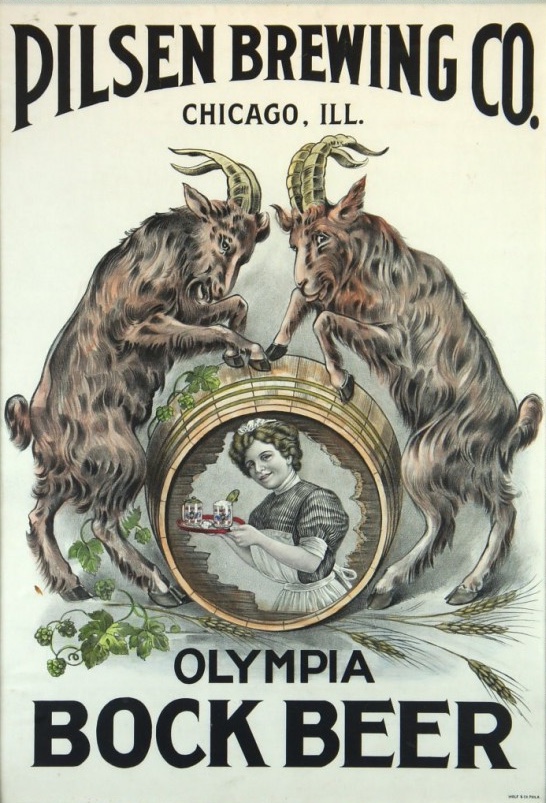
Last year I decided to concentrate on Bock ads. Bock, of course, may have originated in Germany, in the town of Einbeck. Because many 19th century American breweries were founded by German immigrants, they offered a bock at certain times of the year, be it Spring, Easter, Lent, Christmas, or what have you. In a sense they were some of the first seasonal beers. “The style was later adopted in Bavaria by Munich brewers in the 17th century. Due to their Bavarian accent, citizens of Munich pronounced ‘Einbeck’ as ‘ein Bock’ (a billy goat), and thus the beer became known as ‘Bock.’ A goat often appears on bottle labels.” And presumably because they were special releases, many breweries went all out promoting them with beautiful artwork on posters and other advertising.
Monday’s ad is for Gettelman’s Bock Beer, which was published on July 14, 1939. This one was for the A. Gettelman Brewing Co. of Milwaukee, Wisconsin, which was originally founded in 1855. This ad ran in The Journal Times, of Racine, Wisconsin.
Today is the birthday of Joseph Schmid (July 14, 1814-December 18, 1881). He was born in Hausen, Hohenzollern, but grew up in Constantz, where he learned to brew. He started a brewery in Germany, but sold it and came to American when he was 42, in 1856.
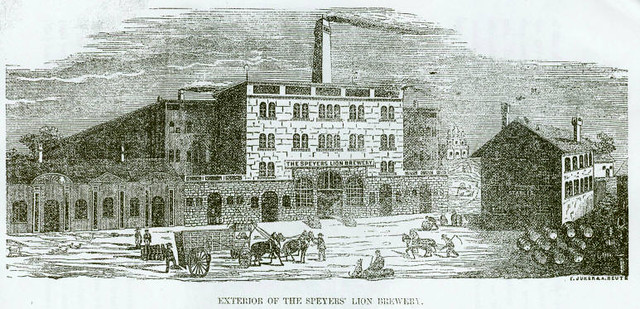
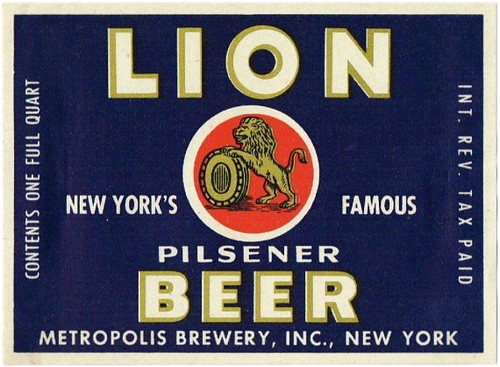
He initially settled in Illinois where he started the Atlantic Brewery in Rock Island, but a decade later when he joined the Lion Brewery, which was also known as the Bernheimer & Schmid Brewery. There was also an August Schmid involved in that business, and it’s unclear the relationship between the two Schmids. The brewery survived prohibition but closed for good in 1941.
This short biography of Joseph Schmid is from the Western Brewer reprinting his obituary 25 years after the fact. The piece mentions the “Lim Brewery” but I’m convinced that’s a typo and should read “Lion Brewery.”
Another account appears to clear up some of the confusion regarding Joseph and August, from the Columbia University Libraries:
A locus for both business and pleasure in Morningside Heights, the Lion Brewery began operations in 1850 and continued until its demolition in 1944. During that time, especially in the late 19th-century, it rose to be a community focal point. It originated with a farm—stretching from Tenth Avenue to Central Park, and 106th Street to 110th Street—belonging to Joseph Schmid (sometimes spelled “Schmidt”) on which he built a brewery in the 1820s, operating as Schmidt & Speyer. Soon, a change of partners brought a change in name to Bernheimer & Schmidt, for Schmid’s new partner, former brewery worker Emanuel Bernheimer. The two renamed it the Lion Brewery in 1850; within thirty years it was generating profits estimated between $1,500,00 and $2,225,000. Real estate speculation doomed the partners, however, and by May 1879, the year after the newspapers’ estimate of their wealth, their combined net worth had fallen to $500,000. They dissolved their partnership and each man transferred his share of the business to his better-educated son: Joseph Schmid transferred his holdings to his son August, and Emanuel Bernheimer to his son Simon. August and Simon applied their education to the management of the business, and by 1888 the plant alone was valued at $1,5000,000.
And this account of some litigation reported by the American Brewers’ Review shed further light on the ownership question of the Schmids.
Last year I decided to concentrate on Bock ads. Bock, of course, may have originated in Germany, in the town of Einbeck. Because many 19th century American breweries were founded by German immigrants, they offered a bock at certain times of the year, be it Spring, Easter, Lent, Christmas, or what have you. In a sense they were some of the first seasonal beers. “The style was later adopted in Bavaria by Munich brewers in the 17th century. Due to their Bavarian accent, citizens of Munich pronounced ‘Einbeck’ as ‘ein Bock’ (a billy goat), and thus the beer became known as ‘Bock.’ A goat often appears on bottle labels.” And presumably because they were special releases, many breweries went all out promoting them with beautiful artwork on posters and other advertising.
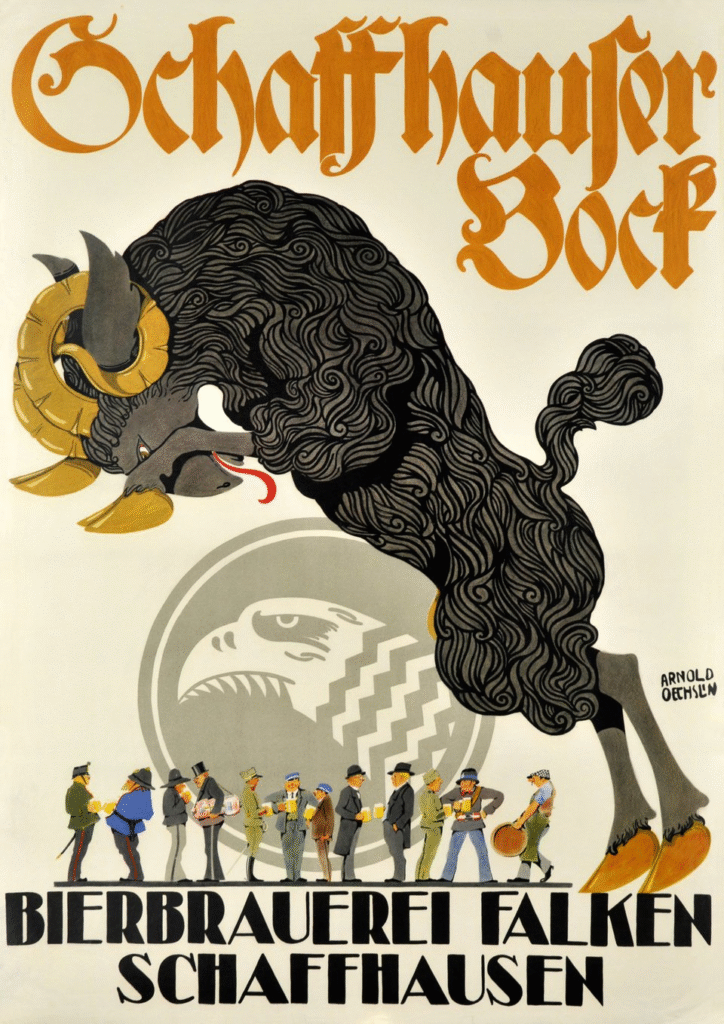
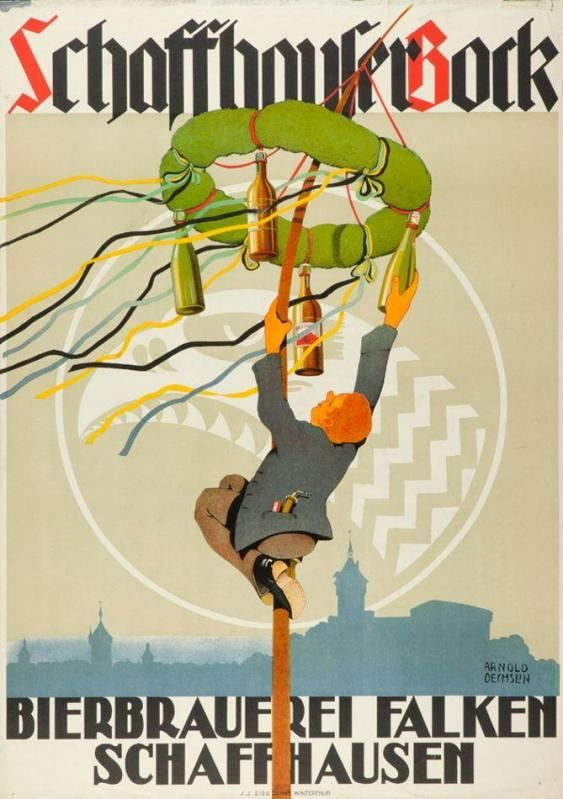
Sunday’s poster is for Falken Schaffhauser Bock Beer, and was published in 1934. This one was made for the Bierbrauerei Falken Schaffhausen, or Falcon Brewery, of Schaffhausen, Switzerland. The brewery was founded in 1799, and is still in business today, and is “considered the only independent brewery in the Schaffhausen region,” and is Switzerland’s 5th largest brewery. This one is for their Schaffhauser Bock and shows a very thirsty man who apparently shimmied up the town maypole to grab one of the bottles of beer tied to the wreath at the top. It was created by Swiss artist Arnold Oechslin.
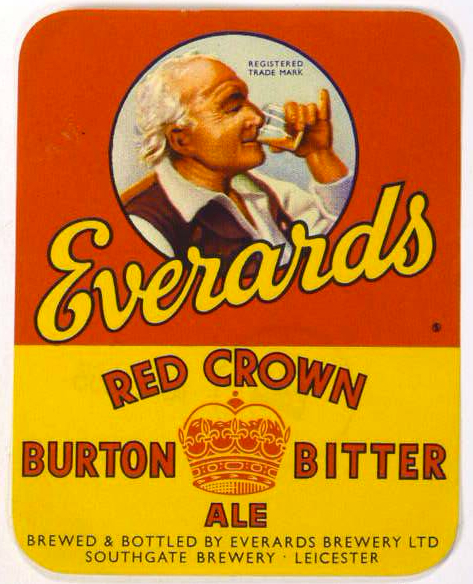
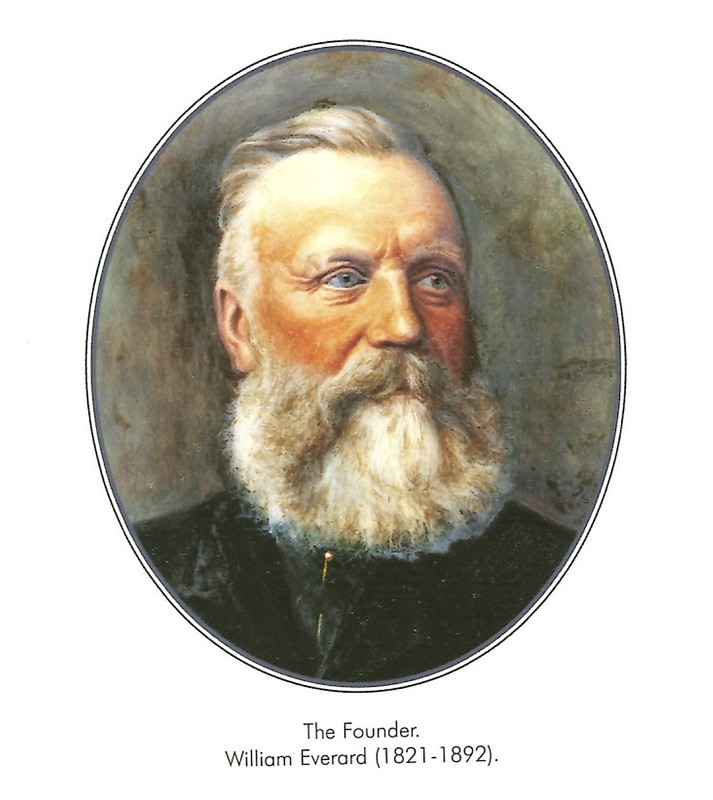
Today is the birthday of William Everard (July 13, 1821-December 28, 1892). Everard co-founded what would become known as the Everards Brewery, which is still a going concern today, and is still run by an Everard, who is fifth generation from William.
William Everard was born on 13th July 1821 in a country where the Industrial Revolution was still in its infancy, and farming remained the largest single occupation. William married Mary Ann Bilson on27th March 1847, they had three children- one of which was Thomas William who would eventually continue his fathers work at the brewery.
On the fifth October 1849, William entered into partnership with Thomas Hull, a local maltster. They leased the existing brewery of Messrs Wilmot and Co. on Southgate Street, Leicester. The brewery became well established during William’s forty two years in charge.
As a successful and responsible Victorian citizen, William took public service seriously and devoted a larage amount of time to several public bodies. He joined the Leicester Highways Board on its constituition, and served for twenty years as its chairman. He was an energetic supporter of the Conservative Party, arranging meetings and political gatherings at his house, eventually becoming chairman of the Harborough Division.
Continuing to operate his farm as well as run his business, William also became prominent in local agricultural affairs as a member of the Chamber of Agriculture and Leicestershire Agricultural Society, founded in 1833.
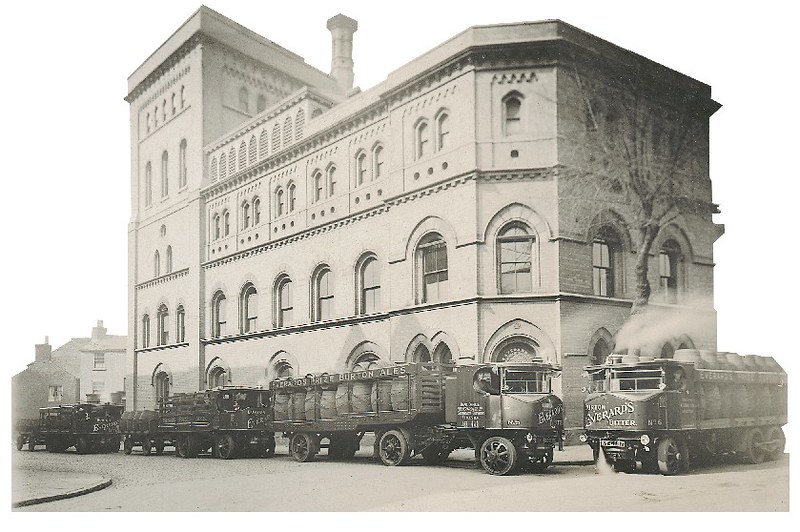
The brewery, around 1875.
And here’s the basic brewery history from Wikipedia:
The company began as Hull and Everard in 1849 when William Everard, a farmer from Narborough Wood House and brewer Thomas Hull leased the Southgate Street Brewery of Wilmot and Co from the retiring proprietors. Although Hull continued as a maltster, Everard was the driving force behind the business which he managed until his death in 1892.
The business expanded as the company progressively acquired outlets, with over 100 pubs by the late 1880s. In 1875 the company moved to a new state of the art tower brewery designed by William’s nephew architect John Breedon Everard. The brewery, on the corner of Southgate St and Castle St extracted very pure water from wells 300 feet deep beneath the premises and steam engines played a significant part in the mechanisation.
After the death of William, control passed to his son Thomas. The historic centre of the UK brewing industry remained some 40 miles away at Burton-upon-Trent, which by the 1890s produced one tenth of Britain’s beer. Everard’s leased the Bridge Brewery on Umplett Green island in 1895 but its 10,000 barrels per year capacity proved insufficient. It was replaced with the newer Trent brewery in Dale St which became available after going into liquidation in 1898. The Southgate brewery remained the distribution centre to the Leicestershire pubs with beer arriving by rail from Burton. The Trent brewery was purchased outright in 1901. It was renamed the Tiger Brewery around 1970.
At some point their Tiger Best Bitter became their flagship beer, and I remember really enjoying during my first CAMRA festival in the early 1990s. It was a regional festival in Peterborough, which happened to be going on in later summer at the end of my wife’s summer semester at the University of Durham. So we took the train up to Peterborough from London to attend the festival, and it was great fun. I had many fine beer that night, but for whatever reason I clearly recall liking this one.
Last year I decided to concentrate on Bock ads. Bock, of course, may have originated in Germany, in the town of Einbeck. Because many 19th century American breweries were founded by German immigrants, they offered a bock at certain times of the year, be it Spring, Easter, Lent, Christmas, or what have you. In a sense they were some of the first seasonal beers. “The style was later adopted in Bavaria by Munich brewers in the 17th century. Due to their Bavarian accent, citizens of Munich pronounced ‘Einbeck’ as ‘ein Bock’ (a billy goat), and thus the beer became known as ‘Bock.’ A goat often appears on bottle labels.” And presumably because they were special releases, many breweries went all out promoting them with beautiful artwork on posters and other advertising.
Saturday’s poster is for Falken Schaffhauser Bock Beer, and was published in 1935. This one was made for the Bierbrauerei Falken Schaffhausen, or Falcon Brewery, of Schaffhausen, Switzerland. The brewery was founded in 1799, and is still in business today, and is “considered the only independent brewery in the Schaffhausen region,” and is Switzerland’s 5th largest brewery. This one is for their Schaffhauser Bock and shows a very thirsty man who apparently shimmied up the town maypole to grab one of the bottles of beer tied to the wreath at the top. It was created by Swiss artist Arnold Oechslin.
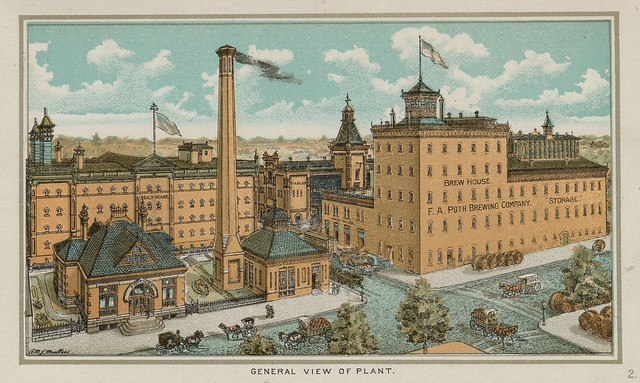
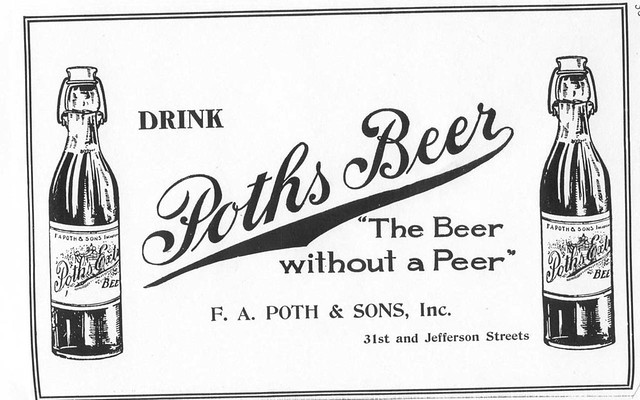
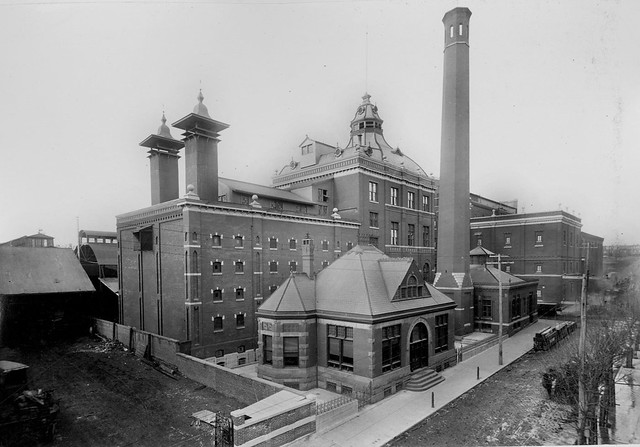
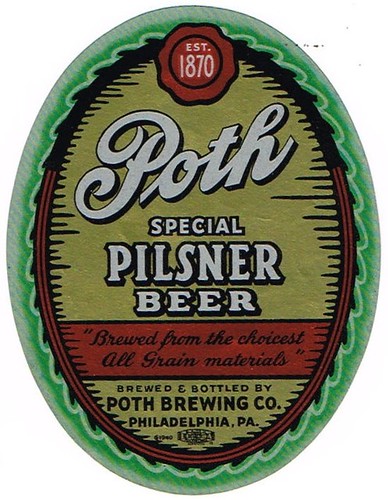
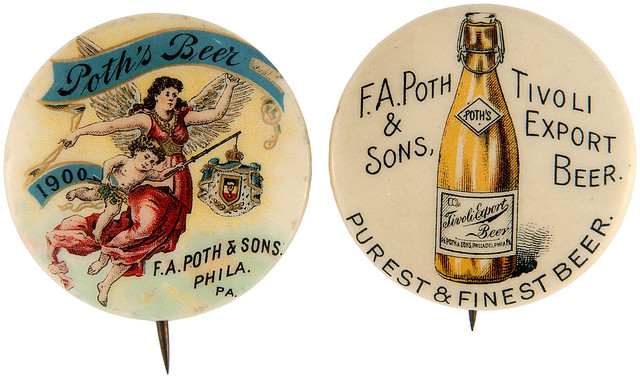
Today is the birthday of Harry A. Poth (July 11, 1881-November 16, 1931). He was born in Pennsylvania, and attended the William Penn Charter School until 1898, after which he graduated from the Pennsylvania Military Academy in 1902. He then attended the Wallerstein Brewing Institution, becoming a brewer at the Fred A. Poth Brewery, which by 1875 was the largest brewery in the U.S., and which his grandfather, Frederick August Poth founded in 1870. It was incorporated in 1893, when his sons were working with him, including Harry’s father Frederick A. Poth, and it was renamed the F. A. Poth & Sons Brewery. Harry, of course, was one of the “Sons” in the name. His younger brother, Frederick J. Poth, seems to have focused on the management side of the business, while Harry was the brewer. It reopened after prohibition briefly as the Poth Brewing Co. Inc., but closed for good three years later, in 1936.
The Poth brewery, from an illustration done in the early 1890s.
I couldn’t find any photographs of him, which isn’t too surprising given I couldn’t find any of his father and only one of his brother, Frederick J. Poth. Sadly, I could find almost nothing else about him, either.
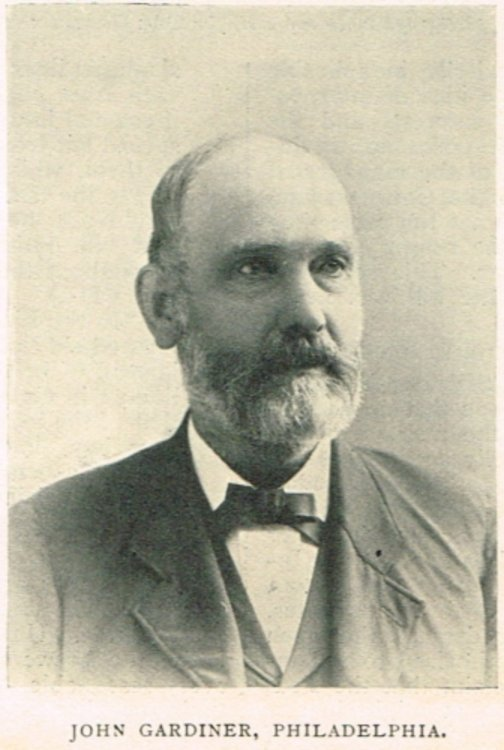
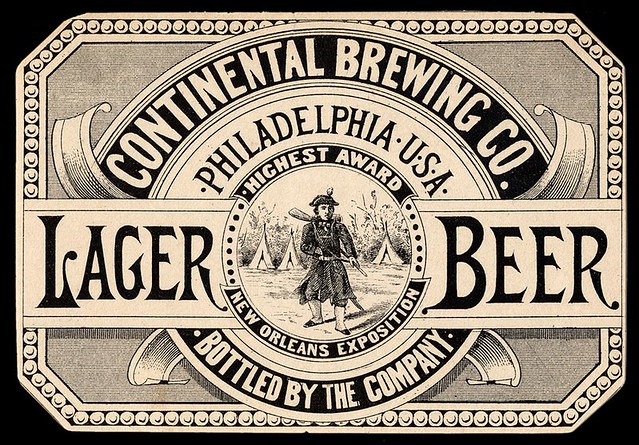
Today is the birthday of John Gardiner (July 11, 1825-July 5, 1903). Gardiner was born in upstate New York, in Albany, where he learned brewing from his father. He moved to Philadelphia when he was 24, in 1849, and worked for Massey’s Brewery before buying the James Smyth Brewery in 1874, renaming it John Gardiner & Co. Brewery. In 1883, Gardiner renamed it again, this time the Continental Brewing Co., which remained its name until it closed at the start of prohibition in 1920.
He appears to have married an Anna E. Snyder, and not Caroline Schmidt (as I’d earlier believed). According to one commenting relative, it was Gardiner’s son, John Jr., who in 1866, married one of brewery owner Christian Schmidt’s daughters, Caroline, and according to a history of Schmidt’s Brewery, he began working for his father-in-law’s brewery at that time. But it’s unclear if there is any relationship to Gardiner’s purchase of the Continental Brewery. Unfortunately, Find-a-Grave’s listing for both John Gardiner and Anna do not list a son named John Francis Gardiner Jr., but instead a John L. Gardiner Jr., a daughter, Mary, and another son, George.
Here’s how Gardiner and his family are mentioned in the history of Schmidt’s Brewery:
For generations the name of Gardiner had been well known in brewing circles. The family owned the Continental Brewing Co. in Philadelphia. John Gardiner married a daughter of Christian Schmidt. John Gardiner Jr., and Edward A. Gardiner, sons of John Gardiner, joined Schmidt’s to add new luster, in, respectively, sales and finance., to the family management team.
During the entire period of relegalization- including the peak year of 1955- and through to 1958, John Gardiner Jr., a grandson of the founder, was sales and advertising manager for the brewery. Mr. Gardiner, now a vice president, saw sales rise under his management from 106,000 in 1934 to almost 2 million in 1955.
Edward A. Gardiner, his brother, now chairman of the board, was responsible for the financial arrangements which made possible the various expansions of the brewery in the 1930’s, 40’s and early 50’s. It was Mr. Gardiner’s raising of the funds to accommodate the expansion of the company in 1947 and 1948 which kept the brewery abreast of modern changes and in a position to meet the difficult competitive challenge of the postwar years.
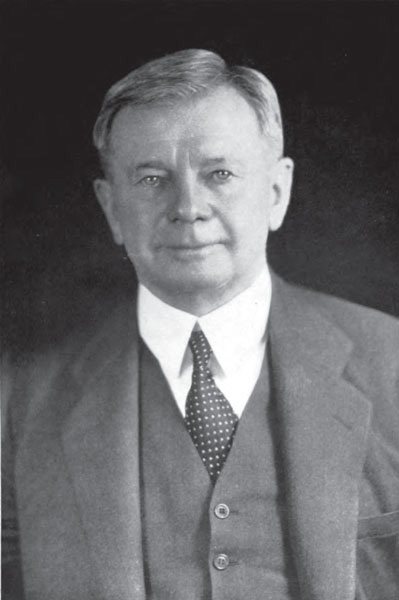
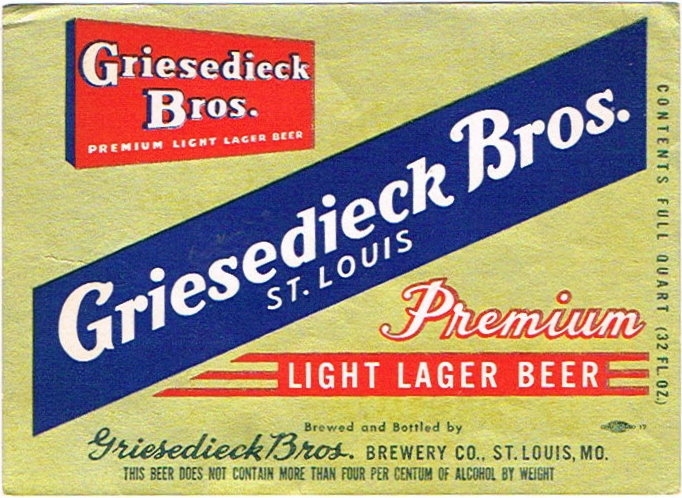
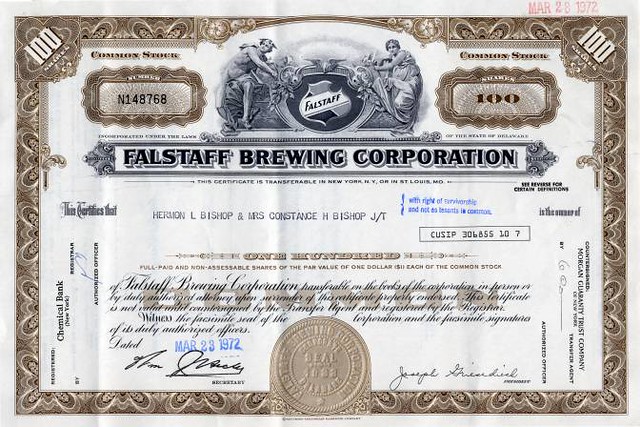
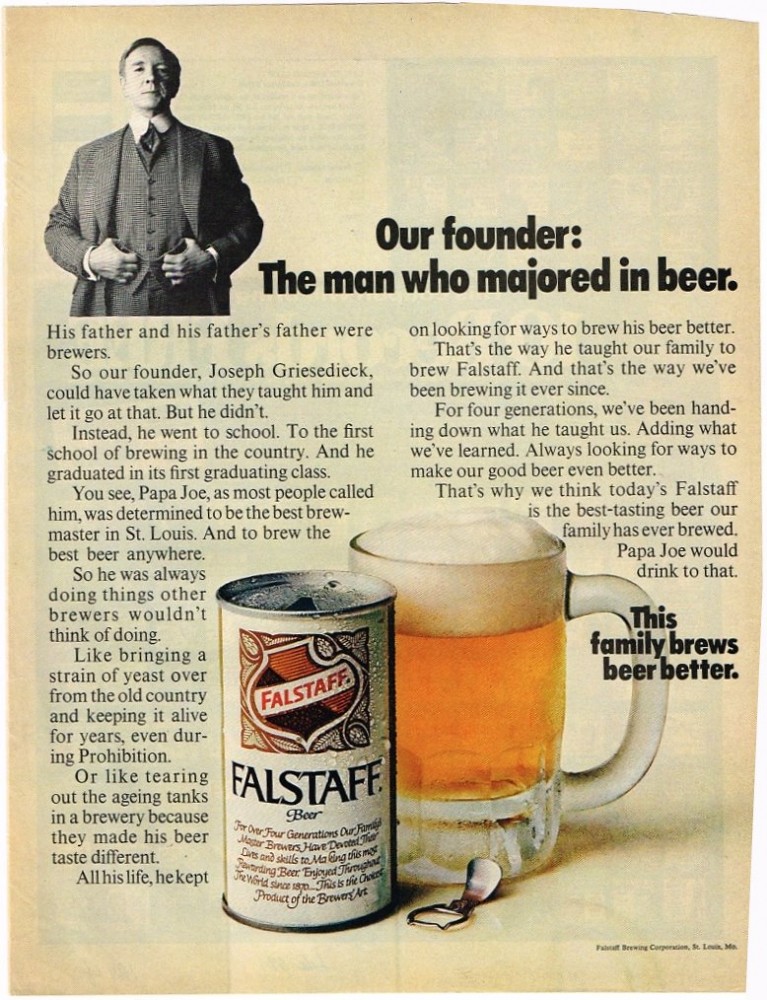
Today is the birthday of Joseph Griesedieck (July 11, 1863-July 14, 1938). Known throughout his life as “Papa Joe,” he founded the Griesedieck Brothers Brewing Company, along with his brothers, and they later bought the Falstaff label from Lemp Brewing, and turned the brand into the iconic Falstaff Brewery.
Griesedieck was a founder of Griesedieck Brothers Brewing Company, later Falstaff Brewing Company. He was a brewer in St. Louis for over 50 years. Born in Germany, Joseph came to the U.S. as a youth, working for a time in breweries in the East. Coming to St. Louis, he managed several breweries before becoming the owner of the old National Brewery & an officer & general manager of the Independent Breweries Company. He owned the Griesedieck Beverage Company, organized in 1917 to manufacture beer & soft drinks, & became president of the Falstaff Corporation, organized in 1921 to make soft drinks.
And here’s the full entry from the Encyclopaedia Britannica:
Introduction
Joseph Griesedieck (born July 11, 1863 in Stromberg, Province of Westphalia; died July 14, 1938 in St. Louis, MO) was one of the most influential brewers in St. Louis in the late nineteenth and early twentieth centuries. From the 1880s to the 1910s, he helped run several city breweries, including the National Brewery Company, the Independent Breweries Company, the Griesedieck Brothers Brewery Company, and the Griesedieck Beverage Company. At the outset of Prohibition, he acquired the Falstaff label from the William J. Lemp Brewery Company and built the Falstaff Corporation around it. While many other brewers failed during Prohibition, Griesedieck kept his company afloat by selling “near beer,” soft drinks, carbonated water, and pork products. After the repeal of Prohibition, he obtained the first federal permit to begin brewing beer legally again. Within five years, the Falstaff Brewing Corporation was operating four plants in three states and had gained a national market.
Family and Ethnic Background
Joseph “Papa Joe” Griesedieck was born on July 11, 1863, in Stromberg, in the Province of Westphalia. He was the third son of the thirteen children born to Anton Griesedieck (1829-1895). Little is known about his mother. Her maiden name was apparently Valhaus, and a biography of Joseph’s older brother Henry (often called Henry, Jr.) gives his mother’s birth name as Johanna. (Given the proximity of the brothers’ ages, it is likely that she was Joseph’s mother as well.)
When Joseph Griesedieck was five or six years old, his father married a woman named Gertrude. It is unclear why Anton Griesedieck’s first marriage ended, but it is reasonable to assume that his wife Johanna had died. Anton’s second marriage gave Joseph at least two half-brothers (Frank and Anton, Jr.) and three half-sisters (Elizabeth, Bertha, and Tony). According to Joseph’s later accounts of his childhood, Gertrude was an abusive stepmother who did not care about her stepsons. In 1893, Anton and Gertrude went through a very bitter and public divorce. During the proceedings, Joseph testified that his stepmother “never had a kind word for any of us. She used to find fault with us and whip and beat us.”
At the very end of the 1860s, Joseph Griesedieck immigrated to the United States with his father, stepmother, and Henry, Jr.; they most likely arrived in January 1870. The family settled in St. Louis, where Anton’s brother Franz (later Frank) operated the Brinkwirth & Griesedieck lager beer brewery. By 1871, Anton and another brother, Henry, were running the H. Griesedieck & Bro. Saloon in downtown St. Louis at Carr and Seventh Streets.[
By the time Anton opened his saloon, the Griesedieck family had already been involved in the brewing industry for more than a century. In December 1766, his great-grandfather Johann Heinrich Griesedieck had opened a brewery in Stromberg, which is where Anton and his brothers first learned the craft. According to Falstaff company lore, when Anton first began brewing beer in the United States, he used the old family recipe. As late as the mid-twentieth century, the original Griesedieck brewery still operated as a tavern for the lager drinkers of Stromberg.
Growing up, Joseph Griesedieck spent much of his time at his family’s malt house, where he learned the trade and did his best to avoid his stepmother. At the age of fifteen, he began an apprenticeship as a practical brewer, thus following in the footsteps of his father and uncles. As part of his training, he worked at A. Griesedieck & Co., his father’s brewery on Twelfth Street and Park Avenue, and at H. Griesedieck Malting Co., his uncle’s malt house. At the malting company, he harvested ice from the Mississippi River to build icehouses and thereby extend the brewing season. During his apprenticeship, he lived at a boarding house, rather than at home, in order to escape his stepmother.
In 1882, Griesedieck enrolled at the U.S. Brewers’ Academy in New York. The school’s founder, Anton Schwarz, was recognized as a pioneer and expert in the field. Born in Bohemia, he had studied at the Polytechnic Institute in Prague under Karl Balling, one of the most influential brewing chemists of the nineteenth century. After immigrating to the United States, he became the editor of American Brewer, the country’s first brewing trade journal. Among other contributions to the industry, Schwarz helped American brewers to create their own version of Bohemian beer. Griesedieck was a member of Schwarz’s first graduating class at the brewers’ school. He also studied the craft in Weihenstephan, Bavaria. In doing so, he followed the lead of his brother Bernard, who had studied in Weihenstephan in 1878-79. In 1884, Joseph returned to St. Louis to put his education and experience to use in the city’s brewing industry.
Business Development
The Griesedieck men arrived in America at a time of brewing industry growth. In 1865, national beer production stood at 3.7 million barrels. By 1870, the year of young Joseph’s arrival, it had almost doubled to 6.6 million barrels. By that time, German-style lager breweries had already gained a foothold in cities with large German-American populations, such as St. Louis, Cincinnati, Brooklyn, Chicago, and Milwaukee. In 1870, the St. Louis city directory listed thirty-six brewers and breweries, the majority of whom seem to have been of German extraction.
In order to establish themselves, Anton Griesedieck and his brothers developed partnerships with other German brewers in their community. Frank (or Franz) Griesedieck, the first of the brothers to arrive in St. Louis, founded the Brinkwirth & Griesedieck brewery with another German immigrant, Theodore Brinkwirth. In keeping with their heritage, the brewery specialized in lager beer. By 1867, Henry Griesedieck had established the Frieling & Griesedieck brewery, and, as mentioned above, he and Anton Griesedieck went on to open a saloon in 1870. In 1878, Anton and his sons purchased the Stumpf Brewery, at 19th and Shenandoah. Within three years, they had outgrown the facilities, so they partnered with August Koehler and Robert Mueller to buy the Christian Staehling Brewery at 18th and Lafayette. Anton named this new brewery A. Griesedieck & Co. In 1884, upon returning to St. Louis after his studies in Weihenstephan, Joseph Griesedieck started working as superintendent of the brewery. He remained there until the latter part of the decade. During that time, he also worked as manager of Joseph Schaider’s Brewery Branch for a brief period.
At the end of the decade – in June 1889 – the St. Louis Brewing Association was formed. The association was a syndicate of St. Louis breweries; its stockholders included Anton Griesedieck, Ellis Wainwright of Wainwright Brewery Co., C.G. Stifel of Stifel’s Charles G. Brewing Co., Henry Grone of Grone H. Brewery Co., and John Knauss of Klausmann Brewery Co. According to the St. Louis Post-Dispatch, by the end of the year, the association controlled every St. Louis brewery except those owned by Anheuser-Busch and Lemp.
Within a few months of the founding of the St. Louis Brewing Association, an English company – the London Investment Company – began acquiring stock, causing concern in St. Louis that the company would obtain a majority of the stock and purchase the association. By November of 1889, it was rumored that the company owned 90% of the association’s stock. The officers of the St. Louis Brewing Association frequently dismissed speculation about how much capital and control the London Investment Company held over its breweries, but this did not prevent the association from being known as “the English Syndicate” to some in St. Louis.
At about this time, Joseph Griesedieck left his father’s brewery (and, by extension, the St. Louis Brewing Association) to establish his own brewery, the National Brewery Co., along with his brothers Henry, Jr., and Bernard. Their brewery opened in 1891 at a cost of $400,000 ($9,890,000 in 2010). Joseph served as superintendent, Bernard as secretary, and Henry, Jr., as president. The plant occupied several buildings at 18th and Gratiot in St. Louis, and included a brewhouse, a stock house, a machine house, a boiler house, a bottling house, a washhouse, and a packing and shipping house. The brewhouse alone was seven stories high. At its inception, the National Brewery was able to produce 150,000 barrels per year.
The following year, the St. Louis Post-Dispatch praised the brothers for forming their brewery. Among other things, the article made clear just how much currency the Griesedieck name held within the St. Louis brewing community. The article proclaimed “there are few names written on the city’s roll of honor which are better known than that of the men who constitute the company [ . . . ] each and all of whom have received the best theoretical and practical education in brewing to be had in this country, as well as in Europe; and in addition have had a ripe experience under their father.” The glowing review even extended to the plant’s equipment, which was described as “the best that inventive genius has produced and that two generations of experience can recommend.”
After the turn of the twentieth century, a number of independent St. Louis-area breweries began to consolidate in response to the St. Louis Brewing Association. In May 1907, after two years of discussions, the Independent Breweries Company (IBC) filed its papers of incorporation. The merger consisted of nine St. Louis-area breweries, including Griesedieck’s National Brewery Co. The syndicate held an aggregate capital of $7 million ($168 million in 2010). The two largest breweries in the area – Anheuser-Busch and the William J. Lemp Company – still remained independent. Two days later, the incorporated companies agreed to transfer all of their property to IBC. Henry, Jr., served as president of the newly formed IBC, and Joseph as general manager.
Unfortunately, the IBC turned out to be a losing venture and the company eventually went into receivership. Alvin Griesedieck, Joseph’s son, later attributed IBC’s failure to the fact that some of the brewers had misrepresented their profits prior to the merger, and more importantly, to IBC’s decision to continue paying partners the same salaries they had earned prior to consolidation. According to Alvin’s recollections, his father once explained that this decision meant that a man who worked as a stable boss was earning $15,000 a year ($359,000 in 2010). The IBC’s overhead was simply too high to be sustainable. The IBC eventually found renown through its production of root beer, which is still sold in the twenty-first century.
Within five years of IBC’s founding, Henry Griesedieck, Jr., recognized that it would fail, and he resigned from its presidency. He then formed the Griesedieck Brothers Brewery Company (GBBC) with his sons Anton, Henry, and Raymond. After some prodding, he convinced his brother Joseph to join GBBC, again in the role of general manager.
In March 1917, Joseph Griesedieck founded his own brewery with the help of some of his nephews. The German Savings Institute (later the Liberty Bank) had just foreclosed on the Forest Park Brewery Company at 3664 Forest Park Boulevard, and bank officials convinced Griesedieck to purchase the newly vacant brewery. It was here that the Griesediecks established the Griesedieck Beverage Company (GBC). The company had capital amounting to $125,000 ($2.13 million in 2010), $105,000 of which was tied to the property. The Griesediecks gave personal notes to the bank in order to fund their new brewery. Joseph took on the largest financial burden; of the 1,250 total shares in the company, which were valued at $100 per share ($1,700 in 2010), Joseph held 750, with his nephews dividing up the remainder. According to Alvin, “this was the beginning of many years of financial difficulties for my father.”
By all accounts, it was an interesting moment for Griesedieck to found his own brewery. The United States was on the brink of entering World War I, with the formal declaration of war against Germany and the other Central Powers coming in April 1917, just one month after the GBC began operations. By the end of 1917, the American brewing industry was feeling the effects of the war, not least because President Woodrow Wilson, as part of a plan to regulate food production to increase efficiency during wartime, had decreed that beer could contain no more than 2.75% alcohol and had restricted the amount of grain the industry could use by almost one-third.
German and German-American brewers faced further obstacles on account of their ethnicity. In the St. Louis metropolitan area, even with – or perhaps because of – its large German population, all things “Kaiser” came under fire. Some area school boards banned the teaching of the German language. Evangelical Lutheran ministers stopped using German in churches in St. Louis and its surrounding suburbs, and individual churches dropped “German” from their names. Things of German origin were given new “patriotic” names: sauerkraut became “liberty cabbage,” dachshunds became “liberty pups,” and the German measles became “liberty measles.” The threat of violence against Germans and German-Americans, though rare in practice, loomed large. All things considered, it was not exactly the optimal moment to establish a new company with a German name.
Additionally, the long-simmering temperance movement had seized upon the growing backlash against all things German to further its push for national prohibition. As Daniel Okrent argues in his history of the rise and fall of Prohibition, the “beer industry’s indelible Germanness” had long been subject to attack from the temperance movement, but the war made these arguments even more potent. Americans who had been neutral or opposed to the dry movement up to that point found their views changing as they became increasingly concerned about potential enemy agents lurking in their midst – or in their breweries and saloons. In the eyes of xenophobes, fighting beer was akin to fighting the Kaiser.
St. Louis’s most prominent brewing family only added fuel to the fire. The Busches had prominent and well-known ties to the Kaiser and his army. Two of the family’s sons-in-law were officers in the German military, and Adolphus Busch had been decorated by the Kaiser himself. Moreover, the family held German war bonds, though these had been purchased before the United States entered the fray. Worse yet, matriarch Lily Busch spent the majority of World War I at the family estate in Germany. She had been vacationing when the war began, and was unable to return immediately on account of health reasons, though this fact was often overlooked in attacks on the family’s loyalty to the U.S.
Despite growing tensions and the certainty of difficult times ahead, Griesedieck was convinced that brewers could survive by selling “near beer” to the St. Louis population. He had seen brewers cope with war-related restrictions that had capped the alcohol content of beer at 2.75%, and he thought that the beer industry would be able to adopt similar survival strategies in the event of national prohibition. He seems to have believed that if “real” beer were outlawed, then it would only be a temporary setback that he and his family could outlast.
By the end of the year, Griesedieck’s belief that his brewery would be able to survive a period of prohibition was put to the test. On December 17, 1917, the House of Representatives passed the Eighteenth Amendment, which prohibited “the manufacture, sale, or transportation of intoxicating liquors” within the United States. The amendment was ratified on January 29, 1919, and went into effect on January 29, 1920. Back on October 28, 1919, Congress had passed the Volstead Act, or the National Prohibition Act, which provided guidelines on enforcing the Eighteenth Amendment. Here, it is important to note that the act did allow for the brewing of “near beer” with less than 0.5% alcohol by volume, though it did not permit dealcoholized beer to use the labels “beer” or “near beer.”
Prohibition and the Volstead Act meant that the Griesedieck Beverage Company needed to produce a near beer, or cereal beverage, to stay in business. Since Griesedieck believed that the similarity between the names – and initials (GBC and GBBC) – of the two Griesedieck companies would lead to brand confusion in the St. Louis area, he decided to brew his near beer under a new label. Griesedieck hired a man to design a new label, and in the course of his work, the designer stumbled across hek, a beverage produced by Egyptians in 1500 B.C. Hek was produced from cereals and fermented, a process that resulted in a drink somewhat similar to beer. In Griesedieck’s eyes, Hek was a perfect fit for GBC’s marketing strategy for near beer.
The GBC registered “HEK” as a trademark, and began rolling out their new brand under the slogan “Hek is beer…without the alcohol.” Since the Volstead Act prohibited the attachment of the word beer to dealcoholized beverages, the slogan was changed to “Buy Hek – by heck!” after the act’s passage. In 1920, a case of twenty-four bottles of Hek sold for $1.65 ($18.00 in 2010). Promotional efforts featured pyramids to highlight the beverage’s roots in ancient Egyptian culture. Additionally, some GBC marketing campaigns presented the cereal beverage as a healthful drink. For instance, one advertisement went as follows:
The Ancient Egyptians, according to history, were the first to brew a cereal beverage [ . . . ]. Their first brew was called – ‘HEK’ – the name for our beverage, because like the Egyptian monuments of old, it is the symbol of everlasting vitality. [ . . . ] HEK is refreshment in its most palatable form – a foamy, cooling, wholesome drink, rich in the carbohydrates and protein of Nature’s strength building cereals. HEK is a sparkling, invigorating,non-intoxicating drink, good for every member of the family, young and old.
The advertisement informed readers that they could find Hek “on sale wherever wholesome drinks are sold.”
At first, Griesedieck limited his promotional efforts to the St. Louis market, since his plant was relatively small. In this market, Hek faced direct competition from Bevo, the near beer produced by Anheuser-Busch since 1916. Like Hek, Bevo was often promoted as a nutritious beverage. According to one Anheuser-Busch pitch plan, “Bevo is pure as purity. Made under conditions of absolute cleanliness. Every step in the process of manufacture and everything that goes into it, a triumph in purity.”[28] Both companies sensed that the public needed a reason to purchase near beer above and beyond the fact that it was the closest legal approximation to regular beer.
In order for Hek to succeed, Griesedieck needed to set his near beer apart from his competitor’s. Anheuser-Busch brewed Bevo under the check-fermentation process, which allowed the beer to ferment only up to the legal limit of 0.5% percent. Bevo did, however, continue to ferment after being packaged, and this, in turn, led to a very short shelf life. Unless Bevo was consumed shortly after being put on the market, it spoiled and turned cloudy. Griesedieck was determined to avoid this problem with his near beer. Bevo may have been better known, but Hek would be of better quality.
Griesedieck set out to develop a new and different fermentation process. He started by looking toward Chicago, where Dr. Herman Heuser had devised a new method for brewing near beer. Rather than fermenting beer only up to the legal limit, Heuser’s method allowed for the dealcoholization of real beer. Brewers could use their normal methods, and then reduce or remove the alcohol to meet the standards of the Volstead Act. Shortly before the beginning of Prohibition, Popular Science described Heuser’s process for “taking the kick out of beer”: as the magazine explained, “this process consists of continuously flowing the beverage in a thin sheet or film over the vertical or inclined zone of an evaporator, preferably a vacuum pan, all the while subjecting the liquor to intense latent heat of steam between the walls of sheets of the container. By this means the beer is boiled momentarily and its alcoholic content is instantaneously reduced.”
According to Heuser – and shortly thereafter the Griesediecks as well – this fermentation process was advantageous because the resulting near beer offered the closest approximation, in terms of taste and odor, to regular, pre-Prohibition beer. Since the “beer” was produced under normal circumstances and then dealcoholized, the ethers and esters that contribute to beer’s taste, smell, and foaminess were still produced in full. This fermentation process differed from check-fermentation, in which the development of the ethers and esters was stunted. Previous methods had attempted dealcoholization by boiling the beverage for long periods at high temperatures. The sustained contact to heat, however, created what Popular Science termed a “distinctly unpleasant taste and odor.”
Griesedieck purchased a dealcoholizer and began brewing his near beer according to Heuser’s method. Alvin Griesedieck later claimed that this allowed Hek to achieve better flavor and stability than any other near beer on the market, at least in the St. Louis vicinity – an opinion that was admittedly not without bias.
Not long after the introduction of Prohibition, it became clear that the public would never consume near beer with the same gusto as the real thing. Many former beer drinkers found near beer less pleasing in taste, not to mention the absence of mood-altering effects. Once the novelty factor wore off, sales for near beer plunged. For this reason, the GBC began expanding into new territories, so that when demand diminished in one location, the supply could be redirected to another place. The company found success in this approach for a short time, and demand even exceeded the production capacity of their small brewing factory, which could only turn out 350-375 bottles per day. In response, Griesedieck decided to add a new building and to renovate the existing facilities. He sold stock in the company to fund this endeavor, but the incoming funds could not keep pace with cost of the project.
On October 22, 1920, the creditors of Griesedieck Beverage Company filed an involuntary petition in bankruptcy, for approximately $450,000 owed ($4.9 million in 2010). The creditors agreed to let Griesedieck serve as receiver, under a bond of $50,000 ($544,000 in 2010).
The GBC was certainly not the only brewery to fall victim to Prohibition. Brewers across the country were shutting their doors in the face of financial losses and uncertainty over the duration of the dry period. At the time, no one knew how long Prohibition would last: would brewers see Repeal in a year, a decade, or ever? They had to decide whether to muddle through by selling “near beer” and soft drinks or to dissolve their companies. After Prohibition had been in effect for a few years, more and more St. Louis brewers started opting for the latter. In 1918, the city directory listed twenty-seven breweries. By 1918, the year in which the Eighteenth Amendment was ratified, that number had already dropped to twenty. In 1922, only nine breweries were listed in the city directory. The breweries of Griesedieck’s former corporation, the Independent Breweries Company, were among those that had closed.
Another significant St. Louis casualty was the William J. Lemp Brewing Company. William Lemp’s father, Adam, had started brewing German lager at his St. Louis grocery store during the 1840s. His beer soon gained favor among the city’s large German-American population. By December 1919, when the Lemps announced their plans to sell the brewery, the company had become the second largest beer producer in St. Louis after Anheuser-Busch. Their Falstaff label, brewed since June 1899, was nationally known. William J. Lemp, Jr., president of the family company since 1904, had chosen William Shakespeare’s Falstaff as the namesake of his flagship label because he wanted his beer to be associated with the character’s “eat drink and be merry” mantra.
By December 1919, the company had been out of the brewing business for a few months, having produced its last batch of real beer in October 1918 and its last batch of near beer, Cerva, in June 1919. William J. Lemp, Jr., later confided to his vice president that he believed that Prohibition would be long. Moreover, he did not foresee beer ever regaining the commercial prominence it once held. It is also possible that his father’s 1904 suicide weighed heavily on his mind during this difficult time in the industry. To add to the family’s growing troubles, William’s sister Elsa Lemp Wright killed herself on March 20, 1920. By this point, in the words of author Carol Ferring Shepley, “none of them [the Lemp family] had the mettle to make it through Prohibition.”
Out of this family’s downfall, the Griesediecks saw a way to save the Griesedieck Beverage Company while carrying on a piece of the Lemp tradition. Joseph and Alvin Griesedieck approached William J. Lemp, Jr., with whom Joseph was close friends, about purchasing the Falstaff trademark and shield, which they would use as the centerpiece of a new company. After some initial resistance from the Kemps, the Griesediecks acquired the Falstaff name and label for $25,000 ($305,000 in 2010), $5,000 of which had to be paid up front. For the remainder, they put up $20,000 in bonds as collateral, to be paid in nine months.
In the meantime, the U.S. District Court had authorized Griesedieck, as receiver of the Griesedieck Beverage Company, to sell the company’s physical property. The receiver’s sale was held on December 17, 1920, with James Cunningham, the director at Chouteau Trust Company, winning the bidding. Griesedieck, who served on the board of directors for Chouteau, had arranged for the company to purchase the assets of the GBC, with each director taking on a share of the requisite notes. From there, the assets were transferred to the Falstaff Corporation, a newly organized company headed by the Griesediecks. The company then issued $250,000 in mortgage bonds ($3.05 million in 2010), of which the Chouteau Trust Company received $150,000 as payment for the purchase of GBC. Griesedieck personally endorsed the $150,000 in bonds ($1.83 million in 2010).
The other $100,000 in bonds needed to be raised through sale to the public. Griesedieck sold these bonds mainly to his friends, who purchased them in increments of $1,000 or $2,500 ($12,200 or $30,500 in 2010), even up to $10,000 ($122,000 in 2010). Griesedieck’s ability to sell bonds for a brewing company during Prohibition speaks to the reputation he had established in St. Louis. He must have been viewed as an intelligent, hardworking, dependable – and generally likeable – businessman in order for people to risk their money in such a venture. Alvin later quoted one investor as saying, “I don’t care if I’m shooting my money at the birds, Joe Griesedieck is in a jam and I’m going to help him out!” These financiers were ultimately validated in their trust of Griesedieck, as all of the bonds, plus interest, were eventually paid in full.
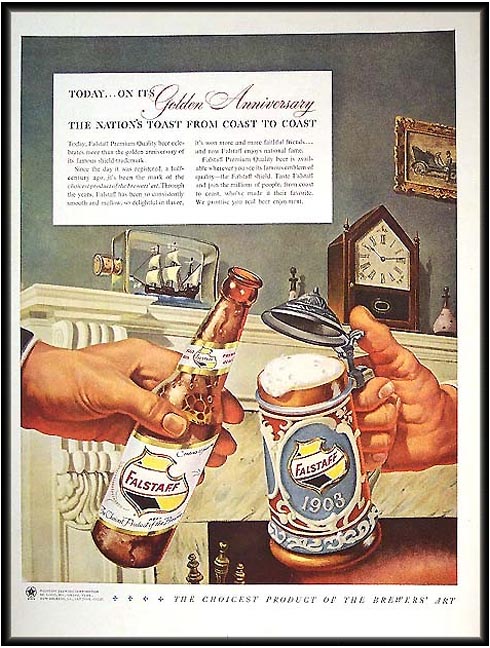
Since Griesedieck’s new venture was known as the Falstaff Corporation, he decided to use the Falstaff label, rather than Hek, on his near beer. In Alvin’s estimation, a beer named “Falstaff” was better positioned for success in some of the company’s new conservative markets than a beer called “Hek.” Falstaff, with its trademark slogan “The Choicest Product of the Brewers’ Art,” also had better brand recognition, both at the local and national levels. While Griesedieck’s previous brewing ventures had focused on regional markets, the relatively well-known Falstaff label allowed him to reach markets as far away as Florida. The corporation produced four primary dealcoholized beers during Prohibition: Falstaff Special, Falstaff Pale, Falstaff Super X, and Dublin-Style Stout, which was modeled on Guinness. This last product eventually became fairly successful, selling for thirty to fifty cents a bottle ($4 to $8 dollars in 2010) on the Pacific Coast and South Atlantic seaboard during Prohibition.
In July 1920, shortly after the start of Prohibition, the government began granting permits for “the manufacture and sale of alcoholic beer for medicinal purposes.” According to Alvin, the Griesediecks used their connections to acquire the only government permit issued to a company west of the Mississippi River. In November 1921, Falstaff began brewing beer with 4.5% alcohol by volume. Before the company could capitalize on the demand, however, President Woodrow Wilson signed the Willis-Campbell Act, or the “anti-beer bill,” on November 23, 1921, which prohibited prescription alcohol. In December 1921, Falstaff Corporation filed a petition with the U.S. District Court. The petition declared the Eighteenth Amendment and the Volstead Acts to be unconstitutional and requested that the State Prohibition Director be prevented from destroying the medicinal beer already produced by Falstaff. The petition, however, did not request that the corporation be allowed to continue making or selling the beverage, which would have been a huge source of revenue.
In 1924, the brewing industry pushed for the legalization of a malt product containing 2% alcohol by volume – four times the legal limit. As with the earlier measure, the malt product was to be sold through drug stores to individuals with a doctor’s prescription. Falstaff began producing a Bohemian malt tonic, dark in color and heavy in volume, which needed to be mixed with beer to be tolerably drinkable. The resulting beverage was a “quite pleasing” beer. But politicians quickly realized that Americans were using this malt product more than medically necessary, so they increased the solid to alcohol ratio of the tonic, which resulted in a syrup that was too thick to drink enjoyably, thus ending that venture.
At this point, Griesedieck and his company determined that soft drinks, such as dry lemon soda, ginger ale, and root beer, would be their best bet to increase revenues, since those beverages could be produced under similar manufacturing conditions as beer. Heavy competition made it difficult for Falstaff Corporation to sell soft drinks outside of their immediate territory due, but the company’s root beer still earned a reputation as a high quality beverage. In the later years of Prohibition, the company also sold carbonated water under the label “Rock Alva,” named after the Griesedieck family farm.
Despite their various products and labels, the Falstaff Corporation never produced more than 30,000 barrels a year, a significant reduction from their pre-Prohibition average. As a result, Joseph and Alvin decided to expand the focus of their company to include pork products. Alvin had prior experience with pigs and determined that their brewery already had many of the elements needed for a packing plant. Falstaff was not in a position to handle the entire production process, but they would be able to cure and smoke pork that had been partially processed from another local packing company.
In 1923, the beer vats were removed from one of Falstaff’s smaller cellars in order to make room for twenty ham-curing vats. The company also purchased boxes for dry curing bacon. For a smokehouse, they assembled what Alvin termed “really nothing more or less than an overgrown chimney.” The whole process of converting part of the plant to handle ham and bacon cost the corporation approximately $5,000 ($63,900 in 2010). The Griesediecks hired John Van Gels, a butcher with a good reputation in the city, to serve as superintendent of the new operations. For a short time, Falstaff ham and bacon sold fairly well in St. Louis – especially their boiled hams, which could be sold to the company’s pre-existing tavern accounts. Overall, though, the rising price of pork products meant that Falstaff could not turn a profit on the venture, despite healthy sales.
The Falstaff Corporation also experimented with the production of beer that circumvented the legal limits. Here, Falstaff’s efforts were inspired by the Missouri-based M.K. Goetz Brewing Company, whose brewmaster had developed a brewing and dealcoholization process that created a beverage that could absorb alcohol successfully. This method allowed the Goetz company to produce a 0.5% alcohol near beer that, when mixed with grain alcohol, could be spiked to 4.5 to 6% alcohol by volume, without sacrificing taste. Customers soon realized how easy it was to spike Goetz’s near beer, and company sales soared. In response, Falstaff decided to produce a similar product, but it never managed to replicate Goetz’s success. Since Falstaff could not advertise its near beer as spike-able, the company was unable to secure the same market share held by Goetz or other home brews.
By 1930, the low demand for near beer had caught up to Falstaff, and the company started going into debt. Only one bank, the Grand National Bank, would provide them with a loan – $15,000 in exchange for $25,000 in Falstaff bonds. Luckily, by 1932, it became evident that Prohibition would be ending, so the company only had to endure until repeal. Finally, in February 1933, Congress passed a resolution proposing the Twenty-first Amendment, which would repeal the Eighteenth. In March, shortly after taking office, President Franklin D. Roosevelt signed the Cullen-Harrison Act, which allowed for the production and sale of beer and wine containing up to 3.2 percent alcohol by volume, to take effect on April 7, 1933. Then, on December 5, 1933, the Twenty-first Amendment was ratified, and Prohibition was officially over once and for all.
Griesedieck recognized that the demand for beer would be high immediately following repeal. The Falstaff Corporation, however, did not have the requisite capital or facilities to produce sufficient supply. The Griesediecks worked out a deal with Bauer-Pogue, Inc., a brokerage company, to reorganize and refinance Falstaff. The deal was negotiated at a considerable expense to them personally. Alvin took on the bulk of the legal responsibility, which showed that he was starting to take on a larger role in the management of the company as “Papa Joe” approached his seventieth birthday. On January 16, 1933, the Falstaff Brewing Corporation of Delaware was duly incorporated, and in the summer of 1933, the Falstaff Corporation was officially liquidated.
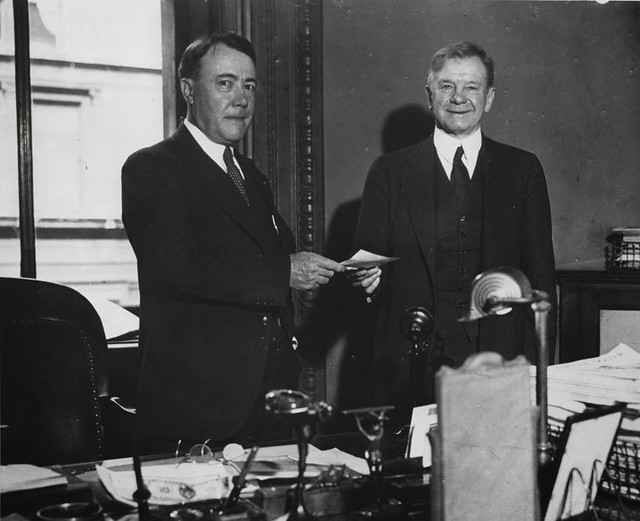
Papa Joe being handed the very first permit to brew beer again after the repeal of prohbition.
The Falstaff Brewing Corporation obtained Federal Permit No. 1 to resume brewing beer as soon as the beverage was legal again, meaning that it was the first brewery authorized to brew beer in the United States in thirteen years. Since Papa Joe had used the dealcoholization process during Prohibition, the Falstaff production line was ready without the retooling needed by other brewers who had employed the check-fermentation process. It was only necessary to skip the dealcoholization step; all else remained the same. In St. Louis, only Falstaff and Anheuser-Busch were able to produce beer for Repeal Day, giving them each half of a very eager market – and more demand than they could possibly meet.
The Falstaff Brewing Corporation received advance orders for thousands of cases, and its two bottling units helped them to produce up to 4,000 cases a day. Griesedieck used his pre-Prohibition recipe for the new Falstaff beer; it was a malt beer “a little heavy in body and sweet in flavor,” with 3.2% alcohol by volume. Even the yeast was the same as before Prohibition. Griesedieck had kept his original strain alive through the dark period, even going so far as to insure it with Lloyd’s of London, which the company played up through its “Million Dollar Yeast Insurance Policy” advertising campaign. This consistency of yeast helped Falstaff keep its distinct, yet dependable, flavor.
On April 6, 1933, stores throughout St. Louis ran advertisements proclaiming the return of beer the following day. The advertisements focused on the two brands that would be available: Falstaff and Budweiser. Weber Bros. Candy and Cigar Company on North Grand toasted newspaper readers with an image of a beaming man holding up a foaming glass of beer; the man urged would-be customers to “come and get yours (Falstaff and Budweiser) by the case…on ‘Brew Year’s Eve’.” A&P Food Stores warned readers “don’t wait!,” and urged them to grab cases of Budweiser or Falstaff from their limited supply. The first two cases from Falstaff, however, were carefully – and politically – earmarked; one case went to Governor Guy Brasfield Park of Missouri and the other to Governor Henry Horner of Illinois.
At exactly 12:01 a.m. on April 7, 1933, the Noble Experiment was over and beer was back. According to the St. Louis Post-Dispatch, a “carnival spirit” gripped the city, as people flocked to Anheuser-Busch and Falstaff and crowded into hotels, restaurants, and nightclubs to imbibe and celebrate. Within half an hour of repeal, downtown hotels had their first cases in stock and were putting drinks on their customers’ tables.
At Falstaff Brewing Corporation, the factory was decorated with patriotic bunting. An estimated 10,000 people gathered outside to cheer as the factory whistles blew at midnight and the first trucks left to make their deliveries, each carrying 600 cases. As many trucks as possible crammed into Falstaff’s garage, and those that could not lined up along both sides of Forest Park Avenue for blocks. The Post-Dispatch estimated that a total of seventy-five trucks were at Falstaff at midnight, with more arriving throughout the day. Falstaff officials reported that they had sent out 40,000 cases and 500 half-barrels by daybreak. Due to the imbalance between demand and supply, Falstaff focused on filling orders from local customers who had stuck by the company through Prohibition, but that did not stop other hopefuls from crowding around the factory for days. The fervor surrounding the factory was so great that police were on the scene to guard the doors.
Falstaff Brewing Corporation’s preparedness provided a financial boost to the Griesedieck family, who had just barely stayed afloat through Prohibition and the early years of the Depression. With only two breweries operating in St. Louis during those first days, they could charge as much as they wanted and still find ample buyers. For the remainder of April, barrels sold for about $18.00 a piece ($303.00 in 2010). Cases of bottles sold for $1.75 to wholesale distributors ($29.40 in 2010) and $2.15 ($36.20 in 2010) to St. Louis retailers. Before expenses, the company brought in $106,000 ($1.78 million in 2010) in the first month after repeal alone.
By the end of 1933, Falstaff Brewing Corporation was able to use beer revenue, as well as money raised from fundraising and stock sales, to fund the expansion of the plant. Building No. 7, which featured expanded bottling capabilities, was added to the Forest Park Boulevard complex. Another floor was built on the stock house, and a garage was converted into a fermenting house, to serve as Building No. 3. The Falstaff Brewing Corporation realized that further expansion was necessary, so the company acquired the former Union Brewery at Michigan and Gravois Avenues. The brewery had previously been owned by Otto Stifel, who was unable to keep his brewery afloat during Prohibition and took his own life in 1920. The Griesediecks converted the Union Brewery into Falstaff Brewing Corporation’s Plant No. 2 and brought on Stifel’s son Carl as plant manager.
Other breweries entered the brewing landscape in 1934. The number of breweries operating in the country more than doubled from 1933 to 1934, as former businesses recovered and reopened, and as new ventures sprouted up to take advantage of the country’s renewed interested in beer. With other breweries appearing across St. Louis, Falstaff was forced to lower its prices to compete in the fractured market. In the winter months, the company’s books started showing a slight loss, so the Griesediecks had to devise ways to put Falstaff Brewing Corporation back ahead of the curve. They decided to turn the Falstaff label into their popularly-priced label and to make the Falstaff Super X their premium (and therefore higher-priced) label, which contained more alcohol by volume. The company also began selling Falstaff at Sportsman’s Park, the home of the St. Louis Browns baseball team, in 1934.
Another marketing initiative launched by Falstaff Brewing Corporation reverberated across the brewing industry as a whole, with lasting effects. In the fall of 1934, one of their salesmen recommended combating the drop-off in winter sales by promoting Falstaff as “the Winter Beer.” Brewing a special beer for winter was common practice in Griesediecks’ home country. German brewers often created special Märzenbier, bock, or doppelbock beers under the name Festbier for consumption during the winter holidays. For Falstaff’s take on the tradition, the Griesediecks created a new, stronger beer, at 5-6% alcohol by volume, to serve as their winter beer and launched an extensive advertising campaign on December 10, 1934. Falstaff’s winter beer proved popular as consumers seemed to embrace the fact that beer, like spirits, could produce a sensation of warmth during the cold months. Perhaps overstating Falstaff’s significance, Alvin boasted that “not only had our campaign on ‘winter’ beer helped our sales, but it had resulted in increasing the general consumption of all beers! We succeeded in making people beer minded in winter.”
In 1935, Falstaff Brewing Corporation expanded production to Nebraska, leasing the Fred Krug Brewing Company plant in Omaha. At the time, engaging in multi-plant brewing carried the risk of damaging brand identity by producing different-tasting products at different plants. Griesedieck sought to avoid that problem by implementing what Falstaff Brewing Corporation termed IPE – identical plant environment. A central technical department in St. Louis ensured that the same ingredients, recipes, and quality control techniques were used across the board. Two years later, after deeming the Nebraska plant a success, the FBC acquired an additional plant in New Orleans, the former National Brewing Company.
By the time Joseph Griesedieck died the following year, he had developed the Falstaff Brewing Corporation into one of the most prominent and successful breweries in St. Louis. In the six months before his death, Falstaff Brewing Corporation turned a profit of $254,978 ($3.95 million in 2010), operating four plants in three states, with its flagship brand known across the country as “The Choicest Product of the Brewers’ Art.”
Social Status, Networks, Family and Public Life
After only a few decades in St. Louis, the Griesedieck men had earned respect for both their name and their craft. In 1914, Reedy’s Mirror reported, “For nearly forty years the name Griesedieck has been a noted one in the brewing industry of this community, and a name connotative of the best elements that give character to business life. The Griesedieck family was and is a large one. It has drawn fortunes from the business and invested them in building and developing the city. And throughout all the history of the family its members have been known for liberality of spirit and social qualities of an ingratiatingly felicific nature.”
As this quote suggests, the Griesediecks were highly involved in St. Louis social life. Joseph Griesedieck became a naturalized U.S. citizen on April 15, 1889, but this did not prevent him from celebrating his heritage as a member of the Germania Club and the Germania Thursday Bowling Club. The Germania Club met at an Eighth Street clubhouse, which had spacious grounds and a garden. The club’s summer season included festivals, concerts, and dances. Membership appears to have been restricted to males, though wives and daughters were invited to attend certain events. Griesedieck also belonged to the Century Boat Club and the Union Club.
Despites his ties to the German community, Griesedieck showed his devotion to the United States during World War I – or at least endeavored to appear patriotic and to exhibit no loyalty to his native land. The Griesedieck Beverage Company helped sponsor several full-page advertisements for the St. Louis Liberty Loan Organization in the St. Louis Post-Dispatch.
On October 13, 1887, Griesedieck married Mathilda Griesedieck, a cousin three years his junior. She was a native-born U.S. citizen, the daughter of Franz and Philippena Griesedieck of Missouri. Franz had been a brewer and his son, Henry C., was also involved in the industry. The Reverend Dr. Jonas of the German Lutheran Church presided over the wedding ceremony, which took place at a family home. The couple went east for their honeymoon. It seems that they had a peaceful and scandal-free marriage. Shortly before Joseph passed away, the pair celebrated their fiftieth wedding anniversary. Religion does not appear to have played a strong role throughout most of Griesedieck’s life, but he returned to Catholicism shortly before his death, according to his son.
Mathilda Griesedieck appears to have been active in St. Louis social life, as well, and she was often featured in the society pages of the St. Louis Post-Dispatch. In March 1895, she was the star of the Liederkranz Society Ball. The society boasted a membership that included “the cream of high German society.” The ball, attended by “everyone of note,” featured a tableaux – or “living pictures” – inspired by art displayed at the previous World’s Fair. Mathilda portrayed the title role from Sappho, and the Post-Dispatch called her “the striking picture of the evening.” Her performance, according to the paper, had been “awaited with breathless interest” and “was received with great applause.”
The Griesediecks had only one child: a son, Alvin, born on July 8, 1894. Papa Joe enjoyed a close relationship with him and made sure that he had every opportunity for a successful future. The Griesediecks sent Alvin to study at Cornell University, where he completed his degree in 1916. After a stint in the armed services during World War I, Alvin returned to St. Louis, where Papa Joe welcomed him into the family business. By the time Prohibition started, Alvin enjoyed a position of relative influence within the company, and he seems to have been a major force behind Falstaff’s pork line.
At first, Griesedieck did not want his son to join the industry, however. According to Alvin, his father “seemed to feel that a successful brewer must of necessity do a lot of drinking and entertaining with, and among his customers, and he did not want his only son subjected to that type of life and environment.” This attitude is interesting given that Papa Joe devoted his whole life to being a brewer; while he often had other side businesses, the brewery was always his main focus. Additionally, the Griesediecks held positions of prominence within St. Louis society, so it is not as though he wanted his son to have a better shot at respect and esteem. It is possible that Joseph simply wanted his son to be able to choose the future he wanted, as opposed to being positioned at a young age to enter the world of brewing – as he had been by his own father.
Griesedieck’s personal relationships were extremely important to him, and he cultivated strong, trusting relationships within St. Louis and the larger brewing community. In 1935, when Falstaff Brewing Corporation was doing well and the local Krug brewery was struggling, Griesedieck leased their brewing plant, so that the family could begin to rebuild financially. Griesedieck also cared about his employees, hosting an annual Falstaff picnic at his home each fall. It began as an event for his employees and their families, but grew to include friends of the family, as well. By the time of Griesedieck’s death, the picnic had become a huge affair for 1,000 people, filled with food, beer, games, dancing, and performances by the Falstaff German Band.
Griesedieck, who was described by his son as 5’11” and almost two hundred pounds “of bone and muscle,” was an active and healthy man for most of his life. He exercised frequently and followed a regimen that involved walks around his estate, weight training, and cold baths. He also enjoyed rowing and participated in St. Louis’s Western Rowing Club and its regattas. Griesedieck often boasted to his son that he never needed more than four hours of sleep a night to recharge.
It appears, however, that the stresses of keeping his company afloat during Prohibition and the Depression eventually took a toll on him, and in 1938, his health began to deteriorate. On June 12, 1938, Griesedieck suffered a heart attack, which led him to be hospitalized for several days. He was diagnosed with cardiovascular disease and hypertension, but Alvin later recalled the doctors saying that his father’s heart had simply worn out. Following his release from the hospital, Griesedieck found himself confined to home rest, which forced the formerly active seventy-four-year-old to cut back drastically on his activities.
One month later, on the morning of July 11 – his seventy-fifth birthday – Griesedieck slipped and fell on a rug in his bedroom. He was taken to St. John’s Hospital, where it was determined that his right hip was fractured and needed to be set. Due to his recent heart troubles, the doctors could only give Griesedieck a local anesthetic to lessen the impact of the painful procedure. In Alvin’s estimation, the shock was simply too great for his father’s weakened heart to stand. Joseph Griesedieck passed away three days later, on July 14, 1938. His funeral was held two days later at the St. Louis Cathedral, and he was interred at Bellefontaine Cemetery.
At the time of his death, according to the inventory filed in the St. Louis County Probate Court, Griesedieck’s estate was valued at $81,101 ($1.26 million in 2010). This included $68,945 ($1.07 million in 2010) in stocks, primarily in Falstaff, as well as holdings valued at $10,000 each ($155,000 in 2010) in Valhaus Realty and Ingram Gold Mine, Inc. Griesedieck’s properties were valued at $7,950 ($123,000 in 2010); this included his half interest in the Phelps Co. farm, whose 2,040 acres were valued at $5,100 ($78,900 in 2010). He left behind $1,950 ($30,200 in 2010) in cash. His estate was to be divided equally between Mathilda and Alvin.
Conclusion
Joseph Griesedieck founded one of the most successful St. Louis breweries of the twentieth century. Along the way, he was aided by his family ties and his connections within the German-American community. As a member of a respected brewing family with a long tradition in the industry, Griesedieck was well poised for success. He was well educated and also benefited from good timing, for he embarked on his brewing career at a moment when lager brewers of German descent were gaining increasing prominence in St. Louis. He assumed his first position in the industry in 1884, when he began working as the superintendent of A. Griesedieck Co., his father’s brewery. During the early years of his career, Joseph helped manage two other family-owned breweries, the National Brewery Company and the Griesedieck Brothers Brewery Company. In 1917, with America on the brink of war with his native country, anti-German sentiment on the rise, and the temperance movement gaining ground, he set out to found his own company, the Griesedieck Beverage Company.
By all accounts, it was a curious time for anyone – let alone a German American – to start a brewery. Prohibition was instituted the following year and remained in place until 1933. Interestingly, it was during this difficult time that Papa Joe Griesedieck really proved his merit, strength, and tenacity as a businessman and brewer. While brewers across the country closed their doors, Griesedieck kept finding new ways to earn revenue during Prohibition. At times, he resorted to the same methods employed by other brewers (e.g. soft drink production), but he also experimented with less conventional survival strategies, such as the addition of a pork line. In the end, his acquisition of the Falstaff label is perhaps the main reason why he was able to stay in business. Here, his ties to the local German community proved decisive, for he would have never acquired the label had he not been friends with William J. Lemp, Jr., the label’s owner and a fellow German-American brewer.
Griesedieck used his knowledge of brewing to produce high-quality products, both during and after Prohibition, and this helped his brands gain respect and a customer base. On Repeal Day, Falstaff was one of only two St. Louis breweries that were open to customers, and Griesedieck’s preparedness helped save his company. He built upon his Repeal Day success and opened additional Falstaff breweries across the country. To combat one problem associated with multi-plant brewing – different tasting beer from different plants – he implemented “identical plant environment,” which standardized production across the board. In the decades after his death, Falstaff continued to grow into one of the most successful breweries in St. Louis, commanding a large national market.
A Falstaff ad from 1969.
After finally selling to Pabst and closing down in 1977, there’s now a new Griesedieck Brothers in St. Louis that is currently contracting three draft beers that they’re selling in the area.
Last year I decided to concentrate on Bock ads. Bock, of course, may have originated in Germany, in the town of Einbeck. Because many 19th century American breweries were founded by German immigrants, they offered a bock at certain times of the year, be it Spring, Easter, Lent, Christmas, or what have you. In a sense they were some of the first seasonal beers. “The style was later adopted in Bavaria by Munich brewers in the 17th century. Due to their Bavarian accent, citizens of Munich pronounced ‘Einbeck’ as ‘ein Bock’ (a billy goat), and thus the beer became known as ‘Bock.’ A goat often appears on bottle labels.” And presumably because they were special releases, many breweries went all out promoting them with beautiful artwork on posters and other advertising.
Thursday’s poster is for Olympia Bock Beer, and was published around the 1910s. This one was for the Pilsen Brewing Co. of Chicago, Illinois, which was originally founded in 1903 by a group of Bohemian tavern owners.