Brookston Beer Bulletin

Jay R. Brooks on Beer

  • Home
  • About
  • Editorial
  • Birthdays
  • Art & Beer

Socialize

  • Dribbble
  • Email
  • Facebook
  • Flickr
  • GitHub
  • Instagram
  • LinkedIn
  • Pinterest
  • RSS
  • Twitter
  • YouTube

Powered by Genesis

Historic Beer Birthday: Christian Weyand

May 11, 2025 By Jay Brooks

weyand
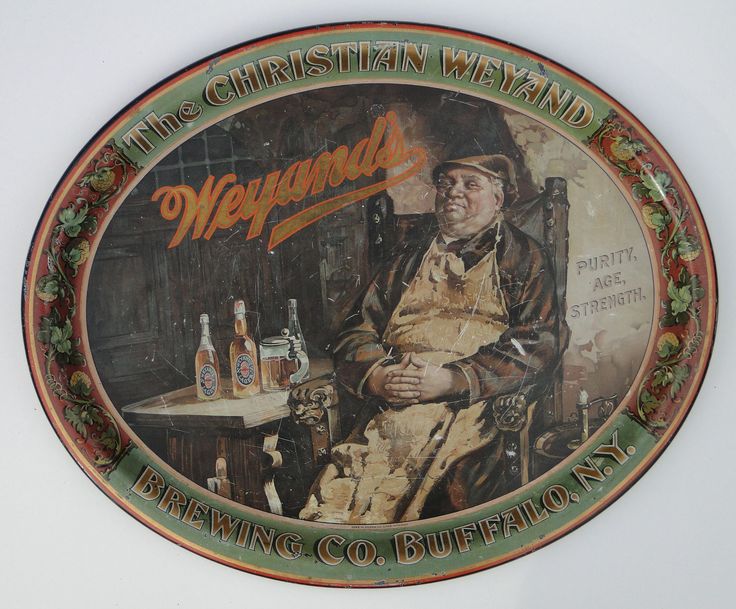
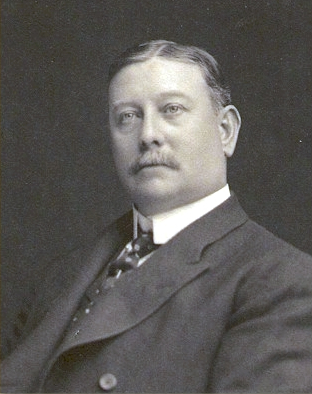
Today is the birthday of Christian Weyand (May 11, 1826-August 7, 1898). He was born in France as Cretien Weyand, but came to the U.S. when he was 21, settling in the Buffalo area of New York. He was originally a shoemaker, but when he was forty years old, he co-founded the Main Street Brewery, along with a partner, John Schetter, who he eventually bought out in 1873. In 1890, the brewery was incorporated as the Christian Weyand Brewing Co. and remained in business until closed by prohibition in 1920.
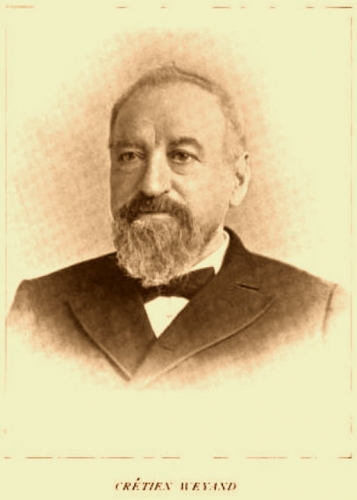
Here’s a short biography from Find-a-Grave:

Weyand, Christian, was born in Lorraine, France, May 11, 1826, attended the common schools, and in the spring of 1847 came to America and settled in Buffalo, where he has since resided. He followed the shoemaker’s trade for some time, and then in 1866 engaged in the brewing business with a partner.

In 1873 he became sole owner of the establishment on the corner of Main and Goodell streets, and in a few years built up one of the largest and best breweries in Western New York. In May 1890, the Weyland Brewing Company was incorporated with C. Weyand. president; John A. Weyand, vice-president and manager; and Charles M. Weyand, secretary, and treasurer. Mr. Weyand is probably the best-known brewer in Buffalo. He is a prominent, public-spirited citizen, widely esteemed and respected, and has always enjoyed the confidence of all who know him. May 9, 1852, he married Magdalena Mayer of Buffalo.
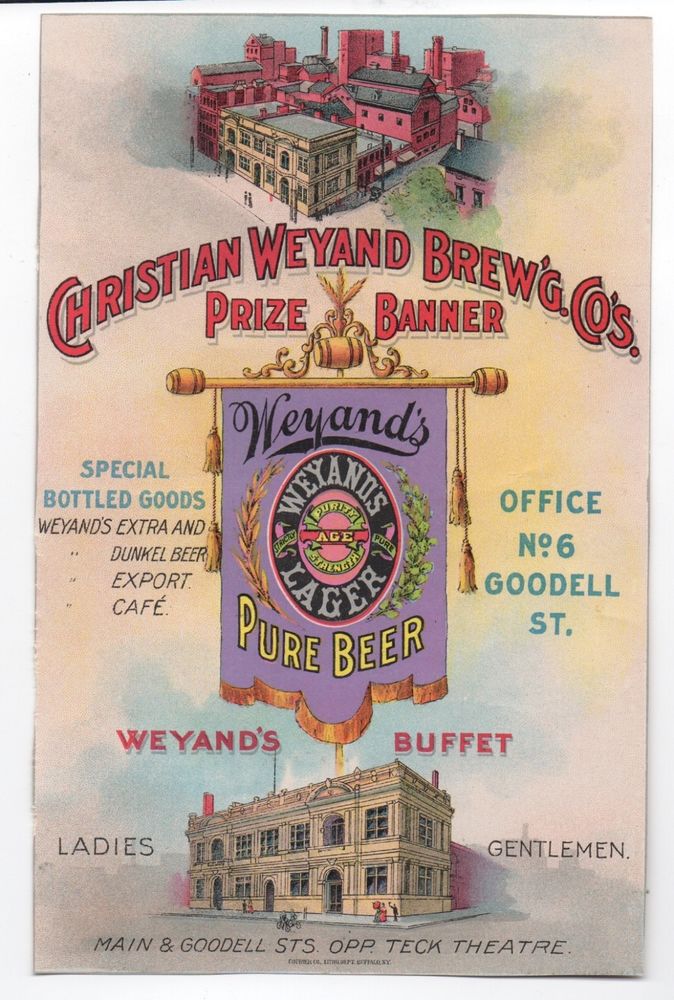
Christian-Weyand-prize-banner-ad

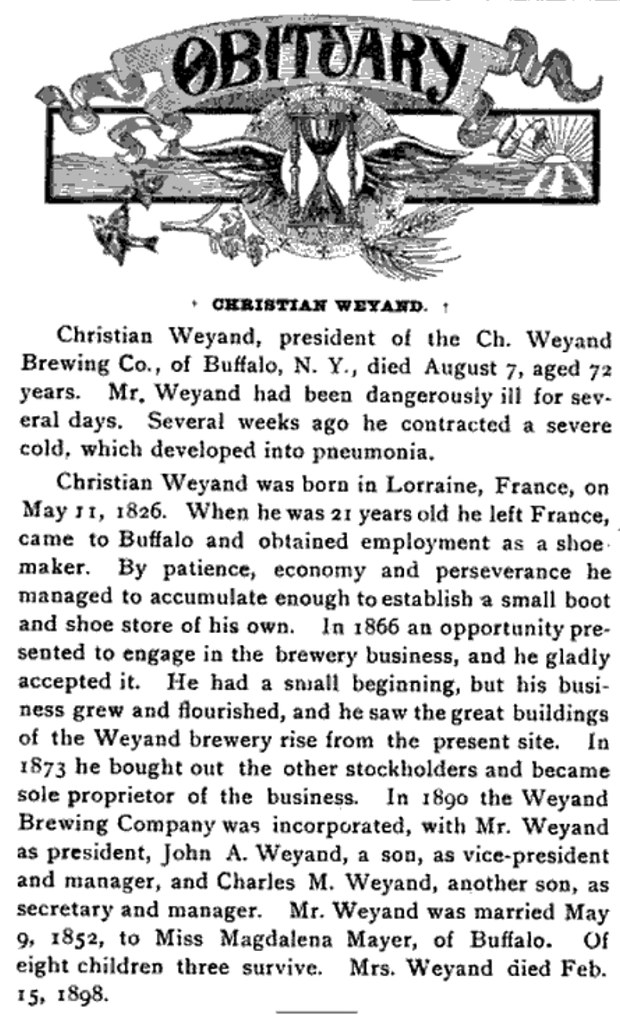
And this is his obituary from the American Brewers Review:
Christian-Weyand-tray

This short history of Christian, and the brewery, is from the “1897 Brewers Convention Buffalo NY,” published by the Buffalo Brewers Association:

Christian Weyand Brewing Company.

In 1866, Christian Weyand established the business now conducted by The Christian Weyand Brewing Company. Mr. Weyand is a native of France, having been born in the province of Lorraine a little more than seventy years ago. There he spent his youth and received his education; but in his twenty-first year he left Lorraine for the wider opportunities of the New World, landing in New York just fifty years ago. He soon found his way to Buffalo, but it was nearly twenty years before he began the business with which his name is now so intimately connected in the minds of all Buffalonians. During these years he worked as a shoemaker — at first as an employee, and later in a shop of his own.

Mr. Weyand, with a partner, began the brewing business in a small way, with little capital and a poorly equipped plant; but the purest and best of barley malt was used from the start, and improved machinery was introduced as fast as the necessary capital could be secured. In 1873. Mr. Weyand assumed entire charge of the business, and applied himself vigorously to the task of building up a model brewery. His efforts met with entire success, and in a few years his establishment became one of the first in its line in Buffalo — a city that boasts of many fine breweries. In 1890, he organized the business into a stock company, called The Christian Weyand Brewing Company, of which he is president, his son, John A. Weyand, vice-president and manager, and another son, Charles M. Weyand, secretary and treasurer. Since then the business has materially increased, and in 1896-97 it became necessary to make extensive additions to the plant. The new buildings on the corner of Main and Goodell streets, built of buff terra cotta elaborately ornamented in Renaissance style, are exceedingly handsome; and it is now one of the best-equipped breweries in the country.
buffalo-main-and-goddell
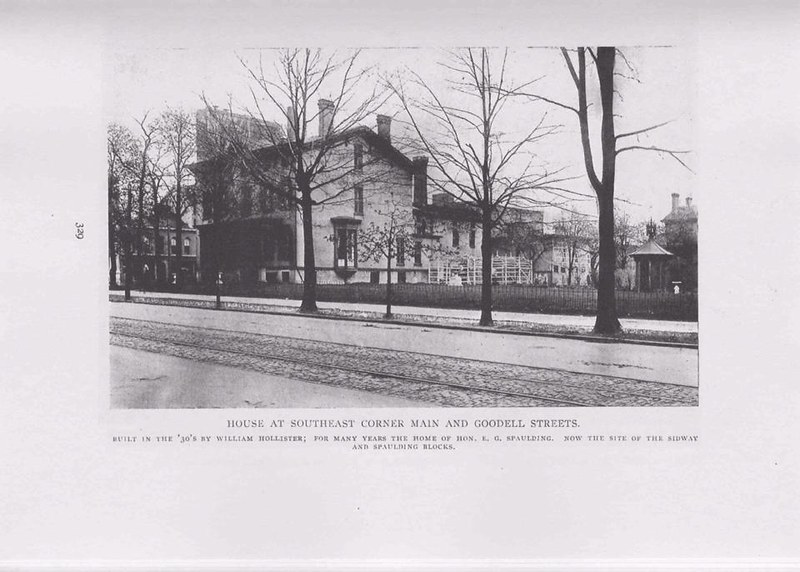
This is purported to be a photograph of the house at the “Southeast Corner Main and Goodell Streets” from the 1912 “Picture Book Of Earlier Buffalo.” But as Michael F. Rizzo and Ethan Cox, authors of “Buffalo Beer” point out, “the structures in the background and to the left of the subject must have been the Christian Weyand brewery. Indeed, the least occluded building to the left was, I think, their office address on Goodell.”

Filed Under: Birthdays, Breweries, Just For Fun Tagged With: France, History, New York

Historic Beer Birthday: John Moffat

May 11, 2025 By Jay Brooks

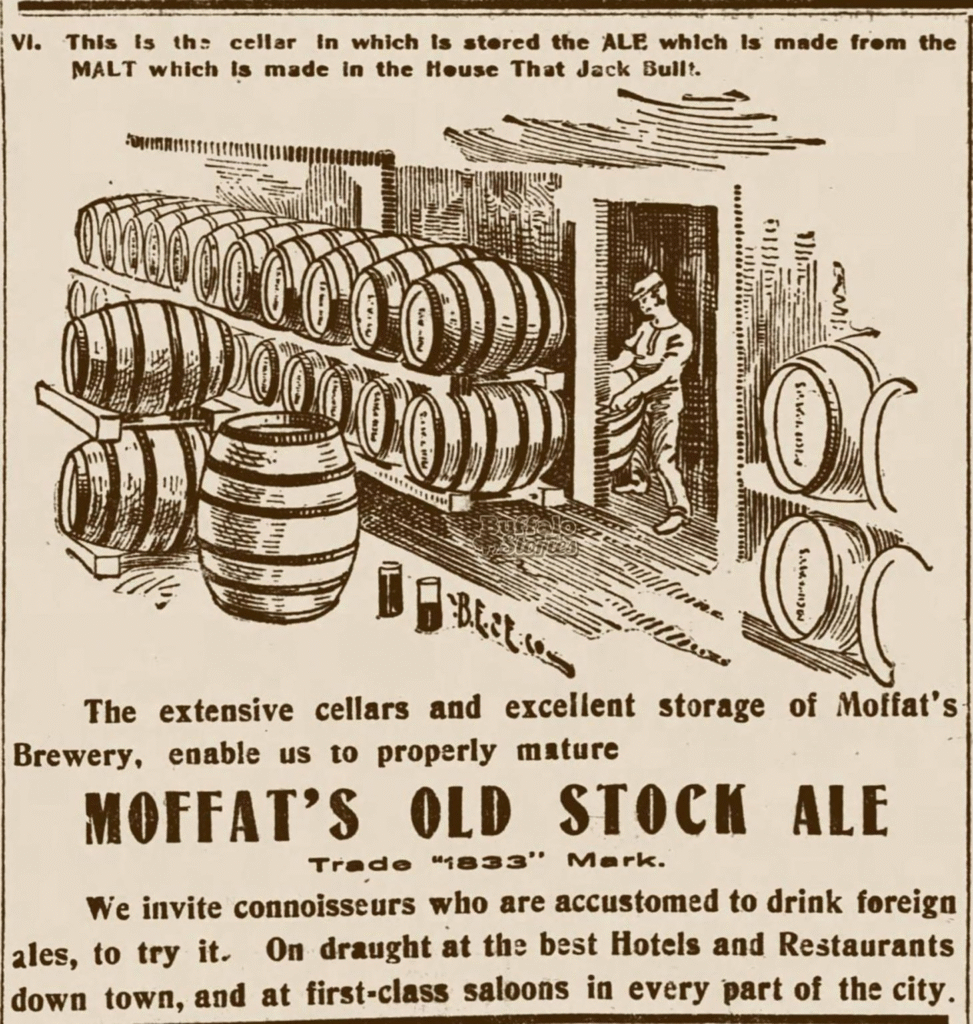
moffats

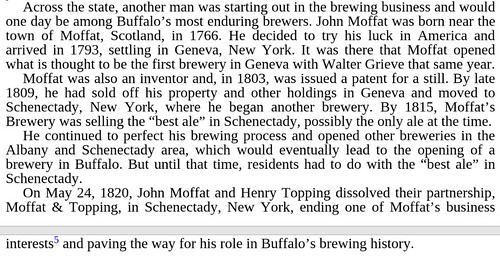
Today is the birthday of John Moffat (May 11, 1766-July 13, 1845). Moffat was born near the town of Moffat, Scotland, in 1766, coming to America in his late twenties, in 1793. He founded one of the earliest breweries in Buffalo, New York, along with his son James, in 1833. I was unable to find a portrait of John Moffat, or much about him personally.

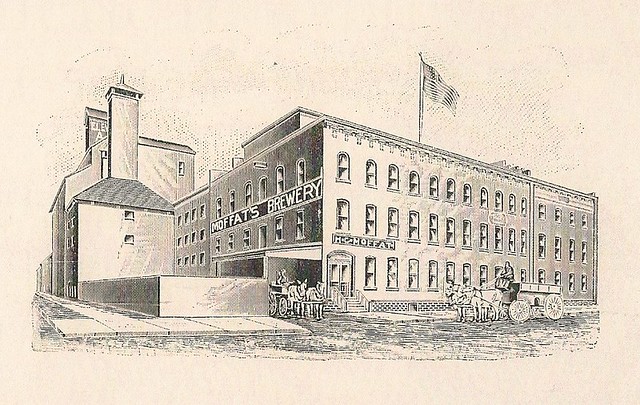
moffats-drawing

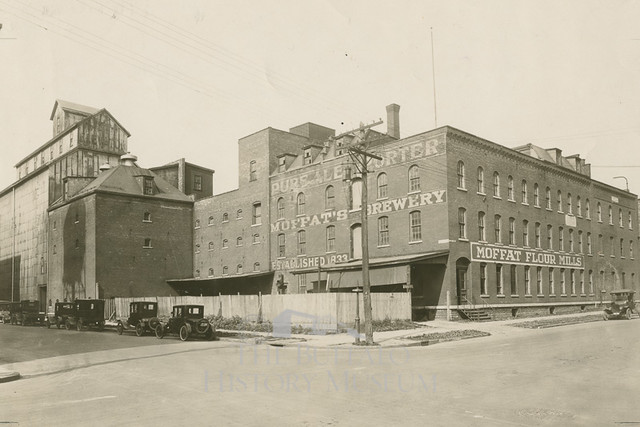
According to John & Dave’s Buffalo Brewing History, John Moffat, along with his son James, acquired what was Buffalo’s second brewery and named it the Moffat Brewery.

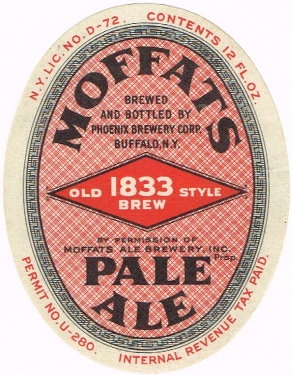
Kane, Peacock and Relay brewery was short lived however and a 1909 article in the Buffalo Evening Times indicates John Moffat and his son James purchased the brewing operation around 1833. Also, the 1836 Buffalo City Directory lists Moffat as a brewer at that location. The 1839 Directory lists James Moffat & Co. as a “Brewery, Soap and Candle Factory”. The Moffat Brewery continued in operation until son James died and it was sold to Arthur Fox and became the Fox and Williams Brewery. In 1876 it was sold back to the Moffat family and continued in operation at the same location until the advent of Prohibition forced their closure in 1920. After Prohibition the Phoenix Brewery continued brewing “Moffats Pale Ale” through an agreement with the Moffat family.

And here’s an account from “Buffalo Beer: The History of Brewing in the Nickel City,” by Michael F. Rizzo and Ethan Cox.

moffats-brewery

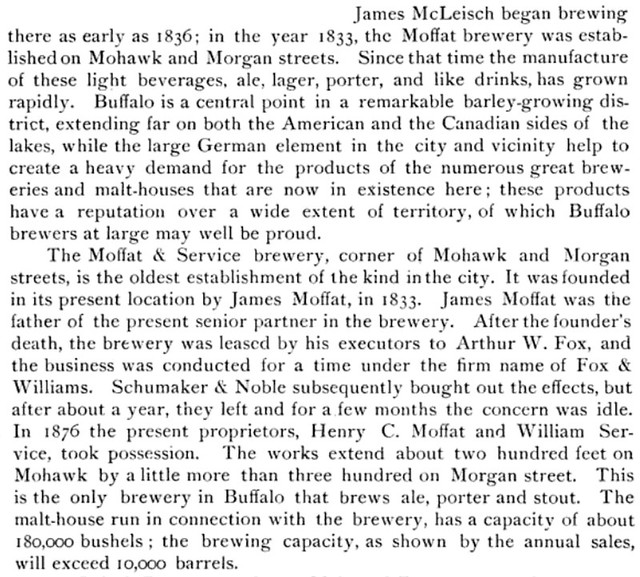
And “History of the City of Buffalo and Erie County, Volume 2,” published in 1884, has this to say about Buffalo’s earliest brewers, including Moffat:

buffalo-brewers

Filed Under: Birthdays, Breweries, Just For Fun Tagged With: History, New York

Beer In Ads #4965: Wiessner’s Bock Beer

May 10, 2025 By Jay Brooks

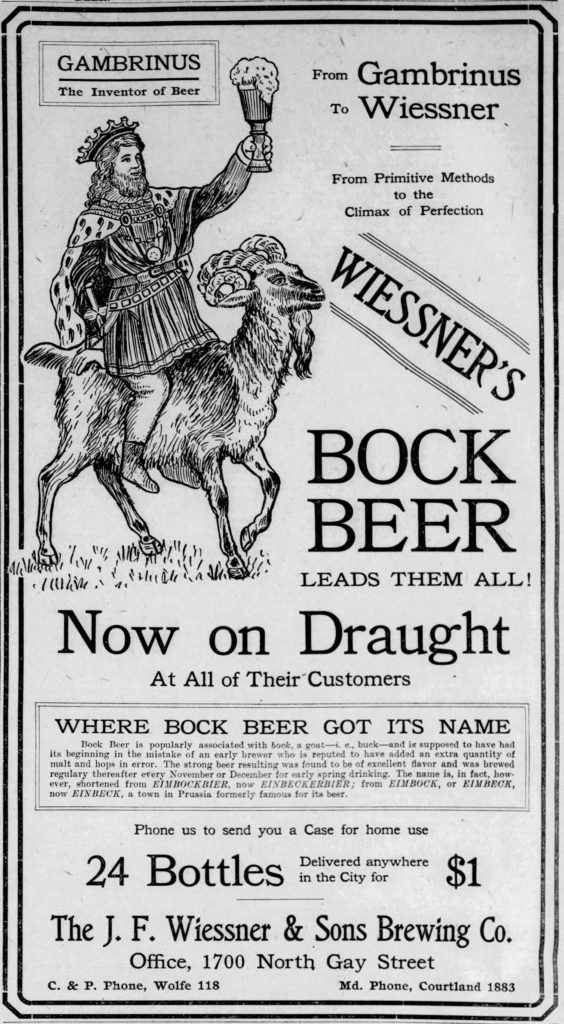
Last year I decided to concentrate on Bock ads. Bock, of course, may have originated in Germany, in the town of Einbeck. Because many 19th century American breweries were founded by German immigrants, they offered a bock at certain times of the year, be it Spring, Easter, Lent, Christmas, or what have you. In a sense they were some of the first seasonal beers. “The style was later adopted in Bavaria by Munich brewers in the 17th century. Due to their Bavarian accent, citizens of Munich pronounced ‘Einbeck’ as ‘ein Bock’ (a billy goat), and thus the beer became known as ‘Bock.’ A goat often appears on bottle labels.” And presumably because they were special releases, many breweries went all out promoting them with beautiful artwork on posters and other advertising.

Saturday’s ad is for Wiessner’s Bock Beer and was published in 1909. The brewery was the J.F. Wiessner & Sons Brewing Co. of Baltimore, Maryland, which was originally founded in 1863. This ad ran in The Baltimore Sun, also of Baltimore, Maryland. It’s funny to see Gambrinus (“The Inventor of Beer” — who knew?) riding a goat with the tagline “From Gambrinus to Wiessner., From Primitive Methods to the Climax of Perfection.”

Filed Under: Art & Beer, Beers, Breweries, Just For Fun Tagged With: Advertising, Bock, History

Historic Beer Birthday: Edward F. Sweeney

May 10, 2025 By Jay Brooks

seattle-brewing-malting
Today is the birthday of Edward F. Sweeney (May 10, 1860-1923). Although born in San Francisco, Sweeney was involved with founding the Seattle Brewing & Malting Company, the makers of Rainier Beer, along with several other brewery and other businesses in the Seattle area.


edward-f-seeney


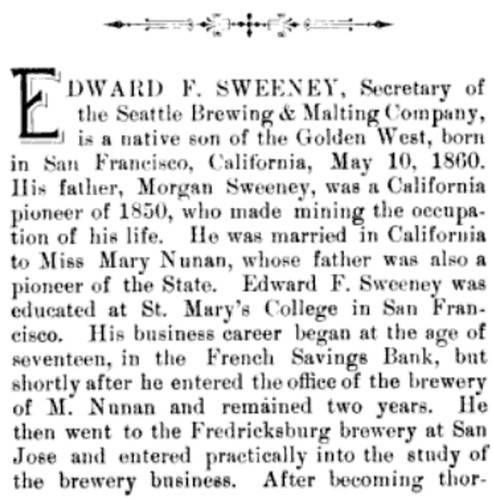
Here’s a biography of Sweeney from “An Illustrated History of the State of Washington,” by Rev. H.K. Hines, published in 1893, as it appears on the Brewery Gems page for Sweeney, by Gary Flynn.

Edward F. Sweeney, Secretary of the Seattle Brewing & Malting Company, is a native son of the Golden West, born in San Francisco, California, May 10, 1860.

His father, Morgan Sweeney, was a California pioneer of 1850, who made mining the occupation of his life. He (Morgan) was married in California to Miss Mary Nunan¹, whose father was also a pioneer of the State.

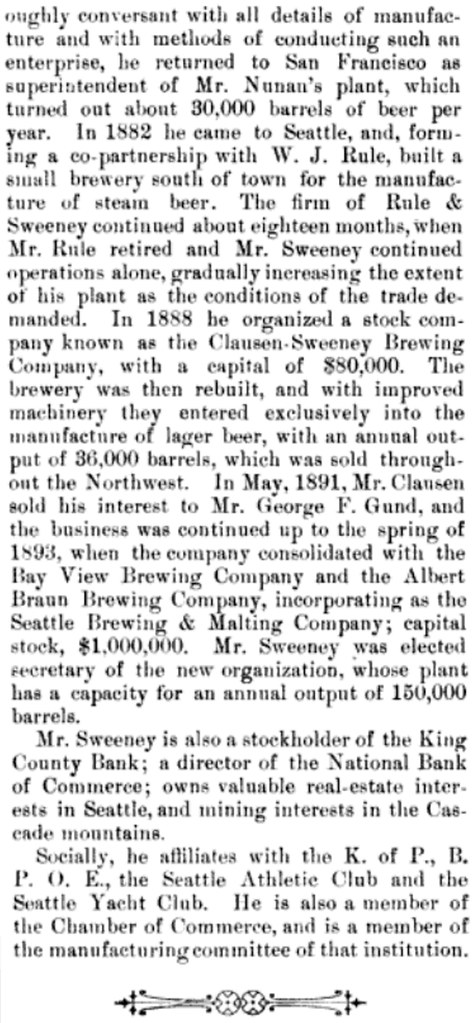
Edward F. Sweeney was educated at St. Mary’s College in San Francisco. His business career began at the age of seventeen, in the French Savings Bank, but shortly after be entered the office of the brewery² of M. Nunan and remained two years. He then went to the Fredericksburg Brewery at San Jose and entered practically into the study of the brewery business. After becoming thoroughly conversant with all details of manufacture and with methods of conducting such an enterprise, he returned to San Francisco as superintendent of Mr. Nunan’s plant, which turned out about 30,000 barrels of beer per year.

In 1882-84 (depending on the account), he came to Seattle, and, forming a co-partnership with W. J. Rule, built a small brewery south of town for the manufacture of steam beer. The firm of Rule & Sweeney continued about eighteen months (sic), when Mr. Rule retired and Mr. Sweeney continued operations alone, gradually increasing the extent of his plant as the conditions of the trade demanded.

In 1888 he organized a stock company known as the Claussen-Sweeney Brewing Company, with a capital of $80,000. The brewery was then rebuilt, and with improved machinery they entered exclusively into the manufacture of lager beer, with an annual output of 36,000 barrels, which was sold throughout the Northwest. In May, 1891, Mr. Claussen³ sold his interest to Mr. George F. Gund⁴, and the business was continued up to the spring of 1893, when the company consolidated with the Bay View Brewing Company and the Albert Braun Brewing Company, incorporating as the Seattle Brewing & Malting Company; capital stock, $1,000,000. Mr. Sweeney was elected secretary of the new organization, whose plant has a capacity for an annual output of 150,000 barrels.

Mr. Sweeney is also a stockholder of the King County Bank; a director of the National Bank of Commerce; owns valuable real-estate interests in Seattle, and mining interests in the Cascade Mountains. Socially, he affiliates with the K. of P., B.P.O.E., the Seattle Athletic Club and the Seattle Yacht Club. He is also a member of the Chamber of Commerce, and is a member of the manufacturing committee of that institution.

Gary Flynn, Brewery Gems, points out that there are several discrepancies with that account and he tries to correct them and adds later details of Sweeney’s life.


And here’s another from “An Illustrated History of the State of Washington.”


Sweeney-bio-1
Sweeney-bio-2


And here’s an account of how the brewery came to be known as the Seattle Brewing & Malting Company from the “History of Seattle from the Earliest Settlement to the Present Time, Volume 2,” by Clarence Bagley

seattle-malting-history


The brewery in 1915.

Filed Under: Birthdays, Just For Fun Tagged With: History, Washington

Beer In Ads #4964: Coors Bock Beer

May 9, 2025 By Jay Brooks

Last year I decided to concentrate on Bock ads. Bock, of course, may have originated in Germany, in the town of Einbeck. Because many 19th century American breweries were founded by German immigrants, they offered a bock at certain times of the year, be it Spring, Easter, Lent, Christmas, or what have you. In a sense they were some of the first seasonal beers. “The style was later adopted in Bavaria by Munich brewers in the 17th century. Due to their Bavarian accent, citizens of Munich pronounced ‘Einbeck’ as ‘ein Bock’ (a billy goat), and thus the beer became known as ‘Bock.’ A goat often appears on bottle labels.” And presumably because they were special releases, many breweries went all out promoting them with beautiful artwork on posters and other advertising.

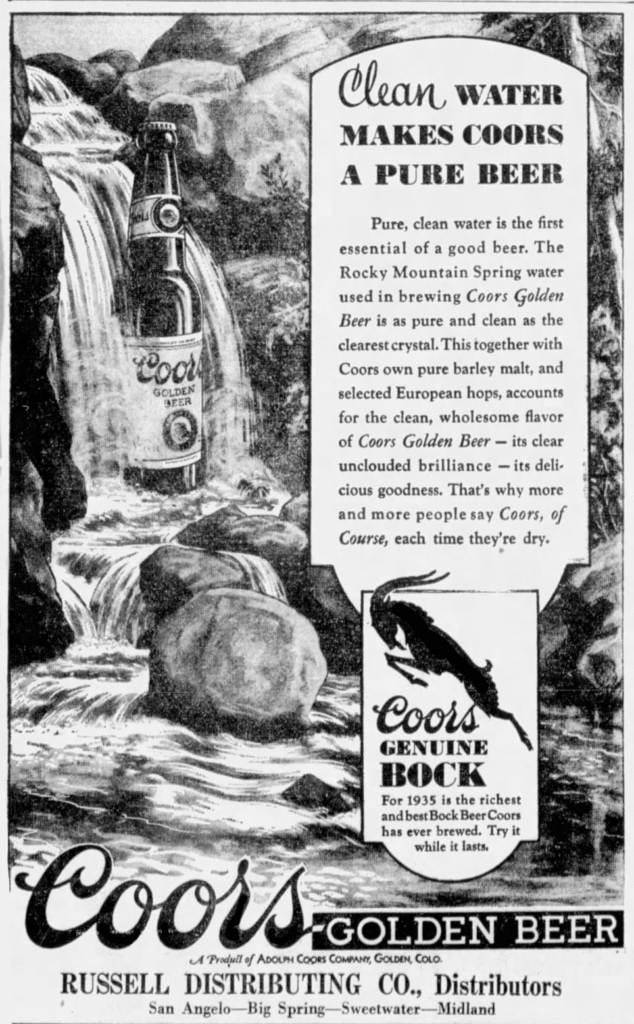
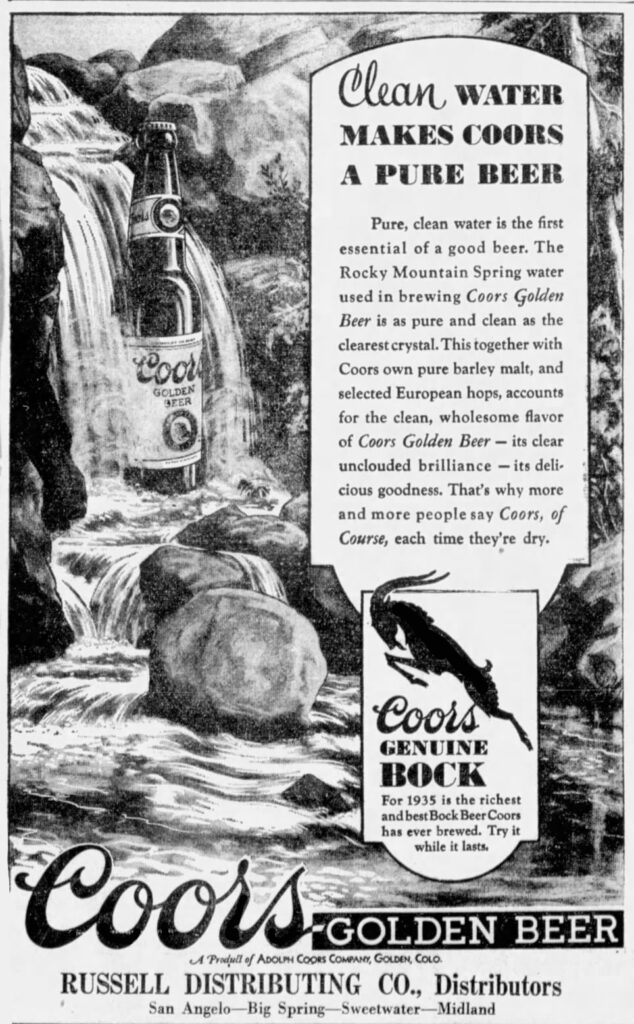
Friday’s ad is for Coors Bock Beer and was published May 9, 1935. The brewery was the Coors Brewing Co. of Golden, Colorado, which was originally founded in 1873. This ad ran in The San Angelo Evening Standard, of San Angelo, Texas.

Filed Under: Art & Beer, Beers, Breweries, Just For Fun Tagged With: Advertising, Bock, Colorado, Coors, History, Texas

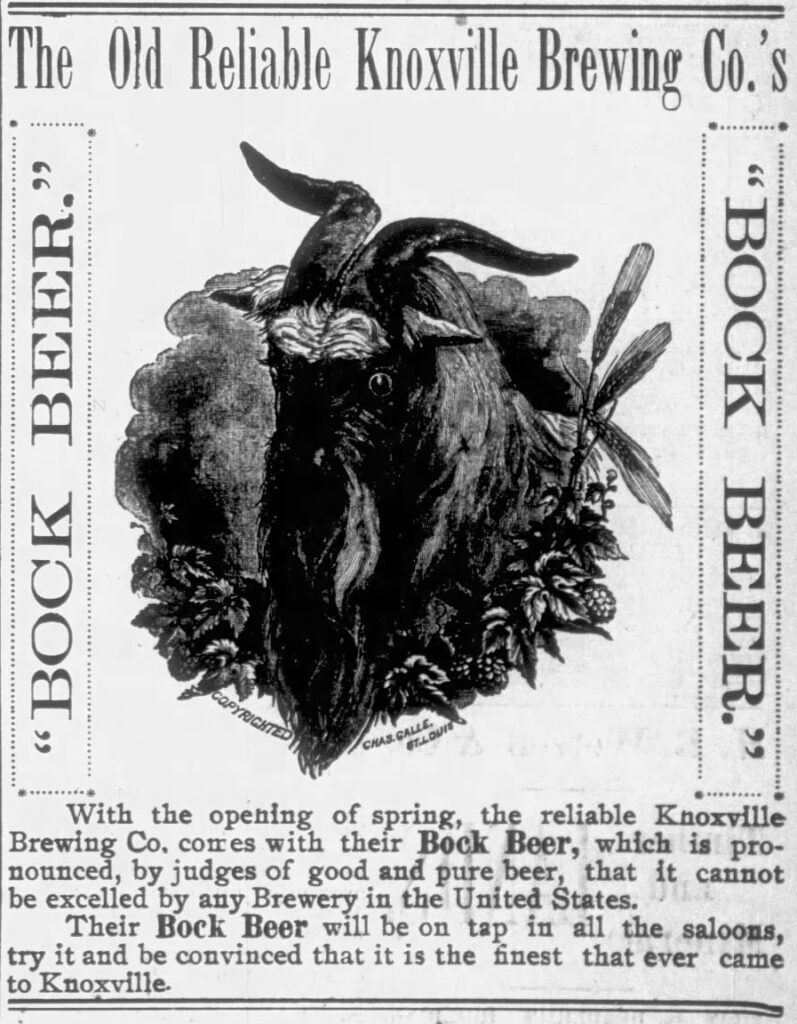
Beer In Ads #4963: The Old Reliable Knoxville Brewery’s Bock Beer

May 8, 2025 By Jay Brooks

Last year I decided to concentrate on Bock ads. Bock, of course, may have originated in Germany, in the town of Einbeck. Because many 19th century American breweries were founded by German immigrants, they offered a bock at certain times of the year, be it Spring, Easter, Lent, Christmas, or what have you. In a sense they were some of the first seasonal beers. “The style was later adopted in Bavaria by Munich brewers in the 17th century. Due to their Bavarian accent, citizens of Munich pronounced ‘Einbeck’ as ‘ein Bock’ (a billy goat), and thus the beer became known as ‘Bock.’ A goat often appears on bottle labels.” And presumably because they were special releases, many breweries went all out promoting them with beautiful artwork on posters and other advertising.

Thursday’s ad is for Knoxville Bock Beer and was published May 8, 1892. The brewery was the Knoxville Brewing Co. of Knoxville, Tennessee, which was originally founded in 1878. This ad ran in The Journal and Tribune, also of Knoxville, Tennessee.

Filed Under: Art & Beer, Beers, Breweries, Just For Fun Tagged With: Advertising, Bock, History, Tennessee

Historic Beer Birthday: Emil Christian Hansen

May 8, 2025 By Jay Brooks

carlsberg-crown
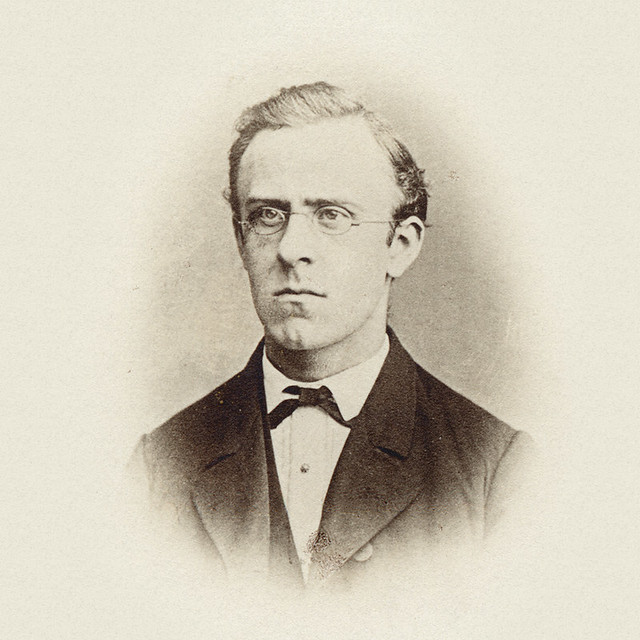
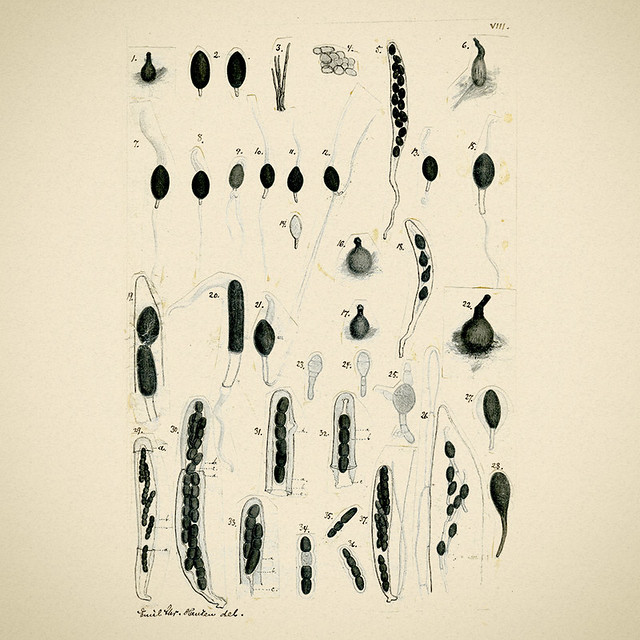
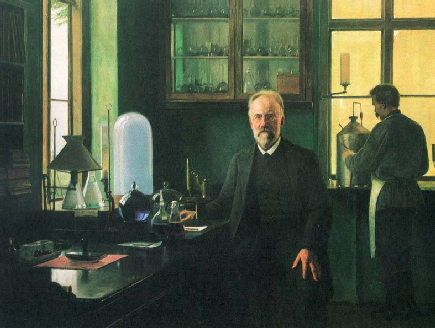
Today is the birthday of Emil Christian Hansen (May 8, 1842-August 27, 1909). Hansen was a “Danish botanist who revolutionized beer-making through development of new ways to culture yeast. Born poor in Ribe, Denmark, he financed his education by writing novels. Though he never reached an M.Sc., in 1876, he received a gold medal for an essay on fungi, entitled “De danske Gjødningssvampe.” In 1879, he became superintendent of the Carlsberg breweries. In 1883, he successfully developed a cultivated yeast that revolutionized beer-making around the world, because Hansen by refusing to patent his method made it freely available to other brewers. He also proved there are different species of yeast. Hansen separated two species: Saccharomyces cerevisiae, an over-yeast (floating on the surface of the fermenting beer) and Saccharomyces carlsbergensis, an under-yeast (laying on the bottom of the liquid).

Emil_Christian_Hansen

Here’s his entry from Encyclopedia Britannica:

Danish botanist who revolutionized the brewing industry by his discovery of a new method of cultivating pure strains of yeast.

Hansen, who began his working life as a journeyman house painter, received a Ph.D. in 1877 from the University of Copenhagen. Two years later he was appointed head of the physiology department at the Carlsberg Laboratory in Copenhagen, where he remained until his death. His research was concerned mainly with yeasts that convert carbohydrates to alcohol, and in 1888 he published an article that described his method for obtaining pure cultures of yeast. The yeast grown from these single strains was widely adopted in the bottom-fermentation brewing industries. Further investigations led him to the discovery of a number of species of yeast. He defined the characters of the different species and devised a system of classification. After further study he devised additional methods for the culture and isolation of certain species.

emil-hansen-young
Emil Hansen as a young man.

This is how Carlsberg describes Hansen’s breakthrough in 1883:

The Carlsberg Laboratory made its first major scientific breakthrough when Dr. Emil Chr. Hansen developed a method for propagating pure yeast.

Fluctuations in the beer quality were not unknown at the time, but had until then been solved by thorough cleaning of all installations after suspension of production. If a brew failed, there was no use in pasteurising it; it had to be destroyed.

In 1883, the Old Carlsberg beer got infected with the beer disease and all efforts were made to find a solution to the problem.

Dr. Emil Chr. Hansen who joined the Carlsberg Laboratory in 1878 was examining the beer, and he found that it contained wild yeast. Through his studies and analyses, he discovered that only a few types of yeast (the pure yeast) are suitable for brewing, and he developed a technique to separate the pure yeast from the wild yeast cells. The problem had been solved, and the new Carlsberg yeast – Saccharomyces Carlsbergensis – was applied in the brewing process.

The propagating method revolutionised the brewing industry. Rather than to patent the process, Carlsberg published it with a detailed explanation so that anyone could build propagation equipment and use the method. Samples of the yeast – Saccharomyces Carlsbergensis – were sent to breweries around the world by request and young brewers came to Carlsberg to learn the skills.

carlsberg-heritage-the_tough_get_going_960x960

This is the entry from Wikipedia on the history of Saccharomyces Carlsbergensis:

So-called bottom fermenting strains of brewing yeast were described as early as the 14th century in Nuremberg and have remained an indispensable part of both Franconian and Bavarian brewing culture in southern Germany through modern times. During the explosion of scientific mycological studies in the 19th century, the yeast responsible for producing these so-called “bottom fermentations” was finally given a taxonomical classification, Saccharomyces pastorianus, by the German Max Reess in 1870.

In 1883 the Dane Emil Hansen published the findings of his research at the Carlsberg brewery in Copenhagen and described the isolation of a favourable pure yeast culture that he labeled “Unterhefe Nr. I” (bottom-fermenting yeast no. 1), a culture that he identified as identical to the sample originally donated to Carlsberg in 1845 by the Spaten Brewery of Munich. This yeast soon went into industrial production in Copenhagen in 1884 as Carlberg yeast no. 1.

In 1904 Hansen published an important body of work where he reclassified the separate yeasts he worked with in terms of species, rather than as races or strains of the same species as he had previously done. Here Hansen classified a separate species of yeast isolated from the Carlsberg brewery as S. pastorianus, a name derived from and attributed to Reess 1870. This strain was admitted to the Centraalbureau voor Schimmelcultures (CBS) in 1935 as strain CBS 1538, Saccharomyces pastorianus Reess ex Hansen 1904. In a further publication in 1908, Hansen reclassified the original “Unterhefe Nr. I” as the new species Saccharomyces carlsbergensis and another yeast “Unterhefe Nr. II” as the new species Saccharomyces monacensis. The taxonomy was attributed to Hansen 1908 and the yeasts entered into the Centraalbureau voor Schimmelcultures in 1947 as CBS 1513 and CBS 1503 respectively.

Since the early 1900s, bottom-fermenting strains of brewery yeast have been typically classified as S. carlbergensis in scientific literature, and the earlier valid name assigned to a bottom-fermenting yeast by Reess in 1870 was rejected without merit. This situation was rectified using DNA-DNA reallocation techniques in 1985 when Vaughan-Martini & Kurtzman returned the species name to S. pastorianus under the type strain CBS 1538 and relegated the two former species assigned by Hansen in 1908, S. carlsbergensis CBS 1513 and S. monacensis CBS 1503, to the status of synonyms. These experiments also clearly revealed the hybrid nature of the lager brewing yeast species for the first time, even though one of the parental species was incorrectly classified in retrospect. Nonetheless, over the last decades of the 20th century, debate continued in scientific literature regarding the correct taxon, with authors using both names interchangeably to describe lager yeast.

E_C_Hansen

Although most accounts mention that he wrote novels to put himself through school, one has a slightly different take, though I’m not sure how true it is. “Emil earned his bread and butter as a painter but he yearned for another life and left Ribe so he could study. He graduated from High School relatively late – he was 29 years old.”

emilchrhansen1908Emil Christian Hansen, taken in 1908, a year before his death.

Filed Under: Birthdays, Just For Fun Tagged With: Denmark, History, Science, Science of Brewing, Yeast

Beer In Ads #4962: Rieker’s Bock Beer

May 7, 2025 By Jay Brooks

Last year I decided to concentrate on Bock ads. Bock, of course, may have originated in Germany, in the town of Einbeck. Because many 19th century American breweries were founded by German immigrants, they offered a bock at certain times of the year, be it Spring, Easter, Lent, Christmas, or what have you. In a sense they were some of the first seasonal beers. “The style was later adopted in Bavaria by Munich brewers in the 17th century. Due to their Bavarian accent, citizens of Munich pronounced ‘Einbeck’ as ‘ein Bock’ (a billy goat), and thus the beer became known as ‘Bock.’ A goat often appears on bottle labels.” And presumably because they were special releases, many breweries went all out promoting them with beautiful artwork on posters and other advertising.

Wednesday’s ad is for Rieker’s Bock Beer and was published May 7, 1913. The brewery was at the time the F.A. Rieker Brewing Co. of Lancaster, Pennsylvania, which was originally founded in 1867 under another name. Frank Rieker appears to have become involved by 1874 and in 1876 the name was changed to the Frank A. Rieker’s Star Brewery. It was later known as the Penn-Star Brewery, but closed for good in 1938. This ad ran in The News Journal, which I believe was in Wilmington, Delaware.

Filed Under: Art & Beer, Beers, Just For Fun Tagged With: Advertising, Bock, History, Pennsylvania

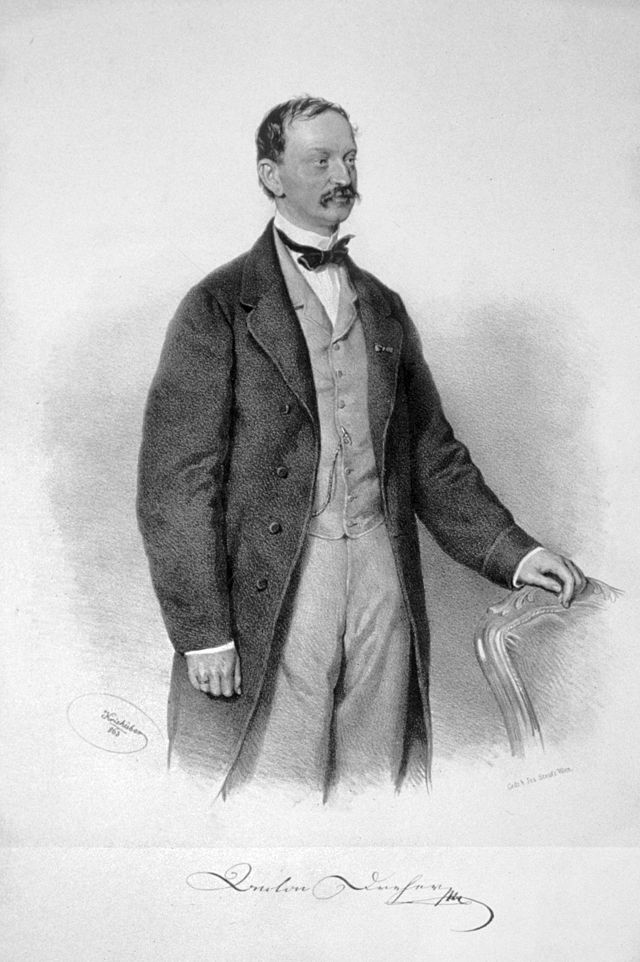
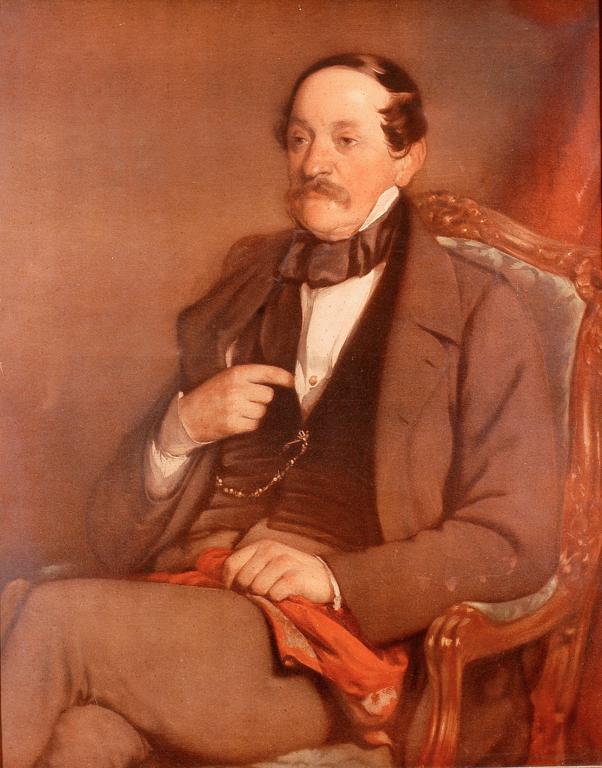
Historic Beer Birthday: Anton Dreher

May 7, 2025 By Jay Brooks

schwechater
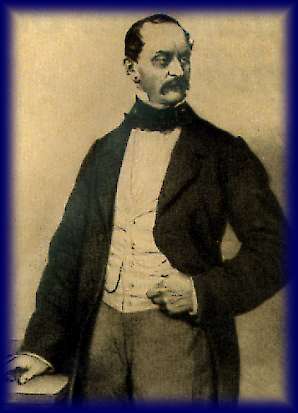
Today is the birthday of Anton Dreher (May 7, 1810-December 27, 1863). He “was an Austrian brewer who was an important figure in the development of pale lager. In 1840, he introduced a beer that combined the crispness of lager with the paler hues of the English ale; this new style of beer became known as the Viennese style and was called Schwechater Lagerbier.” Today we call it Vienna Lager.

Anton_Dreher_der_Ältere_Kriehuber

Here’s his biography from Dreher’s Wikipedia page:

When Franz Anton Dreher (the younger) died of marasmus in 1820, his ten-year-old son was too young to manage the brewing business. Dreher was apprenticed to the brewer Michael, in Simmering and later undertook a study tour, a journeyman’s tour, through Germany, where he studied at the Sedlmayr brewery in Munich, England, where he studied at Barclay and Perkins in London, and Scotland. In 1836, he partnered with his mother, and with the help of his wife’s marriage portion, he experimented with the English malting process, which produced a caramelized, crystal malt; he was able to buy his mother out by 1839.[5] Here he was the first brewer in the European continent to use the English malting process. He owned acres of land throughout Austria and Bohemia, and grew his own hops and barley, which allowed him to save on costs. When he died suddenly in 1863, he was worth 10 million guilden.

Starting in 1836, Anton Dreher took over the brewery and developed the bottom-fermented beer — Schwechater Lagerbier — which he presented in 1840/1841. It was a new style of beer, methodically bottom fermented to produce a brew that was coppery reddish-brown in color. It required steady, cool temperature for maturation and storage, and this requirement gives the beer its name: lager (in German, Lager means storehouse or warehouse). Originally, he called the beer Märtzen, or March beer, because it was brewed in March, when the water was cold, and ice was still available. Eventually the name lager became the accepted name; it was also called Vienna Typ, or Vienna Style beer. In 1858, Dreher’s lager won the gold medal for excellence at the Beer Exhibit in Vienna. The greater honor occurred on 26 November 1861 when Emperor Franz Joseph I visited the brewery and awarded Dreher with the Knight’s Cross of the Franz Joseph Order. In 1862, he received the Gold medal with Diploma from the World Exhibition in Paris. In 1869, his Lager beer won the High First Prize.

The Danube river provided the water needed for unlimited beer and malt making. The attention turned to Kőbánya because of a beer made by Peter Schmidt, a brewer master from Pest who studied in Munich. Schmidt stored beer in his rock cellar in Kőbánya. The water in the wells, made by deep drilling technology, is perfectly suited for beer making; the cellars of Schmidt’s brewery provided the steady cool temperature needed for maturation and storage. It was the ideal warehouse, or, in German Lager, for storing the beer.

The surge of the Kőbánya beer production attracted Dreher’s attention, in part because Schmidt’s beer was competition for him. He visited Pest-Buda on several occasions between 1856 and 1860; by 1862 he was able to buy the Kőbánya Brewery Company. He purchased further plots of land and prepared for expansion, but died suddenly in 1863, leaving his 14-year-old son to implement the plans.

anton-dreher-color

And this is from the German Wikipedia page on Dreher:

Anton Dreher was born as the son of the brewer Franz Anton Dreher and his second wife Katharina Widter. He first visited a Piarist convent and then went to the Simmering Brewery Meichl. In 1836, he bought the small Schwechat (today Schwechat brewery ) from his mother, who had been widowed since 1820. He was able to buy it in 1839 with the money of his wife Anna Herrfeldt.

At a young age he went on study trips to Germany, met in Munich Gabriel Sedlmayr, the son of Spatenbräubesitzers, and traveled with him in 1837 to Barclay and Perkins to England, which at that time “beer technically” leading enterprises. After his return, he was the first European brewer to take over the English malting process. He realized that for refrigerated beers, a technique that came from Bavaria, appropriate cooling and storage were crucial. Anton Dreher laid large cellars, filled with natural ice, to cool his beer. Until 1841, Anton Dreher brewed top-fermented imperial beer in Schwechat until, in 1840/41, he had a bright, lower-fermented lager, Schwechater Lagerbier, Which he first described as a marching beer. This type of beer soon became popular in Vienna and later also worldwide.

The strong demand for lager beer led to Anton Dreher using a steam machine for beer brewing in 1850 as the second beer brewer of the monarchy after Mautner Markhof. This steam engine, built by the kk country-owned metal-machinery factory of Vinzenz Prick, can now be viewed at the Technical Museum in Vienna.

In the course of the 1850s, the brewery Schwechat became the largest of the European mainland, and the consignments of Klein Schwechat stockpiles went far beyond the borders of the Austrian empire.

Anton Dreher bought smaller breweries:

  • 1859 the Michelob brewery near Saaz in Bohemia,
  • 1862 the brewery Steinbruch in Budapest;
  • His son Anton Dreher junior acquired the brewery of Trieste in 1869.

The Hungarian Dreher beer and the Italian Birra Dreher still exist today.

Anton Dreher was 1861-1863 and parliament – and the Reichsrat and one of the largest taxpayers of the monarchy.

In 1863, shortly before his death, he entrusted to Viennese lawyer and mayor deputy Cajetan Felder the guardianship over his 14-year-old son Anton Dreher jun. (1849-1921) and the management of the breweries. His son took over the father’s company in 1870, continued to expand the brewery chamber, and began exporting the lager beer all over the world. His half brother was the writer Anton Breitner.

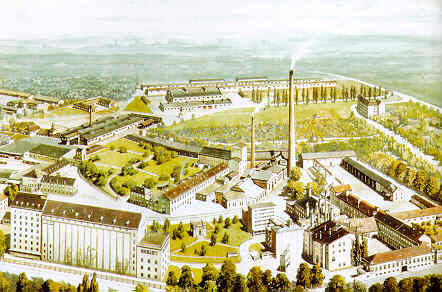
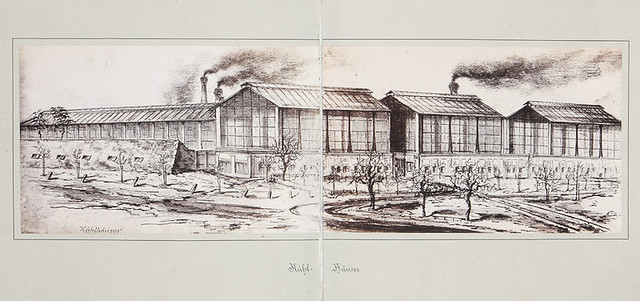
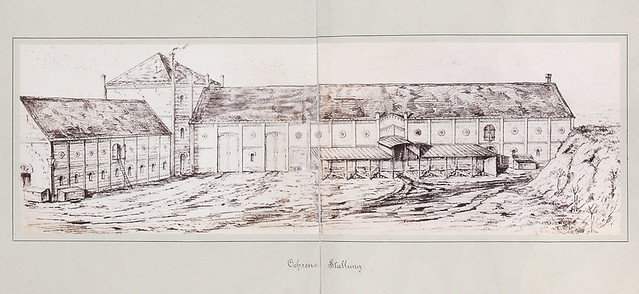
schwechat-brewery

Here the official story of the brewery picks up when Anton Dreher Sr. begins:

In 1810 Anton Dreher, the son of Franz Anton Dreher, was born. He also follows the old practice of brewing and practiced at a foreign brewery in Simmering.

Through travels to Munich and England, he is preparing for his future Braumeister existence by gathering extensive knowledge of the art of bravura!

In 1836, Anton Dreher took the Klein-Schwechat brewer first in lease. In 1839 he bought them from his mother.

In 1841, Dreher imported light-bodied beer for the first time in the hotel “Zur Kohlenkreunze” and in Dreher’s Haus in Kledering, and brought it to Vienna after a complete deposit under the brand “Klein-Schwechater Lagerbier”.

Here it was so enthusiastically received that the Viennese wanted to drink only Schwechater. This was the birthdays of the “Lagerbier”, which is now represented all over the world!

The great onslaught on the lager beer, however, brought with it the use of machinery. In 1848, Dreher became the first brewer of Austria to use a steam engine for beer brewing. This is now exhibited at the Technical Museum in Vienna!

In 1841, Dreher imported light-bodied beer for the first time in the hotel “Zur Kohlenkreunze” and in Dreher’s Haus in Kledering, and brought it to Vienna after a complete deposit under the brand “Klein-Schwechater Lagerbier”.

Here it was so enthusiastically received that the Viennese wanted to drink only Schwechater. This was the birthdays of the “Lagerbier”, which is now represented all over the world!

The great onslaught on the lager beer, however, brought with it the use of machinery. In 1848, Dreher became the first brewer of Austria to use a steam engine for beer brewing. This is now exhibited at the Technical Museum in Vienna!

Dreher

And this is the portion of the brewery’s Wikipedia page that discusses Anton Drehrer Sr.:

The Schwechater Brauhaus was founded in 1632 by Peter Descrolier, the “Camerdiener and Cameradienmeister of the Archduke Matthias” in the Frauenfeld of Schwechat. The Klein Schwechat brewery was destroyed several times and changed its owner still often until until 22 October 1796 Franz Anton Dreher, Bräumeister of the k.k.

In 1837, his son, Anton Dreher, took over the company from his mother and inaugurated a new era in the brewery’s history. In 1839 he turned to Untergärung, which marked the beginning of the lager beer. The breakthrough was made by Dreher in 1841, when he realized that for his under-fermented beer, the “lager” or “Viennese type”, one thing was decisive: the cooling. Dreher laid huge cellars and stored ice.

As a result, the brewery’s brewery expanded through the acquisition of existing breweries to the entire Austro-Hungarian monarchy . These included the brewery Michelob near Saaz, acquired in 1859, the brewery quarry (founded 1854) in Budapest, acquired in 1862, as well as the brewery of Trieste, acquired in 1869.

In 1848, Dreher introduced a steam machine to the Bierbrauen, he was supposed to be the first brewer in Austria. The steam engine is now exhibited at the Technical Museum in Vienna. The first cooling machine, which was also the second machine from Linde AG, was installed in the brewery in Trieste in 1877. After the death of Anton Dreher in 1863, his son Anton Dreher junior took over the company of the brewery Schwechat in 1870 and converted it in 1905 into the Anton Drehers brewery stock company .

Klein-Schwechat

Klein-Schwechat-back

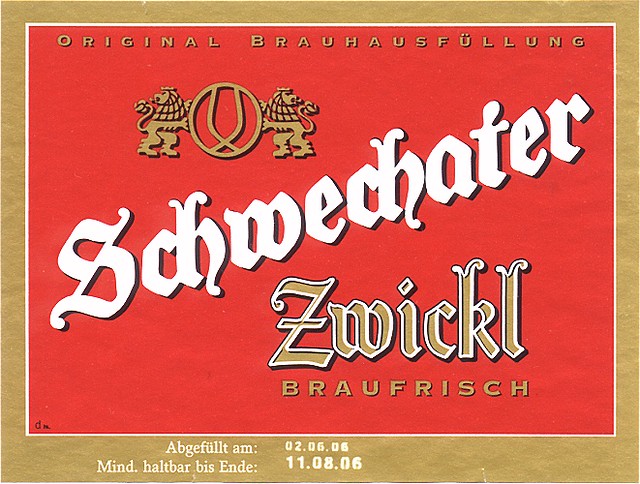
schwe-zwickel

Schwechater_Lager

Filed Under: Birthdays, Just For Fun Tagged With: Austria, History

Beer In Ads #4961: Santa Cruz Bock Beer

May 6, 2025 By Jay Brooks

Last year I decided to concentrate on Bock ads. Bock, of course, may have originated in Germany, in the town of Einbeck. Because many 19th century American breweries were founded by German immigrants, they offered a bock at certain times of the year, be it Spring, Easter, Lent, Christmas, or what have you. In a sense they were some of the first seasonal beers. “The style was later adopted in Bavaria by Munich brewers in the 17th century. Due to their Bavarian accent, citizens of Munich pronounced ‘Einbeck’ as ‘ein Bock’ (a billy goat), and thus the beer became known as ‘Bock.’ A goat often appears on bottle labels.” And presumably because they were special releases, many breweries went all out promoting them with beautiful artwork on posters and other advertising.

Tuesday’s ad is for Santa Cruz Bock Beer and was published May 6, 1908. The brewery was the Santa Cruz Brewing Co. of Santa Cruz, California, which appears to have been located on Neary Street and was in business from the late 19th century until prohibition. This ad ran in The Santa Cruz Evening News, also of Santa Cruz, California.

Filed Under: Art & Beer, Beers, Breweries, Just For Fun Tagged With: Advertising, Bay Area, Bock, California, History

« Previous Page
Next Page »

Find Something

Northern California Breweries

Please consider purchasing my latest book, California Breweries North, available from Amazon, or ask for it at your local bookstore.

Recent Comments

  • Bob Paolino on Beer Birthday: Grant Johnston
  • Gambrinus on Historic Beer Birthday: A.J. Houghton
  • Ernie Dewing on Historic Beer Birthday: Charles William Bergner 
  • Steve 'Pudgy' De Rose on Historic Beer Birthday: Jacob Schmidt
  • Jay Brooks on Beer Birthday: Bill Owens

Recent Posts

  • Beer In Ads #5138: Flower City Bock Beer March 1, 2026
  • Historic Beer Birthday: Danny Williams March 1, 2026
  • Historic Beer Birthday: Charles Weyand March 1, 2026
  • Beer In Ads #5137: Bock Is Back… Look For It March 1st February 28, 2026
  • Historic Beer Birthday: John Holme Ballantine February 28, 2026

BBB Archives

Feedback

Head Quarter
This site is hosted and maintained by H25Q.dev. Any questions or comments for the webmaster can be directed here.